How many more terrorist bullets must we dodge before we finally come to our senses and deploy every possible legal tool against our jihadist enemies? Two news stories from earlier this month got somewhat lost in the turmoil surrounding the presidential election and the excitement of the Olympics, but together they tell us both about the bullet we just dodged and about the ones we can expect to face if Congress doesn’t act more aggressively in defense of the American people. In one story, the FBI announced the arrest of Nicholas Young of Virginia for trying to provide material aid to ISIS. In the other, the New York Times laid out the activities of the so-called “Emni,” a branch of ISIS that oversees its program to plant jihadists in western Europe and the United States.
Young’s history is sobering. A Metro cop since 2003, he was a convert to Islam who ventured twice to Libya to fight with the so-called rebels against Muammar Qaddafi — the same rebels who were later revealed as radical Islamic terrorists affiliated with ISIS. He stockpiled weapons and traveled with military equipment (which we apparently know because his baggage was searched) and had subsequent contact with terrorist sympathizers in the United States, as well as FBI agents posing as terrorist sympathizers. In addition, our allies clearly saw him as a threat — the Egyptian authorities actually prevented him from entering Libya on one trip, although he subsequently gained access through Tunisia. Still, for the six years the FBI had him under surveillance, there does not seem to have been an effort to restrict his movements or raise concerns about his work as a Metro cop, despite the havoc he could have wrecked given his position and jihadist training. The consensus seems to have been that he was kooky but not really serious about committing a terrorist act. Only when he was caught red-handed trying to provide untraceable communications cards to ISIS was he finally arrested for providing material support to a known terrorist group.
While we can all breathe a sigh of relief that this human time bomb is no longer a threat to the innocent commuters of our nation’s capital, the New York Times article should eliminate any sense of false security. Nicholas Young was not just crazy and he was not a lone wolf — he was the forerunner of a gathering pack, a “global network of killers,” that ISIS is mobilizing to attack America and our allies abroad. He is also flesh-and-blood evidence that United States citizens are traveling overseas, contacting terrorist groups, and returning here to plot against us.
For the past three years, our attention has been riveted by the horrific acts of violence carried out by ISIS in its claimed caliphate. Critics of the Obama administration’s ISIS policy have frequently pointed out the anemic pace and intensity of the air strikes against ISIS, and have urged a more rigorous, concerted campaign to actually destroy them. While there have been some recent advances, reports about the activities of a secretive branch of ISIS called “Emni” suggest that even the dissolution of the caliphate will not end the ISIS threat. Indeed, ISIS is already planning for the next phase of this long war, which will shift to their agents in the West — some infiltrating the waves of refugees pouring out of the Middle East, some radicalized online, and some our own citizens who have gone abroad to train with terrorist groups.
There are many red flags around the Young case that need to be addressed. If the Obama Administration continues to refuse to recognize the threat that he represents, hopefully Congress will start to take action on legislation to address the influx of refugees from the Middle East and the ability of the State Department to make joining with a terrorist group overseas grounds for denying re-entry into the United States. In light of the terrorist threat we face, these steps are only the most basic common sense and should enjoy bi-partisan support.
In the case of Nicholas Young, our law enforcement officers were able to keep track of him until he tipped his hand about his intentions. We got lucky in this case, but ISIS has taken note of our vulnerability. The threat is growing, not receding and we might not be so lucky the next time. (For more from the author of “We Dodged One ISIS Bullet. But Will America Be as Lucky Next Time?” please click HERE)
https://joemiller.us/wp-content/uploads/462598238_0ee05a9f87_b-2.jpg7681024Joe Millerhttps://joemiller.us/wp-content/uploads/logotext.pngJoe Miller2016-08-22 01:03:122016-08-22 01:04:53We Dodged One ISIS Bullet. But Will America Be as Lucky Next Time?
Donald Trump may or may not fix his campaign, and Hillary Clinton may or may not become the first female president. But something else happening before our eyes is almost as important: the complete collapse of American journalism as we know it.
The frenzy to bury Trump is not limited to the Clinton campaign and the Obama White House. They are working hand-in-hand with what was considered the cream of the nation’s news organizations.
The shameful display of naked partisanship by the elite media is unlike anything seen in modern America.
The largest broadcast networks — CBS, NBC and ABC — and major newspapers like The New York Times and Washington Post have jettisoned all pretense of fair play. Their fierce determination to keep Trump out of the Oval Office has no precedent. (Read more from “American Journalism Is Collapsing Before Our Eyes” HERE)
A suspected Islamic State child suicide bomber massacred at least 50 wedding guests dancing in a Turkey street.
President Tayyip Erdogan blamed the murders on Islamic State and said the killer, who wore an explosive belt, was between the ages of 12 and 14.
The sickening attack is the deadliest bombing this year in Turkey, which faces threats from militants at home and across the border with neighbouring Syria.
The country’s President Tayyip Erdogan said militants had carried out the late-night attack Gaziantep on Saturday.
The local governor’s office said in a statement 50 people were killed in the bombing, and more wounded were still being treated in hospitals around the province. (Read more from “‘ISIS Child Suicide Bomber’ Kills 50 at Turkey Wedding” HERE)
Democrat Hillary Clinton and Republican Donald Trump each raced to their strongest fundraising month of the campaign in July, but Clinton and her allies continue to outmuscle her GOP rival in the air and ground war for the presidency, according to new details of the candidates’ spending.
Clinton pulled in more than $52 million directly into her campaign last month and spent more than $38 million, according to her campaign’s filings Saturday with federal election regulators.
Trump raised nearly $36.7 million for his campaign and spent at a far slower pace than Clinton, reporting nearly $18.5 million in expenses in July as Clinton and her allies savaged him on the airwaves.
Trump, who has shunned much of the traditions of presidential campaigns, grew his staff modestly last month, employing 82 people, a USA TODAY review shows. Clinton, by contrast, employed 703 aides in July as she readied for her confrontation with Trump in key battlegrounds such as Ohio and Florida.
New campaign reports filed Saturday with the Federal Election Commission show Clinton with another advantage: Super-wealthy Democrats are giving early and often to boost the former secretary of State’s presidential bid and to aid Democrats hoping to seize seats in Congress. Billionaires, such as California environmentalist Tom Steyer and financier George Soros, plowed millions into Democratic-aligned super PACs last month. (Read more from “Hillary Clinton Outspends Trump in White House Showdown” HERE)
https://joemiller.us/wp-content/uploads/24338774540_53610dbc1c_b-3.jpg6831024Joe Millerhttps://joemiller.us/wp-content/uploads/logotext.pngJoe Miller2016-08-22 00:49:592016-08-22 00:49:59Hillary Clinton Outspends Trump in White House Showdown
Donald Trump’s new campaign manager Kellyanne Conway said Sunday on CNN’s State of the Union that it is “to be determined” whether Trump’s official immigration policy will include a deportation force.
After rumors began floating around yesterday that Trump was relaxing his position on illegal immigrants, host Dana Bash asked Conway for comment.
“What he supports,” Conway said, “is to make sure that we enforce the law, that we are respectful of those Americans who are looking for well-paying jobs, and that we are fair and humane for those who live among us in this country. And as the weeks unfold, he will lay out the specifics of that plan that he would implement as President of the United States.”
Pressing for further specifics, Bash then asked if Trump still plans to create a deportation force, to which Conway replied, “To be determined.”
Senator Jeff Sessions (R-AL), a leading immigration hardliner and prominent Trump backer,was also asked about the GOP presidential nominee’s immigration policy during a Sunday morning appearance on Fox & Friends. Host Tucker Carlson asked the senator if Trump had changed his position, which Sessions denied.
Carlson then asked Sessions if Trump still supports the so-called “touchback idea,” which would require illegal immigrants to be deported and then apply to reenter the states in a legal way.
“Well, I don’t know that he’s formally said that,” Sessions replied, “He’s discussed that, other people have discussed that. … I’m not sure that’s the best solution to the problem, but its one solution.” Sessions, chairs the Subcommittee on Immigration, Border Security, and Refugees, then recommended that we first “end the lawlessness. … Then you can begin to talk, more appropriately, about what to do with people who have been here a long time.”
Sunday’s comments come after some serious campaign shakeups, as well as a week in which the Republican Presidential nominee seemingly sought to soften his image — including a visit by Trump to flood-ravaged Louisiana.
If Trump has changed his deportation policy, it wouldn’t be the first time he has done so on immigration, an issue that helped skyrocket his campaign to the front of a crowded Republican primary field. After June’s mass shooting in Orlando by a suspected ISIS sympathizer, he walked back his call for a temporary ban on Muslim immigration, saying he wanted policies to focus on nations with greater infiltration by terrorist elements. (For more from the author of “New Trump Campaign Manager: ‘To Be Determined’ on Whether Trump Will Relax Immigration Deportation Policy” please click HERE)
A federal judge has dismissed all lawsuits against Kim Davis, the Rowan County, Kentucky clerk who refused to issue marriage licenses to gay couples shortly after the U.S. Supreme Court legalized same sex marriage.
Davis was briefly jailed for refusing to issue marriage licenses to gay couples, asserting participation in same-sex marriages violated her religious beliefs. Davis is Pentecostal, a branch of low church Protestantism. After her release, same-sex couples in Rowan County brought claims against Davis, alleging she was violating their civil rights.
U.S. District Court Judge David Bunning dismissed the cases Thursday, ruling that the controversy was now moot.
According to the Courier Journal, the Kentucky General Assembly recently adopted legislation creating new state marriage licenses that do not require the signature of a county clerk. The move came after Governor Matt Bevin issued an executive order to the same effect. Since she, nor any member of her staff, will no longer be required to sign the forms, Davis feels her religious practice is no longer compromised. Her office has already begun issuing the licenses.
“In light of these proceedings, and in view of the fact that the marriage licenses continue to be issued without incident, there no longer remains a case or controversy before the Court,” Bunning wrote. (Read more from “Kim Davis Just Officially Won Her Final Court Case” HERE)
https://joemiller.us/wp-content/uploads/SCOTUS_Marriage_Equality_2015_Obergefell_v._Hodges_-_26_June_2015.jpg16883008Joe Millerhttps://joemiller.us/wp-content/uploads/logotext.pngJoe Miller2016-08-22 00:35:212016-08-28 01:29:49Kim Davis Just Officially Won Her Final Court Case
It would be easy to spend an entire day comparing the media coverage of President Obama’s lack of interest in Louisiana during a natural disaster with their coverage of President Bush and the events surrounding Hurricane Katrina in 2005. Rob Eno reminded everybody of Bush’s response: He was there right away to survey the damage, and coordinate responses between state and local authorities. President Obama, on the other hand, has hardly put down his golf clubs while vacationing in Martha’s Vineyard last week.
And why should he, right? He’s not running for re-election so his attitude is, “Who cares?”
It may sound harsh, but what other reason could there be? The president has issued nary a statement on the events surrounding Louisiana, other than having the Justice Department release 16 pages of guidelines warning recipients of federal disaster assistance to not engage in discrimination.
The Red Cross says the flooding in Louisiana is the worst natural disaster in the U.S. since Hurricane Sandy. Ironically, President Obama’s reaction to that disaster, which happened during a tough re-election campaign in 2012, was far different.
The president made his first statement about Hurricane Sandy on October 29, the same day it first hit New Jersey. Two days later, President Obama landed in Atlantic City Airport and hopped on a helicopter with New Jersey Governor Chris Christie to survey the damage. Gov. Christie still hasn’t been able to escape the infamous Christie/Obama hug that showed a solemn Obama looking … presidential.
It allowed for a narrative to be crafted. While there was a mutual unwritten agreement between President Obama and Republican presidential nominee, Mitt Romney, to stop campaigning, Obama’s “presidential” tour of the storm-ravaged areas of New Jersey was his opportunity to campaign without actually campaigning. (For the record, Obama didn’t visit New York, which also suffered massive damage, until after the election.)
Hurricane Sandy was Obama’s “October surprise.” It allowed him to project a measure of leadership and calm that a president needs during a time of crisis. It is debatable as to whether or not it sealed the election for him as some have argued, but it certainly helped.
Yet four years later, there is a crisis in Louisiana, and Obama is nowhere to be found. The president has finally scheduled a visit to the state this Tuesday. After his vacation ends. What a sport. Regardless of what a president can or cannot do personally is irrelevant to the fact that people are encouraged when they believe their political leaders are looking out for them. In such times, party affiliation does not matter. Yet President Obama is more concerned with golfing, shopping, and going to the beach than cutting his trip short to visit a bunch of yokels in the red state of Louisiana.
It’s been a similar situation in Milwaukee. Obama relishes getting in front of the camera to wax poetic about “disparities” related to crime and interactions with police when there’s some political gain to be had or when he can inflame tensions between Americans even more than they already are. The police shooting in in Milwaukee sparked two days of violent riots, but the president didn’t say a word. Why? Three reasons:
1. The victim, Sylville Smith, was armed with a stolen gun. He has a misdemeanor conviction for carrying a concealed weapon.
2. According to “witnesses,” Smith was shot in the back. The medical examiner, however, says Smith was shot in the arm and chest.
3. The officer who shot Smith, Dominique Heaggan, is also black and was wearing a body camera.
There simply is no political hay to be made from this shooting. That has undoubtedly contributed to President Obama’s silence on the matter.
Political opportunism and narcissism are hallmark traits of President Obama’s tenure. Now that he is five months away from leaving office, it’s safe to say his “leadership” will be non-existent unless it helps to serve him in some manner. (For more from the author of “The Easy Answer to Why Obama Hasn’t Been to Louisiana or Milwaukee” please click HERE)
https://joemiller.us/wp-content/uploads/6334111888_284a6305f8_b.jpg6981024Joe Millerhttps://joemiller.us/wp-content/uploads/logotext.pngJoe Miller2016-08-22 00:18:182016-08-22 00:18:18The Easy Answer to Why Obama Hasn’t Been to Louisiana or Milwaukee
Recently I was invited to participate in the RedState Gathering in Denver, Colorado. During the conference I heard Glenn Beck give a fantastic speech about where we are as a movement and as a culture. One thing he said convicted me to the point I’ve thought about it a lot since.
Beck’s speech was about the need to return to being a people of truth, and a movement of truth. That truth is the greatest casualty of our culture’s decline. And he was right. For example, he talked about those claiming to be in our movement who opted to expose themselves as liars and charlatans during this depressing election cycle. That we shouldn’t forget these people, and remember them going forward. And he was right about that, too.
However, Beck also drew an important distinction between those cretins and those who just philosophically, ideologically, and morally disagree with another about what to do now that Donald Trump is officially the GOP nominee. Beck asked a poignant question: are we leaving space for folks to come together again when this is all over?
Now, light cannot mix with dark anymore than truth can mingle with lies, but just because someone disagrees with you doesn’t mean they’re a miscreant.
Consider Luther, Calvin, and Wesley as three of the greatest Protestant thinkers ever, but they vehemently disagreed with one another in certain doctrinal areas. So are they all heretics at the same time because they couldn’t agree on everything? Furthermore, two of the greatest thinkers in the history of Christendom were Augustine and Aquinas, who each lived prior to the Reformation and are therefore hallmarks of Catholic tradition. Are they heretics, too, because they served the church of St. Peter and not Protestant denominations that wouldn’t be conceived for centuries?
This is the danger of tribalism. It creates a myopia rather than sustaining a movement. We look for people who don’t just share our convictions on non-negotiables, but those who affirm all of our secondary passions and preferences to boot. If you’re looking for a way to shrink your membership, not to mention diminish your effectiveness, that’ll do it right as rain. Works every time.
I realized after Beck’s speech that I was in danger of falling into a similar trap regarding this election, if I had not already. That if I’m rightly concerned about allegiance to Trump’s candidacy causing conservatism to be dumbed down, I need to be equally concerned that not signing up to carry Trump’s considerable baggage doesn’t do the same.
That Trump isn’t the Mendoza Line for conservatism either way. There are people of good conscience on either side of that line. And that if conservatism is truly about conserving the values and virtues that history proves are best for the human condition, then those values were here long before Trump’s divisive candidacy emerged, and will still be here long after it is over.
So what might that look like?
I got a glimpse of what that might look like this week when I was invited to present my “10 Commandments of Political Warfare,” from 2014 book Rules for Patriots: How Conservatives Can Win Again, to a group of activists/party officials in Kansas City. This was a decidedly pro-Trump audience. I am decidedly not.
Yet by focusing on the principles that unite us in the first place, rather than the personalities who don’t, this ended up being one of the more enjoyable talks I’ve done in a while. Even during the Q-and-A portion when Trump came up, the audience was more interested in how my “10 Commandments of Political Warfare” might help Trump than arguing with me over him.
Afterwards, one of them came up to me after seeing Trump’s endorsement in the book, and asked me, “Why the hell isn’t he doing this stuff?”
Some of the fissures exposed during this depressing election will be permanent. That is unavoidable, when people you used to trust reveal themselves to be untrustworthy in broad daylight making it impossible to ignore. Thus, yes, there is a schism taking place. But while that is necessary, it need not be catastrophic. There’s pruning, and then there’s purging. One is painful but necessary discernment. The other throwing the proverbial baby out with the bath water.
I think we can all agree we’ve had enough of angry mobs losing all perspective, and making decisions based on what they’re against and not what they’re for.
I close by now asking you, the reader, the same question Beck asked all of us in Denver a week ago: regardless of which side you’re on, are you leaving space for folks to come together again when this is over? When it comes to Trump, are you leaving space for folks to come together again when this is over? (For more from the author of “A Rare Moment of Hope in the Midst of a Depressing Election” please click HERE)
https://joemiller.us/wp-content/uploads/sad-505857_960_720.jpg541960Joe Millerhttps://joemiller.us/wp-content/uploads/logotext.pngJoe Miller2016-08-22 00:10:372016-08-22 00:10:37A Rare Moment of Hope in the Midst of a Depressing Election
A major new report, published today in the journal The New Atlantis, challenges the leading narratives that the media has pushed regarding sexual orientation and gender identity.
Co-authored by two of the nation’s leading scholars on mental health and sexuality, the 143-page report discusses over 200 peer-reviewed studies in the biological, psychological, and social sciences, painstakingly documenting what scientific research shows and does not show about sexuality and gender.
The major takeaway, as the editor of the journal explains, is that “some of the most frequently heard claims about sexuality and gender are not supported by scientific evidence.”
Here are four of the report’s most important conclusions:
The belief that sexual orientation is an innate, biologically fixed human property—that people are ‘born that way’—is not supported by scientific evidence.
Likewise, the belief that gender identity is an innate, fixed human property independent of biological sex—so that a person might be a ‘man trapped in a woman’s body’ or ‘a woman trapped in a man’s body’—is not supported by scientific evidence.
Only a minority of children who express gender-atypical thoughts or behavior will continue to do so into adolescence or adulthood. There is no evidence that all such children should be encouraged to become transgender, much less subjected to hormone treatments or surgery.
Non-heterosexual and transgender people have higher rates of mental health problems (anxiety, depression, suicide), as well as behavioral and social problems (substance abuse, intimate partner violence), than the general population. Discrimination alone does not account for the entire disparity.
McHugh, whom the editor of The New Atlantis describes as “arguably the most important American psychiatrist of the last half-century,” is a professor of psychiatry and behavioral sciences at the Johns Hopkins University School of Medicine and was for 25 years the psychiatrist-in-chief at the Johns Hopkins Hospital. It was during his tenure as psychiatrist-in-chief at Johns Hopkins that he put an end to sex reassignment surgery there, after a study launched at Hopkins revealed that it didn’t have the benefits for which doctors and patients had long hoped.
Implications for Policy
The report focuses exclusively on what scientific research shows and does not show. But this science can have implications for public policy.
The report reviews rigorous research showing that ‘only a minority of children who experience cross-gender identification will continue to do so into adolescence or adulthood.’
Take, for example, our nation’s recent debates over transgender policies in schools. One of the consistent themes of the report is that science does not support the claim that “gender identity” is a fixed property independent of biological sex, but rather that a combination of biological, environmental, and experiential factors likely shape how individuals experience and express themselves when it comes to sex and gender.
The report also discusses the reality of neuroplasticity: that all of our brains can and do change throughout our lives (especially, but not only, in childhood) in response to our behavior and experiences. These changes in the brain can, in turn, influence future behavior.
This provides more reason for concern over the Obama administration’s recent transgender school policies. Beyond the privacy and safety concerns, there is thus also the potential that such policies will result in prolonged identification as transgender for students who otherwise would have naturally grown out of it.
The report reviews rigorous research showing that “only a minority of children who experience cross-gender identification will continue to do so into adolescence or adulthood.” Policymakers should be concerned with how misguided school policies might encourage students to identify as girls when they are boys, and vice versa, and might result in prolonged difficulties. As the report notes, “There is no evidence that all children who express gender-atypical thoughts or behavior should be encouraged to become transgender.”
Beyond school policies, the report raises concerns about proposed medical intervention in children. Mayer and McHugh write: “We are disturbed and alarmed by the severity and irreversibility of some interventions being publicly discussed and employed for children.”
They continue: “We are concerned by the increasing tendency toward encouraging children with gender identity issues to transition to their preferred gender through medical and then surgical procedures.” But as they note, “There is little scientific evidence for the therapeutic value of interventions that delay puberty or modify the secondary sex characteristics of adolescents.”
Findings on Transgender Issues
The same goes for social or surgical gender transitions in general. Mayer and McHugh note that the “scientific evidence summarized suggests we take a skeptical view toward the claim that sex reassignment procedures provide the hoped for benefits or resolve the underlying issues that contribute to elevated mental health risks among the transgender population.” Even after sex reassignment surgery, patients with gender dysphoria still experience poor outcomes:
Compared to the general population, adults who have undergone sex reassignment surgery continue to have a higher risk of experiencing poor mental health outcomes. One study found that, compared to controls, sex-reassigned individuals were about five times more likely to attempt suicide and about 19 times more likely to die by suicide.
Mayer and McHugh urge researchers and physicians to work to better “understand whatever factors may contribute to the high rates of suicide and other psychological and behavioral health problems among the transgender population, and to think more clearly about the treatment options that are available.” They continue:
In reviewing the scientific literature, we find that almost nothing is well understood when we seek biological explanations for what causes some individuals to state that their gender does not match their biological sex. … Better research is needed, both to identify ways by which we can help to lower the rates of poor mental health outcomes and to make possible more informed discussion about some of the nuances present in this field.
Policymakers should take these findings very seriously. For example, the Obama administration recently finalized a new Department of Health and Human Services mandate that requires all health insurance plans under Obamacare to cover sex reassignment treatments and all relevant physicians to perform them. The regulations will force many physicians, hospitals, and other health care providers to participate in sex reassignment surgeries and treatments, even if doing so violates their moral and religious beliefs or their best medical judgment.
Rather than respect the diversity of opinions on sensitive and controversial health care issues, the regulations endorse and enforce one highly contested and scientifically unsupported view. As Mayer and McHugh urge, more research is needed, and physicians need to be free to practice the best medicine.
Stigma, Prejudice Don’t Explain Tragic Outcomes
The report also highlights that people who identify as LGBT face higher risks of adverse physical and mental health outcomes, such as “depression, anxiety, substance abuse, and most alarmingly, suicide.” The report summarizes some of those findings:
Members of the non-heterosexual population are estimated to have about 1.5 times higher risk of experiencing anxiety disorders than members of the heterosexual population, as well as roughly double the risk of depression, 1.5 times the risk of substance abuse, and nearly 2.5 times the risk of suicide.
Members of the transgender population are also at higher risk of a variety of mental health problems compared to members of the non-transgender population. Especially alarmingly, the rate of lifetime suicide attempts across all ages of transgender individuals is estimated at 41 percent, compared to under 5 percent in the overall U.S. population.
What accounts for these tragic outcomes? Mayer and McHugh investigate the leading theory—the “social stress model”—which proposes that “stressors like stigma and prejudice account for much of the additional suffering observed in these subpopulations.”
But they argue that the evidence suggests that this theory “does not seem to offer a complete explanation for the disparities in the outcomes.” It appears that social stigma and stress alone cannot account for the poor physical and mental health outcomes that LGBT-identified people face.
As a result, they conclude that “More research is needed to uncover the causes of the increased rates of mental health problems in the LGBT subpopulations.” And they call on all of us work to “alleviate suffering and promote human health and flourishing.”
Finally, the report notes that scientific evidence does not support the claim that people are “born that way” with respect to sexual orientation. The narrative pushed by Lady Gaga and others is not supported by the science. A combination of biological, environmental, and experiential factors likely account for an individual’s sexual attractions, desires, and identity, and “there are no compelling causal biological explanations for human sexual orientation.”
Furthermore, the scientific research shows that sexual orientation is more fluid than the media suggests. The report notes that “Longitudinal studies of adolescents suggest that sexual orientation may be quite fluid over the life course for some people, with one study estimating that as many as 80 percent of male adolescents who report same-sex attractions no longer do so as adults.”
Findings Contradict Claims in Supreme Court’s Gay Marriage Ruling
These findings—that scientific research does not support the claim that sexual orientation is innate and immutable—directly contradict claims made by Supreme Court Justice Anthony Kennedy in last year’s Obergefell ruling. Kennedy wrote, “their immutable nature dictates that same-sex marriage is their only real path to this profound commitment” and “in more recent years have psychiatrists and others recognized that sexual orientation is both a normal expression of human sexuality and immutable.”
But the science does not show this.
While the marriage debate was about the nature of what marriage is, incorrect scientific claims about sexual orientation were consistently used in the campaign to redefine marriage.
In the end, Mayer and McHugh observe that much about sexuality and gender remains unknown. They call for honest, rigorous, and dispassionate research to help better inform public discourse and, more importantly, sound medical practice.
As this research continues, it’s important that public policy not declare scientific debates over, or rush to legally enforce and impose contested scientific theories. As Mayer and McHugh note, “Everyone—scientists and physicians, parents and teachers, lawmakers and activists—deserves access to accurate information about sexual orientation and gender identity.”
We all must work to foster a culture where such information can be rigorously pursued and everyone—whatever their convictions, and whatever their personal situation—is treated with the civility, respect, and generosity that each of us deserves. (For more from the author of “Almost Everything the Media Tells You About Sexual Orientation and Gender Identity Is Wrong” please click HERE)
https://joemiller.us/wp-content/uploads/8148105584_780ee9e2f6_b.jpg7241024Joe Millerhttps://joemiller.us/wp-content/uploads/logotext.pngJoe Miller2016-08-21 23:37:392016-08-21 23:37:39Almost Everything the Media Tells You About Sexual Orientation and Gender Identity Is Wrong
I have long been a believer that, in most cases, a private company will do a more effective and efficient job than any government agency charged with the same task. My recent travel experience solidified that belief.
It all started out with a half-empty water bottle at Ronald Reagan National Airport just outside the District of Columbia.
I had checked in the night before, checked my bag at the curbside when I arrived, and now had a full hour to go through security. With Congress gone since late July and much of the District emptied out until Labor Day, I didn’t expect long security lines. I was right. I breezed through in two minutes, until…
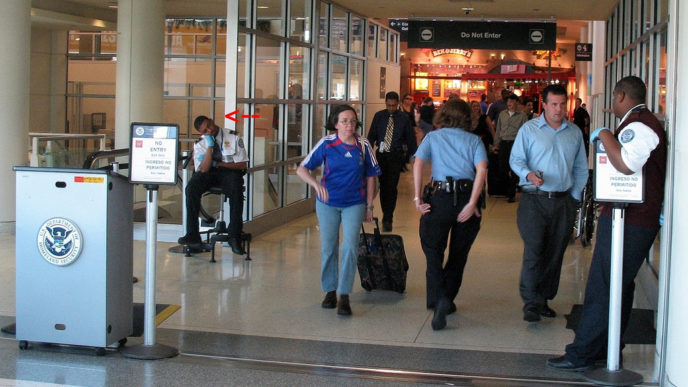
Like many airline passengers, I had forgotten to take my plastic bottle of water out of my bag before placing it on the moving belt for security screening. So, naturally, the screener pulled my bag and after I waltzed through the body image scanner with no hiccups, I joined the Transportation Security Administration agent assigned to check my bag.
As I suspected, the water bottle was the culprit but he still had to do a mandatory chemical test of my bag. That’s when they take those little black sticks with swatches on the end and rub them over your belongings, or sometimes the palms of your hands, and then run them through a machine. Fairly routine. Except this time my swatch sent off an alarm. No noise, just a flashing “Alarm” text on the machine’s computer screen. So, they tried again. Same response.
That meant I qualified for a full-body pat-down. I know people who have gone ballistic when asked to have that done, but I go along as I’ve got nothing to hide and I just want to get my purse and get to my gate. Nope. After the pat-down, they do a chemical test on me and my swatches send off the alarm too.
We’re now about 15 minutes and five (yes, five) TSA agents into this little drama. The screener, the guy who first checked my bag, the female TSA agent who was assigned to do the pat-down, the TSA agent who had checked my ID and boarding pass were all there, along with another agent who, as best as I could tell, was simply assigned to stand next to me and make small talk and make sure I didn’t go anywhere.
The agents do another chemical test and decide they need to do another full-body pat-down. They want to do this one in private, assign a new female TSA agent to do it, but tell the original one to also attend as a witness. When I come back out, there is now a manager involved and they are calling the head of something—I could never get the official title—who was supposedly the only person at Reagan airport who could come check my chemical tests and figure out what was going on.
Twenty minutes later, and with no sense of urgency, he arrives. So here we, meaning me and now up to eight TSA agents, go again. Now they are taking out my items one by one to run through the screener—my two lipsticks, eyeshadow, computer power cord, jewelry bag, wallet, sunglasses, etc. Not sure why the original crew didn’t do that, but at this point it was clear most of these folks, bless their hearts, probably had this job because it is one of the few that requires no problem-solving skills or ability to act with speed, and where, heaven knows, customer satisfaction is found nowhere on a personnel review form.
Four gray TSA bins, each holding a few of my items, are then whisked off by no less than three TSA agents (that’s right, it took three people to carry four bins holding heavy-duty items like makeup and hand sanitizer) to a back room. I’m told nothing. For another 15 minutes I sit, not asking too many questions because I still have hope against hope that I might make my flight and don’t want to do anything to take one of these whiz kids off their game.
Now, 55 minutes into this whole process, the back room door opens, out come all my bins and items and I’m told I’m free to go. Dumping everything into my bag and grabbing my shoes, which I had not been allowed to put on, I race barefoot to the gate.
Alas, it was not meant to be. I missed my flight.
The only positive, or so I thought, was that now I’d have time to go back and check in with the TSA folks to find out exactly what it was that caused the problem. I hadn’t taken the time to do so when they finally gave me the all-clear because I just wanted to get to the gate. But now, in an attempt to not relive this experience in the future, I was determined to find out what shampoo I had used or lotion I was wearing that sent their chemical sensors into a frenzy.
No such luck. They can’t tell you that. When I got back to the TSA area, I found the agent who had been the original screener and asked him if he had been told what had caused the problem. “I can’t tell you,” was his response. “It’s a chemical but I’m not allowed to tell you what kind.”
I prodded further, “You mean you know what it is, you must have concluded it wasn’t dangerous because you all finally let me go, but you can’t tell me so that I make sure not to wear it again or have it in my bag again?”
Mr. TSA Agent: “Right. Sorry.”
So how many TSA agents did it take to make me miss my flight yet give no explanation as to why or what to do different next time around?
I lost count.
My story apparently isn’t unique. A man putting on his shoes after coming through security and sitting on the bench next to me as I was working on this article said the exact same thing happened to his wife last summer, except that in her case it turned out she wasn’t sporting some odd lotion or perfume, the machine had simply malfunctioned multiple times. Too bad she missed her international flight while they figured that out.
I wonder if her story, or mine, would have been different if more U.S. airports did what most European airports do, use private screeners. Since 2001, something called the Screening Partnership Program has existed that allows for U.S. airports to contract with private screeners as opposed to using those assigned by the TSA.
A study by the House Transportation Committee found that $1 billion could be saved over five years if America’s 35 largest airports used private screeners. My Heritage Foundation colleague David Inserra has pointed out that “with smaller overhead costs and lower levels of attrition, the screening program is likely a financial boon for most airports.” He also says those airports report improved customer service.
So why do roughly only 20 U.S. airports make use of the private screening option? Because the Obama administration, in one of its “go around the laws we don’t like” moves, suspended the program in 2011 (Congress rightly later reinstated it), because it can take up to four years for an airport to get approval due to government bureaucracy, and because the TSA and its unionized workforce has no interest in competing with the private sector.
The reality is that air travel need not be the fiasco it has become. Congress can rein in the TSA by streamlining the process to hire private screeners and forbidding the unionization of its employees.
Until then, maybe you shouldn’t shower before your flights. (For more from the author of “Another Travel Fiasco Courtesy of the TSA” please click HERE)