Trump’s Cabinet Picks Sounding Alarms

It’s often said “personnel is policy” when it comes to an incoming president’s Cabinet selections, and that’s what has some of Donald Trump’s most fervent supporters asking, “Why THESE people?”

In fact, Americans on both the left and right of the political aisle are expressing concern over the president-elect’s recent choices for key positions in his administration.

On Wednesday came word that Vice-President-elect Mike Pence was meeting with former Secretary of State Condoleezza Rice, an outspoken Trump critic. In October, Rice called for Trump to end his bid. “Donald Trump should not be president. He should withdraw,” she wrote in a Facebook post following release of a decade-old video of Trump having a lewd conversation about women. Rice even insisted Trump replace himself with “someone who has the dignity and stature to run for the highest office in the greatest democracy on earth.” In July, Rice declined to attend the Republican National Convention. The Trump team has not indicated whether it is considering Rice for a Cabinet post.

Also Wednesday, the New York Times reported Trump may be considering professional wrestling magnate Linda McMahon for the Small Business Administration. McMahon developed World Wresting Entertainment, or WWE, with her husband, Vince McMahon. Upon leaving Trump Tower Wednesday, McMahon told reporters, “The meeting went great. It was really nice to be up, and I was honored to be asked to come in. Anytime I think the president-elect of the United States asks you to come in for a conversation, you’re happy to do that. We talked about business and entrepreneurs and creating jobs, and we talked about S.B.A.”

Trump may also be considering former Alaska Gov. Sarah Palin for secretary of Veterans Affairs, Reuters reported Wednesday. Trump has long said a top priority of his administration will be to improve veterans’ care. (Read more from “Trump’s Cabinet Picks Sounding Alarms” HERE)

Follow Joe Miller on Twitter HERE and Facebook HERE.

Texas Abortion Providers Will Be Required to Bury or Cremate Aborted Babies, Abortionists React

The bodies of aborted children in Texas must be buried or cremated, according to a new rule adopted by the state’s Department of Health and Human Services. The rule, proposed by Gov. Greg Abbot in July, goes into effect on December 19th.

The rule essentially requires that the remains be treated like any other person’s remains, and prohibits their being disposed of in a landfill or by grinding up the bodies and discharging them into the sewer system. “I believe it is imperative to establish higher standards that reflect our respect for the sanctity of life,” Abbot said in an email.

Their bodies can no longer disposed of in the same way as what the New York Times called “other forms of biological medical waste.” The rules added provisions to the existing code, “that afford protection and dignity to the unborn consistent with the Legislature’s expression of its intent,” according to the preamble to the rules.

The new rules covers the bodies of children who miscarry in a hospital. It exempts parents who miscarry or abort children at home.

Abbot has also called for other changes in the law to protect the bodies of aborted children. In his 2016 Report to the People of Texas, Abbot had called for making “partial-birth abortion a felony in Texas” and also making it “illegal for doctors to risk a woman’s health by altering abortion procedures to preserve fetal body parts.” He added “we must criminalize any sale or transaction of fetal body parts or tissue in Texas by an abortion clinic for any purpose.”

The Abortion Reaction

The abortion industry reacted immediately. They are threatening to sue the state, claiming that the regulations restrict women’s right to abortion and that abortion providers will face extra costs.

“Texas politicians are at it again, inserting their personal beliefs into the health care decisions of Texas women,” Stephanie Toti, senior counsel for the Center for Reproductive Rights, said in a statement reported by Texas Tribune after the measures were proposed this past summer. “The Center for Reproductive Rights is prepared to take further legal action to ensure that Texas women can continue to access abortion and other reproductive health care without interference by politicians.”

The state’s health department says the opposite is true — that the costs associated with funerals will be offset by costs currently incurred by hospitals and clinics to transport, incinerate or otherwise dispose of an unborn baby’s body. Its spokeswoman said that the department’s research showed the cost will be “offset by costs currently being spent by facilities on disposition for transportation, storage, incineration, steam disinfection and/or landfill disposal.”

The pro-abortion Texas Medical Association, the Texas Hospital Association and the Healthcare Waste Institute of the National Waste and Recycling Association opposed the new rule. It has also been opposed by the Funeral Consumers Alliance of Texas.

According to the New York Times, the head of the Texas branch of NARAL Pro-Choice Texas attacked what she called “the addition of non-medical ritual.” The new rules are “a thinly veiled attempt to shame Texans who have abortions and make it harder for the doctors who provide them,” she said.

The Pro-Life Response

Texas Right to Life Legislative Associate Emily Horne told The Stream that “we are appreciative of the new policy that provides dignity to pre-born children who have died. These laws give unborn children the same dignity that is already required of pre-born babies that die after 20 weeks. And, more is required because a death certificate is required after 20 weeks.”

Horne told The Stream that her organization will aim to “pass laws that will save some of these deaths from occurring in the first place” when the Texas legislature returns to session in January.

The new rule is “nothing revolutionary,” Horne said. “But you’re not hearing that. This law treats unborn babies with the dignity they deserve.” (For more from the author of “Texas Abortion Providers Will Be Required to Bury or Cremate Aborted Babies, Abortionists React” please click HERE)

Follow Joe Miller on Twitter HERE and Facebook HERE.

Media Shocked That Chip, Joanna Gaines Attend Church Opposed to Same-Sex Marriage

Never fear, America — Buzzfeed and Cosmopolitan are working hard to make sure millions of innocent viewers don’t accidentally enjoy watching TV shows where the stars are Christians with traditional Christian beliefs.

After embarking on what Cosmopolitan described as a “deep-dive” (that involved watching easily-accessible internet videos and reading a church’s online statement of faith), one Buzzfeed reporter Kate Aurthur “uncovered” the fact that HGTV stars Chip and Joanna Gaines’s pastor, Jimmy Seibert of the mega Antioch Community Church, “takes a hard line against same-sex marriage.”

Aurthur’s Buzzfeed article details what Seibert preached the Sunday after the Supreme Court’s decision on same-sex marriage in 2015. (What she doesn’t mention or perhaps doesn’t realize is that thousands of churches across the nation likely preached a similar message.)

After talking about Genesis, and saying that marriage is between “one man and one wife,” Seibert emphasizes the fixedness of this idea. “This is a clear biblical admonition. So if someone were to say, ‘Marriage is defined in a different way,’ let me just say: They are wrong,” he says from the pulpit to applause from the congregation. “God defined marriage, not you and I. God defined masculine and feminine, male and female, not you and I.”

Aurthur also takes issue with Pastor Seibert’s opinion that many people who identify as homosexual were abused as children and his statement that God can change their lives:

We can change, contrary to what you hear. I’ve worked with people for over 30 years — I have seen hundreds of people personally change their direction of same-sex attraction from a homosexual lifestyle to a heterosexual lifestyle. It doesn’t mean they don’t struggle with feelings, it doesn’t mean that they aren’t hurting, it doesn’t mean it’s not challenging. But they have chosen to change. And there has always been grace there for those who choose that.

According to Aurthur, it is still “unclear” whether the HGTV Fixer Upper stars Chip and Joanna actually agree with their pastor’s “severe” views — a point Cosmopolitan writer Gina Mei desperately hopes they clarify soon.

Twitchy compiled a long list of people who found Aurthur’s “deep-dive” ludicrous, with tweets like:

The ‘Deep-Dive’ That Reveals Nothing New

Aurthur may think she has uncovered something new and shocking by pointing out an evangelical pastor’s commitment to biblical teaching, but she hasn’t. Curbed, an outlet of Vox Media, casually referenced Antioch Community Church’s beliefs regarding homosexuality in an October article entitled “Is Fixer Upper a stealth feminist fantasy?” (Aurthur actually links to this article in her own — perhaps she didn’t realize that the Curbed reporter also had the ability to Google search Antioch’s statement of faith and did so first.)

Chip and Joanna have been discussing their Christianity for a long time. They write about their “devout” faith in their newly-released book, The Magnolia Story. They have been interviewed about their faith numerous times (just Google “Chip and Joanna Gaines Christians”) and have shared their religious testimony in videos for Baylor University — the Baptist college they both attended — the Christian ministry I Am Second, and others.

So why the sudden uproar? Because certain people on the political Left are attempting to ab-normalize basic Christian beliefs, coloring them as extreme, oppressive, and hateful. The hype surrounding Buzzfeed’s groundbreaking exposé is simply the latest example in this growing trend.

What the Left Fails to Understand

Apparently a common tenet of leftist ideology is that to disagree is to hate, particularly when it comes to Christians who value a biblical understanding of sexuality and marriage. But this tenet is wrong.

One great example of congeniality and respect shared between two very different people is Dr. Michael Brown’s recent column, “The Gay Rabbi and My Mother’s Funeral.” As Dr. Brown, a Messianic Jew and outspoken critic of the LGBT movement writes,

It really is possible to love your gay neighbor as yourself while at the same time opposing the goals of gay activism, and it really is possible to recognize that every human being is created in the image of God (yet fallen) while at the same time having massive differences on religious, cultural and moral issues.

Many seem to forget that even as Supreme Court Justice Anthony Kennedy decided in favor of legalizing same-sex marriage in 2015, he reaffirmed the very beliefs currently causing the reporters at Buzzfeed and Cosmopolitan to freak out. In Obergefell v. Hodges, Kennedy writes:

Finally, it must be emphasized that religions, and those who adhere to religious doctrines, may continue to advocate with utmost, sincere conviction that, by divine precepts, same-sex marriage should not be condoned. The First Amendment ensures that religious organizations and persons are given proper protection as they seek to teach the principles that are so fulfilling and so central to their lives and faiths, and to their own deep aspirations to continue the family structure they have long revered.

Could this mean that while same-sex couples can now legally decide to get married, people of certain religious faith may legally disagree with the morality of that decision (and perhaps even live their lives accordingly)? Shut the front door!

PSA: It’s Okay to Like Celebrities You Disagree With

As Dr. Brown writes in his piece, it’s perfectly possible to develop relationships with those you disagree with.

So if you are a liberal Fixer Upper addict who could care less where Chip and Joanna attend church but are being made to feel guilty for your lack of care by Buzzfeed or Cosmopolitan, breathe easy. It’s just a TV show, and watching it doesn’t mean you condone the views of its stars.

Christians routinely find ourselves in such situations. I’ll wager that there are plenty of Christians who, like me, love Sir Ian McKellen as Gandalf in the Lord of the Rings despite the fact that he is outspokenly gay, repeatedly watch Saving Private Ryan despite the fact that Tom Hanks is a recipient of the LGBT Outfest’s Trailblazer Award, and loved Downtown Abbey even though it follows the complex and sometimes heart-wrenching story of a gay supporting character.

But what if you are actually surprised and upset to discover that the Gaineses probably support their pastor’s “unmoving position … on same-sex marriage?” Jumping on the bandwagon, Us Weekly also reported Buzzfeed’s apparent discovery and included tweets from concerned fans.

If this is you, then by all means, ignore the show. Cancel your subscription. Send your money to the Human Rights Campaign and not Antioch Community Church. It’s a free country.

But the millions of Americans who identify with the Texas couple’s faith and agree with Antioch’s pastor shouldn’t be made to feel “hateful” simply because they hold a belief that has been around for millennia. (For more from the author of “Media Shocked That Chip, Joanna Gaines Attend Church Opposed to Same-Sex Marriage” please click HERE)

Follow Joe Miller on Twitter HERE and Facebook HERE.

Meet Wilbur Ross, Trump’s Pick for Commerce Secretary

President-elect Donald Trump tapped Wilbur Ross, an investor and longtime Trump associate, to serve as secretary of the Department of Commerce, the transition team announced Wednesday.

“Wilbur Ross is a champion of American manufacturing and knows how to help companies succeed. Most importantly, he is one of the greatest negotiators I have ever met, and that comes from me, the author of The Art of the Deal,” Trump said in a statement. “Together, we will take on the special interests and stand up for American jobs.”

Ross, 79, is a billionaire investor most known for rescuing failed companies — a reputation that earned him the nickname “the king of bankruptcies,” according to Politico.

He’ll take over the Commerce Department as the new administration gears up for implementation of Trump’s “America First” economic plan, which involves creating more than 25 million jobs in the next 10 years.

A native of New Jersey and a former Democrat, Ross spent 25 years at the head of Rothschild Inc.’s bankruptcy practice, according to Forbes. He then launched WL Ross & Co., an investment firm, in 2000 and currently serves as its chairman.

Ross is worth an estimated $2.5 billion, according to Forbes.

“I am delighted to have been selected to join President-elect Trump’s Cabinet and look forward to working especially closely with [newly appointed Treasury Secretary] Steve Mnuchin to implement the economic programs which we have developed jointly to implement the president-elect’s strategy for accelerating our economic growth,” Ross said in a statement.

The 78-year-old billionaire has resurrected companies in the steel, coal and textiles industries. Ross also helped Trump salvage his Trump Taj Mahal casino in 1990, when the casino was on the verge of bankruptcy.

Ross and investor Carl Icahn decided to restructure the bankruptcy filing in 1991, according to The New York Times, which allowed Trump to save his brand.

Ross is most known for his decision to buy struggling steelmakers including LTV and Bethlehem Steel, which he turned into a new company called International Steel Group. In 2004, Mittal Steel purchased International Steel Group for $4.5 billion.

Despite Ross’ success in that deal, the billionaire’s foray into the steel industry took a drastic turn in 2006 when an explosion at the Sago Mine in West Virginia killed 12 miners. A company Ross owned, International Steel Group, took over the mine just months earlier.

Ross served as an economic adviser to Trump during the campaign and shares Trump’s views on the Trans-Pacific Partnership, calling it the “worst trade deal yet for American manufacturing” in an August op-ed in the Pittsburgh Post-Gazette.

If confirmed by the Senate to lead the Commerce Department, Ross will succeed Penny Pritzker. President Barack Obama selected Pritzker for the post in 2013.

As secretary, Ross would serve as a liaison between the White House and the business community. The Commerce Department oversees the U.S. Patent and Trademark Office, the International Trade Administration, the National Weather Service and the Census Bureau.

Ross graduated from Yale University and Harvard University, and lives with his third wife in Palm Beach, Florida, not far from Trump’s Mar-a-Lago estate.

His second wife is Betsy McCaughey, who served as New York’s lieutenant governor from 1995 to 1998. McCaughey also served on Trump’s economic team during the campaign. (For more from the author of “Meet Wilbur Ross, Trump’s Pick for Commerce Secretary” please click HERE)

Follow Joe Miller on Twitter HERE and Facebook HERE.
The Left’s Utterly Ridiculous Claim That Police Are Trained to ‘Shoot to Interview’

As a former uniformed law enforcement officer, federal agent, and law enforcement instructor, I’m growing increasingly frustrated with the dangerous naiveté within the far-left activist and “talking-head” community when it involves discussing police use-of-force incidents.

After nearly every police-involved use-of-force incident, some far-left activist or news commentator feels the need to rush in front of the cameras and, without even knowing the facts, spout off about the incident. Much of this heated and uninformed anti-police rhetoric inspires the same kind of rhetoric in return in defense of the police. (I have engaged in some of these heated debates on camera when I felt that the police are unjustly being attacked.) As a result, no substantive discussion occurs — only a yelling match.

But, what I saw last night set a new low for liberal commentary on law enforcement. What happened on Fox News’ “The Kelly File” was inexcusable and dangerous.

As I sat in front of the television, relaxing after completing my Facebook Live session, I watched liberal commentator Nomiki Konst say something about police officers so outrageous that I nearly choked on the Seltzer I was drinking. Host Megyn Kelly asked Konst to comment on the Ohio State University knife attacks and the since-deleted tweet by former vice presidential candidate Tim Kaine that inaccurately implied the attacker had a gun.

The conversation quickly went off the rails as Konst, unbelievably, implied that the life-saving actions of heroic OSU police officer Alan Horujko may have been an exercise in poor judgement. If you’re saying “What!?” then join the chorus. Now I have met Nomiki before and found her to be both affable and relatable and do not intend this to be, in any way, a personal attack.

Konst went on to state that non-deadly force could have been used against the knife-wielding, murderous savage because, in her words: “The FBI trains in situations like this and they want to make sure the attacker is alive so they can question him, especially if there’s some sort of terrorist affiliation.” She added, “There’s a lot of training behind this. You find a way to injure them, harm them, knock them down, still keep them alive so you can question them.”

Fascinating. This is breaking news if true.

I, along with the legions of local, state, and federal law enforcement agents would be astonished to discover that decades of use-of-force training — designed to STOP a subject from causing serious physical injury or death to himself or others — had changed and that the new policy was “shoot to interview.”

To be sure I hadn’t heard Konst wrong, I rewound the segment and listened again and, to my chagrin, my ears were working just fine. To their credit, host Megyn Kelly and co-panelist Dana Loesch immediately threw the BS flag on this nonsensical and dangerous assertion and forced Konst back on her heels. But the damage had already been done.

Friends, what happened in this cable news segment is the reason why we can’t have a civil discussion in this country about understandably heated intersections such as race and police use-of-force. Not only was Konst grossly misinformed about how police are trained to use force in a situation requiring it, but she was also spouting the exact opposite position many of her fellow, liberal activists and commentators have taken in the past when they stoked the flames of racial division after a use-of-force incident involved a minority.

For example, here’s a headline from an editorial piece written just a few days ago discussing police use-of-force incidents, “Black Lives Matter 2016: Why Do Police Shoot To Kill? How Officers Are Trained In The Use of Force.”

So, liberal activists and commentators, which one is it? Are police trained to “shoot to kill” or to “shoot to interview”? How can we have a serious conversation in this country when liberal activists ask us to reevaluate and change a policy they don’t even understand? Or do they understand it, and they’re just changing their talking points to fit a new narrative designed to sway public opinion in their direction?

Either answer is troubling. Do you see how a productive conversation is impossible given that we aren’t all talking about the same things? People who are trained law enforcement professionals are talking about apples, while the liberal commentators and activists are talking about oranges from Jupiter (or Jupiter being orange, depending on the direction of the political winds of the moment).

As I said previously, I have met Nomiki in the past, and I don’t want to impugn her motives, but this was irresponsible at best. Misinforming the public on such an important issue such as the training of our nation’s police officers in an effort to increase cynicism against the police — in a time where police-community relations are already struggling in many areas of the country — is incredibly irresponsible.

She owes OSU police officer Horujko and the entire law enforcement community an apology. (For more from the author of “The Left’s Utterly Ridiculous Claim That Police Are Trained to ‘Shoot to Interview'” please click HERE)

Follow Joe Miller on Twitter HERE and Facebook HERE.

Why This Potential Pick for DHS Would Be a Huge Reversal on Trump’s Biggest Campaign Promise

The possible appointment of Rep. Michael McCaul, R-Tex. (F, 56%) to the position of Homeland Security chief may finally signal to Donald Trump’s most loyal supporters that the president-elect is not going to follow through on his chief campaign proposals of border security and immigration.

McCaul, who chairs the House Homeland Security Committee, met with the president-elect Tuesday in Trump Tower. He is said to be among a handful of individuals in the running to become the next secretary of the Department of Homeland Security.

During his presidential campaign, especially in the GOP primary, Trump promised to build a security wall along the southern border to strengthen domestic national security. He has also pledged to enforce immigration law and restore order to the immigration system as a whole.

Conservative critics of Rep. McCaul say he’d be a “very disappointing” pick to lead DHS, a gargantuan government department created in the wake of the Sept. 11 attacks.

McCaul, of course, has also earned the scorn of many a conservative for floating the idea of challenging Sen. Ted Cruz, R-Texas (A, 96%) in a primary.

“We certainly hope that Donald Trump would not reward a deceptive pro-amnesty lawmaker like Michael McCaul with a Cabinet position,” William Gheen, president of Americans for Legal Immigration PAC, told the Washington Times on Tuesday. “That would be very disappointing to all of us that believed his campaign promises to secure our borders and deport millions of illegal immigrants under current U.S. laws.”

Immigration hawks are particularly startled by McCaul’s 2015 Secure Our Borders First Act. Critics say the Texas representative’s co-authored bill ignored policy solutions to deal with the millions of people living in America illegally, like the administration’s “catch and release” policy.

Another factor working against McCaul’s credibility to head the Cabinet department simply in charge of “keeping America safe” is his support for Obama’s Countering Violent Extremism (CVE) agenda, which seeks to prevent jihadist radicalization through a mix of community and counter-propaganda approaches.

The overarching goal of the CVE approach is to stop would-be jihadists before they act, by countering the destructive narratives that may radicalize them within their local communities and online. The problem, critics claim, is that the structure of the program does not actually lend itself to countering violent extremism.

Obama’s pilot program has been criticized as a “catastrophic failure,” primarily because it fails to address the roots of this brand of violence and extremism (jihadism), and engages Muslim organizations with extremist ties, instead of reformist outfits.

As Dr. Zuhdi Jasser, a Muslim reformist and president of the American Islamic Forum for Democracy puts it, entrusting groups like these with counter-terrorism responsibilities is akin to “treating arsonists like firefighters.”

What was Rep. Mike McCaul’s role in this? After criticizing President Obama’s approach during the White House CVE conference in Feb. 2015, the House Homeland Security Committee chairman sponsored a bill to create an entire CVE office inside the Department of Homeland Security.

Other potential nominees for DHS secretary (and related national security posts) include: Milwaukee County Sheriff David Clarke, New Jersey Governor Chris Christie, former House Speaker Newt Gingrich, California Rep. Duncan Hunter, former Pennsylvania Rep. Robert Smith Walker, Lt. Gen. Keith Kellogg, former U.S. Ambassador to the United Nations John Bolton, and former CIA officer Clare Lopez. (For more from the author of “Why This Potential Pick for DHS Would Be a Huge Reversal on Trump’s Biggest Campaign Promise” please click HERE)

Follow Joe Miller on Twitter HERE and Facebook HERE.

A New Confederacy?! Levin EXPOSES the Left’s Sanctuary City Crap-Scheme

Do we have a new Confederacy akin to that of the Civil War-era?

Leftist cities around the country, with the support of the Democratic Party and their president, are nullifying federal immigration law. And they are vowing to continue even after a President Trump is sworn in. They are behaving like Civil War-era pro-slavery states, argued Mark Levin on his radio program Wednesday night.

“Their taking a page out of the Confederacy’s handbook,” said Levin. “Why is okay that [the Democrats] violate federal law?”

Listen to the full clip here:

Levin has a solution for Trump and his new Attorney General Jeff Sessions, however. Make sure to listen and find out what can be done! (For more from the author of “A New Confederacy?! Levin EXPOSES the Left’s Sanctuary City Crap-Scheme” please click HERE)

Follow Joe Miller on Twitter HERE and Facebook HERE.

Sen. Mike Lee Calls for 12-Year Term Limits for Lawmakers

The 2016 election cycle has sent a signal “loud and clear” that the federal government needs fixing, a U.S. senator said Tuesday.

Sen. Mike Lee, R-Utah, voiced his support for 12-year term limits on members in either body of Congress while speaking at The Heritage Foundation this week.

“I’m distressed any time I see the right to vote being diluted by an argument that rests on the following line of reasoning,” Lee said Tuesday at The Heritage Foundation event to announce Heritage’s new research Institute for Constitutional Government. He said:

Whenever you see a member of Congress come back and tell his or her constituents, ‘Look I know we’re all citizens in a free republic and that means you can vote for whomever you want, but given the amount of seniority and authority that I’ve accrued during my time in this or that body of Congress, you should know that if you don’t vote for me you will lose money and power and influence.’

“It’s attaching a very high price tag to our most fundamental of rights, our right to vote,” Lee said. “The best way I can see to eliminate that argument, to take it out, is to limit members of Congress to 12 years of service in either house.”

Lee said he believes there should be a constitutional amendment for term limits.

A 12-year term limit in either chamber of Congress would allow U.S. senators to serve for two terms and representatives to serve for six terms.

“Congress is the people’s branch,” Lee said.

Congress needs to be responsible and accountable, he said.

“The American people are frustrated with the government that knows no boundaries,” Lee said. He added:

The American people … know that in many respects they are no longer in charge of their own government. That the government that was created to serve them has tried to untether itself from them, moving away from them and becoming a task-master rather than a servant.

Power has been taken away from the people’s elected representatives and “given to unelected, unaccountable government bureaucrats,” Lee said.

“This is a problem because it results in all kinds of lawmaking made by all kinds of government officials who are never subject to elections and therefore have no reason to fear when the people get concerned about new laws,” Lee said.

“Members of Congress have contributed to this problem,” Lee said of giving too much power to bureaucrats.

Along with advocating term limits, Lee spoke at the event about preserving the Constitution.

“In order to avoid criticism and thereby maximize their chances of achieving perpetual re-election, [members of Congress] depart from and are willing to sacrifice constitutional principles that were designed to connect the people with their own government,” Lee said.

“Power has been taken away from the people and moved to Washington,” he added. “Power that was always supposed to be exercised at the state and local level has been federalized.”

The new constitutional institute at Heritage will help “educate members of Congress, their staff, the new administration, and the American people on the importance of our founding institutions to preserving freedom,” a description of the event says.

“The founders tried to forestall creation of a new tyranny by devising an ingenious system, codified in the Constitution, to limit the power of government and preserve individual liberties,” James Wallner, Heritage’s group vice president for research who will head the new institute, said in a statement.

The B. Kenneth Simon Center for Principles and Politics, the Edwin Meese III Center for Legal and Judicial Studies, and the Center on Public Opinion research centers are part of Heritage’s new Institute for Constitutional Government.

There is “a real need for more high-level civic education on college campuses to the general public, to members of Congress, to their staff,” David Azerrad, director of the B. Kenneth Simon Center for Principles and Politics, said on Tuesday.

“One of the things I think that all conservative and libertarians, and progressives who are still committed to the Constitution, need to recognize is that the task of rebuilding limited constitutional government is going to take a long, long time,” Azerrad said. (For more from the author of “Sen. Mike Lee Calls for 12-Year Term Limits for Lawmakers” please click HERE)

Follow Joe Miller on Twitter HERE and Facebook HERE.
Attack at Ohio State Brings US Terror Plots, Attacks to 93 Since 9/11

This week, terror struck American soil once again—this time on a university campus.

On the morning of Nov. 28, Abdul Razak Ali Artan drove a car into a crowd of pedestrians on the campus of Ohio State University. He then got out of the car and began attacking those around him with a knife.

A nearby police officer, Alan Horujko, was able to respond within a minute, shooting and killing Artan when he refused to drop the knife. Eleven individuals were injured, all of whom are expected to survive.

Authorities believe that Artan may have been inspired by the Islamic State as well as the Yemeni-American propagandist Anwar al-Awlaki. Artan posted a rant against the U.S. on Facebook just before the attack.

Using a vehicle as a method of attack has been recommended by al-Qaeda and ISIS in their magazines and was also used in the terrorist attack in Nice, France, and at the University of North Carolina at Chapel Hill.

According to authorities, Artan was an 18-year-old student at the university. Of Somali descent, Artan was living in the U.S. as a legal permanent resident. Law enforcement officials and refugee resettlement agencies report that Artan and his family came to the U.S. in 2014 from Pakistan as refugees, where they had reportedly lived for seven years after fleeing Somalia.

While some of these details have yet to be officially confirmed, the evidence is clear enough to add this attack to the list of Islamist terror plots. This attack is the 93rd Islamist terrorist attack or plot against the U.S. homeland since 9/11 and the 12th plot or attack this year.

Including this attack, 14 successful Islamist terrorist attacks have occurred on U.S. soil since 9/11, five of which have been in 2016 alone. With Artan also appearing to have been radicalized here in the U.S., the total number of homegrown plots rises to 82 of the 93.

While the threat of complex, overseas-planned or supported terrorist attacks is still real (as evidenced by attacks in Paris and Brussels), the trend in the U.S. has been toward more basic and improvised attacks by homegrown lone wolves.

Such attacks can be difficult to detect—a reality reflected by the growing number of successful attacks in the U.S. As these individuals are already in the U.S. when they become radicalized, immigration vetting can do little, if anything, to detect these individuals.

If the U.S. is to stop homegrown terrorists, it must do more to empower local officials. Federal capabilities are incredibly important, but the threat of lone wolves requires all hands on deck.

To find and stop these lone wolves before they attack, U.S. leaders should work to advance the following policies:

1. Building more effective communication lines between local law enforcement and the FBI.

2. Ensuring that local law enforcement agents receive proper training on how to respond to terrorist attacks and active shooters.

3. Helping local law enforcement build relationships with its community.

(For more from the author of “Attack at Ohio State Brings US Terror Plots, Attacks to 93 Since 9/11” please click HERE)

Follow Joe Miller on Twitter HERE and Facebook HERE.

‘We Need to Know We’re Not Alone’: Ukraine’s Soldiers Carry the Burden of a Nation at War

As the war in Ukraine nears its third calendar year, Ukrainian troops remain entrenched along a static front line in eastern Ukraine where they exchange small arms and artillery fire with combined Russian-separatist forces every day.

More than 21 months after it was signed, the cease-fire is a charade. The war may be at a lower intensity due to the cease-fire’s loosely adhered-to rules—but there is still very much a war in eastern Ukraine.

Combat is ongoing and intense throughout the Donbas—Ukraine’s embattled southeastern territory on the border with Russia. And civilian and military casualties still occur daily.

For many Ukrainian soldiers, war has become a way of life.

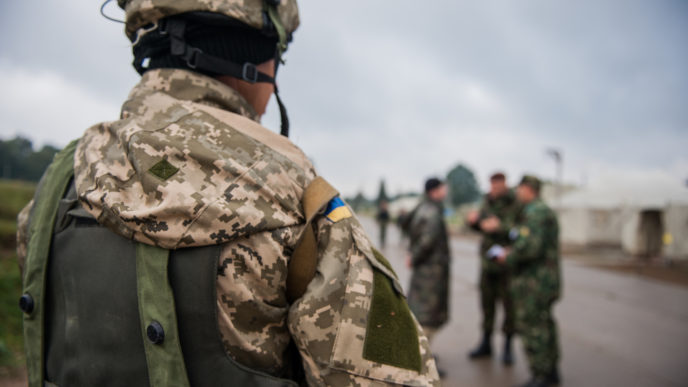
“I am at home now, this is my family,” Andriy, a 30-year-old soldier in the Ukrainian army’s 92nd Mechanized Brigade, told The Daily Signal from a front-line position in the embattled town of Marinka.

Andriy has continuously served in combat since the war began in spring 2014. He asked that his last name not be used due to security concerns.

The Ukrainian troops believe in the justice of their cause, yet, there is a pervasive sense of disappointment, bordering on betrayal, expressed by many front-line soldiers toward their civilian leadership in Kyiv.

“We are fighting for our land, to defend every centimeter of our country,” Dimitry Karamushka, a 30-year-old soldier in the 92nd Brigade, told The Daily Signal in Marinka. “We are not fighting for our government.”

The 92nd Brigade recently rotated to Marinka from a previous combat deployment outside the separatist stronghold of Luhansk. The unit comprises a mix of both draftees and volunteers, with some soldiers having served continuously in combat, with only periodic breaks of a week or two to go home, since spring 2014.

Ukrainian forces are dug in, battle-hardened, and better equipped and armed than they were a year ago. Conditions have improved, but supply shortages are still common, and the Ukrainian troops are still largely left to fend for themselves to provide many basic necessities—such as electricity.

“More than ammunition, we need to know we’re not alone,” Andriy said. “We are fighting two wars. One against Russia, and the other against the government in Kyiv.”

Casus Belli

Ukraine’s deployed troops remain committed to their cause, and treat the war as an existential fight for the country’s independence against what they call a Russian invasion of their homeland.

“We can’t leave the war and go to Kyiv,” Karamushka said. “It would mean surrender to Russia. And what would it mean to all the people who died?”

“We are standing for our territory,” said Alexandr Chernov, a chaplain in the 92nd Brigade. “Everyone wants peace. But peace will only come after victory.”

Chernov paused, smiled, and then added: “And when [Russian President Vladimir] Putin is gone.”

Ukraine’s military has been locked in a static, frontal war against a combined force of pro-Russian separatists and Russian regulars since the second, current cease-fire—called Minsk II—was signed in February 2015.

Today, at some places in and around Marinka, less than 300 meters (about 1,000 feet) of no man’s land divide the opposing camps.

“The situation here is stabilized,” said Vsevolod Chernetskyi, a 22-year-old soldier and Raven drone operator, in near perfect English. “We are in the same positions as a year ago, the Russians and us. It’s mostly artillery now.”

The war has killed about 10,000 Ukrainians and displaced about 1.7 million people, according to various reports from humanitarian organizations.

The conflict began in spring 2014 when Russian-backed separatists formed two breakaway republics in the Donbas.

Despite denials from Moscow, numerous news reports have shown that Russian troops are fighting among the separatists, that Russian military commanders command and control separatist forces, and that Russian weapons and ammunition continue to feed the war effort.

Through binoculars from the roof of the 92nd Brigade’s outpost in Marinka, this correspondent observed a Russian flag flying over a building across no man’s land on the combined Russian-separatist side of the contact lines.

According to Ukrainian military intelligence estimates, there are about 5,000 to 7,500 Russian troops currently deployed in the Donbas. About 55,000 Russian military personnel are also forward deployed to locations within Russia near the Ukraine border.

Combined Russian-separatist forces in eastern Ukraine currently control more tanks than Germany’s armed forces, and the Donbas is replete with Russian surface-to-air missile systems.

“I don’t feel we are winning,” Chernetskyi said. “The Russian forces are much stronger than ours. They can always provide more artillery than us, better tanks, more drones.”

During breakfast, this correspondent remarked to Chernetskyi how the shooting had stopped in time for both sides to take their morning meal.

Chernetskyi replied that the combined Russian-separatist forces operate on Moscow time, one hour ahead of Kyiv’s time zone.

“They eat an hour before us,” he said.

He paused a beat and then added: “They’re always one step ahead of us.”

Differences

The corner of an artillery-blasted apartment building in Marinka is marked by a spray-painted word in Russian. In English it translates to “For what?”

Approximately 5,000 civilians have fled Marinka since the war began, comprising about half of the town’s pre-war population of 10,000.

Daytime is usually relatively peaceful here. Civilians mill about outdoors, pedestrians are on the sidewalks. There’s an outdoor market where one can buy goods ranging from produce to clothing.

Across town, there is the sound of hammering as workers repair buildings damaged by shelling. They replace shattered windows and reconstruct crumbled walls.

There is a daily rhythm to the war, which conceals the brunt of the fighting from the intergovernmental organization responsible for overseeing the cease-fire.

Monitors from the Organization for Security and Cooperation in Europe, or OSCE, do not travel through the war zone at night due to security restrictions.

At night, consequently, the war begins in earnest.

“There is almost no artillery during the day, because the OSCE is here,” Chernetskyi, the 22-year-old Raven operator, said.

Winter sunsets in eastern Ukraine come early, around 4:30 p.m. As darkness falls there is, at first, only the occasional sound of a mortar explosion or an artillery shot, and the every-so-often burst of a machine gun or Kalashnikov.

As the hours pass, the pace and intensity of the shooting slowly builds like the different sections of an orchestra chiming in.

At the nocturnal peak of the fighting, typically around midnight, tracers cut across the night sky, the flashes and booms of mortar and artillery explosions come several times a minute, and there is a nearly constant background din of small arms fire.

This correspondent witnessed such a scene in Marinka on the night of Nov. 21. The Ukrainian soldiers on scene, as well as several civilians from the area, said the intensity of the fighting on that night was “normal.”

While casually smoking a cigarette in the night, one soldier jokingly recommended that this correspondent return “when things really get hot.”

Spartan

When U.S. troops go to war, they usually enjoy the support of specialized units—such as the Army Corps of Engineers, the Navy Seabees, or Air Force Civil Engineers—dedicated to building and maintaining base infrastructure, even in the most austere locations.

For deployed Ukrainian troops, however, this task is a collective effort, in which the diverse skills each soldier brings to the war are identified and utilized for the common good.

One example. A 92nd Brigade soldier with a university electrical engineering degree illegally tapped into the local power grid to provide electricity for the outpost in Marinka—effectively stealing electricity from the same government that had sent him to war.

The power still frequently goes out, however. Wood-burning furnaces provide heat to stave off the winter cold and cook food.

Soldiers say the military has improved on its deliveries of basic necessities such as water and foodstuff during the past year.

Yet, non-essential food items like honey, sugar, and coffee are still provided by civilian volunteers. As are other more vital supplies, including most soldiers’ body armor, boots, and winter underwear.

Weapons and ammunition are not a problem, although the soldiers complain about the quality of their armaments—some of which date back to World War II, almost all of which are Cold War vintage.

The soldiers in Marinka still lack basic sanitation. They use a wooden outhouse as a toilet—a miserable proposition in eastern Ukraine’s frigid winters.

The soldiers’ diets mainly comprise traditional Ukrainian foodstuff—including copious amounts of buckwheat, bread, potatoes, and salo (cured slabs of pork fat). Sweetened condensed milk is another troop favorite.

At night, the soldiers sometimes enjoy a moonshine popular throughout the front lines called Avatar; a reference to one’s facial complexion after over-indulging.

Nearly everyone smokes. At night, as the not-too-distant battles rages, the soldiers stand casually outside for as long as they can tolerate the cold to enjoy a cigarette or two. They are desensitized to the war, able to instantly and instinctively tell when the shooting is near enough to pose a real threat.

As at other front-line Ukrainian positions across the war zone, the items hung on the interior walls are a testament to the life stories of these men at war.

Kalashnikovs and body armor hang beside Orthodox religious icons, and posters of soccer stars and beautiful women. Letters from home share tabletops with grenades and bullets.

Outside the few scattered buildings in which the soldiers are holed up, a collection of tanks and armored personnel carriers are scattered under concealment.

At dawn, this correspondent joined a brief patrol into no man’s land in an armored personnel carrier from the 1970s called a BMP. The foray was cut short when the Ukrainian driver spotted enemy forces.

The ebb and flow of life here is likely not too different than it was for the soldiers who fought for this land in World War II.

Except for the presence of smartphones and a few laptops—and the U.S.-made Raven UAV the unit operates—the war-fighting technology and the circumstances of day-to-day life here would not be out of place seven decades ago.

“We want people to know that this war could happen in other places in Europe,” Chernov, the chaplain, said. “We have to stop Russia here.”

Red to Blue

The soldiers (the majority of whom are millennials) reject their country’s Soviet military heritage in favor of closer ties with the U.S. and NATO.

On Soviet battle maps, red icons (for the Red Army) symbolized friendly forces, and enemy forces were blue.

After the current war in the Donbas began, Ukrainian forces flipped the colors of their icons to match NATO maps, in which the colors are reversed.

The move was a practical step in bringing Ukraine’s military in line with NATO standards (part of a larger effort to foster closer ties with the Western alliance), but it was also a symbolic pushback against Russia.

The soldiers consider the United States to be an ally, and they want American military support. Many, however, oppose the idea of direct U.S. military intervention.

“American help is OK,” Andriy, the 30-year-old soldier from Kharkiv, said. “But we need to learn how to do this on our own. We shouldn’t rely on other countries for help. We need to fight this war on our own.”

There is a symbolic value to U.S. support that the soldiers exploit to rattle their enemies.

The Punisher skull symbol—a comic book emblem made popular among soldiers by Navy SEAL Chris Kyle of “American Sniper” fame—is painted on Ukrainian armored fighting vehicles in Marinka.

As at other locations along the front lines, the Ukrainian soldiers in Marinka did not have encrypted communications. They shared the airwaves with their enemies on off-the-shelf walkie-talkies.

A common Russian propaganda line is that U.S. troops are deployed and fighting alongside the Ukrainians. (There are, in fact, no U.S. troops fighting in the Ukraine conflict.)

Sometimes, as a joke, a Ukrainian soldier fluent in English will speak on the open airwaves, pretending to be a Navy SEAL, or a U.S. Marine. The gag usually elicits a flurry of incensed responses from their enemies, the Ukrainian soldiers said.

The Raven

One overt sign of U.S military support for Ukraine is the 92nd Brigade’s use of the U.S.-made Raven drone. The small drone is tossed in the air like a giant paper airplane.

The U.S. gave 24 Ravens in all to the Ukrainian military, and the drones are scattered throughout various units.

Chernetskyi trained on the Raven with the U.S. Army for three weeks in Huntsville, Alabama.

The Raven is a non-offensive weapon, but Ukrainian forces use it for artillery spotting.

While not a game-changer on the battlefield, the Raven does afford the Ukrainians some advantages over the modified off-the-shelf drones they also use.

“It’s useful mostly because it can fly at night,” Chernetskyi said.

The Raven is still susceptible to Russian jamming, however.

“The Russians can jam it, no problem,” Chernetskyi said. “It was made for Afghanistan, and the Taliban didn’t have jamming.”

Defenders of the Motherland

Some soldiers expressed frustration that their commanders were stuck in antiquated habit patterns from the Cold War, making them resistant to commonsense changes implemented from the bottom up, which could streamline the war effort.

Andriy brought out a thick stack of worn paper maps of the Marinka area. Each map was thoroughly marked in pen and marker notations, indicating enemy and friendly positions.

The troops complained that this pile of maps, enough to fill a wheelbarrow, could be condensed into a single app for a tablet or a file on a laptop.

An electronic version could be continuously updated and overlaid with other information, such as weather or locations where civilians are observed, the soldiers said.

Perhaps most frustrating of all for the front-line troops is the disconnect between life on the front lines and the rest of the country, where daily life seems to carry on unaffected by the war.

While front-line soldiers shiver in sub-zero temperatures, enduring artillery and sniper fire, in Kyiv—a 9-hour journey from the front lines by car and rail—there were Black Friday sales going on at the city’s many shopping malls last weekend.

(Ukraine does not celebrate Thanksgiving, yet Black Friday is a major shopping event.)

Over the weekend, the malls in Kyiv were crammed with bargain-hunting patrons in stores like The Gap, Columbia Sportswear, and Zara. Christmas lights and trees are going up around town.

Bars and restaurants in Kyiv remain busy. At more popular places, you can’t get in without a reservation on the weekends. The city’s trendy speakeasy-style, craft cocktail bars are always packed. One would hardly know this is the capital city of the country home to Europe’s only ongoing land war.

“Everyone should know our story,” Chernetskyi said.

The soldiers are not generally resentful that life is going on outside the war. In fact, many say that’s what they’re fighting for; a sign that the Russian threat has been kept at bay.

Yet, the head-spinning contrast with life on the front lines sparks feelings of unequally shared sacrifice among the troops and combat veterans.

“It is war here,” Evgeniy Varavin, a 27-year-old soldier from Kharkiv, said from Marinka.

“Some civilians look at soldiers and don’t understand why we’re fighting,” Varavin, who was a construction worker before the war, continued. “I don’t pay attention to what civilians say. My parents are proud of me, but they’re worried. They don’t understand why I came back for the second time. But how can I work back home in Kharkiv when there is war, and while my comrades are here? My soul is here.” (For more from the author of “‘We Need to Know We’re Not Alone’: Ukraine’s Soldiers Carry the Burden of a Nation at War” please click HERE)

Follow Joe Miller on Twitter HERE and Facebook HERE.