I Was Raped. But I Decided to Have My Baby Because, Like Me, She Was Innocent

My name is Julia and I was raped at 14 years old by a friend of the family who we all thought was trustworthy.

I remember when I found out I was pregnant and that the baby was the product of the most horrible crime that a woman can undergo. I remember bursting in tears of despair, fear, because I was only 14. At that age I had had no boyfriend, knew nothing about babies or pregnancy, never got involved in anything about that.

But then the only social media I knew was Facebook and one day by chance I came across this Salvar El 1 page (Save The 1 Spanish Facebook page) and I read many testimonies that touched my heart in a very deep way. I had never thought of abortion but perhaps I had considered giving that baby up for adoption because I did not feel ready to face motherhood being so young. I remember a quote I read that made very clear that if I was a victim of a crime, I wouldn’t become guilty of another one and I decided to have my baby and be a mother forever.

Despise the fact of being just a child myself, I decided to have my baby because, like me, she was innocent and she didn’t have to carry the guilt of the aggressor who, eventually, is the one who deserves being punished.

My beautiful baby girl was born a few days after I turned 15. Her name is Mia Victoria and I love her more than anything else on earth. She is one month and a few days old, and being myself so young, I start learning how to be a mother. (Read more from “I Was Raped. But I Decided to Have My Baby Because, Like Me, She Was Innocent” HERE)

Follow Joe Miller on Twitter HERE and Facebook HERE.

New FBI Docs: FBI Official ‘Pressured’ to Change Classification of Hillary’s Email

Documents released by the FBI Monday morning reveal that in 2015 Under Secretary of State Patrick Kennedy, a top aide to Hillary Clinton while she was Secretary of State, asked an FBI senior official to mark one of Clinton’s emails as unclassified before it was made public. In exchange, Kennedy allegedly offered a “quid pro quo” — agreeing to a long-standing FBI request for more agents at foreign posts.

The documents are the fourth set released by the FBI in response to a Freedom of Information Act (FOIA) request by Congress. They contain interview summaries from the agency’s investigation of Democratic presidential nominee Clinton and her handling of classified information on a private email server.

Patrick Kennedy Barters With FBI Over Email Classification

According to one interview summary released by the FBI Monday morning, a senior FBI official stated that the State Department requested a classification review of five of Clinton’s emails sent on her private server. The emails were set to be released to the public in response to a FOIA request.

The official submitted one of the emails, marked classified, to the FBI’s Counterterrorism Division (CTD), which declined to change the classification since “the email was classified properly and accurately.”

But the official was contacted again, this time by the International Operations Division of the FBI, which “pressured” him to change the email’s classification, even though the CTD had already said no. He also claims that Kennedy contacted him personally, asking him to change the email’s classification. In exchange for marking the email unclassified, Kennedy said the State Department “would reciprocate by allowing the FBI to place more Agents in countries where they are presently forbidden.”

Kennedy later presided over an agency-wide meeting to discuss the classification review of Clinton’s emails that would be released in response to the FOIA request. The interview summary reports that “during the conversation, a participant specifically asked whether any of the emails in question were classified. Making eye contact with [the senior FBI official, name redacted], KENNEDY remarked, ‘Well, we’ll see.’”

The interview summary says that Kennedy continued to pressure the FBI to change the email’s classification, but to no avail. The official claims that shortly after a conversation between Kennedy and the Assistant Director of the CTD, who refused once more to change the classification, Clinton appeared before the press “to deny having sent classified emails on her private email server.”

According to the interview summary, the senior FBI official “believes STATE has an agenda which involves minimizing the classified nature of the CLINTON emails in order to protect STATE interests and those of CLINTON.”

Congress and the FBI Respond to ‘Quid Pro Quo’ Allegations

Jason Chaffetz (R-UT), Chairman of the House Oversight and Government Reform Committee, and Devin Nunes (R-CA), Chairman of the House Intelligence Committee, issued a joint statement calling Kennedy’s actions “extremely disturbing.” “Those who receive classified intelligence should not barter in it — that is reckless behavior with our nation’s secrets.” Chaffetz and Nunes also compiled a summary of key findings from the FBI documents.

In their joint statement, Chaffetz and Nunes call for Kennedy’s removal.

Someone who would try to get classified markings doctored should not continue serving in the State Department or retain access to classified information. Therefore, President Obama and Secretary Kerry should immediately remove Under Secretary Kennedy pending full investigation.

Speaker of the House Paul Ryan said that “a senior State Department official’s attempt to pressure the FBI to hide the extent of this mishandling bears all the signs of a cover-up.” Ryan criticized Clinton’s “complete disregard for properly handling classified information” evidenced in the documents, promising that the House’s “aggressive oversight work” would continue.

In a statement, the FBI claimed there “was never a quid pro quo:”

Prior to the initiation of the FBI’s investigation of former Secretary Clinton’s personal email server, the FBI was asked to review and make classification determinations on FBI emails and information which were being produced by the State Department pursuant to FOIA. The FBI determined that one such email was classified at the Secret level. A senior State Department official requested the FBI re-review that email to determine whether it was in fact classified or whether it might be protected from release under a different FOIA exemption. A now-retired FBI official, who was not part of the subsequent Clinton investigation, told the State Department official that they would look into the matter. Having been previously unsuccessful in attempts to speak with the senior State official, during the same conversation, the FBI official asked the State Department official if they would address a pending, unaddressed FBI request for space for additional FBI employees assigned abroad. Following the call, the FBI official consulted with a senior FBI executive responsible for determining the classification of the material and determined the email was in fact appropriately classified at the Secret level. The FBI official subsequently told the senior State official that the email was appropriately classified at the Secret level and that the FBI would not change the classification of the email. The classification of the email was not changed, and it remains classified today. Although there was never a quid pro quo, these allegations were nonetheless referred to the appropriate officials for review.

FOIA Requests Overseen by ‘Shadow Government’

The 100-page FBI document release includes interview summaries from people who claim that Clinton was “unwilling to abide by rules” regarding the security of electronic equipment containing sensitive and classified information.

Another interview summary states that FOIA requests regarding Clinton were screened by a “shadow government” — a “powerful group of very high-ranking STATE officials.”

In an off-record interview with The Weekly Standard prior to the release of the interview summaries, intelligence and congressional officials said that the new revelations would “bolster Donald Trump’s criticism of corruption at Clinton’s State Department, the FBI and Washington, D.C., with just more than three weeks until the 2016 presidential election.”

Trump is harshly critical of Clinton’s actions as secretary of state, asserting during the second presidential debate that she would be in jail if he were president.

The FBI’s investigation of Clinton and her email practices ended in July 2016 when FBI Director James Comey recommended that no charges be brought against the former secretary of state — a decision condemned by Republicans. (For more from the author of “New FBI Docs: FBI Official ‘Pressured’ to Change Classification of Hillary’s Email” please click HERE)

Follow Joe Miller on Twitter HERE and Facebook HERE.

Wikileaks’ Assange Loses Internet in Midst of Podesta Email Dump, Blames a ‘State Party’

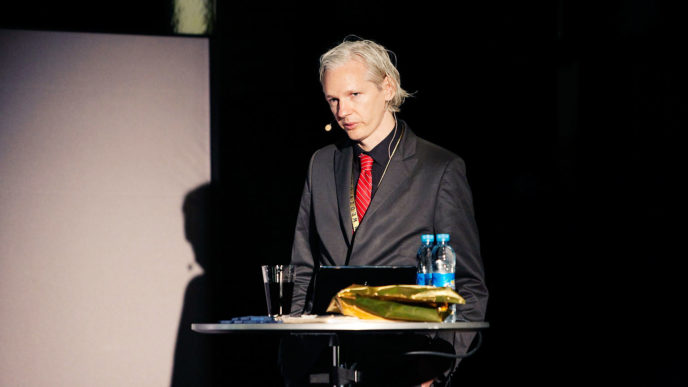
Wikileaks claims its founder, Julian Assange, has lost Internet service thanks to “a state party.”

No updates had been provided by the controversial group’s Twitter account at the time of this writing, and Russia-owned publication RT noted that Wikileaks’ claim is “unverified.” Wikileaks has been releasing e-mails damaging to Democratic presidential candidate Hillary Clinton for months, though the releases have been increasing in recent weeks. The latest e-mails show, among many other things, that Clinton’s senior advisers wanted to undermine and subvert the U.S. Catholic Church, that Clinton thought Wall Street received too much blame after the 2008 financial crash and that the Democratic nominee holds different positions privately than those she claims to voters.

Clinton’s campaign has also been show colluding with various high-ranking public officials at the U.S. Department of Justice and the U.S. State Department in regards to her own email scandal.

A release by Wikileaks over the summer led to the resignation of former Democratic National Committee Chairwoman Debbie Wasserman-Schultz (D-FL), after it was shown that she had colluded with the Clinton campaign against the insurgent candidacy of Senator Bernie Sanders (I-VT). Wasserman-Schultz’s replacement, former CNN commentator Donna Brazile, was caught in a more recent release allegedly providing a question to Clinton in advance of a debate against Sanders. Brazile has denied the accusation.

Assange has been living at the Ecuadorian embassy for four years to avoid extradition on a rape charge in Sweden that he claims is false and is an effort by the U.S. to extradite him on charges related to his years of leaking government documents and emails.

Clinton surrogates have for the most part ignored the most recent e-mail controversy, claiming the leaks’ validity is questionable because Wikileaks may be working with the Russian government to interfere with the U.S. presidential election. (For more from the author of “Wikileaks’ Assange Loses Internet in Midst of Podesta Email Dump, Blames a ‘State Party'” please click HERE)

Follow Joe Miller on Twitter HERE and Facebook HERE.

Pray for Hillary Clinton. Not as the Likely Next President, but as a Person

Throughout the 2016 presidential election cycle, I’ve offered prayers for the nation, for the GOP, for the conservative movement, and other causes. I’ve added some prayers for Donald Trump, and asked God that Hillary Clinton, if elected, would govern differently than her record suggests she would.

But I’ve never offered a prayer for Clinton herself, for her soul. And I don’t think I’m alone.

Why Hillary?

First, we all need prayer. Remember such vivid dictums as “there but for the Grace of God go I,” and “all have fallen short of the Glory of God.” The Bible is full of them.

Second, Vox’s Emily Crockett was right when she said in an e-mailed comment to me that “Hillary was a victim of Bill’s affairs. He cheated on her. He humiliated her.”

I’ve never been married, and I was only 13 when Bill Clinton was impeached. It’s certainly possible that older conservatives are right that the Clintons’ marriage has been more about convenience than love.

But for a moment, I’m removing my political/conservative/reporter hat. Hillary Clinton had to stand by her husband on for a decade when he was hit with various accusations of infidelity as governor and president. Even if she married Bill for power, Hillary could not have been happy to be tied to the credible accusations against her husband. I cannot imagine it wasn’t shameful, embarrassing, etc.

On the flip side, let’s assume Clinton really is the power-hungry politician so many on the right, including myself, tend to think she is. Certainly, Wikileaks has confirmed that her political and policy principles are as up for grabs as her husband’s or Donald Trump’s marital vows. And she truly did enable Bill, attacking his accusers throughout the 1990s.

But that means she needs prayers even more. What sort of person would deal with the national embarrassment of her husband’s impeachment just to gain power? Who would be so cold-hearted so as to remove the modest protections of the Hyde Amendment in order to force taxpayers to fund more abortions? And, likewise, who would so willingly engage in a corrupt pay-for-play at her family’s foundation with dictatorships (such as Saudi Arabia) that kill over differences in religious beliefs?

And those are just her latest public policy sins.

Hillary is Not The Enemy

Hillary Clinton is not the enemy. Neither is Donald Trump or President Barack Obama. Their positions in U.S. politics say more about our national depravity than anything else — they are merely the logical conclusion of decades of abandonment of fiscal, moral and cultural principles by voters and others.

The enemy is whatever has brought us to this state of affairs — Satan, if you will. Hillary is a willing participant in his corruption of the world — we all have free will — and therefore she needs our prayers.

Over the last few years, I’ve seen a lot that has caused me to believe Hillary Clinton would do severe damage to this country. It’s not enough to convince me to vote for Trump, who was good friends with Bill and Hillary until he decided to switch parties and a host of his own political principles in order to make his own run for the White House.

But I noticed last week that I’ve almost stopped seeing Hillary as a person. As many on the Left see Trump, I’ve fallen into the trap of viewing the former First Lady and Secretary of State as the embodiment of the Democratic Party’s largely successful efforts to restructure the values and principles of our nation.

Hillary Clinton is a dishonest politician whose principles appear to be related to gaining power. Plain and simple. But she’s also a person. And it’s up to me to help her as best I can, if only for her soul — never mind the nation, and the hundreds of millions of lives a Hillary White House would affect.

Whether my prayers help her is up to God. But it’s the least I can do for her, and for myself. (For more from the author of “Pray for Hillary Clinton. Not as the Likely Next President, but as a Person” please click HERE)

Follow Joe Miller on Twitter HERE and Facebook HERE.

‘No Snitching’: What Happens When Communities Stop Trusting Police

Boston’s Roxbury neighborhood has long been a haven for gang violence and gun crimes. But the community’s response to a recent shooting calls attention to a two-word phrase that has compromised public safety and cost countless lives: Stop snitchin’.

On Saturday, a 2-year-old girl was shot in Roxbury, marking the fourth shooting in 10 days, according to the Boston Globe. Her father, a suspected gang member, is thought to have been the original target.

Speaking to the Globe, the Rev. Miriam E. Sedzro, who pastors a local Lutheran church, said that “[p]eople have to talk” to police, instead of letting “predators prey on a community.”

“This ‘no snitching’ makes no sense to me …,” Sedzro said. “The way you create a community is you work together. You watch out for each other. You don’t let the criminals intimidate you.”

The “stop snitchin’” code goes back decades in America, illuminating the chronic police-community divide and mistrust. In 2005, then-mayor Thomas Menino infamously started a P.R. war against the widely circulating “Stop Snitchin’” T-shirts in Boston, which he believed discouraged witnesses from reporting crimes by instilling fear. Before this, other high-crime east coast cities like Philadelphia and Baltimore had launched their own wars against so-called snitches.

Brenda Peoples, the grandmother of the 2-year-old Roxbury girl who was wounded over the weekend, told the Globe that Saturday’s shooting exposed her to the consequences of remaining silent:

“She wants her community to speak up for her granddaughter. Peoples abides by a motto she learned working for the [Massachusetts Bay Transportation Authority]: If you see something, say something. She believes this is the only way anyone will be caught, the only way to stop the violence.”

“I wish the young people, the youth around here, would take life a little more seriously,” Peoples said. “This retaliation thing … it’s back and forth, back and forth. She’s going to be 3 in January. She doesn’t have any sense of all this [violence] going down.”

This is the type of story that the mainstream media won’t cover because it shows how a widespread lack of trust in local law enforcement can actually lead to more crime. Today, people are told that “systematic racism” and “institutional bias” within law enforcement are the biggest threats facing minorities in inner-cities. Democratic presidential candidate Hillary Clinton and running mate Tim Kaine have used this argument to justify federal intervention in community affairs.

When enmity exists between police and citizens, communities suffer. Roxbury is just one example of this. When anti-cop hatred and mistrust bar police from doing their job, “predators” — be they gangs or the DOJ — will step in to claim that authority. (For more from the author of “‘No Snitching’: What Happens When Communities Stop Trusting Police” please click HERE)

Follow Joe Miller on Twitter HERE and Facebook HERE.

This Election Proves the American Church Is in Even Worse Shape Than You Think

There’s been a lot of justifiable hand-wringing regarding the Christian vote in this election cycle. Unfortunately, the reality is even worse than the perception.

That’s because data suggests that what’s driving many believers to vote isn’t their beliefs as much as it is their racial/ethnic identity — just like the electorate at large. In other words, voters coming from the institution charged with preserving America’s vitally important moral foundation — the church — collectively aren’t approaching the ballot box any differently than the secularly-minded.

That’s bad news if you’re trying to conserve a society based on God-given (not government granted) rights, but more on that later. First, let’s permit the troubling data to speak for itself.

Let’s begin with Catholic voters, which are a crucial voting bloc for both Republicans and Democrats. Since Roe v. Wade, only once has either side won the presidency without winning the Catholic vote. And that was in 2000 when George W. Bush won the Electoral College despite losing the popular vote, so that’s obviously an outlier.

How critical is this bloc of voters? Consider Obama won Catholics by three points in 2012, which mirrored almost precisely his national popular vote advantage (3.8 points).

While polls have shown Democrats with a decided edge among Catholics ever since the race was narrowed to Donald Trump and Hillary Clinton, Trump doesn’t have a Catholic problem as much as he has a minority problem. Trump has narrowly led among white Catholics since last summer. However, that’s not enough to overcome Clinton’s astounding three-to-one lead among Hispanic Catholics.

The same pattern exists among evangelical protestants, but it’s even more striking.

LifeWay Research just published a fascinating survey drawing distinctions between voters who simply identify as evangelicals, and those who actually have evangelical beliefs. Overall, the survey found among whites who hold evangelical beliefs Trump overwhelmingly leads, 65-10. Meanwhile, Clinton holds almost the exact same lead among non-whites with evangelical beliefs, 62-15.

For the sake of its survey, LifeWay defined evangelical beliefs as the following:

Trusting in Jesus Christ alone for salvation.

Believe they have a responsibility to share their faith in Christ with others.

Believe the Bible is the final authority in their lives.

What’s unsettling is how those who claim they “believe the Bible is the final authority in their lives” could have such starkly different voting patterns. Especially because the Bible makes it clear the Christian is to set aside their worldly identity (race, ethnicity, gender, family legacy, nation of origin, etc.) in order to find his/her identity in Christ first and foremost.

Sadly, just the opposite appears to be happening with many voters.

Whites with evangelical beliefs are voting for a Republican whose lack of character and tendency to bully/demean flies in the face of what the Bible requires of our leaders. On the other hand, non-whites with evangelical beliefs are voting for a Democrat who is a staunch advocate for infanticide and sexual immorality, which are clearly condemned by the Scriptures. Not to mention Clinton’s willingness to have government violate the First Amendment to punish those who believe in Biblical morality.

Here’s why this trend spells certain doom for American Exceptionalism if it continues.

John Adams once said our Constitution establishing self-government was “meant only for a moral and religious people.” Many of his fellow founding fathers echoed similar sentiments. It’s no coincidence that as the culture has become more decadent the government has gotten bigger. The less moral restraint we have, the more government is needed to suffer the consequences of our actions.

Furthermore, those who fundamentally just believe in big government will seek to further incentivize immorality in order to justify their calls for more government. Thus creating a self-fulfilling prophecy. Either way, morality and limited government are hand-in-hand. You cannot have one without the other.

This is why great spiritual awakenings came before liberty in our history, and then later revivals were required to secure that liberty for future generations once it was established. Spiritual revival leads to a morally-restrained people. A morally-restrained people require less government to restrain them.

But if we are now living in a time, as this data suggests, when even those who have inherited that spiritual legacy will instead see things as racially polarized and ethnically balkanized like the general population does, then the last line of defense to preserve our heritage has also been lost.

Many of us long for a day when it seems the majority of Americans once more believe in the right things regardless of our political differences. Those days will not return if believers, who are required to set their cultural biases aside to serve a greater cause, are unable to do so. For if someone is unable to set what divides us aside to serve God, they’ll never do it to serve their fellow man.

This puts us in existential danger. Without a moral and religious people, good luck preserving the notion of God-given rights that empowers individual freedom and limits government intrusion.

Is it any wonder we’re mired in a depressing presidential action between, as 19-year-old Janae Petijean told the Boston Globe, a man who “is everything wrong with America’s culture” and a woman who “is everything wrong with our government,” given everything wrong with the church? (For more from the author of “This Election Proves the American Church Is in Even Worse Shape Than You Think” please click HERE)

Follow Joe Miller on Twitter HERE and Facebook HERE.

In 3 Years, His Insurance Premiums Double as Options Decline Under Obamacare

For the past 15 years, Warren Jones has had the same health insurance plan with Blue Cross and Blue Shield of Kansas City.

But over the years, Jones, of Kansas City, Missouri, has watched the coverage offered in his policy “erode” over time.

First, the company got rid of the dental and vision coverage he had.

Then, Jones’ deductible increased—to $2,500—for his plan alone.

But perhaps the most significant change for Jones, a veterinarian, has been the rising cost of his monthly premiums.

In 2014, the year Obamacare took effect, Jones paid $318 in monthly premiums. In 2015, the price went up to $394 per month, then to $491 for 2016.

For 2017, Blue Cross and Blue Shield of Kansas estimates that Jones will pay $716 each month for his premiums—a 45.8 percent increase—according to a letter the insurer sent him.

“You can’t keep doing this because people’s wages don’t increase by that amount,” Jones told The Daily Signal. “Nobody’s wages are increasing, so it’s taking a bigger chunk of the budget.”

“That’s the scariest part,” he continued. “It takes a bigger chunk of the budget, and there’s no relief in sight.”

Like millions of other Americans nationwide, Jones, 55, doesn’t buy his insurance on Obamacare’s state and federal exchanges.

And even if he did, he wouldn’t qualify for the subsidies that lessened the cost of health insurance for 7.3 million Americans who received the tax credits last year, according to regulatory filings.

Instead, the veterinarian falls into an overlooked subset of consumers who pay full price for their health insurance in a time of skyrocketing premiums and deductibles.

They don’t qualify for the tax credits offered under the health care law, and they don’t receive their coverage from employers, since many are self-employed.

“I have seen so many people, self-employed people, many started their own little business and make whatever they do, they have a small business, and they buy their individual policy or buy for their family, and what are their options?” said Beverly Gossage, a broker who has worked in the Kansas City area for 14 years.

“Do they no longer be self-employed? Maneuver taxes to make less than the income threshold to get subsidies?” Gossage continued. “They don’t want to do that, but they’re being pushed to do that. I get this question every day—‘What am I supposed to do?’”

Gossage ran as a Republican for Kansas insurance commissioner in 2014.

Hooked

Over the past few months, insurers have been submitting rates to state regulators for the 2017 benefit year.

In most states, companies are requesting double-digit rate hikes for those selecting plans sold in the individual market both on and off the Obamacare exchanges.

Experts say insurers are playing catch-up after setting rates too low in the early years of the health care law and enrolling a sicker—and costlier—population than anticipated.

“A lot of insurers didn’t understand that the market was going to be skewed in terms of income and health status as severely as it was,” Ed Haislmaier, a senior research fellow in health policy studies at The Heritage Foundation, told The Daily Signal. “Generally, the pool was much worse than anybody expected because of things the administration did that made it worse.”

In response to questions about the growing cost of health insurance for consumers who buy plans sold in the individual market, the Obama administration has said that many Americans are shielded from premium hikes since they buy coverage on the exchanges and receive a subsidy from the government.

Many of the exchange enrollees who qualify for a subsidy may end up paying as little as $75 per month in premiums, Health and Human Services Secretary Sylvia Mathews Burwell said earlier this month.

But that’s not the case for people like Jones and the 10 million others paying full price for their coverage.

“The traditional individual market, which consisted largely of middle-class people who are self-employed, those people are hooked onto this,” Haislmaier said. “It’s kind of a situation where you have an anchor that’s too big, and it’s pulling the boat under.”

Jones is considering selecting a new health insurance plan altogether, but because Missouri hasn’t yet approved rates for 2017, he’s unsure if he’ll even be able to find a cheaper alternative.

“The big thing is the unknown still,” Jones said. “But we know we’re getting inundated with increases in premiums.”

The Missouri man said he is familiar with Blue Cross and Blue Shield of Kansas City, and switching to another carrier may leave him with even less coverage.

“You get a comfort level, and at least you know what you’re getting,” Jones said. “If I had to change insurance, you miss the changes that occur. You don’t know what you’re signing up for.”

‘50-50’

While Missouri residents like Jones are confronting a spike in rates, consumers across the state’s western border also are facing fewer insurers to choose from.

Among the insurers that will continue to sell coverage in Kansas, the number of plans they’re offering both on and off the Obamacare exchange is decreasing.

Many insurers, large and small, have decided to leave the exchanges after losing millions of dollars last year; they either withdrew from states altogether or decreased the number of policies offered.

According to an August study from the Kaiser Family Foundation, six in 10 counties may have a maximum of two insurers on the exchanges next year. Additionally, five states will have one insurer selling coverage on an exchange.

In Kansas, 17 carriers sold policies in the state before Obamacare’s implementation, Gossage said.

This year, the majority of consumers in Kansas will have only two insurers to choose from on the exchange, according to the Kansas Department of Insurance.

Those buying plans sold in the individual market off the exchange have five insurers, according to the state.

It’s a similar landscape in Missouri, where four insurance companies are selling coverage on the exchange, according to regulatory filings.

Off the exchange, consumers can choose from at least seven different companies.

Gossage said that over the last few years, she has seen insurers significantly lessen the number of policies they’re offering.

“What we did is we went from a very vibrant, competitive marketplace with extremely low rates and lots of different plans to pick from to over-overregulation with the type of plan you have and to mandates placed on insurance companies which led to high premiums and fewer carriers in the marketplace,” Gossage said.

While much of the focus has been on the declining number of choices for consumers selecting coverage on Obamacare’s exchanges, those with plans sold in the individual market off the exchanges are hurting, too.

Rochelle Bird, who is self-employed and lives in Overland Park, Kansas, has had a policy through Coventry, a subsidiary of Aetna, for two years.

In that time, her monthly premiums have risen from $335 to $487, and her deductible went from $1,200 to $6,200.

Late last month, Bird received a letter from Coventry notifying her that her policy will cease to exist at the end of the year.

“We may still offer coverage in your area, but most of the options available today will not be available for 2017,” the letter stated.

Bird said she wasn’t surprised to learn her policy was being canceled. Rather, she expected it.

“I know that this act has created chaos,” she said of Obamacare, formally the Affordable Care Act. “When I get a thing [in the mail] saying that my rate has changed, I know it’s 50-50 when I open it. It’s either a letter saying this is what you’re going to pay starting Jan. 1, or we’re no longer offering that plan anymore. It wasn’t a total shock to me.”

Bird said she has started researching other policies with different insurance companies, but because officials in Kansas only recently finalized rates, she hasn’t yet made a final decision on her coverage for next year.

She has, however, set expectations for the terms of her next plan.

“I am now faced with the fact that unless something changes, there will be one health care provider presumably with two different health plans that I will have a choice of [while] living in the state of Kansas,” Bird said. “That’s absurd. How is that helpful?”

“I’m expecting (a) I’ll pay more, (b) I’ll have less, and (c) I may or may not have the same doctors,” she said. “Those are always the moving parts.”

Backward

Bird herself didn’t purchase her plan on the Obamacare exchange, and she wouldn’t qualify for a subsidy if she did.

While going without insurance and paying the fine—$695 per adult or 2.5 percent of household income for 2016—isn’t an option for her, it is for other Kansas and Missouri residents.

Jessica Huayaban of Olathe, Kansas, and her husband, Joel, each purchased plans in the individual market off the exchange in 2014.

Jessica, 36, bought a plan through Humana, and her husband, 35, through Coventry.

The couple, who own a painting and remodeling company, previously were uninsured and saving money each month to pay for a costly knee surgery Joe needed.

Jessica and Joel had insurance before, but when the recession hit in 2009, coverage was too expensive so they decided to go without.

“It was way cheaper to cash pay,” she said of the years they needed medical services but didn’t have insurance.

In 2014, when Obamacare was implemented, the couple purchased their own coverage, but only because the law required it.

“I wasn’t getting [insurance] for even the coverage part,” Jessica told The Daily Signal. “I was getting it for the compliance.”

Over the past two years, the monthly premiums Jessica pays for her Humana plan have gone up minimally, but her plan has a high deductible.

Then, last month, the 36-year-old mother received a letter from her insurer notifying her they’re canceling her policy.

“This is just something that continues to happen, and I don’t have a choice in it,” Jessica said.

She said she isn’t sure whether she and her husband will purchase plans on Obamacare’s exchange when the open enrollment period opens in November.

And although she may qualify for a subsidy, the young mother fears she’ll be stuck with an expensive tax bill when she files with the IRS for 2017, since her income—she is self-employed—fluctuates drastically from month to month.

“All of it is so backward,” she said of the health insurance system. (For more from the author of “In 3 Years, His Insurance Premiums Double as Options Decline Under Obamacare” please click HERE)

Follow Joe Miller on Twitter HERE and Facebook HERE.

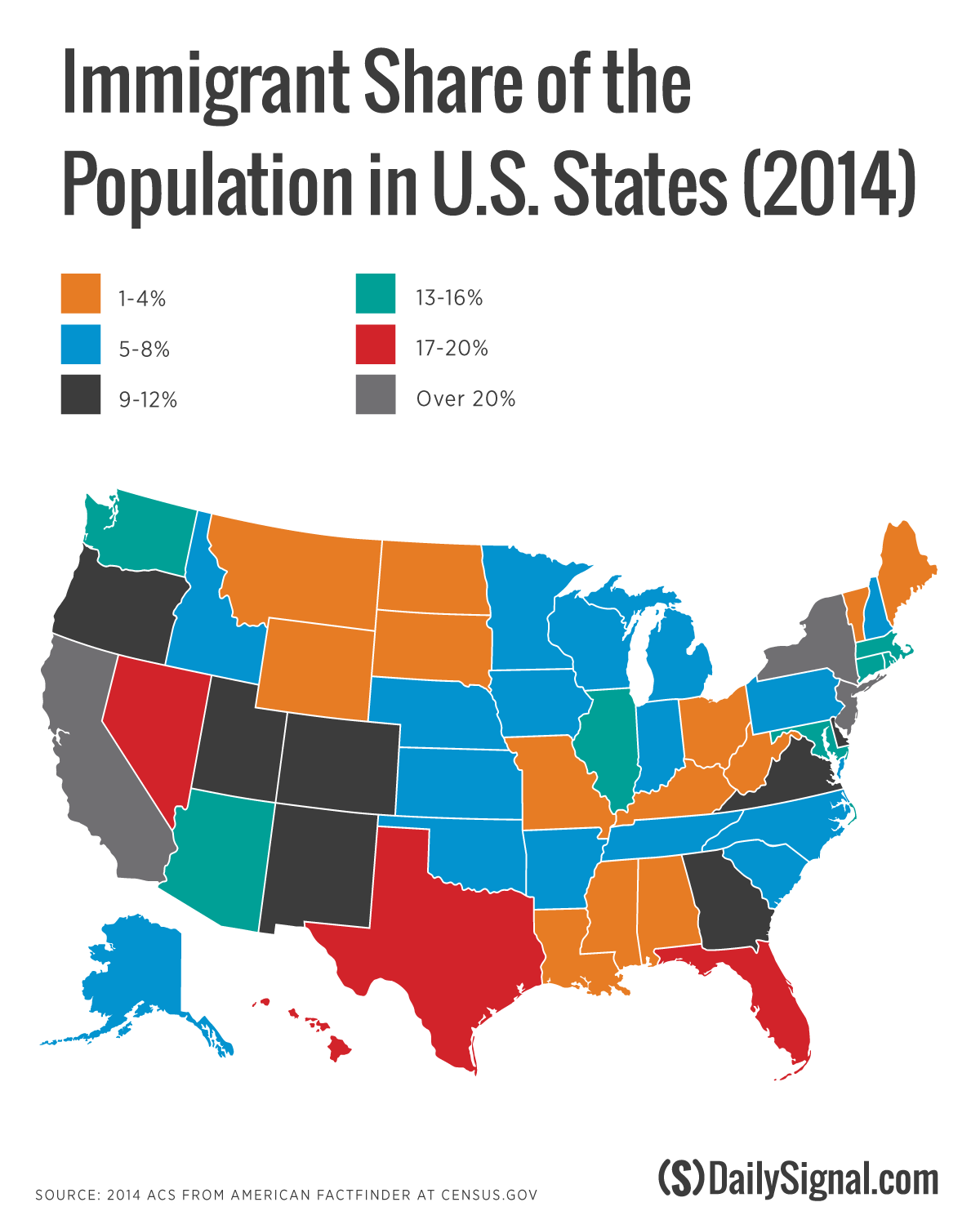
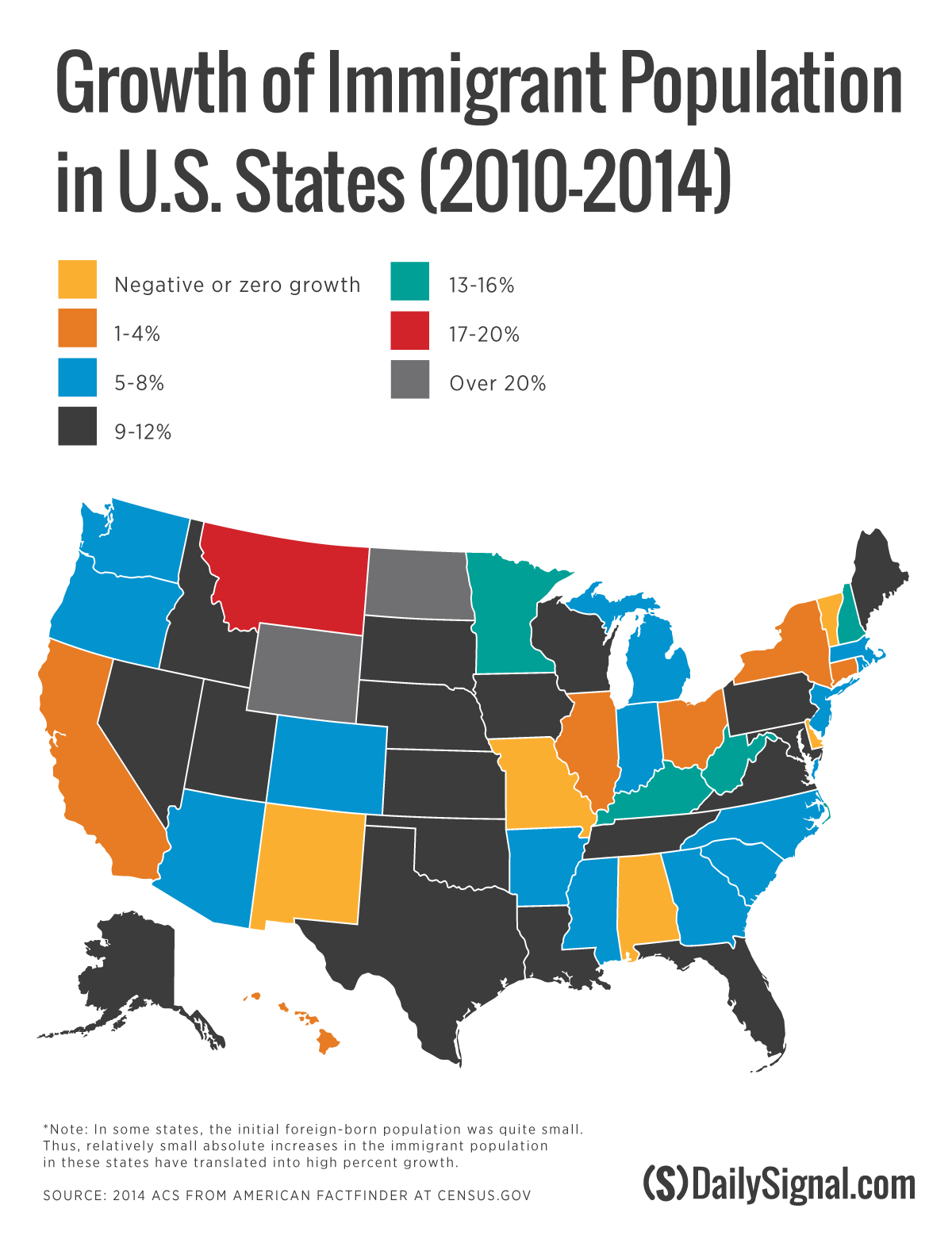
Find out What Immigration Growth Looks Like in Your State

There are more immigrants living in the United States than ever before. The foreign-born are more likely to come from China and India—often equipped with skills and a higher education—than Mexico.

Many of the immigrants who live here have called the U.S. home for a while—an average of nearly 21 years—and their economic and social progress improves over time.

Immigrants continue to flock to places where there are others like them. California has nearly one-fourth of the nation’s immigrants living there, while New York and Texas remain popular places for non-natives to call home.

But states outside of traditional immigrant settlements—like Georgia, North Carolina, Minnesota, Colorado, Washington, and Nevada—have also seen significant increases in their foreign-born populations.

161014_immigration_table-1_v2

This is the profile of the nearly 43 million immigrants residing in the U.S. today, as told from 2014 and 2015 Census Bureau data presented by the Center for Immigration Studies in a recent report.

The study, which includes figures for both legal and illegal immigrants, comes at a time when the question of what to do about immigration is a defining political issue. It’s a debate that promises to continue into a future where the foreign-born occupy a larger and larger percentage of many states’ populations, and the makeup of the nation’s immigrants is proving to reflect the rich-poor divide in America, from wealthy technology innovators, to poor agricultural workers.

“We are kind of heading into uncharted territory when it comes to immigration,” said Steven A. Camarota, the author of the report who is the director of research for the Center for Immigration Studies, which advocates for less immigration.

“From a policy perspective, I would expect efforts to further increase the level of immigrants to the U.S. of all kinds, including family-based and skill-based. I think you will see constituencies trying to satisfy sectors as varied as the hotel and restaurant industries, Silicon Valley, and ethnic advocacy groups that are more about family immigration,” Camarota told The Daily Signal in an interview.

161014_immigration_table-2_v2

The portrait of U.S. immigrants presented in the study will likely be interpreted depending on how an individual values immigration.

Just take education, a measurable where the picture of immigrants is nuanced.

In 2014, 30 percent of immigrants lacked a high school diploma or General Educational Development (GED) certificate, compared to 10 percent of their native-born counterparts.

Yet, that same year, 29 percent of the 36.7 million immigrants ages 25 and older had a bachelor’s degree or higher, compared to 30 percent of native-born adults.

Interestingly, the share of college-educated immigrants is higher—44 percent—among those who entered the country since 2010. That trend is not an accident, experts say.

India was the leading country of origin for new immigrants in 2014, with 147,500 arriving to the U.S. out of 1.3 million total foreign-born individuals who moved to America that year.

About 40 percent of Indian immigrants hold a graduate degree. Fewer than 12 percent of native-born Americans do.

China had the second-largest amount of new entrants to the U.S., with 131,800. And though Mexico ranked third on this list in 2014—130,000 came from there that year—the net number of Mexican immigrants living in the U.S. has not increased since 2010, and even illegal immigration by Mexicans has decreased drastically since the recession.

Illegal immigration is increasingly coming from Central America, where women and children fleeing violence and poverty in El Salvador, Guatemala, and Honduras seek asylum in the U.S.

“Since the recession, the number of Mexican immigrants coming to the U.S. has not grown—that’s an under-told story in the data here,” said Randy Capps, the director of research for U.S. programs at the Migration Policy Institute, which is nonpartisan.

“Contrast that with the rapid growth in the number of Chinese and Indian immigrants—which in total is still a quarter of the number of U.S. residents from Mexico. The numbers of Chinese and Indians are the biggest source of growth now and going forward. People who come from those two countries have increasingly strong economic ties to the U.S., have strong middle-class backgrounds with the ability to get more education as needed, and have more resources and relatives already in the U.S. That’s the future of immigration in America.”

Despite these positive trends, Camarota is quick to point to other indicators that he argues show costs to immigration.

Once they come here, immigrants are more likely to not have health insurance coverage than the native-born. In 2014, 27 percent of the foreign-born were uninsured, compared to 9 percent of natives.

Also that year, 27.1 percent of immigrants and their U.S.-born children under 18 were on Medicaid, compared to 17.9 percent of natives and their children.

More immigrants were in poverty in 2014 (18.5 percent of them), in contrast to 13.5 percent of natives.

While the foreign-born and natives make equal use of cash assistance programs, more immigrant households use food assistance programs.

Most concerning to Camarota, he says, is a downward trend in the number of native-born young adults without a college degree who are not working, a marker that he considers related to competition with immigrants for low-wage jobs.

In 2000, 66 percent of natives 18 to 29 years old with only a high school education were employed. That compares to 53 percent of such U.S.-born young people who were working in 2015.

“This is a point that we should be giving a lot of thought: the drastic deterioration in work among native-born young people,” Camarota said. “And if you don’t work when you are 18, the chance you will work at 27 is a whole lot less. This shows the argument that we have a shortage of workers and need to bring people to the U.S. to be nannies, maids, and busboys is absurd.”

Capps acknowledges Camarota’s concerns over less educated young people not working, but he argues there are many factors that contribute to that. He points to the data showing that gaps are closing between immigrants and natives in skills, education, and wages, and that the foreign-born improve on those indicators the longer they reside in the U.S.

All together, immigrants and natives have virtually identical rates of employment and labor force participation, according to the Center for Immigration Studies report.

“On the legal immigration side, it’s just the reality that we still have a very generous system, with 1 million coming to the U.S. every year,” Capps said. “It’s correct to note there are some costs to that. There are always costs associated to a group as big as 1 million people coming here, with job competition and public benefit use being some of them. But these are relatively small costs compared to the broader economic benefits of so many people immigrating here, many of them now coming with high skills.” (For more from the author of “Find out What Immigration Growth Looks Like in Your State” please click HERE)

Follow Joe Miller on Twitter HERE and Facebook HERE.

Christian Missionaries in Aleppo Crucified and Beheaded

“At several steps on their path to death by beheading and crucifixion last month, 11 indigenous Christian workers near Aleppo, Syria had the option to leave the area and live. The 12-year-old son of a ministry team leader also could have spared his life by denying Christ…” . . .

We’re not hearing much about Aleppo’s Christians: the mainstream media don’t care very much what happens to them:

..The Syrian ministry workers in those villages chose to stay in order to provide aid in the name of Christ to survivors.

“I asked them to leave, but I gave them the freedom to choose,” said the ministry director, his voice tremulous as he recalled their horrific deaths. “As their leader, I should have insisted that they leave.”

They stayed because they believed they were called to share Christ with those caught in the crossfire, he said.

(Read more from “Christian Missionaries in Aleppo Crucified and Beheaded” HERE)

Follow Joe Miller on Twitter HERE and Facebook HERE.
18 Reasons (So Far) Leaked Podesta Emails Reveal Dishonest Side of Clinton, Her Campaign and Media Collusion

Julian Assange, founder and owner of WikiLeaks, has released, so far, over 5,000 (of a promised 50,000) emails hacked from Hillary Clinton’s campaign manager John Podesta, who was also the former chief of staff to President Bill Clinton. Most are incoming emails to Podesta’s account, and contain everything from campaign planning emails to spammy emails from other political campaigns.

While Clinton has neither confirmed nor denied the authenticity of the hacked emails, during Sunday’s presidential debate she clarified some comments reportedly made by her in one of the emails. Podesta has said there could have been some changes made to the emails, but has not identified any.

The Clinton campaign and Podesta claim Russia is behind the emails being hacked from Hillary’s inner circle and the Democrat National Committee, but since Donald Trump has also talked tough in regards to U.S.-Russian relations, some are skeptical that Putin is behind the hacking. As for Assange’s motives, while he says he does not like either Clinton or Trump, he has said he is a big supporter of libertarian Republicans Ron Paul and his son Rand Paul, and believes the libertarian wing of the GOP is the “only hope” for real reform.

Early voting has already started in places around the country, but some of the emails are extremely damaging and may influence undecided voters. The following represent some of the worst emails in the first 5,000. Imagine ten times this many.

1. Clinton “Often” Says False Things

Brett Budowsky, a public affairs consultant with an extensive background in top levels of government, sent an email to Podesta expressing his concern over Clinton telling lies about Bernie Sanders. “Hillary should stop attacking Bernie, especially when she says things that are untrue, which candidly she often does. I am one of the people with credibility to suggest Bernie people support her in November, and she and Benenson and others have no idea of the damage she does to herself with these attacks, which she does not gain by making.”

He went on just as candidly, “Right now I am petrified that Hillary is almost totally dependent on Republicans nominating Trump. … she has huge endemic political weaknesses that she would be wise to rectify… even a clown like Ted Cruz would be an even money bet to beat and this scares the hell of out me. …”

2. Clinton Hates “Everyday Americans”

In an email dated April 19, 2015, Podesta wrote to Clinton’s Director of Communications, Jennifer Palmieri, “I know she has begun to hate everyday Americans, but I think we should use it once the first time she says I’m running for president because you and everyday Americans need a champion.” He convinces Palmieri to use the phrase “everyday Americans” in a speech Clinton is about to give in Iowa.

3. Clinton Foundation COO Almost Driven to Suicide Dealing With Bill, Chelsea Clinton

Doug Band, a former aide to the Clintons, emailed Podesta in 2011 expressing his alarm that the COO of the Clinton Foundation was about to commit suicide, in part due to Bill Clinton and Chelsea: “She called me to tell me the stress of all of this office crap with wjc and cvc as well as that of her family had driven her to the edge and she couldn’t take it anymore. I spent a while on the phone with her preventing her from doing that, as I have a few times in the past few months, and was able to reach roger and her shrink.”

Band also wrote about Chelsea, “She is acting like a spoiled brat kid who has nothing else to do but create issues to justify what she’s doing because she, as she has said, hasn’t found her way and has a lack of focus in her life. I realize she will be off of this soon but if it doesn’t come soon enough. …”

4. Collusion With ABC’s George Stephanopolous to Ambush ‘Clinton Cash’ Author Peter Schweizer

Clinton staffers congratulated themselves over helping ABC’s George Stephanopolous, a longtime Clinton crony, prepare in advance so he could ambush “Clinton Cash” author Peter Schweizer during a TV interview. Jesse Ferguson wrote, “Great work everyone. this interview is perfect. he lands nothing and everything is refuted (mostly based on our work).” Three other staffers gloated about how enjoyable it was to watch.

5. New York Times Reporter Patrick Healy Runs His Thoughts on His Next Clinton/Trump Article Past Clinton Team First

In an email entitled “Hi Angel and Tina — running stuff by you re Clinton/Trump,” New York Times reporter Patrick Healy suggests some ideas for an election-related article to Angel Urena and Tina Flournoy, two Clinton campaign staffers. He provides the two with a lot of helpful information he’s heard from the Clinton campaign, including what Bill Clinton recommends. “President Clinton, like others, thinks that Trump has his finger on the pulse of the electorate’s mood and that only a well-financed, concerted campaign portrayed him as dangerous and bigoted will win what both Clintons believe will be a close November election.”

6. Anti-Catholicism

John Halpin at the Center for American Progress sent an email to Podesta and Clinton Communications Director Jennifer Palmieri, expressing his bewilderment how Catholics could be conservative, “It’s an amazing bastardization of the faith.” Palmieri agreed in response. “I imagine they think it is the most socially acceptable politically conservative religion. Their rich friends wouldn’t understand if they became evangelicals.” Halperin wrote back, “Excellent point. They can throw around ‘Thomistic’ thought and ‘subsidiarity’ and sound sophisticated because no one knows what the hell they’re talking about.”

7 Bill Clinton: Someone Making $110,000 Annually Would Struggle Financially

Staffer Josh Schwerin emailed his concern about a statement Bill Clinton made in New Hampshire, “WJC just told an anecdote about somebody making $110k per year with student loans as an example of someone who would struggle. Could see that being used to say he’s out of touch.” Staffer Tina Flournoy helpfully agreed, “Or it’s so bad that even if you make $110k you struggle. – imagine how it is for those making less.”

8. The AP is “Helpful”

Neera Tanden of the Center for American Progress triumphantly emailed Podesta and Palmieri last summer, “Tide does seem to be shifting a bit on this, great work by the press shop. Cummings is helpful as is AP.” (“Cummings” may be a reference to Elijah Cummings, a member of the House Oversight Committee who has treated Clinton favorably.)

9. Saudi Arabia Providing Aid to ISIS

Podesta engaged in an email exchange over the Middle East with Clinton. Clinton emailed him a 9-point plan, which appears to have been written by her, although this not clear. It acknowledges the suspicion that Saudi Arabia is propping up ISIS: “While this military/para-military operation is moving forward, we need to use our diplomatic and more traditional intelligence assets to bring pressure on the governments of Qatar and Saudi Arabia, which are providing clandestine financial and logistic support to ISIL and other radical Sunni groups in the region.”

10. Clinton’s Affiliated SuperPAC ‘Correct the Record’ Placed 132 Op-Eds, Killed Negative Stories

According to an email from Mary Pat Bonner to Podesta, the Clinton affiliated SuperPAC “Correct The Record” has placed 132 op-eds nationally and in strategic local markets. Since May 15, CTR has helped write and place 36 op-eds across the country in a number of publications including Politico, Times Union, Huffington Post, CNN, Washington Blade, and New Jersey’s Bergen Record.” Additionally, “Correct The Record staff members have conducted over 900 on-the-record and off-the-record media interviews” and “kill negative stories before they are even published.”

11. Clinton Campaign Aware Obama Campaign Committed Massive Voter Fraud in 2008

On May 14, 2015, Podesta sent an email indicating he was aware of voter fraud by the Obama campaign in Colorado during the 2008 presidential election, and was concerned the Sanders campaign might engage in it.

High importance. I met with Jim and Mike in Denver. They are both old friends of the Clintons and have lots of experience. Mike hosted our Boulder Road Show event. They are reliving the 08 caucuses where they believe the Obama forces flooded the caucuses with ineligible voters. They want to organize lawyers for caucus protection, election protection and to raise hard $. They are not just Colorado focused and have good contacts in the region.

12. Clinton’s Wall Street Speeches

Clinton has refused to release her private, paid speeches to Wall Street, but excerpts from some of them are in the leaked emails. In one, she discusses the necessity of having “both a public and a private position” on controversial political issues. She admits that her wealth leaves her “kind of far removed” from the middle class. In fact, she complains about how tough it is being wealthy in politics, “There is such a bias against people who have led successful and/or complicated lives.”

Clinton prefers to have Wall Street write its own financial regulations, “The people that know the industry better than anybody are the people who work in the industry.” In a speech to a Brazilian bank, she expressed her desire for open borders: “My dream is a hemispheric common market, with open borders, sometime in the future.”

13. CNBC’s John Harwood, a Republican Presidential Debate Moderator, Congratulated Podesta on Clinton Campaign Success

After Clinton won all five state primaries on March 15 last year — Florida, Ohio, Missouri, Illinois, and North Carolina — CNBC’s John Harwood, who moderated one of the Republican presidential debates, emailed Podesta: “Congrats – pretty strong.” Podesta chummily replied, “Yup. Feeling good.”

14. Staffers Brazenly Refer to the Democratic Base as “The Red Army”

While discussing support for a $15/minimum wage, Jake Sullivan writes, “John Podesta (and the Red Army) want to support $15!” Neera Tanden, with the left-wing public policy organization Center for American Progress, writes back to clarify that he’s essentially calling hardcore Democrats as communists, “And when you say Red Army, you mean the base of the Democratic party, right?”

15. Carelessly Discussing Sanctions Against Iran Over Unsecured Email

Sullivan sent an email on March 3, 2015 to Podesta, Huma Abedin and others, responding to a speech that Stuart Eizenstat, a former American diplomat, had sent him that he’d given to AIPAC, “Thanks Stu,” Sullivan wrote. “What would those sanctions look like? If Iran actually tried to break out at the end of the period, ostensibly we’d be talking about military action?” Stu helpfully responded, ” We need to keep the military option on the table, but it would be the additional sanctions in the new congressional bill, which would give the future President the right to impose them upon a finding of a violation. But it would als [sic] include current sanctions–SWIFT, CBI, etc.”

16. Racism

Someone with the email address [email protected] sent an email entitled “What’s the difference between a German and a shopping cart? A shopping cart has got a mind of its own,” to Podesta, a fellow professor of Podesta’s at Georgetown University named Charles Abernathy, several staffers at Politico and Huffington Post, and a staffer at Media Matters. The email contains statements like this:

The main reason behind successful immigration should be painfully obvious to even the most dimwitted of observers: Some groups of people are almost always highly successful given only half a chance (Jews*, Hindus/Sikhs and Chinese people, for example), while others (Muslims, blacks** and Roma***, for instance) fare badly almost irrespective of circumstances. The biggest group of humanity can be found somewhere between those two extremes — the perennial overachievers and the professional never-do-wells.

17. Wall Street Banker Included in Top Staffer Email Discussions

As I’ve written previously, it’s no secret that Clinton is the Wall Street candidate for president. Former Deputy Secretary of State Tom Nides, who is now vice-chairman at Wall Street bank Morgan Stanley, is included in several emails between Clinton’s top staffers, including at least one with his work email account. He responds to a few of them. Good thing the bank doesn’t care about his extracurricular political work!

18. Plot to Smear Bernie Sanders and His Supporters as Sexist

Clinton staffer Mandy Grunwald provided some helpful points last year on how to portray Bernie Sanders as sexist. “Bernie Sanders says he supports women’s rights, but has a pattern of expressing and tolerating extreme views on women.” She also lays out how his supporters allegedly harass women with profanity on the internet (too offensive to repeat here). (For more from the author of “18 Reasons (So Far) Leaked Podesta Emails Reveal Dishonest Side of Clinton, Her Campaign and Media Collusion” please click HERE)

Follow Joe Miller on Twitter HERE and Facebook HERE.