5 Reasons Why Planned Parenthood Must Stop Receiving Our Tax Dollars

Planned Parenthood makes many lofty claims about its “services” critical to women’s health. But just digging a little deeper into its actual practices and history reveals something much less positive — and a lot more sinister.

As a pro-life blogger and speaker, who escaped abortion myself in Communist China, and chose life for my “imperfect” child, I feel called to expose abortion lies wherever I see them. This weekend, tens of thousands of people will protest Planned Parenthood nationwide; it’s a critical moment to raise awareness of the abortion giant and its misdeeds.

More than any organization in America, Planned Parenthood is responsible for perpetrating lies about abortion — and lies about its own “women’s health” services. There’s no doubt, the public relations strategy of the abortion giant is built on deception.

If the American public really knew the truth about Planned Parenthood, I truly believe most Americans would immediately stop supporting and defending it. That’s why my latest video gives five reasons why Planned Parenthood must stop receiving our tax funding — the entire $553 million dollars they currently receive annually.

In fact, Congress will soon begin debate over a budget reconciliation bill on this issue. We can expect mainstream media to go crazy over this bill, claiming it will harm women’s health. But the truth is, all it will do is halt abortion providers from receiving about 75 percent of their current taxpayer funding for one year. (Read more from “5 Reasons Why Planned Parenthood Must Stop Receiving Our Tax Dollars” HERE)

Follow Joe Miller on Twitter HERE and Facebook HERE.

Could Moderate Nationalism Save Us From Post-Christian “Americanism”?

As the president’s chief strategist Steve Bannon insists, the election of Donald Trump was a victory for “nationalism.” On that observers agree. But that’s where consensus ends. What exactly does that term mean? Is it something that should frighten us? Fill us with hope? Leave us ambivalent, neutral, or watchful? The answer to that crucial question depends both on what we mean by nationalism, and how its resurgence affects both domestic and foreign policy.

Thoughtful commentators on the right have been weighing in on this subject, especially lately. I’ll offer a round-up of their views in a moment. But first I would like to reiterate a distinction I offered here months ago, before it seemed even likely that Donald Trump would win the election. As I wrote then, there are two lodestars of loyalty among American conservatives, which can complement each other but also compete:

The Golden Egg: moral, civic and economic principles that could, in theory, be applied to any country on earth, and to any group of immigrants we admitted to America, however large. These principles are simply true for every human being, and we must insist on that fact. Instead of the left’s relativism and politics of group resentment, these principles offer conservatives an inclusive, persuasive program which should appeal to any voter of good will. You can find an excellent summary of America’s guiding principles right here at The Stream. Key among them are truths such as “Every human being has equal value and dignity,” and “Judeo-Christian religious faith guards our freedom.” If pursued consistently, these principles should always produce a more peaceful, prosperous, free country than would otherwise be possible.

And:

The Goose: real, existing, historically-founded facts that explain why these principles have worked here in America, while failing spectacularly when tried elsewhere — for instance in the Latin American republics that declared independence shortly after the 13 colonies did, wrote similar declarations and comparable constitutions, and degenerated into a 200-year cycle of dictatorships and chaos. The most important of these facts was the dominance of a tolerant, Anglo-Protestant culture grounded in some 800 years of English resistance to oppressive governments. Change this fact too radically or too quickly, and the principles we treasure will wither and die.

America as a Mere Abstraction

Back in 2003, when “Golden Egg” enthusiasts had almost completely captured the thinktanks, magazines, and other institutions of conservatism, I wrote a long “think piece” warning against the dangers of unmoored ideology that neglected the “Golden Goose,” called “America the Abstraction.” Jim Antle saw fit to reach back some 14 years and cite that piece yesterday in The Washington Examiner. (Antle’s piece is itself an excellent starting point for understanding today’s debate—I encourage all to read it.) As I wrote then:

If you are trying to boil down citizenship to its philosophically respectable components, and if ideology is all you are interested in, then it does not really matter where you were born. Or who your parents were. Or whom you love. Or the hymns you know by heart, the folk tales you treasure, the God you worship. None of these merely human matters measures up, ideologically speaking. None of them can be enshrined in a manifesto, or beamed across the world via Voice of America, or exported in music videos. They do not raise the GDP, or lower the interest rate, or increase our command of oil reserves. They cannot be harnessed to drive the engine of globalization. Therefore, to some people, these things do not matter. Such pieties can be harnessed in the run-up to a war, can form part of the Army recruitment ads and propaganda campaigns, and may even find their way into presidential speeches. But essentially there is no difference between a fourth-generation American and an Afghan refugee who just landed at JFK—so long as they both accept the same ideology.

How did we get to this pass? How did conservatism, which once centered on the fierce defense of tradition, religion, and particularism, turn into an ideology — that is, a philosophy in arms, a political system shorn of its ties to real people and places, slimmed down by dropping historical baggage, packaged for export on the global market of ideas? The simple answer is the Cold War. …

The post-war conservative movement labored mightily to craft … a version of Americanism that could be promoted internationally, which Europeans and Asians, Latins and Africans alike could adopt as an alternative to Marxism. …

Increasingly, America was defined according to the most expansive, abstract reading of the Declaration of Independence, combined with a version of market economics well-suited to the unrestricted “pursuit of happiness.” Anything that did not fit that formula tended to fall down the memory hole: the Anglo-Celtic roots of the Founding, the specifically Christian (mostly Protestant) identity of America, the very existence of the Confederacy, and the profoundly Western roots of our culture. …

To conservatives schooled in this mode of argument, restrictions on immigration are simply insane; anyone, anywhere who will sign on to the Declaration of Independence is already an American. Keeping him out makes no more sense than building a Berlin Wall to divide Manhattan’s East Side from its West. Embittered blacks, or religious conservatives, or leftists who do not accept the Cold War ideology of America are not real Americans. An ideological litmus test becomes the standard of citizenship. American foreign policy must cease to pursue the concrete interests of a concrete, national community and become the tool by which an abstract creed is imposed across the world — hindered only by the resistance of the benighted and bigoted, who are fated to end on the ash-heap of history.

A compatible view of these crucial issues comes from Rich Lowry and Ramesh Ponnuru of National Review, who write:

The outlines of a benign nationalism are not hard to discern. It includes loyalty to one’s country: a sense of belonging, allegiance, and gratitude to it. And this sense attaches to the country’s people and culture, not just to its political institutions and laws. Such nationalism includes solidarity with one’s countrymen, whose welfare comes before, albeit not to the complete exclusion of, that of foreigners. When this nationalism finds political expression, it supports a federal government that is jealous of its sovereignty, forthright and unapologetic about advancing its people’s interests, and mindful of the need for national cohesion.

Nationalism Can Be Dangerous

Jonah Goldberg, in the same magazine, respectfully differs, declaring his preference for the Golden Egg:

Our shrines are to patriots who upheld very specific American ideals. Our statues of soldiers commemorate heroes who died for something very different from what other warriors have fought and died for for millennia. Every one of them — immigrants included — took an oath to defend not just some soil but our Constitution and by extension the ideals of the Founding. Walk around any European hamlet or capital and you will find statues of men who fell in battle to protect their tribe from another tribe. That doesn’t necessarily diminish the nobility of their deaths or the glory of their valor, but it is quite simply a very different thing they were fighting for. …

[N]ationalism is healthy in small doses, but we must remember that all poisons are determined by the dose. Because nationalism is ultimately the fire of tribalism, having too much of it tends to melt away important distinctions, from the rule of law to the right to dissent to the sovereignty of the individual. This is why every example of unfettered nationalism run amok ends up looking very much like socialism run amok (and vice versa). The passionate populist desire for unity above all recognizes no abstract barriers to the general will.

Ben Shapiro warns, also at National Review:

Trump’s definition of nationalism is not the conservative definition of nationalism. Conservatives love America because we believe it is a nation founded on an idea. Our interests ought to prevail because our principles ought to prevail: limited government, individual liberty, God-given natural rights, localism in politics, religious freedom, freedom of speech and of the press, and so forth. If America ceased to believe those things or stand for them, we would not deserve to win. “Make America Great Again” would then ring hollow with the same blood-and-soil nationalistic violence of the Old World. If greatness is measured in utilitarian terms rather than ideological ones, nationalism is merely tribalism broadened, a way of valuing the collective over the individual.

America’s Founding Principles, De-Christianized, Can Be Poisonous

Of course, the critics of nationalism are right, up to a point. They correctly warn that an unreflective attachment to hearth and home, totem and tribe can quickly get out of control and erupt in the kind of ugliness we see around the world, which took its most infamous form in Hitler’s Germany.

But that’s not the only kind of danger. Countries bound together only by an abstract ideology can be very dangerous too — as we see not just from the Soviet Union and revolutionary France, but more recently in the empire created by ISIS, and the relentless drive for power of the Muslim Brotherhood.

Goldberg and Shapiro recognize this of course. They read their history, and know that ideologies can be dangerous. They just don’t seem to think that America’s can be. They don’t seem to see that American principles, while truer than most, can also be abused and applied to evil ends.

But isn’t that exactly what happened when our judicial elites declared that our Constitution enshrined the right to abortion? That central to our right of liberty is the right to make up the meaning of the universe exactly as we wish to? (See Casey v. Planned Parenthood.) That same-sex couples have the right to legally recognized marriage because of their human “dignity”?

You and I might rightly say that these are false inferences from our principles, but they are currently the official governing philosophy of the United States legal system. Stripped by judicial intellectuals of their tolerant, Protestant Christian context (the “originalist” reading of the Constitution that Justice Scalia insisted on), our founding principles can prove very dangerous indeed; they were fatal to almost 60 million unborn American children.

Our Founders were fallen men, and their ideas were not divinely revealed from heaven. The profound truths that did emerge in America’s founding were not some brilliant ideas that Enlightenment thinkers came up with and scribbled down. Instead, they emerged over centuries in a very specific context: the Christian soil of England, with its Saxon resistance to political authority and Protestant obsession with spiritual independence. That was the soil the Pilgrims and other English settlers carried over with them on their ships. Scrape it away, replace it with alien sand or secular gravel, and Liberty’s tree might wither. Or to go back to my first metaphor, the Goose might keel over and die. (For more from the author of “Could Moderate Nationalism Save Us From Post-Christian “Americanism”?” please click HERE)

Follow Joe Miller on Twitter HERE and Facebook HERE.

Victory for Christians: Georgia State Employee Fired for Weekend Sermons Prevails

Dr. Eric Walsh’s lawsuit against the State of Georgia came to an end when the state agreed to pay the Seventh-Day Adventist and former state employee $225,000. First Liberty Institute, the non-profit law firm representing Walsh, announced the victory Thursday.

The settlement comes after a nearly three-year legal battle in which Walsh, a lay-minister for his church, accused Georgia of religious discrimination.

Accusations of Religious Discrimination

Walsh, a member of former President Barack Obama’s Presidential Advisory Council on HIV/AIDS and holder of multiple advanced degrees, was hired as a district health director with Georgia’s Department of Public Health in 2014. But officials abruptly fired him after reviewing YouTube videos of sermons he had preached on the weekends.

First Liberty Institute, a national non-profit law firm based in Texas, helped Walsh file a complaint with the Equal Employment Opportunity (EEOC). As The Stream reported last April, Title VII of the 1964 Civil Rights Act prohibits the discrimination of employers based on their religion.

“No one should be fired from their job for something they said in a sermon, First Liberty Senior Counsel Jeremy Dys told The Stream at the time. “It will be fair game to examine the notes you took in church or the Sunday School lesson you prepared during your annual review.”

Six months later, after receiving the EEOC’s go-ahead, Walsh sued the state of Georgia in April of 2016. Georgia responded in September by demanding that Walsh produce “sermon notes and/or transcripts” and “all documents relating to your service as a pastor.”

Dys responded that the demand was intrusive, calling it “an excessive display of the government overreaching its authority and violating the sanctity of the church.”

Victory for Religious Liberty

First Liberty called the settlement a victory for religious freedom. “We are grateful that the State of Georgia agreed to settle the case and acknowledge the right of their employees to express their religious beliefs,” Dys said in a press release.

Dys pointed out that the law was on Walsh’s side. “No one should be fired for simply expressing his religious beliefs,” he said. He called Walsh “a man of courage and conviction who suffered a serious injustice.”

“It’s been a long, difficult journey,” Walsh commented, “but it’s worth it to have my name cleared and to ensure that all Georgia government employees know they have religious liberty.”

Walsh has been working as a medical missionary and as a medical doctor in California since being fired. Now that the lawsuit has ended, Walsh hopes he can continue to care for his community, First Liberty’s Director of Legal Communications Kassie Dulin told The Stream. (For more from the author of “Victory for Christians: Georgia State Employee Fired for Weekend Sermons Prevails” please click HERE)

Follow Joe Miller on Twitter HERE and Facebook HERE.

Education Secretary Betsy DeVos Physically Blocked by Protesters From Entering D.C. School

Education Secretary Betsy DeVos was physically blocked by protesters from entering Jefferson Academy in SW, D.C. Friday morning. This was her first visit to a public school.

The protesters created a barrier to the entrance of the school, and began shouting.

DeVos turned away and walked toward her vehicle while protesters continued to yell, one screaming, “She doesn’t represent anything that they stand for.” Followed by chants, of “shame, shame, shame.” . . .

The Washington Teacher’s Union organized a gathering outside of the school, but were not among the protesters who blocked her. They arrived earlier in the day and greeted DeVos in peace, but with a strong message.

The union, who said they did not support DeVos’ nomination, stated they hoped she would be successful. They said if DeVos succeeds in her new role then everyone succeeds – including all public schools and teachers. (Read more from “Education Secretary Betsy DeVos Physically Blocked by Protesters From Entering D.C. School” HERE)

Follow Joe Miller on Twitter HERE and Facebook HERE.

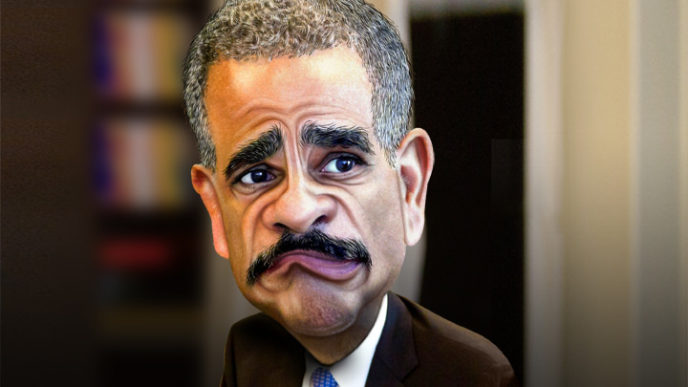
California to Pay Eric Holder’s Law Firm $25,000 a Month for Anti-Trump ‘Legal Strategies’

Former Obama Attorney General Eric Holder’s law firm, Covington and Burling, will receive $25,000 a month from the California Legislature.

The fee is in exchange for 40 hours of work each month on providing “legal strategies regarding potential actions of the federal government that may be of concern to the State of California,” according to documents obtained by Judicial Watch.

In response to the documents, Judicial Watch president Tom Fitton said that California legislators are “wasting tax dollars to bankroll another corrupt politician – Eric Holder – under the pretense of attacking the Trump administration.” . . .

Even before Donald Trump was sworn in as president, California State Senators de León (D-Los Angeles) and Rendon (D-Paramount) announced in a joint statement that “…to protect California’s economy and our sensible policies on climate change, health care, civil rights, and immigration,” the Legislature has hired “an expert legal team…led by former United States Attorney General Eric H. Holder Jr.”

The contract with Covington and Burling, which Holder felt “honored” to receive, is limited to the firm providing “legal strategies.” Should the California Legislature wish to use the firm for litigation or public advocacy work, a new “engagement letter” would be required. (Read more from “California to Pay Eric Holder’s Law Firm $25,000 a Month for Anti-Trump ‘Legal Strategies'” HERE)

Follow Joe Miller on Twitter HERE and Facebook HERE.

Alaska Continues to Push LGBT Agenda in Schools

The State of Alaska is continuing its efforts to push educators in encouraging children to experiment with alternative genders including transitioning away from their biological sex.

Late last year the Alaska Department of Education and Early Development partnered with the Department of Health and Social Services to sponsor a conference that included instructing educators on how to assist students — elementary age and older — who wish to transition away from their biological sex and identify otherwise. The conference also urged teachers to keep this information from parents who may take issue with the school enabling their child’s gender experimentation.

In preparation for an upcoming conference this spring on preventing sexually transmitted diseases, the state is continuing its promotion of gender theory in issuing a call last month for presentations on topics such as “Sexual health promotion for LGBTQ individuals” and “LGBTQ inclusivity in the health care setting.”

A Jan. 5 email from Jenny Baker, Adolescent Health Project Coordinator for Alaska’s Division of Public Health, called for abstracts for the upcoming May 8-10 conference in Anchorage.

The conference website states that it will “Bring together public health and health care professionals and providers in the behavioral, medical, social services and education fields” to share the “newest information available on HIV/AIDS, Viral Hepatitis, STDs and related health issues.”

Baker was a featured speaker at the most recent Alaska School Health & Wellness Institute this past October, where she guided teachers and school nurses through ways to advance what she said many might consider to be “controversial” sex education in their school districts.

She told attendees that sexually transmitted infections are on the rise among Alaska’s youth but pregnancies are dropping. She credited the increased use of “birth control, like pills, IUD shot, patch, ring” as a possible reason for the decline in teen pregnancies. Abortion also plays a role, she said, while noting that more measures need to be taken.

During the same workshop Baker acknowledged that “talking about sex education and talking about sex in general is controversial” and that some parents and school boards don’t support it. Nonetheless, she encouraged Alaska educators to push for “comprehensive” sex education that includes explicit instruction on the proper use of a condom, how to procure and utilize a wide range of contraceptives and how to understand and accept gender roles, gender identity and sexual orientation, among other topics. (For more from the author of “Alaska Continues to Push LGBT Agenda in Schools” please click HERE)

Follow Joe Miller on Twitter HERE and Facebook HERE.

The Data Suggests Unisex Bathrooms Are a Bonanza to Male Perverts

One year ago in February 2015, the Vancouver Province ran a story on the rise of voyeurism in British Columbia, my home province, with the headline “How can we get men to stop doing this?” The sober reality is that the crime of voyeurism, almost always by males, may be virtually impossible to stop. Voyeurism is an enormous monster that lives in the shadows of our culture, hidden to many, but continually nourished by advancing technology, pervasive pornography, and increasing opportunity.

Voyeurism has been seen as a minor crime historically, but recording technology and victim statements are beginning to change that. One of the voyeurism cases the Province article cited was that of Jonathan Stringer, who hid a video camera in a unisex public washroom in Whistler, BC. One of his victims shared the effect it has had on her: “I have post-traumatic stress disorder from it. I was off work for a couple months, I was having problems sleeping and having weird dreams about being watched. It definitely affected me and made me fear for my safety.” More and more, voyeurism is starting to be recognized for what it is: sexual assault against women.

Advancing technology is also changing how seriously we perceive this crime. Not only is miniaturization making it easier for men to record women, but the fact that pictures and video can be stored, shared, and viewed over and over again, has significantly changed the nature of the crime from the traditional “peeping tom.”

Inherent in the question “How can we get men to stop doing this?” is the question of prevalence. Is voyeurism widespread, or limited to a few scattered predators? A look at the literature and studies on voyeurism reveals surprisingly little. In a day and age where every topic has seemingly been studied in minute detail, there is a glaring paucity of good information on the subject.

But the data that does exist is eye-opening. Templeman (1991) found that no less than 42 percent of college men in a rural sample reported that they had engaged in voyeurism. Bradford et al. (1992) reported that “of 443 adult males studied, 115 admitted to voyeurism” (cited from Krueger, 2016). Rye & Meaney (2007) found that 61 percent of the men in their university sample would engage in voyeurism if the likelihood of getting caught was 25 percent (cited from Krueger, 2016). (Read more from “The Data Suggests Unisex Bathrooms Are a Bonanza to Male Perverts” HERE)

Follow Joe Miller on Twitter HERE and Facebook HERE.

Time to Push Back Against Fake Judges Tearing Down the Constitutional Fabric of the Nation

Late yesterday, the three-judge motions panel of the Ninth Circuit, in a per curiam order, denied the federal government’s motion to stay the Temporary Restraining Order issued by a single district court judge from Washington State enjoining enforcement nationwide of President Trump’s Executive Order on immigration and refugees. Primarily in contention were two provisions of the Executive Order: (i) suspending for 90 days the entry of aliens from seven countries (Iraq, Iran, Libya, Somalia, Sudan, Syria, and Yemen) and (ii) suspending for 120 days the United States Refugee Admission Program.

Although the policy underlying the President’s Executive Order always is debatable in the public arena, the basic question before the Courts is whether the Executive Order is lawful — that is, does the President have statutory, and Constitutional, unreviewable authority to issue it. That issue was conveniently overlooked by the Courts, who, yet again, preferred to impose their own policy preferences under the guise of a judicial order.

Executive Order. Certainly, it would have been better crafted if the Executive Order had expressly excluded lawful permanent residents, rather than relying on a clarification issued by White House Counsel on that point. And it would have been better if the Executive Order had set out additional information about the threat of terrorism from the seven countries and refugees in general. However, those omissions did not make the exercise of presidential discretion reviewable by the federal court.

After all, as Justice Robert Jackson taught us in his concurring opinion in Youngstown Sheet and Tube Co. v. Sawyer, 343 U.S. 579 (1952): when a President acts pursuant to express Congressional authority, as here, his power is at its zenith. All that should have been required by the Court was the invocation of the statutory authority for the President’s actions giving him unbridled and unreviewable discretion. At that point, the Court’s role was done. It had no judicial authority to do what it did.

Oral Argument. The quality of advocacy for the United States has been challenged by many commentators — but we think that criticism misses the mark. The Justice Department attorney set out an argument that was fully sufficient to justify the President’s actions, and the Court certainly had before it all that it needed to decide the case properly. However, like many other modern federal judges who believe that they sit as super-legislators, these judges pressed government counsel to present to them the specific basis for the President’s decision, so that they could “rule” as to whether it was sufficient. Since the President made his decision after receiving information received from throughout the defense and intelligence communities, the court had no right to review his exercise of discretion.

Amicus Curiae Briefs. It was apparent that the lawyers developing the case for Washington and Minnesota, and their friends in the open borders community, were active in getting support from a variety of amici curiae technology companies as well as other States. In such cases, the advantage always goes to the party who is initiating the challenge. No Republican state Governor or Attorney General filed an amicus brief supporting the President. In fact, we filed one of only three amicus briefs supporting the President’s Executive Order, ours being filed on behalf of the United States Justice Foundation, Citizens United, Citizens United Foundation, English First Foundation, English First, Public Advocate of the United States, Gun Owners Foundation, Gun Owners of America, Conservative Legal Defense and Education Fund, U.S. Border Control Foundation, and Policy Analysis Center.

Our brief focused on two issues: the President’s statutory authority to suspend or even bar entry into the United States of any alien or group of aliens, demonstrating that his power has never been successfully challenged — and often has never been challenged at all. Secondly, our brief demonstrated the flaws in the vetting process for refugees, citing a report done by the Obama Department of Homeland Security. Neither of these matters were addressed even in passing by the panel.

Standing. Plaintiff States of Washington and Minneapolis claimed to have standing because they were acting parens patriae for its citizens — an approach that has been repeatedly rejected by federal Courts — and the panel declined to find standing on that basis.

The Plaintiff States also asserted a violation of the Establishment Clause, where the federal courts have virtually automatically found standing by any plaintiff making any accusation, but the panel declined to rely on that ground as well.

Rather, the panel relied on the “proprietary” interests of the States in that they operate state facilities such as universities which would be affected. According to the panel, however, the States have standing to contest the legality and constitutionality of the Trump order because their respective universities “have a mission of ‘global engagement’ and rely on … visiting students, scholars, and faculty to advance their educational goals,” and the Trump order interferes with their travel plans. In other word, the States are claiming, as a legal right, that its global educational policies override the nation’s interest in protecting her people from the threat of terrorism.

Truly, neither State brought a claim of its own, but only (at best) the claim of another. According to declarations filed by the States, two “visiting scholars” and “three prospective employees” — all of whom are subject to the Executive Order will not be able to come to Seattle, Washington. But do they have a legal claim to enter the country? There is nothing in the panel opinion indicating that they have anything but a unilateral expectation, not a right, to enter the United States. Thus, even those individuals do not have standing: they have suffered no legal injury.

Immigration Suspension. The 90-day suspension was made by the President pursuant to 8 U.S.C. Section 1182(f) which states:

“Whenever the President finds that the entry of any aliens, or any class of aliens, into the United States would be detrimental to the interests of the United States, he may by proclamation, and for such period as he shall deem necessary, suspend the entry of all aliens or any class of aliens as immigrants or nonimmigrants, or impose on the entry of aliens any restrictions that he deems appropriate.” [Emphasis added.]

Astonishingly, the panel opinion never even referenced this source of the President’s statutory authority.

Animus. One of the most dangerous “judge-empowering” doctrines that has snuck its way into Fake Constitutional Jurisprudence is the notion of animus. Made popular by Roemer v. Evans, 517 U.S. 620 (1996), this doctrine allows any federal judge to assert moral superiority to legislators, citizens who pass referenda, or even Presidents, and find that they had some “improper” motivation, which authorizes the court to substitute its pure judgment for the “hateful” judgment of legislators, voters, or executive branch officials.

Here, the panel presumed that President Trump was motivated by animus against Moslems, wholly ignoring the obvious fact that Islamic Terrorism is inexorably linked to Islam. And Islam is not just a religion, but also a political system — which denies the authority of a constitutional republic to establish laws that apply to all who reside in the country.

But the judges could have believed that Islam is a religion of peace, and it still should have upheld the Executive Order. The seven countries targeted by the ban had been previously identified as associated with a heightened risk of terrorism pursuant to 8 U.S.C. Section 1187(a)(12), and were thus already excluded from the visa waiver program because of international terrorists threats posed by those nations.

Nevertheless, Section c(g) of Trump’s Executive Order allowed for entry on a case-by-case basis. Although the panel questioned the efficacy of the White House Counsel’s clarification of the Executive Order that it did not apply to immigrants admitted with the privilege of residing permanently in the United States, that already was provided for by 8 U.S.C. Section 1101(a)(20).

The panel decision asserts that no aliens from the seven named countries have engaged in acts of terrorism — presumably based on the judge’s reading of the newspapers, and the fact that the Justice Department did not introduce into the record information that the Administration released publicly during the pendency of the litigation, about threats from individuals from those countries.

Refugee Suspension. The 120-day suspension in the refugee program was made pursuant to the President’s power to oversee that program under 8 U.S.C. Section 1157(a). The number of refugees that may enter the country is set by statute, and may not exceed 50,000, “unless the President ‘determines’ — before the beginning of the fiscal year, and only after ‘appropriate consultation’ with cabinet-level representatives of the President and members of the Committees on the Judiciary of the Senate and the House — that the proposed number of refugees is “justified by humanitarian concerns … or is otherwise in the national interest.” 8 U.S.C. Section 1157(d)-(e).

The District Court order included no careful analysis of either the EO or its statutory underpinning. The District Judge granted the plaintiff States request for a TRO on the generalized finding that the States were “likely” to prevail on the merits, that the EO was unlawful, providing no analysis or authority for that conclusion. Although we have seen orders denying relief with such cursory treatment of issues, we cannot recall reading an order imposing a TRO without a careful analysis.

Shifting Burden on Appeal. On appeal to the Ninth Circuit for a stay of that TRO, the burden shifted from the States having to demonstrate the likelihood of winning on the merits to the federal government having to prove that it was likely to prevail on the merits. To that end, the federal government submitted to the court of appeals the claim that, first of all, what President Trump had done was authorized by statute, and second, that the President’s actions did not violate the Constitution, as claimed by the Plaintiff States.

The threshold questions for the court should have been (i) whether President Trump’s action was authorized by Congress, and (ii) whether that the statutes conferred unreviewable authority to suspend the admission of any class of aliens and the ongoing screening refugee process. Yet it never addressed either issue.

Instead, the three-judge panel created a strawman by mischaracterizing the federal government’s claim to be that the President’s decisions about immigration policy, particularly when motivated by national security concerns, are “unreviewable” — even if those actions potentially contravene constitutional rights and procedure.” By posing this broad question, the panel lumped the President’s action to “suspend” for a limited period of time to protect the national interest, with “all executive exercises of immigration authority”:

“The present case … is not about the application of a specifically enumerated congressional policy to the particular facts presented in an individual visa application. Rather, the States are challenging the President’s promulgation of sweeping immigration policy.”

If that were truly the case, then one wonders whether the matter before the courts constitutes a “case” or “controversy” and within the power of the judiciary — or whether the States of Washington and Minnesota should take their beef to Congress.

Throughout the panel opinion, the court insists that it has jurisdiction to determine whether the constitutional rights of persons affected by the EO have been violated and that the federal government has failed to demonstrate that it will prevail against those claims.

First, the panel insists that “[t]he Government has not shown that the Executive Order provides what due process requires, such as notice and a hearing prior to restricting an individual’s ability to travel.” (Emphasis added.) But the panel utterly fails to acknowledge that the due process principles of notice and a hearing are not triggered unless and until the person demonstrates that his desire to travel into the United States is a “liberty or property” interest within the meaning of the due process guarantee. As Judge Gorton of the United States District Court for the District of Massachusetts has ruled in denying injunctive relief — there is “no constitutionally protected interest in either obtaining or continuing to possess a visa.” Indeed, as Judge Gorton also has observed, “a non-citizen has no ‘inherent property right in an immigrant visa.’” Thus, he concludes, such a person has no due process rights.

Second, the panel makes a similar mistake in assessing the likelihood of the federal government showing that the Executive Order unconstitutionally constitutes religious discrimination. The panel fails to lay down a predicate that “disfavoring Muslims” from seven named countries discriminates on the basis of religious faith — not nationality. With respect to the President’s power to exclude aliens, there is nothing unconstitutional about a law or ruling based upon a person’s nationality. Singling out seven predominantly Moslem nations, as the Executive Order does here, is a classic example of the use of a “Muslim ban” based on nationality, not on religious faith. However, even if the Executive Order barred entry to the country by alien Muslims as a class, we have been unable to find a single reported federal court decision under 8 U.S.C. Section 1182(f) which supports the proposition that such a determination would be impermissible under federal law.

Additionally, there is nothing in either the Establishment Clause, the Free Exercise Clause, or the equal protection guarantee that prohibits the special concern for Christians who are being persecuted in Moslem countries and, therefore, given special consideration in the nation’s refugee program. After all, religious persecution is one of the grounds upon which a person may be eligible for refugee status, and the Executive Order does not close the door to affording similar protection of people of different religious faiths.

From the time that the district judge entered his TRO to the day that the Ninth Circuit Motions Panel ruled, this conflict has sharply divided the country, eliciting emotional reactions galore — the most notable of which was President Trump referring to the district judge as a “so-called judge.” The President’s characterization may be crude, but it reflects the views of ordinary Americans who are fed up with a ruling class which thinks it knows better than anyone else how we should live our lives.

Follow Joe Miller on Twitter HERE and Facebook HERE.

No Longer a Nation of Laws, Ninth Circuit Usurps Presidential Powers on Immigration Ban

San Francisco’s federal appeals court asserted a novel theory on Thursday to claim jurisdiction over the legal challenge to Executive Order 13769, affirming the lower court’s order halting President Trump’s temporary travel-restriction policy. . .

The Ninth Circuit went on to reject several of the tenuous theories the states of Washington and Minnesota asserted to claim standing to bring this lawsuit. Nonetheless, a three-judge panel of the court adopted one of the novel theories asserted by the state, holding that, “as the operators of state universities, the States may assert not only their own rights to the extent affected by the Executive Order but may also assert the rights of their students and faculty members.” Some of those students are effected by the immigration order.

President Trump’s Department of Justice (DOJ) argued that Congress has plenary authority over all immigration decisions, and that Congress had delegated complete discretion to the president in 8 U.S.C. § 1182(f) to make such decisions, especially when national security was at stake. . .

[Listen to Joe Miller Hammer the Ninth Circuit:]

The court held that the executive order likely violated the Due Process Clause of the Fifth Amendment, holding that the “Government has not shown that the Executive Order provides what due process requires, such as notice and a hearing prior to restricting an individual’s ability to travel”. . .

The court also gave at least some credence to what many considered one of the most tenuous claims in the lawsuit, the one asserting that appearing to prefer Christianity over Islam for immigrants violates the Constitution’s Establishment Clause. (Read more from “No Longer a Nation of Laws, Ninth Circuit Usurps Presidential Powers on Immigration Ban” HERE)

Follow Joe Miller on Twitter HERE and Facebook HERE.

Here’s a Preview of Where Transanity Is Leading Us

You had to know this was going to happen, and it did, in Scotland. An imprisoned man who identifies as a woman got transferred to a women’s prison, only to be transferred to a men’s prison because he was having sex with the female inmates. Welcome to the world of transanity.

The man in question, referred to in an article on the UK’s Metro only as Paris Green, was found guilty (along with two of his friends) of torturing and murdering another man, for which he was sentenced to at least 18 years in prison. A story on Breitbart gives his original name as Peter Laing, noting that this is not the first time he was accused of inappropriate conduct with female inmates.

Remarkably, in keeping with today’s ridiculous PC journalistic standards, the Metro article refers to Laing/Green in female terms only, with lines like this: “A transgender murderer has been moved from a women’s prison following claims she had sex with female inmates”; and, “She was jailed for 18 years” (my emphasis).

And then, the most telling line of all, from an anonymous source: “The women want sex and Paris is the only person who can give it to them.”

But of course, because Paris is Peter, a biological male, with male private parts and a male sex drive and a male attraction to women. In other words, as the only male inmate in a women’s prison, he’s the obvious (and only) choice for male-female inmate sex. Identifying as a female certainly has its perks.

Truly Transgender — Or Manipulator?

Not surprisingly, the sister of the man killed by Laing/Green questions the sincerity of his female identity, noting, “It’s costing the Prison Service a fortune moving him from jail to jail.” (She’s referring to the fact that this is the second time he’s been moved from a female prison for allegedly having sex with the female inmates. And remember: He has not yet had sex change surgery, so he remains a functionally biological male.)

The bereaved sister added, “The whole thing is a joke. We don’t believe he really wants a sex change. He’s just trying to manipulate the system and the tax payer is footing the bill.”

Of course, only God and Laing/Green know the truth about this. Is he genuinely confused about his gender identity, or is he cynically exploiting the system? In any case, let’s remember that it is transgender activists who constantly remind us that gender identity is different than sexual orientation.

In other words, while a gay man is attracted to other men, a man who identifies as a woman (referred to today as a transgender woman) need not be attracted to men. This means that while identifying as a woman, he is still attracted to women, hence Peter/Paris’s sexual activity with other women.

Naturally, transgender activists have an answer for this as well, telling us that a man who identifies as a woman but is attracted to women is actually a lesbian in a man’s body, in which case his true identity is as a lesbian. Is your head spinning yet?

Back to Reality

Coming back to reality, this unfortunate lesson from the Scottish prison system reminds us of an inconvenient truth that is often ignored in the debate about transgender access to bathrooms and locker rooms.

Let’s say that 16-year-old John identifies as a girl but is heterosexual, and he wants to play on the girls’ sports team and share their bathrooms, locker rooms, and shower stalls (a “right” for which the Obama administration fought vigorously). That means that John, who perhaps wants to be called Jane, will still be attracted to girls — the very ones he’ll be playing with and undressing with and showering with.

This doesn’t mean he’s a sexual predator. It just means that he’s a male teenager, naturally attracted to females, which is one reason why he’s supposed to use the boys’ bathroom, locker room, and shower stalls.

Yet to say this is to be transphobic and insensitive.

Similarly, let’s say that 30-year-old Charlie, who identifies as Charlene but remains a biological, heterosexual male, wants to change in the ladies’ locker room at the YMCA. This means that Charlie will be checking out the ladies there, since he’s heterosexual, and if the women complain to management that they feel uncomfortable, they will be branded troublemakers.

I’m aware, of course, that there are people who struggle deeply with gender identity issues, people who find themselves between a rock and a hard place when it comes to which bathroom or locker room to use, people who are doing their best to fit in and ignore the people looking at them as if they were some kind of freak.

As I’ve said many times before, I do not minimize their struggles and I long to see them find true and lasting wholeness. This recent report from Scotland, however, reminds us of the upside-down world in which we live, one where a biological, heterosexual male who identifies as a woman gets kicked out of a women’s prison for having sex with the female inmates and is still referred to as “she” throughout.

This societal madness must stop. There must surely be a better way. (For more from the author of “Here’s a Preview of Where Transanity Is Leading Us” please click HERE)

Follow Joe Miller on Twitter HERE and Facebook HERE.