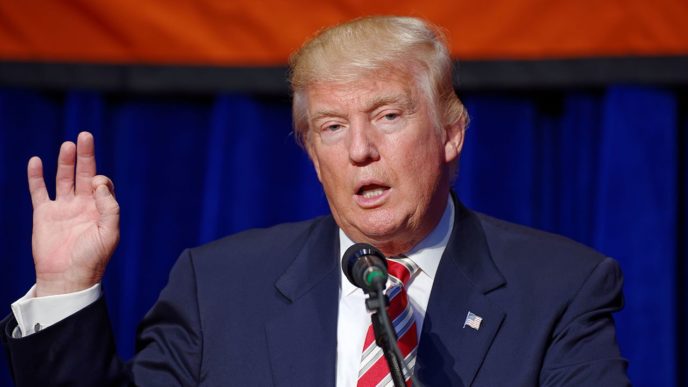
Oh the Outrage! Liberal Racists Are Upset the Trump White House Is Honoring Black History Month

February 1 marks the start of Black History Month, and Tuesday night, White House Press Secretary Sean Spicer announced a series of sponsored events in celebration and recognition of the month.

The events kicked off with a special U.S. Postal Service dedication of a “Forever” stamp featuring Dorothy Height, a leader of the National Council of Negro Women and an architect of the August 1963 March on Washington. Spicer called Height “a true pioneer in the civil rights movement.”

As always, though, that wasn’t enough for the GOP-bashing, race-baiting Left.

Following the White House press briefing Tuesday, the Daily Intelligencer published a satirical piece titled, “Imagining the White House’s Black History Month Schedule.” The imaginary agenda included events like “Postal Service Unveils Its New Steve Harvey Stamp,” “‘So About That Harriet Tubman $20 Bill Rumor …’: A Conversation with Treasury Secretary Steven Mnuchin,” “Keynote Address: ‘Blacks Can Be Racist, Too,’ by Charles Barkley,” “Stacey Dash Meet-and-Greet,” and “If You’re a Christian Black, You Have to Love Donald Trump or You Will Go To Hell.”

The satirical schedule concludes with President Trump announcing “his plan to build ships that will take you back to Africa if you are a Black and your Social Security number is nine digits” and an “announcement of March, May, August and November as White History Months.”

Trump-hating liberals on Twitter followed suit, making it clear that Trump’s White House will always be the sworn enemy of “progress.”

Of course, this is all in good fun … or is it? Underlying all of these jokes is the liberal narrative that Trump and anyone who doesn’t hate Trump is a white supremacist (or an Uncle Tom).

To liberals, Donald Trump will always be a racist, anti-gay xenophobe with a hidden agenda to expunge non-Republican “others” from the face of the Earth. (For more from the author of “Oh the Outrage! Liberal Racists Are Upset the Trump White House Is Honoring Black History Month” please click HERE)

Follow Joe Miller on Twitter HERE and Facebook HERE.

With Gorsuch Pick and Sane Policy Towards Islamists, Trump Defends the Vulnerable

I’m delighted to admit it: I was wrong. I was one of those Christian conservatives who never came around to trusting Donald Trump. I didn’t endorse him, and almost couldn’t vote for him. At the last moment, as I stared at the ballot, thinking of Clinton’s track record of pro-abortion extremism and reckless disregard for religious minorities in the Middle East, I managed to pull the lever.

How glad I am that I did. As I learn more and more about Neil Gorsuch, I cannot wait for him to fill Justice Scalia’s chair on the U.S. Supreme Court. Tens of millions of pro-life Americans should today offer prayers of thanks, and publicly praise the President for such a solid, courageous choice. We must get on the phones and social media, pressing our senators to confirm Judge Gorsuch.

Iraqis in Refugee Camps Danced for Joy When Trump Took Office

But I’d already seen an excellent reason to be thankful that Donald Trump won. On his inauguration day, I wasn’t in Washington, D.C., but in Iraq — finishing up a tour of refugee camps on the borders of ISIS territory, for a documentary I’m producing.

If you thought that Republicans in D.C. were celebrating Trump’s entry into office, you should have seen the Iraqis in those camps. Muslims, Christians, and Yezedis alike were cheering and dancing together. (So, as I learned from my friends there, were Christians down in embattled South Sudan.)

If you want a grimly objective measuring stick of the impact Trump’s election had in this war-torn region: The sex slave traders of ISIS are afraid that their supply of Christian and Yezidi women will soon dry up, so the price of a sex-trafficked girl in Iraq shot up from $8,000 to $20,000. So I learned from a Yezidi family that is trying to ransom back a daughter.

I stopped to ask some of the refugees why they were excited about Trump’s victory. One after another answered me: Because he knows how evil ISIS really is, and he really will “eradicate” it. The Muslims in these camps despised ISIS, which drew support from a fanatical minority and funds from outside the country, then went on to brutalize and destroy their ancestral villages.

“Obama Slit Our Throats with Cotton.”

Obama, by contrast, dismissed ISIS as a “junior varsity” organization. In fact, as every Iraqi whom I spoke with about this told me, it was Obama’s policies that let ISIS become such a monstrous evil. Even those who’d opposed George Bush’s invasion in 2003 — including one of Saddam Hussein’s former generals, whom I interviewed — blamed Obama for making things much, much worse in Iraq by pulling U.S. troops out and leaving a power vacuum, which ISIS filled with blood, tyranny, and terror.

I met with dozens of people, and spoke as the only American at an interreligious conference. From military officers down to ordinary people in the camps, I kept hearing the same conspiracy theory. These people believed that Obama must have somehow wanted ISIS to win. One high-ranking soldier in a Kurdish peshmerga told me how his soldiers saw long lines of ISIS-owned oil tankers streaming into Turkey. They wanted to attack, but the American military advisor whom Obama had sent forbade them — and threatened them with U.S. airstrikes if they disobeyed him. Another officer told me that U.S. advisors had ordered his forces not to defend Mosul from ISIS. The phrase these people kept using, an Iraqi expression, was: “Obama slit our throats — with cotton.”

I pushed the questions further. Weren’t they worried that Trump’s “extreme vetting” of potential refugees from Iraq, Syria, and other troubled countries would keep them out of America? To this they had two answers. First, they simply laughed — and explained that it would be easy to determine which refugees hated ISIS, since all of them did. But more important than that, one after another insisted: “We don’t want to come to America. We want to go home to our towns. We want the U.S. to get ISIS out of the way so we can go back to living our lives, as we were before Obama let ISIS destroy them.”

“We Don’t Want to be Refugees in America.”

Didn’t it bother them that Donald Trump was suspicious of admitting refugees from countries with large jihadi movements? To that they answered again, “What makes you think that the whole world wants to come live in America? We want you to stop blundering in and destroying our countries. Help us stay safe here in the region, and hurry up and defeat the extremists so we can go home.” They mentioned more than ISIS here, noting that they also hoped that other radical Islamist groups such as al Nusra and al Qaeda could be defeated. And they were confident that Donald Trump would do that.

What made them so hopeful? The fact that Trump speaks in plain, honest language about defending America’s national interests — a natural, human concept that people around the world can understand and appreciate. Instead of the Kantian flim-flam of liberal internationalists, or the empty promises of neocon democracy-mongers, Trump talks about fighting America’s enemies and trying to help its friends. To Iraqis brutalized by high-minded Americans for the past 16 years, Trump’s bluntness has the ring of simple truth.

So let’s recap. We have elected a man who during a presidential debate cut through the euphemisms and graphically described a partial birth abortion. A man who sent his Vice President and campaign chair to address the March for Life, and who has chosen for the Supreme Court a judge who believes that the words of the Constitution mean exactly what they say. Trump also believes that his duty to protect his fellow citizens comes first — and that our extremist enemies who say that they want to destroy us also mean what they say, and that we should act to destroy them first, and keep their infiltrators out of our cities and suburbs.

President Trump’s loudest critics on the left mostly said nothing at all when Barack Obama allowed the Middle East to descend into brutal chaos, when ISIS ramped up its genocide and sex-trafficking enterprise, when millions of religious minorities were ethnically cleansed or killed. These same people helped cover for Planned Parenthood’s human organ trafficking. But now they are treating the president’s simple (if perhaps badly implemented) safety measures on immigration as a crime against humanity.

We should be very, very glad that these people lost the election, and aren’t running our country, picking our judges, or deciding the fate of the helpless in the refugee camps of Iraq. (For more from the author of “With Gorsuch Pick and Sane Policy Towards Islamists, Trump Defends the Vulnerable” please click HERE)

Follow Joe Miller on Twitter HERE and Facebook HERE.

Videos Reveal That Often, Ultrasounds at Planned Parenthood Are Only for Abortions

Planned Parenthood CEO Cecile Richards likes to claim that the major abortion provider is also a leader in women’s health and prenatal care services. New videos released by Live Action News tell a different story, The Federalist reported Tuesday.

The videos are a part of an investigation by Live Action News called Planned Parenthood: The Abortion Corporation, and specifically focus on the use of ultrasound machines in Planned Parenthood facilities.

Not for Prenatal Care

One video shows women calling or visiting 68 (out of approximately 650) Planned Parenthood facilities nationwide to ask about ultrasound services. In all but three instances, the Planned Parenthood representatives said they only use ultrasound machines for abortions.

“We don’t do any ultrasounds for prenatal — for prenatal care,” a representative from the Planned Parenthood facility in Council Bluffs, Iowa, said. “We do them when we’re doing abortions but not for any other reason.”

“That’s [abortion] the only service that we do,” a representative in Winston-Salem, North Carolina, said. “We don’t do any prenatal care or adoption here.”

Two former Planned Parenthood managers confirmed what the undercover recordings exposed.

One, Sue Thayer, told Live Action News President and pro-life activist Lila Rose that ultrasound machines were originally brought into the facility where she worked for the purpose of performing “webcam abortions.”

“If Planned Parenthood is really about choice, they would show women the ultrasound,” Thayer said. “And they don’t.” Monitors on the ultrasound machines are turned away from the mothers, and pictures of the unborn babies are never printed, she said.

Planned Parenthood is currently fighting GOP lawmakers to continue receiving taxpayer funding. As part of the effort to defund the abortion giant, protests and rallies will take place Saturday, February 11 at Planned Parenthood locations nationwide. (For more from the author of “Videos Reveal That Often, Ultrasounds at Planned Parenthood Are Only for Abortions” please click HERE)

Follow Joe Miller on Twitter HERE and Facebook HERE.

Trump Should Rescind Obama’s Transgender Agenda and Protect Religious Liberty

The media was abuzz yesterday with rumors that President Donald Trump was preparing an executive order that would protect religious liberty in the aftermath of the redefinition of marriage.

Trump should issue such an executive order, and he should rescind former President Barack Obama’s executive actions on sexual orientation and gender identity that created many of these problems in the first place.

While a candidate, Trump promised to sign the First Amendment Defense Act into law. He needn’t simply wait for Congress. While legislation provides the best long-term protections, Trump can lawfully enact many of those protections through an executive order right now.

Such an order would instruct agencies of the federal government that they may not penalize certain individuals and institutions for acting on the conviction that marriage is the union of husband and wife.

Such an executive order, like the First Amendment Defense Act itself, should strike a careful balance as to whom and when these protections apply. Under the First Amendment Defense Act, protected entities include individuals, nonprofit charities and privately held businesses.

The act, however, would not apply to federal employees and contractors with respect to their job or contract duties. It does allow reasonable accommodation of federal employees’ religion, as under current law, but it makes clear that it does not relieve the federal government of its duty to provide government services, medical care or benefits to all who qualify — it must simply respect conscience in doing so.

Trump’s executive order should do the same.

An executive order on religious liberty should also include protections found in the Russell Amendment. This would prevent the federal government from discriminating against faith-based social service providers who maintain staffing policies that accord with their faith.

Religious charities shouldn’t have to give up their mission and identity simply because they partner with the government in serving the public.

In addition to proactively protecting the rights of Americans to hire for religious mission and to act on the conviction that marriage is the union of husband and wife, Trump should also rescind the various Obama executive actions that caused these problems.

A statement from the Trump administration notes that Trump was the “first ever GOP nominee to mention the LGBTQ community in his nomination acceptance speech, pledging then to protect the community from violence and oppression.”

Trump can and should protect all Americans from violence and oppression, but he should not go along with Obama’s policies of elevating “sexual orientation and gender identity” to a protected class.

The First Amendment Defense Act and similar religious liberty provisions oppress no one — they protect Americans from government-sponsored discrimination and coercion.

For example, in 2014, Obama issued an executive order barring “discrimination” on the basis of “sexual orientation and gender identity” in the private employment policies of federal contractors.

But according to liberals advocating such policies, “discrimination” on the basis of “sexual orientation” can be something as reasonable as an adoption agency preferring married moms and dads for orphans.

And “discrimination” on the basis of “gender identity” can be something as simple as having a bathroom policy based on biological sex, not gender identity.

Indeed, the Obama departments of Justice and Education instructed school districts throughout the country that they would interpret a 1972 law, Title IX, to require schools to allow students to use the bathroom, locker room and shower facility that accords with their self-declared “gender identity.”

They did this by saying the word “sex” would now mean “gender identity.”

Similarly, the Obama Department of Health and Human Services claimed a provision in Obamacare that forbids discrimination on the basis of “sex” means “gender identity” — and thus all health care plans have to cover sex reassignment therapies, and all relevant physicians have to perform them.

Parents and citizens across the country were astonished at this stunning overreach by Washington bureaucracy into local school bathroom policy and delicate medical decisions.

All of this can be undone right away. Trump can rescind Obama’s executive orders, and he can instruct his secretaries of education and health and human services and his attorney general to interpret the word “sex” as Congress intended it — as a biological reality, not as “gender identity.”

Trump can lawfully undo much of the damage that Obama caused, and he can provide immediate protections to all Americans through lawful executive orders.

Congress can then make these orders permanent by passing the First Amendment Defense Act, the Russell Amendment and the Civil Rights Uniformity Act (which specifies that the word “sex” in our civil rights laws does not mean “gender identity” unless Congress explicitly says so).

Whether it be harassing an order of nuns, forcing doctors to perform sex reassignment therapies, or preventing local schools from finding win-win compromise solutions that would respect all students’ bodily privacy, the Obama administration waged an aggressive and unnecessary culture war.

Because it has done so almost exclusively through executive action, a Trump administration can quickly undo this damage. And Congress can then ratify it permanently in law.

That’ll go a long way toward protecting peaceful coexistence, making American truly great again. (For more from the author of “Trump Should Rescind Obama’s Transgender Agenda and Protect Religious Liberty” please click HERE)

Follow Joe Miller on Twitter HERE and Facebook HERE.

Neil Gorsuch Could Rule on These 3 Big Cases If He Joins Supreme Court Soon

President Donald Trump’s nominee for the Supreme Court could have a say in rulings on religious freedom, transgender bathrooms in schools, and private property rights, if he is confirmed before April 16.

Judge Neil Gorsuch of the U.S. 10th Circuit Court of Appeals met with Senate Majority Leader Mitch McConnell, R-Ky., and other senators Wednesday at the Capitol less than 24 hours after Trump announced his nomination.

Senate Minority Leader Charles Schumer, D-N.Y., however, has vowed to filibuster the nomination.

“It’s doable to get a swift confirmation. The average Supreme Court confirmation comes in 67 days. Justice [Ruth Bader] Ginsburg was confirmed in 50 days,” Carrie Severino, chief counsel for the Judicial Crisis Network, told The Daily Signal. “Obviously, Democrats want to drag their heels.”

Senate Judiciary Chairman Chuck Grassley, R-Iowa, told CNN he is planning to have confirmation hearings in six weeks for Gorsuch.

Authorities on the Supreme Court say the likely big-ticket items for the spring will be three cases.

One is regarding whether a Christian school in Missouri is entitled to compete for the same state dollars as nonreligious schools. The outcome could affect so-called Blaine amendments in states across the country.

The second case involves property rights in Wisconsin. The third is a transgender bathroom case out of a Virginia high school, and how broadly the federal government may interpret Title IX, a federal law that bars sexual discrimination in education.

Some Senate Democrats, such as Jeff Merkley of Oregon, have said the Supreme Court seat was “stolen” because Senate Republicans refused to hold a hearing on President Barack Obama’s nomination of Merrick Garland to fill the seat of Justice Antonin Scalia.

But that’s because McConnell and other GOP leaders wanted to allow the electorate to decide in the presidential election, Severino said. McConnell almost certainly would have made sure the Senate Judiciary Committee held a hearing on Hillary Clinton’s nominee had the Democratic candidate been elected, she said.

“The Garland nomination was in the middle of an election,” Severino said. “This is not an election year. We are more than three years away from an election.”

On Wednesday, Trump told reporters he supported killing a Senate filibuster if necessary by using the so-called nuclear option—a rules change in which 51 rather than 60 votes are needed to bring a nomination to the floor.

“If we end up with that gridlock, I would say, ‘If you can, Mitch, go nuclear,’” Trump said of McConnell. “Because that would be an absolute shame if a man of this quality was put up to that neglect. I would say it’s up to Mitch, but I would say, ‘Go for it.’”

Senate Rule XIX, the two-speech rule, empowers the majority to overcome a filibuster and confirm a nominee. This would require the Senate to remain in the same legislative day until filibustering senators exhaust their ability to speak about the nominee, which would be after they give two floor speeches. Then, the Senate could proceed to vote.

Sen. Dianne Feinstein, D-Calif., ranking member of the Judiciary Committee, tweeted yesterday:

ne survey found that the public seems to favor quick action.

A Marist poll released Wednesday, sponsored by the Knights of Columbus, found that 56 percent agreed it should be an “immediate priority” to appoint a Supreme Court justice who will interpret the Constitution as it was originally written, while another 24 percent agreed it is an “important” priority.

Conservatives are hoping Gorsuch will be seated on the court by April 16, when its last session of arguments takes place for the current term, said John Malcolm, director of the Meese Center for Legal and Judicial Studies at The Heritage Foundation. If not, some of the most controversial cases could be reheard, he said.

“It is not the end of the world if he isn’t confirmed by that time, because the court can hold over cases for rearmament in the next term if it believes the case needs a full nine justices to decide,” Malcolm told The Daily Signal.

Here’s a look at the three key cases likely to be argued:

1. Trinity Lutheran Church of Columbia v. Pauley

The case involves whether states can withhold state grants based entirely on the recipient’s being a religious institution.

Missouri’s Blaine Amendment, on the books since 1875, outlaws the use of public funds to aid a church. Today, Missouri has a program that offers grants to nonprofit organizations to install rubber surfaces made from recycled tires to replace gravel as a way to make playgrounds safer.

However, the state denied Trinity Lutheran Church’s application for the resurfacing even though it ranked ranked fifth out of 45 applications in meeting the government’s criteria.

The case began in 2013. Trinity contends the grant wouldn’t violate the Constitution’s Establishment Clause. It argues that singling out a church for exclusion from the program violates the right to free expression of religion as well as the Equal Protection Clause.

2. Murr v. Wisconsin

In this property rights case involving the Takings Clause of the Constitution, four siblings in the Murr family owned two adjacent waterfront properties St. Croix, Wisconsin. One property included a cabin built by their parents.

In 2004, zoning regulations prevented the siblings from developing the second lot because the state declared both properties to be one lot.

The family contends the state effectively took the second property by regulating it to the point of having no value without providing just compensation.

3. Grimm v. Gloucester County School Board

This case out of Virginia involves the Obama administration order requiring public schools to allow transgender students to use the restroom that corresponds to their gender identity.

Gavin Grimm, 17, a transgender student who was born female, wanted to use the boys’ restroom at a Gloucester County public high school. Grimm said school policy violated Title IX, the section of the federal code prohibiting discrimination on the basis of sex in any federally funded education program.

A District Court sided with the school system, but the 4th Circuit Court of Appeals ruled for Grimm.

Obama’s Department of Education issued a directive suggesting noncomplying schools would lose federal money if they didn’t allow transgender restroom choice. Texas and a dozen other states challenged the order.

The Supreme Court is expected to determine whether the department can make the final determination in broadly interpreting Title IX. (For more from the author of “Neil Gorsuch Could Rule on These 3 Big Cases If He Joins Supreme Court Soon” please click HERE)

Follow Joe Miller on Twitter HERE and Facebook HERE.

Nebraska Woman Loses Health Insurance for Fourth Time Under Obamacare

Pamela Weldin’s experiences with Obamacare can be boiled down to just a few numbers.

Since the health care law’s implementation three years ago, Weldin, 60, has lost her insurance four different times.

And the Nebraska woman is currently enrolled in her fifth new insurance policy in four years.

“Yet again, and through no fault of my own,” Weldin told The Daily Signal. “I’m just sitting here minding my own business, and here we go again.”

A former dental hygienist, Weldin has all the hallmarks of a consumer intended to benefit from the Affordable Care Act.

She has been denied coverage in the past because of a pre-existing condition related to her career as a dental hygienist.

Additionally, Weldin qualifies for a tax credit, which she has received every year since 2014.

As a result, her premiums are low when compared to consumers who don’t qualify for financial assistance: In early 2015, Weldin purchased a plan through Blue Cross and Blue Shield of Nebraska that cost her $232 each month.

This year, premiums for her silver-level plan with Medica are $161 per month after her tax credit. Without the financial assistance, her premiums would total more than $1,300 per month.

But though Weldin has benefited from aspects of the law, she hasn’t been immune to the changes in the health insurance market that have occurred in last few years.

“I’m a person who has been denied because of pre-existing conditions,” Weldin, a Pampered Chef director, said. “I’m on Obamacare and have lost my insurance four times in three years. I understand the challenges, but it’s not sustainable.”

Weldin’s Journey

Since HealthCare.gov opened for business in the fall of 2013, four policies sold by three different insurance companies—Humana, CoOportunity Health, and Blue Cross and Blue Shield of Nebraska—that Weldin purchased were ultimately terminated.

The Daily Signal previously covered her experiences with Obamacare in a February 2015 article.

But since then—when Weldin lost her insurance for a third time—she’s logged another cancellation.

First, Weldin’s initial policy with Humana, which she held for several years, was canceled in the lead-up to Obamacare’s implementation in January 2014.

The Nebraska woman then purchased a platinum-level plan for 2014 through CoOportunity Health, a consumer operated and oriented plan, or co-op. But CoOportunity Health terminated her platinum-level policy for 2015 after the co-op decided it would no longer offer those policies.

Weldin, though, decided to stick with CoOportunity Health and selected a silver-level plan for 2015.

On Jan. 23, 2015, Weldin received a notice from the co-op notifying her that it was going out of business. CoOportunity far outpaced its initial enrollment projections, and its customers racked up medical expenses that far outpaced what they paid in premiums.

Weldin had no choice but to select a new insurer and policy, and purchased coverage through Blue Cross and Blue Shield of Nebraska for the remainder of 2015 and 2016—a plan that, though a bit more expensive, allowed her to see her original doctor.

Late last year, though, Blue Cross and Blue Shield of Nebraska announced it would no longer sell coverage on the exchange in the state.

“This system is collapsing under its own weight,” Weldin said, “like the co-ops and basic companies like Blue Cross pulling out of Nebraska.”

To ensure she would be covered for 2017, Weldin went to HealthCare.gov to select a plan that allowed her to see her current doctor in Colorado.

In Nebraska, consumers on the exchange had just two insurance companies to choose from: Aetna and Medica.

A policy through Aetna was more expensive than its competitor, but because Weldin thought her doctor was considered in-network, she selected a plan through that insurer.

It wasn’t until after she paid her first month’s premium, however, that Weldin learned from the insurance company that any doctor located more than 100 miles from her rural Nebraska home wasn’t in her network.

If she wanted to see her doctor in Colorado—considered out-of-network now—Weldin had to meet a $20,000 out-of-network deductible before Aetna would start covering her medical expenses.

That information, she said, wasn’t listed on HealthCare.gov when she was shopping for plans.

“$20,000 for a deductible? Are you kidding me?” Weldin said. “How is that affordable?”

Speaking Volumes

Across the country, millions of Americans faced higher premiums heading into 2017.

And premium hikes have been well documented by The Daily Signal and others.

Less attention, however, has been paid to the number of insurers and plans available to consumers.

According to an October report from the Department of Health and Human Services, insurer participation in Nebraska decreased from four insurers in 2016 to two in 2017.

And consumers nationwide aren’t just seeing a decline in the number of insurance companies selling coverage on the exchange in their states.

The federal government reported that Americans would also see a decrease in the number of plans insurers offered in 2017.

In Nebraska, there was an average of 18 fewer plans per county available on the exchange to consumers this year. Nebraskans purchasing plans on HealthCare.gov in 2017 had 13 plans to choose from, down from 31 last year.

“That speaks volumes in terms of ultimate consumer benefits,” Rep. Adrian Smith, R-Neb., told The Daily Signal of the change in insurers selling plans in his state. “Fewer choices most often means higher prices and less quality.”

In 2015, Smith introduced a bill to exempt consumers like Weldin who purchased coverage from a failed co-op from the individual mandate. The legislation passed the House, but stalled in the Senate.

Now, Smith and other Republicans—who have spent six years talking about repealing Obamacare—are looking to check the box on a major campaign promise.

Republicans have taken the initial step toward dismantling the health care law after passing a budget resolution earlier this month, and often cite the experiences of Americans like Weldin to bolster their arguments that Obamacare needs to be repealed and replaced.

But despite their control over Congress and the White House, Republican lawmakers differ on their approaches to unwinding Obamacare.

Conservatives are urging GOP leadership to move forward with repeal as soon as possible and say they’re frustrated with the speed at which their leaders are moving to dismantle the health care law.

House Speaker Paul Ryan said last week repeal would be slated for March or April.

“I’d like to see an acceleration of the front-end repeal side,” Rep. Jim Jordan, R-Ohio, said Wednesday at a monthly gathering with reporters. “Let’s get rid of [Obamacare]. That’s what we told the voters that we were going to do.”

Jordan was joined by other Republicans who said they want to see GOP leadership move faster on Obamacare repeal.

“I, too, am frustrated with the pace,” Rep. Scott Perry, R-Pa., said Wednesday. “We need to not only be against the [Affordable Care Act] or Obamacare, which I am for a myriad of reasons … but we also, if not for political reasons, but for the reason that our constituents and America needs to know what we stand for. We should vote on something.”

But during a gathering last week of House and Senate lawmakers in Philadelphia, other Republicans showed tepid support for dismantling the law and even expressed doubts over their party’s plans to repeal and replace Obamacare.

Though the GOP agrees that the law needs to be scrapped, members haven’t yet concurred on whether to repeal major parts of Obamacare like its taxes. Many also want to see Congress move a replacement at the same time they repeal the law.

Still, Smith, the Nebraska congressman, points to Americans like Weldin as a reason why Congress needs to act.

“When you look at the overall picture, [Obamacare] has failed miserably and will continue to cause great damage,” Smith said. “That’s why we need to step in.”

“We want to prevent further pain that we know will happen if we just let Obamacare sit the way it is,” he continued.

‘Not Sustainable’

After learning about her $20,000 out-of-pocket deductible, Weldin contacted HealthCare.gov to seek assistance with purchasing another plan.

A representative there was able to enroll her in a new policy with Medica, and Weldin learned that her doctor was, in fact, included in the new plan’s network.

This year, the Nebraska woman will pay $161 per month in premiums after a tax credit.

Weldin is one of the more than 9 million Americans who receives a tax credit and has been relatively immune to the increased costs of health insurance, but she still wants to see changes made to the health care system.

“Allow us the choice of what kind of policy and coverage suits our needs,” she said. “Allow us the choice of deductible and to cross state lines for provider care so we can choose and keep our own doctors. Allow insurance companies to compete across state lines so we have more options and have more choice of providers.”

And Weldin said she recognizes that any action Republicans take on Obamacare could very well lead to further changes with her insurance and the health insurance market.

Still, she said she wants to have additional choices, even it means more coming out of her pocketbook.

“Something has to be done because this is not sustainable,” Weldin said. “I’m fine paying a little bit more if it’s what I need. But let me choose a policy that’s appropriate for my needs. Let me have a policy that’s appropriate to my medical needs. Let me choose a deductible that’s appropriate for my budget.” (For more from the author of “Nebraska Woman Loses Health Insurance for Fourth Time Under Obamacare” please click HERE)

Follow Joe Miller on Twitter HERE and Facebook HERE.

Conservative Lawmakers Warn Congress Not to Reinstate Earmarks

Former and current Republican congressional lawmakers raised concern against reinstating the practice of earmarks during a discussion hosted by the largest conservative caucus in Congress on Tuesday.

“I’m astounded that you’re even having this conversation,” former Sen. Tom Coburn, R-Okla., said during the Republican Study Committee discussion. “If the Republicans really want to give up control of Congress, just [bring back earmarks]. I guarantee it’s going to happen if you do.”

Coburn called earmarks “the gateway drug to overspending,” and cautioned against restoring them.

Earmarks, which were banned under House rules in 2010, allow taxpayer money to be directed to special interests and projects through the budget.

The proposal to reinstate earmarks—led by Reps. John Culberson, R-Texas; Mike Rogers, R-Ala.; and Tom Rooney, R-Fla.—was set in motion just days after the 2016 election.

Jim DeMint, a former South Carolina senator who represented the state’s 4th Congressional District from 2005 to 2013 and who serves as the president of The Heritage Foundation, said that earmarks lead to a corrupted political system.

“You can hear all kinds of good excuses for earmarks, [like] ‘this is a good project,’’’ DeMint said. “For every good project, there are wasteful projects. It corrupts the system, we’ve had congressman go to jail, we’ve had congressmen use earmarks for their own special interests.”

Sen. Jeff Flake, R-Ariz., warned that reinstating earmarks would work against the mandate of voters to “drain the swamp.”

“When you hear ‘drain the swamp’ right now, just realize that was the rallying cry for Nancy Pelosi and the Democrats in 2006 when they took the majority, largely because of earmarks,” Flake said.

Flake added that the process of allocating earmarks takes away from the oversight responsibilities that committees in Congress hold.

“I think that the worst part [of earmarks], worse than the money spent through the actual earmarks themselves, is the time, effort, and resources that the appropriations committees in the House and the Senate spend just trying to divvy out earmarks,” Flake said.

Rep. Jeb Hensarling, R-Texas, said he is disheartened that Congress is raising this proposal again.

“I never thought I would have to be a part of getting the ‘earmark ban band’ back together,” Hensarling said.

Earmarks, Hensarling said, embody everything that is contrary to conservative values.

“[Earmarks] represent a victory of seniority over merit, they represented a victory of secrecy over transparency, they represented a victory of sweetheart deals over competitive bidding … they cause members to vote for spending bills they otherwise would not have voted for,” Hensarling said.

Rep. Bill Flores, R-Texas, the former chairman of the Republican Study Committee, said that achieving spending restraint will not be possible with earmarks in play.

“With the election of [President] Donald Trump, Americans made it clear that they want to ‘drain the swamp,’” Flores said. “Now, there are a lot of people around here that think the swamp is a hot tub, but it’s a swamp and it needs to be drained.”

Flores said that he was “surprised” that the subject of reinstating earmarks has even been raised.

Concerned about Congress’ current stance on earmarks, Flores urged listeners to voice their disapproval of reinstating the process.

“I have this sick feeling that there is more than half the conference that would vote for this if it came back. So we need to make sure that we have grassroots support … so we can make sure this does not come back,” Flores said.

Rep. Ron DeSantis, R-Fla., said bringing back earmarks would only contribute to the problematic public policies in Congress and harm its political climate.

DeSantis said it is a myth that Congress “needs earmarks to reclaim the power of the purse.”

“We forfeited the power of the purse by doing continuing resolutions and omnibus bills, and, if you introduce earmarks tomorrow … you will have even bigger and more grotesque omnibus bills,” he said.

Should earmarks return, DeSantis said that curbing executive overreach and reining in the national debt will be harder to accomplish.

“Earmarks facilitate federal overreach, spending on things that aren’t linked to the general welfare … the more you expand the spending power to subsidize anything possible under the sun, it’s much more difficult for us to get our fiscal house in order,” DeSantis said.

For Sen. Mike Lee., R-Utah, earmarks are a symbol of everything that Congress should avoid.

“When people talk about the fact that Congress needs to get back in charge of its own spending, I couldn’t agree more,” Lee said. “But that does not mean ‘Bring back earmarks.’”

Instead, Lee said Republicans would own the pork-barrel spending legacy, should earmarks be reinstated. (For more from the author of “Conservative Lawmakers Warn Congress Not to Reinstate Earmarks” please click HERE)

Follow Joe Miller on Twitter HERE and Facebook HERE.

The Question the Left Won’t Answer on Abortion

If there weren’t, well, lives at stake, Democrat Rep. Eric Swalwell’s dodging of Fox News’ Tucker Carlson’s questions about whether abortion was the taking of a human life would be comical.

Just check out how often Swalwell (who is, of course, from California) dodged it in an appearance Tuesday night (transcript omits some cross chatter):

Carlson: Do you think it is the taking of a human life, abortion?

Swalwell: I think that, right now … before viability, a woman should be able to make her own decision. After viability, in the case of her own psychological health, in the case of rape or incest, she should also be able to make that decision.

Carlson: OK, but is it the taking of a human life?

Swalwell: That is a woman’s personal decision.

Carlson: OK, but what do you think? I’m not asking about the decision, I mean is it human life or not?

Swalwell: She’s terminating something that she does not want, and that’s her own choice.

Carlson: OK, but do you think it’s human life?

Swalwell: Do I think—I think, at viability, a baby … should be decided by the woman. She’s the one who has to have it.

Carlson: You brought it up, that’s why I’m pressing you, but do you think, before viability, it’s a human life or something else?

Swalwell: I think it’s not viable yet, Tucker, and courts have decided this and it’s a woman’s decision.

Carlson: You’re not going to answer my question, now or ever I suspect, but you should because it’s a basic question I think.

This is … a muddled mess of illogical thinking.

And it really gets to the gist of the abortion debate, which is this: Is the unborn baby human or not, and if not human, at what point does she become human?

Because after all, if the baby isn’t human, it’s irrelevant if women want to have abortions, just as it’s irrelevant if they want to remove tumors or a few cells or have any other number of medical procedures.

But if the baby is human … it’s horrifying that our society wouldn’t protect her life, just because she’s in a vulnerable, dependent position.

Yet this is the question over and over again that the left won’t deal with.

Maybe they won’t deal with it because it threatens their current abortion policies. After all, it’s risible to argue that a full-term baby isn’t human in the womb, and yet acquires humanity passing through the birth canal.

Yet our current laws act like that is the case. Right now, the United States is one of only seven countries in the entire world that allows abortion on demand after 20 weeks.

As President Donald Trump— who pledged during his campaign to make the late-term abortion ban the Pain-Capable Unborn Child Protection Act law—bluntly put it in one of his debates with former Secretary of State Hillary Clinton, “If you go with what Hillary is saying, in the ninth month, you can take the baby and rip the baby out of the womb of the mother just prior to the birth of the baby.”

Incidentally, that’s not a position that aligns with most Americans’ viewpoints: A mere 27 percent of Americans think that abortion should be allowed beyond the first three months, outside of rape/incest/life-of-the-mother situations, according to a January Marist poll sponsored by the Catholic organization Knights of Columbus.

It’s not surprising that Americans aren’t comfortable with abortion during all nine months. The increasingly prevalence of ultrasounds has made seeing unborn babies much more vivid than it was in decades past.

And the age at which unborn babies are viable is steadily lowering: In 2011, a baby born at 21 weeks survived in Germany, according to Time.

There’s no doubt that women who face unexpected pregnancies, particularly women in difficult circumstances, have a tough situation. There’s much as a culture that we can—and should—do to help support these women, whether it’s helping them financially or emotionally or in other ways. Thankfully, there are private organizations across the country that do just that—and deserve our support.

It’s irrelevant what the courts think about when life becomes human. It’s irrelevant what abortion activists think about when life becomes human.

What is relevant is science—which tells us that an unborn child has her own unique DNA at the moment of conception.

If Swalwell doesn’t think unborn babies are human, he should say that (and be ready to explain why having your own unique DNA and being able to grow into an adult human aren’t signs of being human).

But if he does think that unborn babies are human or are human at the time they are viable, he should realize it’s time to demand justice for those babies and their right to life, no matter how tragic the circumstances in which their lives began.

Nor is it just Swalwell who refuses to take this question seriously. When House Minority Leader Nancy Pelosi, D-Calif., was asked a similar line of questions in 2015, she refused to answer:

CNS News: In reference to funding for Planned Parenthood: Is an unborn baby with a human heart and a human liver a human being?

Pelosi: Why don’t you take your ideological questions—I don’t, I don’t have—

CNS News: If it’s not a human being, what species is it?

Pelosi: No, listen, I want to say something to you. I don’t know who you are and you’re welcome to be here, freedom of this press. I am a devout practicing Catholic, a mother of five children. When my baby was born, my fifth child, my oldest child was six years old. I think I know more about this subject than you, with all due respect.

CNS News: So it’s not a human being, then?

Pelosi: And I do not intend to respond to your questions, which have no basis in what public policy is that we do here.

If you’re going to make public policy about who lives and dies, it’s relevant who is human and who’s not. Sadly, that doesn’t seem to be something many on the left agree with. (For more from the author of “The Question the Left Won’t Answer on Abortion” please click HERE)

Follow Joe Miller on Twitter HERE and Facebook HERE.

Trump Taps Evangelist Jerry Falwell Jr. To Lead Higher Education Task Force

President Donald Trump has tapped Liberty University President Jerry Falwell Jr. to lead a White House task force on improving higher education.

Falwell, one of the country’s most prominent evangelical leaders, endorsed Trump in January 2016, just days before the Iowa caucuses, which were the first votes cast in the presidential election cycle.

His support led Trump to victory in the Republican primary and the general election, with 80 percent of white evangelicals choosing for president the GOP leader last November.

Now, NBC News is reporting that Falwell will play an official role in the Trump White House.
The Liberty University president will specifically look at ‘overregulation and micromanagement of higher education,’ according to university spookesman Len Stevens. (Read more from “Trump Taps Evangelist Jerry Falwell Jr. To Lead Higher Education Task Force” HERE)

Follow Joe Miller on Twitter HERE and Facebook HERE.

Trump Makes Unannounced Trip to Honor Fallen Navy SEAL

Assuming the somber duties of commander in chief, President Donald Trump made an unannounced trip Wednesday to honor the returning remains of a U.S. Navy SEAL killed in a weekend raid in Yemen.

Chief Special Warfare Operator William “Ryan” Owens, a 36-year-old from Peoria, Illinois, was the first known U.S. combat casualty since Trump took office less than two weeks ago. More than half a dozen militant suspects were also killed in the raid on an Al Qaeda compound and three other U.S. service members were wounded . . .

Trump’s trip to Delaware’s Dover Air Base was shrouded in secrecy. The president and his daughter, Ivanka, departed the White House in the presidential helicopter with their destination unannounced. A small group of journalists traveled with Trump on the condition that the visit was not reported until his arrival. (Read more from “Trump Makes Unannounced Trip to Honor Fallen Navy SEAL” HERE)

Follow Joe Miller on Twitter HERE and Facebook HERE.