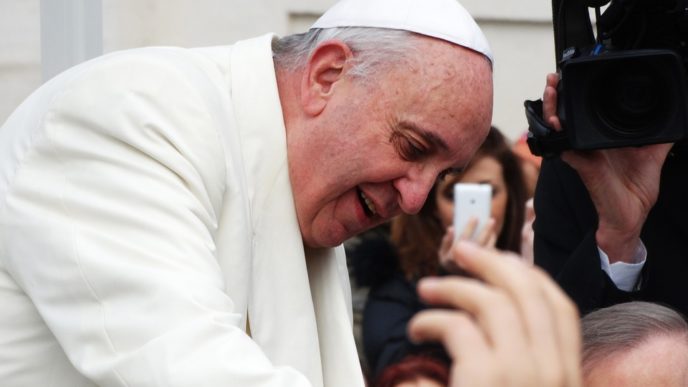
Pope Francis’ Double Standard on Nationalism and Populism

A few months back I addressed a conspiracy theory: It said that Donald Trump’s chief of strategy Steve Bannon was colluding with doctrinal conservative Cardinal Leo Burke to thwart Pope Francis. There was no substance behind it.

But the fault lines that theory pointed to are real. Catholics in Europe and America are just as divided as their countrymen of other creeds. We are torn between competing theories of how to govern our nations.

Whom should we include? How much power must we grant globalist institutions such as the UN and the EU?

Pope Francis Tells Europe to Abandon Nationalism

Pope Francis has just drawn a line in the sand. In his recent address to European and EU leaders, the pope took a clear swipe at leaders such as Donald Trump, and European patriotic politicians. He warned Europe’s leaders that “[f]orms of populism are … the fruit of an egotism that hems people in and prevents them from overcoming and ‘looking beyond’ their own narrow vision.”

He even seemed to endorse the rule of technocratic elites like the EU’s unelected commissioners. The pope said:

Politics needs this kind of leadership, which avoids appealing to emotions to gain consent, but instead, in a spirit of solidarity and subsidiarity, devises policies that can make the Union as a whole develop harmoniously.

Should We Prefer Strangers’ Children to Our Own?

Is it “egotism” to want your country’s elected government to protect its national interests? To look out first for its citizens? Is it egotism to put your own children’s interests before those of strangers in foreign countries?

That’s not what St. Thomas Aquinas taught. He wrote that we owe our first duty to our own children, and then to our neighbors.

Do Would-Be Immigrants Have Equal Claims to Citizens?

The pope called for Europe’s states to make “equal room for the native and the immigrant.” Are their claims really “equal”? If so, then hopeful Syrian immigrants have an equal claim on the government of Poland or France as veterans who fought in those country’s wars.

And that’s how governments in many European countries are acting already. Why else would Sweden forbid its police to give physical descriptions of wanted fugitives? (The point was to avoid inflaming “Islamophobia.”) Why would Germany prosecute citizens who criticize its immigration policies?

Does Pope Francis really think that nations should not protect their own citizens first? That people can’t defend their interests through political action?

If he said that, he’d be saying that the fierce love of family and fidelity to a nation is part of the stain of Original Sin. To be true Christians we must renounce it. We must learn to see strangers as equally important to us as our children. Every human being is an interchangeable unit.

Christianity Isn’t Ayn Rand’s Suicidal “Altruism.”

That’s not Christianity, of course. It’s the ugly parody that appears in Ayn Rand’s novels. She scornfully calls it “altruism.” For Rand, the Gospel demands that we prefer other people’s interests to our own. We should care more about foreign children than our own, in the name of a perfect “unselfishness.”

C.S. Lewis eloquently dismantled this idea in The Screwtape Letters. The Gospel in fact demands that we trim back and restrain the self-interest we were made with. But we can’t abolish it and shouldn’t try. We must learn the love for others in the school of family and community. That starts by loving our kin.

Pope Francis’ Multiculturalist Double Standard

I’m happy to say that Pope Francis does not teach such crackpot altruism as a universal theory. He doesn’t even condemn populism or nationalism per se. He sent a fulsome message of support to the recent Regional Gathering of Popular Movements. Its “Message from Modesto included a long list of claims that appeal to ethnic and economic self-interest.

In 2015, the pope actually addressed a meeting of such movements. That was during the trip when he accepted the “Communist crucifix” from the populist leader of Bolivia.

No, Pope Francis approves of nationalism, populism, and politics that promote one’s economic self-interest. There’s just one catch: Such movements are forbidden to European peoples. Also to members of the middle class. We are not allowed to advance our own interests, ever.

You’ll find no instance of Pope Francis warning Mexicans or Argentines against excesses of nationalism. He hasn’t called for Asian or Latin American countries to open their (fiercely guarded) borders. He doesn’t denounce the populists of Venezuela when they use the state to forcibly redistribute the wealth. (Venezuelan leftist populism is so disastrous that Catholics there can’t even get enough flour to make hosts for Holy Communion. No word from Pope Francis about that yet.)

Winking at Islamists and Socialists

No, it’s only when Europeans, or middle-class Americans, wish to look out for their own interests that Pope Francis feels the need to chastise. He seems to have internalized the ethical double standard of multiculturalism. One set of rules applies to the “privileged,” and another to the “underprivileged.” Only the upper classes are held to the higher standard.

But we’re supposed to wink at groupthink, rage, and the will to power when others indulge it. We’ll coddle it among Muslim immigrants, Bolivian Indians, or members of Black Lives Matter.

Of course, Pope Francis’ position is not an official teaching of the Catholic church. It’s not even a theological theory. It’s just a political bias. Good Catholics are perfectly free to point out that it is, to say the least, a double standard. (For more from the author of “Pope Francis’ Double Standard on Nationalism and Populism” please click HERE)

Follow Joe Miller on Twitter HERE and Facebook HERE.

92-Year-Old NC Man Receives Purple Heart Earned in WWII

A 92-year-old North Carolina man has finally received the Purple Heart he earned more than 70 years ago while fighting in Belgium during World War II.

Oscar Davis Jr. was a private assigned as a radio telephone operator when he was knocked down by a large piece of shrapnel during the Battle of the Bulge, according to a Fayetteville Observer report . The radio on Davis’ back protected him, but the German artillery barrage knocked down a tree that fell on Davis, injuring his spine.

He was paralyzed from the waist down for three weeks and ultimately rejoined his unit in Germany. (Read more from “92-Year-Old NC Man Receives Purple Heart Earned in WWII” HERE)

Follow Joe Miller on Twitter HERE and Facebook HERE.

Orphanage Fire in Guatemala Reflects Dire Situation in Central America

Two weeks ago, at least 40 girls died in a fire at an orphanage in San Jose Pinula, Guatemala.

The facility was fitted to host 500 children, though there were an estimated 700 girls staying there at the time of the blaze. The fire is confirmed to have been started when several girls set fire to a mattress with a match in protest of the conditions at the facility.

The previous day, accusations of mistreatment and sexual abuse of the minors at the facility culminated in a riot. During that riot, 60 or so girls escaped from the facility, but were brought back by riot police and were locked in their classroom for hours.

This tragedy comes after allegations of widespread abuse at the orphanage. There are reports that girls had been beaten, raped, and subjected to other atrocities. Three teachers had even been convicted of rape.

This situation was not unknown, as the Guatemalan government has criticized the operations at the orphanage for the past three years. But the abuse continued up until the fire, and the Guatemalan government did not address the matter sufficiently.

A significant factor that has led to thousands of children being abandoned and neglected is violence from the gang war. Drug trafficking and violent criminal gangs run rampant in these countries, wreaking havoc on society.

Transnational criminal organizations make billions in profits from the trafficking of illicit goods, weapons, and people in and around the region. Their activities have contributed to the Northern Triangle countries of Central America having some of the highest murder rates in the world.

These gangs also wreak havoc in the United States, as shown in a recent case in which two Houston-based MS-13 gang members killed a girl in a satanic ritual.

Another factor enabling this deterioration of conditions is the weak governance in the region. In 2015, Guatemalan President Otto Pérez Molina, alongside his vice president, were ousted after they were accused and later imprisoned for their role in a massive fraud racket.

While initially popular, the current president, Jimmy Morales, has fallen out of favor. Many are calling for his resignation, due to his brother and son being charged with corruption.

With this political instability, it is no surprise that the Guatemalan government has a hard time clamping down on criminal activity and securing its people. Instead, corruption remains high, murder is rampant, and gang wars are creating more orphans.

In order to resolve these problems in the long term, there will need to be a concerted effort in not only fighting these transnational organized crime gangs, but ensuring that the conditions that allow them to thrive are also dealt with.

It is in the United States’ strategic interests to help solve these problems. With an alleviation of the regional security crisis caused by drug crime, the problems of illegal immigration and gang violence facing the United States will likely subside. (For more from the author of “Orphanage Fire in Guatemala Reflects Dire Situation in Central America” please click HERE)

Follow Joe Miller on Twitter HERE and Facebook HERE.
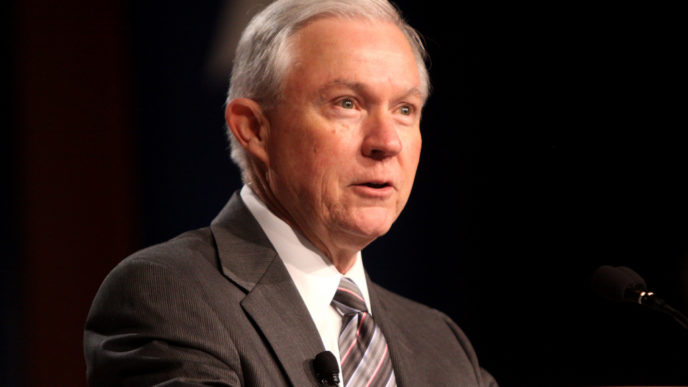
How Jeff Sessions Plans to Fight Back Against Sanctuary Cities

The Justice Department will start enforcing federal immigration laws by discontinuing the funding of sanctuary cities, Attorney General Jeff Sessions said on Monday while speaking at the White House.

If carried out, this new policy will result in the loss of federal money for cities that permit residents to be illegal immigrants, as Sessions stated that the Justice Department will avoid using its $4.1 billion in grant money to fund sanctuary cities. The attorney general added that the DOJ will even “claw back” funds from jurisdictions that refuse to comply with federal immigration laws.

“The Department of Justice will require that jurisdictions seeking or applying for DOJ grants to certify compliance with [U.S. Code 1373] as a condition of receiving those awards,” Sessions said.

U.S. Code 1373 is a law stating that localities cannot prevent the federal government from enforcing the nation’s laws on immigration. The law also regulates communications between local agencies and Immigration and Customs Enforcement.

“Countless Americans would be alive today … if these policies of sanctuary cities were ended,” Sessions said.

Sessions said following this policy was simply enforcing policies put in place by the Obama White House a year ago, as the previous administration made similar threats to sanctuary cities but did not act on the threats in the way Sessions is proposing.

“I strongly urge our nation’s states and cities and counties to consider carefully the harm they are doing to our citizens by refusing to enforce our immigration laws, and to rethink these policies,” Sessions said. “When cities and states refuse to enforce immigration laws, our nation is less safe.”

“We have simply got to end this policy,” Sessions said.

The DOJ’s targeting of sanctuary cities follows a January executive order from President Donald Trump aimed at improving border security and enforcing immigration laws.

Hans von Spakovsky, an immigration law expert at The Heritage Foundation, views this sanctuary city policy as a step in the right direction.

“This is a long-needed move by the Justice Department. The federal government’s chief law enforcement agency should not be giving any funds to cities or states that are obstructing federal enforcement of our immigration laws through sanctuary policies,” von Spakovsky said. (For more from the author of “How Jeff Sessions Plans to Fight Back Against Sanctuary Cities” please click HERE)

Follow Joe Miller on Twitter HERE and Facebook HERE.
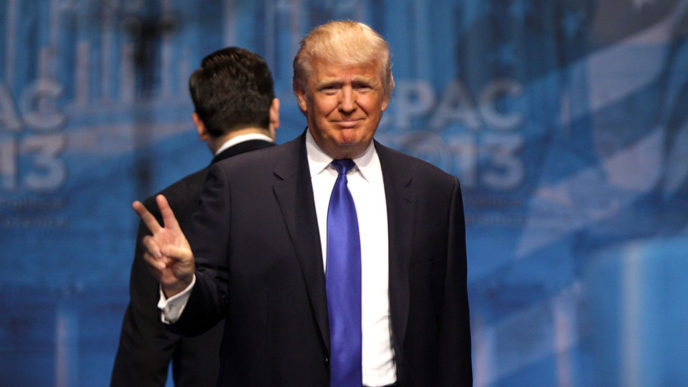
Trump Looks to Rebound With Tax Reform

The White House sees the possibility of broad support for tax reform, and an opportunity for President Donald Trump to take up an issue that hasn’t advanced in three decades—fresh off a legislative defeat Friday on replacing Obamacare.

“It’s been 30 years. We have an economy that has evolved, especially in the technology area that has made a lot of things change, and I think our tax code is outdated,” White House press secretary Sean Spicer told reporters Monday. “Frankly, on the business side, we are uncompetitive. There is a reason companies are leaving America to go to other places.”

The United States has the highest corporate income tax rate of any country in the Organization for Economic Cooperation and Development (OECD), the 34 most industrialized nations in the world.

After 2013 tax increases, small business owners can pay a top federal income tax rate of 39.6 percent, and an additional 3.8 percent investment surtax that became law as part of Obamacare. The 2013 deal also pushes the top federal tax rate on small business income to 43.4 percent.

Large corporations actually pay a lower federal tax rate of 35 percent, according to an analysis by The Heritage Foundation.

Trump and House Speaker Paul Ryan had argued that a failure to pass Republican leadership’s American Health Care Act would inhibit achievement of tax reform. As it turned out, conservatives successfully opposed the bill for not fully repealing Obamacare.

“We will probably be going right now for tax reform, which we could have done earlier, but this really would have worked out better if we could have had some Democrat support,” Trump said Friday after the collapse of the health care bill.

After Ryan pulled the GOP health care bill for lack of enough Republican votes, the Trump administration reportedly is looking past conservative Republicans in Congress to try to build a coalition of centrist Democrats to pass tax reform.

Republicans for years have sought to reform a long, complicated tax code, simplifying it both to lower rates and to make compliance cheaper. The bipartisan Simpson-Bowles commission also called for simplifying the code to reduce deductions.

Senate Minority Leader Charles Schumer, D-N.Y., said over the weekend, referring to Republicans and the health care bill: “They’re going to repeat the same mistake they made on Trumpcare with tax reform.”

Bipartisanship isn’t likely, said Grover Norquist, president of Americans for Tax Reform.

But Norquist said tax reform will have to come without the $1 trillion in tax cuts that were part of the scuttled House GOP’s plan to repeal and replace Obamacare, which he supported.

A bill would have to be crafted to pass with a simple majority in the 100-member Senate to prevent a Democratic filibuster, he said.

“It is still possible to have some tax reform, but it would have to be with 51 votes in the Senate,” Norquist told The Daily Signal. “There aren’t eight Democratic votes for it.”

Norquist said he sees three likely options at this point: One, though unlikely, would be to redo the health care bill to cut the $1 trillion in taxes.

The second option would be a “watered down” proposal cutting the top corporate tax rate to 28 percent, rather than 20 percent as Republicans in Congress have proposed. The third option would be to go big on tax reform—or push for the entire House GOP proposal—but make the cuts temporary, “sunsetting” in 10 years, to win over moderate votes.

House Republicans’ “Better Way” blueprint for tax reform would produce the lowest marginal tax rates since the 1920s.

The top individual rate would drop from 43.4 percent to 33 percent. The top rate for corporations would drop from 35 percent to 20 percent, and the top rate for small businesses would drop from 43.4 percent to 25 percent.

The Tax Foundation, a conservative-leaning tax research and advocacy group, estimates the House plan would grow the economy by 9.1 percent over 10 years, while reducing revenue by $191 billion.

Sens. Mike Lee, R-Utah and Marco Rubio, R-Fla., together have introduced a tax reform proposal, and Sens. Rand Paul, R-Ky., and Ted Cruz, R-Texas, have introduced separate plans.

The Trump proposal most likely would try to follow the House blueprint, said Adam Michel, an economic policy analyst with The Heritage Foundation.

“I hope Republican leadership learned a little bit from the health care bill about building consensus among members,” Michel told The Daily Signal, adding:

It will be about simplifying corporate and individual rates, and simplifying and eliminating some deductions. The Obama administration supported lowering corporate rates and eliminating deductions at one point, so there is at least theoretically some bipartisan support.

Michel, however, said he doesn’t anticipate there will be bipartisan support for the bill in the current political climate.

Congressional Democrats appear ready to oppose Trump on everything except, perhaps, a proposal to rebuild the nation’s infrastructure. (For more from the author of “Trump Looks to Rebound With Tax Reform” please click HERE)

Follow Joe Miller on Twitter HERE and Facebook HERE.

The Myth of an Unbiased Mainstream Media

The attention on The Daily Signal’s Fred Lucas’ role as occasional White House pool reporter has made one thing very clear: For many, the illusion still remains that the mainstream media is unbiased.

“It’s concerning that news organizations with a clear and stated bias are serving as the eyes and ears of the White House press corps, regardless of their political leaning,” Andrew Seaman, chair of the Society of Professional Journalists’ Ethics Committee and a Reuters reporter, told The Washington Post for an article questioning the appropriateness of Lucas’ role as a pool reporter. “In a perfect world, only news organizations with editorial independence and proven track records of reliability should be able to provide pool reports for the White House or any other government agency or official.”

Yet while many mainstream media outlets may not be “clear”—that is, transparent with their readers—about their perspective, there’s no doubt they indeed have a perspective.

First, let’s just look at the data about journalists:

96 percent of the donations given by journalists in the 2016 presidential election as of August were to Hillary Clinton, according to the Center for Public Integrity.

7 percent of journalists identify as Republican, while 28 percent identify as Democrat, according to an Indiana University School of Journalism study conducted in 2013.

“Of the major newspapers that endorsed either Clinton or Trump, only 3 percent (2 of 59) endorsed Trump,” noted FiveThirtyEight’s Nate Silver.

When you keep those facts in mind, the actual behavior of the mainstream media starts to make more sense. Take this analysis by Silver–who got his start on the extremely liberal site Daily Kos—in a piece headlined “There Really Was a Liberal Media Bubble”:

The reporting was much more certain of [Hillary] Clinton’s chances than it should have been based on the polls. Much of The New York Times’ coverage, for instance, implied that Clinton’s odds were close to 100 percent. In an article on Oct. 17—more than three weeks before Election Day—they portrayed the race as being effectively over, the only question being whether Clinton should seek a landslide or instead assist down-ballot Democrats …

Or let’s look at CBS News anchor Scott Pelley, who has drawn media attention for his talk about President Donald Trump in his reports since the election. According to an Associated Press piece on Pelley, the anchor said on air, “The president’s real troubles today were not with the media, but with the facts.” Pelley also said: “Today we learned the length of the president’s fuse—28 days.”

Mark Feldstein, a journalism professor at the University of Maryland, told the Associated Press that Pelley’s remarks were “striking because it’s such a departure from the traditional norm of objectivity that serious news anchors have always gone for over the last few generations.”

Or what about the “quite the ruckus among reporters and editors” that ensued, per a Journal source to Politico, when Wall Street Journal Editor-in-Chief Gerry Baker raised concerns about his newspaper’s use of the words “Muslim-majority countries” to describe the countries targeted in Trump’s executive order?

“Can we stop saying ‘seven majority Muslim countries’? It’s very loaded,” Baker emailed Journal editors, according to Politico, citing a Journal source. “The reason they’ve been chosen is not because they’re majority Muslim but because they’re on the list of [countries President Barack] Obama identified as countries of concern.”

The Journal source told Politico regarding Baker’s actions: “There is no editorial justification for his objection. For the EIC of a major American paper to go out of his way to whitewash this is unconscionable.”

No editorial justification? How about the fact that, as the Trump administration pointed out, over 40 Muslim-majority countries weren’t affected by the ban?

Whatever you think of its other pros and cons, to consider Trump’s executive order a Muslim ban—which is what is suggested when reporters call the countries Muslim-majority without very soon before or after acknowledging the security concerns about those countries—is not supported by the facts.

Or let’s consider what happened when a female former student of Neil Gorsuch’s claimed he had made controversial remarks about women and maternity leave. As my colleague Kelsey Harkness reported:

Multiple media outlets including NBC News, NPR, and Think Progress first reported on this allegation without any mention of [Jennifer] Sisk’s ties to Democrats. (Some news outlets, including NPR, updated their stories hours after publication.)

Sisk is a former political appointee in the Obama administration and also worked as an aide to former Sen. Mark Udall, a Democrat from Colorado.

Or even look at what seems like a new surge of investigative energy coming from two of the nation’s top newspapers, The Washington Post and the New York Times. Poynter.org reported:

Both newspapers are also spending more to cover the White House. The Washington Post and The New York Times have doubled down on investigative journalism, with The Post staffing up for a quick-strike investigative team and The Times hiring Pulitzer Prize-winner Michael LaForgia and Livingston Award-winner Ellen Gabler from regional newspapers.

Beyond investigative reporting, both are coming up with new ways to cover the presidency—The Washington Post by launching a podcast dedicated to examining the bounds of President Trump’s authority and rejiggering its beats and The New York Times by pouring $5 million into examining the effect of the Trump White House on the broader world.

Great! The White House should face media scrutiny. But where was this enthusiasm when Obama was in office?

To be clear, I’m not saying that mainstream media journalists are intentionally slanting the news. Most of them seem to want to be objective.

However, the scarcity of conservatives in mainstream media newsrooms probably helps contribute to that bubble effect Silver mentioned: It’s easy to be unaware of your own assumptions and biases when they’re never or rarely challenged.

And it might indeed be better for our country if there were a substantial number of press outlets that were truly not perspective-driven at all. But the reality is that the mainstream media is not objective. Instead, it merely refuses to be honest about its own perspective.

The Washington Blade, which certainly has a perspective on LGBT rights, did a White House pool report this month. Liberal outlets such as Huffington Post and Talking Points Memo (as well as conservative outlets such as The Daily Caller) were also slated to do pool reports in March.

Perhaps one of the most telling signs of the media bias is that the alarm and consternation arise when an outlet on the right, not one on the left, does a pool press report—especially when there has been no criticism of Lucas’ actual pool reports that I’m aware of.

There’s a lot of problems with news reporting in our nation today. But the mainstream media’s hand-wringing over it will gain credibility only when the mainstream media becomes clear-eyed about its own biases and problems. (For more from the author of “The Myth of an Unbiased Mainstream Media” please click HERE)

Follow Joe Miller on Twitter HERE and Facebook HERE.
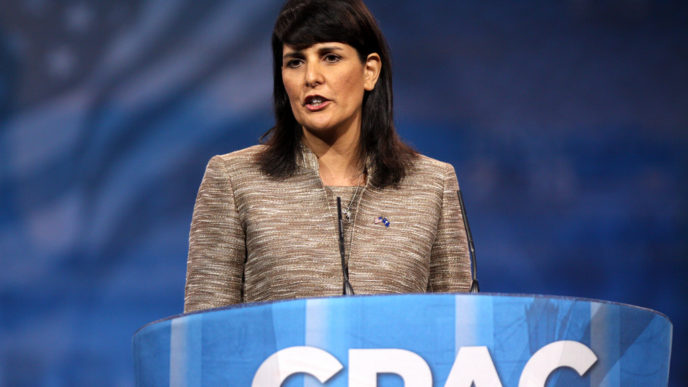
US Leads Boycott of UN Talks on Nuclear Weapons Ban

The United States, Britain and France are among almost 40 countries boycotting talks on a nuclear weapons ban treaty at the United Nations, according to Nikki Haley, the US ambassador to the world body.

With none of the participants – more than 100 countries – at Monday’s talks belonging to the group of states that possess nuclear weapons, the talks were doomed to failure.

According to Haley, the countries skipping the discussions “would love to have a ban on nuclear weapons, but in this day and time we can’t honestly say we can protect our people by allowing bad actors to have them and those of us that are good trying to keep peace and safety not to have them.”

Speaking as the debate at the UN headquarters in New York got under way, Haley also mentioned North Korea, which has recently has carried out missile tests that violate UN resolutions.

“We have to be realistic. Is there anyone who thinks that North Korea would ban nuclear weapons?” Haley said. “North Korea would be the one cheering and all of us and the people we represent would be the ones at risk.” (Read more from “US Leads Boycott of UN Talks on Nuclear Weapons Ban” HERE)

Follow Joe Miller on Twitter HERE and Facebook HERE.
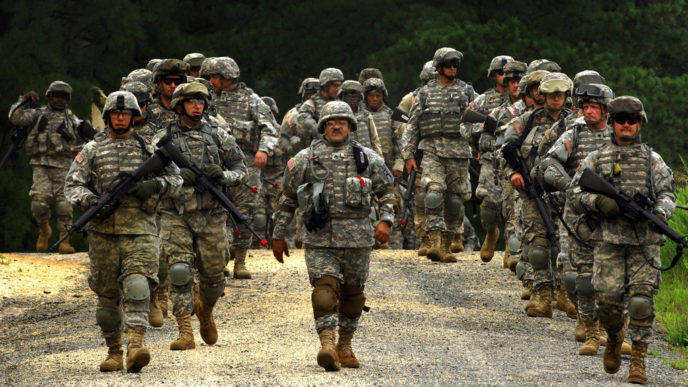
US Sending Around 200 More Troops to Middle East, Official Says

Two companies from the U.S. Army’s 82nd Airborne Division are being deployed to the Middle East to bolster security in either Iraq or Syria at the request of the top American commander in Baghdad fighting ISIS, a U.S. defense official with knowledge of the order told Fox News.

It is not immediately clear where the roughly 200 additonal troops will end up. That decision will be made by Army Lt. Gen. Stephen Townsend, the top commander of the U.S.-led coalition charged with running the war against ISIS on the ground.

The Pentagon was expected to provide more details on the deployment Monday.

In recent weeks, multiple press reports said upwards of 1,000 additional American troops would deploy to Kuwait or Syria to act as a “reserve force.” These reports were said to be inaccurate by multiple Pentagon officials.

“I don’t foresee us bringing in large numbers of coalition troops, mainly because what we’re doing is in fact working,” said Townsend in a press briefing with Pentagon reporters earlier this month. (Read more from “US Sending Around 200 More Troops to Middle East, Official Says” HERE)

Follow Joe Miller on Twitter HERE and Facebook HERE.

Why This Pastor Refuses to Leave War-Torn Syria, and Even Considers His Work a Privilege

Pastor Edward Awabdeh has been leading souls to Christ in Syria for over a decade, even through the worst of his country’s catastrophic civil war.

“It’s so painful to see the degree of evil that’s taken place in my country,” Awabdeh says, lamenting what has become of Syria. But his faith has not only grown in response, it has helped him make sense of the disaster.

Awabdeh oversees Alliance Church and around 20 other congregations in Syria, according to a story at the U.K. Express last year, where his congregation has endured not only the horrors of the country’s civil war, but the encroaching presence of ISIS in the region.

When your mission field is a literal warzone and your congregants under constant threat of becoming casualties, carrying out the great commission is a daunting task.

In an interview with Conservative Review, Pastor Awabdeh recalls one week in particular that was exceptionally trying for his flock. During the week leading up to Easter a few years ago, one of the church girls – who was supposed to sing for Palm Sunday – lost both of her feet in a mortar attack on her school, one of the women of the church was killed in a missile attack on an apartment complex, and a son of one of the church’s pastoral team was killed amidst the conflict.

“I felt a very heavy burden … that it was too much to handle,” Awabdeh said, explaining that he also had to go through with the regular Easter services all the while supporting the grieving families affected by loss.

“It was very challenging,” he said. “But when you see people experiencing the help of the Lord and seeing that the Holy Spirit is really filling their hearts with peace, it was really a great encouragement to us. It really empowers us.”

Speaking before the interview at an event on Capitol Hill, Awabdeh told a similar story of a woman in the congregation whose son was killed by Al-Nusra forces, where militants went door to door slaughtering Christian men en masse, in a genocidal attack. He said the mother – whose son willfully and proudly accepted his martyrdom – still doesn’t know where her child is buried.

Another man he knew, Awabdeh says, was killed by Islamists simply because he had a Christian name.

But, for Christians, the Syrian civil war and its impact are just part of a larger pattern of persecution, conflict, and genocide that is steadily driving Christianity out of the region in which it was born. In his speaking engagement on Capitol Hill, hosted by the International Christian Concern, United States Commission on International Religious Freedom, and the House International Religious Freedom Caucus, Awabdeh remarked sadly on Christianity’s desperate and beleaguered situation in the region.

“It seems that each year goes by, more Christians leave the country,” he said. “Century after century, Christians became less and less.”

Times are indeed dark in the pastor’s homeland. But seeing people come to Christ through such indescribable suffering and desolation is what makes the nightmare in his country make sense to him.

“I see that the Lord has allowed this disaster in my country, but that he is using this disaster to bring eternal salvation, eternal fruits [to people],” Awabdeh tells CR. “That helps me — that He has a great project that He is working on … that it is something eternal and that He is using church to be an instrument in this project. This is the most, one singular encouragement of my life.”

Having served as a pastor in Damascus since 2004, Awabdeh said that the decision to stay when war broke out was a natural one for him and his congregation, even as millions of others began to flee the carnage.

“It was not a challenging decision at all, because I am pastoring a church and I am just helping people,” he says, adding that he only thinks about it when he is asked. “So, when things got worse we felt it was just the normal thing to do — the right thing to do.”

“When things got really bad,” Pastor Awabdeh said, “we felt like it was a privilege to be there. We felt that the hand of the Lord was doing something in this country. How blessed are we that we are there to be part of what the Lord is doing in this country? So we thank God for this privilege.”

“It really taught us in a hard way how to be focused on what’s eternal. And I think this lesson was spread in a clear language to everybody among us,” he said, saying that the challenges he and his congregation have endured have taught them to rely on their faith and God completely. “We need Him every minute, every day of our lives.”

He says that when things get especially tough, one portion of scripture that he goes to for support is the second half of Romans 8, which St. Paul wrote to persecuted Christians, laying out the promises and the power of God.

“I feel that’s very comforting, the wonderful promise of Jesus,” Awabdeh says. “I always feel like the sovereignty of God and the love of God are the two wings that carry me through the storm.” (For more from the author of “Why This Pastor Refuses to Leave War-Torn Syria, and Even Considers His Work a Privilege” please click HERE)

Follow Joe Miller on Twitter HERE and Facebook HERE.

Russia Rocked by Nationwide Protests

Russia’s opposition, often written off by critics as a small and irrelevant coterie of privileged urbanites, put on an impressive nationwide show of strength Sunday with scores of protest rallies spanning the vast country. Hundreds were arrested, including Alexei Navalny, the anti-corruption campaigner who is President Vladimir Putin’s most prominent critic.

It was the biggest show of defiance since the 2011-2012 wave of demonstrations that rattled the Kremlin and led to harsh new laws aimed at suppressing dissent. Almost all of Sunday’s rallies were unsanctioned, but thousands braved the prospect of arrests to gather in cities from the Far East port of Vladivostok to the “window on the West” of St. Petersburg.

An organization that monitors Russian political repression, OVD-Info, said it counted more than 800 people arrested in the Moscow demonstrations alone. That number could not be confirmed and state news agency Tass cited Moscow police as saying there were about 500 arrests. (Read more from “Russia Rocked by Nationwide Protests” HERE)

Follow Joe Miller on Twitter HERE and Facebook HERE.