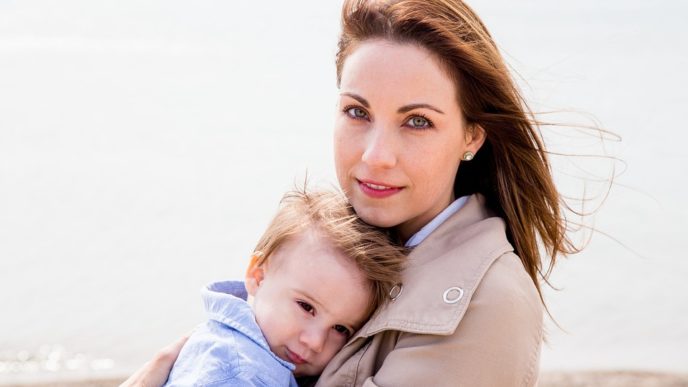
Parenting Coach Urges Mothers to ‘Prioritize’ Children in New Book

Veteran psychoanalyst Erica Komisar is encouraging mothers to prioritize their children over their careers. She spells out her argument in a new book published last week, Being There: Why Prioritizing Motherhood in the First Three Years Matters.

Already, the working mother of three has been called “anti-feminist.” Writing for TIME Monday, Komisar says she’s a feminist, but “child-centric.”

“I strongly believe that women and men should have equal opportunities and choices,” Komisar writes. “I also believe that both women and men, whether they work or not, should put their children first in every way.”

Rising Levels of Anxiety and Depression

Komisar’s insights come from working as a psychoanalyst, social worker and parent guidance expert for over 25 years.

“In my practice I was seeing an epidemic level of children with emotional problems related to the absence of mothers,” she told Fox News. The emotional problems appeared in one in five kids and included anxiety, depression, aggression and ADHD. A child’s chance for such problems increase when their mother returns to work after a short maternity leave, Komisar said.

But not all women can afford to stay home for three years after their child is born. This is something Komisar understands.

It’s not about working or not working, she said of Being There. “It’s a book about prioritizing your children to the best of your ability in the first three years.”

“The first three years are what we call the critical period of brain development,” she said. “By three years old 85 percent of your right brain, or social-emotional brain, is developed.”

She also noted that “you can be there physically, but not emotionally … Being emotionally present means putting away your distractions.”

Pressured to Prioritize Work

But many women feel pressured to prioritize work over children.

Last month Australian columnist Sarrah Le Marquand suggested it be illegal for moms to stay home. The Atlantic published a series last year exploring in part the struggle working mothers face in deciding what to prioritize. Women like Sheryl Sandberg continue to push hard for women to run half of the world’s companies, viewing anything short of the 50/50 goal as a sign of sexism. This is despite the fact that millennials embrace a more traditional family structure. The Washington Post also reported married mothers’ participation in the labor force hasn’t grown since the 90s.

“I dream of a society where women aren’t asked to put their careers before all else at the risk of stunting their own potential,” Komisar writes.

She is glad that today’s women have more choices to pursue careers than previous generations. “But having choices means not that we should, but that we can, if we want to.”

“You may never become a chief executive if you choose to make your family your first priority, and that’s a loss,” she writes. “But sacrificing the chance to create a close relationship with your children is a loss, too.”

Moms and Dad: Both Important, but Different

Komisar told Fox News that while both moms and dads are critical to nurturing their children, “they’re not exactly the same.”

That’s because men and women react differently to oxytocin. Oxytocin is the “love hormone” the brain releases when caring for one’s children.

“For women it makes them more empathic and sensitive nurturers,” she said. “For men it makes them more playful, and it makes them encourage their children to be resilient.”

“Life is long, and you have many, many years to work and be ambitious and make money,” Komisar told Fox News. “You only have a few years to have that great influence on your children.” (For more from the author of “Parenting Coach Urges Mothers to ‘Prioritize’ Children in New Book” please click HERE)

Follow Joe Miller on Twitter HERE and Facebook HERE.

Trump Warns North Korea: ‘Gotta Behave’

A day after a failed North Korean missile test, U.S. President Donald Trump had a message Monday for the North’s ruler: ‘Gotta behave.” At the same time, Vice President Mike Pence warned at the Korean Demilitarized Zone that America’s “era of strategic patience is over.”

Keeping up the verbal volleying, North Korea’s deputy U.N. ambassador accused the United States of turning the Korean peninsula into “the world’s biggest hotspot” and creating “a dangerous situation in which a thermonuclear war may break out at any moment.”

Pence’s visit to the tense DMZ dividing North and South Korea came at the start of a 10-day trip to Asia and underscored U.S. commitment. It allowed the vice president to gaze at North Korean soldiers afar and stare directly across a border marked by razor wire. (Read more from “Trump Warns North Korea: ‘Gotta Behave'” HERE)

Follow Joe Miller on Twitter HERE and Facebook HERE.

Manhunt Expanded for Suspect in Facebook Video Killing

Authorities in several states were on the lookout Monday for a man police say shot a Cleveland retiree collecting aluminum cans and then posted video of the apparently random killing on Facebook.

“He could be nearby. He could be far away or anywhere in between,” FBI agent Stephen Anthony said on Day 2 of the manhunt for Steve Stephens, a 37-year-old job counselor for teens and young adults.

Police said Stephens killed Robert Godwin Sr., a 74-year-old former foundry worker, on Sunday. (Read more from “Manhunt Expanded for Suspect in Facebook Video Killing” HERE)

Follow Joe Miller on Twitter HERE and Facebook HERE.

You’ll Never Guess How Much Money Delta Is Willing to Offer Flyers Who Give up Seats

Delta is letting employees offer customers nearly $10,000 in compensation to give up seats on overbooked flights, hoping to avoid an uproar like the one that erupted at United after a passenger was dragged off a jet.

United is taking steps too. It will require employees seeking a seat on a plane to book it at least an hour before departure, a policy that might have prevented last Sunday’s confrontation.

Those and other changes show airlines are scrambling to respond to a public-relations nightmare — the video showing airport officers violently yanking and dragging 69-year-old David Dao from his seat on a sold-out United Express flight. (Read more from “You’ll Never Guess How Much Money Delta Is Willing to Offer Flyers Who Give up Seats” HERE)

Follow Joe Miller on Twitter HERE and Facebook HERE.

State Funded Abortions Increase 27% under Alaska’s Governor Walker; Dangerous Chemical Abortions Increase as Well

Abortions reported in Alaska dropped last year, but increasingly, abortion practitioners are performing chemical abortions later in pregnancy – killing later-term unborn babies and exposing mothers to greater risks of complications that result in surgery.

According to the state’s Bureau of Vital Statistics, in 2016, 1,260 abortions were performed in Alaska, a five-percent drop from 2015 and the fewest since 2003 when Alaska began recording data.

At the same time, chemical abortions were performed on unborn babies up to four months gestation – well beyond the point the federal Food and Drug Administration (FDA) considers safe for women. There were 329 chemical abortions, including 40 between 9 and 12 weeks, two between 13 and 16 weeks – or four months – and one at a gestational age “not stated.”

LATER & LATER CHEMICAL ABORTION

Chemical abortions involve the mother’s ingestion of a high-powered mix of synthetic hormones which cause the unborn baby’s nourishing placenta to detach from the uterine wall. These abortions often employ mifepristone (RU-486), in combination with other drugs.

Chemical abortions typically require at least three trips to the abortion facility. After the first round of drugs is administered in the clinic, up to 30 percent of women abort later at home or work, and as many as five days later.

According to the Guttmacher Institute, once the research arm of the billion-dollar abortion chain Planned Parenthood, there were 272,400 chemical abortions performed in the U.S. in 2014, about 29.4 percent of the total – an increase of 13.8 percent in three years. According to Alaska’s report, in 2016 chemical abortions were 26.5 percent of the state’s total.

There are serious and well-documented medical side effects of chemical abortions, including severe bleeding and lethal systemic infection (sepsis). In fact, since RU-486 came on the market in the U.S. in 2000, maternal deaths from legal abortion have reached over 100.

BEYOND FDA LIMIT

The dangers of chemical abortions increase with the age of the unborn baby. The federal Food and Drug Administration’s drug protocols limited the use of RU-486 to the first seven weeks of pregnancy because of increased risk of failure if used later. Resulting “incomplete abortions” means aborting women end up in surgical abortions sometimes weeks after.

Nevertheless, in 2016, the Obama Administration issued new RU-486 protocols for use up to 10 weeks or two-and-a-half months.

Last year’s chemical abortions in Alaska were done on unborn babies up to 16 weeks or four months.

In fact, every year since 2003, when Alaska began recording data, abortion practitioners in the state have reported using RU-486 beyond the FDA’s original seven-week limit and even beyond the new 10-week limit.

From 2003 through 2015 — while FDA’s seven-week protocol was in place — Alaska abortionists performed an average of 12 RU-486 abortions annually on unborn babies between nine and 12 weeks (This does not include those performed in 2004 since abortion method data for that year was not included in the Bureau’s annual reports). In 2016, chemical abortions on babies in that age range hit 40.

These do not include those abortions in which abortionists fail to state the baby’s age — a regular occurrence. In 2013 alone, abortionists reported 32 RU-486 abortions without identifying the baby’s age.

In 2005, 2014 and 2016, abortionists performed four chemical abortions on unborn babies ages 13 to 16 weeks.

It is not clear how many women suffered complications in these RU-486 abortions. Alaska does not require abortion practitioners who administer chemical abortion drugs to report complications. In the State of Ohio, where abortion providers are required to do so, RU-486 complications in three reporting counties more than doubled after the FDA relaxed its protocols.

Despite the dangers, Planned Parenthood continues to expand use of RU-486, calling it “a safe and effective way to end an early pregnancy.” And abortion practitioners are pushing to allow chemical abortion drugs be administered directly by pharmacies or ordered online, doing away with appointments with a doctor.

BABY’S MILESTONES

By the time RU-486 abortions are performed, an unborn baby has reached significant milestones in her life.

At fertilization on day one, the embryonic baby is an individual distinct from her mother. By 22 days the unborn baby’s heart begins to beat, often with a blood type different from her mother’s.

At five weeks of pregnancy, the unborn baby’s nervous system is forming.

By the seventh week of pregnancy — the original FDA limit for RU-486 — the unborn child has a face, arms and legs. She kicks and swims.

At the eighth week, every organ is in place, fingerprints form, and the baby starts to hear.

In the 10th week — the FDA’s new RU-486 limit — the baby can turn her head, frown and hiccup.

By the 12th week, the baby — with nerves and a spinal cord — can experience pain. And the baby can suck her thumb.

By 16 weeks – or four months – the baby’s heart is pumping 25 quarts of blood a day. By the end of the fourth month, the baby is 8-10 inches tall and weighs up to a half-pound.

ALASKA REPORTING REQUIREMENTS LAX

Alaska’s abortion statistics are based on forms submitted from across Alaska by abortion practitioners who are required by law to report the procedures. Compared to many states, Alaska’s abortion reporting requirements are considered lax. Abortion practitioners may refuse to disclose data such as the methods they used and the ages of the babies they aborted. If a baby’s age is disclosed, it need only be the abortionist’s estimate.

“This report uses the physician’s estimate of gestational age,” states the Bureau’s report. But it is not clear on what basis reporting abortionists make their estimates. Relying only on an estimate of the baby’s age, the abortion practitioner may not provide a woman sufficient information to make a fully informed decision and could imperil her health.

Moreover, Alaska abortionists are not required by state law to perform an ultrasound before an abortion, the gold standard tool to date and locate a pregnancy. Chemical abortion is contraindicated in the case of ectopic or tubal pregnancy. But without an ultrasound, a tubal pregnancy is easy to miss. Ingesting RU-486 could result in a ruptured fallopian tube, a deadly prospect for child and mother.

Abortion practitioners risk little if they don’t fully report or even if they furnish false information to the state’s Bureau of Vital Statistics: a misdemeanor and, if convicted, a fine of not more than $100.

PUBLIC FUNDING OF ABORTIONS

In 2016, 556 (44.1 percent) of all Alaska abortions were paid for through state Medicaid funds. That compares to 438 abortions (33 percent) in 2015 (that’s a 27% increase in state-funded abortions from 2015 to 2016). (For more from the author of “State Funded Abortions Increase 27% under Alaska’s Governor Walker; Dangerous Chemical Abortions Increase as Well” please click HERE)

Follow Joe Miller on Twitter HERE and Facebook HERE.

Don’t You See What’s Happening? Walker Isn’t Selling–Walker’s Buying!!

There’s a memorable scene in the classic Christmas movie “It’s A Wonderful Life” that aptly sums up what is taking place in Juneau this year. In the scene, Jimmy Stewart passionately explains to his neighbors how the local tycoon’s offer to take over the town’s insolvent bank in exchange for their rights as stockholders really isn’t as generous as it sounds.

Alaskans today face an orchestrated campaign designed to convince them that their future is inexorably tied to the continued government takeover of our economy and that they should abandon their investment in any other future. It’s a powerful message. No doubt some reading this have already been convinced.

The message is not geared for those who work for the state. No, state employees and contractors don’t need to be convinced. Their future really IS tied up in the growth of state government. It’s all the rest of us that this campaign is directed at.

Under this campaign, threatening Alaskan veterans and seniors with fake eviction notices is A-Okay if it results in Mat-Su residents telling their legislators to pass an income tax. In fact, the greater the hysteria, the greater the effect. As with any bailout, the overarching goal boils down to one basic thing: to push consequences off of state government and onto somebody (everybody) else. State government is what must come first. It is the truly essential part of our state: “The people may come and go, but we must take care of the government.”

Do you see what is happening? Special interests rallied together to put a governor into office. That governor has now put them and the state agencies they partner with to the front of the line. Voila! Time for a government bailout! Note: Even though we have over $15 Billion in reserves, we call this a “fiscal crisis”.

Of course, it’s not a fiscal crisis (which is why we have to resort to “fiscal terrorism” of Alaska’s seniors to try to generate support for more taxes). In actuality, it’s a government crisis. But who among us is moved to action by hearing that state government has been spending more than our economy can sustain, and needs to cut back? What’s new?

Yep, that about sums up what is taking place in the capitol this year. The governor demanded more money from Alaskans last year (and more money to government), and he has now terrorized various groups of people (including seniors and vets and those who drive on KGB) into going along with it. The senate just passed a statewide tax that will take $5,000 from every family of four this year, and that’s just the PFD cut.

By convincing the legislature to redirect the dividend and the earnings of the Permanent Fund from Alaska’s private sector to state government, he has “solved the crisis” and is every bit the hero of the state public sector. And while the private sector now experiences the recession even more painfully than it otherwise would have, significant portions of state government get to celebrate that the crisis of downsizing has been averted yet again.

You ask me how this arrangement can continue? Well of course, it can’t, because there is only so much permanent fund money to go around and the appetite of government is limitless. Alaskans allowed their representatives in the State House to approve spending more than $4 Billion of the Permanent Fund

Earnings this year. Think about that. The straw has hardly been placed in the fund, and the vote was to suck out more than $4 billion in the very first swallow!

Talk about unsustainable!!!

Alaskans need to lay the smackdown and fight for a future in which we still have a permanent fund when my kids graduate high school.

Yes, as a resident of Alaska, you are a shareholder (whether you like it or not). If that makes you feel uncomfortably responsible…that’s probably a good thing. You and I each own shares in the future of Alaska, and in the Permanent Fund that has permitted Alaska’s economy to continue to be as “normal” as it is today. Without that Permanent Fund you would see a smaller state economy today, less support for local government, and an even smaller private sector. You would also see the state with a lower credit rating, higher taxes, less investment in Alaska on account of the higher taxes, and an Alaskan economy that looked a bit more like Puerto Rico’s (Note: That’s not a good thing).

You’re invested in this great state simply by living here, and a governor I know would love to take your shares in exchange for a short-term government subsidy. The existence of a “fiscal crisis” is the justification for those invested in state government to do what they’ve always wanted to do: crack the code on how to get Alaskans to redirect the Permanent Fund earnings to government and away from the private sector.

Amazingly, they’ve already convinced enough legislators to do this, in a time when Alaskans are having to lose their health insurance because they can no longer afford it. Oh, and they now tax you for that too! And while some Alaskans are trying to find the money to pay the tax for not having healthcare insurance, the State House of Representatives just voted to pass another $650 Million in new broad-based taxes on all Alaskans. Government crisis solved!!

Government isn’t shrinking in Alaska today. It’s just increasing its market share over the private sector.

Follow Joe Miller on Twitter HERE and Facebook HERE.

We’ll Never Put a Dent in Federal Spending When So Many RINOs Want to Keep After-School Welfare Programs

There is no Republican Party with a united message even related to the most bedrock principles upon which our nation was founded. Not only do most Republicans support the entire premise of the $70 billion+ federal intervention in education, but evidently a number of them support federal involvement in after-school programs!

It’s no secret that Donald Trump, a lifelong Democrat, is not considered a staunch fiscal conservative. And with liberal Gary Cohen running point on domestic policy, we’re lucky to have the president sign off on any modicum of fiscal conservatism. Yet, the one bright spot in the administration is the conservative staff at the Office of Management and Budget (OMB), who have drafted a discretionary budget for FY 2018 that actually fulfills his promise to cut wasteful spending in the deep bureaucracies. Now, congressional Republicans are balking at every spending cut, demonstrating that they are ideologically to the left of a lifelong Democrat on spending, and that many elected Republicans are merely the affirmative action version of Democrats.

If we believe that the federal government should be involved in funding after-school and summer programs for local communities, then there is no party in Washington that believes anything should be outside the scope of the federal government. It’s that simple. It’s simply indefensible for cradle-to-grave-socialism on such a local level to be funded by the federal government, yet the federal government funds just that through the 21st Century Community Learning Centers (21st CCLC) to the tune of $1.67 billion a year. Now, a group of 81 Republicans and Democrats, pressured by teacher’s unions and rent seekers who stand to benefit from “free funding,” are demanding that the Trump administration take this program off its list of cuts.

Late last week, a group of Democrats and Republicans sent a letter to education appropriators requesting that they reject the administration’s call to eliminate the 21st CCLC program. Here is a list of the Republicans who signed the letter:

Susan Brooks, R-Ind.

Lou Barletta, R-Pa.

Ryan Costello, R-Pa.

John Katko, R-N.Y.

Peter King, R-N.Y.

Steve Stivers, R-Ohio

Don Young, R-Alaska

It’s worth noting that Steve Stivers is the chairman of the NRCC, the official Republican committee dedicated to recruiting Republican House candidates. Yet, he doesn’t believe in a foundational Republican principle on education and the role of the federal government! Stivers also recently suggested that in general the GOP needs to work more closely with Democrats rather than with conservatives.

Despite the mellifluous-sounding platitudes in this letter of praise for after-school programs, there is no evidence that this program has netted any success. A very detailed study of this program in 2007 found that after 13 years, much like other government expenditures on education programs, it merely treated bad behavior rather than solving it. Here is a synopsis of the findings as described by David Muhlhausen of the Heritage Foundation:

A multisite experimental impact evaluation of the 21st Century Community Learning Centers program found a whole host of harmful effects.28 Overall, teachers found participating students to have disciplinary problems that were confirmed by student-reported data. According to their teachers, participating students were less likely to achieve at above average or high levels in class and were less likely to put effort into reading or English classes. These students were also more likely to have behavior problems in school than their counterparts. Teachers were more likely to have to call the parents of participating students about misbehavior. Participating students were also more likely to miss recess or be placed in the hall for disciplinary reasons, while also having parents come to school more often to address behavior problems. 21st Century students were also more likely to be suspended from school than similar students.

While reading Mr. Muhlhausen’s congressional testimony from 2015, it’s hard to ignore the absurdity of the entire premise that the federal government should deal with such micro-behavioral issues in school. Yet, even Republicans, and I’m quite certain many more of them than those who signed onto this letter, support full federal involvement in this matter. Just consider the views of Lamar Alexander, R-Tenn., on cradle-to–grave government education. And he is the top Republican chairman on education in the Senate!

What is evidenced by the fight surrounding the after-school program is that every single proposed cut to a program across the federal budget will illicit backlash from many of these same Republicans in addition to every Democrat. This is why we won’t even make a dent in the federal deficit even though the debt is going to drown out our fiscal solvency within a decade and is already smothering economic growth.

Also, remember that some of these members are the very same individuals who are blocking repeal of even a few crucial elements of Obamacare (much less the entire program). They run as Republicans, but govern like Democrats — even on the core issues. I’m still waiting for the Democrats to have their own Tuesday Group.

This opposition to Trump’s budget also reveals another growing trend — that when conservatives oppose Trump from the Right, the president goes after them with full force. But when liberal Republicans oppose him from the Left, he is largely silent. To borrow a math analogy, we are incurring the lowest common denominator of the ideological vices between Trump and congressional Republicans instead of enjoying the greatest common factor. There are no signs that the Trump administration will demand the inclusion of his budget priorities in the upcoming April budget bill, after congressional Republicans already sold out to Chuck Schumer, D-N.Y. As it relates to education, it doesn’t help that a number of Jeb Bush staffers are attempting to infiltrate the Department of Education, which is already under weak leadership.

At its core, this is why Republicans are facing some head winds in special elections that should be slam dunks. They have elicited the backlash of an energized opposition, but have not enjoyed the benefits of energizing their own base with policy victories. This is akin to Obama helping spawn the Tea Party — but at least he delivered for his base and kept them energized to win a second term. Until and unless we have a party willing to unite behind some basic principles, Republicans will not hold power for very long. After all, why not just vote for the real thing instead of the poor-man’s version? (For more from the author of “We’ll Never Put a Dent in Federal Spending When So Many RINOs Want to Keep After-School Welfare Programs” please click HERE)

Follow Joe Miller on Twitter HERE and Facebook HERE.

Millennials’ Views on Communism: All the Proof You Need on Education System’s Abject Failure

Call it the latest in proof positive some Millennials are hell-bent on being ignorant and brash, but they did all they could to live up to their poor reputation earlier in March. A group of Millennials denigrated the Victims of Communism (VOC) Memorial on Capitol Hill, taking photos of themselves flipping it the middle finger, then posting and bragging about their slimy conduct on social media.

Millions of people have been murdered, tortured, and persecuted by communist dictators like Joseph Stalin, Mao Zedong, and Fidel Castro. The memorial was built to honor those innocent lives. The front pedestal reads, “To the more than one hundred million victims of communism and to those who love liberty.”

Several Twitter accounts related to the incident link to the website of the Party for Socialism and Liberation, a socialist-third party that believes “the only solution to the deepening crisis of capitalism is the socialist transformation of society.”

Millennials for communism

This seems to go hand in hand with what we already know Millennials believe about communism as an ideology to be admired. In October, VOC released a survey which gauged Americans’ attitudes toward socialism, communism, and related ideas.

We knew Millennials, born in 1982-2002, had a thing for Bernie Sanders, I-Vt., but the VOC survey showed they embraced much more than just a grandfatherly version of an American-Socialist.

According to the study, just over half of millennials (55 percent) believe communism was and still is a problem, compared with 80 percent of Baby Boomers and 91 percent of elderly Americans. Only 37 percent of millennials have a “very unfavorable” view of communism, while 57 percent of the rest of Americans do. A surprising 64 percent of Americans agreed with the classic Karl Marx statement that underpins Marxist philosophy: “From each according to his abilities, to each according to his needs.

This was not only shocking about their present views, but revealing about their previous or current history education. Marion Smith, executive director of the VOC told me on the phone that the March incident not only “shows a callous disrespect of innocent lives sacrificed,” but unfortunately ties in with how rabidly Millennials have embraced communism. “I think incidents like this are made more likely because so many people don’t understand history. They don’t understand Mao and Stalin are mass murderers. They don’t know about the crimes committed by people of these communist regimes. They don’t understand the human misery as a real fact of history.”

What’s the appeal of dangerous ideologies like this to Millennials? Smith told me, “Many students are taught that the alternative to a free enterprise system is a form of socialism. A marxist interpretation of society. If you don’t like capitalism, the obvious alternative in most people’s minds is some form of marxist faith.”

Ignorance breeds fanaticism

This type of ignorance stems from a lack of education, and in some cases our nation’s cultural slide. But it is exactly what progressives — even Marxists — wanted in order to implement their policies. Millennials have become the type of de facto voter base socialist leaders cater to and ultimately exploit via everything from propaganda to crimes against humanity. If a person has little knowledge of historical perspective, and is therefore vulnerable and willing to agree with any ideological talking point that comes their way in a pretty package, that person is an easy target to woo, to turn into a fanatical zealot, and to then wittingly or unwittingly participate in the types of crimes these very leaders committed. Multiply that by thousands and you have a Katyn massacre on your hands — not because people always knew or were complicit (innocent people should not take the blame), but because evil dictators exploited ignorance and filled empty minds with their twisted ideology.

The only way to stop this trend is to cut it off where it begins: education. It’s imperative we press for a more expansive, clarifying education of global history to high school and college students so they are informed about how communism actually played out in various cultures. VOC has made significant efforts to that end, but more must be done.

Since studies show high-schoolers and collegiates don’t know basic facts about world history, let alone the staggering atrocities communist regimes committed, they offer a supplemental curriculum to aid teachers in educating students about this specific topic. A few minutes watching the videos within their “Witness,” project–stories of survivors of communism–might provide valuable perspective for some Millennials still touting Marx as a mentor. “The danger of forgetting history is it opens up what is acceptable in our politics,” reminds Smith. “The language of violence that is so much a part of certain ideologies.” Let’s do what we can to educate our young people, even Millennials, so this doesn’t happen again and so history does not forget those brutally murdered by communist regimes. (For more from the author of “Millennials’ Views on Communism: All the Proof You Need on Education System’s Abject Failure” please click HERE)

Follow Joe Miller on Twitter HERE and Facebook HERE.

Easter and Syrian Genocide: What Americans Can Learn

As Christians in America commemorate Easter, we are reminded of those who celebrate Jesus’ resurrection in places hostile to Christianity. Consider the Middle East Christians facing genocide. In an interview with The Stream, Knights of Columbus spokesperson Andrew Walther suggests there is much we can gain from the strength of those brothers and sisters in the Lord.

A Source of Inspiration

Last year then-Secretary of State John Kerry labeled the mass killing of Christians in the Middle East genocide. Still they remain strong in their faith, said Walther, spokesperson for the Catholic group Knights of Columbus (KoC). “They face the brunt of genocide,” but they’re still hanging on, he said. He added that their strength in the face of hardship and genocide should be a source of inspiration for Christians in the U.S.

They are optimistic about the new Trump administration, too. “I’ve been told by Iraqi Christians [that] they see a new openness in the past few months on the part of the U.S. government. They hope it translates into action,” said Walther.

Most Syrian Christians are still displaced, often in smaller camps that don’t get attention from organizations and governments on hand to help. “Christians don’t end up on the radar,” said Walther. But they’ve seen many Christian areas liberated. Some people are moving home. Just the fact that people are moving back is a good sign, said Walther. “It’s a first step, there’s still a long way to go.” He added that despite the problems in the area, there is a palpable optimism that things will get better.

The Cradle of the Church

In Iraq, the Christian population is down 80 percent since 2003. And in Syria, the Christian population is down about 60 percent since their civil war began in 2011. This is troubling for many reasons, but for Walther it goes back to St. Paul and his conversion. “The Syrian Christians weren’t converted by St. Paul,” he explains. “They baptized St. Paul. The idea that this [group] could disappear should be alarming.” He added that the roots of Christianity could disappear from the cradle of the Church. However, his organization is working hard to make sure that doesn’t happen.

Knights of Columbus

The Knights of Columbus has operated in the area since mid-2014 when ISIS really began taking over the territory. Walther said the KoC provide help through medical clinics, food, housing, catecheses programs among others. Just last month, the KoC pledged nearly $2 million to help the Syrian and Iraqi Christian refugees. The KoC use a variety of ways to help the people survive and rebuild.

But the assistance isn’t just for Christians, he is quick to point out. “Our clinics we fund and programs can’t turn anyone away,” he said, adding that it is a remarkable witness to non-Christians in the area who are served by Christian organizations.

Going On With Their Lives

Walther said he’d really like Americans to learn about the Christians in the area and how they’ve been persecuted for centuries. He also wants people to know that Syrian Christians “really want to go on with their lives, to go home and be full citizens in their country. They don’t want to be second-class citizens or discriminated against.” Much like the Western world, they’d like to celebrate Easter with family and contemplate Jesus’ gift to them of salvation without fear of persecution. But their faith has kept them strong, said Walther.

The Stream asked “What can Americans do?” Americans can pray for their brothers and sisters in the Middle East, said Walther, and help when possible through financial or other means. He adds that their strength in the face of genocide is an incredible testimony for American Christians and non-Christians alike. (For more from the author of “Easter and Syrian Genocide: What Americans Can Learn” please click HERE)

Follow Joe Miller on Twitter HERE and Facebook HERE.

Bill Nye: The Perfect Talking Head for a March against Science

Bill Nye may not be a scientist. But he used to play one on TV. Now he is an honorary co-chair and speaker for the “March for Science” in Washington D.C. and elsewhere on April 22.

The choice of Nye as one of the faces of the March is revealing. March organizers have paid lip service to critical thinking and “diverse perspectives” in science. However, Nye is a good example of someone who promotes science as a close-minded ideology, not an open search for truth.

He attacks those who disagree with him on climate change or evolution as science “deniers.” He wouldn’t even rule out criminal prosecution as a tool. Asked last year whether he supported efforts to jail climate skeptics as war criminals, he replied: “Well, we’ll see what happens. Was it appropriate to jail the guys from ENRON?”

Real science encourages debate. It doesn’t insist that scientists march in lockstep. Or that they speak with one voice. In fact, scientists disagree on far more issues than the March organizers admit.

Models Vs. Evidence

Take global warming. Many marchers will wear their belief in climate change on their sleeves. On their signs, too. They, like Nye and others who claim to speak for science, equate belief in man-made climate disaster with science itself. If you disagree, you’re “anti-science.”

Yet there are strong reasons to doubt the so-called “consensus” on warming. But the popular media rarely cite them.

From 1890 to 1990, records show only a .45 degree C rise in global temperature as measured from near-surface thermometers around the Earth. Yet about 75 percent of the increase occurred before World War II, while most of the increase in human produced greenhouse gases occurred after World War II. So, human industrial activity doesn’t really correlate with the main effect of interest. Meanwhile, after a few warmer than usual years in the early 1990s, global temperatures have flat-lined. They show no net increase over the last two decades.

Most warmists’ models have predicted steep rises. But these models don’t match the real global temperatures collected after the fact. So why believe the dire predictions that those same models make about future temperatures before the fact?

Bill Nye, Al Gore, and former President Obama have said we must accept what “the scientists” say. To listen to the skeptics would be to reject “settled science.” But skeptics of extreme warming include many top scientists: physicists, biologists, earth and atmospheric scientists like Richard Lindzen (MIT), Freeman Dyson and William Happer (Princeton), Roy Spencer (University of Alabama, formerly NASA), John Christy (Earth System Science Center, University of Alabama), and Matt Ridley (DPhil, Oxford). How strong can the “consensus” be if such stars of science question the idea?

What About Neo-Darwinism?

But let’s say widespread agreement did exist on the question. Has such an agreement served as an error-free guide to truth in the past? The history of science says no.

Here’s another scientific issue to ponder. Nye claims the evidence for evolution is “Undeniable.” That’s how he put it in the title of his recent book. By “evolution” he means textbook neo-Darwinism. So the case for evolution is “undeniable”? In truth, many leading scientists, including evolutionary biologists, reject neo-Darwinism. Many biologists now doubt the creative power of random mutation with natural selection. But that is the core idea of the theory.

This past November I attended a conference of the prestigious Royal Society of London. The meeting was called to address this problem. Speaking first, biologist Gerd Müller listed the “explanatory deficits” of neo-Darwinism. He said those include its failure to explain the “origin of biological complexity” and the origin of major morphological “novelties.” It also doesn’t predict their abrupt appearance in the fossil record.

Other biologists echo his concerns. They argue that mutation and selection can account for “the survival, but not the arrival of the fittest.” That is, minor, but not major, changes in the history of life.

I say more on this in my book Darwin’s Doubt. For instance, neo-Darwinism fails to explain the origin of the new genetic information needed to build new forms of life.

Our own experience with computer code helps to explain why. Random changes to the digital characters in a section of functioning software code will degrade the information in a program and destroy its function. That will happen long before those changes can generate a new program or operating system. Yet, neo-Darwinists invoke just such random changes to the characters in the genetic text to explain where new genetic information comes from. Mathematicians who know biology say “not a chance.”

What Do You Mean By “Evolution”?

In any case, the textbook examples of natural selection and random mutations do not involve creating new genetic information. Many biology texts tell about the famous finches in the Galápagos Islands whose beaks have waxed and waned in shape and length over time. These books also recall how moths in England got darker and lighter as levels of industrial pollution changed. Darwinists present such cases as knockdown evidence for evolution. But that depends on what you mean by “evolution.”

That term has many meanings. “Evolution” can refer to anything from minor change within the limits of a gene pool to the creation of wholly new genetic information and structures.

Yet, as a host of biologists have argued in recent papers, small-scale “micro-evolutionary” changes can’t explain large-scale “macro-evolution.” Mostly, micro-evolution (such as changes in color or shape) just uses pre-existing genetic information. But the large changes needed to build new organs or whole body plans need entirely new sources of information. This explains the growing doubts about the power of natural selection and random mutation.

It also explains why many biologists are seeking new theories of evolution. As yet, though, nothing like a consensus is emerging.

March for Conformist Science

Don’t expect Nye or the others “marching for science” to breath a word about any of this. And that’s a shame. A real “March for Science” would celebrate scientific puzzles, disagreements, and competing ideas rather than fear them.

Just ask Italian philosopher of science Marcello Pera. In his book The Discourses of Science, he writes that science advances as scientists argue about how to interpret the evidence. They can only do that, though, if they are free to challenge established ideas and advance new ones.

Those who truly want to support science should defend the right of all scientists — including dissenters — to express their views. Those who stigmatize dissent do not protect science from its enemies. Instead, they subvert the process of scientific discovery they claim to revere. (For more from the author of “Bill Nye: The Perfect Talking Head for a March against Science” please click HERE)

Follow Joe Miller on Twitter HERE and Facebook HERE.