Why Don’t We Care about the Slaughter of Christians?

A United Airlines passenger is violently hauled off a plane, and there is national outrage, rightly so. Press Secretary Sean Spicer says that Assad is worse than Hitler, and again, there is national outrage, rightly so. Forty-five Egyptian Christians are slaughtered by ISIS while attending church services on Palm Sunday and scores of others are wounded, and there is barely a national yawn. How can this be?

You might say, “That’s easy. The first two events took place right in front of our eyes, here in America. The third event took place in Egypt, and as tragic as it was, it’s a matter of out of sight, out of mind.”

I understand that. But what about the Islamic terror attack on the Brussels airport last year, killing more than 30 people? That was covered by our media day and night, with footage from the blast shown over and over by the hour.

And what about the Islamic terror attack in France, when a driver plowed his truck into hundreds of people in Nice, killing more than 80? That too received day and night coverage, with the bloody footage, including dead children lying in the streets, put before us by the hour.

But when it’s Christians being slaughtered by Islamic terrorists while worshiping the Lord in the safety of their church buildings, it only receives passing mention on our networks. Why?

We have the video footage of the attacks, which took place in two different locations in Egypt. We see the bomber being directed to walk through the metal detector, and then we see the massive explosion. And we see the carnage within one of the church buildings — blood all over the floor; corpses scattered in the debris; wooden pews torn apart; the sound of people moaning and crying.

The video footage is compelling and agonizing, just as much as any of the footage from Brussels or Nice. Yet most of us have not seen this footage on major TV networks, or if it has been aired on these networks, it has received a fraction of the coverage that the other attacks have received. Why?

But I’m not the only one asking this question. Nor is this a new question. For the last decade, a Christian genocide has been taking place in the Middle East representing one of the ugliest chapters in recent human history, yet most Americans remain sadly uninformed. The secular media is complicit.

As expressed by none other than Piers Morgan,

Unfortunately, if it happens in the Middle East, this kind of atrocity, it just does not seem to attract the kind of media attention in America that it would if it happened, as we’ve seen in attacks in Sweden the last few days, in London two weeks ago. I was there for that. Huge attention in the American media. In Paris and Nice. These get huge attention. Yet what happened in Egypt was unbelievably significant.

If you look at what ISIS really stands for, what they are carrying out now in the Middle East and the Egypt in particular, is a kind of genocidal attack on Christians and Christianity. They want Christianity eradicated and they want to convert all Muslims to their crusade, they want it to be a holy war. They want Christians gone. And I don’t think that narrative is getting the attention it should get in the American media and, I have to say, in other media around the world.

These are strong words: What happened in Egypt is a “genocidal attack on Christians and Christianity.” These Islamic terrorists “want Christianity eradicated. … They want Christians gone.”

Morgan added, “I think this is a huge story. This is the kind of story that ought to be dominating cable news in America. It should be dominating headlines around the world. ISIS have declared war on Christianity. I’m not seeing that being covered enough.”

He is absolutely right, and somehow, the secular media is barely covering one of the most important humanitarian stories of the age. Again I ask: Why?

We’re talking about multiplied hundreds of thousands of Christians being displaced, exiled, attacked, maimed, tortured, starved and killed. We’re talking about a crisis of epic proportions, yet the news coverage of this ongoing tragedy receives is negligible. Why?

Whatever the reason, there is a solution to the media’s relative silence.

All of us can raise our voices and draw attention to the suffering of our brothers and sisters in the Middle East (and elsewhere). And all of us can pray for their protection, their courage and their comfort. In the words of Letter to the Hebrews, “Remember those in prison, as if you were there yourself. Remember also those being mistreated, as if you felt their pain in your own bodies” (Heb. 13:3 NLT). (For more from the author of “Why Don’t We Care about the Slaughter of Christians?” please click HERE)

Follow Joe Miller on Twitter HERE and Facebook HERE.

My Near-Abortion Experience: What I Would Have Missed

Those of you who have read one of my earliest stories know how close I came to an abortion when I was pregnant with my fourth child. I considered it as a single 40-year-old mom of three. Now having just passed my son’s third birthday, I reflect on what could have been had I chosen death instead of life. Here’s what I would have missed.

I would have missed my baby calling me “Mama” for the first time. More than that, I would’ve missed hearing him sleepily say “Mama, I want you,” first thing in the morning as he’s waking in his crib.

I would’ve missed his cuddling and the kisses where we play who-can-smack-louder and say “MUA!”

I would’ve missed his first dance as I played TobyMac’s Feel It. (Incidentally, the chorus says, “You take our brokenness and make us beautiful.”)

I would have missed that precious day when a little voice in the back seat of the car said, “Mommy, you’re my best friend.” I almost cried.

I would have missed him saying “No, I want Daddy to change my poopy diaper,” because only Daddy knows how. (That is just fine with me).

I would’ve missed the dumbfounded look on his face when he was watching Johnny Depp play Willy Wonka and hearing him say, “Something on the T.V.’s strange.”

I would’ve missed hearing him say, “Mommy, I want to sleep in your big girl bed.” (Um, no.)

I would’ve missed hearing him talk about a bad day at daycare and concluding the story with “Every single one of those kids get on my last nerve!” (I laughed hysterically.)

I would’ve missed hearing him quote one of my favorite Madea movies, hollering at me: “Do you understand the words that are coming out of my mouth??!”

I would’ve missed all of the firsts. First kiss, first hug, first steps, first words, first tooth, first real meal.

I wouldn’t have known that he loved green beans. Or boudain (gross). Or hot salsa from Mexican restaurants. Or black olives that he puts on his fingers before popping them in his mouth.

I wouldn’t have known he was so independent. That his mantra would be, “I want to do it all by myself!” while brushing his teeth, or crawling into his car seat, or sitting on the big boy potty.

I wouldn’t have known his awesome personality. I wouldn’t have known him.

Yes, I would’ve missed all of the temper fits, the corner time, the spitting, the screaming, the poopy diapers. But I would’ve missed the greatest blessing in my life, too. I would’ve missed an unconditional love that is almost unequaled. Only Jesus did that better.

If I chose death over life, I would’ve still been trying to convince myself that it was only tissue. That I wasn’t ready. That I didn’t make a mistake. That a baby would’ve complicated things. And they do. But in the best way possible.

(For more from the author of “My Near-Abortion Experience: What I Would Have Missed” please click HERE)

Follow Joe Miller on Twitter HERE and Facebook HERE.

Why Jesus Washed the Apostles’ Feet, and Why We Do It Too

My wife has nice feet. Mine aren’t. I think of this every Holy Thursday. Our pastor washes the feet of twelve people, in imitation of Jesus washing the Apostles’ feet at the start of the Last Supper, and I always think “I’m glad I’m not up there.” Vain, I admit.

While I’m being honest, the washing always seems to me a little hokey. It feels to me more like theatre than worship. Bad theatre. Twelve people sit on chairs at the front of the church, most of them with their pantlegs rolled up, holding their shoes and socks in their hands. It doesn’t look real.

I know the reason we do it on Holy (or Maundy) Thursday. But the symbol is so far away from anything we do in our culture, it feels artificial to me. Who washes a guest’s feet? How does this apply in downtown Phoenix or the suburbs of Boston, or the corn fields of western Nebraska? We don’t do anything like that. It feels hokey.

The Sacramentum Christi

It may feel hokey, but it isn’t hokey. Like so many things in the Christian life, we learn backwards: first obedience, then understanding. In this case: first obedience, then understanding, then being able to enter into the symbol and feel its power.

Pope Benedict can help with this. The pope gives the Holy Thursday homily every year and Benedict talked about the washing in his homily in 2008. He called the washing a “sacramentum Christi.” That means the mystery of Christ as he comes to us.

Jesus’s washing the Apostles’ feet points to “the sacramentum Christi in its entirety: his service of salvation, his descent even to the cross, his love to the end, which purifies us and makes us capable of God.” His being a servant to his friends in that way — even to Judas, who he knows will betray him — points to the even greater sacrifice he would make for us the next day. He washed his disciples’ feet as a sign that he would die for them so he could wash their souls.

What does this mean for us? Lots, of course, but in this homily Benedict offers two lessons.

First, he says, it tells us to confess our sins. “We need the ‘washing of the feet,’ the washing of our everyday sins, and for this we need the confession of sins.” He points us to John’s first letter: “If we say, ‘We are without sin,’ we deceive ourselves, and the truth is not in us. If we acknowledge our sins, he is faithful and just and will forgive our sins and cleanse us from every wrongdoing.”

Notice he says “everyday sins.” He means the little sins we commit: snapping at the children, watching a TV show when we should be praying, pushing in front of someone in a line, saying snarky things about someone behind his back, thinking lustful or covetous or greedy thoughts. We may not have killed anyone, but we’ve gotten ourselves dirty, like having dirty feet. We must confuse those sins to God and ask him to clean us up.

The Gift to Others

This points us to something else, Benedict says. Washing others’ feet is a gift to them. He says this: “If I, therefore, the master and teacher, have washed your feet, you ought to wash one another’s feet.”

Not literally, in our culture. (For which I’m very glad.) Benedict explains: “We must wash each other’s feet in the daily mutual service of love. But we must also wash our feet in the sense of constantly forgiving one another.” Because, he says,

The debt that the Lord has forgiven us is always infinitely greater than all of the debts that others could owe to us (cf. Mt. 18:21-35). It is to this that Holy Thursday exhorts us: not to allow rancor toward others to become, in its depths, a poisoning of the soul. It exhorts us to constantly purify our memory, forgiving one another from the heart, washing each other’s feet, thus being able to join together in the banquet of God.

The Pastor Up Front

I will never, not in a million years, volunteer to be one of the twelve people sitting up front with their pantlegs rolled up having their feet washed. I suspect the ceremony will always feel a little hokey to me.

But less so now that I’ve read Benedict’s explanation. And less so, I hope, as God teaches me how better to confess my sins and love others more sacrificially. Especially by forgiving them, as I hope they forgive me. Which, to be honest, is probably easier than actually washing their feet. (For more from the author of “Why Jesus Washed the Apostles’ Feet, and Why We Do It Too” please click HERE)

Follow Joe Miller on Twitter HERE and Facebook HERE.

Have a Bleak and Blessed Good Friday

The weakest link in recurring adventure shows, like Daredevil or The Flash, is the lack of real suspense. However fatal the trouble the hero seems to be in, you know that he will survive it. Somehow or other. At worst, he will lose his powers for a while. Or he’ll “die” and get reanimated. I’m sure that writers struggle to keep the story compelling anyway. For us, marking Good Friday carries the same challenge.

It’s all too easy to let this holy day get swallowed up by Easter. We know how things turn out. Death gets swallowed up by victory. Jesus goes down into darkness just for a weekend.

In fact, we know that tomorrow He will be rooting around in Hades to free Elijah and Esther, Abraham and Moses, even schlemiels like Adam and Eve. They will follow Him to glory. So it’s all too easy for us to fast forward through the Passion. Just so, lax Christianity would glide over the darkness of sin, to focus on forgiveness. That’s natural, of course. But then, our nature is fallen.

To really embrace the grace that’s offered by this season, we must master our minds and emotions. We should travel the road of these holy days at the same speed as the apostles. It won’t help us to jump ahead. In fact, it impoverishes everything.

How to Harness Your Mind and Heart on Good Friday

Ignatius of Loyola invented a method of mental prayer. He called it the “composition of place.” It proved so powerful that soon English Protestants — no fans of Jesuits — were adapting it for themselves. (John Donne’s poetry bears its traces.) It’s easy to master and profoundly useful.

Take a Bible passage (for today, the Good Friday narrative) and try to place yourself there. See it through the eyes of one of its participants. Of Jesus, yes, but also of His disciples, the apostles, even His mother, Mary.

Use the five senses God gave us as your starting point.

Imagine what John must have heard coming down from the cross. The screams and cries and psalms. Then the jeers coming up from the raucous, whipped up mob.

What it smelled like, up on Golgotha, where bodies died every day.

What John saw looking up at the rabbi whom he had followed, even this far, as others had fled.

Squirm your toes in his sandals, and feel the ache of his feet, as he stood there for three long hours.

Taste the salt of his tears.

Go further, and try to imagine John’s disappointment. He too was a Jew, and surely treasured hope for earthly liberation. For an end to strutting Romans and sold-out Sadducees. For a king again in Jerusalem. Whatever John came to believe about Jesus’ broader mission, he surely did hope for that.

How did you feel the last time some crucial battle in the world went against you? Think back to the last bad Supreme Court decision, or evil law enacted. Or just the last time you suffered or witnessed injustice. Remember how it felt to see freedom, fairness, and faith get hammered by worldly powers. That’s a hint of how John must have felt when he heard the Roman troops tramping by, while Jesus hung above, dying.

What Did Simon Peter Think?

Or put yourself in Simon Peter’s place. You have spent the past few months boasting of your faithfulness unto death. But last night you could not even stay awake with Jesus for an hour. Then you pulled out your sword and tried to kill a temple guard. And then, worst of all, when you found that you couldn’t fight. … You turned and fled.

You lied, and denied the Lord three times, just as He’d predicted. That cock that crowed marked you for life. From now on, you fear that every dawn will call you out as a coward. Now you skulk on the outskirts of a bloodthirsty mob, unable to tear yourself away, too ashamed to approach the cross.

We Are All Judas, Too

It might even profit to spend some time with Judas. Consider how your own sins helped hustle off Christ to the cross. Remember how little profit or pleasure they really brought you. Like a bag of ill-gotten money, you wanted to give it all back. And you thought your sins might really be too grand for a mere God to forgive.

There are many other witnesses. Spend time with more than one. But don’t read past the verse where the sun dies in the sky. Treat Good Friday as the open casket wake for your best friend in the world. Let tomorrow be watchful and quiet, if you can. Blot Easter out of your mind, except as a distant glimmer. Let it come in God’s good time.

When you walk with the women to the tomb on Sunday morning, you don’t want to miss the surprise: That it is empty. (For more from the author of “Have a Bleak and Blessed Good Friday” please click HERE)

Follow Joe Miller on Twitter HERE and Facebook HERE.

Trump White House Moves Forward with Plan Government Employee Union Dubs ‘Dangerous’

In six months, the Trump administration plans to produce a plan to shrink the size of government, eliminate programs, and reduce the federal workforce—and is seeking public input on how to proceed.

The memo from Office of Management and Budget Director Mick Mulvaney directs federal agencies:

As part of their planning efforts, agencies should focus on fundamental scoping questions (i.e. analyzing whether activities should or should not be performed by the agency), and on improvements to existing business processes.

Requiring agencies to justify their functions is long overdue, said Chris Edwards, director of tax policy studies at the libertarian Cato Institute. He said the “scoping” should include determining if activities are “nonessential, whether they violate federalism, and whether they would flunk a cost-benefit test.”

Still, he said the success of the plan could depend on the will of both Congress and political appointees implementing the reforms.

“This could be the best shot we have of eliminating agencies,” Edwards told The Daily Signal. “A lot will depend on the quality of political appointees, and are they committed to smaller government. During the [George W.] Bush administration, a lot of the political appointees were just corporate climbers.”

“Also, will members of Congress be supportive? After [President Donald] Trump’s skinny budget, we saw a lot of Republicans in Congress, unfortunately, defend programs in their region,” Edwards added.

Trump has moved at a very deliberative pace in filling political positions thus far, noted Robert Rector, a senior research fellow with The Heritage Foundation, who is skeptical of the plan.

“Policy changes can’t come from the bureaucracies themselves,” Rector told The Daily Signal. “Policy change needs to come through Congress and comes when you bring outsiders in to impose reforms.”

Rector said neither the Department of Health and Human Services nor the Department of Housing and Urban Development were likely to come back with viable plans for change.

“If they did, it’s the exact opposite of what reform you would want,” he said.

In a White House video, Mulvaney said, “President Trump calls it draining the swamp. What it really means is making government more accountable to you, more effective and more efficient.”

The Mulvaney memo doesn’t outline cuts, but with the requirements, the video says, “Mulvaney is building a case to cut government a year from now.”

Mulvaney released the 14-page memo Wednesday, titled “Comprehensive Plan for Reforming the Federal Government and Reducing the Federal Civilian Workforce,” that aims to save tax dollars and require each government agency to submit a proposal to modernize and streamline operations in 180 days. The OMB is seeking input from the public, and will incorporate the final plans into the fiscal year 2019 budget proposal issues next March. President Donald Trump’s signed an executive order on March 13 directing the OMB to submit a comprehensive plan to reorganize the federal government.

The Mulvaney memo proposes “crosscutting reforms” to streamline all programs over the next four years, including reducing the number of federal employees.

But the plan will have opponents. The leader of the American Federation of Government Employees, the largest union representing federal workers, said, “There are some good ideas and some very dangerous ideas” in the memo.

One he didn’t like stresses more outsourcing, when the government already spends twice as much on contractors as employees, according to the union.

“Nobody knows precisely what these contractors do, how well they do it, who they’re hiring, or where they’re working,” American Federation of Government Employees President J. David Cox said in a statement. “In contrast, the data on federal employees’ jobs, pay, productivity, demographics, and location are completely transparent and widely scrutinized, as is appropriate.”

Cox also defended funding for the Environmental Protection Agency workforce. But the union president did find some common cause with the Trump administration’s report.

He said that it would be useful to evaluate layers of management—or the problem of having too many supervisors per worker.

“As representatives of front-line employees, AFGE members can tell you that excessive ratios of managers to workers on the front lines creates operational inefficiency and takes resources away from the direct provision of services to taxpayers,” Cox said in the statement. “The government does have too many managers and some of those positions should be converted to jobs that serve the American people.”

Reducing the workforce is important, but eliminating whole government programs is where the money is, Edwards said. The report requires agencies to justify why government should be involved in a specific function.

“There is no doubt the left has built a fortress to defend programs,” Edwards said. “Federal money goes to the states and then to city and local governments and every level will defend that money. So will government employees, contractors, and interest groups. It’s a fortress, but it’s not insurmountable. When Republicans are able to cut spending, it doesn’t hurt them politically. It usually helps them.” (For more from the author of “Trump White House Moves Forward with Plan Government Employee Union Dubs ‘Dangerous'” please click HERE)

Follow Joe Miller on Twitter HERE and Facebook HERE.
New Turmoil in Middle East Makes Sisi-Trump Ties Even More Important

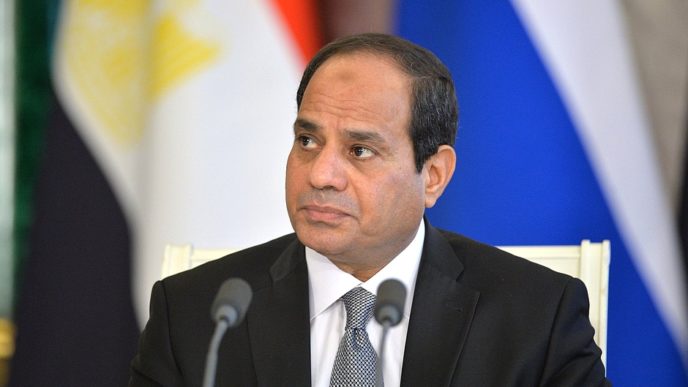
Given the turmoil of the last few days, it’s fortunate that the presidents of Egypt and the U.S. have begun to reforge the strategic partnership that unraveled under President Barack Obama.

The horrific attacks on Christian churches in Egypt, a declaration of emergency rule, and Syrian President Bashar al-Assad’s gas attack on innocent civilians have set a tense region further on edge. Bringing a measure of stability back is going to require the two leaders to work together.

It’s not surprising that Presidents Donald Trump and Abdel Fattah el-Sisi hit it off without even a round of golf. The two see the world in much the same way.

Both believe the Islamist threat from terrorists and subversive political movements is the top menace to regional stability. Both worry that unsettled states such as Libya, Somalia, Syria, and Yemen will serve as hotbeds for terrorist activity.

Both are intolerant of state-sponsored terrorism as foreign policy as practiced by states such as Iran. Both find Russia’s meddling in the Middle East unhelpful. Both would like to see the Israel-Palestinian peace process get back on track. (Read more from “New Turmoil in Middle East Makes Sisi-Trump Ties Even More Important” HERE)

Follow Joe Miller on Twitter HERE and Facebook HERE.

Top Tax-Writing Republicans Renew Call for DOJ to Investigate Lois Lerner over IRS Scandal

Two top tax-writing Republicans in the House are calling on the Department of Justice to reopen its investigation into whether former IRS official Lois Lerner unlawfully targeted conservative organizations applying for tax-exempt status.

Ways and Means Committee Chairman Kevin Brady and Tax Policy Subcommittee Chairman Peter Roskam sent a letter to Attorney General Jeff Sessions Wednesday, noting the Obama administration refused to review the information the committee gathered in its extensive investigation into the matter. According to the congressmen, there is clear evidence Lerner willfully partook in criminal activity during her tenure as the Exempt Organizations Division director, yet former President Barak Obama insisted there was “not a smidgeon of corruption” at the agency.

“On April 9, 2014, the House Committee on Ways and Means voted to send a letter to the Department of Justice referring former IRS Exempt Organizations Division Director Lois G. Lerner for criminal prosecution,” Brady and Roskam wrote. “As indicated in the attached letter, the Committee’s nearly three-year investigation uncovered evidence of willful misconduct on the part of Ms. Lerner. Despite this fact, and for what many believe were purely partisan reasons, the prior administration refused to review Ms. Lerner’s misconduct.”

The lawmakers cited evidence showing Lerner provided misleading information to Treasury Inspector General for Tax Administration’s questions and the use of her personal email, which put taxpayers’ confidential information at risk of exposure, as reasons for reopening the investigation.

The DOJ announced in October, 2015, it would not pursue criminal charges against Lerner at the close of its two-year probe. The investigation faced challenges due to Lerner’s crashed hard drive, the absence of email archives and the destruction of over 400 electronic backup tapes, and it was unable to prove the IRS official “intentionally discriminated against an applicant based upon viewpoint” and cited line-employees’ “ignorance, inertia” and “negligence” for delays in tea party applications for r 501(c )(3) status. (Read more from “Top Tax-Writing Republicans Renew Call for DOJ to Investigate Lois Lerner over IRS Scandal” HERE)

Follow Joe Miller on Twitter HERE and Facebook HERE.

A Constitutional Amendment That Would Drain the Swamp

Congressional reform begins with stopping Congress from spending us into oblivion—and that begins with a balanced budget amendment to the Constitution.

To make that happen, I propose using a tool our Founders gave us—the Article V amendment process.

Some of the Founders themselves recognized the need for such an amendment. For example, Thomas Jefferson first proposed an amendment in 1798 to keep Congress from borrowing money. Twenty trillion dollars in debt later, we can understand why.

On top of that, we need to put more limits on federal power, which can be done with the budget, and term limits on members of Congress.

I propose these solutions as someone who has experienced Congress’ business-as-usual corruption firsthand. I know they can work. And I know what won’t work.

What won’t work is expecting Congress to fix the problem on its own. Congress is not going to force itself to balance the federal budget and eliminate deficit spending, because the congressional leadership has little incentive to do so.

We need to give them that incentive.

Congress came close to passing a balanced budget amendment as recently as 1995. Voters swept Republicans into a congressional majority in 1994 based on the Contract with America, which promised a vote on a balanced budget amendment.

The House passed the amendment easily. Fourteen Democrats joined with 52 Republicans in the Senate, but it wasn’t enough.

The amendment failed to clear the two-thirds requirement when Republican Sen. Mark Hatfield sided with the remaining Democrats to defeat the effort by one vote.

One vote would have sent the amendment to the states to be ratified. Polls showed an overwhelming majority of Americans favored the amendment. Looking back now at the trillions in debt we’ve accumulated since then, that was a pretty expensive vote.

It was even closer than it looked. Some Democrats had said they would vote for the amendment if Congress were barred from dipping into the Social Security trust fund to balance the budget. The Senate couldn’t agree to that.

The first balanced budget amendment was proposed in Congress in 1936. In 1982, in the Reagan era, the Senate passed a balanced budget amendment, but it failed to get the needed two-thirds approval in the House.

And there are proposed balanced budget amendments in Congress right now, but they are going nowhere, because most congressmen think they get reelected by spending more. They will continue to do so until Americans make them stop.

>>> Check out Rep. Ken Buck’s new book, “Drain the Swamp: How Washington Corruption is Worse than You Think.”

Forty-one states have some sort of balanced budget requirement; 33 of them are required to have balanced budgets by their state constitutions. If the states can balance their budgets, so can the federal government.

At the simplest level, a balanced budget amendment would require Congress—and the president—to spend only the money actually received as revenue.

With a balanced budget amendment in place, it would be illegal for the federal government to run an annual budget deficit, except in extreme cases of war or national emergency, and then only with the approval of a supermajority in Congress.

The president could not propose it, the House could not offer to do it, and the Senate could not approve it.

A balanced budget amendment would result in the following key benefits to the American people. It would:

Restrict the ability of congressional leaders to manipulate the budget process for personal and political gain.

Lower the national debt.

Attract investment by improving America’s bond rating.

Bolster the American dollar.

Free up credit, otherwise taken up by government borrowing, for job-creating private investment.

Stop the immoral burdening of our grandchildren with debt.

Force Congress to make the tough, but necessary, budget decisions it has been putting off for far too long—$20 trillion too long.

A balanced budget amendment would force Congress to finally do its job of actually taking responsibility for the nation’s finances.

Agencies would come under closer scrutiny, because every dollar would matter. Government would be more responsible because it would be on a financial leash, and ineffective, wasteful, and unaffordable programs would have to go.

And, as part of the balanced budget amendment, we would need to ensure that fees and fines are accounted for in the general budget—no more shadow budgets.

Some have worried that a constitutional convention would become a “runaway” convention and dramatically change the Constitution. But that’s not how it works. A constitutional convention is called for a specific purpose and it would only have authority to propose amendments related to that stated purpose.

Even then, any amendments would need to be ratified by three-fourths of the states, hardly an easy accomplishment.

Supreme Court Justice Antonin Scalia noted that Article V was intended by the Founders to serve as a popular check on Congress and the federal government:

The Founders inserted this alternative method of obtaining constitutional amendments because they knew the Congress would be unwilling to give attention to many issues the people are concerned with, particularly those involving restrictions on the federal government’s own power. … The Founders foresaw that and they provided the convention as a remedy.

I do not have a lack of trust in the American people. …. The people do not feel that their wishes are observed. They are heard but they are not heeded, particularly at the federal level. …. The one remedy specifically provided for in the Constitution is the amendment process that bypasses Congress.

On no issue is this more applicable than the need for a federal balanced budget amendment.

Note: This condensed excerpt is from Rep. Ken Buck’s new book, “Drain the Swamp: How Washington Corruption is Worse than You Think.” (For more from the author of “A Constitutional Amendment That Would Drain the Swamp” please click HERE)

Follow Joe Miller on Twitter HERE and Facebook HERE.

Poll: Joe Miller Dominates among 2018 Hopefuls for Alaska’s Governorship

Yesterday, we told you how some Democrats would do in their 2018 gubernatorial primary if it were held today. Today is the Republicans’ turn. Well, Republicans and Gov. Bill Walker.

But before we give you all the numbers, just as we did yesterday, we’ll tell you about the poll itself. The survey was conducted by Harstad Strategic Research, Inc. and sampled registered voters in Alaska between March 22 – April 2. You can see the sample breakdowns here:

gov-poll-1-e1491786182558

gov-poll-8

gov-poll-7-e1491786214879

The poll asked voters who say they normally vote in GOP primaries who they would vote for if their choices for Governor were former Speaker of the House Mike Chenault, former candidate for U.S. Senate Joe Miller, former gubernatorial candidate John Binkley, current State Senators Mike Dunleavy and Peter Micciche, and current Governor Bill Walker.

Walker’s inclusion in the poll is interesting. We’ve told you in recent months that we believe if at least 3-4 candidates get in the GOP primary — Alaska GOP Vice-Chairman Rick Whitbeck has said on numerous occasions he has a list of about 50 names of people who could run — then Walker would likely have a path to victory if he jumped in.

The rest of model looks like a good mix of names. There are candidates from various areas of the state including Kenai, Mat-Su, Valdez, and Fairbanks, current legislators and those who can play the “outsider” card, and a blend of business conservatives, social and fiscal conservatives, and moderates. The pollster gave Republican voters options that varied in enough ways to see where they really stand.

Here is how numbers came out:

gov-poll-4

Joe Miller dominates with 25% of the vote, with Walker coming in just behind him at 19%. The rest barely make a blip. That is likely because despite being well-known names in political circles most voters likely have never heard of them.

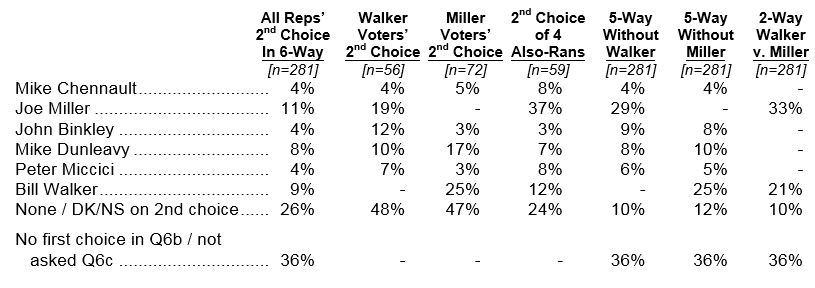
Now, here’s where things get really interesting. Look at what happens when respondents are asked their second choice, or who they would vote for if Miller or Walker (the top two picks) weren’t in the election.

gov-poll-5

Interestingly, Joe Miller is Walker voters’ top second choice (19%), and in what will come as a shock to many, Walker is the second choice of a full quarter of Miller voters. It should come as no surprise, then, that when either Walker or Miller are taken out of the race, the other takes a commanding position. Miller gets 37% without Walker, three times his closest competitor, and Walker comes in with 25% without Miller, two and half times anyone else.

Finally, if Walker and Miller went head to head, Miller would start off 12 points ahead at 33% to 21%, with a hefty 46% undecided.

The conclusion has to be that if the GOP primary attracts more than one credible candidate other than Walker, the Governor would have a plausible path to victory if he chooses to go that route for reelection. The only Republican currently positioned to disrupt such a move is everyone’s favorite beard, Joe Miller. (For more from the author of “Poll: Joe Miller Dominates among 2018 Hopefuls for Alaska’s Governorship” please click HERE)

Follow Joe Miller on Twitter HERE and Facebook HERE.

UN Peacekeepers Caught Running Massive Child Sex Ring — Not One Person Jailed

In a blow to victims of human trafficking worldwide, a massive child sex ring was exposed in Haiti — involving international ‘peacekeepers’ with the United Nations as well as other high-level officials from around the world — and no one is going to jail.

For years, UN peacekeepers, their high-level commanders, and other ‘personnel’ from around the globe came to Haiti for sex with boys and girls as young as 12.

“I did not even have breasts,” said a girl, known as V01 — Victim No, according to a report out of the Associated Press.

After Haiti’s downfall from a tropical paradise resort destination, hundreds of children were left homeless and many of them without parents. This easy prey then attracted the world’s most vile predators.

More than 300 children have come forward in the last decade with these claims and only a tiny fraction of those accused have ever faced any form of accountability.

One of the reasons these sickos aren’t charged is because when it comes to keeping its peacekeepers in check, the UN passes the buck. So, as reports of sexual abuse and child exploitation pour in to the UN (2,000 over just the last 12 years), the countries sending troops either remain ignorant or deliberately refuse to hold these people accountable.

As the Free Thought Project reported earlier this year, UN spokesman Stephane Dujarric explained how they pass the buck in situations like this.

“So obviously we’ll keep an eye on this. But as we’ve said, it is the responsibility of member states to fully investigate and hopefully prosecute crimes. The fight against impunity for these horrendous actions has to be a partnership between the UN and member states,” Dujarric said.
Given the nature of child sex trafficking and its ties to the elite, it is likely that these countries are covering it up as any investigation into these crimes would possibly expose those in positions of power.

According to the report in the AP:

The AP interviewed alleged victims, current and former U.N. officials and investigators and sought answers from 23 countries on the number of peacekeepers who faced such allegations and, what if anything, was done to investigate. With rare exceptions, few nations responded to repeated requests, while the names of those found guilty are kept confidential, making accountability impossible to determine.

The problem of sexual abuse and child exploitation among UN peacekeepers and their leaders has become so rampant that U.N. Secretary-General Antonio Guterres was forced to address it last month.

“Let us declare in one voice: We will not tolerate anyone committing or condoning sexual exploitation and abuse. We will not let anyone cover up these crimes with the U.N. flag,” Guterres said.

However, as the AP points out, these words mean very little given the sheer length of the abuse and the same rhetoric being used repeatedly by the UN.

More than a decade ago, the United Nations commissioned a report that promised to do much the same thing, yet most of the reforms never materialized.

For a full two years after those promises were made, the children in Haiti were passed around from soldier to soldier. And in the years since, peacekeepers have been accused of sexual abuse the world over.

In one particularly grim case in Haiti, a teenage boy said he was gang-raped in 2011 by Uruguayan peacekeepers who filmed the alleged assault on a cellphone. Dozens of Haitian women also say they were raped, and dozens more had what is euphemistically called “survival sex” in a country where most people live on less than $2.50 a day, the AP found.

Mario Joseph, a Haitian lawyer is attempting to change this paradigm. For the past few years, Joseph has fought to get compensation for victims a deadly cholera strain linked to Nepalese peacekeepers that killed an estimated 10,000 people, according to the AP.

Now, he’s taken on the case of the Haitian child sex ring.

“Imagine if the U.N. was going to the United States and raping children and bringing cholera,” Joseph said in Port-au-Prince. “Human rights aren’t just for rich white people.”

U.S. Sen. Bob Corker is also attempting to force accountability among the UN.

“If I heard that a U.N. peacekeeping mission was coming near my home in Chattanooga,” he told AP, “I’d be on the first plane out of here to go back and protect my family.”

Peter Gallo, a former U.N. investigator familiar with the case, explained to the AP how the system is setup in such a way that it seemingly facilitates this abuse.

“It’s an indictment of how the whole U.N. system works,” Gallo told the AP.

In spite of the rampant and unchecked child rape, the United Nations maintains that they are still contributing to the stability in the region.

“I would not say we have achieved everything we set out to do, but we are engaged in a process of continuous improvement that any harmful effect on the local populations could be minimized, if not completely eradicated,” Atul Khare, the U.N.’s head of field support which oversees the conduct and discipline of peacekeepers, said.

However, the locals — who’ve endured nearly a decade of hell at the hands of the organization whose mission is ostensible peace — aren’t buying it.

“I’d like to see my attacker face to face and tell him how he has destroyed my life,” said 21-year-old Melida Joseph who was raped by a UN Peacekeeper. “They’ll look at this as one big joke,” she said. “As far as the U.N. goes, they came here to protect us, but all they’ve brought is destruction.” (For more from the author of “UN Peacekeepers Caught Running Massive Child Sex Ring — Not One Person Jailed” please click HERE)

Follow Joe Miller on Twitter HERE and Facebook HERE.