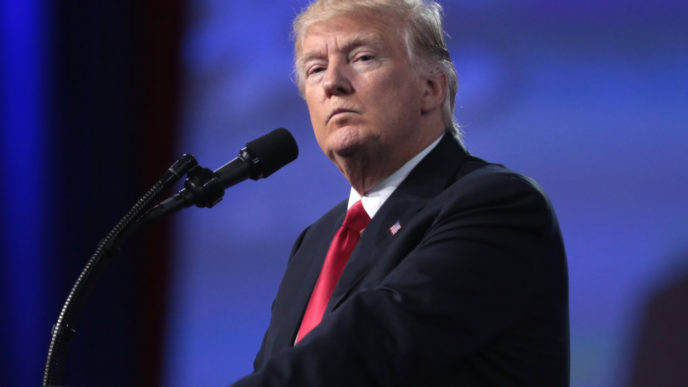
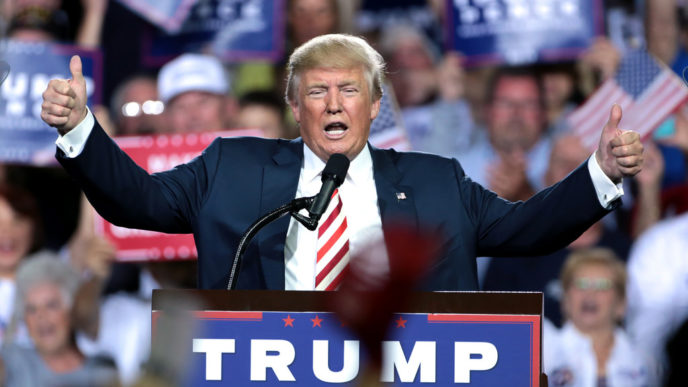
President Trump seems to be adopting the standard Republican response to criticism from the left-wing media, that is, to act more like a Democrat.
That both justifies and fulfills the media agenda at the expense of the Trump agenda, at least what we thought it was.
That also explains the rise in influence of Jared Kushner, a Democrat, and his Goldman-Sachs globalist team at the expense of Stephen Bannon, a nationalist, whose views reflect those of the people who actually elected Trump.
The President should heed the admonition of English poet John Dryden, “Beware the fury of a patient man.”
That “patient man” is Trump’s base of support, which is now growing impatient. And without that base, the President has no support. None.
The Trump Presidency is at risk because he seems to be operating under a false assumption.
Forgive me for being blunt, Mr. President, but you were elected because of what you promised to do, not for who you are, but largely for who you claimed not to be.
You said it best yourself, Mr. President, in “The Art of the Deal” (1987):
You can’t con people, at least not for long. You can create excitement, you can do wonderful promotion and get all kinds of press, and you can throw in a little hyperbole. But if you don’t deliver the goods, people will eventually catch on.
A recent New York Times opinion article frames the current dilemma:
Stephen K. Bannon, the architect of Donald Trump’s campaign and presidency, is a man with a lot of ideas. He believes that Western civilization is locked in an existential battle with the barbarians at the gates, that nationalists must wrest control from the aloof and corrupt globalist elite, and that America is a once great nation shackled by welfare for both the poor and the wealthy…The first few months of President Trump’s term have been an attempt to put all of that theory into practice, and by any reasonable standard, that attempt has failed.
The ideas that carried you to your Presidency, Sir, did not fail – they were sabotaged. And now the agenda upon which your election was based, Mr. President, is withering through intentional neglect in order to replace it with one maintaining the corrupt and dysfunctional political status quo.
It should tell you something, Mr. President, that the same people who denounced and ridiculed you from the day you announced your candidacy, and still do, are now saying “Jared Kushner might save us after all.”
In that case, the “us” to be saved are the Democrats, the left-wing media and the swamp.
Saving them won’t save your Presidency, Sir, but will doom it because the people making such arguments are not those who elected you.
The downsizing of Stephen Bannon and the attacks on other “nationalist” advocates in your administration, Mr. President, are just some of the thousand cuts your enemies hope to inflict to bleed your Presidency white.
It is not a choice between family or friends or a competition between “Nepotism and Nationalism” and certainly not a matter of buttressing the Trump brand.
It is about the President keeping the promises he made to the American people and not diluted versions of them in order to placate those who had always preferred a Trump loss.
In the end, it is really about the survival of representative government.
https://joemiller.us/wp-content/uploads/32984155372_356bc301de_b.jpg6831024Joe Millerhttps://joemiller.us/wp-content/uploads/logotext.pngJoe Miller2017-04-07 23:33:322017-04-09 22:17:46Trump’s Presidency Could Be the Shortest in U.S. History
Amidst the chaos of any sudden use of military force, there are numerous opinions, observations, and pearls of wisdom offered regarding the action. These opinions often fall along non-ideological lines that we are not used to seeing on domestic policy issues. But considering the airstrike against Assad’s airfield last night, there is an opportunity for people on all sides to unite behind the general need for congressional authorization of force. We must move back towards the direction of getting congressional approval at least for protracted engagements that are war in all but name only.
Putting aside any debate over the air strike last night, going forward it is clear both from a political and legal standpoint that any calls for a more protracted engagement in Syria should be backed by a Declaration of War or an Authorization of Use of Military Force (AUMF). This is a policy that should be enthusiastically embraced by both proponents and opponents of a deeper engagement in Syria.
What the Constitution and the founders said about war powers
It is very clear that our founders, based on the reality of warfare defined in their time, believed that any initiation of offensive action taken against another nation must be approved by Congress. As James Madison said, there must be “rigid adherence to the simple, the received, and the fundamental doctrine of the [C]onstitution, that the power to declare war, including the power of judging of the causes of war, is fully and exclusively vested in the legislature; that the executive has no right, in any case, to decide the question, whether there is or is not cause for declaring war…”
George Washington, in a 1793 letter to the governor of South Carolina regarding conflict with the Creek Indians, made it clear that the question to initiate any major offensive war was out of the hands of the president: “The [C]onstitution vests the power of declaring war in Congress; therefore no offensive expedition of importance can be undertaken until after they shall have deliberated upon the subject and authorized such a measure.”
On the other hand, any decisions about the execution of the war thereafter or to immediately repel an invasion were placed squarely in the hands of the president. This arrangement was born out of the Article I Section 8 enumerated congressional power to declare war on the one hand, but the president’s role as commander-in-chief of the armed forces on the other.
This is also why Madison had the convention members alter the original draft of the Constitution, which gave Congress the power to “make war,” to a more limited language of “declare” war, making it clear that all operations beyond the initial declaration would not be subject to the chaotic whims of 100 people.
The question of how to square modern day war fighting, communications, transportation, and logistics of urgency and secrecy with Congress authorizing every use of force is a complicated one. One can make a strong argument that the definition of war has changed and that the need for urgent or clandestine action could be justified under Article II commander-in-chief powers. Clearly, this has guided every president since World War II and the fact that we have special operations ongoing in 140 countries. Without addressing one-time urgent surgical strikes, such as last night’s bombing or the broader use of special forces, it’s important that everyone agree we need to move away from the post-WWII trend of almost never getting authorization from Congress for anything, even protracted commitments that are tremendously costly and consequential.
Congressional buy-in is not just a Constitutional requirement, but a strategic one
Although there are many reasons one can posit why we have failed to win most wars post-WWII, it is no coincidence that our losing streak began when we stopped declaring war. A congressional debate over making such a grave commitment and an ensuing declaration of war is not just a constitutional imperative, it is a political and strategic one.
A declaration of war allows the entire representative body of the people to raise the important questions about our strategic interests, definition of the mission, feasibility, and cost of achieving that mission, and the exit strategy. If Congress votes to pass a resolution, it serves as a definitive guide for defining the enemy, how victory is achieved, and what success looks like. This further serves the purpose of rallying the country behind a defined mission because public support is always needed to achieve such victory. This is what we have been lacking in most engagements since WWII.
Based on the statement put out from the Trump administration, it is very possible that last night’s bombing was limited to deterring the proliferation of WMD and is not part of a broader engagement. But if the administration or Republicans in Congress believe we must further engage in the Syria civil war, a view I personally disagree with, even supporters of such action must agree to the imperative of congressional buy-in.
The same way some may argue that the requirement for a declaration of war for any offensive action by the president, in the modern era, necessarily abrogates his role as commander-in-chief, the continuation of endless protracted ground missions in the Middle East without any declaration from Congress completely overrides the unambiguous dictates of Article I powers. Moreover, it ensures that our troops remain in precarious situations indefinitely without any definitive mission or understanding of how to achieve victory. Thus, the opportunity for a congressional debate over authorizing force is good for both opponents and proponents of any given military engagement.
Yet, there is a dangerous notion being peddled by Sens. Mitch McConnell, R-Ky., and John McCain,R-Ariz., that the AUMF passed by Congress in 2001 is somehow a retroactive catch-all for any engagement against any conventional or non-conventional adversary in the entire Middle East until the end of time. Such a worldview completely vitiates our Constitution and ensures that every new engagement in the Middle East will result in the same failed outcome to which we have grown accustomed. (For more from the author of “The Merits of Trump’s Syria Strike Aside, We Need to Bring Back Congress’ Power Over Declaring War” please click HERE)
https://joemiller.us/wp-content/uploads/Flickr_-_The_U.S._Army_-_Hovering_Hawks-1-1.jpg21233185Joe Millerhttps://joemiller.us/wp-content/uploads/logotext.pngJoe Miller2017-04-07 23:29:022017-04-07 23:29:02The Merits of Trump’s Syria Strike Aside, We Need to Bring Back Congress’ Power Over Declaring War
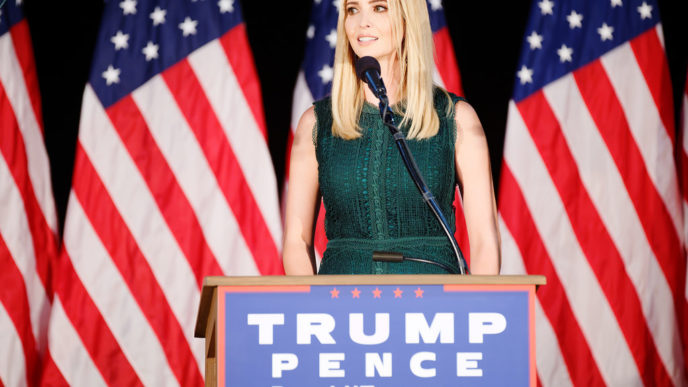
In preparation for her now full-time role in the Trump administration, Ivanka Trump has been secretly reaching out to the heads of liberal special-interest groups for months, including Planned Parenthood President Cecile Richards.
Politico reports that the first daughter “requested a sit-down with Cecile Richards,” apparently wanting “to know more about the facts of Planned Parenthood” and to reach “common ground” on abortion.
“The purpose of the meeting, from Cecile’s point of view, was to make sure that Ivanka fully understood what Planned Parenthood does, how it is funded, and why it would be a terrible idea for Planned Parenthood to be removed from being able to see Medicaid patients,” Dawn Laguens, executive vice president of the Planned Parenthood Federation of America told Politico.
The long and short of their discussion, reportedly, was an argument from Cecile Richards to Ivanka Trump on why Planned Parenthood should not be defunded – a position that conflicts with President Trump’s campaign promises and claim to be pro-life.
Ivanka was, of course, fed several lies by Richards — like how “the money doesn’t actually go to abortions” (money is fungible) and how Planned Parenthood provides cancer screenings (mostly false).
Whether those lies translate to policies in the Trump administration remains to be seen, but the first daughter and her husband Jared Kushner have already worked to stop an executive order on religious freedom in defense of LGBT special-interest groups. It is not unreasonable to think Ivanka Trump will fight an effort to defund Planned Parenthood as well.
And that’s not all. Perhaps the most revealing part of Politico’s story is that Trump has been meeting with several leaders of progressive special interest groups since the election.
Ivanka Trump has been on a listening tour since moving to Washington, as she stakes a claim on women’s issues. In addition to her meeting with Richards, she has quietly met with other leaders of the progressive women’s movement, including Marcia Greenberger, co-president the National Women’s Law Center, and Judy Lichtman, senior adviser to the National Partnership for Women and Family, sources familiar with the meetings told POLITICO.
The only conceivable purpose for doing this is to pitch the liberal lies and talking points directly to the president — to move the administration further leftward. That’s what happened when Ivanka Trump brought Al Gore to Trump Tower to discuss environmental issues. Months later, the Trump administration is mulling a carbon tax.
So, through Ivanka Trump, liberal organizations have a direct influence on White House policy. And the administration continues to lurch to the left.
Which member of the Trump administration is meeting with conservatives? (For more from the author of “Ivanka Trump Holds Secret Meetings With Liberal Special Interest Groups. No Good Can Come From This” please click HERE)
https://joemiller.us/wp-content/uploads/29118258224_47b9f5ebb0_b.jpg6831024Joe Millerhttps://joemiller.us/wp-content/uploads/logotext.pngJoe Miller2017-04-07 23:21:282017-04-07 23:21:28Ivanka Trump Holds Secret Meetings With Liberal Special Interest Groups. No Good Can Come From This
Neil Gorsuch became the 113th justice of the United States Supreme Court Friday afternoon, following a Republican circumvention of a filibuster with a long-anticipated “nuclear vote” majority.
While the fulfillment of this particular Trump campaign promise is cause for modest celebration for constitutionalists, those who promoted Gorsuch’s nomination need to remain clear-eyed about what this victory really means for our ongoing constitutional crisis.
Now that the dust has settled in the upper chamber, we’re left with a few things: a fulfilled promise from the Trump campaign, the end of the Supreme Court filibuster for the foreseeable future, and at least a nominal return to the balance of the Supreme Court before Justice Antonin Scalia’s passing last year.
It’s hard to imagine how this nuclear-option change doesn’t set the stage for the upper chamber to nuke the legislative filibuster in following suit, thus reaching the natural end of what the progressive populists sought to achieve with the 17th Amendment.
As Conservative Review Editor-in-Chief Mark Levin pointed out on his radio program this week, the roots of this move are over 100 years old and lie at the feet of the Progressive movement. In short, progressives cast the first stones, both on changing the nature of the Senate and politicizing the process (See: Robert Bork, 2013 et al.).
Ironically, what we have seen this week is the natural conclusion of two progressivist forces that simultaneously – if seemingly contradictorily – seek the end of centralization through the means of mob rule. Long story short, when your judiciary and contemplative body — with authority over approving its members — have been so politicized by judicial activism, a hyper-partisan outcome to the system was inevitable.
The nature of Gorsuch’s confirmation has made it painfully clear that there is no longer the prospect of lukewarm talent on the bench. Now the impetus remains on Republicans to go all out and take the Obama strategy of stacking the court with Trump appointees in the lower courts – albeit encumbered by the “blue slip” process . (And remembering all the while that this political football will change hands, leaving Democrats to do the same once again in the future.)
But, nuclear or not, Justice Scalia’s seat has been filled with an originalist and all is right again with the world, right? No. Rather, conservatives ought to keep in mind that this appointment — while a big fulfilled promise to a greatly concerned constituency — will not solve the judicial crisis facing our Constitution and our republic.
At best, the court now stands at the same ideological balance that gave us the Obergefell decision. At worst, we’re a few degrees further away from original intent than we were on Justice Scalia’s last night on this Earth. Either way, hanging all of one’s hopes for the republic, the rights of the unborn, or a list of other issues before the court solely on Neil Gorsuch’s confirmation and then walking away is a fool’s gambit.
Certainly, should Anthony Kennedy step down and offer up a way to halt the pivot on the court’s “swing vote,” or should anyone else on the progressivist side of the bench leave, then it will be incredibly easier to confirm an even more originalist jurist to fill the spot, as Josh Hammer points out at The Daily Wire.
Neil Gorsuch may in fact be “the kind of jurist we need,” as Sen. Mike Lee, R-Utah, said before the committee, but there’s ground for healthy skepticism on this front. Daniel Horowitz explains that while Gorsuch is indeed a constitutionalist in a broad sense, and his articulation of the philosophy was both succinct and clear, his history of jurisprudence skews closer to that of an Alito than a Scalia. (And definitely short of a Thomas on the originalism scale.) Only time will tell.
But hope is not a course of action, especially when one branch of our government has so thoroughly co-opted the duties of the other two, as Daniel Horowitz points out in his book “Stolen Sovereignty.” Rather, the problems that so many have sought to fix by finding “better judges” are systemic, and the best answers to them are systemic as well.
The situation we see before us is two-pronged, as is the answer. If we want to see the Senate return to being the Senate again, then it needs to return to its original function prior to the 17th Amendment, while enacting reforms to make the courts themselves less political by nature.
But more important is the need for Congress to depoliticize the process of judicial appointments by depoliticizing the federal courts. Per Article III, the legislative branch has the power to completely reform the black-robed branch of government — as Horowitz and I have written about ad nauseam. And if the Senate’s nuclear outcome doesn’t spur that discussion on both sides of the aisle, perhaps the further politicization of the judicial branch will. Until then, we can only anticipate a more partisan Supreme Court and a more radioactive Senate. (For more from the author of “Gorsuch Is in and the Senate Is More Nuclear. Where Do Conservatives Go From Here?” please click HERE)
https://joemiller.us/wp-content/uploads/american-flag-1416349_960_720.jpg663960Joe Millerhttps://joemiller.us/wp-content/uploads/logotext.pngJoe Miller2017-04-07 23:13:462017-04-07 23:13:46Gorsuch Is in and the Senate Is More Nuclear. Where Do Conservatives Go From Here?
For the past five years, Syrian dictator Bashar Assad has been given a free pass to murder hundreds of thousands of his own people with impunity. During his tenure, former President Obama used strong language, even implementing a supposed “red-line,” to try and deter the genocidal Syrian leader from further action, but it didn’t work. Assad has continued to push the boundaries of the free world, utilizing weapons of mass destruction to continue his reign of terror over much of Syria. His massive chemical weapons bombardment on innocent women and children this week appears to be the straw that broke the camel’s back for President Trump.
In launching some 59 Tomahawk missiles at a Syrian regime air base Thursday night, President Trump made clear that the use of chemical weapons as an instrument of warfare would not be tolerated. Allowing for such a precedent to be established, one in which tyrants are allowed to use WMDs without consequences, threatens both the security of the American people and the global community.
The Tomahawks were launched from the USS Porter and USS Ross, which were situated in the Eastern Mediterranean at the time of the assault. The Pentagon made clear the missile raid was a “proportional response,” and not part of a larger engagement. The U.S. launch targeted Shayrat Airfield, which was reportedly used as a base for Syrian fighter jets and chemical weapons.
A Pentagon statement said that the strikes have “severely damaged or destroyed Syrian aircraft and support infrastructure and equipment, adding that the Tomahawks reduced Assad’s “ability to deliver chemical weapons.”
Moreover, the launch sent a signal to the Syrian dictator’s enablers — the Iranian regime and Russia under autocrat Vladimir Putin — that America would no longer “lead from behind” or take a back seat on global security issues.
President Trump’s strike against Assad was praised by American allies in Israel, the United Kingdom, Japan, Australia, Turkey, Saudi Arabia, and others.
“Tonight, I ordered a targeted military strike on the air base in Syria from where the chemical attack was launched,” President Trump said from his Mar-a-Lago property in Palm Beach, Florida Thursday night. “It is in this vital national security interest of the United States to prevent and deter the spread and use of deadly chemical weapons.”
Secretary of State Rex Tillerson slammed Russia for failing “in its responsibility” to move chemical weapons out of the nation. “Either Russia has been complicit or Russia has been simply incompetent in its ability to deliver on its end,” Tillerson said of Russia’s failures.
Syrian state-media is claiming that the U.S. attack killed nine civilians, but provided no proof for its claims. “The United States of America committed a blatant act of aggression targeting one of the Syrian air bases in the Central Region with a number of missiles, leaving 6 people martyred and a number of others injured and causing huge material damage,” Syria’s government-run SANA news agency commented. (For more from the author of “The US Missile Strike Against Syria: What You Need to Know” please click HERE)
https://joemiller.us/wp-content/uploads/29496108493_ace9f429dd_b.jpg6831024Joe Millerhttps://joemiller.us/wp-content/uploads/logotext.pngJoe Miller2017-04-07 23:08:312017-04-07 23:08:31The US Missile Strike Against Syria: What You Need to Know
The House left for its two-week Easter recess Thursday without passing its Obamacare repeal bill, leaving questions about what comes next in terms of health-care reform.
Leadership announced a last-minute Rules Committee meeting on an amendment to the American Health Care Act — put forward by House Freedom Caucus members Gary Palmer of Alabama and David Schweikert of Arizona — allowing them to go back to their districts with the message they are making progress on the bill. But some speculate if members can’t strike a deal, it could be catastrophic for some of their political futures.
White House Chief of Staff Reince Priebus told House Speaker Paul Ryan his job could be at risk if he fails to get something passed during a meeting with White House officials Wednesday night, Politico reports.
The administration is calling on leadership to push members to come to a consensus following the bill being pulled off the floor in March due to a lack of votes — a major blow to the GOP’s message of unity. In the wake of the political blunder, top Republicans have been cautious in their approach, saying they are taking a bottom-up approach, allowing conservatives and moderates to come together on changes. Ryan, House Majority Leader Kevin McCarthy and House Majority Whip Steve Scalise have all repeatedly said they don’t want to put an “artificial timeline” in place, as it might be counterproductive to making improvements to the bill. With the White House looking for a win, the pressure is on for Congress to get something done quickly.
Leadership has largely taken a back seat on their second attempt to make good on their campaign promise, allowing Vice President Mike Pence, Budget Director Mick Mulvaney and Priebus to take the reins on the negotiation process. Pence, Mulvaney and Priebus met with top members of the three largest House GOP caucuses, which represent the different factions of the conference — the House Freedom Caucus, Republican Study Committee and Tuesday Group — Tuesday evening in an attempt to strike a deal. But despite members leaving the meeting asserting progress had been made, bill text remained unseen and finger-pointing continued Wednesday. (Read more from “Where Obamacare Repeal Stands and What It Means for House Republicans” HERE)
https://joemiller.us/wp-content/uploads/obamacare-7.jpg8001200Joe Millerhttps://joemiller.us/wp-content/uploads/logotext.pngJoe Miller2017-04-07 22:09:342017-04-07 22:09:34Where Obamacare Repeal Stands and What It Means for House Republicans
Secretary of State Tillerson says that Bashar Assad is guilty of using chemical weapons against his own people. Former senator Ron Paul says there’s no way Assad would do this at this time. A report on Alex Jones’ Infowars claims that Syrian rebels are responsible for the attack. President Trump blames Obama’s inaction for what happened in Syria.
Do we really know what’s going on in Syria? And even if we did, should we try to remove Syrian leader Bashar al-Assad?
According to Rex Tillerson, “There is no doubt in our mind and the information we have supports that Syria, the Syrian regime under the leadership of Bashar al-Assad are responsible for this attack and I think further it’s very important that the Russian government consider carefully their continued support for the Assad regime.”
According to Ron Paul, “[I]t doesn’t make any sense for Assad under these conditions to all of a sudden use poison gasses,” he continued. “I think there is a zero chance he would have done, you know, this deliberately.”
According to Infowars, “the White Helmets, a al-Qaeda affiliated group funded by George Soros and the British government, reportedly staged the sarin attack on civilians in the Syrian city of Khan Shaykhun to lay blame on the Syrian government.”
Who’s right?
Obviously, the Trump administration has far more intel than any of us, and America has already launched its first attack on an airfield in Syria.
But our previous missteps in the Middle East call for caution. We should not act unilaterally until we have a long-term plan.
Remember Iraq
Think back to Iraq.
We may have had the best intentions in removing Saddam Hussein from power. He was guilty of horrific crimes. But his removal created a vacuum of power in the region. This contributed to the rise of ISIS and the terrible persecution of Christians (and others). What happens if we take out Assad?
Right-wing commentator Paul Joseph Watson expressed his concerns in one tweet: “Regime change in Syria = More dead children More terrorism More refugees ISIS taking the entire country Possible war with Russia. Disaster”.
Regime change in Syria =
More dead children More terrorism More refugees ISIS taking the entire country Possible war with Russia.
The problem is that the sarin attack is so ghastly that it feels criminal not to act.
Who can forget the images of the gassed children? Who can forget the picture of the father holding his dead baby twins?
If war is hell, the war in Syria has been a special kind of hell, a literal inferno of suffering. Yet this latest attack has crossed yet another line. But that’s why we must act cautiously and carefully, especially now that we have struck our first retaliatory blow.
Letting Atrocities Force Our Hand
Hundreds of thousands of lives have already been lost. Unspeakable atrocities have already been committed. People have been blown to bits, ripped apart, maimed, tortured, and more.
Children have lost their parents and parents have lost their children. Whole families have been destroyed in a single day. The peace-loving have been butchered side by side with the terrorists. And really bad guys are present on all sides of the battle.
In short, while the sarin attack crossed a definite line, other lines have been crossed time and again. (Do you remember President Obama’s red line?) And so we must act, but we must act prudently. The most recent atrocity, as appalling as it is, cannot force our hand.
Pray for Divine Intervention
What then do we do?
First, if we are not 100 percent sure that the Assad regime is responsible for the chemical attack, we must continue gathering information, even after our first strikes. The lasting controversy over WMDs in Iraq serves as a cautionary warning.
Second, we must think through the long-term regional implications of whatever actions we take. We don’t want to add even greater suffering and instability to the region.
Third, we must do what we can to support the best players in this bloody drama (if such players exist) while doing our best to protect and aid the innocent, like Syrian Christians who have been caught in the crossfire.
Fourth, we must pray for God’s kingdom to come to Syria, in the words of the Lord’s prayer. Only divine intervention can bring real healing to that ravaged nation. (For more from the author of “Should We Take out Assad?” please click HERE)
https://joemiller.us/wp-content/uploads/Qgxt0zmgKuLFCOMRjtsNVWdxQiOzDxJA.jpg580940Joe Millerhttps://joemiller.us/wp-content/uploads/logotext.pngJoe Miller2017-04-07 22:05:472017-04-07 22:05:47Should We Take out Assad?
Recently in Religion Dispatches Daniel Schultz criticized a Reuters column that claimed that the religious left is becoming a strong political force. Schultz is a United Church of Christ pastor, and very much on the left himself. He’s right that some media mistake slight bouts of liberal religious activism as signs of broader revival. Such stories may highlight a rally of religious leaders wearing clerical collars and robes for show. Do these demonstrators have a popular following among the religious? It’s not clear that they do.
But I don’t think Schultz understands why the religious left has so little influence. He thinks it has too much diversity — ethnic and otherwise — to ever unite and draw on a larger popular base. Perhaps, but I think that misses the larger point.
It’s true that the religious right is largely made up of conservative white evangelicals, Catholics, Mormons and Jews. But the religious left is largely made up of white liberal mainline Protestants, Catholic social justice activists and Jewish groups. It’s been that way for a long time. Black Protestant church leaders sometimes work with the religious left. But their religious and moral differences have hindered full unity.
So why isn’t the religious left more of a force in politics?
The religious left had weight years ago because it was made up of strong mainline Protestant denominations. It had large ecumenical groups like the National Council of Churches. The “God Box” at 475 Riverside Drive in New York was their headquarters. They had hundreds of staffers and millions of dollars. They were protected by church bodies that founded and sustained American democracy.
Most of that old liberal Protestant world is now gone or much deflated. Most of those church agencies have left New York. The old mainline seminaries became the hotbed of the religious left a century ago. Most are now marginalized with far fewer students and reduced funding. A few have closed despite storied histories.
What institutions represent the religious left today? There is Jim Wallis’s Sojourners, the Interfaith Alliance and Faith in Public Life, among a few others. Much of their constituency is the ever-dwindling base of liberal Mainline Protestants. They can organize petitions and small demonstrations. But they don’t have wide, broad-based followings. That’s why the media usually ignore them, as do politicians. The National Council of Churches worked with the Clinton Administration 20 years ago. There was nothing like this during the Obama Administration.
The religious right, in contrast, came about through groups that work with churches, not denominational heads. The right was often headed by well-known evangelicals followed by Christian media. They were supported by mail campaigns. The Moral Majority and later the Christian Coalition were the early models. After the fall of a pastor or advocacy group, there were many early claims that the religious right was dead. But always there are new leaders and new organizations that have popular appeal.
The religious right is inventive while the religious left is still stuck to declining liberal Protestantism. Even now, most lay mainline Protestants ignore their own denominations and vote conservative.
Here’s the twist that most claims about religious left revival ignore or don’t appreciate: religious left activism is almost always the work of elites who have lost touch with their religious base. Take evangelicalism. It is now the largest religious demographic. But many evangelical colleges, relief and other groups have moved left. Many of the evangelical elite tilt left and don’t want to be associated with the conservative base in their own denominations. Most political witness jamborees for young college educated evangelicals are left-leaning. Much of the evangelical blogosphere is left-leaning.
In short, much of evangelicalism is retracing the steps of Mainline Protestantism 100 years ago. As the elites move left, they also lose touch with their religious roots.
This is why the religious left will never have a very wide following. Religion is about keeping traditions and holding fast to teachings that may go against the culture. Religious people are committed to Scripture, family, and real church institutions. They may engage in politics, but it will never be their top concern. The religious left may have religious motives, at least at first. But it’s often more wedded to politics than to the religious convictions of the ordinary faithful. As a result, it slowly loses its religious identity in favor of secular politics and activism.
This cycle at least in American Protestantism never seems to end. Religious liberals may stretch the boundaries of their faith or leave it altogether. Then, a new generation of excited converts rediscover the old orthodoxy and replace those who are content to provide a religious gloss to left wing politics. (For more from the author of “Why Is the Religious Left Not More of a Force?” please click HERE)
https://joemiller.us/wp-content/uploads/bible-879073_960_720.jpg720960Joe Millerhttps://joemiller.us/wp-content/uploads/logotext.pngJoe Miller2017-04-07 22:00:062017-04-07 22:00:06Why Is the Religious Left Not More of a Force?
With Neil Gorsuch’s confirmation as the 113th Supreme Court justice Friday, it won’t be long before he starts revealing what he really thinks about a range of hot topics he repeatedly sidestepped during his confirmation hearing.
In less than two weeks, the justices will take up a Missouri church’s claim that the state is stepping on its religious freedom. It’s a case about Missouri’s ban on public money going to religious institutions and it carries with it potential implications for vouchers to attend private, religious schools.
Other cases the court could soon decide to hear involve gun rights, voting rights and a Colorado baker’s refusal to design a cake for a same-sex couple’s wedding. Some of those cases may come up April 13, which could be Gorsuch’s first private conference — where justices decide whether to hear a case. It takes four votes to do so, though the court does not generally announce each justice’s decision. (Read more from “Gorsuch May Be Decisive Vote in Divisive Supreme Court Cases” HERE)
https://joemiller.us/wp-content/uploads/32790341605_9835c011de_b.jpg5871024Joe Millerhttps://joemiller.us/wp-content/uploads/logotext.pngJoe Miller2017-04-07 21:06:582017-04-07 23:13:31Gorsuch May Be Decisive Vote in Divisive Supreme Court Cases
After President Donald Trump was mostly cheered by the international community for his missile strikes targeted at the Syrian government, he must now grapple with how to pair his first use of decisive military force with a strategy to contest a six-year-old war that has challenged the world.
U.S. officials described Trump’s sudden decision to launch 59 Tomahawk cruise missiles against a Syrian air base as a targeted retaliation on the source of a suspected deadly attack on civilians that occurred two days before—and a symbolic show of American power.
But foreign policy experts say that Trump, by inserting himself squarely into a complex battlefield, will have to deal with the aftermath, and decide how he wants to handle the dual challenges of fighting ISIS, and responding to Syria’s dictator leader Bashar al-Assad, whose brutality many blame for inflaming terrorism in the region.
“Last night’s strikes were an act of war. We need to be clear about that,” said Jonathan Schanzer, a scholar in Middle Eastern studies and vice president at the Foundation for Defense of Democracies, in an interview with The Daily Signal. “The intent here and messaging has been, this was a contained, commensurate response and that’s where this ends.”
“But the question is whether the Russians, Iranians, and Syrians continue to test America’s patience,” he added. “I don’t put it past that axis to continue the atrocities in Syria. The Syrian war certainly has now grabbed the attention of the president, so I wouldn’t rule out future strikes.”
‘Mobilize a Common Strategy’
During the campaign, Trump emphasized his focus in Syria would be on defeating ISIS, the terrorist group that maintains its base in that country, and in the early weeks of his administration, the White House articulated that facilitating the removal of Assad from power was not a priority.
This week, Trump’s calculus seemed to change when the president said the chemical weapons attack had “crossed a lot of lines for me” and that his attitude toward “Syria and Assad has changed very much.”
H.R. McMaster, Trump’s national security adviser, said Thursday night that he hoped the U.S. strikes on the Syrian government’s infrastructure would “shift Assad’s calculus,” because this was the first time America had taken direct military action against the dictator’s regime.
President Barack Obama had feared being dragged deeper into a civil war that has killed nearly 400,000 people and displaced half the country. He refused to strike Assad’s government after a similar chemical weapons attack in 2013 despite issuing a “red line” that created expectations for military force.
Trump’s action, some experts say, could provide leverage against Assad that the previous administration never had.
“The cruise missile strike sends a strong signal that Assad cannot act with impunity and use chemical weapons,” said Jim Phillips, a Middle East expert at The Heritage Foundation. “It undermines his perceived power and is a powerful warning shot that will constrain his future options. It is crucial to follow up the strike with aggressive and focused diplomacy to mobilize allies behind a common strategy in Syria.”
Yet the the situation on the ground in Syria has changed dramatically since 2013, with Russian troops intermingled among Syrian forces as part of Moscow’s push to keep Assad in power.
“This strike comes four years from when we should have taken another strike in a similar way,” said Brian Katulis, a senior fellow for national security at the Center for American Progress, in an interview with The Daily Signal. “Now, there is more uncertainty and instability. You don’t want to escalate things and inadvertently kill Russian troops. The chances of retaliation or blowback today are much greater.”
Dealing With Russia
Next week, Secretary of State Rex Tillerson will meet with President Vladimir Putin of Russia, who, along with Iran and Hezbollah, the U.S.-declared Shia terrorist group, has propped up Assad’s government and provided military support to it.
“We have not really seen the affect of U.S. power on the Russian calculus for the last six years or longer,” Schanzer said. “The previous administration was very circumspect with applying power. The Russians took that as a green light to engage in destabilizing activities in Syria and Ukraine. Whether Trump’s new action has a deterrent effect will be interesting to see.”
Russia’s immediate reaction to Trump’s decision has been to not back down. Dmitry Peskov, a Putin spokesman, told reporters the Russian president “considers the American strikes against Syria an aggression against a sovereign government in violations of the norms of international law, and under a far-fetched pretext.”
The Russian government said it was pulling out of an agreement to minimize the risk of in-flight incidents between U.S. and Russian aircraft operating in Syria.
U.S. military officials later insisted Russia was continuing to comply with the agreement.
Russia’s early rhetoric concerns experts about the possibility of a direct military confrontation with Moscow, which has air defense systems in Syria that can shoot down U.S. aircraft. This could complicate the fight against ISIS, since the U.S.-led coalition until now has been conducting airstrikes mostly without interference from Russia and the Assad government.
“Trump’s decision to strike in Syria only improves the U.S. leverage against Assad and Russia to a limited extent,” said Michael O’Hanlon, director of research for the foreign policy program at the Brookings Institution, in an interview with The Daily Signal. “Russia will call our bluff. If we really want them to believe we will dramatically increase our military role in Syria, they know we aren’t serious. I don’t think that’s something Trump wants to do, and I wouldn’t advise it either. As much as I want the war to end, I am not sure I want to risk a U.S.-Russia conflict to do it.”
But James Jeffrey, a deputy national security adviser to President George W. Bush, predicts Russia will increasingly feel isolated because of Trump’s action. Peskov, the Putin spokesman, recently said Moscow’s support for Assad “is not unconditional” and Jeffrey says the international condemnation of the chemical attack could frustrate Russia enough to change its calculus.
“We amassed support from around world for these strikes,” Jeffrey told The Daily Signal in an interview. “That’s something the Russians have to consider. They want to isolate the U.S. and Western world, and that’s not something Russia has now. Putin is outgunned against the U.S. coalition, and isolated internationally. If Trump gives him some way out of Syria through a diplomatic process, why wouldn’t Putin take that?”
‘Has to Stop’
Still, the experts say the Trump administration should proceed cautiously in how aggressively it presses Assad, who remains determined and capable.
Phillips notes that Trump’s strikes only targeted one airfield, not Syria’s air force or chemical weapons capabilities, and he warns there is little the U.S. can do to stop Assad’s security forces from continuing the war, short of taking more military action.
“It would be a mistake to expand the military effort to include the goal of removing Assad,” Phillips said. “That would be a costly and risky mission creep that would entail military clashes with Russia and Iran. And it would bog down the U.S. military in an open-ended effort to stand up and stabilize a post-Assad government. Pressing Assad to step down as part of a political settlement should be a long-term diplomatic goal pursued through sanctions, but ISIS and al-Qaeda should remain the chief targets for U.S. military action in Syria.”
Max Abrahms, a terrorism expert at Northeastern University, is concerned that pushing for the removal of Assad could leave a power gap and make the country even more of a haven for Islamic extremists.
“I worry by weakening the Syrian government’s position, this will help to breathe new life into the al-Qaeda-allied rebels,” Abrahms told The Daily Signal in an interview. “I don’t think Trump wants to get involved into the domestic politics of this country. It will absolutely consume his presidency.”
Even if the Trump administration keeps its word about the limited intent of its missile attack, the experts agree the president has sent a political message that the U.S. can use to its advantage by demonstrating the use of force is on the table.
“This is not George W. Bush going to Iraq in 2003,” Jeffrey said. “There is no doubt in my mind Trump won’t use force to drive Assad out. But he can use military force as part of a diplomatic strategy to get an agreement between Assad and the Sunni majority of his population who he is trying to bomb out of existence. That has to stop and it started stopping yesterday.” (For more from the author of “After Missile Attack, the Challenges Facing Trump in Syria” please click HERE)