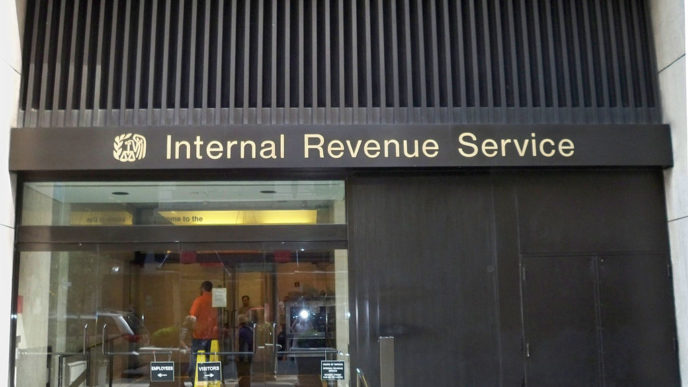
The IRS Expects to Write-Off $129 Billion. Here Are Two Better Ideas

The Government Accountability Office’s recent audit report of the IRS showed that the IRS collected an extra $54.3 billion through enforcement efforts. That is a great return on investment. However, a troubling fact was buried in Note 5 on the 110th page of the report: The IRS is owed $178 billion in back taxes, interest, and penalties, but expects to collect only $49 billion.

To put it in plain English: The IRS expects to write off as uncollectible $129 billion of its receivables. So, what is Congress’ answer to this challenge? They voted to place outstanding tax accounts with private debt collectors and let them keep a percentage of what they collect. This venture will fail just like a similar project 10 years ago. Let me explain.

Inevitable Crash and Burn

In 2004, Congress authorized a pilot program to assign delinquent tax accounts to private debt collectors.The IRS assigned about $1.87 billion in delinquent accounts to private debt collectors on a commission basis. According to a report by the IRS Taxpayer Advocate (an office that reports directly to Congress and not the IRS Commissioner), the private collectors managed to collect $86 million before the accounts were returned to the IRS. The IRS then collected a further $139 million. That means that the IRS collected $53 million more than the private debt collectors.

Congress now wants a do over. Alas, this program will crash and burn also for several reasons. First, Congress has placed several counterproductive restrictions on the private firms. For instance, the delinquent taxpayer can tell the private debt collector to send their accounts back to the IRS. I don’t think the private debt collectors will collect much money if the delinquent taxpayers can tell them to buzz off. Second, the private debt collector has no authority to settle the tax debt for a lower amount. So, the delinquent taxpayer will have little reason to bargain.

What’s wrong with this picture?

We Need to Stop Adding Debt

I would like to propose two better options:

1. President Trump could scrap his proposed $238 million cut in IRS funding in favor of a $2 billion increase. This increase would level the IRS budget at roughly the 2010 funding level (adjusted for inflation), and reverse over a half decade of budget cuts to the agency. The IRS would then be responsible for closing the $406 billion Net Tax Gap. That’s the amount of taxes the IRS fails to collect, due mostly to a lack of resources.

2. Auction the $178 billion in tax, interest, and penalties to the highest bidder. If the IRS can get more than $49 billion on the open market, then the federal government comes out ahead. Maybe the IRS can sell the debt on EBay. Or maybe they can entice U.S. multi-national corporations who have $1 trillion in cash overseas to repatriate the money (tax free of course) if they use the repatriated funds to buy the tax debts. The tax debts would be sold (in accounting parlance) “without recourse,” which means that all sales are final. The new owners of the debt would then be free to pursue collection actions against the delinquent taxpayer. They would earn a profit if they can collect more from the delinquent taxpayer than they paid to the IRS. This option, however, would require a major revision to IRS Disclosure Laws.

The federal government is $20 trillion in debt. It adds hundreds of billions more every single year. This can’t go on forever. We need an IRS that can enforce the Internal Revenue Code (IRC) to ensure that the government can pay more of its bills. It’s time for our congressional leaders to put partisanship aside and get to work. (For more from the author of “The IRS Expects to Write-Off $129 Billion. Here Are Two Better Ideas” please click HERE)

Follow Joe Miller on Twitter HERE and Facebook HERE.

Psychologist Analyzes Trump’s Election and the Progressive Left

Sifting through the tumultuous aftermath of President Donald Trump’s election, a former clinical psychologist steeped in understanding cultural Marxism, shares his observations on how Democrats are working to distract and delegitimatize Trump.

According to Tim Daughtry, co-author of Waking the Sleeping Giant, our elections since 2010 demonstrate citizens want Washington to stop governing against the will of the people as it drives the nation towards liberal progressive socialism. The clear 2016 ballot box message, he says, was “change course, secure our borders, get rid of Obamacare, put in some free market reforms, get our economy going again” with this man, who has never held elective office.

Daughtry says America is clearly facing a crisis over the “consent of the governed” as citizens demand a responsive national government, just as the British turned from globalism of the European Union in their surprising Brexit vote last June. Trump’s inaugural address echoed this very theme as, to cheers, he promised to transfer power back to the citizen, from a small Washington elite.

“The establishment protected itself, but not the citizens of the country. Their victories have not been your victories,” Trump said, echoing his defense of the “forgotten man and woman” who elected him.

If Washington’s swamp-like behavior continues, Daughtry predicts “conditioned helplessness,” apathy and the surrender of America being founded on the core principle of the “consent of the governed” as elections will demonstrate to have no consequences. (Read more from “Psychologist Analyzes Trump’s Election and the Progressive Left” HERE)

Follow Joe Miller on Twitter HERE and Facebook HERE.

Democracy Dies in the Administrative State

In the age of Trump, the so-called “mainstream media” has once again been possessed of its manic Republican administration energy levels, determined to shine the light on government corruption and malfeasance stemming from the administration.

The Washington Post even adopted the motto “Democracy Dies in Darkness” to show the world its rediscovered commitment to keeping government honest, while attacking The Daily Signal’s legitimacy for its coverage of the White House.

However, what happens when the spotlight turns on the permanent, unaccountable administrative state?

Conservative Review recently ran a series of stories on State Department staffers who had deep ties to the Obama administration. Several had been key architects of the last administration’s nuclear deal with Iran, and one had been openly critical of President Donald Trump on social media.

It would seem reasonable that the American people have a right to know about the activities of federal staffers working in the allegedly nonpartisan civil service.

Instead, Politico ran a story about how federal staffers are “panicked by conservative media attacks,” and insinuated that these reports were orchestrated by an administration that operates completely outside of norms.

Politico reported that the civil servants who were exposed worry the White House may “feel pressure to act from voters in the Republican base.”

Politico followed up with an op-ed labeling reporting on the so-called “fourth branch” of government “McCarthyism.”

Yet, agencies wield vast power over individual Americans, and those who staff them have almost absurd levels of job security that Americans working in the private sector could only dream of.

As I argue in my paper, co-authored with my wife, Inez Stepman, and published through the American Legislative Exchange Council, there is a desperate need for immediate change in civil service laws, which have made it nearly impossible to fire federal employees.

The Pendleton Civil Service Reform Act was passed in 1883 to stop the “spoils system” of politicized hiring and firing of employees. But while passed with good intentions, the law created new problems that are more readily apparent in the 21st century.

The Pendleton Act and a century of similar laws increasing the protections around the civil service fit in nicely with the goals of early 20th-century progressives, like Woodrow Wilson, who dreamed of fundamentally changing American government.

Wilson and the progressives argued for gutting the system of checks and balances envisioned by the Founders and awarding their carefully-distributed powers to an ostensibly apolitical branch with technical expertise.

Since the Pendleton law was enacted, civil service protections have gown—as has the size of government—and now around 90 percent of the nearly 3 million federal employees have protected jobs for life from which they can almost never be fired.

And in the rare situation in which the government has “just cause” to fire a bureaucrat, it can take 300 days, filled with a labyrinth of the sort of arcane hearings usually reserved for lawsuits, to get rid of them—even for blatant misconduct and failure to carry out their duties.

Little wonder why so few ever lose their positions, even for criminal offenses.

The progressive dream of a politically-detached civil service of experts has always been a myth, but the curtain on federal agency neutrality has been pulled back more than ever during and after the 2016 elections.

During that campaign, 95 percent of the political donations from 14 federal agencies went to Hillary Clinton, a Democrat-Republican donation ratio more imbalanced than the more notoriously partisan gap among university faculty.

In recent months, some of these allegedly nonpartisan civil servants have openly attempted to undermine the new administration’s policies, including working with their former political bosses from the Obama White House.

Civil service laws have never and will never be able to ensure a truly apolitical civil service. Political appointees “burrow” into the next administration, securing permanent civil service jobs where they are free to continue conducting their policy preferences.

Instead of incentivizing efficiency and expertise, civil service protections have entrenched a class of bureaucrats with their own policy interests in Washington, and insulated them from the corrective force of democratic accountability.

Today, American confidence in government is dangerously low. Though the voting franchise has been extended enormously in the past 100 years, the changes American voters can actually effect in Washington grow ever more circumscribed by out-of-control agency power, and restoring democratic accountability to the agencies is lambasted by mainstream media outlets as unacceptable “McCarthyism.”

For constitutional government to be restored and true democracy to thrive, the administrative state must be curtailed. That can’t begin to happen until the fourth branch is changed from within.

Andrew Jackson, whom Trump has spoken of favorably, warned of a system in which office is “considered as a species of property, and government rather as a means of promoting individual interests than as an instrument created solely for the service of the people.”

The political preferences of modern-day voters are increasingly opposed by a “swamp” class of almost 3 million nearly unfireable bureaucrats: overpaid, underworked, and wielding far, far too much power over the lives of their fellow Americans.

If Trump wants to be able to say “you’re fired” to those opposing him within the executive branch, he would do well to use his bully pulpit to urge Congress to unwind some of these century-old job protections.

Powerful and permanent agency employees who are outraged at the very notion of democratic accountability threaten not just the Trump administration, but the very notion that American government should remain “of the people, by the people, and for the people.” (For more from the author of “Democracy Dies in the Administrative State” please click HERE)

Follow Joe Miller on Twitter HERE and Facebook HERE.
Politically Incorrect Professor Gets Denied Grant Funding

A professor who opposes political correctness and refuses to use gender-neutral pronouns was denied research grant funding.

Professor Jordan Peterson of the University of Toronto, who has recently sparked controversy for opposing social justice initiatives, was denied research grant funding, according to his Twitter account.

“This was the money that would have funded my research into the personality predictors of political correctness (and liberalism/conservatism),” noted Peterson in a subsequent Friday tweet.

The professor also tweeted that the reviewers for Social Science and Humanities Research Council grants are anonymous and that he had predicted he would be denied grant money in the fall of 2016.

(Read more from “Politically Incorrect Professor Gets Denied Grant Funding” HERE)

Follow Joe Miller on Twitter HERE and Facebook HERE.
What Newt Gingrich Sees as Missteps by Trump, House Leaders in Failed Obamacare Repeal

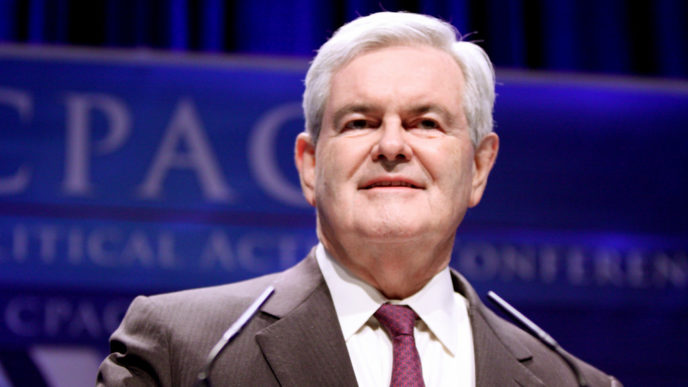
House Republican leaders made a big mistake by trying to rush through their plan to replace Obamacare, conservative star Newt Gingrich says.

And, Gingrich adds, President Donald Trump should have waited longer to step in.

Instead of setting unrealistic timelines that don’t account for the complexity of health care policy, the former House speaker said during a speaking engagement, Republican leaders should have allowed for a vigorous debate that could stretch out for months.

“I actually think the system, if you let it, works pretty well,” Gingrich told an audience of about 1,000 at Rider University’s Rebovich Institute for New Jersey Politics.

“But to work well takes time,” he said. “You have to have hearings, then you have to have markups, then you have to find out what is good, and the leadership has to realize it may not be perfect. Maybe it could be improved.”

The day after Gingrich spoke, one of his successors, House Speaker Paul Ryan, pulled Republican leadership’s Obamacare replacement bill—the American Health Care Act—for lack of enough votes as conservatives and some centrists refused to embrace it.

Trump got involved and put himself on the line too early in the Obamacare repeal debate, Gingrich argued.

“The time for President Trump to become involved in health care legislation is when a bill finally moves to [House-Senate] conference,” Gingrich said, because until then, “you are not shooting with real bullets.”

The House Freedom Caucus, made up of some of the most conservative members of the House, argued that the leadership bill supported by Trump did not completely repeal the Affordable Care Act, popularly known as Obamacare.

Among other things, caucus members complained that Ryan did not hold hearings on the plan, nor allow major changes.

Gingrich, a former Republican congressman from Georgia and presidential candidate who is now a prolific author, initially gained national attention as the primary architect of the GOP’s “Contract with America.” The agenda proved to be instrumental in securing majorities for his party in both houses of Congress in 1994, for the first time in 40 years.

Gingrich spoke March 22 at Rider on “The Virtues of Capitalism and Free Markets” as part of a series of lectures bringing prominent public figures to campus.

During the question-and-answer session following his talk, Gingrich was asked to comment on how the House and Senate have handled health care after the election of Trump and the GOP’s promised repeal and replacement of Obamacare.

Before President Barack Obama’s health care bill became law, it took eight months for the legislation to work its way through both chambers of Congress, Gingrich reminded audience members.

Rep. Nancy Pelosi, D-Calif., who was House speaker when the Democrats were in the majority, introduced the Obamacare bill in July 2009; Obama signed the final version of the massive bill into law in March 2010.

In the end, not a single Republican voted for it in either the House or Senate.

“Why these guys would have set up a two- or three-week process is beyond me,” Gingrich said of Ryan and other House Republican leaders seeking to repeal and replace Obamacare.

Proponents of any legislation must navigate through both the House and Senate, two very different bodies, Gingrich noted.

“The House is a truck stop and the Senate is a country club,” he quipped. “I’m a creature of the House, so I have a very deep bias.”

Conservative Republicans in the Senate also had big concerns with the House GOP’s health care bill. And the Senate, Gingrich reminded the audience, typically rewrites and revises House bills before final details are worked out by conferees from both chambers.

Every morning, each U.S. senator looks in the mirror and says, “Yes, I would be a better president,” Gingrich said in jest. “So, what you have there [in the Senate] are 100 presidents negotiating.”

In his prepared remarks, Gingrich referenced an essay by Lebanese-American statistician and scholar Nassim Nicholas Taleb. Called “The Intellectual Yet Idiot,” it critiques governing elites, including tenured academics who are “really good at taking tests and writing essays” but can’t operate in the real world.

The elite figures described by Taleb “could write a brilliant essay on how to change a flat tire,” Gingrich said, “but if you walk into their office and say, ‘I have a flat tire,’ they wouldn’t know what to do because they’ve never seen a flat tire.”

Gingrich also took on academics who have been reticent to acknowledge the benefits of capitalism and free markets.

“To walk around and say capitalism doesn’t work and free markets don’t work is a denial of everything we know,” Gingrich said. “It would be like flying on a 747 from New York to Tokyo and debating whether or not the Wright Brothers succeeded.”

Tom Simonet, a journalism professor at Rider University, bristled at Gingrich’s description of tenured professors.

“The market does not magically regulate itself, and his anti-academic theme sounds like reverse elitism,” Simonet told The Daily Signal. “If he hears a critique of any one of his positions from a scholarly, well-researched point of view, he can just sit back and say it is fantasy.”

But Simonet said he enjoyed Gingrich’s discussion of the legislative process.

“He made the House and Senate sound almost like different planets in terms of culture,” Simonet said in an email, adding: “I was surprised that Gingrich voiced any criticism of the president. But the process of legislation is a subject Gingrich really knows.”

Ben Dworkin, a political science professor at Rider, is director of the Rebovich Institute for New Jersey Politics.

“His descriptions of House-Senate relations were realistic and often [are] overlooked by outside observers watching the legislative process unfold,” Dworkin told The Daily Signal in an email. “Trump has moved very quickly in a number of different areas, and I think one big takeaway from the speaker’s remarks was his view that six weeks is not nearly enough time to build the coalition to replace the ACA.”

Gingrich’s robust defense of capitalism and his challenge to academic elites struck a chord with Rob Pluta, who owns and operates Leonardo’s II restaurant in Lawrenceville, a few miles from the Rider campus.

“Tenured professors who are protected by the bubble of academia never have to worry about meeting a payroll or having enough business to pay the mortgage,” Pluta said. “This is exactly what Newt meant when he talked about people who can test well and write well but have no idea of how the real world works.” (For more from the author of “What Newt Gingrich Sees as Missteps by Trump, House Leaders in Failed Obamacare Repeal” please click HERE)

Follow Joe Miller on Twitter HERE and Facebook HERE.

Gun Sales Have Fallen Since Obama Left Office

The gun industry may be headed for a slump after eight years of explosive growth under former President Barack Obama.

From December through February, the number of federal background checks conducted each month declined from the same month a year ago, according to the Associated Press. While not an exact measure of total firearm sales, background checks are considered a key measure of how gun manufacturers are performing.

One reason for the softening demand, some gun industry experts say, is that potential gun buyers are no longer worried Washington will issue new regulations restricting gun sales.

“President Obama was the best gun salesman the world has ever seen,” Karl Sorken, a production manager at Houston-based Battle Rifle Co., told the AP.

During Obama’s tenure, customers rushed to buy firearms before the administration could follow through on its goal of placing tighter controls on the type and number of guns that could be sold. The gun industry boomed on the surging demand: The number of U.S. companies licensed to make firearms jumped 362 percent over the decade ending in 2015. (Read more from “Gun Sales Have Fallen Since Obama Left Office” HERE)

Follow Joe Miller on Twitter HERE and Facebook HERE.
Rogue Intelligence Agencies Remind Me of the Kennedy Assassination

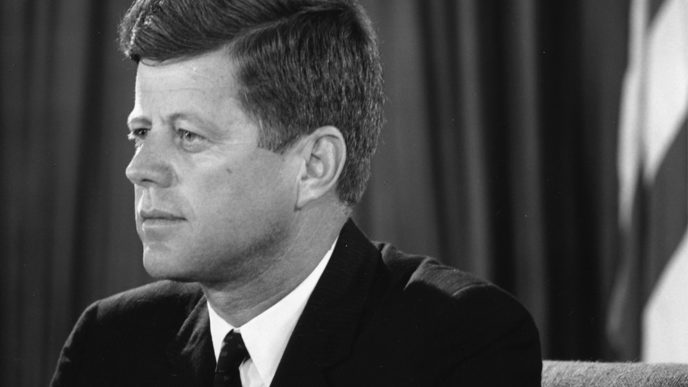
On December 22, 1963, one month after the assassination of President John F. Kennedy, former President Harry S. Truman, who initially authorized the creation of the Central Intelligence Agency (CIA), wrote in the Washington Post:

“I think it has become necessary to take another look at the purpose and operations of our Central Intelligence Agency…For some time I have been disturbed by the way CIA has been diverted from its original assignment,” that is, as a collator of “accurate and up-to-the-minute information,” upon which the President could make decisions, information not “slanted to conform to established positions of a given department.”

In contrast to Truman’s intent, the CIA, starting with the appointment of Allen Dulles as Director in 1953, became “an operational and at times a policy-making arm of the Government,” often “injected into peacetime cloak and dagger operations” and using intelligence “to influence or to lead the President into unwise decisions.”

There is no better example of those assumed roles than the Bay of Pigs operation, a CIA-organized paramilitary invasion to overthrow the Cuban government of Fidel Castro:

“Arch-Establishment figure Allen Dulles had been offended when young President Kennedy had the temerity to ask questions about CIA plans before the Bay of Pigs debacle, which had been set in motion under President Dwight Eisenhower. When Kennedy made it clear he would NOT approve the use of U.S. combat forces, Dulles set out, with supreme confidence, to mousetrap the President.”

“Coffee-stained notes handwritten by Allen Dulles were discovered after his death and reported by historian Lucien S. Vandenbroucke. They show how Dulles drew Kennedy into a plan that was virtually certain to require the use of U.S. combat forces. In his notes, Dulles explained that, “when the chips were down,” Kennedy would be forced by “the realities of the situation” to give whatever military support was necessary “rather than permit the enterprise to fail.”

Kennedy did not deploy the U.S. military to Cuba and the enterprise did fail. Subsequently, Kennedy fired Dulles and his deputy director General Charles P. Cabell, whose brother Earle, incidentally, was mayor of Dallas on the day Kennedy was assassinated.

After the Bay of Pigs fiasco, Kennedy reportedly said that he wanted to “splinter the CIA into a thousand pieces and scatter it into the winds.”

In my opinion, as a consequence of Kennedy’s real or perceived hostility toward the agency and its rogue operations, elements of the CIA either participated directly or created the conditions whereby President John F. Kennedy would be assassinated in Dallas, Texas on November 22, 1963.

Like Dulles, CIA operative David Atlee Phillips, who “was involved in the organization of the Bay of Pigs operation” and afterwards was appointed Chief of Cuban Operations having “the freedom to roam the entire Western Hemisphere mounting secret operations to get rid of Fidel Castro,” said “his goal was to provoke US intervention in Cuba by ‘putting Kennedy’s back to the wall.'”

Nothing would put “Kennedy’s back to the wall” more than an assassination attempt linked to Cuba.

Phillips, not only had the authority, but had access to all the necessary CIA assets including organized crime, anti-Castro Cubans and a low-level CIA agent named Lee Harvey Oswald, who pretended to be a Marxist and pro-Cuban activist. Oswald ultimately failed in his efforts to infiltrate the Soviet Union and communist organizations in the U.S., but eventually provided the ideal patsy, when an assassination “incident” became a reality, as the mafia took final control of the operation in Dealey Plaza.

That is, the assassination was an operation within an operation, which from the CIA’s standpoint, unintentionally or intentionally killed President Kennedy and, in either case, because of those involved, required a government cover-up.

Fast forward to the present, when, not only do U.S. intelligence agencies still engage in cloak and dagger, make policy, and decide what intelligence the President and Congress are allowed to see, but they now monitor and record every telephone conversation, every email, every social media post and every financial transaction by every American, 24 hours a day, 365 days a year.

Interestingly, less than two years before he was to leave office, Barack Obama authorized CIA Director John Brennan to reorganize the agency, a man who admittedly, as late as 1980, voted for the Communist Party and reportedly converted to Islam.

What was the purpose of a reorganization occurring so late in Obama’s term of office and orchestrated by a close political ally?

Brennan’s reorganization created the CIA’s own cyber capability, the Directorate of Digital Innovation and ten separate centers: “six of which have a regional-based focus – Africa, East Asia and Pacific, Europe and Eurasia, the Near East, South and Central Asia, and the Western Hemisphere; and four of which have a mission-based focus – counterintelligence, counterterrorism, global issues, and weapons and counterproliferation.”

One might say that the new CIA, which is modeled after a traditional multi-function fusion structure like the Counter Terrorism Center, is more tactical than strategic, more operational than intelligence-gathering and, overall, is more digitally intrusive, which potentially affects every “incidentally surveilled” American.

Alternatively, a cynic might conclude that such a late-term reorganization was simply an opportunity to permanently embed personnel and policies that would serve the Obama-Brennan ideology.

Intelligence as a continuation of politics by other means. I don’t think that is what Harry S. Truman had in mind. (For more from the author of “Rogue Intelligence Agencies Remind Me of the Kennedy Assassination” please click HERE)

Follow Joe Miller on Twitter HERE and Facebook HERE.
It’s Official, Pentagon Will Now Keep Troop Count in Iraq and Syria Secret

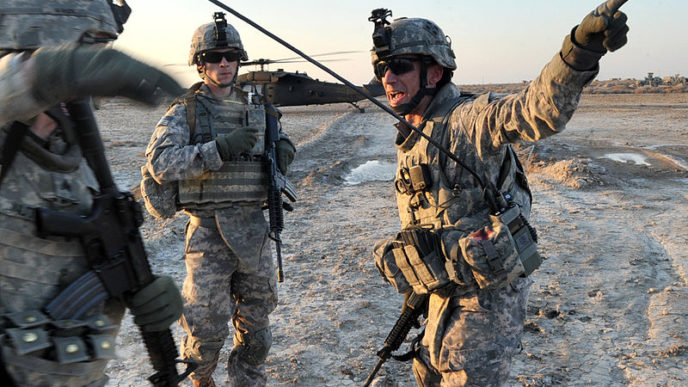
The U.S. Central Command recently announced that troop numbers in Iraq and Syria will no longer be reported to the public. In its announcement, CENTCOM spokesman Army Col. John Thomas declared that “capabilities, not numbers,” should be the area of focus, and the public will be given general estimates of troop sizes in the future.

Jason Ditz of antiwar.com points out that the Obama administration was already less than forthcoming about the number of soldiers sent to these areas by utilizing a variety of tactics, including “deliberately omitting large numbers of troops from the official count by labeling them ‘temporary.’”

The Pentagon’s announcement comes during a time in which the U.S. military’s recent use of airstrikes is under fresh scrutiny and stands accused of causing deaths of hundreds of civilians in recent weeks, including strikes in Mosul last week that killed an unconfirmed, but reportedly numerous, number of noncombatants.

According to Reuters regarding the strike in Mosul, “Eyewitnesses from Mosul and Iraqi officials have said last week’s strike on Islamic State targets may have collapsed homes where rescue officials say as many as 200 people were buried in the rubble.” Reuters described this event as “one of the deadliest single incidents for civilians in recent memory in any major conflict involving the U.S. military.”

In the Pentagon’s acknowledgment of the Mosul strike and announcement of its investigation into the incident, Army Col. Joseph Scrocca admitted that “we believe a coalition strike contributed in at least some way to the civilian casualties.”

In addition, reports have surfaced alleging that recent U.S. airstrikes in Syria have led to significant civilian deaths. One strike that was launched in northern Syria in mid-March, reportedly targeted at a building “that local officials said was a mosque filled with worshippers at evening prayer” and also resulted in civilian casualties. Another strike by a U.S.-led coalition at a school in Raqqa that was being “used as refugee centre,” according to The Guardian. The Guardian’s report notes that “Over the past eight months, there have been four cases in which US planes or drones have been blamed for mass civilian casualties in Syria.”

The new U.S. presidential administration has unsurprisingly provided little change in its approach to foreign policy and the war on terror; in fact, President Trump is currently considering sending at least 1,000 more troops to Syria. As Ditz noted, the government has long lacked transparency regarding troop numbers in Iraq and Syria, and it appears that CENTCOM may be seeking to avoid further criticism over specific deployment numbers by simply eliminating these reports. However, this increase in secrecy that further places civilians in the dark will undoubtedly exacerbate tensions across the globe in regards to American accountability.

Another troubling revelation from Thomas is the military’s dismissal of making changes to airstrike policy. Thomas stated that General Joseph Votel, the head of CENTCOM, “is not looking into changing the way we operate other than to say our processes are good and we want to make sure we live by those processes.” (For more from the author of “It’s Official, Pentagon Will Now Keep Troop Count in Iraq and Syria Secret” please click HERE)

Follow Joe Miller on Twitter HERE and Facebook HERE.

PC Kills: Will the West Ever Wake up From the Delusional Approach to Jihad?

A jihadist attacks individuals in the public square of a Western town.

The media refuses to provide a description of the attacker, reporting only the weapon he used.

A physical description of a man of African, South Asian, or Middle Eastern descent leaks out in the ensuing hours.

Law enforcement authorities deliver a press conference confirming the attacker’s Islamic name and stating that at this time, his motive is unclear.

Rumors on social media percolate about the man screaming “Allahu Akbar.”

Mainstream reporters ask local Muslim community leaders and neighbors about the attacker. They express universal shock, describing him as a decent man who might have been rough around the edges but never showed signs of being a terrorist. The man came from a middle-class family, liked playing video games with friends, and by all accounts lived a normal existence. Toward the end of the stories, those close to the attacker note that he had grown increasingly devout in recent years.

Bloggers begin to research and quickly find that the attacker was a member of a mosque led by an imam who had been recorded preaching hatred and violence toward the West. The attacker posted violent verses from the Quran and railed against the “Crusaders’” wars in the Levant on social media pages captured by screenshot before they were taken down. It emerges that he had spent months in the Middle East during recent years.

Several days later, law enforcement authorities report that the attacker in fact appears to have been a terrorist. But he had no direct ties to IS or Al-Qaeda, so there is no reason for alarm.

Politicians plead with the public that this man perverted one of the world’s great religions – Islam, “the religion of peace” – and that his acts were “non-Islamic.” They urge us all to come together in a shared belief in tolerance and diversity. Love trumps hate. Lone wolves are a fact of life, and their efforts only underscore the need for community engagement to “counter violent extremism.”

How many times are we in the West going to see the above script play out before something changes?

How long will we live a naïve fantasy in which we act as if all is well as the global jihadist movement metastasizes, bringing the violent murder of infidels to our shores?

If the murder of 3,000 innocents on American soil has not caused the West to openly and honestly examine who the enemy is and what animates him, and to develop a comprehensive strategy that mobilizes all of our resources and capabilities to defeat him, do we expect anything to change the next time we experience a mass attack?

Meanwhile, those who do understand the enemy are dismissed as cranks or called bigots. Those who assert that jihad is the motive – that violent subversion with the goal of world domination is justified by core Islamic texts, as the jihadists themselves clearly illustrate – are told to pipe down.

If you offend by speaking truth, you will cause violence. Shut up, and maybe you can keep your head.

Government service predicated on an understanding of the theopolitical Islamic supremacism that animates jihadists is simply out of the question. Heaven forbid that national security and foreign policy officials have any understanding of the Sharia law that both de facto and de jure governs the lives of hundreds of millions of people worldwide.

What will it take for the West to flip this script?

To date, murder, bloodshed, and fear abound. In spite of that fact, much of the West would rather cling to a narrative that makes it feel good about itself than recognize the reality of a global jihadist menace that threatens its very survival. This insane delusion will continue to have fatal consequences until we wake up. (For more from the author of “PC Kills: Will the West Ever Wake up From the Delusional Approach to Jihad?” please click HERE)

Follow Joe Miller on Twitter HERE and Facebook HERE.
Donnelly Becomes Third Democrat to Back Gorsuch

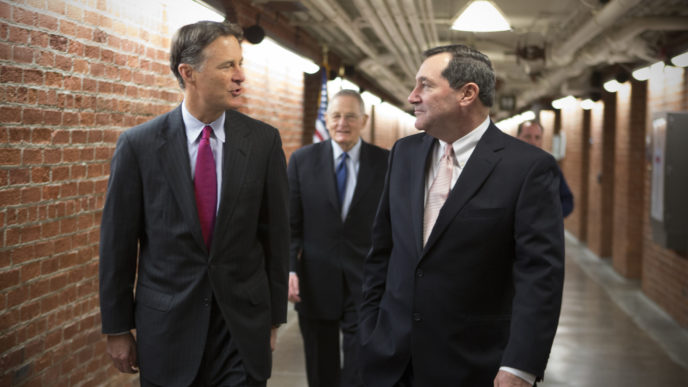
Sen. Joe Donnelly (D-Ind.) said Sunday that he will support the nomination of Neil Gorsuch to the Supreme Court, becoming the third moderate Democrat to break with his party and back President Trump’s nominee.

“After meeting with Judge Gorsuch, conducting a thorough review of his record, and closely following his hearing before the Senate Judiciary Committee, I believe that he is a qualified jurist who will base his decisions on his understanding of the law and is well-respected among his peers,” Donnelly said in a statement.

Donnelly said the Senate should keep its 60-vote requirement for breaking a filibuster on Supreme Court nominees in place, a reference to Republicans suggesting they may resort to the “nuclear” option.

Republicans, vowing to confirm Gorsuch “one way or another,” have indicated, however, they may alter the Senate rules so that ending debate on Gorsuch would only need a 51-vote simple majority. They currently hold a 52-person majority in the upper chamber and would need five additional Democrats or Independents to back Gorsuch if the rules are not changed . . .

Democrats, still reeling after former President Barack Obama’s nominee to the court was blocked by Republicans from getting a hearing or a vote last year, have largely come out against Gorsuch. Thirty-eight Democrats have said they will oppose his nomination. (Read more from “Donnelly Becomes Third Democrat to Back Gorsuch” HERE)

Follow Joe Miller on Twitter HERE and Facebook HERE.