Obama’s Sex Secrets Laid Bare

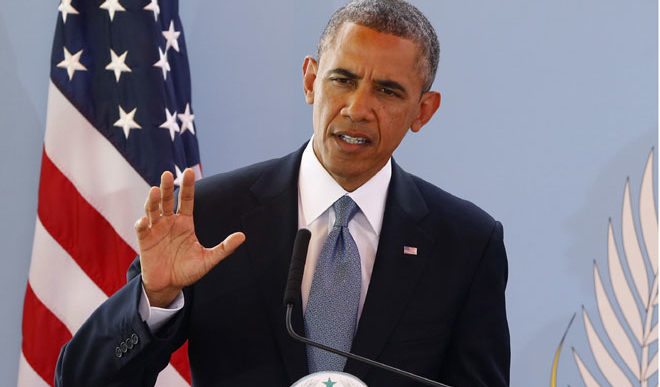
The sex secrets of the young Barack Obama have been revealed in an authoritative new biography of the ex-president.

Obama slept with his girlfriend Genevieve Cook on their first date, before she wrote him a poem about their ‘f***ing’ and called their sex ‘passionate’, the book about the former president reveals . . .

Obama also considered a gay relationship while at college, twice proposed to another white girlfriend, and cheated on Michelle with his ex during the first year of their relationship.

His past is revealed in the 1,078-page biography Rising Star: The Making of Barack Obama, to be published on May 9.

Obama, a new Columbia graduate who was working for a firm that prepared financial reports at the time, made dinner for Cook at his apartment in Manhattan two weeks after meeting her at a New Year’s Eve party and handing her his phone number. (Read more from “Obama’s Sex Secrets Laid Bare” HERE)

Follow Joe Miller on Twitter HERE and Facebook HERE.

The Lesbian Porn Star Who Claims to Be an Evangelical Christian

I’m not going to mention her name, nor will I link to her story. The last thing I want to do is point a struggling reader to a website that might draw him or her into temptation. Suffice it to say that the woman in question is reputed to be a well-known porn star in her home country (which is not America).

She was being interviewed on an X-rated TV show when she explained that she had an “evangelical faith” and was a “good person at heart.”

The host of the show was surprised by her comments, saying to her, “But how do you relate that to your work because people believe a porno actress cannot be evangelical and cannot be religious?”

God Sees Our Hearts — Differently Than We Do

That’s certainly a fair question. How, pray tell, do you reconcile having sex with multiple partners on camera with being a person of evangelical faith? How do you reconcile choosing to be an object of lust to thousands of viewers with being a follower of Jesus?

Doesn’t the Bible condemn adultery and fornication? Doesn’t Jesus say that to lust after a woman is to commit adultery with her in his heart? Doesn’t He also pronounce judgment on people who lead others into sin?

The porn star responded: “People are very judgmental. They try to make you conform in a way they think an evangelical should be because society says so.”

What? It’s being judgmental to say you can’t commit sexual immorality for a living and serve God at the same time? It’s society, rather than Scripture, that says that porn movies are wrong? The Lord has no issue with videos that degrade women, with videos that celebrate perversion, with videos that incite lust?

Not according to this young star. “I think God sees inside our hearts,” she said. “He judges the good and the bad things you do, and I do good things for people.”

Yes, He sees our hearts, and He sees this woman as a poor lost soul in need of a Savior. She might be a very sweet person. She might do lots of good things for others. But she is a sinner in need of forgiveness, and what she does for a living is ugly is God’s sight.

“I’m a good person at heart and that’s what matters,” she said.

Her holy Creator differs with her assessment. And this is where all of us can learn a lesson. We can deceive ourselves as easily as we can deceive others. We may not be porn stars, but some of us are porn addicts. Yet, we say, “God sees my heart, and He knows I’m a good person.”

Right in One’s Own Eyes

Before I was a believer in Jesus, I was a heavy drug user to the point of shooting heroin at the age of 15. I stole drugs from a doctor’s office. I even stole money from my own father. I had a terrible temper and would tear people up with my words. And I indulged the flesh every way I could.

Yet when my best friends came to faith and talked to me about the Lord, I said to myself, “If there really is a God, He knows I’m a good person. He knows if I see a homeless man on the streets, I’ll give him some change. If I see an old woman entering a building, I’ll open the door for her.”

What deception. That’s why the Scriptures say that every way of a man is right in his own eyes, but the Lord weighs the hearts (Prov 16:2).

Getting back to this porn star, she explained that “my family don’t have a clue about what I do for a living. I haven’t told them, but to be honest, I really don’t care if they find out.”

In fact, her being a porn star isn’t the big issue to her churchgoing family. They’re upset because she divorced her husband and now lives with a woman.

She said, “My family was really shocked when they found out. It took them a while to accept because their evangelical beliefs and prejudice against gay relationships made it hard for them to come to terms with my decision.”

So, the plot thickens. Not only is a she a porn star. She’s in a sexual relationship with another woman. She said, “I’m prepared to live with anyone so long as they make me happy, and that could include finding love with a transsexual.”

Who cares about the will of God? This is what you call living for self. Yet for this deluded young woman, it’s all fine with the Lord.

As a teenager, she realized how much she enjoyed sex, especially when others were watching. “I love my work,” she said, “and I want people to appreciate and respect what I do. It’s a job where I make good money and I am successful. … I still have a normal life outside and when I get the chance, I go to church with a Bible in my hand.”

Are We Deceived?

As the old saying goes, deception is very deceiving.

But perhaps there’s one more lesson to learn.

There are plenty of churches in America (and other nations) where you can be a porn star (or alcoholic or wife-beater or thief) and sit comfortably through sermon after sermon without the slightest feeling of conviction. You’ll hear a pep-talk gospel or a feel-good gospel or a self-help gospel — it’s all about me! — without hearing a call to turn from sin.

And carrying a Bible in your hand without taking the words of that sacred text to heart will do you no good at all.

Could it be, then, that it’s not just this porn star who is deceived? Could some of us be deceived as well? Could it be that some of us who are the quickest to condemn this lost young woman are the biggest hypocrites of all?

I pray for the repentance of this young, deluded soul. But I pray for our repentance as well. It’s time we undeceive ourselves. Attending church services, Bible in hand, is no substitute for a holy life. (For more from the author of “The Lesbian Porn Star Who Claims to Be an Evangelical Christian” please click HERE)

Follow Joe Miller on Twitter HERE and Facebook HERE.

Democrats Are Now Officially the Party of Death

There is no more room in the Democratic party for pro-life Americans. The chairman of the Democratic National Committee has made that clear. As clear as the water Pontius Pilate used to wash his hands. Townhall reports:

Top Democrats recently told their party to get in line with their radical abortion agenda or step aside. As a way to bury the controversy over the Democrat National Committee campaigning with a Democratic mayoral candidate, Heath Mello, who once voted for pro-life legislation, DNC Chair Tom Perez and Sen. Dick Durbin (D-IL) insisted that it was a mistake and that Roe v. Wade is non-negotiable.

The magazine America, whose liberal Jesuit editors are at least pro-life, pointed out what this really means:

Abortion is now the single issue defining the Democrats, and Ilyse Hogue, the president of NARAL Pro-Choice America, is the de facto head of the party. … NARAL is at least as powerful within the Democratic Party as the National Rifle Association is within the Republican Party.

Bad News? Or Just Reality Emerging?

It’s hard to know precisely how to feel about this development.

We are Christians, pro-lifers and conservatives — in that order. There’s no conflict among those things. In fact they go together. But each is a different angle from which to view political questions.

We live in a democracy. We bear a solemn responsibility under God: making just laws for ourselves. So abortion is a political question. It isn’t in China, Cuba or other totalitarian states. There the people’s masters simply impose the practice on them. (You know, the way liberals want the Supreme Court to keep on doing.)

It’s key to keep our priorities in order. So let’s scrutinize this news about the Democrats under each of those three categories.

As Christians, We’re Saddened

From a spiritual perspective, this is tragic. One of our nation’s two political parties is now completely dedicated to a fundamental evil. Abortion is even worse than segregation. (Democrats defended that for 100 years). It’s on the level of slavery. To be an active Democrat, going forward, is now to participate in evil. If you raise money for Democratic candidates, give to Democratic causes, or in any way participate in that party’s bid for power. … You are implicated.

Our hearts go out to lifelong Democrats who care about unborn life. And to candidates like Heath Mello who tried to save their party from plunging over the cliff. But it has taken the plunge.

And that is something to mourn. It should lead us to prayer. It should lead pro-lifers who’ve belonged to the Democratic party to take a good hard look at leaving. Maybe they should start a third party that’s clearly pro-life, which also represents their views on other issues, where morality is not so black and white: such as poverty programs, immigration policy and other liberal priorities.

But they can’t go on cooperating with the party of NARAL — any more than pro-life Republicans could stay in that party if it endorsed euthanasia to cut back on Medicare costs.

As Pro-Lifers, We’re Conflicted

As citizens committed to protecting the vulnerable from violence, we’re deeply saddened. We honor pro-life Democrats of the past, like the great Ellen McCormack and Robert Casey. They championed the human rights of unborn children in a party that was being hijacked by hedonism and feminism. They fought the good fight. And failed.

Strategically, it’s a bad thing for a cause to be trapped in just one party. Defenders of Israel are glad that pro-Israel candidates exist in both political parties. The National Rifle Association cultivates pro-Second Amendment Democrats. So have pro-lifers, as long as that party made room for differences of conviction. The danger is that Republicans will take our votes for granted, and continue to shove the life issue to the back burner.

But the two-party strategy might be falling apart for other causes too. The anger and intolerance of leftist activists is driving the Democratic party away from a true defense of Israel. Ever more liberal organizations are backing the bigoted “Boycott-Divestment-Sanctions” movement that targets Israel and even American Jews for open discrimination.

On the gun issue, Democratic leadership still prudently allows candidates in selected regions to dissent from the overwhelming party consensus against private handgun ownership. But how long that will last, in our current atmosphere of a rush to extremes? Of hooded leftist demonstrators silencing campus speakers with impunity? Ten years, max, we predict. Sooner rather than later, there will be no more room for Jim Webbs in the Democratic party.

Now the Stakes Are Obvious

On the positive side, the Democrats’ decision to side as a party with baby-parts merchants like Planned Parenthood does … clarify matters. It shreds for once and all the phony “Seamless Garment” that leftists within the churches have used to bury the unborn under a pile of other, more popular priorities.

As we wrote here last summer, members of Democrats for Life were essentially giving political cover to rabid pro-choicers like Hillary Clinton. How? By pretending that issues where people of good will can differ over the wisest policy for enhancing human life were somehow comparable to abortion. No, health insurance, welfare, wages or even gun violence cannot be classed with abortion. Like genocide or unjust wars of conquest, it’s a practice that’s purely evil which no just government should enable. Period.

As Conservatives, We’re Hopeful

Of course, as citizens with strong, clear convictions about the sanctity of human life, we don’t like to see the party that represents half the country oppose us. It pushes the common good a little further out of reach. We wish that Democrats would come around on a whole range of issues. In an ideal world, both parties would accept core conservative principles — as both parties did on many issues, back in 1960 or so. Then elections could be about competency, honesty and character.

Just as slavery and segregation denied the founding principles of our country, so does abortion. It is profoundly toxic to have one of our two major political parties aligned against the nation’s very founding. The Democratic party at first clung to slavery, then to segregation. Now it clings to abortion. How long will it take political reality to peel its white knuckles off its latest fetish of evil? Only time will tell.

That said, from the point of view of accomplishing things: The Democrats’ move is wicked, vicious and helpful. To us. It demonstrates in flesh and blood the left’s commitment to an ideology of suicide.

The left in America has increasingly embraced a whole set of convictions that fit together like a puzzle. What holds the pieces in place is a dark, insidious view of human beings.

We Represent Different Species

Conservatives (especially Christians) believe that human beings are free, responsible creatures — the image of God. We only enjoy our freedoms as part of a compact; each one comes paired with a solemn responsibility. We don’t expect to “get away” with enjoying our rights while abandoning our duties. We don’t want to be paid for work we didn’t do. Nor to fund other people’s willful idleness. We don’t expect to enjoy all the pleasures of life and evade the consequences.

What better example could we find of a reckless abuse of freedom and disregard of duty than the practice of legal abortion? Everyone knows that sex is connected to having children, as eating is to nutrition. But the Sexual Revolution came along and offered us all the “benefits” of bulimia. Contemporary hedonism wants to totally sever that connection — to change the very nature of sex itself. God made it to be the glue that holds two people together in love for life, and generates new lives. Modern man wants it to be a low-investment, low-commitment (but much more enjoyable) game of Twister.

No real conservative can support that. Few liberals today have the stomach to oppose it. So of course the Democratic party is monolithically pro-abortion. It’s the logical consequence of the secular leftist view of man: a lumpy featherless biped who seeks out pleasure. We can win his votes, the Democrats reckon, by offering him a bigger pile of bananas. (For more from the author of “Democrats Are Now Officially the Party of Death” please click HERE)

Follow Joe Miller on Twitter HERE and Facebook HERE.

Fact Check: Trump’s 100-Day Low Approval Ratings

While President Trump has had a strong first 100 days in office, critics point to his low approval ratings. An AOL headline blares, “Trump has lowest approval rating in history after 100 days in office.” Trump denounces his approval polls as fake news, citing bias.

According to the left-leaning political and elections site FiveThirtyEight, Trump’s approval ratings averaged 42 percent at the end of his first 100 days in office. His disapproval ratings averaged 52 percent.

Mind you, these polls wrongly predicted Hillary Clinton would win the election. FiveThirtyEight’s averaging of polls gave Trump only a 1-in-3 chance of winning. He beat his polling averages by 2 to 3 points in swing states. He beat them by even more in Michigan, Wisconsin and Pennsylvania.

So how can we trust the polls now that say the president’s so unpopular?

Most Polling Companies Lean to the Left

Let’s look at the most accurate polling company today, one that is not biased to the left. Rasmussen consistently shows Trump with the highest approval ratings. In fact, in one snapshot of polls from February, Rasmussen showed Trump 6 points higher than the next closest poll, 55 percent to 49 percent.

The former is the same approval rating former President Bill Clinton had after 100 days in office. Yet no one is talking about this. Instead, they cite Gallup far more often.

Larger Sampling of Democrats Polled

Since most of the polling companies lean to the left, it is not surprising to find they often include more Democrats than Republicans in samplings.

Last June, a Reuters presidential poll surveyed 52 percent Democrats and 35 percent Republicans. The rest were Independents or other. Reuters polled almost 33 percent more Democrats than Republicans. Naturally, the poll results showed Clinton far ahead, 47 percent to 33 percent.

Clever Wording

Reuters/IPSOS was caught last July changing a poll’s wording to favor Clinton. After Trump pulled ahead of her in a July poll, Reuters/IPSOS eliminated the word “Neither” from the Neither/Other choice. That change gave Clinton a 7-point bounce.

Just a Snapshot

While Trump’s approval rating may have dipped in late April, that is just one snapshot in time. It was much higher in prior months. Rasmussen conducted several polls since Trump entered office. Several showed over 50 percent approval.

Likely Voters v. Registered Voters v. Adults

Trump generally had the lowest approval ratings in polls of adults. In polls that interviewed registered voters or likely voters, he tended to have the highest approval ratings. Since likely voters decide elections, why would a polling company choose to interview adults? Some suspect this is done on purpose to skew the results against the GOP.

In fact, if polling companies wanted to be really accurate, they would survey “likely likely voters.” These are voters who have not just voted in one election in recent years, but several in a row. That demographic tends to favor the GOP even more.

Devil’s Advocate: What if the Low Approval Ratings are Valid?

If there is some truth to Trump’s low approval ratings, it may be due to — ironically — his high level of success. He’s cracked down on illegal immigration, the travel ban, intervening in Syria and repealing Obamacare — all fairly controversial positions.

The low ratings could also be due to the spread of social media. It has made it easy to broadcast biased mainstream media articles everywhere. People who normally wouldn’t read The New York Times can’t help but see its articles in their Facebook news feed.

But it Doesn’t Matter Anyway

FiveThirtyEight admits that approval ratings “do a relatively poor job of forecasting the election results.” Based on previous presidents’ experiences, it is too early to predict how Trump’s presidency will go.

Trump’s approval ratings at the beginning of his first 100 days in office started out almost the same as former presidents Ronald Reagan and George W. Bush. Reagan went on to become a very popular president. Both won reelection. FiveThirtyEight points out, “Trump is not very popular, but he’s also no more unpopular than Barack Obama was for much of his presidency.”

Democrats can gloat all they want about Trump’s low approval ratings, but not only are they probably meaningless, they could fool the party into thinking it’ll easily beat Trump in 2020. They could find themselves repeating last year’s surprise loss. (For more from the author of “Fact Check: Trump’s 100-Day Low Approval Ratings” please click HERE)

Follow Joe Miller on Twitter HERE and Facebook HERE.

Alaska Lawmakers Consider Calling Abortion ‘Ultimate Child Abuse’

A conservative state lawmaker has successfully tacked an anti-abortion message onto a resolution in the Alaska House aimed at raising awareness about sexual assault and child abuse.

The amendment from Republican Rep. David Eastman of Wasilla refers to abortion as “the ultimate form of child abuse” . . .

The amendment was approved by a divided House Rules Committee. The vote on Monday followed an about-face by Anchorage Republican Rep. Gabrielle LeDoux, the committee chairwoman who last week refused to hear amendments. (Read more from “Alaska Lawmakers Consider Calling Abortion ‘Ultimate Child Abuse'” HERE)

Follow Joe Miller on Twitter HERE and Facebook HERE.

In His First Criminal Cases, Neil Gorsuch Already Mirroring Scalia

It is only Neil M. Gorsuch’s first month as an associate justice on the Supreme Court, but he is already showing just how similar his judicial philosophy is to that of his predecessor, the late Justice Antonin Scalia.

In several difficult criminal law cases, Gorsuch has asked sharp questions from the bench and cast one of his first votes to deny a stay of execution—moves that echo Scalia’s approach to the law.

The Death Penalty in Arkansas

First, in McGehee et al. v. Hutchinson, Gorsuch voted to deny several Arkansas death row inmates’ requests to halt their executions.

Justices Stephen Breyer, Ruth Bader Ginsburg, Elena Kagan, and Sonia Sotomayor would have granted their request. Breyer wrote a two-page dissent questioning “whether the death penalty is consistent with the Constitution” (he clearly believes it isn’t).

While the majority did not state their reasons for denying the inmates’ request, it seems clear that they relied, at least in part, on the reasoning set out by Scalia in his concurring opinion in Glossip v. Gross (2015), in which he wrote that “not once in the history of the American republic has this Court ever suggested the death penalty is categorically impermissible.”

“The reason is obvious: It is impossible to hold unconstitutional that which the Constitution explicitly contemplates.”

Scalia continued, “The Fifth Amendment provides that ‘[n]o person shall be held to answer for a capital … crime, unless on a presentment or indictment of a grand jury,’ and that no person shall be ‘deprived of life … without due process of law.’”

The Washington Post describes votes on stays of execution as “a time when the responsibility of the role crystallizes.” In McGehee, Gorsuch held firm, silently adopting Scalia’s constitutionalist reasoning.

No ‘Linguistic Somersaults’

Second, Gorsuch demonstrated his adherence to textualism through some of the questions he posed to the advocates during oral argument in Maslenjak v. U.S.

At issue in the case is whether the government was justified in removing the U.S. citizenship of Divna Maslenjak, an ethnic Serb from modern Bosnia.

Maslenjak, who came to the United States in 2000 and was subsequently naturalized as a citizen, was convicted of lying to a U.S. immigration official.

During an interview in 1998, she told the immigration officer that she and her husband were seeking asylum because they feared persecution in Bosnia because her husband had evaded conscription into the Serbian army.

In reality, he had served as an officer in a Serbian militia unit which was subsequently accused of war crimes.

In 2006, Maslenjak falsely stated on an immigration form that she had never lied to an immigration officer, and was subsequently convicted of making false statements on a government document.

A key issue before the Court is whether that lie was “material” enough to affect the original immigration decision, which would, in turn, be sufficient to uphold her conviction and her subsequent denaturalization.

As Amy Howe writes at SCOTUSblog, “ruling for the government” in this case “would give U.S. officials boundless discretion to take away citizenship based on even very minor lies.”

In the midst of this high stakes argument, Gorsuch’s questions focused on one issue in particular: The text of the law itself.

The statute, Gorsuch noted, “doesn’t contain an express materiality provision,” and Gorsuch was concerned about having to do “a lot of linguistic somersaults to add” such a provision into the law.

That harkens back to Scalia’s dissenting opinion in King v. Burwell (2015). There, the U.S. Supreme Court held that the Affordable Care Act’s “tax credits are available to individuals in states that have a federal exchange.”

In signature prose, Scalia wrote that “[t]he somersaults of statutory interpretation” that the majority “performed (‘penalty’ means tax … ‘established by the state’ means not established by the state) will be cited by litigants endlessly, to the confusion of honest jurisprudence.”

Gorsuch appears sympathetic to Scalia’s disapproval of “linguistic somersaults” and the idea that judges are empowered to rewrite laws that they may disagree with.

The Big Picture

Third, Gorsuch showed a keen awareness of how the Supreme Court’s rulings carry far-reaching implications for future cases in Weaver v. Massachusetts.

That case involved a man named Kentel Weaver, who in 2006 was convicted of unlicensed possession of a firearm and premeditated murder of 15-year-old Germaine Rucker. Weaver was 16 at the time of the murder.

In 2011, he sought a new trial, claiming that his counsel was ineffective because they did not object to the courtroom being closed during jury empanelment, when the defendant, judge, and jury first meet.

Weaver argued that this was a procedural irregularity that violated his Sixth Amendment right to a public trial.

But as Chief Justice John Roberts pointed out at oral argument, the reason the courtroom was closed was that it was full. Ninety members of the public were in attendance as prospective jurors, and they all needed seats.

Weaver objected to this reasoning, saying that while prospective jurors were seated, his mother and his other supporters weren’t able to enter the courtroom during the early stage of the proceedings.

At this point, Gorsuch entered the fray with a big picture question.

He asked whether a “triviality exception” might apply here, or whether the Court should consider the potential unintended consequences that can arise when it tries to prevent every injustice—no matter how small—by imposing new procedural requirements across the entire criminal justice system.

Gorsuch asked whether ruling for Weaver would create a “Professor Stuntz” problem, whereby in “perfecting procedure, we actually result in its denial…”

This reference was to the late Harvard criminal law professor, William J. Stuntz, who argued that by following the Warren Court’s “fetishization of so many formalistic procedures,” the criminal justice system is now overburdened by an excess of procedural technicalities at play.

Berkeley law professor Andrea Roth summed up Stuntz’s argument, saying that these rules “at best indirectly ensure fairness of trial and sentencing outcomes” but have “rendered trials too expensive” and complex for anyone but elite lawyers to tackle.

In turn, writes Roth, this “has driven prosecutors and lawmakers to seek ways to avoid trial and force pleas through draconian sentencing schemes, a skewed focus on easily detected urban drug crimes mostly committed by racial minorities, and ever-expanding substantive criminal law.”

Scalia worked to constrain some of the Warren Court’s excesses in this regard during his time on the Court.

In Hudson v. Michigan (2006), for example, Scalia, writing for the majority, refused to extend the “exclusionary rule” (which requires the suppression of incriminating evidence, notwithstanding the fact that a defendant may be guilty) to technical violations of “the knock-and-announce rule,” which establishes that, absent extenuating circumstances, police officers must knock on the door and announce their presence before entering a suspect’s home.

He also asserted, in a noteworthy University of Chicago Law Review article, that there is a “dichotomy between ‘general rule of law’ and ‘personal discretion to do justice’”—that is, to rule as a judge personally desires rather than as the law instructs—and that the latter may lead to “unfortunate practical consequences.”

So far, Gorsuch is modeling this Scalia-esque approach and honoring the rule of law.

This is the exact approach he espoused in a dissent in A.M. v. Holmes (2016) while sitting on the U.S. Court of Appeals for the Tenth Circuit. There, he wrote, “[a] judge who likes every result he reaches is very likely a bad judge, reaching for results he prefers rather than those the law compels.”

A Fitting Successor to Scalia

Throughout his nomination and confirmation process, Heritage Foundation legal scholars noted Gorsuch’s striking similarities to Scalia, which include a shared sensitivity to overcriminalization, textualism, and the separation of powers.

In these first few cases, Gorsuch is showing just how well he fits the Scalia mold of being a committed constitutionalist and textualist on the High Court. (For more from the author of “In His First Criminal Cases, Neil Gorsuch Already Mirroring Scalia” please click HERE)

Follow Joe Miller on Twitter HERE and Facebook HERE.

While the Left Ignores Voter Fraud, More Evidence Mounts to Prove Them Wrong

The 2016 elections have passed, but courts still have plenty of work to do sorting out cases of voter fraud throughout the country.

Convictions have continued to roll in this spring, and The Heritage Foundation’s voter fraud database is growing longer by the day.

This week, we are adding 19 convictions, including cases from Texas, Colorado, and Illinois. These are just the latest convictions. Yet despite the overwhelming evidence, the left prefers to bury its head in the sand and refuses to acknowledge the reality of Voter fraud.

Take one example from Kansas. When Kansas Secretary of State Kris Kobach claimed his first conviction in a voter fraud case against a non-U.S. citizen, opponents of the conviction had no interest in dealing with the facts.

Instead, some groups on the left—like the liberal news site Think Progress—accused Kobach of “voter suppression.” Another Salon article completely dismissed Kobach without addressing the evidence he found, saying, “Someday he’ll have evidence of a problem that doesn’t exist.”

In many states, voter registration requires proof of citizenship. The left calls such policies anti-American. But is that really such a radical idea, that voters in a U.S. election would have to be U.S. citizens?

If liberals want evidence, then Heritage has it. To date, we have documented 773 confirmed criminal convictions in 492 voter fraud cases spanning 44 states.

Here are a few of the newest entries to the database:

Toni Lee Newbill, of Colorado, pleaded guilty to voting twice for her deceased father, once in the 2013 general election and again in the Republican Primary of 2016. Newbill was sentenced to 18 months of unsupervised probation, 30 hours of community service, and was ordered to pay a $500 fine and additional court fees.

Noe Olvera, of Texas, pleaded guilty to a federal bribery charge. Olvera, a postman, admitted to taking a $1,000 bribe from a paid campaign worker in exchange for a list of the names and addresses of mail-in ballot recipients on his postal route.

After a two-year investigation into local voting fraud, hidden camera footage surfaced revealing a uniformed and on-the-job Olvera “negotiating an exchange of money for mail-in voter lists.” Olvera is scheduled to be sentenced on May 25.

Steveland Kidd, of Illinois, pleaded guilty to two counts of absentee ballot abuse during a municipal election in April 2013. Kidd took possession of, and delivered, an absentee ballot to election authorities despite being legally barred from doing so.

The crime is a Class 3 felony. Kidd was sentenced to 12 days in the St. Clair County Jail and is now barred from engaging in campaign-related activities or electioneering.

Brian McDouglar, a resident of Cahokia, Illinois, was sentenced to two years in prison on charges of falsifying or tampering with an absentee ballot—a class 3 felony. McDouglar illegally took an absentee ballot from a voter he was not related to, and then placed it in the mail.

Clearly, absentee voting remains particularly vulnerable to fraud.

Simply put, in most states there are few measures in place to sufficiently verify the identity of those casting absentee ballots. Signatures can be forged—a problem that can be addressed by requiring the voter to include a photocopied valid ID along with the absentee ballot.

But more robust identification requirements would only solve part of the problem. They cannot defend against the pernicious targeting of absentee voters by pressuring, coercing, or “assisting” them in filling out their ballots in order to assure that particular candidates or causes prevail.

So long as states continue to allow the names of deceased voters and residents who have moved away to remain on their voter rolls, they are leaving the door wide open to fraudsters who are willing to take advantage of the system by voting in their names.

The Heritage Foundation published “Does Your Vote Count?,” a guide to help voters and policymakers understand the issue of election fraud. That report provides policy recommendations that states should adopt to help thwart illegal activity and ensure that the election process remains free and fair for all.

Procedures that can be implemented include requiring a photographic, government-issued ID and proof of citizenship to register to vote. In addition, participating in an interstate voter registration crosscheck program will help guarantee that people are not voting twice.

Secretaries of state should verify voter registration data with other state and federal agencies, such as the state Department of Motor Vehicles and the Social Security Administration. Such measures will offer a barrier of protection not only to eligible voters, but also to the electoral process in general.

A single fraudulent vote does more than just cancel out the vote of another American. It puts a stain on the results of the entire election.

If voters are discouraged to participate in what they perceive as a tainted process, it only empowers those who would seek to steal elections.

Instead of vilifying those who fulfill their duties to protect the electoral process, the left should embrace the facts. Voter fraud is real, and we must take seriously the task of securing the integrity of our elections. (For more from the author of “While the Left Ignores Voter Fraud, More Evidence Mounts to Prove Them Wrong” please click HERE)

Follow Joe Miller on Twitter HERE and Facebook HERE.

Why Conservatives Are Unhappy With the Final Spending Bill

The House of Representatives, with 103 Republicans voting no, passed a $1.1 trillion spending package Wednesday to keep the government running through September.

Conservative lawmakers who opposed the omnibus spending bill in the 309-118 vote said they’re disappointed the final plan doesn’t reflect that Republicans hold the levers of power in Washington.

Republicans hold 238 seats in the House and Democrats hold 193. Four seats are vacant.

“I don’t think it’s a win for conservatives or for Americans,” Rep. Warren Davidson, R-Ohio, a member of both the Republican Study Committee and the more conservative House Freedom Caucus, told The Daily Signal in an interview before the vote.

But Davidson, who voted against the spending bill, did not decry it altogether.

“There are things to like in the bill,” Davidson said. “I am glad we are doing some good things for the Department of Defense, I am glad we are doing things for border security.”

Rep. Mark Walker, R-N.C., chairman of the Republican Study Committee, voted against the spending bill, as did Rep. Mark Meadows, R-N.C., chairman of the Freedom Caucus.

The Senate, where Republicans hold 52 seats, was expected to vote later this week.

Conservatives tended to agree that Republicans scored points by securing $21 billion in new defense spending and $1.5 billion for border security, and by blocking new money for Obamacare and reducing the number of jobs at the Environmental Protection Agency.

Democrats, however, said their wins included adding $2 million for the National Endowments for the Arts and Humanities, securing health care coverage for retired coal miners and blocking Republican attempts to defund Planned Parenthood.

There is a bright side and a dark side to the omnibus spending package, Rep. Raul Labrador, R-Idaho, said Wednesday at a monthly Capitol Hill briefing with reporters called Conversations with Conservatives.

“I do not see it as a win,” Labrador said, adding:

If you look at what happened, the negotiations started before we had the president and his Cabinet were in place. … So you’re not seeing a lot of the White House priorities in this bill, so I don’t see how we can say this is a win for the American people, or for the election that just happened. I could never call this actual spending bill a victory for conservatives or Republicans.

Labrador voted no.

“I don’t see it as a win for conservatives,” Rep. Scott Perry, R-Penn., who also voted no, said at the conservative lawmakers’ meeting with reporters, which occurred before the vote. “While there are some good things in it that conservatives want, the hallmark things that most of us ran on are conspicuously absent.”

But Office of Management and Budget Director Mick Mulvaney said President Donald Trump had been able to change the spending package for the better, despite Democrats’ crowing.

“[Democrats] wanted a shutdown, Mulvaney said. “They were desperate to make this administration look like we couldn’t function, like we couldn’t govern.”

Mulvaney said the lack of funds for Trump’s promised border wall was not a setback, especially since some of the new money is going to reinforce existing fencing. He told reporters in a White House briefing:

Keep in mind, building the border wall is not like building a wall at your house, OK … We would fix all those things anyway as we’re working our way to the new areas. So I wouldn’t agree with the premise that this sets us back at all. If nothing else, it actually helps us to fast-track where border security would be otherwise.

Republican lawmakers in the House and Senate have said they preferred to put off a fight with Democrats over beginning to pay for the wall until the fall, rather than as part of funding the government for the rest of the current fiscal year.

The official deadline for lawmakers to approve the spending package was Sept. 30, 2016, and Davidson bemoaned the fact that Congress has continued to rely on short-term packages rather than passing a budget on time.

“I think you should quit giving a pass to people for missing their deadlines,” Davidson said.

The last time Congress met its budget deadline was in 1996.

But during a press briefing Monday at the White House, Mulvaney said the Trump administration could influence the spending package because Congress had not finalized it on time:

Can you imagine how different this bill is from what the bill that President Obama would have signed back in September? And it’s those differences that I want to talk about today, and those differences that summarize why we think this was a really solid bill for the administration.

However, Senate Minority Leader Chuck Schumer, D-N.Y., called the spending package a “big win” for Democrats.

House Speaker Paul Ryan, R-Wis., pronounced himself satisfied.

“I feel very good about the wins that we got with the administration in this bill,” Ryan said Tuesday.

The spending package includes an additional $331 million for airport security, $2 million more for the National Endowments for the Arts and Humanities, and $137 million more for Customs and Border Protection, The Washington Post reported.

Rep. Justin Amash, R-Mich., who voted no, did not mince words in his assessment of the spending legislation beforehand:

“This bill … really didn’t push the conservative ball down the court very much, with the possible exception of the increase in defense spending,” Rep. Andy Harris, R-Md., a member of the House Appropriations Committee who voted no, said Wednesday.

In a commentary, Justin Bogie and Rachel Greszler, senior policy analysts at The Heritage Foundation, said the spending package was a missed opportunity.

“While the bill does make progress on issues like additional defense funding and increasing border security, it woefully fails the test of fiscal responsibility and does not advance important conservative policies,” they wrote. (For more from the author of “Why Conservatives Are Unhappy With the Final Spending Bill” please click HERE)

Follow Joe Miller on Twitter HERE and Facebook HERE.

The First Step in Revoking Obama’s Land Grab

What is done by executive power can be undone by executive power.

Former President Barack Obama began to learn that lesson this Wednesday when President Donald Trump signed an executive order directing Interior Secretary Ryan Zinke to conduct a review of all Antiquities Act designations larger than 100,000 acres over the past 30 years.

Specifically, the executive order directs Zinke to consider “the requirements and original objectives of the Act, including the Act’s requirement that reservations of land not exceed ‘the smallest area compatible with the proper care and management of the objects to be protected’” and whether “designated lands are appropriately classified under the Act as ‘historic landmarks, historic and prehistoric structures, [or] other objects of historic or scientific interest.’”

This wording strongly suggests that Obama’s lame duck decision to designate 1.35 million acres in San Juan County as a national monument will at least be significantly reduced and possibly entirely rescinded.

Some environmental activists may claim that Trump does not have the power to shrink or revoke Obama’s Antiquities Act designations, but these claims are ignorant of both history and the law.

For starters, as University of California Berkeley Law School professor John Yoo and Pacific Legal Foundation Executive Director John Gaziano detailed in a recent legal report, five presidents have significantly reduced four previous monument designations, and no one has ever questioned the legality of those reductions.

Specifically, President Ike Eisenhower reduced the Great Sand Dunes National Monument by 25 percent, President Harry Truman reduced the Santa Rosa Island National Monument by 49 percent, Presidents William Howard Taft, Woodrow Wilson, and Calvin Coolidge collectively reduced the Mount Olympus monument by 49 percent, and Taft reduced the Navajo National Monument by 89 percent.

A current president’s power to alter a previous president’s flows from the text of the statute, which authorizes the president “in his discretion, to declare by public proclamation … national monuments …. the limits of which in all cases shall be confined to the smallest area compatible with proper care and management of the objects to be protected.”

As Yoo and Gaziano point out, “there is no temporal limit” on the requirement that a monument must be limited to “the smallest area compatible with proper care and management of the objects to be protected” so all presidents must use their ongoing discretion as to whether every monument is the proper size.

“What is done by executive power can be undone by executive power.”

Furthermore, what if a later president determines that an earlier president’s designation was so exceedingly beyond the “smallest area compatible with proper care” that the entire designation was illegal?

Yoo and Gaziano argue that the entire monument designation could be revoked.

Whatever Zinke does end up recommending to Trump—and a preliminary report is due in 45 days on Utah’s Bears Ears National Monument—further executive action will only be the beginning of solving San Juan County’s public lands issues.

Congress will then need to pick up the Public Lands Initiative legislation that was working through the House before Obama derailed the legislative process and pass a commonsense solution that includes real input from local residents.

Only through the legislation can local residents, including the Navajo, be given real power over their land use decisions. (For more from the author of “The First Step in Revoking Obama’s Land Grab” please click HERE)

Follow Joe Miller on Twitter HERE and Facebook HERE.
Target Slashes CEO Pay Package After Bleak Year

Target Corp’s (TGT.N) Chief Executive Brian Cornell took a sharp cut in compensation after the company failed to meet financial goals in a year marred by declines in sales and share price.

Cornell’s cash-and-stock compensation fell by nearly a third to $11.3 million, according to a document filed with regulators two months after the company reported results that sent its stock tumbling to 2-1/2-year lows.

As per Target’s short-term incentive plan, Cornell’s compensation was based on the performance of two financial metrics: incentive EBIT, which makes up 75 percent of Cornell’s stock component, and the rest on adjusted sales.

Target said it missed its 2016 incentive EBIT goal of $5.74 billion by $623 million and fell short of its adjusted sales target of $71.62 billion by $2.13 billion.

“This looks pretty normal in terms of executive compensation and, I think, it is actually good executive compensation in a turnaround situation,” said Paul McConnell, managing director at Board Advisory LLC, an executive compensation, performance and succession advisory group. (Read more from “Target Slashes CEO Pay Package After Bleak Year” HERE)

Follow Joe Miller on Twitter HERE and Facebook HERE.