Despicable Nebraska Democrat Says He’s ‘F**King Glad’ Scalise Got Shot

A Nebraska Democratic Party (NDP) operative has been fired from his position on the Technology Committee of the of the NDP after recorded audio appeared in which he says he was “f***ing glad” that Congressman Steve Scalise, R-La., was shot and that he wishes Scalise “was f***ing dead.”

Phil Montag, the state party’s technology committee co-chairman, was recorded saying “I’m glad he got shot” and “I wish he was f***ing dead” during a private meeting with NDP Black Caucus Chair Chelsey Gentry-Tipton that was recorded.

Rep. Scalise was shot during a targeted attack on GOP members of Congress in Alexandria, Va., in mid-June by radical leftist James T. Hodgkinson, who wanted to kill Republicans. Gentry-Tipton has come under fire herself after she made comments on Facebook that she thought it was “funny” that Republicans were “crying” after Scalise and four others were injured.

Listen:

Here is a transcript of the discussion, provided by Leavenworth St., a conservative blog in Nebraska:

Male: “Right now, so what is it that you want to do?”
Phil Montag: “Let me tell you, that motherf***er, the one that was shot, the scafie guy…I mean that guy, what’s was his name scafie?”
Female: “Scalise”
Male: “I really don’t want you to deflect right now.”
Montag: “No, this motherf***er, like his whole job is to like get people , convince Republicans to f***in’ kick people off f***in’ healthcare”
Female: “We know all of this.”
Montag: “I hate this motherf***er”
Female: “We know this”
Montage: “I’m f***in’ glad he got shot!”
Male: “Phil! Phil!”
Montag: “I’m glad he got shot!”
Male: “Dude!”
Montage: “I’m not going to f***in’ say that in public.”
Female: “You don’t have to say that in public.”
Male: “Then what are you saying it to us for?”
Female: “Say something, say something.”
Male: “What are you telling us for?”
Montag: “I wish he was ***in’ dead!”
Male: “Why are you telling us but not telling anyone else?”
Montag: “Cause I’m trying to f***in’ figure all this s*** out.”
Male: “It’s OK, because I’ve been recoding this conversation since you’ve come in, so I will publicly release it myself.”

In the wake of the released audio, NDP Chairwoman Jane Kleeb removed Montag from his position with the state party.

“I apologize to all the Democrats who now have to answer at the sale barn or hair salon what is wrong with the direction of politics,” Kleeb told the Lincoln Journal Star.

“The hateful rhetoric has no place in the Democratic Party and does not represent the values of Democrats across our state and country who lift up working-class families every day.”

Reached for comment by Conservative Review, Kleeb said “The amount of heated political rhetoric is dangerous and reckless.”

Montag denied wishing that Scalise was dead, arguing to the Omaha World-Herald Thursday that his words had been taken out of context.

“Like every decent American I am saddened and horrified by the shooting of Congressman Scalise,” Montag told the paper by email. “I do not and did not wish for his death. I am hopeful that the entirety of the original, unedited recording will emerge so we can get to the truth of the matter.”

Mr. Montag did not respond to a request for comment from Conservative Review. (For more from the author of “Despicable Nebraska Democrat Says He’s ‘F**King Glad’ Scalise Got Shot” please click HERE)

Follow Joe Miller on Twitter HERE and Facebook HERE.

Asian Yale Dean Makes “White Trash” Comment, Forced to Step Down

June Chu, who came under fire earlier in 2017 for using disparaging terms like “white trash” in Yelp reviews, has left Yale University.

“Dean Chu has left her position at Pierson College and wishes the best to the students,” Pierson College administrative head Stephen Davis wrote in an email to students. “As a result, I am initiating the process of the search for a new dean, who will be in place before the start of the fall term” . . .

Chu had been placed on leave by Yale towards the end of May over disparaging remarks she made on Yelp towards local establishments surrounding New Haven, Connecticut, where the university is located.

“This establishment is definitely not authentic by any stretch of any imagination and perfect for those low-class folks who believe this is a real night out,” Chu wrote in one post. In another review, Chu wrote that the restaurant was perfect for anyone who was “white trash.”

“Let me be clear,” she wrote. “No one, especially those in trusted positions of educating young people, should denigrate or stereotype others, and that extends to any form of discrimination based on class, race, religion, age, disability, gender identity or sexual orientation.” (Read more from “Asian Yale Dean Makes “White Trash” Comment, Forced to Step Down” HERE)

Follow Joe Miller on Twitter HERE and Facebook HERE.

How Low Can They Go? CNN’s Laughably ‘Sketchy’ Stunt

The CNN team is extremely upset that the White House is limiting coverage of daily press briefings. White House press secretary Sean Spicer is relying more heavily on gaggles and audio only press briefings. To fight back, CNN actually brought in a courtroom sketch artist. No, really, they did.

On Thursday, CNN’s Jim Acosta even said the White House was violating the “rights” of the American people.

No, Jim, that isn’t how the First Amendment works. No politician has an obligation to hold press briefings or even allow those briefings to be televised, lest he or she violate the “rights” of Americans. The First Amendment states that the freedom of the press should not be infringed upon. That means government officials shouldn’t be allowed to shut down media outlets because they don’t like what they are saying. It doesn’t mean anyone in the government must talk to those outlets on their terms.

Here are more of the sketches.

As Miller said, this is more about the media personalities wanting to preen for the camera than any fundamental right.

The CNN crew should probably get over themselves. (For more from the author of ” How Low Can They Go? CNN’s Laughably ‘Sketchy’ Stunt” please click HERE)

Follow Joe Miller on Twitter HERE and Facebook HERE.

No Tapes: Trump Says He Didn’t Record Meetings With Comey

President Donald Trump said Thursday he “did not make” and doesn’t have any recordings of his private conversations with ousted FBI Director James Comey, speaking up on Twitter after a month-long guessing game.

“With all of the recently reported electronic surveillance, intercepts, unmasking and illegal leaking of information,” Trump said he has “no idea” whether there are “tapes” or recordings of the two men’s conversations. “But,” he declared, “I did not make, and do not have, any such recordings.”

The saga began in May, just days after Trump fired Comey, who was then leading an investigation into contacts before and after the election between the president’s campaign and Russian officials. Trump disputed Comet’s version of a January dinner during which Comey said Trump had asked for a pledge of loyalty. (Read more from “No Tapes: Trump Says He Didn’t Record Meetings With Comey” HERE)

Follow Joe Miller on Twitter HERE and Facebook HERE.

Military Heads Want Transgender Enlistment Hold

Military chiefs will seek a six-month delay before letting transgender people enlist in their services, officials said Friday.

After meetings this week, the service leaders hammered out an agreement that rejected Army and Air Force requests for a two-year wait and reflected broader concerns that a longer delay would trigger criticism on Capitol Hill, officials familiar with the talks told The Associated Press.

The new request for a delay will go to Defense Secretary Jim Mattis for a final decision, said the officials, who weren’t authorized to discuss the internal deliberations publicly and spoke on condition of anonymity. (Read more from “Military Heads Want Transgender Enlistment Hold” HERE)

Follow Joe Miller on Twitter HERE and Facebook HERE.

Bernie Sanders’ Supporters Face Threats Over Their Lawsuit Against the DNC, Cite Seth Rich Murder

The Democratic National Committee has tried to shut down investigations into the mysterious death of former DNC staffer Seth Rich, who was suspected of leaking DNC emails to Wikileaks. They have labeled questions into his death a “right-wing conspiracy.” In retaliation for his discussing the topic, they convinced some of conservative talk show host Sean Hannity’s advertisers to pull their ads from his show.

But it’s not just the right looking into the suspicious death.

Strange Bedfellows

This makes for some strange bedfellows. Antifa USA promotes violence against conservatives. They also praised a lawyer who filed a lawsuit against the DNC on behalf of Bernie Sanders’ supporters.

They filed the class-action lawsuit after the leaked DNC emails showed that the DNC was slanting the election to favor Hillary Clinton. Many suspect that Rich, a Sanders’ supporter, leaked the emails because he wanted to expose the fraud. The suit was filed on July 13, 2016, just three days after Rich was murdered. It accused the DNC of fraud and other legal violations. The plaintiffs are asking for damages, including punitive and compensatory.

The actual complaint doesn’t allude to Rich. Instead, it alleges that Russian hackers accessed the DNC’s emails and posted them on the website of shadowy figure Guccifer 2.0. He is rumored to be Russian.

On June 13, plaintiffs’ attorneys filed a motion requesting a protective order for the plaintiffs, their families and any potential witnesses. In support of the motion, they cited:

1) The untimely death of their process server, Sean Lucas

2) Rich’s unsolved murder

3) The recent untimely death of federal prosecutor Beranton Whisenant, Jr., in south Florida

4) Recent bizarre and disturbing conduct, including threats directed at the plaintiffs, their counsel and employees.

‘Bizarre and Disturbing Conduct’

The fourth category includes several disturbing actions. Florida resident Carol Wilding, a secretary in the Beck & Lee law firm representing the plaintiffs, said someone called the firm with a voice-masking device. She also reported that an unknown woman paid a strange visit to her mother’s home. The woman asked her mother if she was around, and left a DNC vote-by-mail application. The stranger did not visit any other homes in the vicinity.

On June 1, the plaintiffs’ attorneys filed a notice with the court about the call Wilding received. The caller used a voice changer and asked her about the firm’s lawsuit against the DNC. The firm took a screenshot of the caller ID, which showed “305-936-5724.” An internet search of the number traced it to Debbie Wasserman Schultz’s congressional district office in Florida.

Schultz was the head of the DNC at the height of the scandal. She denies the call came from her office. She said she has turned the matter over to the police to investigate.

Attorney Cullin O’Brien, who is also representing the plaintiffs, said he received received three telephone calls from a “No Caller ID” number. The caller identified himself as “Chris.” He inquired if O’Brien was working on the “DNC fraud lawsuit.” When O’Brien asked him to put this in writing, the caller hung up.

The second call appeared to be from the same caller. He said, “This is bigger than you and your family and your law partners.” He referenced the news of the recent mysterious death of Assistant U.S. Attorney Whisenant. Whisenant was allegedly looking into Wasserman Schultz. O’Brien again asked the caller to put his message in writing. The caller responded in part, “I’ll play the law firms off of each other.”

O’Brien hung up, but the caller called back again. O’Brien didn’t pick up the phone. The caller left a nearly four-minute-long message. It is included in the suit as a sealed exhibit. O’Brien also said he received 11 emails from the caller. They are included in another sealed exhibit.

Plaintiff Angela Monson says she returned home recently to discover that her computer had been tampered with and was no longer working. Finally, the motion referenced the death of Rich and the mysterious death of their process server, Shawn Lucas, who served the DNC with notice of the lawsuit. The DNC has been trying to get the lawsuit dropped for improper service, and Lucas is no longer available to testify and refute this.

Motion Denied

The judge denied the motion on June 15, citing the defendants’ denial of the charges.

Two of the plaintiffs’ attorneys, husband-wife team Jared and Elizabeth Beck, often tweet about the lawsuit. On May 27, Beck tweeted that he feared for his life.

Left-Wing Conspiracy Theory?

Rich was the DNC’s Voter Expansion Data Director. One of his duties was developing an app to help voters locate polling stations. In one video, he can be seen asking officials about votes that aren’t counted. He asks, “How do we get better access to data that tell us why ballots were rejected, why ballots were cast as provisional …?”

While Sanders’ supporters may be be proved wrong on some or all of their theories, their questioning of these circumstances shows everything cannot be written off as a “right-wing conspiracy.” (For more from the author of “Bernie Sanders’ Supporters Face Threats Over Their Lawsuit Against the DNC, Cite Seth Rich Murder” please click HERE)

Follow Joe Miller on Twitter HERE and Facebook HERE.

A Liberal Democrat Student Explains Why He Advocates Free Speech at Colleges

Free speech on campuses—and the lack thereof—was the topic of a hearing on Tuesday of the Senate Judiciary Committee.

Among the panelists was Zachary Wood, a 21-year-old student at Williams College and president of a group called Uncomfortable Learning, which attempts to expose students to a diversity of opinion by hosting speakers on campus.

Opposition from administrators and students forced the cancelation of two speeches planned by the group this year. Wood, a self-described liberal Democrat, is a passionate advocate for free speech, and wise beyond his years.

Madison Laton, a member of The Heritage Foundation’s Young Leaders Program, interviewed Wood the day after the hearing about the search for civil discourse on campus.

Why did you get involved with Uncomfortable Learning?

I got a sense early on that there were certain subjects on campus that people were less inclined to want to discuss and debate simply because they were controversial. It wasn’t the case that people could debate things and disagree on things and work through their understandings of complicated issues without thinking, “This person is against me, or doesn’t like me.”

I thought that Uncomfortable Learning was important because it addressed the need to bring views to campus that people really weren’t engaging with, and those were largely conservative views.

While I identify as a liberal Democrat, and while I admire President [Barack] Obama and I agree with him on most things, there are times, there are circumstances in which I think what Republicans are saying not only needs to be heard, but has some insight and might even be right. Just because I’m a liberal Democrat, I don’t always agree with liberal Democrats.

How would you describe the political climate on your campus?

A lot of people are solidly to the left, but the most vocal factions on campus are not just left, they tend to be very radical. They don’t really believe in the political system. They don’t just think the right is wrong, they think that the left and right together are wholly inadequate and that what we need is a kind of socialist democracy. They’re Marxists, largely.

So the ones who constantly speak out on everything are far to the left, so it gives the impression that everyone is that far to the left.

Do those who oppose Uncomfortable Learning fairly represent the student body?

We have got a group of about 50 to 70 students who absolutely hate Uncomfortable Learning, and because they are so vocal, and because some are antagonistic—even using intimidation at times—it is difficult for people to come out and say, “I’m not that against this idea of Uncomfortable Learning, I’m at least willing to think about it more and try it out.”

And there is a number of people who are like, “I like UL but don’t tell anyone I said that.”

Why do you think so many of your generation are against free speech?

One thing at work is the echo chamber. You have a bunch of liberals in one place. The second part of it is that people have so much access to information, and so much of the news is opinionated and opinion-based.

Sites like Facebook that have algorithms make it easy for people to create a steady influx of things they want to hear. It makes it very easy for people to just say, “If there is a certain set of views that I don’t want to engage with, then I’m just not going to engage with them.” You can block anything or ignore anything.

I also think there is another element, and this is not discussed much: the trend on the left, in progressivism, to view inclusivity as a necessary component of moral progress. I have no problem with inclusivity, but in many respects this push for inclusivity often means restricting or constraining the rights of others, and that’s what I have a problem with.

College administrators and college educators are not encouraging students to see the world as a place with many layers of complexity, and a place in which you have to work through your differences and solve things and figure things out, not just push everything away and ignore it. So I think that my generation is less resilient than generations in the past.

Are students exposed to a variety of viewpoints in class?

No, with one caveat on that: I can name a few professors at Williams who do their very best to expose us to a variety of viewpoints. But outside of that, I do not think that people are exposed to a variety of viewpoints in class. It is often the case that professors have leftist views and they advance these views and they express these views as if that’s simply the way it is.

I try to give people the benefit of the doubt, not to assume that because of moral or political differences someone doesn’t have principles as well. Maybe they have insight into something that I could really benefit from.

What do you think are the consequences of barring speakers from campus?

Sen. Ted Cruz, R-Texas, touched on this [in the hearing], and I was glad he asked the question: “What happens when a heckler’s veto wins, when people can effectively shut down a speaker or prevent an event from happening?”

It allows them to see that as a victory when it should not be viewed as a victory. That is not what this country was founded on. That’s not what America’s about at our best. We are about empowering dissent. We are about saying, “Listen, you say what you think, you stand by your principles.”

When speakers are barred, what happens is that you have certain preconceptions, certain assumptions about how people see the world that do not get challenged in any way. You lose sight of individual differences. It subsumes individuality, and you don’t appreciate people for the uniqueness of their own perspectives. You lose sight of things like, Cruz and I disagree on a number of things, but when it comes to free speech, it sounds like we are pretty much in line with each other.

If colleges and universities are supposed to foster ideas, why do so many administrations cave to demands that undercut free speech?

It has to do with job security. It has to do with this idea of “no trouble on my watch.”

But my view is very different. I think that every issue that matters in this country is, in and of itself, controversial because people disagree. We shouldn’t be running from that on college campuses. We should be embracing that precisely because by embracing that we are deepening and advancing our own ability to construct stronger arguments.

That’s what college is really about. It’s about preparing us to be, whatever we’re going to be in the world, to make a positive difference in the world and to address any number of these issues that we really care about.

A lot of times, college administrators are trying to make students feel safe. But who is going to try to make you feel safe after you graduate? Is your employer going to say, “I want to make sure you feel safe today at work, so in this meeting, no one is to say anything”? That’s not how the world works.

At the hearing, Sen. Dianne Feinstein, D-Calif., said that the threat of violence should carry more weight than free speech in deciding whether to allow a speaker on campus. Do you think there is a point when security concerns should outweigh free speech?

I would agree with what Floyd Abrams and Frederick Lawrence said: We should always make the presumption in favor of free speech. That is to say, we should trust students, have faith in our students.

Let’s trust that if college administrators are doing our jobs correctly, students can handle this. If you really believe in the fact that your institution of higher education is a great institution, then you’ve got to have faith in your students.

Everyone needs to understand that part of liberty is the fact that I can’t force you to go to a talk you don’t want to go to. If it bothers you that much, don’t go. When I invite Suzanne Venker or John Derbyshire, you’re not mandated to attend. You’re not mandated to read their books. I think it would be great if you did, and I would encourage you to do so.

Administrators need to think about ways in which they can ensure that events are conducive environments for learning. If that requires more security, if that requires police, if that requires planning ahead, they need to take those steps. What they shouldn’t be doing is discouraging students from bringing controversial speakers.

You mentioned yesterday that you have tried to encourage your conservative classmates to speak up in class. What do you think it would take to convince them to do so?

The one thing that I’ve tried to do is when we’ve had panels, and everyone on the panel is liberal, if I have a friend who is a conservative, I’ll say: “This is an opportunity. They’re not grading you, they’re not someone from whom you may end up having to ask for a letter of recommendation. Try it here.”

The real fix would be for professors to encourage students to say what they think, to encourage them to speak up, to challenge them. I’d say that fewer than 20 percent of my professors, maybe 15 percent, say that.

How did you feel after the hearing? What do you think it accomplished, if anything?

I was encouraged by the fact that there was a general consensus that free speech is not just critical as this abstract value, but that people understand the concrete ways in which free speech is essential to our democracy, the concrete ways in which intellectual freedom on a college campus is indispensable to the kind of intellectual growth and development that is essential to becoming a more capable citizen in a very complex and competitive world.

I was emboldened by the fact that everyone on the panel, for the most part, seemed to agree that we’re oftentimes compromising speech and we need to push back against that.

Is there anything you would like to add?

I’ve received a lot of criticism and backlash, and I think it’s very easy sometimes for people to say that the problem is students—they are too sensitive or too intolerant.

I want to be clear about this: There is intolerance on college campuses, and the idea that you’re too weak or too frail or too sensitive is real. But it is on educators and administrators to think about the ways in which they can do more.

I think students mean well and administrators mean well, but I want to encourage people to not just blame student activists. Ultimately, we need to see this in terms of “What are the ways educators and administrators can do more to protect these values and promote political tolerance on campus?” (For more from the author of “A Liberal Democrat Student Explains Why He Advocates Free Speech at Colleges” please click HERE)

Follow Joe Miller on Twitter HERE and Facebook HERE.

New Poll Shows Americans Do Not Want the Debt Ceiling to Be Raised

A large number of Americans across the political spectrum have come to an agreement on one thing: Congress should not raise the debt ceiling.

According to the Morning Consult, a joint poll between the Morning Consult and Politico was taken between June 15 and 19, asking, “Do you believe that Congress should or should not raise the debt ceiling, the amount of money the U.S. government can legally borrow?”

The debt ceiling, as stated by the Department of the Treasury, is the total amount of money the government is authorized to borrow to fulfill its existing legal obligations. It does not raise the total amount of money the government is authorized to spend.

Results of the poll indicate that a majority of Americans do not want the debt ceiling to be raised.

However, the Department of the Treasury states that not raising the debt ceiling would lead the government to defaulting on its legal obligations, causing “catastrophic economic consequences” that would “precipitate another financial crisis and threaten the jobs and savings of everyday Americans.”

Despite such a warning from the Department of the Treasury, 57 percent of Americans do not want to raise the debt ceiling. Sixty-four percent of Republican voters and 49 percent of Democrat voters oppose raising the debt ceiling.

Only 2 in 10 voters say they believe Congress should raise the debt ceiling, according to the poll, with only 20 percent of Republicans and 25 percent of Democrats in support.

There is a higher level of support for raising the ceiling from individuals who make over $100,000. Of those, 30 percent are in favor. However, a majority, 53 percent, of these higher earners oppose raising the ceiling.

For paid government workers and those who receive their salaries from the Treasury, the results were similar. Thirty-one percent said they support raising the debt ceiling, while 54 percent oppose.

According to Romina Boccia, a leading fiscal and economic expert at The Heritage Foundation:

Nearing $20 trillion and already in excess of the economic product created in the U.S. this year, the only responsible choice in dealing with our national debt at the debt limit is to pursue spending controls before raising the debt ceiling again.

“It is both morally and economically wrong to continue burdening younger generations with overspending and overborrowing without controls. Congress should put the budget on a path to balance and enshrine this path with a firm spending limit that cuts spending automatically when Congress fails to act,” Boccia continued. “The current path of automatic spending increases is detrimental to America’s fiscal and economic future.”

The Morning Consult poll was a national survey of 2,051 Americans with a margin of error of plus or minus 2 percentage points. (For more from the author of “New Poll Shows Americans Do Not Want the Debt Ceiling to Be Raised” please click HERE)

Follow Joe Miller on Twitter HERE and Facebook HERE.
Trump Nominee Not Hindered by Bernie Sanders’ Religious Litmus Test

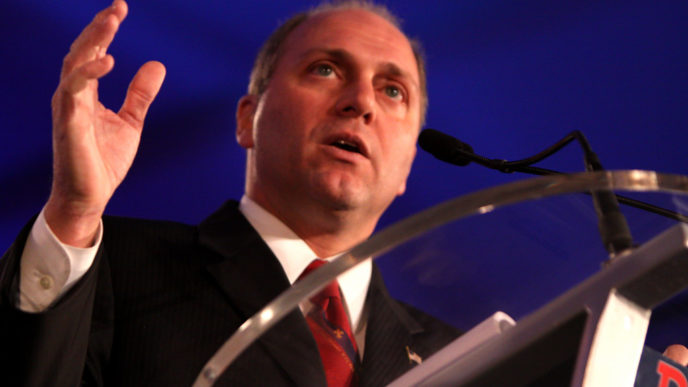
No thanks to Sen. Bernie Sanders, I-Vt., President Donald Trump’s pick for the Office of Management and Budget is one step closer to his new job.

After a faith-based grilling that left Sanders red-faced and Americans in shock, Russell Vought’s nomination squeaked out of the Senate’s Homeland Security and Governmental Affairs Committee by the narrowest of margins, 8-7.

The hearings caught the country’s attention when Sanders made the case that Christians like Vought are unfit for public office—even in jobs that have nothing to do with faith.

While Sanders fired shot after shot at the Office of Management and Budget’s soon-to-be second-in-command, Vought was the picture of poise, explaining that he thinks everyone has inherent dignity, even if they don’t agree with him that Jesus is the only way to salvation.

No thanks to Sen. Bernie Sanders, I-Vt., President Donald Trump’s pick for the Office of Management and Budget is one step closer to his new job.

After a faith-based grilling that left Sanders red-faced and Americans in shock, Russell Vought’s nomination squeaked out of the Senate’s Homeland Security and Governmental Affairs Committee by the narrowest of margins, 8-7.

The hearings caught the country’s attention when Sanders made the case that Christians like Vought are unfit for public office—even in jobs that have nothing to do with faith.

While Sanders fired shot after shot at the Office of Management and Budget’s soon-to-be second-in-command, Vought was the picture of poise, explaining that he thinks everyone has inherent dignity, even if they don’t agree with him that Jesus is the only way to salvation.

Americans need an alternative to the mainstream media. But this can’t be done alone. Find out more >>

It was a surreal scene for anyone watching, especially since Vought’s convictions—not his qualifications—were Sanders’ main concerns.

Like many in the media who were taken aback, National Review’s Ian Tuttle explains how the left’s religion of non-religion is unfairly influencing politics.

There is a long and stupid tradition of believing that the American right threatens to impose an evangelical Christian theocracy on the United States—that every Republican lawmaker is looking to erect an official church and make women cover their ankles. In reality, it is the proudly irreligious left that has smuggled religious debates back into our politics. It is the unabashedly secular left that has knocked down the ‘wall of separation’ and made the afterlife an immanent political issue.

Fortunately, plenty of others piled on, including the Conservative Action Project (which released this letter demanding that liberals stop their religious intolerance) and Sen. James Lankford, R-Okla.

On Wednesday, the Oklahoma leader fired back at Sanders’ religious test.

There was some dispute in a different hearing about Russell Vought and his faith and this came up in a budget meeting about is he too much of a Christian to be able to serve. I just want to make a public statement that that’s appalling to me that that became part of the debate at the dais that someone made a statement that because he was strong in his Christian faith he was not qualified to serve.

Article XI of the Constitution says there’s no religious test for any officer of the United States and that shouldn’t even have been a discussion in that committee hearing. I’m glad that wasn’t a discussion or a consideration here, but it is one of the things that we should not evaluate people. He’s in an economics position. It doesn’t matter if he’s Muslim, Christian, Jewish, Buddhist, or no faith at all. We’re faith-neutral. And so I’m grateful that was not an issue for any of us and I would hope that’s not a growing trend for us as a body.

Disclosure: Russ Vought’s wife, Mary Vought, works for The Heritage Foundation, the parent organization of The Daily Signal. Russ Vought was formerly employed by Heritage Action for America, the think tank’s lobbying affiliate.

(For more from the author of “Trump Nominee Not Hindered by Bernie Sanders’ Religious Litmus Test” please click HERE)

Follow Joe Miller on Twitter HERE and Facebook HERE.
This School Board Leader Tried to Rig a Public Forum in Favor of Transgender Advocates. That’s Unconstitutional.

Stacking the deck at the casino makes for bad feelings among friends.

Things get more serious when you’re a government official stacking the deck at public forums with speakers in favor of your personal political views. That not only makes for bad public policy—it violates the First Amendment.

The Prince William County Virginia School Board convened last Wednesday to vote on a proposed rule that would undermine the principle of student privacy between the sexes. It would have laid the groundwork for opening up sex-specific locker rooms, showers, and other private facilities to members of the opposite sex.

Many parents have legitimate convictions that maleness and femaleness are essential biological, anatomical attributes, and they would like to openly defend the policy of maintaining privacy between the sexes, despite the claims of gender identity advocates.

Nonetheless, before the meeting, Ryan Sawyers, school board chairman, sent a text to the clerk telling her to frontload a list of favored speakers to comment before those who had already signed up.

This violated local school board rules, which say the public is to speak in the order that each citizen contacts the clerk.

This is particularly significant because at Prince William County Public School board meetings, only 10 to 15 people get to speak before the vote, since initial public comment is limited to 30 minutes. Everybody else has to wait until after the vote to make their views known.

But dishing out political leftovers to one’s opponents and frontloading the initial discussion with allies goes beyond violating local school board policy. It’s flatly unconstitutional.

School board meetings must protect viewpoint neutrality to satisfy First Amendment principles of free speech. If a school board chooses to open a forum for public comment, the process of determining who speaks cannot be determined by the viewpoint of the speaker.

The U.S. Court of Appeals for the 4th Circuit agrees.

In Child Evangelism Fellowship of MD, Inc. v. Montgomery County Public Schools, the majority opinion notes that “‘the state may be justified in reserving [its forum] for certain groups or for the discussion of certain topics,’ subject only to the limitation that its actions must be viewpoint-neutral and reasonable.”

And just last week, the Supreme Court reiterated in Matal v. Tam that government officials cannot “regulate speech in ways that favor some viewpoints or ideas at the expense of others.”

The traditional method of letting people speak in the order they sign up with the clerk is an orderly way to achieve these objectives. But giving the chairman the power to decide who speaks before the vote does not satisfy these criteria.

If the chairman is not bound by a limiting principle, then he has unbridled discretion to determine who can use the coveted 30 minutes of speech. It will be difficult, over time, for him not to hand-pick allies, particularly since he is a Democratic candidate for Congress.

Indeed, the first speaker on the chairman’s list, Danica Roem, is also a political player, a local Democrat recently nominated to run against incumbent Republican Bob Marshall in a Virginia House of Delegates race.

To be clear, after the chairman’s text messages were made public and Alliance Defending Freedom sent a letter to Prince William County Public Schools, the chairman did not stick to his original plan on Wednesday night.

But it remains unclear whether the final speaking order came from a new alternative list he created, or whether he reverted back to school board policy and used the original list of speakers, based on the order that local citizens signed up to speak.

That is precisely the problem. In the American system of ordered liberty, government officials don’t have the power to make that choice. They cannot dish out fast passes for the view they like while relegating opposing views to second-class status.

Rather, if officials choose to set up times for public comment, they must set up an orderly process that respects the free speech of all participants.

All voices should equally receive free speech protection, because our Constitution recognizes that when the government plays favorites, everyone’s freedom flounders. (For more from the author of “This School Board Leader Tried to Rig a Public Forum in Favor of Transgender Advocates. That’s Unconstitutional.” please click HERE)

Follow Joe Miller on Twitter HERE and Facebook HERE.