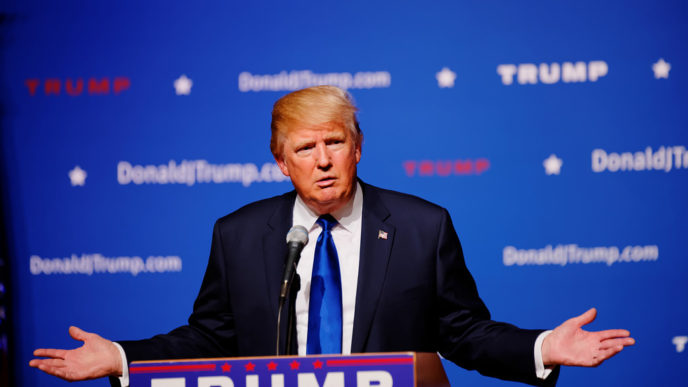
Trump Accused of Using Hurricane Harvey as Distraction

As Hurricane Harvey bore down on the Texas coat Friday night, President Donald Trump‘s news hurricane struck as well, leading to condemnation from Democrats but praise form Fox News panelists.

On Friday night, Trump announce the pardon of former Sheriff Joe Arpaio, made official his ban on transgender recruits in the military, and parted ways with aide Sebastian Gorka, whose exit was part of a general housecleaning that has been taking place since the arrival of White House Chief of Staff John Kelly.

Senate Minority leader Chuck Schumer expressed outrage at the timing.

“As millions of people in TX and LA are prepping for the hurricane, the President is using the cover of the storm to pardon a man who violated a court’s order to stop discriminating against Latinos and ban courageous transgender men and women from serving our nation’s Armed Forces,” he posted on Twitter. “So sad, so weak.”

On the Fox News show The Five, co-host Juan Williams pondered the “politically explosive” actions, wondering whether Trump was “trying to distract from something else.”

But host Ed Henry read a text he received from a Trump adviser.

“Who says the president doesn’t know what he’s doing? He pardons Arpaio and bans transgenders in the military in the middle of a hurricane,” Henry read.

“That sounds to me like people around this president get what they’re doing,” Henry said. “This is a news dump. There’s no other way of saying it.”

“Technically, I kinda admire it,” said Dana Perino, who was White House press secretary under former President George W. Bush.

“The president is doing this on purpose,” said co-host Kimberly Guilfoyle. “We knew he was going to do with Sheriff Joe Arpaio, he said it the other night during the rally in Arizona, so he’s gonna give his followers what he’s promised them … and you have North Korea going on, you’ve got Venezuela sanctions, you’ve got all of these things at once.”

“It’s seems to me like it was a good strategy, you know politically, to do this on a Friday night in the middle of Harvey,” she continued.

Henry chimed in to say this “has been one of the great fears” heard from Democrats that Trump knows what he’s doing as he gets “very effective at overturning Obama regulations, rules and all of the rest.”

Alex Conant, a Republican strategist and former aide to Sen. Marco Rubio, R-Fla., said that it was an unorthodox move by an unorthodox president.

“It was very risky because if the hurricane is as bad as the experts were predicting then he’s opening himself up to a lot of potential criticism,” he said. “But very little that Trump does surprises me any longer. He’s proven to be very unpredictable and to not act within the norms of other politicians.”

Conant also admitted that Trump may have timed it just right.

“The president has great political instincts — he can read the temperature of the public better than almost anyone else,” he explained. “He is very well aware that his base is shrinking and in a way that explains almost everything he’s done over the last month.”

In its reporting on the blizzard of news, The Washington Post said the presence of Gen. John Kelly as Trump’s new chief of staff should be factored into the equation

“Kelly is really strong right now,” said a source described by The Post as a Republican close to the White House. “He gives his best advice but he wasn’t going to stop the Sheriff Joe thing.

“Everything else was textbook — what a really good chief of staff would do: Dump a whole bunch of stuff when there’s a hurricane coming.” (For more from the author of “Trump Accused of Using Hurricane Harvey as Distraction” please click HERE)

Follow Joe Miller on Twitter HERE and Facebook HERE.

New Report Concludes Nurse May Be Postwar Germany’s Most Prolific Killer

A German nurse currently imprisoned for killing patients he injected with lethal doses of medicine before trying to revive them is now a suspect in at least 84 other murder cases, officials said Monday.

Niels Hoegel, 40, was sentenced to life in prison in February 2015 after he admitted administering overdoses of heart medication to some patients. At the time, he said he had done so to about 90 people of the 130 to 200 people for whom he provided care. Officials then launched a further investigation.

During his 2015 trial, he said he acted to show off his excellent skills at resuscitation, and admitted to acting on impulse when he gave drugs to those who were ailing. Prosecutors alleged that he acted because he was bored.

“The findings continue to breach any imagination,” said Oldenburg Police Chief Johann Kuhme. “It is simply not possible to say how many people were killed.”

Kuhme said that Hoegel’s victims crimes go back to 1999, and that some who died have been cremated.

“The realization of what we were able to learn is horrifying,” Kuhme said. “It defies any scope of the imagination.”

Kuhme said that Hoegel’s spree could have been cut short.

“The killings could have been prevented if the people responsible at the time — and I stress at the time — particularly at the Oldenburg clinic but also later on in Delmenhorst hadn’t hesitated to alert authorities, for example the state prosecution,” he said.

Police believe Hoegel killed 36 patients in Oldenburg between 1999 and 2001, and another 48 people from the hospital in Delmenhorst.

If verified, the toll of victims would make Hoegel the most prolific murderer in post-World War II Germany.

“The death toll is unique in the history of the German republic,” said chief police investigator Arne Schmidt, who said the selection of victims appeared to be random.

There was “evidence for at least 90 murders, and at least as many (suspected) cases again that can no longer be proven”, he said. (For more from the author of “New Report Concludes Nurse May Be Postwar Germany’s Most Prolific Killer” please click HERE)

Follow Joe Miller on Twitter HERE and Facebook HERE.
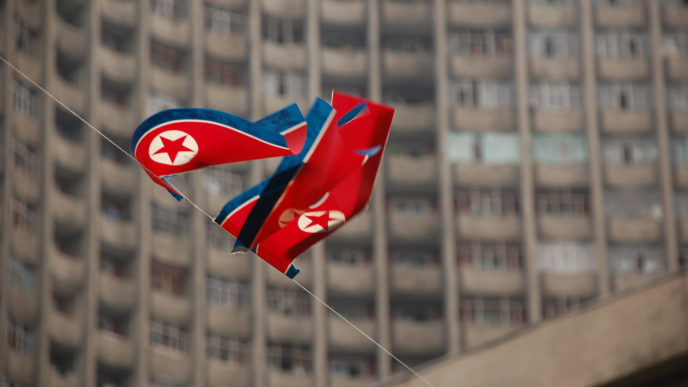
North Korea Fires Missile Over Japan, Sharply Escalating Tensions

North Korea fired a missile that flew over Japan and landed in waters off the northern region of Hokkaido early on Tuesday, South Korean and Japanese officials said, marking a sharp escalation of tensions on the Korean peninsula.

The test, which experts said appeared to have been a recently developed intermediate-range Hwasong-12 missile, came as U.S. and South Korean forces conduct annual military drills on the peninsula, against which North Korea strenuously objects.

Earlier this month, North Korea threatened to fire four Hwasong-12 missiles into the sea near the U.S. Pacific territory of Guam after U.S. President Donald Trump warned Pyongyang would face “fire and fury” if it threatened the United States.

North Korea has conducted dozens of ballistic missile tests under young leader Kim Jong Un, the most recent on Saturday, but firing projectiles over mainland Japan is rare.

“North Korea’s reckless action is an unprecedented, serious and a grave threat to our nation,” Japanese Prime Minister Shinzo Abe told reporters. (Read more from “North Korea Fires Missile Over Japan, Sharply Escalating Tensions” HERE)

Follow Joe Miller on Twitter HERE and Facebook HERE.

Should Antifa Be Declared a Domestic Terrorist Organization?

On Sunday, members of the far-left Antifa (“anti-fascist”) fascist group stormed a free-speech demonstration known as the “Rally Against Hate,” destroying public and private property and viciously attacking and intimidating journalists, police officers, and those whom members of the group deemed its political opposition.

Sunday’s violent display was just one of the countless nationwide flare-ups this year in which Antifa rioters used physical force against innocents, using deadly weapons and homemade items to batter and intimidate people the group opposes.

To determine if Antifa should be designated, we must first explore its roots.

Antifa is modeled after Antifaschistische Aktion, a 1930s communist organization controlled by the Soviet Union that climbed to prominence during the simultaneous rise of the Nazi Party in Germany. During this time, the group was explicitly a militant organization that used violence to achieve its political ends. Similar to today’s Antifa, Antifaschistische Aktion supported a totalitarian communist society and labeled all of its opponents (including the ones who supported capitalism and liberal democracy) as “fascists.” While these “red shirts” became famously known for their anarchic street battles against Nazi devotees, under a Weimar Republic government that was unable and unwilling to keep order, they also targeted other political outfits that opposed communist rule.

However, there is no longer a Soviet Union, and today’s U.S. branch of Antifa appears to be operating independently of any foreign state. While Antifa demonstrations have flared up in other countries, there is no current evidence its U.S. branch is being directed by any international bodies. Therefore, a debate over Antifa’s criminal status should center around whether the group should be considered a domestic terrorist organization.

The FBI defines domestic terrorism as the “unlawful use, or threatened use, of force or violence by a group or individual based and operating entirely within the United States or Puerto Rico without foreign direction committed against persons or property to intimidate or coerce a government, the civilian population, or any segment thereof in furtherance of political or social objectives.”

Furthermore, under the Patriot Act, independent acts of domestic terrorism are defined by the following criteria:

“(A) involve acts dangerous to human life that are a violation of the criminal laws of the United States or of any State; (B) appear to be intended – (i) to intimidate or coerce a civilian population; (ii) to influence the policy of a government by intimidation or coercion; or (iii) to affect the conduct of a government by mass destruction, assassination, or kidnapping; and (C) occur primarily within the territorial jurisdiction of the United States.”

Antifa certainly uses intimidation and violence to suppress its opponents. Its members often attempt to influence and coerce policy through mob violence. Members of the group have yet to engage in murder and assassination; it appears to only be a matter of time before its extremely violent gatherings result in the killing of innocents to further its political ends.

The evidence makes a serious case that Antifa should be declared a domestic terrorist group. However, the United States does not designate domestic extremist groups as terrorist organizations, because it would interfere with First Amendment protections under the Constitution.

Given its lack of proven foreign influence, Antifa members should be considered part of a domestic extremist group, comparable to the likes of the Ku Klux Klan, the Aryan Nations, the Animal Liberation Front, Black Liberation Army, and countless other U.S.-based extremist outfits. Law enforcement should use all resources available to fight back against the organization’s extremist activities. (For more from the author of “Should Antifa Be Declared a Domestic Terrorist Organization?” please click HERE)

Follow Joe Miller on Twitter HERE and Facebook HERE.

Another Bakery Faces Backlash Because It Won’t Bake Cake for Gay Wedding

A bakery in Bakersfield, Calif., is facing criticism for refusing to bake a cake for a gay couple who posted about the ordeal on Facebook Saturday.

Eileen Del Rio said the bakery owner, Cathy Miller, refused to make her and her partner’s wedding cake because she doesn’t condone same sex marriages, The New York Daily News reported Monday. Del Rio did note in her post, however, that the baker offered to make up their order and send it off to another bakery for the wedding day.

“The ceremony, when you’re getting married is in the eyes of the Lord,” Miller told KGET. “That’s a celebration of a union that God has brought together and that’s a whole lot different than coming in and wanting a cookie.”

“Here at Tastries, we love everyone. My husband and I are Christians and we know that God created everyone and He created everyone equal, so it’s not that we don’t like people of certain groups of people. There is just certain things that violate my conscience,” Miller said according to Fox40. (Read more from “Another Bakery Faces Backlash Because It Won’t Bake Cake for Gay Wedding” HERE)

Follow Joe Miller on Twitter HERE and Facebook HERE.

MEDIA CRITICISM: WaPo Gives Stunningly Accurate Account of Antifa Attacks on ‘Peaceful Protestors’

In a surprisingly accurate report contrary to the establishment media’s recent tendency to downplay Antifa violence, The Washington Post recounted visceral details Monday of the violence the anti-fascists unleashed on “peaceful right-wing demonstrators.”

“A pepper-spray wielding Trump supporter was smacked to the ground with homemade shields,”reports Kyle Swenson for The Post. “Another was attacked by five black-clad antifas, each windmilling kicks and punches into a man desperately trying to protect himself. Their faces hidden behind black bandannas and hoodies, about a 100 anarchists and antifa — ‘anti-fascist’ — barreled into a protest Sunday afternoon in Berkeley’s Martin Luther King Jr. Civic Center Park.”

Recent coverage of Antifa and left-wing inspired violence has been sparse, with little media outcry or focused reports. Antifa violence was seemingly downplayed by the establishment media in Charlottesville, and on Tuesday, Reuters and The Post referred to left-wing protestors at a Trump rally as “peace activists,” although they started fights, threw rocks and lobbed water bottles.

The original event planned for Monday, “No to Marxism in America” at MLK Jr. Park, had been canceled by organizer Amber Cummings because of security concerns. “I’m sorry for this but I want this event to happen peacefully and I do not want to risk anyone getting harmed by terrorists,” Cummings wrote according to NBC Bay Area. Despite the cancellation, many Trump supporters decided to show up anyway. (Read more from “MEDIA CRITICISM: WaPo Gives Stunningly Accurate Account of Antifa Attacks on ‘Peaceful Protestors'” HERE)

Follow Joe Miller on Twitter HERE and Facebook HERE.

Lawsuits Pile up Over Trump’s Transgender Recruitment Ban

Two civil rights organizations brought separate lawsuits against President Donald Trump’s order banning transgender people from serving in the military Monday.

The complaints allege a variety of constitutional violations and seek injunctions barring the order’s enforcement while it is adjudicated in the courts.

The first suit was brought by the ACLU in the U.S. District Court for the District of Maryland. It names Trump, Secretary of Defense Jim Mattis, as well as the secretaries of the Army, Navy, and Air Force. The plaintiffs in the ACLU action include six active duty servicemen in various stages of gender transition who are currently receiving hormone therapy and related medical care. Several of the plaintiffs have done extended tours in Afghanistan.

“Our lawsuit argues that the ban violates the constitutional guarantees of equal protection and substantive due process by singling out transgender individuals for unequal and discriminatory treatment,” said Chase Strangio, a staff attorney with the ACLU’s LGBT and HIV Project. (Read more from “Lawsuits Pile up Over Trump’s Transgender Recruitment Ban” HERE)

Follow Joe Miller on Twitter HERE and Facebook HERE.

This ‘Endangered Species’ Story Was Government-Sponsored Fake News

Leave it to the federal government to make a costly mistake, obscure it for decades at taxpayer expense, and then try to claim it was a success.

In 2016, Johnston’s frankenia—a wiry, blue-green, roughly 1 to 2-foot-tall shrub with tiny oblong leaves—was taken off the endangered species list. The Fish and Wildlife Service’s endangered species database reports the happy plant was “delisted” because it had recovered.

It seems strange that such good news did not get much attention, and that the Fish and Wildlife Service only put out a press release in the southwestern U.S.

The reason it was not more publicized is probably because the whole thing is a farce. The species did not recover—it never was endangered in the first place.

When the Fish and Wildlife Service added this plant to the endangered species list in 1984, the agency reported it could only find about 1,000 of them in a few southern Texas counties, and that there was concern about “grazing pressure” on the hapless plant.

But surveys conducted after 1984 found a wealth of Johnston’s frankenia—over 4 million by one account and over 9 million by another—enough that biologists probably quit trying to guess.

The Fish and Wildlife Service hailed the “recovery” of the plant, saying, “The threats to this species have been eliminated or reduced to the point that the species has recovered … ”

That sounds a lot like a doctor claiming his patient is cured after realizing a terminal diagnosis was totally wrong.

When the Fish and Wildlife Service removes a species from the list, it is to attribute the action to either recovery, data error, or extinction. It’s clear Johnston’s frankenia was never “recovered” because it was never in desperate condition at all.

The Fish and Wildlife Service’s annual expenditure reports indicate that $670,000 were spent on Johnston’s frankenia between 1998 and 2014 alone. This includes nearly $250,000 shelled out by Customs and Border Protection in 2008 in order to avoid adversely affecting the plant.

Even more troubling than the expenditures is the fact that the government knew the plant was just fine when it made them. I know this because I petitioned the Fish and Wildlife Service to remove the species from the list as a mistake in 1997, citing data familiar to the service.

A half-decade later in 2003, the Fish and Wildlife Service finally announced a proposal to delist the species, stating that it was “not able to act on this petition upon receipt due to the low priority assigned to this activity … ”

The effort to deregulate the plant somehow ground to a halt until the Fish and Wildlife Service announced in 2011 that it was reopening the public comment period on the proposal to take this species off the list.

By January of 2016, the Fish and Wildlife Service finally removed the plant from the endangered list.

It took the agency decades to correct this mistake, and when it finally did, it was dishonest.

Because the Fish and Wildlife Service calls the plant “recovered,” it is required to monitor the species after taking it off the list. This requirement was intended to make sure species that actually belonged on the endangered list don’t slip back into an imperiled state.

The Fish and Wildlife Service has a 28-page monitoring plan that explains how the agency will keep a vigilant watch over the frankenia. It will spend $100,000 over nine years to conduct remote sensing at 20 sites and on-site assessments at nine sites.

And, as explained in the Federal Register, the Fish and Wildlife Service will make sure that threats, including “substantial human persecution,” are not visited upon the plant.

Of course, this is all an absurd waste. These measures do nothing but paper over the agency’s decadeslong mistake.

But after promulgating dozens of pages in the Federal Register costing perhaps $500 a pop, producing a 55-page recovery plan, and imposing hundreds of thousands of dollars on agencies that have other important things to do, what’s another nine years of monitoring to hide embarrassing facts from the public?

The Fish and Wildlife Service’s press release regarding removal of the plant from the endangered species list states, “The goal of the service is to make implementation of the Endangered Species Act less complex, less contentious and more effective.”

Nice idea—but how does the service now expect to have any credibility with landowners whose role in species conservation is crucial?

Smart public policies cannot be made when the government is producing patently fake information. The secretary of the interior should correct the record for Johnston’s frankenia. (For more from the author of “This ‘Endangered Species’ Story Was Government-Sponsored Fake News” please click HERE)

Follow Joe Miller on Twitter HERE and Facebook HERE.
Why Trump’s Upcoming Decision on Federal Lands Matters

The ongoing controversy about the federal government’s role in managing land may soon come to a head.

Earlier this month, in accord with a presidential executive order issued in April, Interior Secretary Ryan Zinke delivered recommendations to the president on national monument lands that are being reviewed by his department.

Details about the report—whether lands should be reduced, and if so, which ones—are expected from the White House in the coming days.

The highly anticipated report has stirred a great deal of angst this summer, particularly among environmental activists who are convinced the Interior’s review is an unprecedented ploy to sell off or sully federal lands.

For example, luxury outdoor retailer Patagonia argued the following in its first ever television ad: “Public lands have never been more threatened than right now because you have a few self-serving politicians who want to sell them off and make money.”

Beautiful scenes of the Grand Tetons, Yosemite, and Zion pan across the screen as the company urges viewers to defend these lands and hold Zinke accountable.

The Patagonia commercial and much of the conversation this summer have been muddled with hyperbole and misinformation. It’s worth taking a step back to understand the issue.

Who’s Involved

In April, President Donald Trump requested that Zinke review all presidential national monument designations or expansions since 1996. In particular, Trump requested review of designations of areas over 100,000 acres and/or those that were “made without adequate public outreach and coordination” to determine if revisions were necessary.

Other presidents have reviewed and altered national monuments—among them Presidents William Howard Taft, Woodrow Wilson, Calvin Coolidge, Harry Truman, and Ike Eisenhower.

What’s at Issue

The subject of Interior’s report is presidential use of the Antiquities Act of 1906. The law allows presidents to unilaterally designate federal lands as “historic landmarks, historic and prehistoric structures, and other objects of historic or scientific interest.” These designations change how land is managed and who has access to it.

Trump is considering the need to reduce the size of, or altogether eliminate, some of these monuments.

Contrary to what the Patagonia commercial and many others would imply, reducing the size of a national monument or even rescinding its status does not open up the federal land to be overrun by oil interests or clear cut by the foresting industry.

Federal lands are managed by a web of laws determining who can do what and when. For example, at least nine other laws also address artifact preservation on federal lands.

The Lands in Question

Perhaps where environmental groups most mislead the public is in explaining which lands are being reviewed. National monuments are distinct from other land designations like national parks, which are created by Congress.

Zinke’s review covered 27 national monuments, mostly in the western United States, though some are located in New England and in offshore federal waters. In other words, this debate has nothing to do with the Grand Tetons, Yosemite, or Zion—all of which are national parks.

It’s also worth keeping in mind that the federal government owns hundreds of millions of acres in America. To put that in perspective, that’s about the same size as all of Western Europe.

Why Trump’s Upcoming Decision Matters

The reason this 110-year-old law has become so contentious is complicated.

In part, it has to do with past presidents abusing the purpose of the law. The Antiquities Act directs the president to protect artifacts on federal lands according to the “smallest area compatible with proper care and management of the objects to be protected.”

However, in recent history the Antiquities Act has instead been used to pull vast swathes of land out of use.

President Barack Obama in particular used this power aggressively. The Sutherland Institute reports that 66 percent of all national monument acreage was designated so under the Obama administration, and 25 percent under President George W. Bush.

It also has to do with ensuring quality management of lands. It is no secret that the Department of Interior is facing $15.4 billion in maintenance backlogs, and $11.9 billion of that is in the National Park Service alone.

Holly Fretwell of the Property and Environment Research Center reports that “[o]nly 40 percent of park historic structures are considered to be in “good” or better condition and they need continual maintenance to remain that way.”

The “why” also has to do with who should get the most say in decision-making.

The Patagonia ad encourages people to oppose changes to national monuments because “this [land] belongs to all the people in America—it’s our heritage.” But this glosses over decades and generations’ worth of contentious debate about who “our” refers to.

Does it refer to fly fishermen, hunters, hikers, and bikers as Patagonia would have its customers believe? Does it refer to the Native Americans and locals who are directly impacted by federal land management decisions, but who have little say in the matter?

Are American natural resource industries to be excluded from the collective “our”?

If Congress doesn’t like what the Trump administration is doing, it ought to act to clarify the law. Zinke rightly noted that “the executive power under the Act is not a substitute for a lack of congressional action on protective land designations.”

At the very least, Congress ought to amend the law to give states more say in the matter.

Land management decision-making has been contentious for decades. Shifting more control from Washington to those with direct knowledge of the land in question and a clear stake in the outcome of decisions would be a step in the right direction. (For more from the author of “Why Trump’s Upcoming Decision on Federal Lands Matters” please click HERE)

Follow Joe Miller on Twitter HERE and Facebook HERE.

Joel Osteen Slammed for Not Opening Church to Flood Victims

Celebrity televangelist Joel Osteen is under Twitter fire for not opening his church to victims of Tropical Storm Harvey.

Osteen is the head of Lakewood Church in Houston, which is housed in The Summit–the former NBA stadium of the Rockets, which holds 16,800 people.

The storm, which started out as a Category 4 hurricane but was reduced to a tropical storm once it hit land, has showered Texas with more than 30 inches of rain, has left 300,000 people without power and displaced 30,000 in temporary shelters across the state. FEMA is expecting as many as 450,000 potential disaster victims.

Lakewood Church’s Facebook page on Sunday said the church was “inaccessible due to severe flooding,” though the message doesn’t clarify whether the church itself is flooded. Pictures of the church purportedly taken since Harvey made landfall seem to show that it is less affected than other areas of Houston. Here’s a photo:

(Read more from “Joel Osteen Slammed for Not Opening Church to Flood Victims” HERE)

Follow Joe Miller on Twitter HERE and Facebook HERE.