The Key Reason DC Hates President Trump – It’s a Big Club, and He Ain’t in It…

Something 99% of American voters do not understand. Congress doesn’t actually write legislation. The last item of legislation written by congress was sometime around the mid 1990’s. Modern legislation is sub-contracted to a segment of operations in DC known as K-Street. That’s where the lobbyists reside.

Lobbyists write the laws; congress sells the laws; lobbyists then pay congress commissions for passing their laws. That’s the modern legislative business in DC.

CTH often describes the system with the phrase: “There are Trillions at Stake.” The process of creating legislation is behind that phrase. DC politics is not quite based on the ideas that frame most voter’s reference points.

With people taking notice of DC politics for the first time; and with people not as familiar with the purpose of DC politics; perhaps it is valuable to provide clarity.

Most people think when they vote for a federal politician -a House or Senate representative- they are voting for a person who will go to Washington DC and write or enact legislation. This is the old-fashioned “schoolhouse rock” perspective based on decades past. There is not a single person in congress writing legislation or laws.

In modern politics not a single member of the House of Representatives or Senator writes a law, or puts pen to paper to write out a legislative construct. This simply doesn’t happen.

Over the past several decades a system of constructing legislation has taken over Washington DC that more resembles a business operation than a legislative body. Here’s how it works right now.

Outside groups, often called “special interest groups”, are entities that represent their interests in legislative constructs. These groups are often representing foreign governments, Wall Street multinational corporations, banks, financial groups or businesses; or smaller groups of people with a similar connection who come together and form a larger group under an umbrella of interest specific to their affiliation.

Sometimes the groups are social interest groups; activists, climate groups, environmental interests etc. The social interest groups are usually non-profit constructs who depend on the expenditures of government to sustain their cause or need.

The for-profit groups (mostly business) have a purpose in Washington DC to shape policy, legislation and laws favorable to their interests. They have fully staffed offices just like any business would – only their ‘business‘ is getting legislation for their unique interests.

These groups are filled with highly-paid lawyers who represent the interests of the entity and actually write laws and legislation briefs.

In the modern era this is actually the origination of the laws that we eventually see passed by congress. Within the walls of these buildings within Washington DC is where the ‘sausage’ is actually made.

Again, no elected official is usually part of this law origination process.

Almost all legislation created is not ‘high profile’, they are obscure changes to current laws, regulations or policies that no-one pays attention to. The passage of the general bills within legislation is not covered in media. Ninety-nine percent of legislative activity happens without anyone outside the system even paying any attention to it.

Once the corporation or representative organizational entity has written the law they want to see passed – they hand it off to the lobbyists.

The lobbyists are people who have deep contacts within the political bodies of the legislative branch, usually former House/Senate staff or former House/Senate politicians themselves.

The lobbyist takes the written brief, the legislative construct, and it’s their job to go to congress and sell it.

“Selling it” means finding politicians who will accept the brief, sponsor their bill and eventually get it to a vote and passage. The lobbyist does this by visiting the politician in their office, or, most currently familiar, by inviting the politician to an event they are hosting. The event is called a junket when it involves travel.

Often the lobbying “event” might be a weekend trip to a ski resort, or a “conference” that takes place at a resort. The actual sales pitch for the bill is usually not too long and the majority of the time is just like a mini vacation etc.

The size of the indulgence within the event, the amount of money the lobbyist is spending, is customarily related to the scale of benefit within the bill the sponsoring business entity is pushing. If the sponsoring business or interest group can gain a lot of financial benefit from the legislation they spend a lot on the indulgences.

Recap: Corporations (special interest group) write the legislation. Lobbyists take the law and go find politician(s) to support it. Politicians get support from their peers using tenure and status etc. Eventually, if things go according to norm, the legislation gets a vote.

Within every step of the process there are expense account lunches, dinners, trips, venue tickets and a host of other customary financial way-points to generate/leverage a successful outcome. The amount of money spent is proportional to the benefit derived from the outcome.

The important part to remember is that the origination of the entire process is EXTERNAL to congress.

Congress does not write laws or legislation, special interest groups do. Lobbyists are paid, some very well paid, to get politicians to go along with the need of the legislative group.

When you are voting for a Congressional Rep or a U.S. Senator you are not voting for a person who will write laws. Your rep only votes on legislation to approve or disapprove of constructs that are written by outside groups and sold to them through lobbyists who work for those outside groups.

While all of this is happening the same outside groups who write the laws are providing money for the campaigns of the politicians they need to pass them. This construct sets up the quid-pro-quo of influence, although much of it is fraught with plausible deniability.

This is the way legislation is created.

If your frame of reference is not established in this basic understanding you can often fall into the trap of viewing a politician, or political vote, through a false prism.

The modern origin of all legislative constructs is not within congress.

“We have to pass the bill to, well, find out what is in the bill” etc. ~ Nancy Pelosi 2009

“We rely upon the stupidity of the American voter” ~ Johnathan Gruber 2011, 2012.

“If Congress isn’t going to convene until the bill is ready to vote on… who the hell is writing the bill?” ~ Tom Massie, 2020

Once you understand this process you can understand how politicians get rich.

When a House or Senate member becomes educated on the intent of the legislation, they have attended the sales pitch; and when they find out the likelihood of support for that legislation; they can then position their own (or their families) financial interests to benefit from the consequence of passage. It is a process similar to insider trading on Wall Street, except the trading is based on knowing who will benefit from a legislative passage.

The legislative construct passes from K-Street into the halls of congress through congressional committees. The law originates from the committee to the full House or Senate. Committee seats which vote on these bills are therefore more valuable to the lobbyists. Chairs of these committees are exponentially more valuable.

Now, think about this reality against the backdrop of the 2016 Presidential Election. Legislation is passed based on ideology. In the aftermath of the 2016 election the system within DC was not structurally set-up to receive a Donald Trump presidency.

If Hillary Clinton had won the election, her Oval Office desk would be filled with legislation passed by congress which she would have been signing. Heck, she’d have writer’s cramp from all of the special interest legislation, driven by special interest groups that supported her campaign, that would be flowing to her desk.

Why?

Simply because the authors of the legislation, the originating special interest and lobbying groups, were spending millions to fund her campaign. Hillary Clinton would be signing K-Street constructed special interest legislation to repay all of those donors/investors.

Congress would be fast-tracking the passage because the same interest groups also fund the members of congress.

President Donald Trump winning the election threw a monkey wrench into the entire DC system…. In early 2017 the modern legislative machine was frozen in place.

The “America First” policies represented by candidate Donald Trump were not within the legislative constructs coming from the K-Street authors of the legislation. There were no MAGA lobbyists waiting on Trump ideology to advance legislation based on America First objectives.

As a result of an empty feeder system, in early 2017 congress had no bills to advance because all of the myriad of bills and briefs written were not in line with President Trump policy. There was simply no entity within DC writing legislation that was in-line with President Trump’s America-First’ economic and foreign policy agenda.

Exactly the opposite was true. All of the DC legislative briefs and constructs were/are antithetical to Trump policy. There were hundreds of file boxes filled with thousands of legislative constructs that became worthless when Donald Trump won the election.

Those legislative constructs (briefs) representing tens of millions of dollars worth of time and influence were just sitting there piled up in boxes under desks and in closets amid K-Street and the congressional offices. Legislation needed to be in-line with an entire new political perspective, and there was no-one, no special interest or lobbying group, currently occupying DC office space with any interest in synergy with Trump policy.

Think about the larger ramifications within that truism. That is also why there was/is so much opposition.

No legislation provided by outside interests means no work for lobbyists who sell it. No work means no money. No money means no expense accounts. No expenses means politicians paying for their own indulgences etc.

Politicians were not happy without their indulgences, but the issue was actually bigger. No K-Street expenditures also means no personal benefit; and no opportunity to advance financial benefit from the insider trading system. Republicans and democrats hate the presidency of Donald Trump because it is hurting them financially.

President Trump is not figuratively hurting the financial livelihoods of DC politicians; he’s literally doing it. President Trump is not an esoteric problem for them; his impact is very real, very direct, and hits almost every politician in the most painful place imaginable, the bank account.

In the pre-Trump process there were millions upon millions, even billions that could be made by DC politicians and their families. Thousands of very indulgent and exclusive livelihoods attached to the DC business model. At the center of this operation is the lobbying and legislative purchase network. The Big Club.

Without the ability to position personal wealth and benefit from the system, why would a politician stay in office? It is a fact the income of many long-term politicians on both wings of the uniparty bird were completely disrupted by Trump winning the 2016 election. That is one of the key reason why so many politicians retired in 2018.

When we understand the business of DC, we understand the difference between legislation with a traditional purpose and modern legislation with a financial and political agenda.

When we understand the business of DC we understand why the entire network hates President Donald Trump.

Lastly, this is why -when signing legislation- President Trump often says “they’ve been trying to get this through for a long time” etc. Most of the legislation that is passed by congress, and signed by President Trump in his first term; is older legislative proposals, with little indulgent value that were shelved in years past.

Example: Criminal justice reform did not carry a financial benefit to the legislative bodies, and there was no financial interest funding the politicians to pass the bill. If you look at most of the bills President Trump has signed, with the exception of a few economic bills, they stem from congressional construction many years, even decades, ago.

Think about it carefully and you’ll see it. The “First step act”, “Right to Try”, etc. were all shelved by Boehner, Pelosi, Ryan, McConnell, Reid and others before them. When the value of legislation is measured by the financial underwriting and payoffs behind it, what type of legislative calendar does that require?…. (For more from the author of “The Key Reason DC Hates President Trump – It’s a Big Club, and He Ain’t in It…” please click HERE)

Follow Joe Miller on Twitter HERE and Facebook HERE
Deep State Plotters: Nunes Describes “Corruption at the Highest Levels”, Clinton Campaign’s Connection to Rosenstein, Mueller, and Flynn Witch Hunt

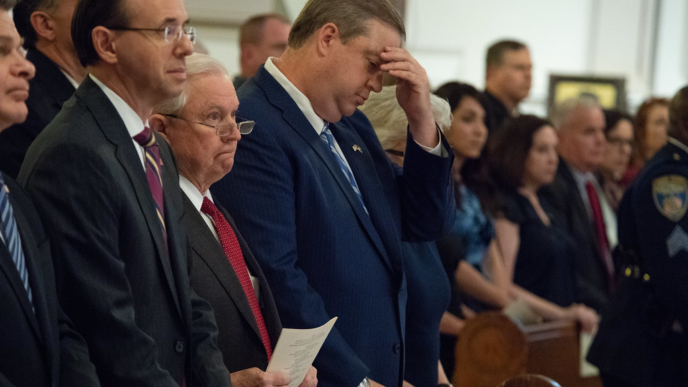
When contemplating the malign activity of Rod Rosenstein; and how angered President Trump is with former AG Jeff Sessions; it is worth remembering that Sessions requested Rod Rosenstein as his deputy, and then immediately thereafter Sessions recused himself, effectively positioning Rosenstein to run the operation against President Trump.

That’s the background context for a great interview by Gregg Jarrett where Jarrett walks through the timeline of events with former HPSCI Chairman Devin Nunes. At the 5:30 point of the interview, Nunes identifies Rosenstein as part of the coup attempt and blasts him for how Rosenstein structured the fraudulent scope memos.

Nunes says his investigation is now looking at the part of the effort where Robert Mueller’s investigation was used as part of the initiating effort to remove President Trump. With the focus on the Mueller team, Nunes is now making additional criminal referrals based on his findings. WATCH:

Read more from this author HERE.

Shocking Video Emerges of Mother Attempting to Murder Autistic Son; Police Claim She Later Succeeded

Days after Miami’s Patricia Ripley was charged with her autistic son’s murder, shocking surveillance video of her apparently pushing the child into a canal has emerged.

The video, obtained and aired by Univision’s national news network, shows Ripley walking 9-year-old Alejandro on the bank of a West Kendall canal, looking around, stroking his head — and then forcefully shoving him into the water.

Then, Ripley runs away off screen. About 20 seconds later, she returns accompanied by a bystander who saw the child in the murky water and rushed to rescue him.

(from Univision, Spanish narration):

Authorities say the shove was Ripley’s first, but thwarted, attempt to kill Alejandro Thursday evening. About an hour later, with no bystanders to rescue him, the boy was led into another canal, where he ultimately died, Miami-Dade State Attorney Katherine Fernandez Rundle has told reporters. (Read more about the mother’s alleged attempt to murder autistic son HERE)

Infamous Michigan Governor’s Family in Hot Water; To Make Matters Worse, She Admits She Can’t Tell Trump What She REALLY Thinks of Him

By Kate Sheehy. Gov. Gretchen Whitmer pushed some of the strictest regulations in the country as Michigan became engulfed in cases and deaths, prompting widespread protests by some residents, including those who stormed the state house last month bearing nooses, swastikas and guns screaming, “Lock her up!”

Last Monday, Whitmer announced that she was lifting some lockdown restrictions in areas before Memorial Day weekend [but warned], “A small spike could put the hospital system in dire straits pretty quickly. That’s precisely why we’re asking everyone to continue doing their part. Don’t descend on [waterfront] Traverse City from all regions of the state.”

Three days later, a marina owner wrote on Facebook that the governor’s husband, Marc Mallory, had asked its workers to get their nearby boat in the water before Memorial Day, a report said Monday.

“Well our office personnel [explained they couldn’t] and he replied, ‘I am the husband to the governor, will this make a difference?’”

. . .Republican state Sen. Tom Barrett, R-Charlotte, noted to the News that Whitmer had urged state residents not to flock to Traverse City, and “Yet, what did her family try and do? (Read more about the Michigan Governors issues HERE)

_________________________________________________

Whitmer admits she can’t tell Trump what she REALLY thinks of him

By Mary Olohan. Asked in an Axios interview if she censors her comments about POTUS “for the sake of continuing to receive federal assistance,” Whitmer said, “Yes.”

Whitmer also said she has worried about criticism from Trump over Twitter.

“The worst night sleep that I’ve gotten in the last 10 weeks is when he has attacked me on Twitter,” Whitmer told Axios.

The Michigan governor has sparked protests in her state over strict stay-at-home orders prohibiting Michigan residents from visiting their family and friends, holding public and private gatherings of any kind, and restricting which businesses may operate. . .

Despite protests against her strict lockdowns, the Whitmer has not backed down. (Read more about the Michigan governors feud with Trump HERE)

Federal Judge Decisively Rules Florida Ex-Felons Can’t Be Denied the Right to Vote

A federal judge ruled Sunday that it is unconstitutional to prevent felons in Florida from voting because they can’t afford to pay back court fees, fines and restitution to victims, striking down parts of a law passed by Republican lawmakers and signed by Gov. Ron DeSantis last year.

Calling the law a “pay-to-vote system,” U.S. District Judge Robert Hinkle’s 125-page ruling declares that court fees are a tax, and it creates a new process for determining whether felons are eligible to vote.

“This order holds that the State can condition voting on payment of fines and restitution that a person is able to pay but cannot condition voting on payment of amounts a person is unable to pay,” Hinkle wrote.

With one sentence, Hinkle also allowed two large groups of felons to register to vote: those who were appointed an attorney for their criminal case because they couldn’t afford one on their own, and anyone who had their financial obligations converted to civil liens. . .

For all other felons who can’t afford to pay their financial obligations, Hinkle ordered state officials to adopt a new process for determining whether felons are too poor to vote: They can request an advisory opinion from Secretary of State Laurel Lee. (Read more from “Federal Judge Decisively Rules Florida Ex-Felons Can’t Be Denied the Right to Vote” HERE)

Follow Joe Miller on Twitter HERE and Facebook HERE

Honor Our Fallen by Understanding Their Missions

. . .Our service members’ sacrifice is an abstraction when the average citizen has little idea where we are fighting and why. Our military’s broader missions don’t get much public attention, and our elected leaders struggle to describe them in easily digestible soundbites. Indeed, our complex war against transnational jihadists defies tidy abbreviation. The days of a discrete “war in Iraq” are gone. Our “war in Afghanistan” rages on, but is vastly reduced. The “war on terror” as a catch-all term is uselessly ill-defined. . .

Around 10,000 U.S. troops support the Afghan government against the Taliban and ISIS while peace negotiations proceed intermittently. A decade ago, 100,000 troops served on the ground. Now, only a few hundred participate in front-line combat missions alongside Afghan commandos, mainly against ISIS.

Most troops provide training, logistics, and air support to the Afghans. Without our help, the fragile Afghan government risks being overwhelmed by Islamists. The resulting anarchy might permit jihadist groups to carve out a sphere of influence and export terrorism, forcing us to return later. Since last year, 15 service members, all U.S. Army soldiers, have fallen to hostile action in Afghanistan. An additional six from the Air Force and Army died in non-hostile incidents. . .

About 6,000 service members partner with Iraqi forces and hunt the remaining ISIS cells. The Iraqi military, though far from perfect, is more capable now than in 2014, when it collapsed in the face of an ISIS blitzkrieg.

Our troops now train the Iraqis to prevent ISIS from making a resurgence. We also present a latent challenge to Iran’s expansionist designs on the region. It’s a risky situation, as seen when Iran-backed militias targeted our forces in December, precipitating our killing of Iranian Gen. Qassem Soleimani in January. Leaving would open the door for Iraq to become an Iranian satellite and trigger the reemergence of the ISIS. Last year, we lost five service members to hostile action: three Marines, a soldier, and an Air National Guardsman. A U.S. interpreter was also killed. Three others died in non-hostile incidents. (Read more from “Honor Our Fallen by Understanding Their Missions” HERE)

Follow Joe Miller on Twitter HERE and Facebook HERE

White House Discussing Possible Resumption of Nuclear Testing

The White House has been discussing the possible resumption of testing nuclear devices as a means to pressure Russia and China to come to the bargaining table.

Nuclear testing was completely banned in 1991 when George H. W. Bush signed the START treaty. Resuming tests now would send a clear message that the U.S. wants another arms control treaty, this time involving China. China has rebuffed the suggestion, saying its nuclear arsenal is tiny compared to those of Russia and America. But the Chinese military is building missiles as fast as it can, and putting the brakes on China’s efforts makes sense.

The White House meeting discussing the testing option was a “deputies level” meeting, meaning it didn’t involve any cabinet secretaries or the president.

Guardian:

The discussion was first reported on Friday night by the Washington Post, which cited a senior administration official as saying that a demonstration to Moscow and Beijing that the United States could carry out a “rapid test” could be a useful bargaining counter in the achieving the administration’s priority on arms control – a trilateral deal with Russia and China.

(Read more from “White House Discussing Possible Resumption of Nuclear Testing” HERE)

Follow Joe Miller on Twitter HERE and Facebook HERE

Shameful: On Eve of Memorial Day, NYT Accuses U.S. Military of Celebrating ‘White Supremacy’

Memorial Day often marks the beginning of summer in earnest. Americans go outside, enjoy a barbecue, watch football, and take some time to remember the brave men and women who lost their lives to protect and serve the United States of America. The coronavirus may dampen some of these celebrations, but it should not impact America’s tribute to the soldiers, sailors, airmen, and marines. Yet the editors at The New York Times thought Memorial Day weekend a great time to post a screed asking the question, “Why Does the U.S. Military Celebrate White Supremacy?

Sure, the editorial posted on Saturday, not Monday. But it still came out during the weekend Americans associate with the holiday dedicated to commemorating the deaths of those who gave their last measure of devotion to this country. On that weekend, the Times accused the military — as a whole — of “celebrating white supremacy” because … military bases are named after Confederate generals.

Yes, that’s the entirety of the “evidence” that the military supposedly celebrates “white supremacy.”

The Times accused the U.S. military of celebrating racism because ten of America’s eight hundred military bases are named after Confederates — and the editors of America’s newspaper of record chose Memorial Day weekend to run this editorial. (Read more from “Shameful: On Eve of Memorial Day, NYT Accuses U.S. Military of Celebrating ‘White Supremacy'” HERE)

Follow Joe Miller on Twitter HERE and Facebook HERE

Army Is Spending Half a Billion to Train Soldiers to Fight Underground

U.S. Army leaders say the next war will be fought in mega-cities, but the service has embarked on an ambitious effort to prepare most of its combat brigades to fight, not inside, but beneath them.

Late last year, the Army launched an accelerated effort that funnels some $572 million into training and equipping 26 of its 31 active combat brigades to fight in large-scale subterranean facilities that exist beneath dense urban areas around the world.

For this new type of warfare, infantry units will need to know how to effectively navigate, communicate, breach heavy obstacles and attack enemy forces in underground mazes ranging from confined corridors to tunnels as wide as residential streets. Soldiers will need new equipment and training to operate in conditions such as complete darkness, bad air and lack of cover from enemy fire in areas that challenge standard Army communications equipment.

Senior leaders have mentioned small parts of the effort in public speeches, but Army officials at Fort Benning, Georgia’s Maneuver Center of Excellence — the organization leading the subterranean effort — have been reluctant to discuss the scale of the endeavor.

“We did recognize, in a megacity that has underground facilities — sewers and subways and some of the things we would encounter … we have to look at ourselves and say ‘ok, how does our current set of equipment and our tactics stack up?'” Col. Townley Hedrick, commandant of the Infantry School at the Army’s Maneuver Center of Excellence at Fort Benning, Georgia, told Military.com in an interview. “What are the aspects of megacities that we have paid the least attention to lately, and every megacity has got sewers and subways and stuff that you can encounter, so let’s brush it up a little bit.” (Read more from “Army Is Spending Half a Billion to Train Soldiers to Fight Underground” HERE)

Follow Joe Miller on Twitter HERE and Facebook HERE

President Trump: ‘I Have a Chance to Break the Deep State’ (VIDEO)

. . .While the interview hadn’t yet aired as of Saturday morning, Attkisson had begun releasing snippets and teasers from it, including one bombshell teaser regarding the president’s ongoing war with the so-called “deep state” of Obama-era operatives who’ve been working against him since before he’d even stepped into office.

“If it keeps going the way it’s going, I have a chance to break the deep state. It’s a vicious group of people,” the president reportedly said during the interview.

He was likely referencing the latest bombshells concerning the improper investigation into and prosecution of former National Security Adviser Michael Flynn.

The bombshells have shown, among other things, that a slew of Obama administration officials sought in late 2016 and early 2017 to unmask Flynn’s name. One of those officials then leaked the findings to the press.

Now, while the “deep state” remark was the most explosive from the interview, it wasn’t the only notable one. Not by a long shot.

(Read more from “President Trump: ‘I Have a Chance to Break the Deep State’” HERE)

Follow Joe Miller on Twitter HERE and Facebook HERE