Why the March for Life Can Be a Remedy for ‘Fake News’
Washington, D.C., has had a few days to recover from the inauguration and the vile leftist Women’s March on Washington. But the nation’s capital is already gearing up for its next large, national demonstration with oceans of protestors taking peacefully to the streets … and you probably won’t hear a thing about it on the evening news.
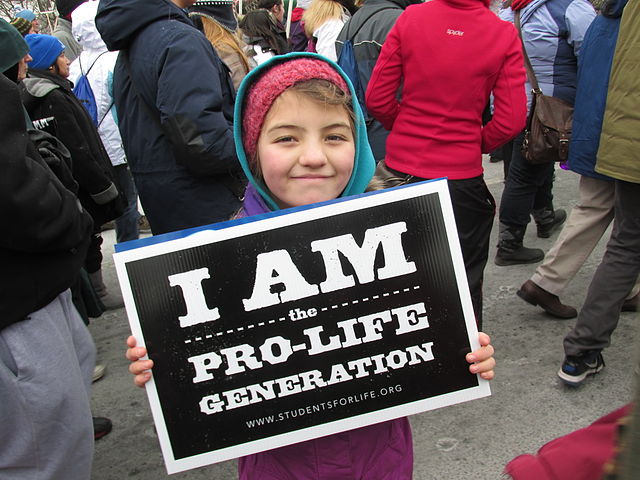
This Friday, mainstream media outlets will have an opportunity to cover a potentially larger event of even greater significance: The March for Life. The event, held every year on or around the Jan. 22 anniversary of Roe v. Wade, features hundreds of thousands of people from across the country marching against abortion. It also enjoys notoriously low media coverage outside of conservative circles and outlets.
This is of course in stark contrast to media coverage of Richard Spencer’s fringe neo-Nazi, alt-“Right” gathering a few months ago, where networks, online outlets, and newspapers went absolutely gaga covering a handful of racists sitting in a multi-purpose room as if they heralded the dawn of a new era. Same with the Women’s March on Washington, which, from a firsthand perspective, appeared to be little more than a chance to wear a pink hat and show off the set of genitals you drew on some poster board. But I digress …
Of course, America’s distrust of the mainstream media is at an all-time high, the reputations built in decades past by figures like Ed Murrow and Walter Cronkite have been largely undone by years of grossly lopsided coverage — election cycles rife with blatant bias and salacious, unverifiable stories about Russian prostitutes doing unspeakable acts with the now-president.
The Federalist’s Sean Davis diagnoses the press’ problem as such:
This country desperately needs a source of information that is deemed credible by people across the political spectrum. It needs a free press that is capable of and willing to hold everyone in power accountable, regardless of their party or their ideology and regardless of their personal feelings toward whomever happens to be in charge. We need a press that believes in the rule of law rather than rule by men. And we need a media establishment that cares more about getting facts right than about anything else.
“Judging by the type of coverage we’ve seen since the election, that institution does not currently exist in this country,” he concludes.
And while the obscene, the salacious, and the unverified get wall-to-wall coverage and lionizing headlines, don’t expect anywhere near the same this Friday. Very few groups in America are as familiar with the consequences of the “fake news” phenomenon as the pro-life movement.
When news related to the unborn isn’t being covered up by mainstream outlets it’s being grossly misrepresented. Take for example The New York Times’ recent coverage of the March for Life, which excluded nearly every reference to the march’s actual name, referring to it only as an “anti-abortion” event (save for the March for Life president’s title).
And even then, the NYT story’s hook wasn’t about the consistently record-breaking crowds, or the actual message, but that Trump advisor Kellyanne Conway would be speaking at an “anti-abortion” event. No, really.
This sort of thing is common practice. On Monday, an annual Marist poll, sponsored by the Knights of Columbus and released in anticipation of March for Life, found that a whopping 74 percent of Americans favor significant restrictions on abortions, with a mere 16 percent believing that it should be allowed without any restriction. While this leaves Hillary Clinton and her extremist abortion lobby cronies in some rather thin company, don’t expect to see this covered outside the usual sources of pro-life news and information.
More than likely, if there’s any coverage of the march by the mainstream media, expect little more than a 30-second clip about some sort of abortion protest on the National Mall that’s heavy on footage of the pro-abortion counter-protestors who, after all, are just out there fighting a bunch of fundamentalists in the name of “women’s rights.”
Perhaps this year ought to be the one to change that — to attend the march and speak to attendees in earnest. To try to truly understand where they’re coming from. To give them as much air time and ink as will be given the pro-abortion protesters annually found at the end of the parade route.
“If the media wants to continue to be seen as a propaganda arm of the Democratic Party, ignore the march as usual. But if journalists are serious about improving their perceived objectivity and serving the American people at large, they should show up this Friday and give the tremendous pro-life crowds the news cycle they warrant,” reads a Monday morning statement from Terry Schilling, executive director of American Principles Project.
“This is a defining year for the pro-life movement. With a Republican House, Senate, and President, pro-life legislative goals are about to become pro-life legislative realities. The story is significant.”
To their credit, a few outlets in the wake of the presidential election have made concerted efforts to expand their horizons to include more voices, either by hiring new talent or realigning internally. While it may be comforting to see some outlets confront their extreme leftist imbalance in their newsrooms – which sometimes look more like North Korean election results – they should know they’re more than welcome on the Mall this Friday. (For more from the author of “Why the March for Life Can Be a Remedy for ‘Fake News'” please click HERE)
Follow Joe Miller on Twitter HERE and Facebook HERE.