Do you know the difference between a democracy and a constitutional republic? Georgetown University law professor Randy Barnett wants to clear up any confusion.
Barnett, director of Georgetown’s Center for the Constitution, wrote the book “Our Republican Constitution” to explain what the founders really meant by “We the People” in the U.S. Constitution.
During a recent visit to The Heritage Foundation, we caught up with Barnett to talk about the book and why he’s pessimistic about the outlook of the U.S. Supreme Court following Antonin Scalia’s death and President Barack Obama’s nomination of Merrick Garland.
“There’s a lot at stake with the next Supreme Court justice, but I can already tell you, I believe that fight has been lost,” Barnett said. “We have to decide how we’re going to survive under a court that is hostile to how we think.” (For more from the author of “What Does ‘We the People’ Really Mean? A Constitutional Scholar Explains” please click HERE)
https://joemiller.us/wp-content/uploads/maxresdefault-46.jpg10801920Joe Millerhttps://joemiller.us/wp-content/uploads/logotext.pngJoe Miller2016-05-12 23:04:002016-05-12 23:05:00Watch: What Does ‘We the People’ Really Mean? A Constitutional Scholar Explains
A major section of Obamacare that allows the federal government to subsidize costs for insurance plan enrollees has been struck down by a federal judge.
U.S. District Judge Rosemary Collyer ruled Thursday that the administration does not, on its own, have the power to spend money on what are termed “cost sharing reduction” payments without an appropriation from Congress. The administration is expected to appeal.
In light of that, the judge allowed Obamacare’s operation to continue unchanged until the appeal process ends.
House Republicans had filed suit, claiming subsidies paid to insurance companies so they, in turn, lower costs for people enrolled under Obamacare, were unconstitutional. House Republicans claimed that because Congress never authorized the expenditure, the executive branch could not spend the money.
In the court case, the administration said a section of law that funds tax credits to help people pay for coverage also was the legal source for paying the subsidies.
However, the judge ruled that cost-sharing reductions require a separate congressional appropriation. Congress has made no such appropriation.
“Such an appropriation cannot be inferred,” Collyer wrote. “None of Secretaries’ extra-textual arguments — whether based on economics, ‘unintended’ results, or legislative history — is persuasive. The Court will enter judgment in favor of the House of Representatives …”
“Authorization and appropriation by Congress are non-negotiable prerequisites to government spending,” she wrote.
In September, Collyer had ruled in favor of House Republicans in rejecting an attempt by the Obama administration to say House GOP members lacked standing to bring the suit.
“The House sues, as an institutional plaintiff, to preserve its power of the purse and to maintain constitutional equilibrium between the executive and the legislature,” Collyer said then. “If its non-appropriation claims have merit … the House has been injured in a concrete and particular way.” (For more from the author of “House Republicans Win Court Fight over Obamacare” please click HERE)
A man who claims he was blinded by an oncoming car’s high-beam lights while riding his electric bicycle is recovering after having a 7-inch tree branch removed from his right eye socket.
Wu Xuan, 34, said he accidentally drove into the branch, which was protruding from a tree, during a thunderstorm, Central European News (CEN) reported. He said he was blinded after a driver flashed his lights at him twice.
He then rode directly into the branch which became wedged in his eye socket and down his throat, CEN reported. Despite the gruesome injury, Xuan was able to ride to the hospital for help where he told doctors he could feel the branch in his throat. (Read more from “Doctors Remove 7-Inch Tree Branch From Man’s Eye Socket” HERE)
The Food and Drug Administration has given so-called “breakthrough” status to a treatment that uses the once-feared polio virus to target aggressive forms of brain cancer, in the hope of speeding it to market.
The therapy, developed at Duke University, hopes to use the virus’ debilitating properties to help fight cancer instead of harming its host, CBS News reported Thursday.
The experimental treatment was the brainchild of molecular biologist Matthias Gromeier. By removing a certain genetic sequence and replacing it with material from the common cold virus, the polio would not be able to cause the incapacitating symptoms that once afflicted President Franklin D. Roosevelt and numerous others because it would be unable to reproduce in normal cells.
However, the altered version of polio could still reproduce in cancer cells—therefore making the cancer susceptible to Lipscomb’s and other patients’ immune systems.
“All human cancers … develop a shield of protective measures that make them invisible to this immune system,” Gromeier told CBS. “By infecting the tumor, we are actually removing this protective shield and enabling the immune system to attack.” (Read more from “FDA Fast-Tracks Treatment That Uses Polio Virus to Fight Brain Cancer” HERE)
https://joemiller.us/wp-content/uploads/ER_room_after_a_trauma-1.jpg12001600Joe Millerhttps://joemiller.us/wp-content/uploads/logotext.pngJoe Miller2016-05-12 10:10:242016-05-13 01:40:28FDA Fast-Tracks Treatment That Uses Polio Virus to Fight Brain Cancer
The Republican from Texas gave CNN a one-word affirmative answer when asked if he will run for re-election to the U.S. Senate seat he won in 2012. Cruz then released a letter Wednesday that he sent to the Federal Election Commission reactivating his campaign account for the Senate and stating he was no longer a candidate for president in 2016.
Tuesday marked Cruz’s first return to Congress since ending his race for the White House last week. During a press conference, Cruz declined to use the occasion to endorse the presumptive GOP presidential nominee, Donald Trump.
In characterizing his return, The Wall Street Journal said Cruz “seemed emboldened by his unexpectedly strong showing in the race, not humbled by losing, and showed no interest in being more accommodating to the Washington establishment he campaigned against.”
“If fighting for the American people makes you an outsider in the Senate, then I will happily remain one,” he said.
Upon his return to the Senate floor, Cruz was greeted by many colleagues, some of whom he disparaged on the campaign trail as part of the “Washington cartel.”
“Wild ride,” Cruz could be heard saying at one point, according to CNN.
“It’s good to be back,” he said to Sen. Dianne Feinstein, D-Calif.
Sen. Orrin Hatch, R-Utah, spoke with Cruz at length.
“I was encouraging him to really get to work here,” Hatch said. “He’s got a lot of talent, a lot of ability.”
Senate Majority Leader Mitch McConnell (R-Ky.) was “nearby but didn’t approach Cruz,” CNN said. (For more from the author of “Cruz Returns to Senate, Reveals What His Next Move Will Be” please click HERE)
https://joemiller.us/wp-content/uploads/8570175139_bb3987ce80_b.jpg6831024Joe Millerhttps://joemiller.us/wp-content/uploads/logotext.pngJoe Miller2016-05-12 03:26:192016-05-12 03:27:17Cruz Returns to Senate, Reveals What His Next Move Will Be
New details continue to emerge from Judicial Watch’s Freedom of Information Act fight with the National Archives over the release of draft indictments of Hillary Clinton in the Whitewater case. According to the Archives, release of the indictments—drafted by an independent counsel examining the Clintons’ relationship to a corrupt Arkansas S&L and an alleged cover-up—would violate grand jury secrecy and Mrs. Clinton’s personal privacy. FOIA request denied.
Judicial Watch declined to take “no” for an answer, and so off to court we went. The case is now in the hands of a federal judge.
In the course of litigation, new facts have come to light. Under FOIA, the Archives must produce a “Vaughn Index”—a tantalizing and at times maddening document. A Vaughn Index is the government saying: we are not giving you the documents, but here is an “index” of what we are not giving you, and why we are not giving it to you. Your tax dollars at work.
In the National Archives Vaughn Index for the case, we learn that the government is sitting on at least twelve versions of the the draft indictment of Mrs. Clinton, including one “listing overt acts.” From the public record, we know that the Whitewater case centered around whether Mrs. Clinton, while First Lady, lied to federal investigators about her role in the corrupt Arkansas S&L, concealed documents (including material under federal subpoena), and took other steps to cover-up her involvment. Prosecutors ultimately decided not to indict Mrs. Clinton, concluding that they could not win the complicated, largely circumstantial case against such a high-profile figure.
The draft indictments range from three to forty pages—the former likely excerpts or “scraps” from longer documents, the Vaughn Index indicates. Some of the drafts doubtless are copies but many clearly are not. A total of 451 pages of draft indictments are being withheld by the Archives.
In its final brief in the case, Judicial Watch took a wrecking ball to the Archives’ grand jury secrecy and personal privacy claims. Judicial Watch noted “the truly enormous quantities of grand jury material already made public” in the independent counsel’s final report. Judicial Watch provided the court with a detailed list of grand jury and non-grand jury material that had already been made public. If there ever was a valid claim to grand jury secrecy in this closely scrutinized case, it is long gone.
The Judicial Watch brief noted that the Archives “fails to identify a single, specific privacy interest Mrs. Clinton still has in the draft indictments” following publication of the independent counsel’s report and “hundreds of pages of grand jury materials, non-grand jury materials, and independent counsel legal theories and analysis that are already in the public domain.”
A typical FOIA privacy claim centers on unwarranted invasions of personal privacy. But in Mrs. Clinton’s case, the brief noted, the Archives “makes no claims that disclosure of the draft indictments will reveal any particular personal, medical or financial information about Mrs. Clinton, much less anything intimate or potentially embarrassing.”
Mrs. Clinton of course is one of the most famous women in the world, a former First Lady, senator and secretary of state, and the Democratic Party’s presumptive nominee for president of the United States. The findings of an investigation into whether Mrs. Clinton told the truth to federal investigators and withheld evidence under subpoena while she was First Lady is clearly matter of public interest as voters weigh her suitability for the highest office in the land. (For more from the author of “BOOM: 12 Versions of Hillary Clinton’s Whitewater Indictments Emerge” please click HERE)
Sen. Tom Cotton won’t rule out or “rule in” the possibility of joining presumptive Republican nominee Donald Trump’s general election ticket as a candidate for Vice President, he reveals in a new interview.
Would you accept an offer to be Trump’s running mate?
(Laughs) I haven’t seen it floated out there. Like I said I’ve been focusing my political work on making sure that we hold the Senate and focus the rest of the time on my son.
So that’s not ruling it out?
I wouldn’t rule it in either.
(Read more from “Tom Cotton Won’t Rule out VP Slot on Trump Ticket” HERE)
Hillary Clinton’s well-heeled backers have opened a new frontier in digital campaigning, one that seems to have been inspired by some of the Internet’s worst instincts. Correct the Record, a super PAC coordinating with Clinton’s campaign, is spending some $1 million to find and confront social media users who post unflattering messages about the Democratic front-runner.
In effect, the effort aims to spend a large sum of money to increase the amount of trolling that already exists online.
The plan comes as Clinton operatives grapple with the reality that her supporters just aren’t as engaged and aggressive online as are her detractors inside and outside the Democratic Party.
The lack of engagement is one of Clinton’s bigger tactical vulnerabilities, particularly when compared with rivals like Donald Trump, whose viral social media attacks are legion, and Sen. Bernie Sanders, who is backed by a passionate army of media-savvy millennials…
…using a super PAC to create a counterweight to movements that have sprung up organically is another reflection of the campaign’s awkwardness with engaging online, digital pros said.
“It is meant to appear to be coming organically from people and their social media networks in a groundswell of activism, when in fact it is highly paid and highly tactical,” said Brian Donahue, chief executive of the consulting firm Craft Media/Digital.
“That is what the Clinton campaign has always been about,” he said. “It runs the risk of being exactly what their opponents accuse them of being: a campaign that appears to be populist but is a smokescreen that is paid and brought to you by lifetime political operatives and high-level consultants.”
With Granny Catlady’s favorability rating trending to that of the Zika virus, one would assume that times are getting desperate in the Clinton campaign. (For more from the author of “GRASSROOTS: Clinton Super PAC Attacking Hillary Online Critics” please click HERE)
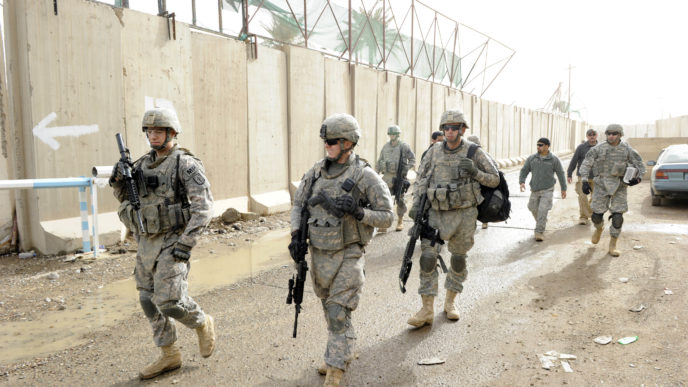
The aircraft parked on the ramp at this military base in northern Iraq offer a symbolic counterpoint to the White House narrative that U.S. forces are on the sidelines of the ground war against the Islamic State.
U.S. Army medevac Blackhawk helicopters are based here, including the one that picked up mortally wounded Navy SEAL Charles Keating IV under heavy enemy fire during a May 3 battle north of Mosul.
Also lined up on the tarmac are Army Apache attack helicopters; intelligence, surveillance, and reconnaissance aircraft; and a variety of armed special operations aircraft from different military branches.
“We’re in a war zone, and this place is dangerous,” an Army officer told The Daily Signal.
The U.S. base is an operational hub for Operation Inherent Resolve, the U.S.-led, 66-nation coalition combating Islamic State, the terrorist army also known as ISIS that holds territory in Iraq and Syria.
From the base in the vicinity of Erbil, capital of Iraqi Kurdistan, U.S. and coalition personnel coordinate airstrikes to support Kurdish peshmerga forces. U.S. special operations troops also stage operations from here to advise and assist the peshmerga during combat.
To accomplish the advise-and-assist mission, U.S. special operations troops frequently go into areas where combat is happening.
While embedded with the peshmerga on the ground, U.S. special operations troops sometimes call in airstrikes from coalition warplanes against ISIS forces, a U.S. Army officer told The Daily Signal on condition of anonymity due to security concerns and restrictions on speaking with news reporters.
The White House, however, has insisted U.S. ground forces in Iraq are not in combat.
The day of Keating’s death, White House Press Secretary Josh Earnest told reporters in Washington: “The relatively small number of U.S. service members that are involved in these operations are not in combat but are in a dangerous place.”
The night after Keating was killed, the mood on the base in northern Iraq was somber, yet there was not a feeling of shock or surprise.
For many U.S. military personnel on the ground in Iraq, Keating’s death underscored something they’ve known for a long time—U.S. special operations forces are neck-deep in the daily grind of the ground war against ISIS.
“Most people took it in stride,” the Army officer told The Daily Signal. “We’re in a war zone, and this place is dangerous. We know people are going to get hurt.”
Indispensable
The base in northern Iraq has all the trappings of other U.S. military installations spread across the Middle East, North Africa, and Central Asia.
It has a tent gym loaded with Crossfit equipment and truck tires stacked out back. Civilian contractors in khaki 5.11 Tactical cargo pants and button-down shirts are here. And inside the chow hall, called a DFAC, an eclectic mix of uniforms from coalition countries and military branches is on parade.
There’s also a subgroup of oft-bearded, elite troops who tend to stick to themselves.
The infrastructure at the base has expanded noticeably since this correspondent last visited in September 2015. More troops, tents, aircraft, and equipment are here than eight months ago.
The installation’s growth reflects the creeping growth in the U.S. presence in Iraq, and the increasingly indispensable role U.S. airpower and special operations support play in the ground war against ISIS.
“We can’t fight without U.S. airstrikes or U.S. support,” a Kurdish official at the Kurdistan Region Security Council told The Daily Signal on condition of anonymity due to security rules. “But the U.S. mission can’t exist without us. It’s a partnership.”
A Dangerous Place
U.S. special operations forces in Iraq for the advise-and-assist mission are not sequestered inside fortified compounds impervious to attack.
These members of the military, including Navy SEALs and Army Special Forces, deploy to team safe houses behind the front lines to carry out their mission and to forward stage as land-based, quick-reaction forces in case U.S. servicemen and servicewomen come under attack.
The Navy SEAL quick-reaction force in which Keating served was stationed at one such team house outside Mosul.
The SEALs deployed in “nontactical vehicles,” military jargon for civilian SUVs. The ensuing firefight lasted for hours, according to military personnel and news reports.
The U.S. Army DUSTOFF Blackhawk helicopter that picked up Keating came under heavy fire and returned pockmarked with bullet holes.
Keating was the third U.S. service member to die in Iraq from enemy fire since Operation Inherent Resolve began in 2014. And the May 3 battle wasn’t the first time U.S. aircraft took fire from ISIS over Iraq.
In September 2015, Air Force pararescuemen, also known as PJs, and combat rescue officers from the 57th Rescue Squadron, then deployed to this location, told The Daily Signal that ISIS forces frequently fired on the HH-60G Pave Hawk helicopters they used to forward position behind enemy lines.
“We take fire every time we go out,” a combat rescue officer said then.
Also in September, U.S. Air Force A-10 attack pilots flying missions over Iraq and Syria from a base in the Persian Gulf region said the volume of surface-to-air fire they faced was much higher than in Afghanistan.
“There’s a real threat here, unlike in Afghanistan,” an A-10 pilot told The Daily Signal at the time. “I’ve had a few close calls. Do we respect the threat? Yes. Are we afraid of it? No.”
Center of Gravity
The Department of Defense said it officially maintains 4,087 troops or less in Iraq and has plans to increase the number of special operations troops and support personnel in Syria from 50 to 300.
The number of U.S. troops on the ground in Iraq and Syria does not, however, reflect the aggregate U.S. war effort against ISIS.
To support Operation Inherent Resolve and military operations in North Africa, as well as operations in Afghanistan, the U.S. is standing up new bases and refurbishing old ones across the Middle East, reflecting a reversal of White House plans to draw down U.S. forces in the region.
“It’s busier now than it was a year ago,” Air Force Lt. Col. Mike Cummings, a C-130 pilot from the Alaska National Guard, told The Daily Signal during an interview at an undisclosed location in the Persian Gulf region.
“We were drawing down and now we’re building back up,” Cummings said. “Now we’re moving in the opposite direction.”
As of the end of April, the U.S. had conducted 9,073 airstrikes in Iraq and Syria in support of Operation Inherent Resolve, according to the Pentagon. Nearly all the U.S. military aircraft, manned and unmanned, launched from bases and Navy vessels outside Iraq and Syria.
U.S. Central Command, or CENTCOM, declined to disclose the number of bases U.S. forces use throughout the Middle East to support the operation.
CENTCOM also declined to disclose the total number of U.S. military personnel committed to Operation Inherent Resolve due to “host-nation sensitivities and operational security.”
According to news reports and open source data, about 50,000 U.S. military personnel are deployed throughout the Middle East, including locations in Turkey and Navy personnel at sea. And, according to CENTCOM, 9,800 personnel remain in Afghanistan.
In an emailed statement to The Daily Signal, a CENTCOM spokesperson said: “We maintain the necessary forces and capability throughout the region to assist our partners and respond to threats as appropriate.”
Chasing the Front Lines
The total number of U.S. troops throughout the Middle East region is only a fraction of the approximately 170,000 U.S. troops who were in Iraq alone during the “surge” in 2007.
And unlike the days of Operation Iraqi Freedom and Operation New Dawn, no countrywide network of U.S. forward operating bases and combat outposts inside Iraq exists from which ground and air forces can project power.
The war against ISIS in Iraq is a frontal war, with a clear delineation between enemy and friendly territory. The 1,200-mile-long front line in Iraq is defined in places by trenches and hilltop forts. Opposing camps trade potshots across no man’s land.
As Iraqi and Kurdish forces take back ground from ISIS, coalition air assets and advise-and-assist personnel constantly move to new bases closer to the shifting front lines. Some bases that were strategically positioned to launch warplanes a year ago are now inconveniently distant from the battlefield’s northward shifting center of gravity.
Bases in Turkey, consequently, play a more important role due to their geographical proximity to the battle space.
The Turkish air base at Incirlik, for example, was reopened to U.S. Air Force F-16s in August 2015 to conduct airstrikes against ISIS targets. The F-16s were swapped out for A-10 attack planes in October. And, according to news reports, F-15C fighter jets and F-15E strike aircraft also have deployed to Incirlik since August.
The total U.S. military force deployed at Incirlik has grown to nearly 2,500, up from about 1,300 last year, according to news reports.
Long-Term Plans
The Daily Signal recently visited an Air Force base at an undisclosed location in the Persian Gulf region. Military officials at the base said about 1,800 U.S. troops and about 2,200 civilian support personnel are deployed there.
The base is a key airlift hub for Operation Inherent Resolve and for supporting military operations in the Horn of Africa. The location is also the launching pad for U.S. and British drones flying missions over Iraq and Syria. Other coalition partner countries fly intelligence, surveillance, and reconnaissance missions from here.
Air Force Col. Clarence Lukes Jr., commander of the 386th Air Expeditionary Wing headquartered at the base, said Pentagon planners drew up a three- to five-year plan to build up its infrastructure after Operation Inherent Resolve kicked off in 2014. And, Lukes added, the Pentagon plans to use the base “for much longer.”
“This puts us in a perfect crossroads for different types of mission sets … regardless of the adversary,” Lukes said.
The base has a swimming pool, a movie theater, and a state of the art gym. Plans are under way to build brick and mortar dormitories to replace the tents and trailers in which most personnel now live.
A recreation center, called the Drop Zone, includes ping-pong tables, flat screen TVs tuned to the Armed Forces Network, and cans of nonalcoholic Beck’s beer in the fridge.
A coffee shop, the Green Bean, offers free Wi-Fi, mocha lattes, and protein shakes. Wi-Fi is available throughout the base. Self-serve ice cream and Krispy Kreme doughnuts can be found in the DFAC.
“Morale hinges on three things,” Lukes said. “Self-serve ice cream, laundry, and Wi-Fi.”
U.S. servicemen and servicewomen say there has been a noticeable uptick in operational tempo since Operation Inherent Resolve began almost two years ago. Yet, many also consider the battle against ISIS to be just the latest chapter in nearly 15 years of nonstop combat operations.
For them, combat deployments are now a way of life.
“It’s just the status quo,” Lt. Col. Corey Reed, deputy operations group commander for the 386th Air Expeditionary Wing, said. “As Afghanistan tapered off, OIR [Operation Inherent Resolve] kicked off. So it’s business as usual.”
“It’s like the last one never ended,” Cummings, the C-130 pilot, said. “It’s not really the start of something new.” (For more from the author of “‘People Are Going to Get Hurt’: America’s Quiet War in Iraq” please click HERE)
https://joemiller.us/wp-content/uploads/Elements_of_the_3rd_Stryker_brigade_on_patrol_in_Iraq_-a.jpg13122000Joe Millerhttps://joemiller.us/wp-content/uploads/logotext.pngJoe Miller2016-05-12 02:47:432016-05-12 02:47:43‘People Are Going to Get Hurt’: America’s Quiet War in Iraq
America’s oldest veteran Richard Overton celebrated his 110th birthday with family and friends on Wednesday, saying “I don’t think about dying… I just think about living.” Maybe that’s the secret recipe to long life.
Overton, of Austin, Texas, fought in the 1887th Engineer Aviation Battalion in World War II, and served as a corporal in Hawaii, Guam and Iwo Jima.
“I feel good. A little old, but I’m getting around like everybody else,” Overton told NBC News on Wednesday by phone from the same Austin house he’s lived in since he returned from the war. He paid $4,000 for it.
His tips for longevity are far from traditional: He chain-smokes cigars, insists on a splash of whiskey in his morning coffee, and enjoys a steady diet of fried catfish and butter pecan ice cream, he told TODAY two years ago.
While Overton has been surrounded by the spotlight in recent years receiving media attention, awards, and visits from politicians, it never fazes him.
After meeting former Gov. Rick Perry on his 106th birthday he said of Perry, “He’s human, ain’t he?”
You can watch their meeting here. Overton has also met President Barack Obama when he had breakfast at the White House 3 years ago. (For more from the author of “Meet Richard Overton: He’s America’s Oldest Veteran and He Turned 110 Today” please click HERE)