Impeachment Controversy Stokes Uncertainty Ahead of South Korean Election

The next South Korean presidential election is scheduled to be held on or before Dec. 20, 2017. However, there is a possibility that South Korea will have its election in advance because of President Park Geun-hye’s impeachment, which led to her immediate suspension.

Park’s impeachment must be ratified by the Constitutional Court within six months in order to become permanent. If the Constitutional Court votes to ratify, South Korea must then hold new presidential elections within 60 days.

Potential candidates are already starting to declare their intention to run for president, including a major South Korean opposition leader, Moon Jae-in.

However, there are concerns among experts in South Korea and the U.S that progressive opposition parties are attempting to reverse current South Korean foreign policies that have been pragmatic on North Korea and have seen an improvement in U.S.-Japan-South Korea trilateral relations.

Moon, the leading progressive candidate, has persistently expressed a desire to strengthen ties with China and reopen its banner of “inter-Korean dialogue.” He also suggested he would renegotiate and review the comfort women agreement and the General Security of Military Information Agreement with Japan.

During his interview earlier this month, Moon said, “The Kaesong Industrial Complex has to be resumed immediately, and the deployment of Terminal High Altitude Area Defense has to be left as a task for the next government.”

Moon also said he will “visit North Korea first” before the U.S. if he wins the election. This statement caused a public controversy and stoked the flames of a scandal that had been dogging Moon for several months.

In a recent memoir, former Foreign Minister Song Min-soon claimed that Moon was responsible for South Korea’s decision to abstain from a 2007 U.N. resolution vote on North Korea’s human rights situation after listening to Pyongyang’s opposition. At the time, Moon was chief of staff to President Roh Moo-hyun.

The question of Moon’s “suspicious security standards” has limited his increasing popularity, even as he has benefited from the recent impeachment. But according to a poll from Realmeter, Moon was still leading with a 23.7 percent support rate in early December.

There is speculation, however, that Moon will face a challenge from another progressive candidate, Lee Jae-myung, the mayor of a satellite city of Seoul. Lee ranks third in the polls and has a 14.9 percent support rate. In response to Moon’s earlier statement, Lee said he would “visit the U.S. first.” But his foreign policy proposals do not seem to vary much from Moon’s.

U.N. Secretary-General Ban Ki-moon is currently polling ahead of Lee and behind Moon with 20.5 percent of popular support. He has not spoken much about his decisions at the U.N. or his policy views because his tenure as U.N. chief has not yet expired.

But Ban is considered to be the only moderate conservative candidate who has a chance over Moon. If the conservative party manages to recover from the recent scandal, it will probably reassemble under Ban, who is considered favorable to the U.S.

The South Korean presidential race is a multicandidate field. The two most likely scenarios are: Ban vs. Moon or Ban vs. Lee. Whether Moon or Lee compete as progressive candidates, Ban will have a hard fight considering the current political atmosphere in South Korea.

The next South Korean election is important because it may affect the future of U.S.-Korean relations. If the progressive candidate wins, South Korea might pivot to China, reverse pragmatic policies against North Korea that enforce U.N. resolutions, and raise tensions against Japan—all policy moves that contravene U.S. national interests.

In this period of relative political uncertainty, the U.S. should reassure its extended guarantee of deterrence to its allies, encourage an improving relationship between South Korea and Japan, and affirm its dedication to enhancing sanctions and targeted financial measures to increase pressure on the North Korean regime. (For more from the author of “Impeachment Controversy Stokes Uncertainty Ahead of South Korean Election” please click HERE)

Follow Joe Miller on Twitter HERE and Facebook HERE.

Israel Green-Lights Settlements After UN Snub

Israeli authorities gave the go-ahead for the construction of hundreds of new settlement sites in East Jerusalem Monday after a United Nations resolution condemned Israel over the issue.

The defiant move comes after the U.S. government did not veto the U.N. condemnation of Israeli settlements, a marked change in U.S. policy. The Obama administration affirmed the decision to abstain in the vote on the resolution, despite being able to defeat it with its veto power, saying that Israeli settlements “puts at risk the two-state solution, as does any continued incitement to violence.”

“Israel is a country with national pride, and we do not turn the other cheek,” Israeli Prime Minister Benjamin Netanyahu said in the wake of the resolution. “This is a responsible, measured, and vigorous response, the natural response of a healthy people that is making it clear to the nations of the world that what was done at the U.N. is unacceptable to us.”

President-elect Donald Trump more closely aligns with Netanyahu’s position, and lashed out at the U.N. in the wake of the vote.

Beyond approving more settlements, the Israeli government has cut diplomatic contact at the U.N. with countries that voted in favor of the resolution, and summoned the U.S. ambassador to Israel to admonish him.

Palestinian leaders immediately hailed the vote as a victory.

“Now we can talk about the boycott of all settlements, the companies that work with them, et cetera, and actually take legal action against them if they continue to work with them,” the foreign minister of the Palestinian Authority told Palestinian media.

Ron Dermer, Israel’s ambassador to the U.S., even charged the Obama administration with orchestrating the vote. “The United States was actually behind that gang-up,” Dermer told CNN Sunday. He continued that the evidence of the Obama administration’s role would be presented to the Trump administration in due time. (For more from the author of “Israel Green-Lights Settlements After UN Snub” please click HERE)

Follow Joe Miller on Twitter HERE and Facebook HERE.

Dangerous Times for Israel Demand Renewed American Commitment

“The release of atom power has changed everything except our way of thinking,” said a troubled Albert Einstein as he contemplated the horror of nuclear weapons. “The solution to this problem lies in the heart of mankind. If only I had known, I should have become a watchmaker.”

Dr. Einstein was right in echoing what the Prophet Jeremiah wrote in the 7th century B.C.: “The heart of man is deceitful above all things, and desperately sick” (Jeremiah 17:9). Like the permanence of human falleness, however, the technology and reality of militarized nuclear power cannot be undone.

When, this week, the United States failed to prevent the United Nations’ Security Council from condemning Israeli settlements in “occupied Palestinian territory,” the possible use of nuclear weapons became a more vivid fear for the Jewish State, a nation Albert Einstein supported vigorously in its early years.

Attacking Israel has become a cottage industry at what supposedly is the world’s forum to prevent international conflict. In November 2015 alone, the United Nations passed no less than 20 resolutions “singling out Israel for criticism — and only 3 resolutions on the rest of the world combined.”

Yet this week’s resolution is unique in that given the opportunity, America declined to stop a one-sided, anti-Israel bill from going through the Security Council.

The Connection Between U.N. Action, U.S. Indifference and Nuclear Weapons

So, what’s the relationship between the U.N. action, America’s indifference to it, and nuclear weapons? First, some background: Israel has control of areas it took from Arab Palestinian control following the 1967 Six-Day War. Its control of this territory is hotly disputed. What is indisputable is Israel’s strategic importance to American security interests throughout the Middle East, as is our moral duty to stand by one of our truest allies and friends.

Israel’s reaction to America’s failure to stand with her was swift and devastating. “Israel rejects this shameful anti-Israel resolution at the U.N. and will not abide by its terms,” said Israeli Prime Minister Benjamin Netanyahu said following the vote. “At a time when the Security Council does nothing to stop the slaughter of half a million people in Syria, it disgracefully gangs up on the one true democracy in the Middle East, Israel, and calls the Western Wall ‘occupied territory.’”

And in an extraordinary public criticism of President Obama, Mr. Netanyahu said, “The Obama administration not only failed to protect Israel against this gang-up at the UN, it colluded with it behind the scenes. Israel looks forward to working with President-elect Trump and with all our friends in Congress, Republicans and Democrats alike, to negate the harmful effects of this absurd resolution.”

Mr. Trump personally intervened earlier in the week in contacting the president of Egypt, whose Security Council representative was planning to offer the measure. Pursuant to the President-elect’s call, Egypt agreed to refrain from offering the resolution. Yet four other countries, including American ally New Zealand, took advantage of their outgoing membership on the U.N. Security Council to offer the resolution instead of Egypt.

And the Obama Administration did nothing.

Enter the threat of nuclear weapon use. Israel’s most intransigent enemy, Iran, may or may not have nuclear weapons. But clearly Iran has been pursuing the development of such for many years, and the deal struck by the Obama Administration with Iran concerning its nuclear program is hardly reassuring to close observers concerned that it contains atomic bomb-size loopholes.

America’s failure to support Israel at a time of enormous crisis in that interminably roiling region (Syria, ISIS, and Iran, to name but three continuing thorns in the world’s flesh) sends a signal of weakness and, thereby, opportunity for Israel’s dedicated foes. Although President-elect Trump promises to restore America’s unequivocal allegiance to Israel (“As to the UN, things will be different after Jan. 20th,” the Tweetmaster-in-Chief commented last week), the West’s cowardly collusion with Israel’s enemies (among other Security Council members, France and Britain voted to condemn the settlements) only strengthens the hands of the hard-liners in Iran who want to reduce Israel to a smoking smudge on the map of the world.

A few days ago, Iranian President Hassan Rouhani said, “Today, the world public opinion is faced with this strong argument that the Zionist regime has never been after peace, and this argument and reasoning should be used to show that there is no way, but jihad and resistance for the Palestinians against the usurper regime.”

Israel is not for peace, and is a “usurper regime?” This from a man whose government pays for the terrorist group Islamic Jihad’s vicious violence against Israel.

Will Iran attack Israel with nuclear weapons tomorrow? No. But do American vacillation and Western anti-Israelism incentivize not only Iranian-sponsored terrorism but, in all likelihood, renewed clandestine efforts by Iran’s government to construct nuclear weapons? Almost certainly.

It can be hoped that when Donald Trump takes office, his bold support for Israel will not waver. He has promised to move the U.S. embassy to Jerusalem and to ensure a robust U.S.-Israeli military alliance.

Let us pray that Mr. Trump’s commitment to the Jewish state will be dogged. If it is, perhaps Albert Einstein, were he still with us, would be a little less inclined to have been a watchmaker than the founder of modern physics. (For more from the author of “Dangerous Times for Israel Demand Renewed American Commitment” please click HERE)

Follow Joe Miller on Twitter HERE and Facebook HERE.

Many Iraqi Christians Won’t Be Home for Christmas. One Group Is Determined to Change That

For the past two Christmases, historically Christian neighborhoods and towns in Northern Iraq have passed the holiday without church bells, thanks to ISIS occupation. While this year will be different, those communities are still a long way from fully coming home. One organization is now trying to engage U.S. congregations and parishes to make their return possible.

News broke in October that the military campaign to retake Iraq’s second-largest city, Mosul, from the grips of ISIS’ occupation was met with hopeful anticipation.

In 2003, Iraq’s Christian population numbered around 1.4 million. Thirteen years later, that number has dwindled to just under an estimated 300,000, with most of it concentrated in lands once held by ISIS. Now, Iraqi Christians who want to return home have been met with post-occupation aftermath that leaves many of them wondering when they’ll be able to start putting the pieces of their lives back together.

The problems for those who are trying to repatriate are “multi-layered,” explains Juliana Taimoorazy, founder and president of the Iraqi Christian Relief Council (ICRC) and senior fellow at the Philos Project.

“First off, it’s cold,” she explained, noting the issues of trying to move populations during northern Iraq’s harsh winters. “Secondly, they’re returning to ground zero. The cities that have been liberated, completely … have been completely devastated.”

Taimoorazy is herself an Assyrian Christian. She was smuggled out of her native Iran into Switzerland in 1989 due to religious persecution from Iran’s Islamist regime. She eventually was granted asylum in Germany a year later before coming to the United States in 2000. Now, she works as an advocate for persecuted Christians in the Middle East with ICRC.

One of the biggest problems in the area has been ISIS’ use of chemical warfare and the lasting effect it has on the area. She notes that in one city alone, 60 percent of the homes have been chemically targeted, while many of the farms in the fertile region along the

Tigris River have also been chemically polluted.

Even worse, in many cases ISIS’ devastation has gone beyond the structural and economic damage done to homes, businesses, churches and farms, to something far more fundamental: the family.

“So many people are returning while their mothers and sisters have been sold into ISIS sex slavery, their fathers have been executed, or their kids are missing, ” Taimoorazy said. “So the family unit has been torn apart. It’s not the same as it used to be in many cases. In many ways, their crisis has just gotten worse.”

“This is where we’ve been asking the international community and the Iraqi government to think seriously about what [the displaced individuals’] return and rebuilding is going to look like,” Taimoorazy said. In response, she’s working through her organization to rebuild things, block by block.

The Iraqi Christian Relief Council began planning Operation Return to Nineveh shortly after the military campaign to reclaim Mosul began, launching it in mid-November. The operation’s mission is to “support the return of thousands of families to their ancestral towns [through] the rebuilding of community centers, schools, homes and churches destroyed by ISIS.”

ICRC’s focus currently is primarily on the town of Teleskof, north of ISIS lines, along with Bartella, Baghdeda (Qaraqosh), Karmlis, and Batanya in the Nineveh Plains region, which has been home to Christians since the first century A.D.

One of the group’s biggest efforts right now is to convince American congregations to adopt and sponsor churches in liberated areas for reconstruction and renewal.

“In a lot of these places, the local church structure is still standing, along with a lot of the homes,” Juliana Taimoorazy explained to CR. “But the things inside have been destroyed, looted, or burned.”

“Right now, the biggest challenge is that people are coming back to ground zero with very few [outsiders] stepping up to help,” she added, stating that the conditions present too big an obstacle for some to return at all.

“For the past two years a lot of the people I talk to say they have been living in limbo. They’ve had dreams of returning, and they haven’t been able to see what’s happened to their homes, their churches, and their community centers,” she said. “Now that they’ve been able to return and assess the damage, they’re completely heartbroken. Reality sinks in.”

While funds have come in from “all over the world,” Taimoorazy said, 95 percent of the money raised so far has come from individual donations in the United States. They’ve gotten sums raging from “$2.50 to thousands of dollars.” (Interested parties can donate to VictimsofISIS.org.)

“We are seeking churches to adopt ‘sister churches’ in the region to help them rebuild,” she said. “For example, we have a proposal from St. George’s Church in Teleskof that tells us how much the floor costs, how much the ceiling costs, the price of windows, and things like that.”

ICRC is also seeking corporate and nonprofit partners in their efforts, which have even earned the endorsement of evangelical author Erwin Lutzer, former senior pastor of the Moody Church in Chicago.

“This is an ongoing project and it’s going to be broken into phases,” said Taimoorazy. “Phase 1: the street, the block, so-and-so has been cleaned. Check mark. Phase 2: the Church rebuilding has begun. Check mark.” And so on.

But these efforts, and others like them, need all the help they can get to succeed. (Or even begin, in many cases.)

“I thank people [in the West] for standing with these [Christian refugees] while they were in displacement for two-and-a-half years,” Taimoorazy said. “But now the work begins. Now they need the church’s help, and American help, and Canadian help, and European help more than ever to help them rebuild their lives.” (For more from the author of “Many Iraqi Christians Won’t Be Home for Christmas. One Group Is Determined to Change That” please click HERE)

Follow Joe Miller on Twitter HERE and Facebook HERE.

President Obama Throws Israel Under the Bus the Day Before Hanukkah and Christmas Eve

It is a decision that will live on in reproach and infamy, bringing further shame to the legacy of President Barack Obama: Just one day before the beginning of Hanukkah and Christmas, our departing president threw Israel under the bus.

Shame on you, Mr. President. Your betrayal will not be forgotten.

For weeks now there has been talk that Obama would take one last shot at Prime Minister Netanyahu, with whom he has had an icy, often tense, relationship. There were even accusations that he actively worked against Netanyahu’s 2015 reelection, accusations that make Obama’s indignation over Russia’s alleged involvement in our 2016 elections all the more ironic.

Would he try to push again for a two-state solution, even arguing for 1967 borders, as he once did?

It turns out there was another plan, one that would use the UN Security Council to condemn Israeli settlements in the West Bank and East Jerusalem — the so-called disputed, Palestinian territories — with one Israeli official claiming that the Obama administration helped the Palestinian leadership craft the resolution.

This much we know for sure. On Thursday, when the vote was to go before the security council, President-elect Trump reached out to Egyptian President el-Sisi, asking him to withdraw sponsorship of the bill, and remarkably, el-Sisi complied.

It appears that Egypt wants to have Israel as an ally in its war against Isis and the Muslim Brotherhood, not to mention Egypt’s desire to be on good footing with our new president, and so, the resolution was tabled for the day.

On Friday, however, New Zealand, Malaysia, Senegal, and Venezuela reintroduced the bill for a vote, and for the first time, rather than using our veto power as a permanent member of the security council to stop this biased attack on Israel, President Obama instructed Samantha Power, our Ambassador to the UN, to abstain from voting. And so, with the direct help of the President of the United States, the UN Security Council condemned the nation of Israel for building settlements in the “occupied territories.”

I’m aware, of course, that there are legal and moral disputes over the settlements, with Israel constantly reaffirming its legal and moral right to continue to build. A spokesman for the president gave this simple justification for our actions on Friday: We stand with Israel — after all, we “just concluded a $38 billion tenure (memorandum of understanding) for security assistance to Israel” — and we join the international community in opposing the settlements, which are an obstacle to peace.

But there is no coincidence that, with just days left in his administration, and with the reality that much of his legacy will quickly be undone by incoming President Trump, outgoing President Obama committed this act of betrayal against our one true ally in the Middle East, America’s historic close friend, Israel.

The fact is, there are more than 1.5 million Palestinian Arabs living as full-citizens in Israel, serving on the Supreme Court, holding seats in the Knesset, enjoying the unique benefits and freedoms that Israel offers to its people. (For the record, when polled, they have no desire to be under Palestinian leadership.) In contrast, the Palestinians do not want any Jews living in their disputed territories, all the more so if there is a two-state solution.

In other words, the Palestinian Arabs will continue to live in Israel, but a Palestinian State must be Judenrein — entirely free of Jews. Where is the world outcry over this?

The bottom line, though, is this.

The UN has been infamously anti-Semitic through its history – that is to say, it has been so unjustly and blatantly anti-Israel that it has demonstrated actual anti-Semitism – and this latest UN resolution was just another manifestation of that ugly pattern.

At times like this, regardless of whether America was supportive of Israel’s settlement policy, there was only right thing for us to do, namely, veto the resolution and stand with Israel. Instead, President Obama was complicit in condemning Israel on the world stage shortly before leaving office, thereby confirming the criticisms of the many who always questioned the depth of his solidarity with the Jewish state.

Ironically, this has paved the way for President-elect Trump to make his solidarity with Israel (and his antipathy to the UN) all the more clear, as he tweeted out yesterday: “As to the U.N., things will be different after Jan. 20th.”

And on the allegedly anti-Semitic Breitbart.com, Orthodox Jewish columnist Joel B. Pollack has already written about, “Five Ways Trump Could Avenge the Anti-Israel UN Vote,” all of which are very feasible.

President Obama, then, has shown his true colors in the closing days of his presidency and immediately before the beginning of Christmas Eve and the first day of Hanukkah.

But the timing of his infamous act reminds me of this: God’s purposes for the world through Jesus will continue unabated, and in the Hebrew words commemorated by the Hanukkah miracle, Am Yisrael Chai, The People of Israel Live. (For more from the author of “President Obama Throws Israel Under the Bus the Day Before Hanukkah and Christmas Eve” please click HERE)

Follow Joe Miller on Twitter HERE and Facebook HERE.

Thank You, Bibi Netanyahu! This Is How You Deliver a Christmas Message

The Prime Minister of Israel Bibi Netanyahu posted a special message for Christians around the world today, wishing them a Merry Christmas and a Happy New Year.

Israel remains a bright spot for religious liberty in the war-torn Middle East, where Christians, Muslims, and other religions are free to worship and proselytize according to their consciences. Christians there will be able to celebrate Christmas openly, without the fear of persecution felt by so many in the Middle East.

Meanwhile, the American president has thus far only sent a “Happy Holidays” card. Will we see a Merry Christmas message from President Obama? (For more from the author of “Thank You, Bibi Netanyahu! This Is How You Deliver a Christmas Message” please click HERE)

Follow Joe Miller on Twitter HERE and Facebook HERE.
Germany to Commit More Troops to NATO in Lithuania

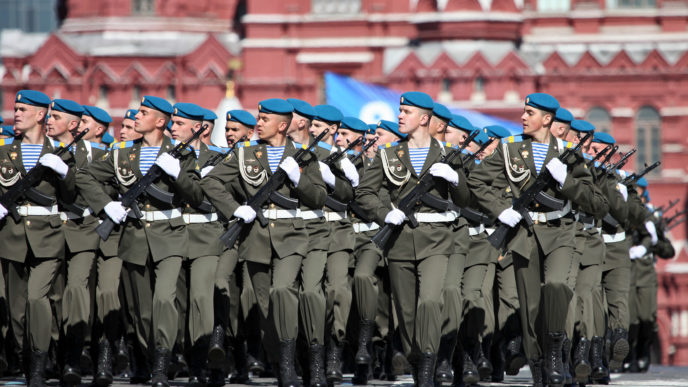
Germany is upping its contribution to the North Atlantic Treaty Organization in the Baltic state of Lithuania. This is a welcome development.

The initial news came in October when Germany announced its commitment of Bundeswehr forces to Lithuania in 2017 as part of a NATO deterrence mission.

Materially, the German deployment will be substantial. Of the 1,000 NATO soldiers that are to be posted in Lithuania, almost 700 will be provided by Germany. Heavy weapons such as the Leopard 2 main battle tank are also to be a part of the contingent.

Germany’s contribution is particularly welcome since it tends to get lumped into a group of NATO countries that could probably contribute more, but often fail to do so. The timing is also opportune, considering President-elect Donald Trump has stressed that NATO’s European members need to do more.

Furthermore, Germany is often criticized as sympathizing with Russia in order to safeguard deep economic interests with Moscow. The Bundeswehr deployment signals that Germany prioritizes European security and its relationship with the U.S.

There is a positive history of recent U.S.-German military cooperation that should be acknowledged but not overstated. Germany is also home to numerous U.S. military installations.

Through NATO, Germany has stepped up to the plate in Afghanistan. At one time, Germany was the third-largest troop contributing nation to the NATO-led mission in Afghanistan. However, German soldiers were largely confined to the peaceful northern part of the country and were heavily restricted by operational caveats.

Yet one should not conclude from this deployment that Germany will always follow the U.S. policy line. Disagreement abounds between the U.S. and Germany on issues ranging from Ukraine, the eurozone debt crisis, the desirability of a European Union army, and the details of a potential transatlantic trade agreement.

Nor can Berlin guarantee acquiescence to U.S. policy. For example, Italy’s new prime minister, Paolo Gentiloni, recently resisted attempts to extend European Union sanctions on Russia by a year in addition to broadening the sanctions to cover Russia’s actions in Syria.

The Trump administration needs to appreciate Germany’s delicate relationship with the rest of Europe. During the periodic episodes of the eurozone debt crisis, depictions of Angela Merkel as a Nazi or of panzers rolling through southern European countries were commonplace.

Caricatures like these, while ridiculous, unfair, and unworthy of serious consideration, reflect lingering European suspicions that Germany harbors ambitions of geopolitical hegemony.

Acting through multilateral organizations like NATO allows Germany to positively contribute to European security and governance without engendering fear from its neighbors.

Ultimately, the Trump administration will have to deal with the Germany it has, not the one it wants. Berlin will probably never be willing to partake in every military operation that the U.S. undertakes. Berlin will probably insist that any NATO operation abide by the dictates and fine minutiae of international law. Berlin will probably place as much emphasis on dialogue with unsavory regimes as it ever will on military strength.

But when push comes to shove, Berlin will hopefully be there for Washington when it needs a partner that will do what it can to safeguard a peaceful and prosperous Europe, just as it is doing now in Lithuania. (For more from the author of “Germany to Commit More Troops to NATO in Lithuania” please click HERE)

Follow Joe Miller on Twitter HERE and Facebook HERE.
Terror Attack in Germany Puts Spotlight on Refugee Policy

Before this year, Germany was not used to Islamist terrorists striking on its home soil. A lot has changed since.

The terror threat that haunts Germany seemingly culminated—at least for 2016—in the outrage that occurred in Berlin this week. At present, 12 are dead and dozens more were injured in a truck attack that mirrored the one that took place in Nice, France, this past summer.

It comes as no surprise that the Islamic State, also known as ISIS, has claimed credit for the attack in Berlin, although the actual perpetrator is yet to be arrested.

Intelligence services clearly had an idea that something like this was possibly coming. A State Department travel alert from November warned of a “heightened risk of terrorist attacks throughout Europe, particularly during the holiday season.”

The travel alert went on to say, “U.S. citizens should exercise caution at holiday festivals, events, and outdoor markets.” It stated that “credible information” indicated that ISIS or al-Qaeda could be likely perpetrators of an attack.

Such target-rich environments appeal to terrorist groups aiming to cause death and carnage during the holiday season. Even before the plot targeting Berlin, a 12-year-old boy radicalized by an ISIS operative tried to blow up a Christmas market in Ludwigshafen on Nov. 26. Fortunately, his bomb failed to detonate.

On the same day, arrests were made in Strasbourg and Marseille, which disrupted an ISIS plot targeting a Christmas market in Champs-Elysees, Paris.

Yet the threat does not begin and end with ISIS. Those trained by al-Qaeda have also planned to attack a Christmas market in Strasbourg. That plot was disrupted in December 2000 and four Algerians were subsequently jailed for between 10 and 12 years.

Al-Qaeda has also launched terrorist attacks on aviation during the holiday season—in 2001, via shoe bomber Richard Reid, and in 2009, via underwear bomber Umar Farouk Abdulmutallab.

With the Berlin assailant still on the loose (at the time of this writing), German authorities will be working with counterterrorism partners domestically and internationally to try and stop another attack from taking place. In the short-term, this involves finding whoever was responsible, what networks they were connected to, and any ties to foreign terrorist groups.

It may be that there were ties to terrorists based in Germany. For example, it is worth remembering that “Charfeddine T”—a 24-year-old Tunisian—was arrested just days ago on the suspicion that an attack was being planned in Berlin. Whether there are any ties is unknown, although the timing is worth noting.

Presumably, whoever carried out the attack will be caught relatively quickly. Even so, there is much to reflect on for Chancellor Angela Merkel and for German society generally.

This is the fourth terrorist attack that has taken place there this year, and there have been a host of other attempted attacks thwarted. Several of these plots have been planned by refugees recently settled into the country.

Clearly the vast majority of the 1 million-plus refugees to have entered Germany are not terrorists. Yet the numbers that Germany took in were so large that even a small minority has led to a very big issue.

So, the problem is clear. Whether the German political class has adequate solutions, much less so. (For more from the author of “Terror Attack in Germany Puts Spotlight on Refugee Policy” please click HERE)

Follow Joe Miller on Twitter HERE and Facebook HERE.

Could Murder of Russian Ambassador Lead to a Reassessment of Turkey’s Role in NATO?

Imagine if the U.S. Ambassador to Mexico were publicly executed in Mexico City by a Mexican government security guard who shouted slogans about “justice” for illegal immigrants. And if then we found out that the guard had a track record of involvement in radical nationalism. How would the U.S. government respond to that? What would ordinary Americans demand that we do?

Expect the Russian government to be similarly aggressive in responding to the blatant, vicious murder of Andrei Karlov, its Ambassador to Turkey — who was gunned down on camera while visiting an art gallery by Turkish riot policeman Mevlut Mert Altintas. Russian president Vladimir Putin has called for Russian security services to be involved in Turkey’s investigation of the murder, which was caught on camera (WARNING: graphic footage):

Revenge for Those “Moderate Rebels” in Syria

The murderer claimed that his attack was revenge against Russia, which has helped Syria’s dictatorial government defeat al Qaeda-allied Islamist rebels in Aleppo, preserving that country’s secular regime and the safety of religious minorities in Syria, including a million Christians. Turkey has been one of the prime sponsors of the Islamist militias in Syria, which have executed Christians, ISIS-style, in regions which they seized. Those jihadists also benefited from U.S. aid, advocated by the likes of John McCain and Lindsey Graham for “moderate rebels” who turned out not quite to exist.

If a confrontation were to develop between the governments, whose side will America take? The media-vilified Russian government or the Islamist regime in Turkey? By treaty, we are actually committed to defend Turkey, because it is still a member of NATO. No doubt Erdogan’s rogue regime feels empowered by that legacy of the Cold War. It will also count on the reflexive hostility to Russia by those who see that country as our inveterate enemy, whatever its regime. But it’s time to reconsider those impulses, and a Trump administration seems likely to ponder long and hard whether Russia is our enemy or Turkey our friend.

Who is Invading Europe: Russia or Turkey?

Before Russia shook off its Communist regime, Turkey was a solid U.S. ally, with a secular government that did a reasonable job of protecting the rights of Christian and other minorities — the tragic remnants of Byzantine Christianity after centuries of ethnic cleansing and grinding Islamic rule under the Ottomans. That Muslim empire lorded it over the citizens of Hungary, Romania, Greece, Bulgaria and Serbia for centuries. Features of Ottoman rule included the regular kidnapping of thousands of Christian infants, to be raised as Muslim soldiers.

Secular Turkey could protect its minorities, serve as a U.S. ally, and advance toward modernization as long as it was a military regime, which enforced its non-Islamic constitution by refusing to hold elections. Once Turkey, under misguided American pressure to democratize, began its transition to mass elections during the late 1990s, the voice of Islamist radicals began to drown out all the others.

Springtime for Islamists

Now the country is ruled by the increasingly autocratic Recep Tayyip Erdogan, who has jailed hundreds of journalists in the wake of a dubious coup attempt in July. Erdogan has made it clear that he is nostalgic for Turkey’s old imperial, Islamist past: He is dressing his palace guards in old Ottoman uniforms, revising history books to glorify the country’s Islamist past, and cracking down on the religious rights of Christians.

Turkey aided and abetted the mass colonization of Europe by Syrian “refugees,” who under international law should have remained there, as the “first safe country” they could reach. Instead, Turkey helped them to enter Greece and other countries, from which they could travel to Germany, Sweden, and other lands with generous welfare systems. The resulting wave of immigrant crimes and terrorist attacks is disrupting politics all across the European Union.

Instead of mitigating the flow, Turkish president Erdogan is using the fear of more refugees as a stick in negotiations with the EU, demanding that it continue moves to admit Turkey to the EU, and grant visa-free travel for the whole population of Turkey throughout the whole European Union — or else face a new influx of 1-2 million more colonists, who he threatens to ship into a supine Europe unwilling to defend its southern borders.

NATO was created to deter a Russian invasion. It succeeded. What a hideous irony it would be if NATO were used to protect a regime that is invading Europe with a far more intractable enemy: Muslims who oppressed and terrorized large parts of Europe for 400 years. (For more from the author of “Could Murder of Russian Ambassador Lead to a Reassessment of Turkey’s Role in NATO?” please click HERE)

Follow Joe Miller on Twitter HERE and Facebook HERE.

What a Special Committee Investigating Russia’s Cyberattacks Could Do

A bipartisan group of senators is pressing for the creation of a special panel—known as a select committee—to investigate and provide the definitive account of Russian cyberattacks on the U.S. political system.

Sens. John McCain. R-Ariz., and Lindsey Graham, R-S.C., along with incoming Democratic leader Chuck Schumer of New York and Sen. Jack Reed, D-R.I., called for a select committee on cybersecurity in a bipartisan letter to Senate Majority Leader Mitch McConnell, R-Ky.

McConnell, so far, has resisted the idea of appointing a unique investigative body, preferring to go through the normal process where already existing committees with jurisdiction over cybersecurity issues, like the Intelligence Committee and Armed Services Committee, conduct their own probes.

“We don’t need to set up a special committee to do what we [can do] through regular order,” McConnell said Monday night on Kentucky Educational Television.

Supporters of the select committee say Russia’s actions are extraordinary enough to warrant an all-encompassing investigation.

“Recent reports of Russian interference in our election should alarm every American,” the bipartisan group of senators wrote on Sunday to McConnell. “Cybersecurity is the ultimate cross-jurisdictional challenge, and we must take a comprehensive approach to meet this challenge effectively.”

McConnell would need to allow the vote on a select committee to go forward, although senators could force a vote on the floor.

According to media reports, the intelligence community, including the CIA and FBI, have concluded that hackers associated with Russia broke into the computer systems of the Democratic National Committee and other political organizations, and leaked emails during the presidential campaign.

The CIA recently told Congress that Russia tried to help President-elect Donald Trump win. A new leaked memo shows the FBI director backs that assessment. Russia hackers also tried to hack the Republican National Committee, The Wall Street Journal reports.

The procedural debate is important because forming a select committee would raise the public profile of Russia’s actions at a time when Trump continues to reject the conclusions of intelligence reports.

The Daily Signal below explains the many questions surrounding a potential select committee.

What Is a Select Committee and How Is One Formed?

Congress usually forms a select committee to examine a specific issue for a limited time, but they are rarely created. When they are, these special panels tackle issues that span the different coverage areas of the normal committee structure.

“You can imagine if lots of committees looked into this, you would get different answers and interpretations of evidence, so there is a lot of value in having a select committee that produces the definitive account,” Susan Hennessey, a fellow in national security in governance studies at the Brookings Institution, said in an interview with The Daily Signal.

Members and senators in either chamber of Congress could introduce a resolution creating a select committee. The House and Senate could also authorize a select committee together, but it’s more likely to be handled by one chamber individually.

On Monday, Politico reported that Sen. Cory Gardner, R-Colo., plans to introduce a bill that, if passed, would mandate a new select Senate committee on cybersecurity.

A stand-alone proposal in the Senate creating a select committee would require 60 votes to overcome a filibuster attempt. The president cannot veto the imposition of a select committee.

Select committees are made up of lawmakers from both parties chosen by leadership.

What Would a Select Committee on Cybersecurity Do?

Lawmakers spell out the specific duties of a select committee in the resolution mandating its creation.

“The role could be framed as a committee just investigating Russian cyberattacks or it could be framed more broadly and be about foreign cyberattacks conducted on the U.S. since a specified date,” said Jordan Tama of American University, who specializes in foreign and national security policymaking.

Schumer, McCain, Graham, and Reed, indicated to McConnell that the panel they propose would focus not only on Russian cyber behavior but also potential threats from other countries, including China and Iran.

The senators recommended that such a committee also develop “comprehensive recommendations and, as necessary, new legislation to modernize our nation’s laws, governmental organization, and related practices to meet this challenge.”

Typically, however, select committees do not have direct legislative authority, meaning they cannot issue legislation. They usually devise a report with recommendations for action, and lawmakers could use the findings to separately introduce legislation outside the committee structure.

A select committee does have the power to issue subpoenas, and they would likely hold high-profile news conferences and hearings, bringing more attention to the Russian hacking issue.

Supporters of a major investigation say that would be the biggest role of a select committee—credibly telling the story of what happened to a still skeptical public.

A new Politico/Morning Consult poll revealed that just one-third of Americans say they believe Russia influenced the 2016 presidential election.

“Many Americans still don’t believe that the Russians influenced our elections, and vast majorities for Russians don’t believe it,” Michael McFaul, a former U.S. ambassador to Russia in the Obama administration, wrote in an email to The Daily Signal. “You need firm attribution before taking steps against Russian individuals or agencies.”

What Other Select Committees Has Congress Authorized?

The most prominent recent example is the House select committee investigating the 2012 attacks on the American diplomatic compound in Benghazi, Libya. Democrats have dismissed that committee as partisan.

Select committees have a longer history in the Senate where dozens have been formed, according to CNN, including ones probing the Iran-Contra scandal, Watergate, and the Ku Klux Klan.

The 9/11 Commission, set up to provide the “complete account” of the Sept. 11 attacks, is perhaps the most recognized congressionally-authorized investigation. However, an independent commission is different than a select committee in significant ways.

The 9/11 Commission included bipartisan members who were not in elected office at the time, but they had previous legislative and executive experience.

House Democratic leader Nancy Pelosi, D-Calif., has led a chorus in her caucus calling for an independent commission into Russia’s actions this election. Republicans so far are not supporting that effort.

Does the Trump Administration Have to Follow the Committee’s Findings?

Trump has downplayed the Russian hacks so far, and if he maintains that stance, he could clash with Republicans in Congress if they participate in a select committee that proposes actions against the Kremlin.

“The president is not bound by the findings, nor does he have to agree with it,” Hennessey said. “To the extent the committee’s report includes classified information, he does have some control over what can be made public.”

Tama said Trump could also limit the degree to which the executive branch cooperates with a select committee investigation.

“With an investigation, the bigger, more direct conflict is whether Trump will allow or encourage executive branch officials to cooperate with the investigation,” Tama said. “Any congressional investigation can be made more complicated if the president is not cooperating either directly or implicitly by saying he doesn’t want the executive branch to cooperate.”

Reince Priebus, White House chief of staff, suggested Sunday that Trump will accept Russia’s role in the hacking if the intelligence agencies draft a report with consensus agreement.

“I think he would accept the conclusion if they would get together, put out a report, and show the American people they are on the same page,” Priebus said on “Fox News Sunday.” (For more from the author of “What a Special Committee Investigating Russia’s Cyberattacks Could Do” please click HERE)

Follow Joe Miller on Twitter HERE and Facebook HERE.