Will GOP Keep Its Promise to Defund Planned Parenthood?

A number of promises were made to pro-life voters in 2016, not the least of which was that if given control of Congress, Republicans would defund the country’s largest abortion provided, Planned Parenthood.

But the only way for the GOP to keep that pledge is by passing the reconciliation bill to repeal Obamacare. The longer Republican leaders delay that effort, the less likely either defunding Planned Parenthood or fully repealing Obamacare will actually happen.

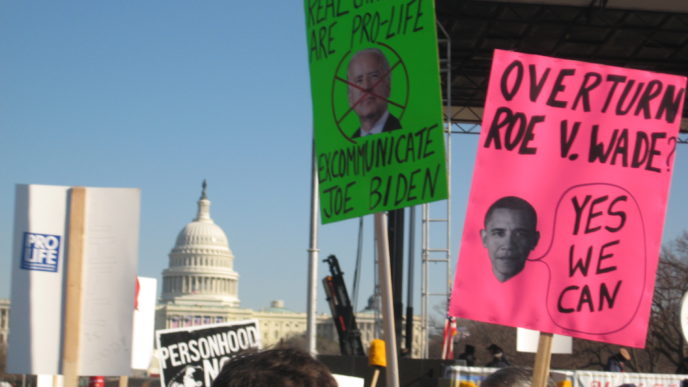
We spoke with pro-life activists participating in the recent 44th annual March for Life in Washington, D.C., who said they expect the GOP to keep its campaign promises.

(For more from the author of “Will GOP Keep Its Promise to Defund Planned Parenthood?” please click HERE)

Follow Joe Miller on Twitter HERE and Facebook HERE.

Nebraska Woman Loses Health Insurance for Fourth Time Under Obamacare

Pamela Weldin’s experiences with Obamacare can be boiled down to just a few numbers.

Since the health care law’s implementation three years ago, Weldin, 60, has lost her insurance four different times.

And the Nebraska woman is currently enrolled in her fifth new insurance policy in four years.

“Yet again, and through no fault of my own,” Weldin told The Daily Signal. “I’m just sitting here minding my own business, and here we go again.”

A former dental hygienist, Weldin has all the hallmarks of a consumer intended to benefit from the Affordable Care Act.

She has been denied coverage in the past because of a pre-existing condition related to her career as a dental hygienist.

Additionally, Weldin qualifies for a tax credit, which she has received every year since 2014.

As a result, her premiums are low when compared to consumers who don’t qualify for financial assistance: In early 2015, Weldin purchased a plan through Blue Cross and Blue Shield of Nebraska that cost her $232 each month.

This year, premiums for her silver-level plan with Medica are $161 per month after her tax credit. Without the financial assistance, her premiums would total more than $1,300 per month.

But though Weldin has benefited from aspects of the law, she hasn’t been immune to the changes in the health insurance market that have occurred in last few years.

“I’m a person who has been denied because of pre-existing conditions,” Weldin, a Pampered Chef director, said. “I’m on Obamacare and have lost my insurance four times in three years. I understand the challenges, but it’s not sustainable.”

Weldin’s Journey

Since HealthCare.gov opened for business in the fall of 2013, four policies sold by three different insurance companies—Humana, CoOportunity Health, and Blue Cross and Blue Shield of Nebraska—that Weldin purchased were ultimately terminated.

The Daily Signal previously covered her experiences with Obamacare in a February 2015 article.

But since then—when Weldin lost her insurance for a third time—she’s logged another cancellation.

First, Weldin’s initial policy with Humana, which she held for several years, was canceled in the lead-up to Obamacare’s implementation in January 2014.

The Nebraska woman then purchased a platinum-level plan for 2014 through CoOportunity Health, a consumer operated and oriented plan, or co-op. But CoOportunity Health terminated her platinum-level policy for 2015 after the co-op decided it would no longer offer those policies.

Weldin, though, decided to stick with CoOportunity Health and selected a silver-level plan for 2015.

On Jan. 23, 2015, Weldin received a notice from the co-op notifying her that it was going out of business. CoOportunity far outpaced its initial enrollment projections, and its customers racked up medical expenses that far outpaced what they paid in premiums.

Weldin had no choice but to select a new insurer and policy, and purchased coverage through Blue Cross and Blue Shield of Nebraska for the remainder of 2015 and 2016—a plan that, though a bit more expensive, allowed her to see her original doctor.

Late last year, though, Blue Cross and Blue Shield of Nebraska announced it would no longer sell coverage on the exchange in the state.

“This system is collapsing under its own weight,” Weldin said, “like the co-ops and basic companies like Blue Cross pulling out of Nebraska.”

To ensure she would be covered for 2017, Weldin went to HealthCare.gov to select a plan that allowed her to see her current doctor in Colorado.

In Nebraska, consumers on the exchange had just two insurance companies to choose from: Aetna and Medica.

A policy through Aetna was more expensive than its competitor, but because Weldin thought her doctor was considered in-network, she selected a plan through that insurer.

It wasn’t until after she paid her first month’s premium, however, that Weldin learned from the insurance company that any doctor located more than 100 miles from her rural Nebraska home wasn’t in her network.

If she wanted to see her doctor in Colorado—considered out-of-network now—Weldin had to meet a $20,000 out-of-network deductible before Aetna would start covering her medical expenses.

That information, she said, wasn’t listed on HealthCare.gov when she was shopping for plans.

“$20,000 for a deductible? Are you kidding me?” Weldin said. “How is that affordable?”

Speaking Volumes

Across the country, millions of Americans faced higher premiums heading into 2017.

And premium hikes have been well documented by The Daily Signal and others.

Less attention, however, has been paid to the number of insurers and plans available to consumers.

According to an October report from the Department of Health and Human Services, insurer participation in Nebraska decreased from four insurers in 2016 to two in 2017.

And consumers nationwide aren’t just seeing a decline in the number of insurance companies selling coverage on the exchange in their states.

The federal government reported that Americans would also see a decrease in the number of plans insurers offered in 2017.

In Nebraska, there was an average of 18 fewer plans per county available on the exchange to consumers this year. Nebraskans purchasing plans on HealthCare.gov in 2017 had 13 plans to choose from, down from 31 last year.

“That speaks volumes in terms of ultimate consumer benefits,” Rep. Adrian Smith, R-Neb., told The Daily Signal of the change in insurers selling plans in his state. “Fewer choices most often means higher prices and less quality.”

In 2015, Smith introduced a bill to exempt consumers like Weldin who purchased coverage from a failed co-op from the individual mandate. The legislation passed the House, but stalled in the Senate.

Now, Smith and other Republicans—who have spent six years talking about repealing Obamacare—are looking to check the box on a major campaign promise.

Republicans have taken the initial step toward dismantling the health care law after passing a budget resolution earlier this month, and often cite the experiences of Americans like Weldin to bolster their arguments that Obamacare needs to be repealed and replaced.

But despite their control over Congress and the White House, Republican lawmakers differ on their approaches to unwinding Obamacare.

Conservatives are urging GOP leadership to move forward with repeal as soon as possible and say they’re frustrated with the speed at which their leaders are moving to dismantle the health care law.

House Speaker Paul Ryan said last week repeal would be slated for March or April.

“I’d like to see an acceleration of the front-end repeal side,” Rep. Jim Jordan, R-Ohio, said Wednesday at a monthly gathering with reporters. “Let’s get rid of [Obamacare]. That’s what we told the voters that we were going to do.”

Jordan was joined by other Republicans who said they want to see GOP leadership move faster on Obamacare repeal.

“I, too, am frustrated with the pace,” Rep. Scott Perry, R-Pa., said Wednesday. “We need to not only be against the [Affordable Care Act] or Obamacare, which I am for a myriad of reasons … but we also, if not for political reasons, but for the reason that our constituents and America needs to know what we stand for. We should vote on something.”

But during a gathering last week of House and Senate lawmakers in Philadelphia, other Republicans showed tepid support for dismantling the law and even expressed doubts over their party’s plans to repeal and replace Obamacare.

Though the GOP agrees that the law needs to be scrapped, members haven’t yet concurred on whether to repeal major parts of Obamacare like its taxes. Many also want to see Congress move a replacement at the same time they repeal the law.

Still, Smith, the Nebraska congressman, points to Americans like Weldin as a reason why Congress needs to act.

“When you look at the overall picture, [Obamacare] has failed miserably and will continue to cause great damage,” Smith said. “That’s why we need to step in.”

“We want to prevent further pain that we know will happen if we just let Obamacare sit the way it is,” he continued.

‘Not Sustainable’

After learning about her $20,000 out-of-pocket deductible, Weldin contacted HealthCare.gov to seek assistance with purchasing another plan.

A representative there was able to enroll her in a new policy with Medica, and Weldin learned that her doctor was, in fact, included in the new plan’s network.

This year, the Nebraska woman will pay $161 per month in premiums after a tax credit.

Weldin is one of the more than 9 million Americans who receives a tax credit and has been relatively immune to the increased costs of health insurance, but she still wants to see changes made to the health care system.

“Allow us the choice of what kind of policy and coverage suits our needs,” she said. “Allow us the choice of deductible and to cross state lines for provider care so we can choose and keep our own doctors. Allow insurance companies to compete across state lines so we have more options and have more choice of providers.”

And Weldin said she recognizes that any action Republicans take on Obamacare could very well lead to further changes with her insurance and the health insurance market.

Still, she said she wants to have additional choices, even it means more coming out of her pocketbook.

“Something has to be done because this is not sustainable,” Weldin said. “I’m fine paying a little bit more if it’s what I need. But let me choose a policy that’s appropriate for my needs. Let me have a policy that’s appropriate to my medical needs. Let me choose a deductible that’s appropriate for my budget.” (For more from the author of “Nebraska Woman Loses Health Insurance for Fourth Time Under Obamacare” please click HERE)

Follow Joe Miller on Twitter HERE and Facebook HERE.

The Question the Left Won’t Answer on Abortion

If there weren’t, well, lives at stake, Democrat Rep. Eric Swalwell’s dodging of Fox News’ Tucker Carlson’s questions about whether abortion was the taking of a human life would be comical.

Just check out how often Swalwell (who is, of course, from California) dodged it in an appearance Tuesday night (transcript omits some cross chatter):

Carlson: Do you think it is the taking of a human life, abortion?

Swalwell: I think that, right now … before viability, a woman should be able to make her own decision. After viability, in the case of her own psychological health, in the case of rape or incest, she should also be able to make that decision.

Carlson: OK, but is it the taking of a human life?

Swalwell: That is a woman’s personal decision.

Carlson: OK, but what do you think? I’m not asking about the decision, I mean is it human life or not?

Swalwell: She’s terminating something that she does not want, and that’s her own choice.

Carlson: OK, but do you think it’s human life?

Swalwell: Do I think—I think, at viability, a baby … should be decided by the woman. She’s the one who has to have it.

Carlson: You brought it up, that’s why I’m pressing you, but do you think, before viability, it’s a human life or something else?

Swalwell: I think it’s not viable yet, Tucker, and courts have decided this and it’s a woman’s decision.

Carlson: You’re not going to answer my question, now or ever I suspect, but you should because it’s a basic question I think.

This is … a muddled mess of illogical thinking.

And it really gets to the gist of the abortion debate, which is this: Is the unborn baby human or not, and if not human, at what point does she become human?

Because after all, if the baby isn’t human, it’s irrelevant if women want to have abortions, just as it’s irrelevant if they want to remove tumors or a few cells or have any other number of medical procedures.

But if the baby is human … it’s horrifying that our society wouldn’t protect her life, just because she’s in a vulnerable, dependent position.

Yet this is the question over and over again that the left won’t deal with.

Maybe they won’t deal with it because it threatens their current abortion policies. After all, it’s risible to argue that a full-term baby isn’t human in the womb, and yet acquires humanity passing through the birth canal.

Yet our current laws act like that is the case. Right now, the United States is one of only seven countries in the entire world that allows abortion on demand after 20 weeks.

As President Donald Trump— who pledged during his campaign to make the late-term abortion ban the Pain-Capable Unborn Child Protection Act law—bluntly put it in one of his debates with former Secretary of State Hillary Clinton, “If you go with what Hillary is saying, in the ninth month, you can take the baby and rip the baby out of the womb of the mother just prior to the birth of the baby.”

Incidentally, that’s not a position that aligns with most Americans’ viewpoints: A mere 27 percent of Americans think that abortion should be allowed beyond the first three months, outside of rape/incest/life-of-the-mother situations, according to a January Marist poll sponsored by the Catholic organization Knights of Columbus.

It’s not surprising that Americans aren’t comfortable with abortion during all nine months. The increasingly prevalence of ultrasounds has made seeing unborn babies much more vivid than it was in decades past.

And the age at which unborn babies are viable is steadily lowering: In 2011, a baby born at 21 weeks survived in Germany, according to Time.

There’s no doubt that women who face unexpected pregnancies, particularly women in difficult circumstances, have a tough situation. There’s much as a culture that we can—and should—do to help support these women, whether it’s helping them financially or emotionally or in other ways. Thankfully, there are private organizations across the country that do just that—and deserve our support.

It’s irrelevant what the courts think about when life becomes human. It’s irrelevant what abortion activists think about when life becomes human.

What is relevant is science—which tells us that an unborn child has her own unique DNA at the moment of conception.

If Swalwell doesn’t think unborn babies are human, he should say that (and be ready to explain why having your own unique DNA and being able to grow into an adult human aren’t signs of being human).

But if he does think that unborn babies are human or are human at the time they are viable, he should realize it’s time to demand justice for those babies and their right to life, no matter how tragic the circumstances in which their lives began.

Nor is it just Swalwell who refuses to take this question seriously. When House Minority Leader Nancy Pelosi, D-Calif., was asked a similar line of questions in 2015, she refused to answer:

CNS News: In reference to funding for Planned Parenthood: Is an unborn baby with a human heart and a human liver a human being?

Pelosi: Why don’t you take your ideological questions—I don’t, I don’t have—

CNS News: If it’s not a human being, what species is it?

Pelosi: No, listen, I want to say something to you. I don’t know who you are and you’re welcome to be here, freedom of this press. I am a devout practicing Catholic, a mother of five children. When my baby was born, my fifth child, my oldest child was six years old. I think I know more about this subject than you, with all due respect.

CNS News: So it’s not a human being, then?

Pelosi: And I do not intend to respond to your questions, which have no basis in what public policy is that we do here.

If you’re going to make public policy about who lives and dies, it’s relevant who is human and who’s not. Sadly, that doesn’t seem to be something many on the left agree with. (For more from the author of “The Question the Left Won’t Answer on Abortion” please click HERE)

Follow Joe Miller on Twitter HERE and Facebook HERE.

Trump Taps Evangelist Jerry Falwell Jr. To Lead Higher Education Task Force

President Donald Trump has tapped Liberty University President Jerry Falwell Jr. to lead a White House task force on improving higher education.

Falwell, one of the country’s most prominent evangelical leaders, endorsed Trump in January 2016, just days before the Iowa caucuses, which were the first votes cast in the presidential election cycle.

His support led Trump to victory in the Republican primary and the general election, with 80 percent of white evangelicals choosing for president the GOP leader last November.

Now, NBC News is reporting that Falwell will play an official role in the Trump White House.
The Liberty University president will specifically look at ‘overregulation and micromanagement of higher education,’ according to university spookesman Len Stevens. (Read more from “Trump Taps Evangelist Jerry Falwell Jr. To Lead Higher Education Task Force” HERE)

Follow Joe Miller on Twitter HERE and Facebook HERE.

Alaskan Pro-Life Advocates to Protest Federal Funding of Planned Parenthood on Feb. 11

In an effort to remove federal funding from the nation’s largest abortion chain pro-life advocates are planning “Defund Planned Parenthood” rallies in Alaska and across the country.

On Feb. 11 rallies will be held at Planned Parenthood locations throughout the United States, including in Anchorage.

“The time has come to defund America’s abortion giant!” said Patrick Martin, outreach director for Alaska Right To Life. “Planned Parenthood is the nation’s largest abortion chain, killing over 300,000 babies each year, and nearly half of their billion dollar budget comes from our tax dollars.

More than 60 pro-life organizations are supporting and participating in the rallies in an effort to encourage Congress to defund Planned Parenthood in its upcoming 2017 budget.

A budget without Planned Parenthood funding was sent to the president’s desk last year, and though President Obama vetoed it, pro-life advocates are hoping for a different outcome under newly elected President Donald Trump.

With Planned Parenthood actively pressuring lawmakers to oppose defunding the organization, pro-life leaders are hoping to show strong grassroots support for the defunding effort.

In Anchorage, the rally will take place Saturday, Feb. 11, beginning at 9 a.m. at the Planned Parenthood abortion clinic located at 4001 Lake Otis Drive.

Martin said the Anchorage rally will be “positive and family friendly” and participants “protest and pray for an end to Planned Parenthood’s massive government subsidy, and an end to abortion in our country.”

Pro-Life Action League and 40 Days for Life are spearheading the national effort and local pro-life leaders throughout the country such as Alaska Right to Life have responded on the grassroots level.

“The message of the February 11 national rally isn’t just to demand an end to all federal defunding of Planned Parenthood, which comprises roughly 40 percent of their annual $1 billion budget,” states the website of Pro-life Action League. “We’re also calling for those funds to be redirected to Federal Qualified Health Centers that provide a far wide spectrum of services to women without killing children through abortion.”

If Planned Parenthood were to lose its federal funds it “would send the organization into a major crisis, possibly requiring them to begin shutting down locations within months, and crippling their ability to oppose pro-life legislation,” the website adds. “The goal of the February 11 ‘Defund Planned Parenthood’ rally is to help speed that day.

A vote on the defunding language is expected in Congress by the end of February. (For more from the author of “Alaskan Pro-Life Advocates to Protest Federal Funding of Planned Parenthood on Feb. 11” please click HERE)

Follow Joe Miller on Twitter HERE and Facebook HERE.
A Few Facts About SCOTUS Pick Neil Gorsuch’s Religion

Judge Neil Gorsuch has been nominated to fill Antonin Scalia’s seat on the Supreme Court. Here are a few facts about his religious history and commitments, including positions important to religious conservatives.

1) Neil Gorsuch attended a Catholic school, the exclusive Georgetown Preparatory School, while his mother Anne served as head of the EPA under President Reagan. The school is run by the Jesuit order. He was student body president his senior year and graduated in 1985. The school makes a point of noting that it was founded the same year as the Supreme Court was established.

He studied at Oxford under the Catholic philosopher John Finnis. Finnis is one of the world’s leading Natural Law thinkers. One of Finnis’s other students, Princeton professor Robert P. George, wrote on his Facebook page that “Judge Gorsuch, whom I know well, is a faithful constitutionalist and extraordinarily well-qualified. President Trump could not have done better. Kudos to him.” Before the nomination, George had written, “He would be a superb Supreme Court justice. He is intellectually extremely gifted and is deeply committed to the (actual) Constitution and the rule of law. He will not manufacture ‘rights’ or read things into the Constitution that aren’t there or read things out of the Constitution that are.”

2) He’ll be the only Protestant on the court. He now attends St. John’s Episcopal Church in Boulder City, Colorado, where his daughters served as acolytes. The church describes itself as “an inclusive, Christ-centered community reaching out to all who are seeking a deeper spirituality and relationship with God and one another.” It has a woman pastor.

3) He opposes the legalization of euthanasia, as he wrote in his book The Future of Assisted Suicide and Euthanasia. Princeton University Press published the book in 2009. Two of the nation’s leading Catholic bioethicists, Princeton’s Robert P. George and Georgetown’s John Keown, praised it.

However, as the Southern Baptist’s Ethics and Religious Liberty Commission noted, “during his confirmation hearing [for the Tenth Circuit] he said he would follow the law rather than personal convictions, and that in his writings he has largely defended existing precedent in these areas.” As one constitutional scholar described Gorsuch’s views:

[He] believes that “any State’s decision to legalize assisted suicide would likely bring with it both benefits and some attendant costs, and, accordingly, the legalization question presents a difficult moral and legal choice.” … In his book, Gorsuch elaborates on these ideas, proposing as a guiding principle the intrinsic value of human life and arguing that “to act intentionally against life is to suggest that its value rests only on its transient instrumental usefulness for other ends.” He suggests a standard that would leave room for patient autonomy while not allowing intentional killing.

4) Gorsuch is taken to be an opponent of abortion, though he’s never written a court decision on the matter. He wrote in his book that “All human beings are intrinsically valuable and the intentional taking of human life by private persons is always wrong.” Also, “To act intentionally against life is to suggest that its value rests only on its transient instrumental usefulness for other ends.” And also:

It is simply not acceptable when we are deciding who is and is not treated as fully human…. It is incompatible with the promise of equal justice under law that any of us should feel at liberty to sit in judgement to decide who is and who is not entitled to the benefits of that promise.

In a footnote to the book, he argued that “Abortion would be ruled out by the inviolability-of-life principle I intend to set forth.” He noted that this depended on another belief. It would be true “if, and only if, a fetus is considered a human life. The Supreme Court in Roe v. Wade, however, unequivocally held that a fetus is not a ‘person’ for purposes of constitutional law.” Observers believe he would find that the fetus is a person.

His one judicial encounter with the issue came in Planned Parenthood of Utah v. Herbert. “Last October,” writes constitutional expert Ed Whelan of the Ethics and Public Policy Center, Gorsuch “dissented strenuously” when the court left standing a order keeping funds going to Planned Parenthood and over-rode the governor’s directive. “Gorsuch faulted the panel for failing to accord the appropriate degree of deference to the district court’s factual findings and for making its own bizarre inferences about the governor’s reasons for acting.”

A negative testimony to his position is NARAL’s reaction. The formerly named National Abortion Rights Action League tweeted, “We will fight hard, we will fight back, and we will #RESIST Neil Gorsuch & Trump’s extreme #antichoice agenda! #StopGorsuch”.

5) He’s an advocate of religious freedom and tolerance. He wrote in his book that “The law … doesn’t just apply to protect popular religious beliefs: it does perhaps its most important work in protecting unpopular religious beliefs, vindicating this nation’s long-held aspiration to serve as a refuge of religious tolerance.”

Gorsuch has “an especially strong record” on this subject, writes Whelan. In 2013, Gorsuch supported Hobby Lobby against the Obamacare mandate to provide conception, a decision upheld by the Supreme Court. Two years later, he supported the Little Sisters of the Poor, an organization of Catholic nuns, against similar requirements.

He “has also written or joined opinions — again, largely vindicated by the Supreme Court — that have criticized doctrines that limit religious expression in public spaces,” writes another legal scholar, Eric Citron, on the SCOTUSblog.

The common thread in these cases is one that matters very deeply to conservatives: a sense that the government can permit public displays of religion – and can accommodate deeply held religious views – without either violating the religion clauses of the Constitution or destroying the effectiveness of government programs that occasionally run into religious objections. In his 2009 concurrence in Pleasant Grove City, Utah v. Summum, Scalia articulated very similar views.

6) Gorsuch is intellectually independent. He’s willing “to rethink constitutional principles from the ground up,” says Jeffrey Rosen of the National Constitution Center, quoted by Politico. “Like Justice Scalia, he sometimes reaches results that favor liberals when he thinks the history or text of the Constitution or the law require it, especially in areas like criminal law or the rights of religious minorities, but unlike Scalia he’s less willing to defer to regulations and might be more willing to second-guess Trump’s regulatory decision.”

7) He loves his wife Louise and two daughters, Emma and Belinda. He dedicated his book to them with the words “Finally, and borrowing in part from P.G. Wodehouse, I thank my wife, Louise, and my daughters, Emma and Belinda, without whose constant love and attention this book would’ve been finished in half the time — but without whom life wouldn’t been half as fully lived.” (For more from the author of “A Few Facts About SCOTUS Pick Neil Gorsuch’s Religion” please click HERE)

Follow Joe Miller on Twitter HERE and Facebook HERE.

OUTRAGE: Doctor Has Family Members Hold Grandma down in Horrific Euthanasia Case

A Dutch woman doctor who asked an elderly patient’s family to hold her down while she administered a fatal drug dose has been cleared under Holland’s euthanasia laws.

Mailonline reported that the patient fought desperately in an attempt not to be killed.

Jacob Kohnstamm, chairman of the Regional Review Committee, which considered the case, said: “I am convinced that the doctor acted in good faith, and we would like to see more clarity on how such cases are handled in the future.”

As a result, the case will be considered by Dutch courts to clarify the law over whether doctors who carry out euthanasia on patients with dementia should face prosecution if they acted in good faith . . .

In this case, the woman, who was suffering from dementia, had earlier expressed a desire to have her life ended when she felt the “time was right”. (Read more from “OUTRAGE: Doctor Has Family Members Hold Grandma down in Horrific Euthanasia Case” HERE)

Follow Joe Miller on Twitter HERE and Facebook HERE.

Is There an Anti-Vaccine Shadow Network?

In the wake of Robert F. Kennedy Jr. telling reporters that President Trump asked him to chair a commission on vaccine safety and scientific integrity, the media is angling to shame and ridicule vaccine safety and informed consent proponents, be they physicians, scientists or parents with the ability to read and think for themselves.

Although Kennedy’s appointment has not been confirmed yet by the Trump administration, The Atlantic has gone so far as to suggest that a “shadow network of anti-vax doctors” is being emboldened by questions and concerns the new president has voiced about vaccine safety.

Like Kennedy and many other critics of vaccine science and policy, President Trump has been outspoken about his suspicions that vaccines and vaccine policies may not be nearly as safe as they’re portrayed, and that the science is far from settled.

Meanwhile, Kennedy recently co-wrote an article in which he released documents revealing that officials at the Food and Drug Administration (FDA) and Centers for Disease Control and Prevention (CDC) “knew that infant vaccines were exposing American children to mercury far in excess of all federal safety guidelines since 1999.”

Recent reports also reveal that medical treatment guidelines are frequently influenced by drug industry ties, and scientific “citation cartels” are gaming the system by repeatedly citing each other’s work, thereby making their studies appear more noteworthy and establishing what amounts to a false base of research that becomes difficult to overturn by independent researchers. (Read more from “Is There an Anti-Vaccine Shadow Network?” HERE)

Follow Joe Miller on Twitter HERE and Facebook HERE.

Now Is the Time to Defund Planned Parenthood

“Life is winning in America,” declared Vice President Mike Pence last week as he spoke to the countless thousands of Americans assembled on the National Mall for the annual March for Life.

Pence’s presence at the rally was itself evidence of the momentum behind the pro-life movement in America. Last week marked the March for Life’s 44th consecutive year, but it was the first time that a government official as high ranking as the vice president attended in person to speak to the crowd.

This timing of the vice president’s attendance was fitting, as it came on the heels of President Donald Trump’s momentous decision earlier in the week to reinstate the Mexico City policy, which prevents American taxpayers from financing international organizations that perform or promote abortions abroad.

Established in 1984 by President Ronald Reagan, the Mexico City policy was revoked by President Barack Obama and then, in one of his first major actions after taking the oath of office, restored by Trump.

To account for the shifting landscape of today’s global health and foreign aid environment, Trump’s executive order also modernized the Mexico City policy to ensure that it applies to other U.S. foreign aid funding sources beyond simply the U.S. Agency for International Development family planning account.

But despite these successes and reasons for optimism, there is still more work to do.

Life may be winning in America, but it has not yet won. And it won’t ever win so long as the United States Congress permits a dime of taxpayer money to flow to the abortion giant Planned Parenthood.

Planned Parenthood doesn’t just lead the abortion business in America—it performed nearly 1 million abortions between 2011 and 2013—but abortions lead Planned Parenthood.

Of the “pregnancy services” offered by the organization, 94 percent are abortions, according to its 2013-2014 annual report, while prenatal care and adoption referrals account for only 5 percent and 0.5 percent, respectively.

And what does this horrifying business model earn Planned Parenthood from the federal government? More than $520 million every year in taxpayer-funded subsidies.

This is indefensible and it must stop. Luckily, Congress will have an opportunity in the next several weeks to end federal funding for Planned Parenthood and transfer its subsidies to other women’s and community health clinics.

When the House and Senate vote to repeal Obamacare, as Republican leaders from both chambers have committed to do, we can attach a provision that would eliminate all taxpayer funding of Planned Parenthood.

The privileged status of the Obamacare repeal measure, which requires only 51 votes to pass the Senate, presents a unique opportunity for Congress, once and for all, to revoke Planned Parenthood’s lavish government subsidies, which have long been a stain on our nation’s great history.

With last week’s March for Life as our inspiration, I can think of no better reason for Congress to move swiftly and boldly to repeal Obamacare as soon as possible. (For more from the author of “Now Is the Time to Defund Planned Parenthood” please click HERE)

Follow Joe Miller on Twitter HERE and Facebook HERE.

For the Dignity and Worth of Every Person

Forgive me, as I’m feeling dizzy and disoriented by the events of the last week.

On Friday I heard Vice President Mike Pence give a beautiful speech at the March For Life, inspiring pro-lifers with the hope that “life is winning” and painting an image of the movement as one for compassion and gentleness:

But as it is written, ‘Let your gentleness be evident to all.’ Let this movement be known for love, not anger. Let this movement be known for compassion, not confrontation. When it comes to matters of the heart, there is nothing stronger than gentleness.

I believe that we will continue to win the hearts and minds of the rising generation if our hearts first break for young mothers and their unborn children, and if we each of us do all we can to meet them where they are, with generosity, not judgment.

To heal our land and restore a culture of life we must continue to be a movement that embraces all, cares for all, and shows respect for the dignity and worth of every person.

Every person there knew the sincerity of the Vice President’s words. I spoke with many Trump supporters that day, but also with Trump skeptics who were nonetheless encouraged by Pence’s speech. The pro-life movement is about caring for the least of these, the most vulnerable members of society, those orphaned and widowed by a culture of convenience. Hearing gentleness and compassion championed as the way forward was a fulfilling moment for those of us who have been working with joy for the right to life.

It’s that same joy, compassion and gentleness that I find in my friends who not only march for life every year and volunteer in pregnancy centers but work for persecuted Christians and refugees. As the Vice President says, in the movement for life we “embrace all, care for all, and show respect for the dignity and worth of every person.”

This is why I was not surprised when the same friends who marched with me on Friday asked me to join them at the Dulles airport on Saturday to support the people detained under President Trump’s travel ban.

To Dulles, With Love

We were alerted to the situation not by a hysterical liberal media (that came later) but by a friend (we’ll call him Alex) who was recently granted asylee status. His lawyers were the same lawyers working on behalf of the detainees, and Alex was asked to come and translate the legal documents for them.

Often when I talk about the importance of standing up for the preborn, I get asked about how I got started caring about the issue. For many of us in the pro-life movement, there is a story about how abortion has affected us, about people we have loved and loss we have experienced. One of the reasons the younger generation is more pro-life is that we have lived our lives in a post-Roe world: We see and know the consequences of abortion. We also are confronted with the humanity of the child in the womb with the advent of the sonogram and the definitive moment of the heartbeat.

Philosopher J. Budziszewski says there are some things we can’t not know, foundational principles of right and wrong that are written on every human heart. The worth and dignity of every human life, as Vice President Pence said, is one of those things.

Honoring the worth and dignity of every human life involves welcoming the immigrant even as we secure American borders and keep people safe. I would never argue that we should stop screening altogether, and my bleeding-heart conservatism is thankful for the measures that keep Americans safe. But when I learned that a Syrian Christian family who made it to the Philadelphia airport only to be turned around and sent back, I wept. When Alex asked me and my friends to come to the airport and support the people being detained, I went.

Knowing Alex means I know someone who has survived persecution and who has endured more than I can imagine, first putting his life on the line as a military interpreter for the sake of American troops in Iraq, then losing his home and his family for the sake of Jesus Christ.

On Saturday, our tribe of evangelical and Catholic friends prayed as we heard that Customs and Border Protection (CPB) was defying the federal court order to allow the detained travelers (including some green card holders) to see their lawyers. We watched and waited as a few were released and reunited with their families, the numbers slowly moving from 60 detained to 22.

On Sunday we went back home for church and rest and prayer, and Alex was asked to return to Dulles to do more translation work. Then his lawyer called him in a panic, telling him to stay away because of the risk that non-US citizens would be arrested and the complications this could cause Alex’s immigration status.

My friend, who has given America much, is not the only one. The executive order is so broad that it threatens other military interpreters who would otherwise be finding refuge in the nation they have served. Because this executive order is sloppy and not well implemented, we have confusion and chaos that will likely and needlessly cost human lives as refugees are sent back to face persecution, starvation and possible assassination.

I am grateful to God for the witness of Vice President Pence at the March For Life, and I take him at his word: We should be known for our gentleness and the value we place on every human life. May God help us make this a reality, not only for those vulnerable in the womb, but also for those vulnerable on our borders. (For more from the author of “For the Dignity and Worth of Every Person” please click HERE)

Follow Joe Miller on Twitter HERE and Facebook HERE.