Legal Experts Weigh in on Trump’s Right to Be Riled at Sessions, DOJ

Jeff Sessions will likely continue to lead the Department of Justice, despite the public clash between President Donald Trump and his choice for attorney general.

But Trump’s frustration with the direction of the Russian probe and the special prosecutor are understandable, said Tom Fitton, president of Judicial Watch, a government watchdog group.

“Sessions should un-recuse himself and get rid of [special counsel Robert] Mueller,” Fitton told The Daily Signal. “This is a political effort to jail the president and his family because people don’t like him.”

Trump told The New York Times that he regrets tapping Sessions for attorney general since Sessions recused himself from the investigation into Russian interference into the 2016 presidential campaign. Trump called Sessions’ decision to recuse himself from the case “unfair to the president.”

It was the recusal that eventually led to the Justice Department appointment of Mueller, who has reportedly expanded the investigation beyond Russia’s role in the 2016 presidential campaign and into Trump’s past business dealings. Furthermore, Mueller has staffed up with Democratic donors.

“To be fair to Sessions, I think he believed he was recusing himself from a very limited set of circumstances,” Fitton said. “He was a bit naïve because that is not the way to approach it. You can’t have an attorney general that is unable to manage the largest case known to the public that is going on in the Justice Department. Now they have moved beyond Russia and are investigating everything.”

Trump, in an interview with the Times, said:

Jeff Sessions takes the job, gets into the job, recuses himself, which frankly I think is very unfair to the president … How do you take a job and then recuse yourself? If he would have recused himself before the job, I would have said, ‘Thanks, Jeff, but I’m not going to take you.’ It’s extremely unfair—and that’s a mild word—to the president.

During a press conference Thursday where Sessions wanted to talk cybersecurity, the only questions were about Trump’s comment. The attorney general responded, “I plan to continue to do so as long as that is appropriate.”

White House deputy press secretary Sarah Huckabee Sanders told reporters Thursday the president doesn’t plan on pushing Sessions out.

“As the president said yesterday, he was disappointed in Attorney General Sessions’ decision to recuse himself. But clearly he has confidence in him or he would not be attorney general.”

Pressed further if Trump wants Sessions to resign, Sanders responded, “I think you know this president well enough to know that if he wanted somebody to take an action, he would make that quite clear.”

Sessions had little choice but to recuse himself in the matter, argued Matthew Whitaker, a former U.S. attorney for the Southern District of Iowa.

“My understanding of the DOJ policy is that he needed to recuse himself from the investigation because he was part of the campaign,” Whitaker told The Daily Signal.

Whitaker, president of the Foundation for Accountability and Civic Trust, a government watchdog group, said Trump’s comments shouldn’t interfere with the Russian investigation.

“This just confirms rumors we’ve been hearing for the last several months,” he said. “The president just had a forum and a venue to share his feelings. It’s unfortunate, but it won’t have any bearing on the important work of the DOJ. The remarks will pass.”

During his March announcement, Sessions said:

During the course of the last several weeks, I have met with the relevant senior career department officials to discuss whether I should recuse myself from any matters arising from the campaigns for president of the United States. Having concluded those meetings today, I have decided to recuse myself from any existing or future investigations of any matters related in any way to the campaigns for president of the United States.

However, in lieu of a finite charge, Sessions could have delayed recusal and would be on solid legal ground, contends Ken Boehm, chairman of the National Legal and Policy Center, a government watchdog group.

“Jeff Sessions could have said to Trump, ‘If asked, I would recuse myself,” Boehm told The Daily Signal. “I think the world of Jeff Sessions. I think he’s a good man. But, if you look at every other incident, people in positions at Justice in the past administration wouldn’t do it because they would fear a fishing expedition. Before Sessions recused himself, he should have called for an actual crime, a statute. He would have been on firm legal ground.” (For more from the author of “Legal Experts Weigh in on Trump’s Right to Be Riled at Sessions, DOJ” please click HERE)

Follow Joe Miller on Twitter HERE and Facebook HERE.

Republicans Just Made Tax Reform More Difficult

This week, the House Budget Committee released its long-awaited budget. It makes progress in some areas, and falls short in others.

One of the places it falls short is in facilitating tax reform.

By all accounts, tax reform will be difficult. True tax reform that simplifies the tax code while making important reforms to enable greater economic growth must also take on the difficult task of taking away special tax privileges that benefit well-organized special interests.

The proposed budget includes reconciliation instructions that allow Congress to fast-track reform in the Senate, limiting debate and lowering the necessary vote threshold to a simple majority, instead of requiring 60 votes.

However, the budget sets tax reform up to be revenue-neutral, which makes tax reform a Herculean task. The budget does provide room for repeal of the Obamacare taxes, but the revenue-neutral constraint on the remaining effort for tax reform is problematic for several reasons.

First, revenue is not the problem.

Over the next 10 years, the Congressional Budget Office’s projected baseline revenues are set to grow as a percentage of gross domestic product from the current 17.6 to 18.4. At the end of the 10-year budget window, revenues will be a full percentage point above historical averages.

I will say it again—revenue is not the problem. Spending is the problem. The budget proposal instructs the committees to find $203 billion in mandatory savings, but these reforms are only a small piece of the necessary cuts to truly reform our long-term fiscal problems.

Sustainable, long-term tax reform should be deficit-neutral in reconciliation, allowing Congress to adjust both spending and taxes to alleviate the pressure for future tax hikes from rising deficits. Congress must reform the programs that our tax dollars fund.

Second, the revenue-neutral constraint forces Congress to make a false choice between not doing tax reform at all, and tax reform that is tied to new revenue raisers.

The search for additional new sources of revenue has already led policymakers down several unfortunate paths. Carbon taxes, value added taxes, and international minimum taxes have all been proposed as revenue raisers tied to otherwise pro-growth tax reforms.

The most prominent example of a new and possibly destructive source of additional revenue is the proposed border adjustment tax.

Third, revenue-neutrality may be difficult to accomplish, even if harmful revenue raisers are included.

It is unclear if the current House tax reform blueprint, which includes about a trillion dollars from the border adjustment tax, will be scored as revenue-neutral.

Some dynamic analyses—analyses that take economic feedback into account—have shown the House plan to be revenue-neutral. However, others, whose modeling is probably more consistent with how congressional scorekeepers will likely look at the reforms, show the plan will lose around $3 trillion in revenues over 10 years.

The true economic impact will be more pronounced than the projections of congressional scorekeepers, but unless Congress is willing to take unprecedented actions to use outside revenue analysis—which is not prohibited—they will have to work within the constraints of the scores they are given by their internal referees.

Lastly, the proposed budget continues the tradition of using a current law rather than a current policy baseline.

Using a current policy baseline, which basically assumes the status quo will continue, would have made tax reform easier by assuming a revenue target of about $460 billion less.

Instead, the continued use of the current law baseline follows the letter of the law, which does not take into account the current policy of regularly extending many expiring provisions.

There are competing reasons to use one baseline over the other, but the use of current law as a benchmark certainly makes tax reform more difficult.

The proposed budget does provide about $1 trillion for the repeal of Obamacare taxes. This is an improvement over past budgets that have not included the repeal of these destructive taxes.

However, the repeal of the Obamacare taxes is only a small piece of tax reform. True reform will require additional room to work.

The rules of reconciliation require deficit neutrality outside the 10-year budget window—not revenue neutrality—and there are many options for pro-growth tax reform that include both spending restraint and economically desirable base broadeners that remove current tax preferences and raise additional revenue.

The budget could use a longer budget window to allow for more gradual spending reforms and additional tax savings. It is also not necessary to outline specific spending cuts this year.

Congress could impose an automatic mandatory sequester to limit the growth of government spending and meet reconciliation’s constraints, allowing more time to review spending reforms in a process separate from the tax reform debate.

On the revenue side, there are more than $3 trillion of base broadeners that are not included in the House tax reform blueprint that Congress should consider including in its reform.

Pro-growth tax reform that provides relief for American families and businesses must continue to be the centerpiece of Congress’ agenda going forward. The House Budget Committee’s proposed budget makes that task considerably more difficult. (For more from the author of “Republicans Just Made Tax Reform More Difficult” please click HERE)

Follow Joe Miller on Twitter HERE and Facebook HERE.
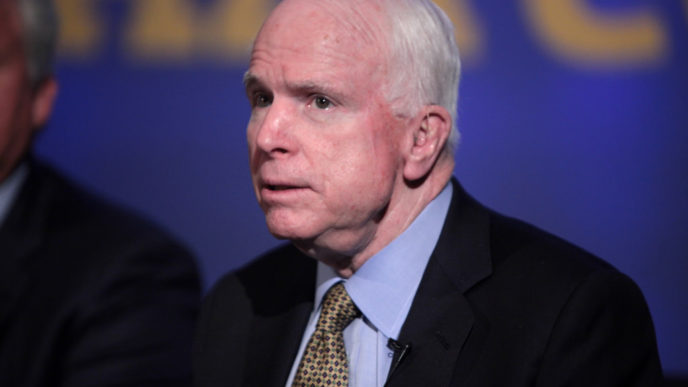
McCain Vows: ‘I’ll Be Back Soon’

Sen. John McCain used his signature snark on Thursday to warn colleagues that he will be returning soon to Washington — and chastised the Trump administration for ending assistance to moderate Syrian rebels battling the government of Bashar al-Assad.

The twin statements served as reminders of the outsized role the 80-year old senator plays on Capitol Hill. Republicans badly need him to return as they try to shore up a weeks-long debate on a health-care overhaul. And he has been more willing than most Republicans to buck his party and the president to demand more decisive action to bolster the nation’s security, particularly in areas involving the country’s cyber defenses and posture against Russia.

McCain announced late Wednesday that he has been diagnosed with a tumor called a glioblastoma after surgery to remove a blood clot above his left eye last week. The tumor is an aggressive type of brain cancer, and the prognosis is generally poor.

The news sparked bipartisan calls for his swift return and public statements of support from Trump and his predecessors. Former president George W. Bush said on Thursday that he phoned his 2000 GOP presidential campaign rival to “encourage him in his fight.” (Read more from “McCain Vows: ‘I’ll Be Back Soon'” HERE)

Follow Joe Miller on Twitter HERE and Facebook HERE.
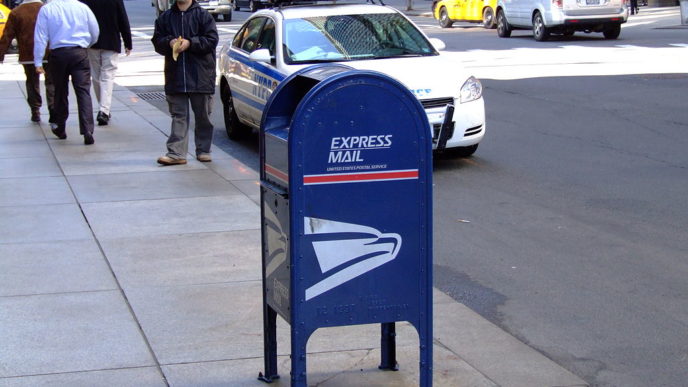
US Postal Service Breaks Election Laws to Support Hillary, Media Silent

The big three networks ignored a report Wednesday uncovering violations of federal law committed by the U.S. Postal Service, which pressured managers to approve time off for employees to campaign for former Secretary of State Hillary Clinton and other Democrats.

“High-level postal officials had for years granted employees’ requests for unpaid leave, leading last year to an ‘institutional bias’ in favor of Clinton and other Democrats endorsed by the National Association of Letter Carriers, one of the largest postal unions” amounting to a violation of the Hatch Act, reports The Washington Post.

The Hatch Act is a law enacted in 1939 to prevent federal employees from supporting candidates. Investigators concluded that the postal service had been involved in the process since the 1990s.

“You kind of have to scratch your head when you have such systemic violations of the Hatch Act and nobody’s really held accountable,” Republican Sen. Ron Johnson of Wisconsin told WaPo. (Read more from “US Postal Service Breaks Election Laws to Support Hillary, Media Silent” HERE)

Follow Joe Miller on Twitter HERE and Facebook HERE.
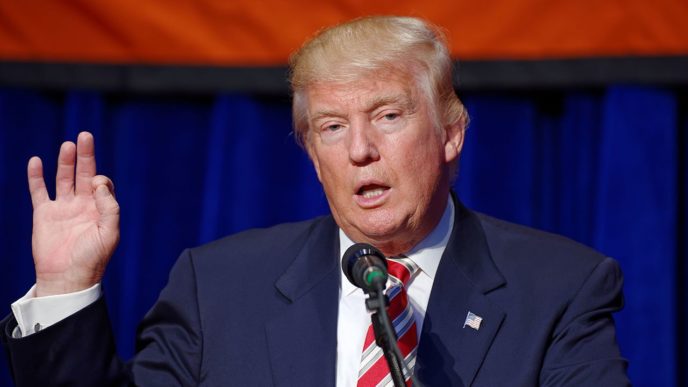
Spokesman for Trump’s Legal Team Abruptly Resigns

Mark Corallo, the spokesman for President Trump’s independent legal team, resigned his position on Thursday, according to several reports.

Corallo’s resignation comes as Trump’s legal staff ramps up a campaign to discredit Special Counsel Robert Mueller, who has expanded the scope of his investigation of Trumpworld in recent weeks.

What began as an investigation into potential collusion between members of the Trump campaign and Russian government has broadened to include a look at Trump’s businesses and those of his family members and other associates, including former campaign chairman Paul Manafort.

According to reports from The New York Times and The Washington Post, Trump’s Russia-related legal staff, which is separate from White House counsel, has been looking for ways to discredit Mueller and his staff of lawyers and investigators. Many of the lawyers hired by Mueller have donated to Democratic politicians, including Hillary Clinton. (Read more from “Spokesman for Trump’s Legal Team Abruptly Resigns” HERE)

Follow Joe Miller on Twitter HERE and Facebook HERE.

Democrats’ New Slogan Might Be a Blatant Pizza Chain Rip-Off

The Democrat Party is still struggling with its messaging, now releasing a slogan that sounds awfully similar to Papa John’s Pizza.

According to Jeff Stein, a reporter with Vox, the new Democrat slogan will be “A Better Deal: Better Skills, Better Jobs, Better Wages.”

Stein reports that the slogan idea took the Democrats months of “polling and internal deliberations.”

The Papa John’s Pizza slogan is “Better Ingredients. Better Pizza.”

Twitter had a field day with the new Democratic messaging campaign.

(Read more from “Democrats’ New Slogan Might Be a Blatant Pizza Chain Rip-Off” HERE)

Follow Joe Miller on Twitter HERE and Facebook HERE.
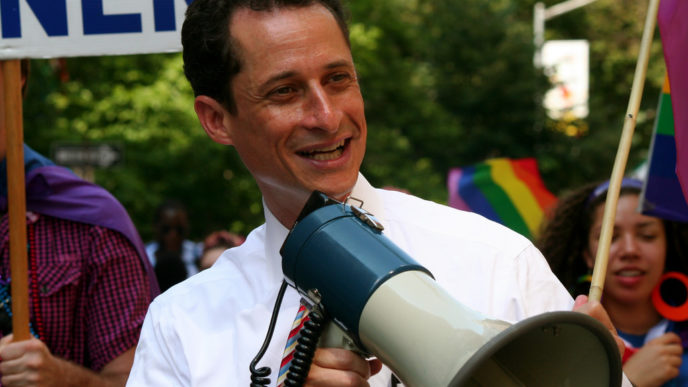
FBI Turns Over 7,000 Documents From Weiner’s Laptop

The FBI has turned over 7,000 new documents from Anthony Weiner’s private laptop to the State Department as part of a watchdog group’s lawsuit related to last year’s Hillary Clinton email case.

Judicial Watch and State Department representatives appeared in federal court in Washington, D.C., on Thursday over the group’s Freedom of Information Act suit seeking Clinton emails from her tenure at the State Department.

It emerged during the hearing that the 7,000 new documents were turned over. The trove is expected to contain some emails sent by Weiner’s estranged wife, Clinton aide Huma Abedin.

Judicial Watch President Tom Fitton told Fox News after the hearing that they expect to begin receiving those documents in three months, once the State Department determines whether the Weiner documents are government or personal records.

The State Department was ordered in November to turn over 500 pages of Clinton-related documents a month to Judicial Watch. (Read more from “FBI Turns Over 7,000 Documents From Weiner’s Laptop” HERE)

Follow Joe Miller on Twitter HERE and Facebook HERE.

O.J. Simpson Granted Parole

O.J. Simpson was granted parole Thursday after more than eight years in prison for a Las Vegas hotel heist, successfully making his case in a nationally televised hearing that reflected America’s enduring fascination with the former football star.

With the ruling, the 70-year-old Simpson, who was convicted in 2008 of an armed robbery involving two sports memorabilia dealers in a Las Vegas hotel room, could be out of prison as early as Oct. 1 after serving the minimum nine years of a 33-year sentence.

When the final vote to grant parole was read after parole commissioners deliberated just over 30 minutes, Simpson lowered his head and then raised it up with a big smile . . .

All four parole commissioners cited his lack of a prior conviction, the low risk he might commit another crime, his community support and his release plans, which include moving to Florida. (Read more from “O.J. Simpson Granted Parole” HERE)

Follow Joe Miller on Twitter HERE and Facebook HERE.

Creepy New ‘Smart Toys’ Allow Pedophiles to Track and Talk Directly to Kids

A particularly ominous warning was put out by the FBI’s Internet Crime Complaint Center this week alerting people to the potential dangers Internet-connected toys pose to adults and children alike. Not only do these ‘spy toys’ have the potential to record kids’ conversations, track their movements, reveal their location — they even allow perverts to TALK to children directly.

The alert, titled: CONSUMER NOTICE: INTERNET-CONNECTED TOYS COULD PRESENT PRIVACY AND CONTACT CONCERNS FOR CHILDREN, warns users of the security risks and vulnerabilities posed by this new line of smart toys that connect via WiFi or Bluetooth to your home network.

The toys, according to the warning, typically contain sensors, microphones, cameras, data storage components, and other multimedia capabilities – including speech recognition and GPS options.

According to the FBI, “microphones could record and collect conversations within earshot of the device. Information such as the child’s name, school, likes and dislikes, and activities may be disclosed through normal conversation with the toy or in the surrounding environment. The collection of a child’s personal information combined with a toy’s ability to connect to the Internet or other devices raises concerns for privacy and physical safety.”

Given how easily children give out their information — especially considering they think they are engaging with a harmless toy — the implications for abuse from criminal and government actors are damning.

The deliberate or accidental vulnerabilities inside these toys present a unique opportunity for sickos who want to spy on or otherwise engage in conversation with unsuspecting children.

According to the FBI, these “devices could pose a risk for unauthorized access to the toy and allow communications with a child user.”

In other words, pedophiles could access these toys and talk to children, potentially luring them out of the home and into the arms of their attacker. Given the fact that many of these spy toys use GPS, the predators would easily be able to locate their victim.

However, it’s not just children that are unprotected, these toys are vulnerable to exploits which could allow hackers access to the microphone and cameras — essentially allowing for unauthorized surveillance of their unwitting victims. These exploits would then pave the way for identity theft, bank fraud, or even violent crimes against adults and children alike.

The FBI notes that “Security safeguards for these toys can be overlooked in the rush to market them and to make them easy to use.

“Consumers should perform online research of these products for any known issues that have been identified by security researchers or in consumer reports,” the FBI recommended.

Even if you do all your research and pick out the safest spy toys on the market, however, the data collected and security measures are all out of your hands and in the hands of the manufacturer or server operations.

As the tech site Slash Gear points out, unfortunately, server security is on the manufacturer or their third-party partner responsible for storing the data, and it certainly seems that in a lot of cases, security of these servers is put on the back burner until a breach actually occurs.

As with any Internet-connected devices, allowing children unsupervised access from the start is a terrible idea. And, if you must have them, it is your responsibility to supervise your children, secure your internet access, and make sure that these toys aren’t wholeheartedly spying on you and your kids.

Ironically enough, these toys sound like the FBI’s wet dream.

As TFTP reported last year, a formal complaint filed with the FTC by the Electronic Privacy Information Center (EPIC), the Campaign for a Commercial Free Childhood, the Center for Digital Democracy, and the Consumers Union notes that the “toys subject young children to ongoing surveillance,” in violation of privacy and consumer protection laws — and, worse, the nature of the company Genesis Toys employs for that purpose.

“Nuance Communications,” the aforementioned groups state in a complaint to the FTC, “represents itself as a leader in voice technology, including speech recognition software and voice biometric solutions that allow a search of the company’s 60 million enrolled voiceprints for a voice match from recorded conversations to be performed within minutes. Nuance markets its technology to private and public entities and delivers its voice biometric technology to military, intelligence, and law enforcement agencies.”

“Both Genesis Toys and Nuance Communications unfairly and deceptively collect, use, and disclose audio files of children’s voices without providing adequate notice or obtaining verified parental consent,” the complaint stated.

While the FBI lists a myriad of different ways consumers can limit their risks of exploitation from these toys, conveniently absent from their list is the simple option of not buying them. (For more from the author of “Creepy New ‘Smart Toys’ Allow Pedophiles to Track and Talk Directly to Kids” please click HERE)

Follow Joe Miller on Twitter HERE and Facebook HERE.
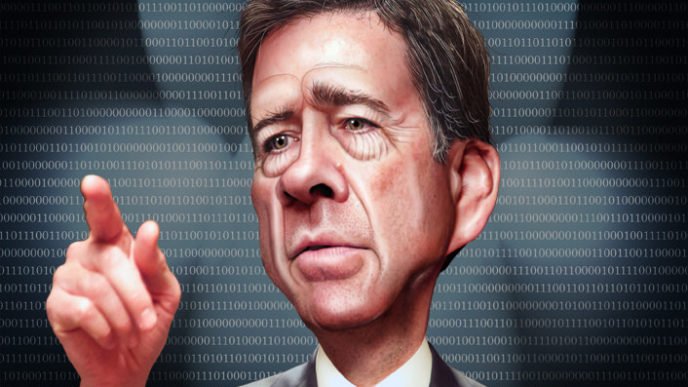
Comey Went Outside FBI Protocol With Leaks

Former FBI Director James Comey’s actions in leaking to the media his own memos about meetings with President Donald Trump were not in keeping with how the Department of Justice operates, Deputy Attorney General Rod Rosenstein said Wednesday.

During a Fox News interview, Rosenstein said he would not directly address Comey’s actions. However, he was forthright when asked by Martha MacCallum on The Story whether he would ever consider it proper for an FBI director to leak notes to the media regarding a meeting with a president.

“As a general proposition, you have to understand the Department of Justice. We take confidentiality seriously, so when we have memoranda about our ongoing matters, we have an obligation to keep that confidential,” Rosenstein said.

Rosenstein also said the principle of confidentiality is basic to the work of the Department of Justice.

“I think it is quite clear,” he said. “It’s what we were taught, all of us prosecutors and agents.”

During the interview, he also defended hiring special counsel Robert Mueller to investigate collusion between the Trump campaign and Russia, something Trump has denied for months.

“I’ve got to explain that I made the decision to appoint Director Mueller based upon his reputation. He had an excellent reputation. Really bipartisan support for his integrity. That’s why I made that decision,” Rosenstein said. “But I can assure you that if there were conflicts that arose because of Director Mueller or anybody employed by Director Mueller, we have a process within the department to take care of that.”

Rosenstein said Mueller’s probe should be judged once it completes its work.

“The Department of Justice, we judge by results, and so my view about that is, we’ll see if they do the right thing,” Rosenstein said.

Comey said he believed the memos he wrote were his to do with as he pleased, but the FBI has indicated it has a different view. Four of the seven memos Comey wrote contained classified information, the FBI has told Congress.

FBI policy forbids an agent from sharing classified information without prior written permission, and all records created during official duties are government property.

Columbia University professor Daniel Richman, a Comey friend who leaked part of one memo to The New York Times, has said no rules were broken.

“No memos were given to the press, and no memos were classified at the time I received them,” Richman said, adding that the physical memo was never shared, only its “substance.” (For more from the author of “Comey Went Outside FBI Protocol With Leaks” please click HERE)

Follow Joe Miller on Twitter HERE and Facebook HERE.