With Senators Like These, Obamacare Repeal Was Always a Tease

This week will be marked by raging debate over the Better Care Reconciliation Act, the Senate’s version of Obamacare-lite that is drawing a swarm of criticism from conservatives for failing to repeal Obamacare and from moderate and liberal Republicans for going too far toward repealing Obamacare. Over the weekend, several U.S. senators clarified their position on the bill – casting doubts on the feasibility of its passage in its current form.

Sen. Ron Johnson, R-Wisc., elaborated on his opposition to the current version of the BCRA in an op-ed published at the New York times, explaining that “it relies too heavily on government spending, and ignores the role that the private sector can and should play.”

“Once again, a simple solution is obvious,” Johnson writes. “Loosen up regulations and mandates, so that Americans can choose to purchase insurance that suits their needs and that they can afford.”

“Like many other senators, I had hoped that this was where things were headed during the last several weeks as the Republican bill was discussed. We’re disappointed that the discussion draft turns its back on this simple solution, and goes with something far too familiar: throwing money at the problem.”

Johnson was joined in his opposition to the bill last week by Senators Ted Cruz, R-Texas, Mike Lee, R-Utah, and Rand Paul, R-Ky. All have said they are open to voting for the BCRA if certain improvements are made. In an interview with ABC’s “This Week,” Sen. Paul said that he would “consider partial repeal” if the Senate were to reach an “impasse.” Senator Cruz has offered an amendment to permit insurers to sell plans that are not compliant with Obamacare regulations, in an effort to allow insurance companies to give greater choice to consumers and drive down prices.

Senator Lee has made his vote conditional on an “opt-out provision,” acknowledging that other attempts at compromise from his position of full repeal have failed to move the liberal Republicans in the Senate.

“Conservatives have compromised on not repealing, on spending levels, tax credits, subsidies, corporate bailouts, Medicaid, and the Obamacare regulations. That is, on every substantive question in the bill,” Lee wrote Friday. “Having conceded to my moderate colleagues on all of the above, I now ask only that the bill be amended to include an opt-out provision, for states or even just for individuals.”

The liberal Republicans are wavering on the bill for vastly different reasons. Senator Dean Heller, R-Nev., declared his opposition to the bill during a press conference Friday, saying, “This bill would mean a loss of coverage for millions of Americans, and many Nevadans.” The contentious issue for these Republicans are worries that rolling back Medicaid expansion will cause some Americans to lose their insurance coverage as an entitlement is taken away. Senators Shelley Moore Capito, R-W.Va., Lisa Murkowski, R-Alaska, and Bill Cassidy, R-La., are among the moderates expressing concerns.

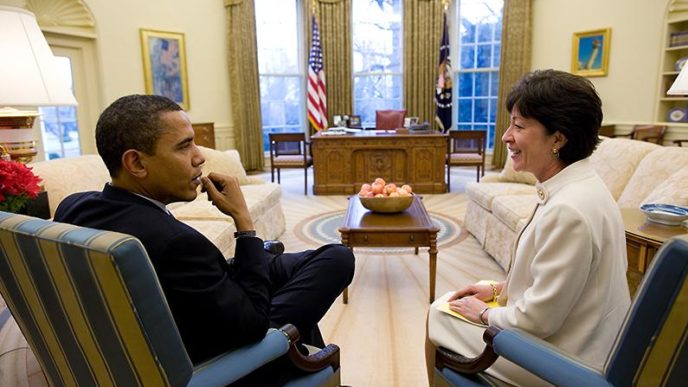
Senator Susan Collins, R-Maine, is waiting for the Congressional Budget Office score of the bill before making a final decision. ‘‘I have very serious concerns about the bill,’’ she said on ABC’s ‘‘This Week,’’ acknowledging that the CBO score ‘‘will be so important.’’ The CBO is expected to release its score of the Senate bill later today.

In the same interview, Sen. Collins objected to defunding Planned Parenthood in the BCRA, saying, “It makes absolutely no sense to eliminate federal funding for Planned Parenthood.” The bill would block Medicaid reimbursements to Planned Parenthood for one year. Eliminating that provision would further alienate conservative senators who have made defunding Planned Parenthood a condition of their support. Taking the provision out will alienate Sen. Collins and other liberals.

As these battles play out, other senators remain undecided or silent. Still others don’t know what to think. Senator Joni Ernst, R-Iowa, is polling her constituents for their thoughts before taking an official position.

The bottom line is that intense negotiations on this bill will dominate the work of the U.S. Senate this week. The CBO score will complicate the matter. In all likelihood, the CBO will project that millions of Americans will lose their current health insurance coverage, just as it predicted (somewhat inaccurately) would happen in the House American Health Care Act. (For more from the author of “With Senators Like These, Obamacare Repeal Was Always a Tease” please click HERE)

Follow Joe Miller on Twitter HERE and Facebook HERE.

Religious Liberty Wins Big at the Supreme Court

A big win today for religious liberty from the Supreme Court. In a sweeping 7-2 decision, the Supreme Court upheld the First Amendment. The case was Trinity Lutheran v. Comer.

Missouri offered recycled tires to schools for safer playgrounds. Missouri said that Trinity Lutheran School couldn’t even have used tires. Why? Because it is run by a church.

Keeping kids safe doesn’t spread the Gospel. There is no “compelling state interest” in leaving religious school playgrounds more dangerous than public ones.

Chief Justice John Roberts knew what to think about banning an ordinary public benefit like safety equipment from a school just because it’s Christian. He called it “odious to our Constitution.”

Here’s a second piece of (maybe) good news. The Court today decided to hear Masterpiece Cakeshop v. Colorado Civil Rights Commission. Colorado fined baker Jack Phillips for refusing to decorate a gay wedding cake.

Mississippi’s Religious Freedom Act

A third piece of good news from the lower courts: Last week a 5th Circuit Court of Appeals panel lifted an injunction. It had blocked Mississippi’s “Protecting Freedom of Conscience from Government Discrimination Act.”

Mississippi’s 2016 law is the best in any state. It provides the broadest protections for gay marriage dissenters. It guards those with three specific beliefs:

Marriage is the union of one man and one woman;
Sexual relations are properly reserved to such a marriage
Man or woman refers to an individual’s immutable biological sex.

The law gives religious organizations new protections. Government may not force them to provide goods and services for a gay wedding. It can’t punish them for hiring believers who agree with their teachings. They don’t have to offer married student housing to gay married couples. They can’t be banned from running foster care or adoption agencies for their marriage policies.

Individuals also receive new protections. Government can’t punish:

Traditional believers who wish to be adoptive or foster parents.
Medical and other professionals who won’t take part in sex reassignment, fertility services, or psychological counseling.
Business owners who decline to provide goods and services for weddings.
State employees who express their beliefs. (If Georgia had passed such a law Atlanta fire chief Kelvin Cochran would still have his job.)

The 5th Circuit three-man panel of judges did not rule on the substance. Instead they ruled that the plaintiffs lacked standing to sue. Merely feeling “triggered” or stigmatized doesn’t count as a harm.

The first time a wedding photographer refuses a client, however, the law will likely be back on trial. (An aside: the law’s chances of surviving under the current Court would be stronger if it protected both gay marriage supporters and dissenters.)

he plaintiffs have requested that the whole 5th circuit review the three-judge ruling. But if this ruling stands Trump will have more time to appoint another Gorsuch to the court.

An Insight Into the Supreme Court

The good news is the Trinity Lutheran victory shows us the current Court is more supportive of religious liberty than many of us feared.

Justice Elana Kagan joined the majority opinion without any reserve. Justice Breyer wrote his own concurring opinion limiting his judgement to playground resurfacing programs and not all government benefits.

Only Justices Sonia Sotomayor and Ruth Bader Ginbsurg dissented. In Justice Sotomayor’s dissent, she warned of almost apocalyptic consequences:

This ruling, “weakens this country’s longstanding commitment to a separation of church and state beneficial to both,” she wrote, “If this separation means anything, it means that the government cannot, or at the very least need not, tax its citizens and turn that money over to houses of worship. The court today blinds itself to the outcome this history requires and leads us instead to a place where separation of church and state is a constitutional slogan, not a constitutional commitment.”

If so, it’s a good thing.

If religious freedom means anything it is that the government may not exclude us based on our faith. It may not tell Muslims they can’t build a mosque. It may not tell a church “Our firemen won’t protect your buildings.” It may not tell a religious school that their children’s safety doesn’t matter. (For more from the author of “Religious Liberty Wins Big at the Supreme Court” please click HERE)

Follow Joe Miller on Twitter HERE and Facebook HERE.

Court Partly Reinstates Trump Travel Ban, Fall Arguments Set

The Supreme Court is letting a limited version of the Trump administration ban on travel from six mostly Muslim countries to take effect, a victory for President Donald Trump in the biggest legal controversy of his young presidency.

The court said Monday the ban on visitors from Iran, Libya, Somalia, Sudan, Syria and Yemen could be enforced as long as they lack a “credible claim of a bona fide relationship with a person or entity in the United States.” The justices will hear arguments in the case in October.

Trump said last week that the ban would take effect 72 hours after being cleared by courts. (Read more from “Court Partly Reinstates Trump Travel Ban, Fall Arguments Set” HERE)

Follow Joe Miller on Twitter HERE and Facebook HERE.
On “Travel Ban,” Supreme Court Backs Away From Brink of a Constitutional Crisis

As the AP reports, the U.S. Supreme Court has thrown out most of the lower court decisions that crippled President Trump’s immigration decisions (that is, his “travel ban”). This is good news not just for fighting terrorism. It’s huge for fans of the separation of powers, the rule of law, national security, and democratic lawmaking. Read David French’s excellent legal analysis of why each of those claims is true.

Essentially, the lower courts vastly overreached the legitimate function of jurists. Their job was to scrutinize the laws to see whether President Trump’s decision to restrict travel from terrorist-ridden hellholes was Constitutional. Instead, they regurgitated his campaign rhetoric and pored over his Twitter archive to scrutinize his alleged motives. They invented imaginary rights for foreign residents. They granted legal “standing” to law firms who recruited foreign clients. Attempting to reverse the effects of a presidential election, they usurped the legitimate powers of the president.

The executive branch has broad Constitutional and legislated authority to protect national security. Immigrants have zero presumptive right to enter the United States. It would be perfectly Constitutional, though stupid, to admit them based on aesthetics (that is, a “Melania” standard).

Avoiding a Constitutional Crisis

Had the Supreme Court followed the lower courts’ lawless precedent on this case, it should have provoked a Constitutional crisis — in the form of GOP-backed bills to challenge courts’ jurisdiction, or term-limit SCOTUS members. I think that even the liberal justices on the Supreme Court saw that, which is why most of them blinked and backed away from the brink.

With many crucial issues on the docket, that crisis still might come. There is just one way to avoid it: If the president stays true to his campaign to appoint only strict constructionists to the courts. Or else if conservatives cravenly surrender.

I wrote before the 2016 election that the race was mostly about the courts. Since Roe v. Wade, the left has relied on the judicial branch to override voters’ will on crucial issues. Progressives wield vast, overweening power. They micromanage the media. They smother and censor the colleges. They terrorize big business via pressure campaigns.

Still, sometimes all that doesn’t turn out to be enough. We saw that in the recent Georgia election: Jon Ossoff called in Planned Parenthood as his Death Star, and still lost to the pro-life Karen Handel.

The Left’s All Purpose Plan for Overriding the Voters

So where they can’t get the votes, as they couldn’t on same-sex marriage, leftists follow this playbook:

Pretend that the U.S. Constitution enshrines whatever “basic rights” that academic elites invented five minutes ago — even those that would have horrified every one of the U.S. Founders, down to the last pallid Deist.

Claim that “international norms” from foreign courts or the United Nations have binding force in basic American laws.

Convince Democrat appointees on lower courts to overturn or stay a democratically enacted law. Or a legitimate use of presidential authority. Because it violates those invented rights.

Pretend that each case is the same as Brown v. Board of Education. And each of their opponents is no better than a bigoted Southern sheriff. Imply that those who put up a fight will end up as disgraced and marginalized as white segregationists.

Win in the Supreme Court by a narrow margin. Then despite the learned dissents by distinguished jurists…

Pretend that anyone who still opposes the decision is an uncivilized Neanderthal. Their organizations are “hate groups.” Except if they’re Muslim. Those groups are exempt, because they’re so peaceful that we don’t want to provoke them.

Use this brand-new consensus to browbeat churches into rewriting the Gospel. Then presto-chango, 2000 years of Christian belief and practice is discredited.

Rinse and repeat.

This strategy worked amazingly well on same-sex marriage. The narrowly decided and crudely anti-Constitutional Obergefell decision is now being foamed into every nook and corner of the culture like toxic asbestos insulation. “Mainline” churchmen (Catholic and Protestant alike) are falling over themselves to accommodate it. They’re wearing out holes in their clerical shirts from patting themselves on the back for groveling before Caesar.

We Will Fight in the Wedding Chapels

But the same strategy backfired on abortion. The pro-life movement is gaining in power, popularity, and influence. Even the socially laissez faire President Trump seems like a genuine convert on the topic.

So there’s no need to despair. And no excuse to retreat into some “Benedict Option” ghetto, which would always be just one court decision away from the cops coming to remove Christian kids from their parents’ custody. Which is happening not in North Korea but in Canada.

We should welcome lawful decisions, and fight lawless ones tooth and nail. We cannot even give up on seemingly implausible goals like overturning Obergefell, and returning marriage jurisdiction to the states. That decision, as Justice Roberts (hardly a right-wing extremist) warned, planted religious liberty time bombs throughout our legal system. Christianity cannot coexist with legal same-sex marriage forever. One of them or the other will end up legally hamstrung. America needs to pick between them.

Yes fixing Obergefell seems out of reach and hopelessly unpopular. But then, in 1973, Roe v. Wade seemed untouchable too. (For more from the author of “On “Travel Ban,” Supreme Court Backs Away From Brink of a Constitutional Crisis” please click HERE)

Follow Joe Miller on Twitter HERE and Facebook HERE.

New Study of Seattle’s $15 Minimum Wage Says It Costs Jobs

Seattle’s $15-an-hour minimum wage law has cost the city jobs, according to a study released Monday that contradicted another new study published last week.

A University of Washington team studying the law’s effects found that the law has boosted pay in low-wage jobs since it took effect in 2015, but that it also caused a 9 percent reduction in hours worked, The Seattle Times reported. For an average low-wage Seattle worker, that’s a loss of about $125 per month, the study said.

“If you’re a low-skilled worker with one of those jobs, $125 a month is a sizable amount of money,” said Mark Long, one of the authors. “It can be the difference between being able to pay your rent and not being able to pay your rent.” (Read more from “New Study of Seattle’s $15 Minimum Wage Says It Costs Jobs” HERE)

Follow Joe Miller on Twitter HERE and Facebook HERE.

EXACTLY WHAT SHE DESERVES: Professor Fired for Saying Otto Warmbier ‘Got Exactly What He Deserved’

The University of Delaware has sacked Katherine Dettwyler, the taxpayer-funded professor who declared that Otto Warmbier was a “spoiled,” “white, rich, clueless” American college student who “got exactly what he deserved” when he recently ended up comatose and then died at the age of 22 after serving part of a lengthy prison sentence in North Korea.

“The University of Delaware has announced that Katherine Dettwyler, who last taught in the spring as an adjunct faculty member, will not be rehired to teach at the University in the future,” school officials said in a statement sent to The Daily Caller on Sunday.

Dettwyler made her comments on Wednesday on Facebook and in the comments section of a National Review article. At some point on Friday, she later removed or otherwise concealed the comments.

“Is it wrong of me to think that Otto Warmbier got exactly what he deserved?” the no-longer-employed professor wondered on Facebook. “He went to North Korea, for fuck’s sake, and then acted like a spoiled, naive, arrogant, US college student who had never had to face the consequences of his actions.”

The 62-year-old anthropology professor — an expert on breastfeeding (according to a now-deleted curriculum vitae) — was even more critical of Warmbier in her National Review comments. (Read more from “EXACTLY WHAT SHE DESERVES: Professor Fired for Saying Otto Warmbier ‘Got Exactly What He Deserved'” HERE)

Follow Joe Miller on Twitter HERE and Facebook HERE.
Trump: Not ‘That Far off’ From Passing Health Care Overall

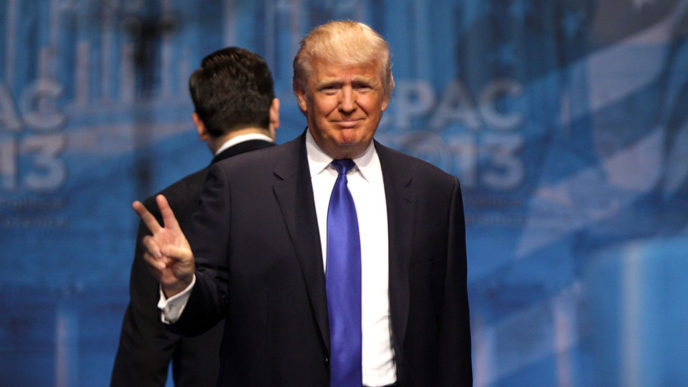
President Donald Trump said Sunday he doesn’t think congressional Republicans are “that far off” on a health overhaul to replace “the dead carcass of Obamacare.”

Expressing frustration, he complained about “the level of hostility” in government and wondered why both parties can’t work together on the Senate bill as GOP critics expressed doubt over a successful vote this week.

It was the latest signs of high-stakes maneuvering over a key campaign promise, and the president signaled a willingness to deal. (Read more from “Trump: Not ‘That Far off’ From Passing Health Care Overall” HERE)

Follow Joe Miller on Twitter HERE and Facebook HERE.

How Environmental Groups Are Responding to Trump’s ‘Solar Wall’ Pitch

President Donald Trump’s idea of putting solar panels on his long-promised border wall hasn’t gained a lot of support among top environmental lobbying groups—even though the organizations have long backed solar power as a key renewable energy.

“The problem with talking about solar panels on Trump’s border wall is that it’s science fiction,” Travis Nichols, a spokesman for Greenpeace, a liberal environmentalist group, told The Daily Signal. “Just like clean coal does not exist and will never exist, Trump’s wall with solar panels won’t exist, so it’s irrelevant to discuss climate issues.”

A spokesman with the Sierra Club referred to a tweet storm by the Sierra Club executive director, Michael Brune, reacting to Trump’s proposal for solar panels on the border wall.

Speaking Wednesday in Cedar Rapids, Iowa, Trump proposed putting solar panels on the wall. Such panels would capture power along the hot southern border, to help increase the power supply, which the president said would help pay for the wall.

“We’re thinking of something that’s unique, we’re talking about the southern border, lots of sun, lots of heat. We’re thinking about building the wall as a solar wall, so it creates energy and pays for itself. And this way, Mexico will have to pay much less money,” Trump told the Iowa crowd.

“And that’s good, right? Is that good? You are the first group I’ve told that to. A solar wall. It makes sense. Let’s see. We are working it out. Solar wall panels.”

Trump added: “Pretty good imagination, right? Good? My idea.”

There would likely be more effective ways to pay for the wall, said Steven Camarota, director of research for the Center for Immigration Studies, a pro-border enforcement think tank.

“It is one of the sunnier parts of the country, but solar panels are fairly fragile,” Camarota told The Daily Signal. “Each illegal border crosser has a cost of about $75,000 for taxpayers. A modest reduction in border crossings could help pay for the wall.”

Camarota, who believes interior enforcement is perhaps more important than the wall, said the reduction in needed law enforcement and health costs from drugs not entering the country would also offset the costs.

There are too many uncertainties to know whether this would cover the cost of the border wall, said Nick Loris, a research fellow in energy and environmental policy at The Heritage Foundation.

“It’s entirely too early to tell and there are too many outstanding questions. If the solar panels are subsidized, we’re just paying for them through another mechanism,” Loris told The Daily Signal. “It’s difficult to know what the solar panels would cost, how much energy they’d produce standing vertically as opposed to angled horizontally like you see at a solar farm or a rooftop.”

It would require additional building, Loris said, adding:

You also have to factor in the transmission lines to take the energy from remote places to where it’s needed. There’s repair, replacement, and waste costs. They’re also not very efficient compared to other forms of energy, which is why they only account for a meager 2 percent of our net electricity generation, even with generous support from the taxpayer. There’s a lot of question marks surrounding the project so that it’s difficult to know how costly or beneficial it would be.

A Wall Street Journal op-ed headlined “A Shiny Border Wall That Pays for Itself” by Vasilis Fthenakis, an earth and engineering professor at Columbia University, and Ken Zweibel, director of the Solar Institute at George Washington University, contends:

Resolving the political impasse between Mexico and the U.S. over a border wall requires innovative thinking. How about this: Presidents Donald Trump and Enrique Peña Nieto should work together to construct a ‘solar wall’—a massive string of photovoltaic panels—on the Mexican side of the border.

Another op-ed in the liberal Huffington Post on Dec. 16, 2016, “Instead of Trump’s Wall, Let’s Build A Border of Solar Panels,” by Homero Aridjis, a poet and novelist, and James Ramey, a professor at Metropolitan Autonomous University and member of Mexico’s National System of Researchers, said:

There is indeed a way that Mexico could create a barrier between the U.S. and Mexico, one constructed exclusively on the Mexican side, with substantial benefits for both countries and the planet: a solar border. …

If one were to construct the equivalent of a strip of arrays one-third the width of a football field south of the entire U.S.-Mexico border, wider in some areas and narrower in others, with a wide berth allowed for populated areas and stretches of rugged terrain, sufficient energy might be produced to also supply Los Angeles, Las Vegas, Albuquerque, Dallas, and Houston. For the U.S. cities, it would be a way to obtain cheaper and cleaner energy than they can from other sources.

(For more from the author of “How Environmental Groups Are Responding to Trump’s ‘Solar Wall’ Pitch” please click HERE)

Follow Joe Miller on Twitter HERE and Facebook HERE.

What a Wounded Veteran Thinks of Trump’s VA Reform

Sgt. Mike Verardo’s military career ended seven years ago because of an improvised explosive device in Afghanistan, but he said the worst part of his injuries was dealing with a “broken VA” when he returned home.

He had to go to the Department of Veterans Affairs hospital weekly, wait 57 days for a prosthetic leg, make long drives to VA medical centers to verify he had injuries and undergo more than 100 surgeries. He said the doctors were patriotic and cared about veterans, but much of the bureaucracy failed those returning home from war.

“When I came home it was incredibly difficult going once a week to the VA trying to get the basic care that I needed,” Verardo told The Daily Signal in an interview at the White House shortly after President Donald Trump signed legislation to hold VA staff more accountable and improve service to veterans.

In the East Room, surrounded by veterans groups, Trump signed the Department of Veterans Affairs Accountability and Whistleblower Protection Act of 2017.

The bill was set up to create a new streamlined process to remove, demote, or suspend any VA employee for poor performance or misconduct. It also provides expanded protections for whistleblowers and bars the VA from using this removal authority if the employee has an open whistleblower complaint.

The new law also allows the VA secretary to to reduce an employee’s federal pension if he is convicted of a felony that influenced his job at the VA and to directly appoint individuals to the positions of medical center director at VA centers.

“President Trump definitely engaged with the veterans on his campaign. He definitely listened to what we had to say,” Verardo told The Daily Signal.

Verardo also spoke at the bill signing ceremony before Trump spoke.

During his remarks, Trump asked Verardo to stand up and the president shook his hand. Trump joked, “He gets up better than I do.”

“What happened to Michael is happening to many but it’s rarely happening under our leadership and David’s leadership,” Trump said, referring to VA Secretary David Shulkin.

The president talked about the 2014 VA waiting list scandal, in which the department’s inspector general determined that some VA medical centers’ falsified waiting lists led to denied care and in some cases deaths.

“We all remember the nightmare that veterans suffered during the VA scandals that were exposed a few years ago. Veterans were put on secret wait lists, given the wrong medication, given the bad treatments, and ignored in moments of crisis for them,” the president said.

Trump added:

Many veterans died waiting for a simple doctor’s appointment. What happened was a national disgrace, and yet some of the employees involved in these scandals remained on the payrolls. Outdated laws kept the government from holding those who failed our veterans accountable.

Shulkin talked during the bill signing ceremony about how the department could not fire employees with a record of driving under the influence or an employee who watched pornography during work hours. Still, he said the purpose of the new law is not to fire more people but to set up a culture of higher standards at the department.

During a press conference at the White House after the bill signing, Shulkin told The Daily Signal:

Every organization needs to see whether something works and whether you need to make changes. So it won’t surprise me if we’re going to need to ask for further legislative changes. Frankly, I’m looking for additional support on the hiring piece because getting the right people in place not only involves removing people that have lost their way but more importantly it involves attracting the very best and the brightest to serve our country’s veterans. And it still takes too long to do that and we’re still too restrictive so I’m going to be looking for help in that area.

(For more from the author of “What a Wounded Veteran Thinks of Trump’s VA Reform” please click HERE)

Follow Joe Miller on Twitter HERE and Facebook HERE.

Nonprofit Tracker to Remove ‘Hate Group’ Labels on Conservative Groups for ‘Time Being’

The nation’s leading source of information on U.S. charities announced it will modify its use of a controversial “hate group” designation in listings for some well-known and broadly supported conservative nonprofits.

“We have decided to remove the SPLC annotations from these 46 organizations for the time being,” read a statement posted Friday on GuideStar’s website. “This change will be implemented during the week of June 26, 2017. In the meantime, we will make this information available to any user on request.”

GuideStar, which calls itself a “neutral” aggregator of tax data on charities, recently incorporated the “hate group” labels produced by the left-wing Southern Poverty Law Center, which inspired 41 conservative leaders to protest the move, asking GuideStar in a letter last week to remove the flagging

In an interview with The Daily Signal last week, William G. “Jerry” Boykin, a retired Army general who is executive vice president of the Family Research Council, said GuideStar’s messaging is not neutral.

“GuideStar says that they are neutral, but they are anything but neutral. In fact … I would say at this point, they are becoming an arm of the ultra-left,” Boykin said.

The conservatives’ letter, dated June 21 and directed to GuideStar President and CEO Jacob Harold, who is described on GuideStar’s website as a social change strategist, asked the website to drop the “hate group” labels put on 46 organizations.

Before joining GuideStar, Harold worked for the Hewlett Foundation’s philanthropy program as a “climate change campaigner” for Rainforest Action Network and Greenpeace USA, and as an organizing director at Citizen Works.

Organizations represented on the letter included the Family Research Council, the American Freedom Defense Initiative, the Immigration Reform Law Institute, the American College of Pediatricians, the National Task Force for Therapy Equality, the American Family Association, the London Center for Policy Research, and the Jewish Institute for Global Awareness.

Signers of the letter pointed to recent history and noted the “hate group” designation propagated by the Southern Poverty Law Center and adopted by GuideStar can have serious implications.

Floyd Corkins, the man convicted of a 2012 attempt to massacre employees at the Family Research Council, was inspired by SPLC’s description of the Christian pro-family research organization as a hate group.

In an interview with the FBI, Corkins said a list on the Southern Poverty Law Center’s website motivated his attack, a connection which the SPLC has acknowledged.

The signers also note that that James T. Hodgkinson, the man who police say tried to gun down Republican lawmakers June 14 during practice for a congressional baseball game just outside Washington in Alexandria, Virginia, liked the Southern Poverty Law Center on Facebook.

House Majority Whip Steve Scalise, R-La., was gravely wounded in the gunman’s attack. Four others were injured.

Among the signers of the June 21 letter was Edwin J. Feulner, founder and president of The Heritage Foundation, the parent organization of The Daily Signal. Two other fixtures of the conservative think tank, Heritage board member Edwin Meese III and Heritage Action for America CEO Michael Needham, also signed the letter. Heritage is not labeled a hate group by either SPLC or GuideStar.

The signers asked Harold “that GuideStar return to its prior, nonpolitical approach to evaluating nonprofit organizations. Please send your reply within one week of receipt of this letter.”

The self-described “neutral” aggregator announced it would continue to navigate the “political spectrum” and evaluate how to move forward.

“We hope to engage in a constructive dialogue with experts from across the political spectrum to help us determine the best way to fulfill this need,” GuideStar’s press release said. (For more from the author of “Nonprofit Tracker to Remove ‘Hate Group’ Labels on Conservative Groups for ‘Time Being'” please click HERE)

Follow Joe Miller on Twitter HERE and Facebook HERE.