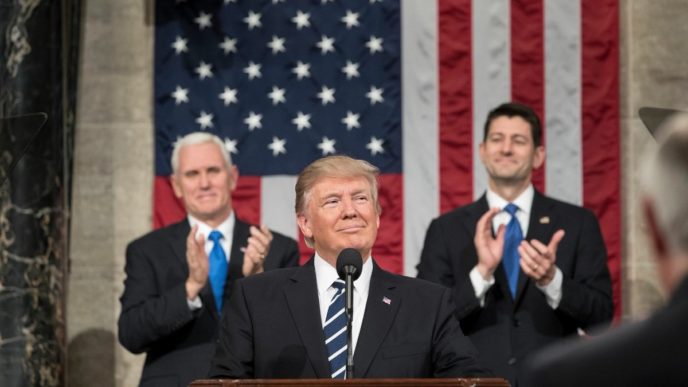
With Support From Conservatives, House Republicans Move Closer to Obamacare Repeal Deal

Republican leaders in the House received a boost to their attempts to repeal and replace Obamacare on Wednesday as the Freedom Caucus, an influential bloc of conservatives, announced its support for a revised plan.

The group of more than 30 lawmakers said it would support a new version of the bill, called the American Health Care Act. The revision includes an amendment crafted by Freedom Caucus Chairman Mark Meadows, R-N.C., and Tuesday Group Co-chairman Tom MacArthur, R-N.J.

“The MacArthur amendment will grant states the ability to repeal cost-driving aspects of Obamacare left in place under the original [American Health Care Act],” the Freedom Caucus said in a statement. “While the revised version still does not fully repeal Obamacare, we are prepared to support it to keep our promise to the American people to lower health care costs.”

For the Freedom Caucus to take an official position on legislation, its rules call for 80 percent of members to agree.

The culmination of weeks of negotiations between Meadows and MacArthur, the compromise amendment aims to unite the House’s centrist and conservative Republican wings behind the health care bill.

With their legislation, GOP lawmakers and President Donald Trump are working to fulfill a major campaign promise—to repeal and replace Obamacare.

Trump initially promised to dismantle the health care law his first day in office, but disagreement among Republican lawmakers has delayed efforts in Congress to do so.

Lawmakers received the text of the amendment last night, but a rough outline of the plan was leaked to the press last week.

The deal takes aim at regulations implemented under what President Barack Obama considered one of his major domestic achievements, the Affordable Care Act, which conservatives said caused premiums to rise dramatically.

Under the amendment, states can apply for federal waivers to opt out of Obamacare’s essential health benefits requirement, a list of 10 services that insurance plans are required to cover.

The measure leaves in place a provision of Obamacare that prohibits insurers from denying coverage to patients with pre-existing conditions, but allows states to waive its community ratings rules, which ban insurers from charging sick patients more than healthy ones.

States could opt out of the community ratings rules only if they implement a program designed to minimize costs for patients with pre-existing conditions, such as a high-risk pool.

High-risk pools, subsidized by the government, are insurance pools for patients with pre-existing conditions.

Additionally, only patients who fail to maintain continuous coverage could be charged more by insurers.

The amendment from MacArthur and Meadows attempts to assuage the concerns of House conservatives who, along with a bloc of centrist Republicans, opposed GOP leadership’s original health care bill.

Though Republican leaders now have the support of the Freedom Caucus, it’s unclear if the revised plan will have the backing of centrist Republicans.

Members of the centrist Tuesday Group told reporters Wednesday they needed more time to look over the amendment.

The revised bill has swayed influential conservative groups, however.

Club for Growth and FreedomWorks, which both opposed the original bill, announced their support for the amendment and said they would back the bill with its addition.

“While we’re still short of full repeal, this latest agreement would give states the chance to opt out of some of Obamacare’s costliest regulations, opening the way to greater choice and lower insurance premiums,” Club for Growth President David McIntosh said in a prepared statement. “It’s a solution we’ve supported for weeks, and the time to move forward is now.”

Heritage Action for America, the lobbying affiliate of The Heritage Foundation, backed away from its key vote against the health care bill.

In a formal statement, Mike Needham, CEO of Heritage Action, said:

To be clear, this is not full repeal and it is not what Republicans campaigned on or outlined in the Better Way agenda. The amendment does, however, represent important progress in what has been a disastrous process. Given the extreme divides in the Republican Party, allowing Texas and South Carolina to make different decisions on health insurance regulations than New York and New Jersey may be the only way forward.

Discussions over the health care bill began early last month after Republican leaders revealed their plan to repeal and replace Obamacare, a yearslong promise to voters.

Lawmakers were supposed to vote on the original legislation twice late last month. But House Speaker Paul Ryan delayed one vote and then abruptly pulled the bill the next day after it became clear not enough Republicans supported it.

Conservatives, led by Meadows, continued discussions with MacArthur, Republican leaders, and the Trump administration.

GOP leaders and the White House are discussing a potential vote on the revised bill Friday, according to Axios, and the House whip team is counting votes.

Ryan, R-Wis., told reporters at a press conference earlier Wednesday that the lower chamber would vote “when we’ve got the votes.”

Still, the speaker said the MacArthur amendment “helps get us to consensus.”

“We think it’s very constructive,” Ryan said, adding:

We think the MacArthur amendment is a great way to lower premiums, give states more flexibility while protecting people with pre-existing conditions. Those are the three things we want to achieve.

(For more the author of “With Support From Conservatives, House Republicans Move Closer to Obamacare Repeal Deal” please click HERE)

Follow Joe Miller on Twitter HERE and Facebook HERE.
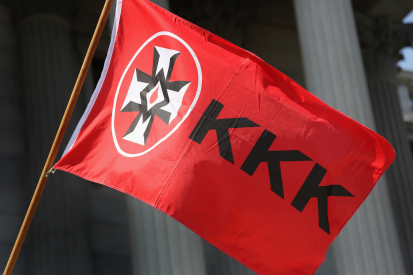
Antifa Thugs Unmasked – by Laws Originally Passed Against the KKK

In a standoff between white supremacists and communist thugs, there are no heroes — save local law enforcement. Occasionally, however, there’s some half-decent schadenfreude to be found.

In a twist of delicious irony, a law originally enacted to deal with the Ku Klux Klan led to the unmasking of several Antifa thugs on the streets of Auburn, Alabama, Tuesday.

According to a story at Twitchy, local police told people protesting a speech by Alt-Right leader Richard Spencer at Auburn University — which was court-ordered to host him — to take off their hallmark masks.

From video shot outside the venue, it appeared as though the police were enforcing the rules, which included a no-mask policy. That meant the members of the [A]ntifa, or anti-fascists, were made to uncover their faces as they marched past law enforcement toward the campus.

As the story notes, the responses to the unmasking on social media included tweets lauding the Auburn Police Department for enforcing the law while criticizing local cops in Berkeley, California, where lax law enforcement has been blamed for riots over the weekend. Spencer’s views are despicable, but the way a free society deals with bad ideas is to drown them out with better ones, not engage in domestic terrorism. Someone needs to pass that memo along.

As my colleague Chris Pandolfo pointed out in the wake of the past weekend’s riots in Berkeley, Antifa’s name, which is a truncation of “anti-fascism,” really ought not to be taken at face value.

“‘Antifa’ is made up of self-described anarchists — radical left-wing thugs who employ violence and intimidation to advance their beliefs,” he writes. “They’ve shown up previously at Berkeley to shut down a “free speech” event hosted by provocateur Milo Yiannopoulos, leaving damaged property, fires, and assault victims in their wake.”

In short, Antifa has no problem shutting down political demonstrations with brute force and intimidation tactics for their socio-political ends [read: terrorism], and they typically wear masks to do it.

Covering one’s face to commit acts of political violence is not limited to Antifa thugs. It’s also a favorite tactic of groups like ISIS and other Islamist terror cells, as well as another U.S.-based, Democrat-sympathetic domestic terrorist organization: The Ku Klux Klan.

What many may not know, however, is that the current law forcing the Antifa demonstrators to remove their facial coverings finds its roots in a decades-old provision originally passed to take on the robe-clad hate group.

Title 13 of the Alabama State Code prohibits masked people from congregating in public places without facing criminal charges. If you want to publicly gather in the Yellowhammer State, you can either take your mask off, move along, or leave in cuffs. This, along with a provision the court order was what was being enforced, a spokesman for the Auburn Police Department confirms via email.

While several states now have laws prohibiting the covering one’s face in public, these laws in the deep south herald back to mid-20th century efforts to keep white supremacists from going about incognito to terrorize and intimidating law-abiding citizens.

The history of Alabama’s anti-masking law go back to Governor Jim Folsom — a noted opponent of the KKK — who in 1949 signed a law making wearing a mask a misdemeanor, punishable, back then, by a $500 fine and a year in jail, according to Time Magazine archives. The law was the first of its kind passed in the Deep South since Reconstruction.

The current version of the law was passed in 1977.

Furthermore, in “Hooded Americanism: The History of the Ku Klux Klan”, historian David Mark Chalmers notes that Folsom also ordered the arrest of anyone who similarly covered their license plates, saying “mobs, hooded or unhooded, are not going to rule Alabama.” Nor would they at Auburn.

Georgia also has a similar statute, which was upheld by the Supreme Court in 1990, after it faced a legal challenge from the KKK on First Amendment grounds.

So there you have it: A law put in place to combat racist terrorists over five decades ago is now being used against communist terrorists trying to intimidate racists. Welcome to 2017, folks. (For more from the author of “Antifa Thugs Unmasked – by Laws Originally Passed Against the KKK” please click HERE)

Follow Joe Miller on Twitter HERE and Facebook HERE.

The Supreme Court Has a Chance to Right a Long Standing Wrong

Last week, the U.S. Supreme Court heard oral arguments in Trinity Lutheran Church v. Comer. The case stems directly from religious bigotry in the mid-1800s.

In 2012 Trinity Lutheran Church in Missouri applied for a state grant to resurface their playground to make it safer. The church’s pre-school uses the playground and it’s also available to the local community. Most of the children in the pre-school and neighborhood do not attend the church.

Missouri denied the funds. They claimed state law prohibited them from aiding “any church, sect, or denomination of religion.”

And so on to court and now to the U. S. Supreme Court. The case offers the Court the chance put right the wrong imposed on religious believers in Missouri 140 years ago.

That wrong is called the Blaine Amendment.

Catholic Immigrants Found Catholic Schools

By the mid-1800s, in the wake of the Second Great Awakening, the religion of the American people was for the most part lowest-common-denominator (LCD) Protestantism. Charles Finney, the most prominent evangelist during the awakening, summed it up:

Persons of all denominations, forgetting their differences, gave themselves to the work. They all preached the same thing, the same simple Gospel. They held out substantially the same truth: Christ died to save souls; you may be saved; you are a sinner and need to be saved; now, will you come to Christ and submit yourself to God? This was about the amount of instruction.

That LCD Protestantism influenced all of American public life including public education. Since Protestantism was part of what it meant to be a real American, public schools promoted it with enthusiasm.

During that same era, the country experienced great waves of Catholic immigrants. For Catholics, Mr. Finney’s “simple gospel” was true as far as it went. It just didn’t go far enough. In fact, they found it so inadequate and, in the public schools, so objectionable that they founded their own schools. These would promote Catholic faith, education, and identity.

Keeping “Sectarian” Catholic Schools at Bay

Protestant America was never very keen on Catholics, but this went beyond too far. There had to be a way to make it harder for poor Catholics to send their children to these new “sectarian” Catholic schools. How could Catholic children be forced into the public schools with their “non-sectarian” Protestant bias so that they could become good Americans — and good Protestants?

To save the Republic from rampant Catholicism, the Order of the Star Spangled Banner was formed in 1849. Their core issue was the abolition of slavery, an extremely good cause, but they fueled that good cause with anti-Catholic bigotry. The Order was a secret society. When asked about it, members were bound by oath to say, “I know nothing.” Hence, they were called “The Know-Nothings.” Politically they were the American Party.

Their idea of the First Amendment was to keep Catholic “sectarianism” at bay while strengthening “non-sectarian” LCD Protestantism.

This was nearly enshrined in the U. S. Constitution in 1879. President Ulysses S. Grant proposed an amendment banning “sectarian” religious instruction in public schools and the use of tax dollars to in any way support “sectarian” schools. The amendment was named for James G. Blaine who had been Speaker of the House.

Protestants and non-religious people loved the amendment. While it was never ratified, all but eleven states adopted and still have Blaine Amendments or similar legislation. Missouri is one of them.

Danger for All Religious Groups

What Grant, Blaine, the Know-Nothings, and the amendment’s other supporters didn’t take into account is that “sectarian” is in the eye of the beholder.

They thought they were safeguarding the republic from the dangers of “rum, Romanism, and rebellion.” Instead they created a legal trap for religious believers including the good folk at Trinity Lutheran. Today when all religion is regarded as “sectarian” it’s possible to exclude all religion from government benefits.

Now I know it’s a mistake to judge those in the past by our standards. It’s easy to second-guess a 140-year old decision with 20/20 hindsight. Still, the Blaine Amendments give states the power to discriminate against any or all religious groups. That exacts a steep tax on freedom as Trinity Lutheran and many others have discovered.

Those who observe the Supreme Court seem to think that the Court will find for Trinity Lutheran. Besides, the new governor of Missouri has changed the policy. One way or the other, Trinity Lutheran will receive their grant.

What the Court should do, if it can, is declare Blaine Amendments across the country unconstitutional. That would set right a long standing injustice. (For more from the author of “The Supreme Court Has a Chance to Right a Long Standing Wrong” please click HERE)

Follow Joe Miller on Twitter HERE and Facebook HERE.

Mike Lee Warns Trump About Taxpayer Funding of Soros Groups Overseas

For eight years, U.S. foreign assistance was tied to a leftist political agenda rather than American interests, and it’s now up to President Donald Trump to correct that, Sen. Mike Lee said Tuesday.

Lee took particular aim at U.S. support during the Obama administration for the overseas work of nonprofits bankrolled by liberal billionaire George Soros.

“Whatever one’s views about abortion, energy regulation, alternative family structures, they are neither core international priorities of the American people, nor essential to American national security. They are domestic political controversies, pet causes of a sort of privileged, globalist elite,” Lee said in the speech at The Heritage Foundation.

“Yet for eight years under President Obama’s administration, they were the substance of a global reeducation campaign, funded by … American taxpayers,” the Utah Republican said.

Lee made the remarks, in which he specifically criticized the U.S. Agency for International Development, or USAID, ahead of a panel discussion on U.S. foreign assistance at The Heritage Foundation.

“President Trump and his team must change the culture of American diplomacy towards one that prioritizes American interests and respects the sovereignty and self-determination of other peoples,” Lee said.

Trump’s fiscal year 2018 budget proposal would cut funding for the State Department and USAID by 28 percent.

The senator noted that Eastern European countries are more socially conservative than Western European countries because of the influence of Catholic and Orthodox churches. He said they also are more economically conservative because of their past suffering under communism.

The citizens of countries such as Macedonia, Poland, and Albania see the U.S. government spending money on progressive political causes as a “well-funded external political activism that undermines legitimate governments and long-held cultural norms of their nations with leftist policies and leftist politicians,” Lee said, adding:

And who can question their concerns, when the State Department and USAID have provided millions of American taxpayer dollars to organizations in Eastern Europe associated with well-known progressive advocates like George Soros and his Open Society Foundations, who make no secrets about the kinds of politics they support?

The mission of USAID, which has a $22.7 billion annual budget, is to fight poverty and promote democracy abroad.

A State Department spokesman told The Daily Signal in a written statement that USAID money is properly accounted for.

“USAID is committed to accountability and transparency and to the oversight of U.S. government funds to ensure they are not subject to waste, fraud, or abuse,” the spokesman said in an email. “USAID regularly conducts rigorous reviews and audits of programs implemented by partner organizations. These reviews are conducted to measure the programs’ effectiveness and efficiency and to ensure their compliance with applicable statutes, regulations, and policies.”

Lee’s chief example was Macedonia:

Macedonia today is embroiled in a governing crisis that has been brought about largely by external interference in domestic issues and political processes. The crisis has deepened the political divide in the country and threatens to inflame ethnic tensions.

Such unrest is like an engraved invitation to an opportunist like [Russian President] Vladimir Putin, who can inflame divisions and actively court populations who feel that they have been betrayed by the United States.

From 2012 through 2016, USAID gave $4.8 million to Foundation Open Society-Macedonia, a division of the Soros-funded nonprofit, “in partnership with four local civil society organizations,” according to the agency’s website.

The conservative government watchdog Judicial Watch has sued the State Department and USAID for detailed information about funding for Foundation Open Society-Macedonia.

Open Society Foundations spokesman Maxim Tucker disputed much of Lee’s comments about the Soros-funded groups in a statement to The Daily Signal. Tucker said in an email:

Senator Lee must know that since 1973, U.S. law prohibits USAID from funding groups that support abortion as a method of family planning–it’s simply false to suggest that the Open Society Foundations or its affiliated organizations use USAID funding to promote abortion rights abroad.

Indeed, we administer only a fraction of USAID funding and that money goes on to local organizations working on local issues–such as health care, infrastructure, education, community activism, and journalism. We do spend nearly a billion dollars of our own money each year funding a wide range of groups that promote human rights, democracy, and good governance.

In central and Eastern Europe, these groups are increasingly attacked or smeared by corrupt and authoritarian governments seeking to deflect legitimate criticism of their leadership.

Lee and five other Republican senators last month wrote Secretary of State Rex Tillerson asking for a review of USAID dollars going to fund political causes, including Soros’ Open Society Foundations.

“The department’s initial response was dismissive of our concerns, and refused to promise any such review,” Lee said during his remarks Tuesday, which may be seen in their entirety here:

“The immediate priority for the Trump administration is to get the right appointees into key positions at the State Department and USAID,” Lee said later, adding:

President Trump, Secretary Tillerson, and other administration officials must also clarify the position of the United States on a number of foreign policy issues, especially in areas where the Obama administration left a damaging impact or caused confusion about U.S. priorities.

USAID doesn’t have a presence in Ireland, for example, according to James Walsh, a former member of Ireland’s senate. Walsh spoke at Heritage’s forum about how the State Department has backed progressive causes in Ireland, including abortion and same-sex marriage.

Walsh said “the most prominent support for so-called progressive causes” has come from U.S.-based nonprofits.

However, Walsh said, the U.S. Embassy in Dublin provided financial help to set up the LGBT group Shout Out. He said that group had “a very prominent role” in Ireland’s 2015 referendum that legalized same-sex marriage.

Walsh added:

The known support from the official U.S. government sources may be relatively modest, but it contributes greatly to an impression which the rhetoric of the Obama administration strongly underlined. And that is that the U.S. government is actively and vigorously promoting these euphemistically called progressive causes around the world and is prepared to interfere in what many people would regard as a matter exclusively for the domain of the people of that particular country.

The State Department did not have an immediate answer for The Daily Signal about whether the embassy financially supported the new lesbian, gay, bisexual, and transgender group in Ireland. (For more from the author of “Mike Lee Warns Trump About Taxpayer Funding of Soros Groups Overseas” please click HERE)

Follow Joe Miller on Twitter HERE and Facebook HERE.

Here’s How Wrong Past Environmental Predictions Have Been

Each year, Earth Day is accompanied by predictions of doom.

Let’s take a look at past predictions to determine just how much confidence we can have in today’s environmentalists’ predictions.

In 1970, when Earth Day was conceived, the late George Wald, a Nobel laureate biology professor at Harvard University, predicted, “Civilization will end within 15 or 30 years unless immediate action is taken against problems facing mankind.”

Also in 1970, Paul Ehrlich, a Stanford University biologist and best-selling author of “The Population Bomb,” declared that the world’s population would soon outstrip food supplies.

In an article for The Progressive, he predicted, “The death rate will increase until at least 100-200 million people per year will be starving to death during the next 10 years.”

He gave this warning in 1969 to Britain’s Institute of Biology: “If I were a gambler, I would take even money that England will not exist in the year 2000.”

On the first Earth Day, Ehrlich warned, “In 10 years, all important animal life in the sea will be extinct.”

Despite such predictions, Ehrlich has won no fewer than 16 awards, including the 1990 Crafoord Prize, the Royal Swedish Academy of Sciences’ highest award.

In International Wildlife (July 1975), Nigel Calder warned, “The threat of a new ice age must now stand alongside nuclear war as a likely source of wholesale death and misery for mankind.”

In Science News (1975), C.C. Wallen of the World Meteorological Organization is reported as saying, “The cooling since 1940 has been large enough and consistent enough that it will not soon be reversed.”

In 2000, climate researcher David Viner told The Independent, a British newspaper, that within “a few years,” snowfall would become “a very rare and exciting event” in Britain. “Children just aren’t going to know what snow is,” he said. “Snowfalls are now just a thing of the past.”

In the following years, the U.K. saw some of its largest snowfalls and lowest temperatures since records started being kept in 1914.

In 1970, ecologist Kenneth Watt told a Swarthmore College audience:

The world has been chilling sharply for about 20 years. If present trends continue, the world will be about 4 degrees colder for the global mean temperature in 1990 but 11 degrees colder in the year 2000. This is about twice what it would take to put us into an ice age.

Also in 1970, Sen. Gaylord Nelson, D-Wis., wrote in Look magazine: “Dr. S. Dillon Ripley, secretary of the Smithsonian (Institution), believes that in 25 years, somewhere between 75 and 80 percent of all the species of living animals will be extinct.”

Scientist Harrison Brown published a chart in Scientific American that year estimating that mankind would run out of copper shortly after 2000. Lead, zinc, tin, gold, and silver were to disappear before 1990.

Erroneous predictions didn’t start with Earth Day.

In 1939, the U.S. Department of the Interior said American oil supplies would last for only another 13 years. In 1949, the secretary of the interior said the end of U.S. oil supplies was in sight.

Having learned nothing from its earlier erroneous claims, in 1974 the U.S. Geological Survey said the U.S. had only a 10-year supply of natural gas.

The fact of the matter, according to the U.S. Energy Information Administration, is that as of 2014, we had 2.47 quadrillion cubic feet of natural gas, which should last about a century.

Hoodwinking Americans is part of the environmentalist agenda. Environmental activist Stephen Schneider told Discover magazine in 1989:

We have to offer up scary scenarios, make simplified, dramatic statements, and make little mention of any doubts we might have. … Each of us has to decide what the right balance is between being effective and being honest.

In 1988, then-Sen. Timothy Wirth, D-Colo., said: “We’ve got to … try to ride the global warming issue. Even if the theory of global warming is wrong … we will be doing the right thing anyway in terms of economic policy and environmental policy.”

Americans have paid a steep price for buying into environmental deception and lies. (For more from the author of “Here’s How Wrong Past Environmental Predictions Have Been” please click HERE)

Follow Joe Miller on Twitter HERE and Facebook HERE.

Shock Poll: 67 Percent of Americans Believe Dems Are out of Touch

Despite the media’s best efforts to attack conservatives and Republicans, it seems the American people aren’t buying it. After three months of wall-to-wall coverage about Russian interference in the election, and a general hostile attitude by the media, 96 percent of Trump’s voters would vote for him again, according to a new ABC News/ Washington Post poll.

But that’s not even the biggest story to come out of the poll. A staggering number of American voters think the Democratic Party is “out of touch” with “people’s concerns.”

The media have been focused on the horse-race numbers coming out of the poll. Numerous outlets have run stories that show Donald Trump winning by a 43-40 percent margin if the election were held today. In a bit of media bias that would make even the most shameless propagandist blush, The Hill went with this headline, “Poll: 85 percent of Clinton supporters would vote for her again.” While those are nice hypothetical horse-race numbers, they hide what the media really don’t want to talk about.

The real headlines should be about how distasteful voters think the Democratic Party is. When asked the question, “Do you think the Democratic Party is in touch with the concerns of most people in the United States today, or is it out of touch?” a whopping 67 percent said the Democratic Party was “out of touch.”

The “out of touch” percentage was five percent higher than the same question asked of the Republican Party, and a whopping nine percent higher than Trump’s negative number. According to Langer Research, who conducted the poll, it is “a steeply negative turn for the Democrats, 19 percentage points more critical than when last asked three years ago, including especially steep losses in their own base.”

These numbers succinctly show that it wasn’t a massive conspiracy by the Russians that lost the Democratic Party the presidency; it was their ideology. In March of 2014, those polled were evenly split at 48 percent between those who answered the question with “in touch” and “out of touch.”

In that same poll, the GOP number was 68 percent “out of touch,” versus 28 percent “in touch.” The Republican Party, in three years, has marginally been considered more in touch with the problems of Americans, and the Democratic Party has cratered. Yet the media continue to act the same as they did during their failing election cycle.

After 100 days of pussy-hat parties, violence by Antifa thugs, marches for science, and a whole host of other “out of touch” radical left-wing priorities being pushed by Democrats, the American people have spoken. They want nothing to do with the radical agenda of the Democrats. In fact they would re-elect Donald Trump again to stop it.

Media narrative destroyed, full stop.

There are signs that this poll has shaken the Democratic Party to its core. On “Meet the Press,” after this polling came out a midnight, Nancy Pelosi went on “Meet the Press” to say that “of course” you can be pro-life and a Democrat. The question came after the Daily Kos recanted its endorsement of the Democratic mayoral candidate in Omaha, Nebraska after it was revealed the candidate co-sponsored the state’s 20-week abortion ban, according to the Washington Times. Pelosi’s reaction has not been the mainstream position of Democratic leadership over the last decade.

Once again the mainstream media are not reporting on the real story: that the policies they and the Democratic Party have been pushing are turning off the vast majority of Americans. Instead, they are focused on easy hypothetical horse-race headlines.

The numbers also go to show that if the GOP were serious about keeping their campaign promises and accomplishing what the American people have time and time again elected them to do, they could turn their fortunes around. (For more from the author of “Shock Poll: 67 Percent of Americans Believe Dems Are out of Touch” please click HERE)

Follow Joe Miller on Twitter HERE and Facebook HERE.

Bill Nye Makes a False Claim About the US Constitution — Again

Bill Nye the “Science Guy” tried to claim the Constitution supported the concerns of thousands of scientists and environmental activists who took to the streets on Earth Day to protest the Trump administration’s proposed budget cuts to federal agencies.

“If you suppress science, if you pretend climate change isn’t a real problem, you will fall behind other countries that do invest in science, that do invest in basic research,” Nye told CNN Saturday as the “March for Science” took place.

The march took place in dozens of cities across the world, and the main march took place in Washington, D.C., Saturday. Nye spoke at the rally where thousands carried signs deriding skeptics of global warming and cuts to the Environmental Protection Agency (EPA) and other bureaucracies that fund or conduct scientific research.

“And it is interesting to note, I think, that Article 1 Section 8 of the U.S. Constitution refers to the progress of science and the useful arts,” Nye said.

“Useful arts in 18th Century usage would be what we call engineering or city planning or architecture,” Nye said. (Read more from “Bill Nye Makes a False Claim About the US Constitution — Again” HERE)

Follow Joe Miller on Twitter HERE and Facebook HERE.

NYT Refuses to Use Term ‘Female Genital Mutilation’ Because It’s ‘Culturally Loaded’

Worried the term “female genital mutilation” might sharpen the divide between those who oppose brutally cutting away a little girl’s genitalia to deprive her of sexual pleasure and those who practice the “rite,” one New York Times editor instead refers to the ritual as “genital cutting.”

“There’s a gulf between the Western (and some African) advocates who campaign against the practice and the people who follow the rite, and I felt the language used widened that chasm,” NYT science and health editor Celia Dugger explained Friday. She also said the widely used term (FGM) is “culturally loaded” in the explanation, which came as a result of inquiries from The Daily Caller News Foundation regarding a reporter’s decision to use the term “cutting” in a recent story about a doctor in Michigan.

The doctor was allegedly caught mutilating innocent little girls as young as six and charged with a felony. Performed in American culture and subject to American laws, female genital mutilation carries a sentence of up to five years.

Dugger said she made the decision to ditch “mutilation” for “cutting” after traveling to sub-Saharan Africa for an immigration story in 1996. While she says she never “minced words in describing exactly what form of cutting was involved” and the “terrible damage” it inflicted on young girls, Dugger apparently wanted to soften the instinctive horror by many who oppose the brutal practice by using “cutting” instead.

Other human rights organizations have frowned upon using the term “genital cutting,” saying that it does not accurately describe the suffering placed on young girls. (Read more from “NYT Refuses to Use Term ‘Female Genital Mutilation’ Because It’s ‘Culturally Loaded'” HERE)

Follow Joe Miller on Twitter HERE and Facebook HERE.
FBI Stories: Comey Didn’t Trust Lynch, FBI Willing to Pay $50,000 for Trump Dossier

Two weekend stories are raising further questions of the role politics played in both the criminal investigation of Hillary Clinton’s email abuses and the investigation into Donald Trump’s alleged Russian ties. If J. Edgar Hoover could see these stories he would roll over in his gown.

50 Gs for the Trump Dossier?

The New York Times reported Saturday that the FBI was willing to pay $50,000 to the source of a dossier on Donald Trump containing information gathered by former British spy Christopher Steele. This dossier, which has since been discredited, includes allegations of sexual antics by Trump in Moscow and talk of ties to Putin.

As the Daily Caller reports in a story dated April 22,

A July 19 memo from Steele’s dossier alleges that the Trump campaign used (advisor Carter) Page as an intermediary in a “well-developed conspiracy” [with Russians] to help Trump during the election. The source of that claim has since been identified as Sergei Millian, a Belarusian-American businessman who has a history of exaggerating his business ties.

The Bureau wanted corroboration. If Steele delivered, he’d get the 50 G’s. (Talk about G-men!) However the ex-MI6 agent was never paid, the Times says.

Never paid by the FBI would be more accurate. As reported by The Stream, Steele is an “opposition researcher.” After a stint collecting dirt for Trump’s GOP opponents, Steele was hired by Fusion GPS, an opposition research firm aiding Hillary Clinton.

So not only was the FBI willing to lap up allegations from an opposition researcher tied to Hillary Clinton, they were willing to shell out $50,000 tax dollars if he could confirm the allegations. Since the Feds didn’t pay Steele, the Daily Caller speculates that perhaps he could not confirm the information.

End of story, right? Wrong.

The FBI reportedly relied on Steele’s dossier last September when seeking a Foreign Intelligence Surveillance Act (FISA) warrant against Page. That gets us into the whole gathering of intel on Trump associates. This leads to the dubious unmasking of names, the definitely illegal leaking and all the rest. A scandal that curiously has vanished from the airwaves quicker than Bill O’Reilly.

What’s more, The Washington Post reports the relationship between Steele and the FBI ended because the dossier “became the subject of news stories, congressional investigations and presidential denials.” For those not fluent in translating liberal media-speak, let me help: “They got caught.

The Stream has laid out how the dossier’s arrival at the FBI curiously lines up with Bill Clinton’s not-so-secret rendezvous with former Attorney General Loretta Lynch. To refresh:

Steele crafts an anti-Trump dossier for his client, the Clinton-backing Fusion GPS.

Seems logical Fusion GPS would share it with their client.

June 27: The client’s husband secretly huddles with Loretta Lynch at the Phoenix airport.

July 5: Steele brings the dossier to the FBI.

July 5: James Comey says he’s going to let Hillary skate for the ” extremely careless” mishandling of highly classified documents.

By month’s end, the FBI is instead investigating Trump and his associates.

Why bring up Lynch? Because somebody was playing politics with FBI investigations last year. But don’t believe me. Ask FBI Director James Comey.

Comey Worried Lynch was Playing Politics with His Clinton Investigation

James Comey didn’t trust Lynch when it came to the Clinton investigation so he kept her out of the loop. According to The New York Times:

… this go-it-alone strategy was shaped by his distrust of senior officials at the Justice Department, who he and other F.B.I. officials felt had provided Mrs. Clinton with political cover. The distrust extended to his boss, Loretta E. Lynch, the attorney general, who Mr. Comey believed had subtly helped play down the Clinton investigation.

What does “subtly helped play down” mean?

How to “Subtly Play Down”

On July 10, 2015, the FBI launched a criminal investigation into Hillary Clinton’s email activities. However, the next morning Lynch’s Justice Dept. insisted “it is not a criminal referral.” Hillary would use the distinction without a difference to falsely declare she was not under criminal investigation. “It’s a security review,” she would say.

In September, Comey met with Lynch before testifying on Capitol Hill. He would not reveal details of the investigation, of course. But Lynch went further. She pushed him to refer to the case as a “matter,” not an “investigation.” Comey felt Lynch was “asking him to be misleading and line up his talking points with Mrs. Clinton’s campaign.” One prosecutor ribbed Comey, “I guess you’re the Federal Bureau of Matters now.”

Fast forward to the weeks before the election. Agents find tens of thousands of Hillary emails on Anthony Weiner’s computer. Comey felt it was his duty to tell Congress. He knew failing to do so would lead to accusations he had been withholding information before the election. Lynch was dead set against telling Congress about the emails. However, in the end, she decided against ordering him not to send the letter.

That’s the Times‘ idea of subtly playing down.

Apparent confirmation of Comey’s suspicions came from a document seized from a Russian hacker. It was written by a Democratic operative who expressed confidence that Lynch would stop the Clinton investigation from going too far.

Meanwhile …

Hillary Clinton made a surprise appearance at the Tribeka Film Festival Saturday night. She talked about elephant poaching.

Which gets to our final point: Even the talented filmmakers at Tribeka could not make any of these characters and intrigue up. (For more from the author of “FBI Stories: Comey Didn’t Trust Lynch, FBI Willing to Pay $50,000 for Trump Dossier” please click HERE)

Follow Joe Miller on Twitter HERE and Facebook HERE.

It’s Almost Impossible to Find out the Cost of a Medical Procedure. This Company Is Trying to Change That.

For a patient looking to see a doctor for any given medical procedure, costs often vary wildly based on the facility or physician.

Take non-surgical repair for a broken ankle.

For a 26-year-old female insured by Cigna who chooses a top-rated orthopedic surgeon in Washington, D.C., such a procedure costs $1,729.

But if she chooses another top-rated orthopedic surgeon in nearby College Park, Maryland, the procedure costs $1,199.

That’s according to a company called Amino, which mines data from billions of health insurance claims from the private and public sectors. Amino then gives patients access to information on the cost of various procedures and how much experience doctors nationwide have in those procedures.

And in the age of rising deductibles and out-of-pocket costs for health care, this Silicon Valley-based company is working to put more of such information in the hands of patients.

An alumnus of Zillow, a real estate company that provides data on the housing market, Amino CEO David Vivero decided to start the company in 2013 based on what he personally had gone through in searching for a new insurance plan.

Because Vivero has a pre-existing condition, he realized he probably would have trouble finding a good insurance plan and a good doctor.

“I realized just having the consumer experience that health care had offered me was really frustrating,” Vivero says in an interview with The Daily Signal. “So I decided to build Amino to solve that.”

The company provides consumers with access to specifics about procedures, doctors, and costs generated by its massive database of health insurance claims from government and private-sector partners.

Users head to its website, Amino.com, and click through five screens—procedure, gender, age, location, and insurer, which is optional—before they’re presented with results for doctors based on quality and prices for more than 90 procedures.

Need a chest X-ray in the Arlington, Virginia, area?

For a 26-year-old female enrolled with UnitedHealthcare, the nation’s largest insurance provider, the procedure will cost $662 at Virginia Hospital Center, the top-billed facility.

Need to repair a broken ankle in the Sarasota, Florida, region?

For a 48-year-old male insured by Blue Cross and Blue Shield of Florida, the procedure will cost $2,029 to see the top-rated doctor for fixing a broken ankle.

The website doesn’t have any ads or sponsorships, and because of this, Vivero says, he hopes Amino can offer “truth” to health care consumers.

“By committing to not taking advertisements or allowing for providers of care to bid up, we can promise the results are data-driven for consumers,” he says.

Vivero says he believes that having access to this information helps consumers make more informed choices about their health care:

Transparency can really change markets. Having an empowered consumer was really something that would really create both a competent set of choices, and also solve problems for insurance plans and providers who are now dealing with the realities of this emerging consumer class in health care.

And as deductibles on health care plans have continued to rise, leaving consumers to pay more out of their own pockets, more companies see a market for showing patients the costs of medical procedures.

“When people pay their own way, they’ll start to shop and demand prices,” Twila Brase, president of the consumer group Citizens’ Council for Health Freedom, tells The Daily Signal. “Lots of people wanted to force doctors to be transparent about their prices, but it didn’t matter until people pay their bills.”

When it first launched, Amino provided users with information on the quality of doctors featured on the site.

In October 2015, the company introduced a service allowing users to tap into its database of doctors nationwide to determine which they like based on how much experience doctors have with specific conditions and the insurance accepted. It also allows users to book an appointment.

And last year, the health care company unveiled its cost estimates, allowing patients to find the costs of 49 different services or procedures and estimate what they may have to pay based on their insurer.

Today, Amino provides cost estimates for more than 90 procedures.

“They’ve been able to finally compare and understand the prices that are available for them, which is a huge opportunity for the average consumer,” Vivero says of users.

‘The Pioneers’

As of 2015, health care spending in the United States reached $3.2 trillion, according to the federal government, and health insurance data has been used by others in the industry to build actuarial models and combat fraud.

But Vivero says his company is the first to marry access to that data with patients’ desire for transparency.

“As it relates to using this data to empower consumers to feel informed and confident in their health care choices, we feel we’re the pioneers,” Vivero says.

The company is one of several ushering in a new era of transparency in health care, fueled by higher deductibles and the increased amount patients pay out of their own pockets.

“As deductibles rise in health care, more and more decisions become the sole financial responsibility of that head of household or that individual insured member,” Vivero says. “As a result of that, the information appetite that people have has grown substantially.”

According to the Kaiser Family Foundation, the size of deductibles increased 12 percent in 2016 for consumers in the group market.

For employers with fewer than 200 employees, 65 percent of workers are in high-deductible plans, with the average deductible totaling $2,000.

In the individual market, deductibles have continued to rise as well.

According to an Avalere study of plans sold on Obamacare’s exchanges, combined deductibles—which include medical and drug deductibles—for silver-level plans jumped 20 percent from 2016 to 2017.

In 2016, for example, the average combined deductible for a silver-level plan was $3,075. In 2017, that rose to $3,703.

Though many patients began noticing a rise in deductibles after implementation of the Affordable Care Act, the Kaiser Family Foundation notes that this trend began before Obamacare was signed into law.

Still, as consumers move toward health insurance plans with lower premiums in exchange for higher deductibles, they tend to desire more information on health care services.

“Private-sector companies see an opening because people are now forced to pay cash to meet their deductibles,” Brase, of the Citizens’ Council for Health Freedom, says. “[Obamacare] has returned a cost-consciousness to a fair amount of people.”

Brase and her organization advocate a cash-based system of health care, where patients don’t have to rely on insurers to pay their bills. Removing insurers from the equation allows patients to negotiate prices directly with providers, she says.

But those with insurance, Brase says, are becoming more aware of the impact medical procedures will have on their pocketbooks:

Transparency is really important because it moves us back to true sensitivity about prices. Because of Obamacare, it forced people into paying for their own bills, [and] they then naturally gravitated toward transparency. They started asking for prices, shopped around, and went on the internet.

Brase warns that in today’s system of health care, it’s difficult to know what the “true cost” of any given procedure is, since insurance companies negotiate prices directly with providers.

That means that even within the same hospital or medical facility, costs may vary.

But the push for more transparency in the health care industry can help get patients closer to solving that puzzle, Brase says.

“It brings us closer to the true cost,” she says. “It also brings the prices down because then there’s competition between the posted costs.”

‘Nuanced Choices’

Vivero says he has heard from many Amino users who use his company’s website for different purposes.

Some report that Amino helped save “tens of thousands of dollars,” he says. Other consumers praise the company for helping to avoid misdiagnoses, since they were able to find experienced doctors to get a second opinion.

And others changed their habits of health care consumption based on the information Amino provided.

“Being able to see that information up front is incredibly empowering,” Vivero says of consumers, adding:

What they do with that is either to choose a physician, or sometimes they budget differently. Or they might decide to get that procedure done in one calendar year versus another. But at the very least, you have the information you need to make that informed choice.

To provide patients with cost estimates, Amino partnered with more than a dozen companies across the health care supply chain—health IT companies, payment processors, insurers—to compile data on patients’ health insurance claims.

That gave the company access to a trove of insurance information from the private sector.

Then, in 2014, the Centers for Medicare and Medicaid Services—the federal agency that also oversees Obamacare—named Amino a “qualified entity,” making it the first for-profit company to receive the designation. As a qualified entity, the company received claims data from Medicare Parts A, B, and D.

Amino removed all identifying information from the data it received and, with the claims, built a database with information on which doctors take which insurers, how much different procedures cost, and how much consumers will pay.

Vivero says his company now has data from more than 9 billion health insurance claims, and Amino users can book appointments online with more than 900,000 doctors and facilities.

The company recently added Amino Plus, a service for insurance companies or employers that gives members access to additional information on their insurance plans, including plan documents, network data, and the current status of their deductibles and out-of-pocket maximum fees.

“The effect of that is to drive even greater use of in-network services so that … the consumer gets fewer surprise bills and so the employer gets fewer surprise bills and out-of-network charges,” Vivero says.

In March, Amino released a study with Ipsos, a market research company, exploring Americans’ attitudes about health care costs.

The study found that 63 percent of Americans said that receiving a medical bill they can’t afford is worse than or as bad as being diagnosed with a serious illness.

Additionally, 55 percent said they received a medical bill they couldn’t afford, and 1 in 5 said they avoid high medical bills by avoiding the doctor.

Vivero says Amino’s mission is to help patients make more informed decisions that save money.

“We hope to give them the information they need to make smart choices that in the long run are better for their wallets and better for their health,” he says. (For more from the author of “It’s Almost Impossible to Find out the Cost of a Medical Procedure. This Company Is Trying to Change That.” please click HERE)

Follow Joe Miller on Twitter HERE and Facebook HERE.