At a time when President Donald Trump’s administration is reportedly considering cuts to public broadcasting, one Democrat governor already has proposed to eliminate taxpayers’ subsidies for his state’s TV and radio affiliates.
West Virginia Gov. Jim Justice’s budget proposal would cut state funding for the West Virginia Public Broadcasting, or WVPB, from $4.6 million all the way down to zero.
Justice’s fiscal year 2018 budget proposal is aimed at closing a $500 million revenue shortfall. It also includes about $450 million in new tax hikes.
“You’re faced with a $500 million hole in the bucket,” Justice told the state Legislature earlier this month. “And the next year is a $700 million hole in the bucket … We’ve got an 18 carat dog’s mess, don’t we? We do. I didn’t create the dog’s mess. I have inherited the dog’s mess. And I am telling you, you have to have real direction and real ideas and real cooperation together to be able to get out of this.”
Justice went on to broadly talk about making spending cuts and tax hikes painless, but didn’t specifically address public broadcasting during his State of the State address.
Justice’s spokesman Grant Herring didn’t return multiple phone calls and emails from The Daily Signal on Wednesday.
WVPB CEO Scott Finn referred The Daily Signal to Herring for all questions.
The state’s portion of the funding makes up almost half of the WVPB’s $10 million budget, according to Friends of West Virginia Public Broadcasting and the West Virginia Public Broadcasting Foundation, which advocate on behalf of and raise private money for the state’s public broadcasting.
A statement from the organizations’ chairs read, “such a drastic and immediate cut threatens the very existence of our state’s PBS and NPR stations.”
“This state cut would translate into layoffs of up to 75 percent of our staff, which would endanger our ability to operate,” read the statement from Friends of WVPB Chairwoman Susan C. Hogan and WVPB Foundation Chairman Ted Armbrecht.
About $4.2 million of the $4.6 million covers the salaries and benefits for WVPB’s 71 employees, according to the Charleston Gazette-Mail.
Hogan told The Daily Signal the organization has hired a lobbyist and a marketing director to galvanize public support.
“Alternative ways [for WVPB] to exist would be as a private nonprofit. The other is to become part of a university,” Hogan told The Daily Signal. “The former would take years to get to that point. The latter would take intense negotiation.”
The state Legislature is holding hearings and drafting its own budget proposal, said Jared Hunt, spokesman for West Virginia House Speaker Tim Armstead, a Republican. For now, the speaker doesn’t have a specific position on public broadcasting. But, it’s ultimately up to the governor, Hunt said.
“Even if we do restore the funding, the governor does have line-item veto power and if he wanted to, he could take that funding back out,” Hunt told The Daily Signal. “If he wanted to take that funding back out in the final version of the budget bill, that is his prerogative. A lot will depend on what the governor’s perspective is at the time.”
Taxpayers, whether at the state or federal level, shouldn’t have to fund what is heavily liberal-leaning programming, said Mike Gonzalez, a senior fellow at The Heritage Foundation.
“Whether it’s state or federal, all taxpayers shouldn’t be expected to fund such marked bias,” Gonzalez told The Daily Signal. “They have been criticized for this for years, and their only defense is ‘No, we’re not [biased].’”
Trump met Wednesday with his budget team at the White House, as the president plans to present a budget proposal in the near future. News reports say he intends to privatize the Corporation for Public Broadcasting, the agency that oversees the TV network, Public Broadcasting System, as well as National Public Radio.
U.S. taxpayers spend $445 million annually on the Corporation for Public Broadcasting.
In brief remarks from the White House, Trump didn’t address any specific detail other than cutting waste and getting spending under control. Office of Management and Budget Director Mick Mulvaney and Treasury Secretary Steven Mnuchin sat on each side of the president, while other top advisers were also in the Roosevelt Room with him.
“The finances of this country are a mess but we’re going to clean that up,” Trump said. “I will be holding everybody accountable for that.”
Gonzalez thinks PBS and NPR could do well as private nonprofits.
“It is unfair and unwise to fund any media organization that ignores the philosophy and arguments of one-half of the country,” Gonzalez added. “I think their membership model for raising money works. I think they would survive and thrive on their own.”
Hogan contends that public broadcasting is essential for the America.
“[The Corporation for Public Broadcasting] is the spirit and soul of America,” Hogan said. “You tell me a cable station that does what PBS does.” (For more from the author of “Democrat Governor Wants to Cut Taxpayer Funding for Public Broadcasting to Zero” please click HERE)
https://joemiller.us/wp-content/uploads/NPR_Headquarters_Building_Tour_33180_10714293993.jpg16883008Joe Millerhttps://joemiller.us/wp-content/uploads/logotext.pngJoe Miller2017-02-22 20:11:432017-02-22 20:11:43Democrat Governor Wants to Cut Taxpayer Funding for Public Broadcasting to Zero
A U.S. Army OpSec (Operational Security) PowerPoint presentation obtained by Judicial Watch lists former Secretary of State and presidential candidate Hillary Clinton and former CIA Director General David Petraeus as examples of ‘insider threats’ and ‘careless or disgruntled employees’ who may be guilty of ‘critical information compromises.’
Source: Judicial Watch
The presentation, produced as part of a cybersecurity lecture, also includes terrorists Nidal Hasan and Aaron Alexis, and classified information leakers Chelsea (formerly Bradley) Manning and Edward Snowden.
The presentation warns against “Critical Information Compromises,” including material such as itineraries of “VIPs,” which could result in “attack” or “kidnapping” by a “domestic terrorist or protestors.”
It also lists “unsecure email” as an issue that can lead to an enemy being able to “kill, counter, or clone.” (Read more from “U.S. Army Document: Hillary Clinton ‘Careless or Disgruntled Employee’ — Potential Insider Threat?” HERE)
Rogue congressional staffers took $100,000 from an Iraqi politician while they had administrator-level access to the House of Representatives’ computer network, according to court documents examined by The Daily Caller News Foundation’s Investigative Group.
The money was a loan from Dr. Ali al-Attar, an Iraqi political figure, and was funneled through a company with “impossible”-to-decipher financial transactions that the congressional information technology staffers controlled.
Imran Awan, ringleader of the group that includes his brothers Abid and Jamal, has provided IT services since 2005 for Florida Democrat Rep. Debbie Wasserman Schultz, the former Democratic National Committee chairwoman. The brothers are from Pakistan.
The trio also worked for dozens of other House Democrats, including members of the intelligence, foreign affairs, and homeland security committees. Those positions likely gave them access to congressional emails and other sensitive documents.
The brothers, whose access to House IT networks has been terminated, are under criminal investigation by the U.S. Capitol Police. (Read more from “House Democrat Aides Got $100K From Mysterious Iraqi While Overseeing Hill IT” HERE)
https://joemiller.us/wp-content/uploads/G.W._Bush_delivers_State_of_the_Union_Address.jpg337515Joe Millerhttps://joemiller.us/wp-content/uploads/logotext.pngJoe Miller2017-02-21 22:57:512017-02-21 22:56:45House Democrat Aides Got $100K From Mysterious Iraqi While Overseeing Hill IT
In 1947, the president of the United States, Harry Truman, decided: I’m going to create a snake and call it the CIA. Its watchword will be secrecy. It will collect secrets of our enemies and hold them secret and report the secrets to the president, who will decide what to do. Of course, the snake will remain under the president’s control. Its entire personality will be based on deception, but it will remain loyal to the president. No problem. Sure.
I’m thankful for Charles Hollander’s challenging piece on Thomas Pynchon’s novel, The Crying of Lot 49: “Pynchon, JFK and the CIA: Magic Eye Views of The Crying of Lot 49.”
Hollander offers vital reminders of the war between two parts of the Executive Branch: the presidency and the CIA.
“Implicit in Pynchon’s fiction is the view that events in recent American history have led to a virtual constitutional crisis, a challenge to the supremacy of the presidency by the intelligence community.”
“When Eisenhower made his ‘open skies’ proposal, in July 21, 1955, at a Geneva summit conference, calling for unrestricted but monitored overflight of national territories on both sides of the Iron Curtain, many observers felts its acceptance would have gone a long way toward thawing the Cold War. To make a gesture of good faith toward Soviet Premier Khrushchev, the president ordered the CIA (under Allen Dulles) to halt its U–2 photo–reconnaissance flights. But Dulles secretly arranged for the flights to continue. When Francis Gary Powers’s U–2 spy plane was shot down in the Ural mountains on May 1, 1960, and Khrushchev announced the facts to the world media, the embarrassed Eisenhower lied to cover up. To many it appeared that the CIA chief had disobeyed a direct order from the Commander–in–Chief. The St. Louis Post–Dispatch asked the next day, ‘Do our intelligence operatives enjoy so much freewheeling authority that they can touch off an incident of grave international import by low–level decisions unchecked by responsible policy–making power’?”
“Later, when Lee Harvey Oswald’s possible role in the U–2 affair became known, some observers felt Dulles’s action implied that the director of the CIA was above the president and that the military–industrial complex could do what it pleased, independent of the will of the people as expressed by the popularly elected and duly constituted chief executive. No wonder Ike [Eisenhower] was peeved: the CIA was running the U.S. the way it ran Latin America. The U–2 affair was no mere personality squabble, Ike vs. Dulles; it was two institutions of the executive branch vying for supremacy, the presidency vs. the CIA, hence the democratic process vs. a form of totalitarism.”
“The CIA had already planned the April 1961 Bay of Pigs invasion before Kennedy took office in January, and when the invasion failed, Kennedy felt that the CIA had set him up. He let it be known he intended to dismantle the CIA and assign its functions to the other intelligence units within the government. He reportedly vowed ‘to splinter the CIA in a thousand pieces and scatter it to the winds’… Kennedy, a Democrat, forced the Republican Allen Dulles to resign, along with other senior CIA officers. But the CIA was too deeply involved just then in operations around the world to be disassembled. Kennedy was assassinated in 1963, in a way that implicated the CIA…critics of the Warren Commission Report, maybe even J. Edgar Hoover—believed the CIA had some hand in Kennedy’s assassination and the coverup. If it had, the CIA was again demonstrating that the presidency was subordinate to the CIA.”
“In a very short time, two presidents, a Republican and a Democrat, ran afoul of the CIA. The result amounted to a constitutional crisis, a change in our actual form of government without benefit of a duly ratified constitutional amendment. The crisis is reminiscent of that period in Roman history when the Praetorian Guard could sell the office of Emperor to the highest bidder and then, after a time, assassinate him and have a new auction. To this day, the president has never again challenged the CIA, though the agency has made its share of egregious errors. With the selection of former CIA director George H.W. Bush, the presidency and the CIA effectively merged…”
These days, President Trump is in his own war against the CIA and other parts of the intelligence community (IC).
In his case, he has overtly criticized the IC and called them disseminators of fake news and lies. He claims he’s putting an end to foreign wars of conquest. He’s already canceled a major Globalist trade treaty, the TPP.
But the IC believes it owns the Presidency and sets his agenda.
This is not a recent assumption. It goes all the way back to the early days of the CIA; Eisenhower, Kennedy.
In 2016, the IC leadership decided Trump would be a threat to their power, so they leaked/invented information about the Russians influencing the election on behalf of Trump. This effort was aimed at corroding his right to claim that he was the legitimate president.
The war continues.
The IC doesn’t want presidents with independent ideas.
They’re the bosses, and they intend to keep it that way.
—The snake slithers in the sun and the shade. It moves deftly and collects information and decides what to do with it. It compiles its own private list of enemies and allies. It senses its own power. Why should it honor its mandate? There is an Empire to be gained. (For more from the author of “The CIA vs. The Presidency: This Is Not the First Time” please click HERE)
https://joemiller.us/wp-content/uploads/2000px-Flag_of_the_United_States_Central_Intelligence_Agency.svg_-1.png12002000Joe Millerhttps://joemiller.us/wp-content/uploads/logotext.pngJoe Miller2017-02-21 22:47:042017-02-21 22:47:04The CIA vs. The Presidency: This Is Not the First Time
On Tuesday, President Donald Trump denounced bigotry and racism in a short speech given at the National Museum of African American History and Culture. The reaction to his speech on Twitter was, ironically, full of bigotry and racism.
“Today and every day of my presidency I pledge to do everything I can to continue that promise of freedom for African-Americans and for every American,” Trump said. He called his first visit to the museum “a meaningful reminder of why we have to fight bigotry and hatred and intolerance.”
Many on Twitter were vocally intolerant of Trump’s presence at the museum.
Trump denouncing antisemitism and racism at the African American Museum will never be enough for a left whose only true focus is hatred. pic.twitter.com/3v9oySjDL6
Dr. Ben Carson, the president’s nominee to lead the Department of Housing and Urban Development, was in attendance of Trump’s visit to the museum. The reaction to Carson’s presence was also hateful.
@CNN@CNNgo I see ben Carson is being used as the token black friend
What was it that Rev. Martin Luther King Jr. said? “Darkness cannot drive out darkness; only light can do that. Hate cannot drive out hate; only love can do that.”
It’s a shame these folks won’t listen. (For more from the author of “Trump Denounces ‘Bigotry and Hatred’ at African American Museum. The Left Didn’t Get the Memo” please click HERE)
https://joemiller.us/wp-content/uploads/Donald_Trump_Rally_Dallas.jpg8481280Joe Millerhttps://joemiller.us/wp-content/uploads/logotext.pngJoe Miller2017-02-21 22:40:352017-02-21 22:40:35Trump Denounces ‘Bigotry and Hatred’ at African American Museum. The Left Didn’t Get the Memo
In other news, Congress has said it plans to debate repealing Obamacare, maybe sometime end of February, and “hopes” to have a bill end of March. Maybe not … the GOP could just keep stalling.
How many times have Republicans voted to repeal Obamacare in the last six years? Twenty, 30, 40 times? MSNBC claims it’s around 62. In 2015, Congress actually put a repeal bill on President Obama’s desk.
And now that Republicans control every lever of power in the legislative process, suddenly the task to repeal has become monumental. Not so when the GOP was in the minority.
It is not easy to name a member of Congress — or any GOP elected official — who has not run on repealing Obamacare. Certainly every House Republican worth his or her salt is already on record voting for a full repeal — that is, back when there was no danger of those bills seeing daylight. As one member recently phrased it: “We’re playing with live rounds this time.”
The prospect of making a difference has resulted in schoolboy stage fright. The chance to win has made our guys terrified of facing the other team’s fans in the parking lot.
Campaign pledges to do away with the Affordable Care Act were not always, nor even often, married to specific replacement plans. It was widely acknowledged from the start that repealing the law would leave room for debate over the best market-based solutions. Well, Republicans got their chance. Voters believed them. And within five weeks, the repeal movement has smashed up against barriers erected by the very members who ran and won on the promise of ACTION.
A repeal bill would not pit the country against the party — that is only what the opposition wants us to believe. What is certain to damage the party, perhaps irreparably, is a stalled Congress, an impotent executive, and a surviving health care law that continues to wreak havoc on a country that has stridently rejected it. Leave the law where it is, and the GOP flushes its mandate. There are too many other things to accomplish — and such little time to see them through — for this party to squander its credibility on the one issue it can wipe out with a two-page bill.
In the age of Trevor Noah, Lena Dunham, and John Oliver, elected Republicans have my sympathies. Liberal elites control the levers of culture, and as such, it is hard not to believe that after the non-stop bombardment from liberal media, even when in power, that one is governing in direct opposition to the wishes of a hostile electorate. But it is an illusion. Trump won because he saw the illusion for what it was. He ignored the ache of bad press, shaking off the weight on his shoulders intensified by a media-biased bubble. He proved that if you simply press on and do what you told the voters you would do, the voters will keep up their end. They will show their appreciation by showing up for you.
Republicans must learn this lesson, if no other. (For more from the author of “Why Is the GOP Just Sitting Around on Repealing Obamacare After Winning the Impossible?” please click HERE)
https://joemiller.us/wp-content/uploads/obamacare-2-1.jpg8001200Joe Millerhttps://joemiller.us/wp-content/uploads/logotext.pngJoe Miller2017-02-21 22:33:512017-02-21 22:33:51Why Is the GOP Just Sitting Around on Repealing Obamacare After Winning the Impossible?
Polarizing writer Milo Yiannopoulos resigned as an editor at Breitbart News on Tuesday and apologized for comments he had made about sexual relationships between boys and men . . .
He said he was resigning from Breitbart, which helped make him a star, because it would be “wrong to allow my poor choice of words to detract from my colleagues’ important reporting.”
The apology followed days of criticism from fellow conservatives after the release of video clips in which Yiannopoulos appeared to defend sexual relationships between men and boys as young as 13. (Read more from “Milo Yiannopoulos Apologizes for Remarks, Quits Breitbart” HERE)
The Department of Homeland Security will make prioritization key in its beefed-up enforcement of the border and the interior of the country—removing criminals first, while more recent arrivals will also face expedited removal.
However, critics call it “mass deportation” that will face a legal challenge.
Homeland Security Secretary John Kelly released implementation memos to agencies to enforce President Donald Trump’s executive orders he signed in January. A key new policy is expanding the number of illegal immigrants subject to “expedited removal” procedures if an illegal immigrant can’t provide evidence they have been in the country for more than two years.
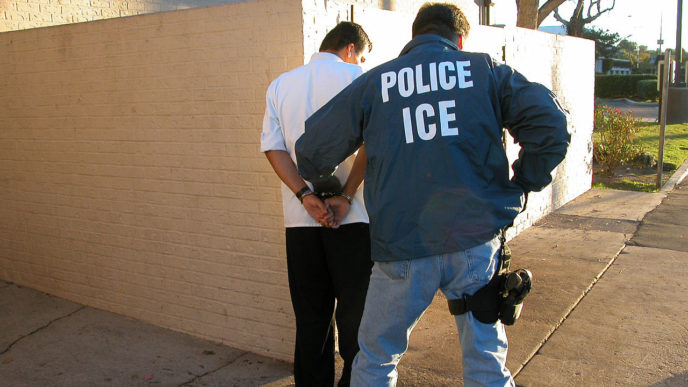
Among other matters, the memos call for moving forward on building a border wall, hiring more Customs and Border Protection agents to stop illegal border crossings, and adding more Immigration and Customs Enforcement agents to police the interior. Also, the Victims of Immigration Crime Engagement Office was established within ICE.
White House press secretary Sean Spicer said the actions Tuesday demonstrate the administration is serious about making the country safer.
“The message from this White House and from DHS is that those people who are in this country and pose a threat to our public safety and committed a crime will be the first to go and we will aggressively be making sure that occurs,” Spicer said during the White House press briefing.
The DHS actions are a welcome change from the Obama administration that interfered with immigration enforcement, said Ira Mehlman, spokesman for the Federation for American Immigration Reform, a pro-enforcement group. But, Mehlman added, the emphasis on prioritizing dangerous illegal immigrants is “a lot like the Obama administration.”
“The past administration put a priority on criminals and those that just entered the United States,” Mehlman told The Daily Signal. “The difference is that the Obama administration just focused on recent arrivals at the border, and sent them back. That’s important, but we also need serious interior enforcement.”
The policies won’t survive a court challenge, said Omar Jadwat, director of the Immigrants’ Rights Project at the American Civil Liberties Union.
“These memos confirm that the Trump administration is willing to trample on due process, human decency, the well-being of our communities, and even protections for vulnerable children, in pursuit of a hyperaggressive mass deportation policy,” Jadwat said in a public statement. “However, President Trump does not have the last word here—the courts and the public will not allow this un-American dream to become reality.”
More than likely, the implementation orders have solid legal ground, said Josh Blackman, an associate professor at South Texas College of Law Houston.
“There is probably not a strong challenge to the order Secretary Kelly signed, but a question of due process could come up regarding expedited removal,” Blackman told The Daily Signal. “If you’re picked up at the border and turned around there usually is no question. Expanding that to being picked up at the interior, that could arguably imply a stronger connection to the U.S. and require due process for removal.”
A legal challenge would have little merit, but doesn’t necessarily mean the administration will prevail, said Hans von Spakovsky, senior legal fellow at The Heritage Foundation.
“It is well within the administration’s authority, but anyone can file a lawsuit, and that won’t stop errant judges from acting,” von Spakovsky told The Daily Signal.
Spicer stressed that the administration is only enforcing immigration law as it would any other law.
Our job, especially here at the White House, isn’t to call balls and strikes and say this person only violated part of the law. If this was any other subject, if this was tax evasion and we said, ‘Well, they really only cheated on their taxes a little,’ you wouldn’t be saying should they be going to prison or should they be getting a fine. At some point laws are laws. If people have a problem with the law, whether it’s at the local, state, or federal, then we should petition our lawmakers and executives to change it. Our job should not be should this individual not have to abide by the law, should this individual get a pass?
(For more from the author of “Trump Targets Criminals, Late Arrivals in Immigration Enforcement” please click HERE)
Army Lt. Gen. H.R. McMaster is a perfect fit for the position of national security adviser, and it is no surprise that his selection by President Donald Trump has delighted many in the defense and national security community.
Trump announced Monday night that McMaster will replace Michael Flynn, the retired Army general who resigned a week ago after he admitted misleading the vice president about the content of a December phone call with the Russian ambassador.
McMaster is a scholar-warrior, much like two fellow flag officers serving in Trump’s Cabinet—retired Marine generals James Mattis and John Kelly.
McMaster is a brilliant strategist who has devoted his Army career to understanding military history and helping America’s armed forces learn from the mistakes of the past in order to fight more effectively in the future. One of us, Thomas Spoehr, can say this with confidence, having known him for many years.
Notably, McMaster wrote a 1997 book, “Dereliction of Duty,” which criticized top military leaders during the Vietnam War for failing to give their candid advice to the president and secretary of defense. As national security adviser, one of McMaster’s key roles will be to provide unvarnished advice to the president.
More recently, as commander of the 3rd Armored Cavalry Regiment during the Iraq War, McMaster led U.S. forces in beating back an insurgency that was running rampant in the western Iraqi city of Tal Afar, where al-Qaeda had taken control.
In an interview with National Geographic, he described the situation his troops, and the Iraqi people, faced in Tal Afar:
All the schools were closed because of violence, all the marketplaces were closed. There was no power. There was no water. The city was lifeless. People lived in abject fear.
What McMaster did next changed the course not only of one city, but the entire U.S. military strategy in Iraq. He invested in working directly with the Iraqi people and building trust in the U.S. military’s capability to eliminate terrorists threatening their livelihoods. He moved his troops off large bases and brought them in contact with local residents.
In so doing, McMaster contributed to laying the groundwork for a new counterinsurgency strategy implemented by Army Gen. David Petraeus that ultimately would lead to the neutralization of al-Qaeda in Iraq and increased stability throughout the nation.
This strategy was not popular at the time, yet McMaster recognized its potential and was unwavering in his drive to try a new approach. Remaining willing to re-examine strategies and plans is a key attribute for the national security adviser.
McMaster is also just as much a warrior as he is a scholar and brilliant intellectual. He served in the first Persian Gulf War, receiving a Silver Star for his leadership and bravery in the 1991 Battle of 73 Easting, the largest tank-on-tank battle since World War II.
In this 23-minute battle, McMaster’s company destroyed 28 Iraqi tanks, 16 personnel transports, and more than 30 trucks.
These accomplishments speak volumes about McMaster’s professionalism, leadership, and passion for defending America. He is an extraordinary choice to be national security adviser, and Trump was wise to select him.
Going forward, Americans can rest assured knowing that H.R. McMaster will be the man providing national security advice and options to the leader of the free world. (For more from the author of “Trump’s Stellar Pick for National Security Adviser” please click HERE)
One of the most inane arguments against constructing a border wall is that the estimated cost of $12-$15 billion is just too much to bear. As if liberals suddenly care about spending when it comes to defending our sovereignty, security, and society from the crushing human and fiscal costs of illegal immigration, terrorist infiltration, drug importation, and sex trafficking. It’s akin to refusing to pay for the water to preempt a fire from spreading to your neighborhood and burning down your house.
Now a new report from the inimitable Steve Camarota of the Center for Immigration Studies demonstrates how easily the wall will pay for itself by saving taxpayers the heavy costs of future illegal aliens successfully kept out of the country. Camarota finds that, at a lifetime cost of $74,722 per illegal alien, the border wall will pay for itself within the 10-year budget frame if it only succeeds in keeping out 9 to 12 percent of those expected to successfully cross in the next decade. And as I will demonstrate, border fences are almost fully effective in keeping out those who smuggle through non-legal points of entry. Plus, the lifetime cost of keeping out each alien is very likely much higher.
Border fences work spectacularly
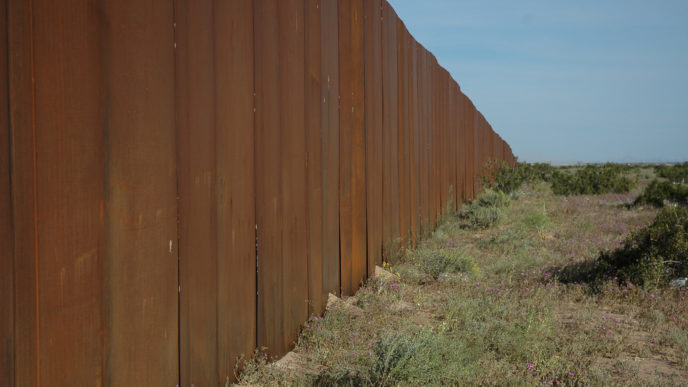
Once we establish the efficacy of a double-layered security barrier — similar to the one built in San Diego and Israel — it is simply indefensible to focus on the cost of the actual construction. Last month, we reposted my “Case for a Border Fence,” in which I prove conclusively that a double-layered security wall in the toughest areas serves as a force-multiplier.
The facts stand for themselves. A similar wall stopped almost 100% of the most committed Hamas terrorists in the West Bank and migrants on Israel’s southern border. The presence of such a security wall in the San Diego sector and a plain double (or triple) layered fence in the Yuma Sector reduced apprehensions by 95% and substantially reduced the flow of drugs. And most importantly, only a fraction of those two sectors — primarily in urban areas — have the double layered fence. Imagine if most of the sectors were sealed off?
We can see the effectiveness of fencing from a report published several months ago by the Senate Homeland Security Committee. Although there are only 35 miles of heavy duty double-layer fencing along the southern border, roughly one-third of the border has some form of fencing or vehicle barriers, with all but 100 or so miles being woefully inadequate. Nonetheless, the report found that while interdiction rates were over 50% across the border, they were as low as 5% in areas without any form of fencing. The history of the efficacy of fencing is “settled science,” as liberals like to say.
Thus, it’s quite evident that a fence would succeed in stopping a lot more than 9-12 percent of crossings. Camarota, however, just wanted to demonstrate how even a modest level of success would result in full savings. As Camarota noted, a full-proof wall, in his estimation keeping out 170,000 aliens per year, would actually save $64 billion over 10 years, which would mean taxpayers would recover the cost of the fence after just a few years’ worth of blocking illegal entry.
A wall stops hundreds of billions in unfunded liabilities and amnesty costs
But it gets better.
Camarota’s report uses data from the National Academies of Sciences, Engineering and Medicine to estimate the life-time fiscal impact (taxes paid minus services used) of immigrants by education level. He comes up with a sum of $74,722 per illegal-crosser. However, if the descendants of these illegal immigrants are factored in to the equation, the cost increases to $94,391 per illegal. And if different mythologies are used to calculate the life-time fiscal cost (not using net present value), the cost could be as high as $140,000-$150,000 per illegal, according to Camarota.
Moreover, there are more factors to consider when conducting a cost-benefit analysis of the wall. These numbers are merely comparing the cost of having a low-income migrant live here illegally vs. keeping that individual out. Liberals don’t merely oppose the border fence and allow illegals to come in only to remain here illegal. They want to give all these people amnesty, which will grant them access to welfare and entitlements. According to Robert Rector, “If amnesty is enacted, the average adult unlawful immigrant would receive $592,000 more in government benefits over the course of his remaining lifetime than he would pay in taxes.” That is eight times the cost of non-amnestied illegals residing in the country, per Camarota’s report.
Assuming a 95% success rate in deterring 170,000 immigrants, we could save roughly $100 billion a year relative to the cost of amnesty. Which means that just 6-8 weeks’ worth of deterring illegal entry would make building the fence more cost effective than amnesty.
A wall saves the cost of deportation, litigation, detention, and interior enforcement
The wall would likely save us from more than the estimated 170,000 illegals that evade the border patrol between points of entry. Until now we were only counting the fiscal cost of impoverished illegal immigrants who successfully infiltrate our borders and remain in the country undetected. In FY 2016, for example, 408,870 illegals were apprehended at or near the southern border. How many were not caught and successfully disappeared into the country? There is no way of telling for sure, but DHS estimated that in FY 2015 they apprehended 54% of those who infiltrated the country.
But even the 54% of illegals we supposedly apprehend every year are not free of charge. Not by a long shot. Many of them wind up successfully remaining in the country. According to recent data from the Syracuse University’s Transactional Records Access Clearinghouse (TRAC), nearly six in ten illegal aliens during the first ten months of FY 2016 were set free by immigration judges.
Even the ones we wind up deporting come at a big cost. They almost always surrender themselves to the border patrol, many of the children are let out of ICE custody, and even many families are now being released by the courts. The cost of the detention centers, the crushing burden on the courts, the education and health care for the Central American children, and the logistics of deportation all cost money. There is no better cost effective enforcement mechanism than a fixed impenetrable deterrent that prevents illegals from stepping foot on our soil in the first place. Not to mention the fact that it solves the political and legal arguments about deportation that invariably come into play the minute they enter our country.
Moreover, by focusing our investment in enforcement on a border wall, which is an up-front non-reoccurring cost for something that actually works, we will save billions in extra funding for the many other assets that have failed to secure the border. Just over the past decade, we have spent over $100 billion on different methods of security but to no avail — all to avoid the $12-$15 billion cost of building a double layer security barrier.
Thus, even if we say conservatively that roughly 700,000 illegals cross the border per year – including those apprehended and those who evade the border patrol – we can easily say that the life time cost of illegal immigration would be paid for within just a few weeks of a fence successfully deterring over 50,000 border crossings. And that is just the cost of illegal immigration.
Avoiding the cost of harmful drugs
According to the DOJ’s National Drug Intelligence Center, the economic cost of drugs in terms of crime, health care, and productivity is some $215 billion a year. And that was long before the recent opioid epidemic. The war on drugs has been a dismal failure in stopping drugs (although it has helped reduce crime across the board). However, there is one idea we never tried: keeping drugs out of America in the first place. The same wall that keeps out illegal immigrants and stopped Hamas terrorists will stop most drug smugglers.
The 800-pound gorilla in the room when it comes to analyzing the drug problem is the open southern border, and particularly the sectors with limited or no fencing. Almost every drop of marijuana seized by the feds in FY 2016 (99.8%) and 76% of cocaine came though the southern border. Of all the marijuana seized at the southern border, 82% was found in just two sectors: Tucson and Rio Grande (east Texas). Those are by far the two busiest corridors for illegal immigration and the sectors with the least meaningful fencing.
Remember the double-layered fence we mentioned earlier that was constructed in only part of the Yuma Sector? As a result, Tucson suffers from marijuana smuggling exponentially more than Yuma — by a factor of 22. Arizona has become the drug-smuggling capital of the country. From 2010 to 2015, heroin seizures in Arizona have increased by 207 percent, while methamphetamine seizures grew by 310 percent.
It’s hard to even calculate the tens of billions we would save every year as a result of plugging the hole and building a security wall in just those two sectors alone. In addition, according to the National Drug Threat Assessment, most of the heroin in this country, which is tearing our communities apart, is coming from Mexico. Obviously, we will never live in a utopia and a portion of the other drugs will come in through the maritime borders, with some drugs will be smuggled through cars passing legally over the border, but building the wall would go a long way in cutting the costs of the drug epidemic.
In addition to drug smuggling, the permanent presence of an impenetrable fence will deter the appalling sex trafficking cartel and terrorist smugglers. This has an enormous fiscal cost as well as a moral and national security cost. Also, to paraphrase DHS Secretary John Kelly at his confirmation hearing, “in America, some of us think of this drugs as leisure, but in Latin America they are killing their people.” And remember, every dollar of drug revenue that is lost to the Narco-terrorist gangs is a dollar less flowing into Islamic terror.
Anyone who wants to haggle over the price of the fence clearly has no understanding of the severe burden open borders has on our budget or doesn’t want to secure the border. (For more from the author of “New Report: A Border Wall Easily Pays for Itself With Its Own Effectiveness” please click HERE)
https://joemiller.us/wp-content/uploads/3370155351_cde8ae5644_b.jpg6811024Joe Millerhttps://joemiller.us/wp-content/uploads/logotext.pngJoe Miller2017-02-20 23:58:002017-02-25 22:36:36New Report: A Border Wall Easily Pays for Itself With Its Own Effectiveness