Experts Debate Whether Trump’s Refugee Order Will Make America Safer

With an executive order signed Friday, President Donald Trump delivered on his campaign promise to impose a restrictive U.S. policy toward refugee resettlement and other forms of legal immigration.

By preventing Syrian refugees from entering the U.S. indefinitely, imposing a 120-day suspension on all refugee admissions from anywhere in the world, and temporarily blocking visas from seven Muslim-majority countries, Trump took a different approach than his predecessor with a stated aim to keep extremists out of America.

While some security experts welcome the orders as a short-term way to evaluate and improve U.S. vetting procedures, others worry that limiting American assistance to the most vulnerable of immigrants is detrimental to the fight against terrorism.

“It’s a good short-term measure that allows us to take a step back and look more holistically at immigration and refugee policy, but this is by no means a long-term fix and it would undermine our interests and values if this becomes the new norm,” said Andrew Bowen, a visiting scholar at the American Enterprise Institute, in an interview with The Daily Signal.

Throughout his campaign, Trump targeted the U.S. refugee resettlement program, arguing the government’s vetting system needed to be tougher, especially for Syrians fleeing war and attempting to come to the U.S. His executive order calls for “extreme vetting” of refugees.

The U.S. admitted 84,995 refugees in fiscal year 2016, the most since 1999. The total included more than 12,000 Syrians, making them the second-largest origin group.

“We are establishing new vetting measures to keep radical Islamic terrorists out of the United States,” Trump said Friday at the Pentagon during a ceremony for James Mattis, the new defense secretary. “We want to make sure we aren’t admitting to our country the threats our soldiers are fighting overseas. We only want to admit those to our country who will support our country and love deeply our people.”

Trump’s predecessor, President Barack Obama, countered that the current vetting process for refugees is the most stringent screening for any category of legal immigrant. The process for Syrians has additional layers, and can take up to two years.

There is no known case of a Syrian refugee being involved in a terror plot in the U.S.

“The people who come to the U.S. from Syria are not walking over borders like in Europe,” said Robert Ford, a former ambassador to Syria in the Obama administration who is currently a senior fellow at the Middle East Institute and Yale University.

“They are not taking trains without passports and visas,” Ford told The Daily Signal in an interview. “They are getting on airplanes and screened ahead of time. The public perception that these Syrian refugees are like illegal immigrants sneaking across the border does not pertain to America. We have an ocean between the U.S. and Middle East. There is a whole level of control. I am not saying it’s perfect, but compared to other security risks, it’s manageable.”

But in recent congressional testimony, critics note, FBI Director James Comey said Syrian refugees are particularly hard to screen because the war-torn country has few criminal terrorist and criminal databases to check.

“If we don’t know much about somebody, there won’t be anything in our data,” Comey said, although he assured the screening process has “improved dramatically” over time. “I can’t sit here and offer anybody an absolute assurance that there’s no risk associated with this.”

What the Order Does

Trump’s order imposes an immediate 90-day pause to the legal admission of people seeking visas—for business, family reasons, humanitarian emergencies, or tourism—from Iraq, Iran, Sudan, Libya, Somalia, Yemen, and Syria.

The refugee resettlement program is shut down for four months, and when it returns, Trump proposes to cut the maximum number of refugees allowed into the U.S. in fiscal 2017 from 110,000—as Obama proposed—to 50,000. In 2011 and 2012, Obama admitted less than 60,000 refugees, before ramping up the numbers in recent years.

In addition, once the Trump administration eases restrictions on visas and the refugee program, the government will prioritize those claiming religious persecution, “provided that the religion of the individual is a minority religion in the individual’s country of nationality.” Some observers say this means Trump will prioritize Christian refugees over Muslim ones, but the president is fighting that characterization.

According to the Pew Research Center, the U.S. admitted almost as many Christian refugees (37,521) as Muslim refugees (38,901) in the 2016 fiscal year.

A relatively small number of Syrian Christians have been admitted. Pew reports that about one-half of 1 percent of the refugees admitted in calendar year 2016 from Syria are Christian, even though they make up about 5 percent of the Syrian population.

“To be clear, this is not a Muslim ban, as the media is falsely reporting,” Trump said in a statement Sunday night. “This is not about religion—this is about terror and keeping our country safe. There are over 40 different countries worldwide that are majority Muslim that are not affected by this order.”

Even so, Ford, the former U.S. ambassador to Syria, said blocking immigration from certain Muslim-majority nations legitimizes ISIS’ propaganda that aims to turn Muslims against the West.

“On the one hand, the Trump administration is talking about eradicating radical Islam,” Ford said.

“He is promising a hard-fisted military approach. On the other hand, measures like this will paint the American administration as at best indifferent, and more likely, hostile, to Sunni Muslims in places like Syria and Iraq who feel like they are already under attack. That will fuel jihadi recruitment, whether from individuals living in bombed out cities in Syria or in Lebanon refugee camps.”

‘Improved US Security’

Edward Alden, a senior fellow at the Council on Foreign Relations, told The Daily Signal that since 9/11, the U.S. has implemented enhanced security procedures to a degree that European countries have not.

Today, visa applicants from overseas are fingerprinted and photographed to check their identities against terrorist databases.

The government is better able to ensure identity by intercepting phony passports and inadequate identification, Alden said. It created a comprehensive database of people across the world with known or suspected terrorist history, and it targets people with suspicious travel or other patterns, such as how they communicate and who they are communicating with, including internet conversations.

Alden said information-sharing among allies is the most important factor underlying these security procedures, and he worries Trump’s executive order will harm that effort.

“One of the most important elements in the improved U.S. security we have seen since 9/11 is intelligence cooperation from allied governments and cooperation in particular from moderate Muslims in the United States, and around the world,” said Alden, who is author of “The Closing of the American Border: Terrorism, Immigration, and Security Since 9/11.”

“By targeting a handful of Muslim countries in this fashion, and targeting the most vulnerable segment of this population, this will undermine our ability to solicit cooperation.”

In his executive order, Trump expresses concerns over information-sharing, and threatens to withhold visas from countries deemed insufficiently cooperative.

The president directs the relevant Cabinet agencies to review the vetting process for citizens of all countries where visas are required to travel to the U.S.

If those nations don’t improve their cooperation, they will be added to the list of countries whose citizens are barred from entry to the U.S.

Alden notes that because visa programs are supposed to be reciprocal, many of the affected countries could decide to respond to Trump’s aggressive approach by restricting American travelers.

Already, leaders in Iran and Iraq, two of the countries targeted by Trump’s order, vowed to take retaliatory action against the U.S.

‘Preparing’ for Life After ISIS

James Carafano, a national security expert at The Heritage Foundation, disagrees with this characterization and says that prudency is necessary at a time when the U.S.-led military coalition is making major gains against ISIS in Iraq and Syria.

“What the Trump administration is doing is taking a perfectly practical measure preparing for the time when ISIS is defeated in the Middle East and all those foreign fighters in the region will outflow, potentially targeting the United States,” said Carafano, who was on the Trump transition team. “Trump got elected to look at these things and get ahead of the threat by making sure the American people are adequately protected.”

Ford, and Bowen of the American Enterprise Institute, acknowledge the foreign fighter risk, but they consider the list of targeted nations to be flawed.

The list does not include Muslim-majority countries like Saudi Arabia, where most of the 9/11 hijackers were from. The other hijackers were from United Arab Emirates, Egypt, and Lebanon, none of which are on Trump’s list.

“That list could have been put together better,” Bowen said. “It’s a bit haphazard in that countries like Saudi Arabia and Tunisia, and even European countries like Germany, France, and Belgium, have individuals fighting in Syria and Iraq. If you are going to take this action, individuals from those countries should also be strongly vetted.”

The targeted countries do share common traits.

The U.S.-led military coalition is conducting airstrikes against terrorists in five of the seven targeted countries: Iraq, Syria, Libya, Yemen, and Somalia.

The U.S. government considers three of those countries to be sponsors of terrorism (Iran, Sudan, and Syria), and the Obama administration designated the others as countries of concern (Libya, Somalia, Iraq, and Yemen).

Of 161 people charged with jihadist terrorism-related crimes or who died before being charged, 11 were identified as being from Syria, Iraq, Iran, Libya, Yemen, Sudan, or Somalia—the countries specified in Trump’s order—The Wall Street Journal reported.

Experts note that in recent jihadist terrorist attacks, from San Bernardino to Orlando, American citizens or green card holders have been the perpetrators.

“The biggest threat to our nation is not someone coming from across the border with a visa or as a refugee,” said Mustafa Tameez, who has worked as a consultant for the Department of Homeland Security and State Department on counterterrorism issues. “The threat is from homegrown terrorists, someone who is radicalized over the internet and latches on to ISIS’ message that Islam is incompatible with Western democracy,” Tameez told The Daily Signal in an interview.

The Trump administration has adjusted the refugee policy since its rollout was heavily criticized.

On Sunday night, it said that green card holders would be exempt from the new policy. And the Pentagon reported Monday that it is compiling a list of Iraqis who have aided the U.S. military to determine if they should be exempted from Trump’s order.

“The executive order is not a policy,” said Mark Krikorian, the executive director of the Center for Immigration Studies, in an interview with The Daily Signal. “It’s just hitting the pause button so we can see what policy changes we need to make America safer. That’s what people aren’t getting. This isn’t the end point.” (For more from the author of “Experts Debate Whether Trump’s Refugee Order Will Make America Safer” please click HERE)

Follow Joe Miller on Twitter HERE and Facebook HERE.
Let’s Be Real: Obama ‘Barred’ Syrian Christian Refugees

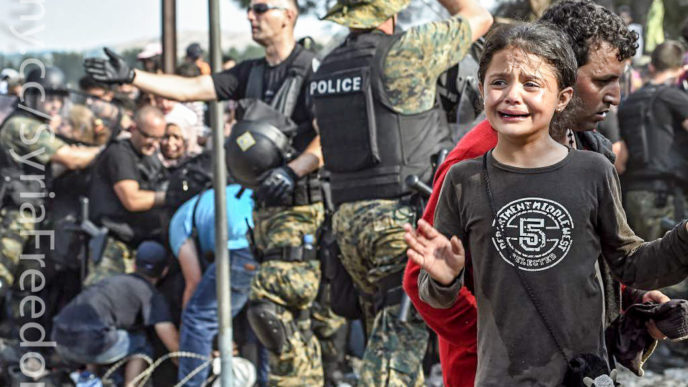
President Trump said he’s righting a wrong in ordering his administration to prioritize refugee applications from Christian minorities in Muslim countries Friday, but critics are declaring the move unfair and “un-American.” Let’s look at what the numbers have to say about the way Christian refugees were treated under President Obama.

The country admitted about the same number of Christian refugees as Muslim refugees in Fiscal Year 2016, according to Pew Research Center figures cited by The New York Times in an effort to refute Trump’s statement. About 38,000 Christian refugees were admitted compared to about 39,000 Muslims.

But this figure is a sum total of refugees worldwide, when Trump was clearly referring to specific Christian minority populations in the Middle East. The way it’s deployed in The New York Times report is incredibly misleading and entirely misses the point.

Previous administrations made it “almost impossible” for Syrian Christian refugees to gain admission, Trump told the Christian Broadcasting Network Friday, although they were “horribly treated” in their country.

“If you were a Muslim you could come in, but if you were a Christian, it was almost impossible,” he said. “I thought it was very, very unfair. So we are going to help them.” (Read more from “Let’s Be Real: Obama ‘Barred’ Syrian Christian Refugees” HERE)

Follow Joe Miller on Twitter HERE and Facebook HERE.

White House Defends Omission of Jews from Holocaust Statement

By Michael Wilner and Tamara Zieve. The Trump Administration defended its decision to omit any mention of Jews or antisemitism from its statement marking International Holocaust Remembrance Day, noting that Jews were not the only victims of Nazi slaughter.

“Despite what the media reports, we are an incredibly inclusive group and we took into account all of those who suffered,” Hope Hicks, a communications aide for the president, said in a comment to CNN. In his statement, Donald Trump vowed to stand up against the forces of evil as president.

“It is with a heavy heart and somber mind that we remember and honor the victims, survivors, heroes of the Holocaust,” the US president said in the statement.

“It is impossible to fully fathom the depravity and horror inflicted on innocent people by Nazi terror.”

The omission drew ire from the Anti-Defamation League, whose CEO Jonathan Greenblatt tweeted that it was “Puzzling and troubling @WhiteHouse #Holocaust- MemorialDaystmt has no mention of Jews. GOP and Dem. presidents have done so in the past.” (Read more from “White House Defends Omission of Jews from Holocaust Statement” HERE)

_________________________________________

German Muslim Students Protest Holocaust Remembrance, Attack Israel

By Benjamin Weinthal. Muslim students of Arab and Turkish origin protested participation in an International Holocaust Remembrance Day event in Germany, while their high school’s administration showed understanding for their criticism of Israel.

“Some Muslims students said they would not participate in the event,” said Florian Beer, a teacher at the school in the city of Gelsenkirchen in North Rhine-Westphalia state, Der Westen newspaper reported on Thursday.

The Holocaust remembrance event was part of a global commemoration in which participants take selfie photographs along with a sign saying “I Remember“ or “We Remember.“ A blackboard at the school was defaced with the sentence: “F*** Israel, free Palestine.” The school was not able to identify the perpetrator.

Dr. Efraim Zuroff, the head of the Jerusalem office of the Simon Wiesenthal Center, told The Jerusalem Post on Friday, “Muslims students are greatest in need of Holocaust education, so it would be unfortunate if they were excused from those activities.”

Zuroff, who is Wiesenthal’s chief Nazi-hunter, added, “Given that Holocaust consciousness is a central idea of civic identity in the Federal Republic, it is doubly important for families that come from countries with deep antisemitic traditions and no knowledge of the Holocaust and the destruction of European Jewry.” (Read more from “German Muslim Students Protest Holocaust Remembrance, Attack Israel” HERE)

Follow Joe Miller on Twitter HERE and Facebook HERE.

Trump Refugee Order Balances Security and Compassion

Read any commentary on the just signed executive order on visa and refugee vetting from several countries in the Middle East and odds are the assessment will tell you more about the writer’s politics than be an analysis of the order.

I confess: I have a perspective as well. Mine comes from working on the presidential team on both foreign policy and homeland security from after the Republican convention up to the inauguration. I can’t share the detailed workings of the team. But what I can share, having worked on the issues, is what I believe guided the work.

And it all started with making America safe.

Not campaign promises, anger at any religion, or prejudice of any kind impacted our thinking on the transition team. What we were worried about were future threats.

As the space for the Islamic State, or ISIS, gets squeezed in the Middle East, the remains of the tens of thousands of foreign fighters will have to flow somewhere. Every nation, not just the U.S., believes they are most likely to flow to the countries cited in the order. That fact, and only that fact, is why those countries are included on the list. Indeed, when it comes to visa vetting, that’s why the European Union has restrictions that are comparable to the United States.

The reason why we all worry is because, from those countries, foreign fighters could well try to flow to the West, principally by using visas or posing as refugees. When they get to the West, they could carry out terrorist acts. We know that because they already have—specifically in Western Europe.

They haven’t come to the U.S.—yet. Right now, our primary threat is Islamist-related terror plots that are organized by terrorists who are already here.

What this administration is doing is making sure we are ready for the next wave of terrorism as well—the outflow of terrorists from the countries of conflict where the foreign fighters are likely to go first.

There are already cries that the precautions are unfair—creating hardships. Fair enough, but terrorists attacks (like those at the Bataclan in France by the followers of ISIS) create unbearable hardships as well—and the government has the responsibility to find the right balance between security and compassion for its citizens as well as consider how U.S. actions impact others around the world.

One area where the order tries to get that balance right is to ensure future refugee processing prioritizes addressing the plight of religious minorities. That is particularly crucial in the Middle East where the remnants of the region’s Christian communities are under severe threat.

Worldwide persecutions against Christian minorities have been rising for four straight years. It’s particularly problematic in the Middle East. The administration is making an extra effort to address that crisis.

While critics will continue to demonize the administration’s policies because they don’t fit their politics, Americans who crave a foreign policy that prioritizes American interests, puts a compassionate face on statecraft that reflects our values, and acts responsibly will find much to respect in the order. (For more from the author of “Trump Refugee Order Balances Security and Compassion” please click HERE)

Follow Joe Miller on Twitter HERE and Facebook HERE.

Republicans Express Doubts over Obamacare ‘Repeal and Replace’ Plan

Some Republican lawmakers are beginning to have doubts about the GOP’s plans to repeal and replace Obamacare, they revealed in a closed-door gathering Thursday in Philadelphia.

But those lawmakers find themselves at odds with conservatives who have for years pushed for repeal of the Affordable Care Act—as well as the top Republican in the House.

“We have to repeal it,” Rep. Jim Jordan, R-Ohio, said of Obamacare in an interview with The Daily Signal. “That’s what we told voters we’re going to do, and we have to repeal all of it. Every mandate. Every regulation.”

The Washington Post reported Friday that some Republicans appeared to be wavering over how to follow through on their long-held promise to repeal and replace Obamacare.

The Post obtained a recording of a session on health care held Thursday at House and Senate Republicans’ joint retreat at the Loews Philadelphia Hotel.

Some lawmakers in the meeting expressed concerns over tackling major issues accompanying repeal of the health care law, including how to craft a replacement plan in a timely manner and whether to include a measure to defund Planned Parenthood in the repeal legislation.

Reps. Tom McClintock of California, John Faso of New York, and Tom MacArthur of New Jersey were among those The Post identified on the recording.

Despite their hesitations, however, House Speaker Paul Ryan reaffirmed the GOP’s commitment to rolling back the health care law this year.

“We have to move quickly because we’re in the midst of collapse [of the health care law],” Ryan said during an event Friday organized by Politico.

“We have a moral obligation to fix this problem. Period,” he said.

In a meeting with fellow Republicans in Philadelphia, Ryan mapped out a timeline for repealing and replacing the health care law. He told lawmakers that Congress would pass the bill repealing Obamacare by March or April.

Republicans initially planned to pass a repeal bill shortly after President Donald Trump’s Jan. 20 inauguration.

That legislation—passed through a budget tool called reconciliation—also would include parts of a replacement.

For years, conservatives such as Jordan, who previously chaired the roughly 40-member House Freedom Caucus, have made a target of Obamacare—which Congress passed in 2010 without a single Republican vote.

Now that Republicans have the numbers to successfully repeal the health care law, Jordan is calling for Congress to move quickly.

“I want to do it as soon as we possibly can, because I start from the very fundamental premise that health care will be better and cost less when Obamacare is gone,” the Ohio Republican said. “So let’s get rid of it as quickly as we can.”

Despite a commitment to repealing Obamacare in coming weeks, some Republicans are skeptical that ending taxpayer funding of Planned Parenthood, the nation’s largest abortion provider, should be included in that action.

That provision was part of the bill Republicans sent to President Barack Obama’s desk early last year to roll back major provisions of Obamacare.

Obama vetoed that bill. But with Republican control of both chambers of Congress and the White House, conservatives are pushing for the new repeal bill to at a minimum mirror the legislation passed last year.

Ryan said earlier this month that the House will include Planned Parenthood’s defunding in the budget reconciliation bill the chamber takes up this year.

And conservative lawmakers are urging the House speaker to follow through on that pledge.

“The repeal should include the Planned Parenthood defund language as well because, for goodness sake, that was in the bill we put on President Obama’s desk,” Jordan told The Daily Signal. “Are we going to put something less on President Trump’s desk than what we put on President Obama’s desk?”

“Of course the Planned Parenthood funding should be dealt with in that bill,” he said. (For more from the author of “Republicans Express Doubts over Obamacare ‘Repeal and Replace’ Plan” please click HERE)

Follow Joe Miller on Twitter HERE and Facebook HERE.

Trump Takes the First Step in Restoring the US Military

On Friday, President Donald Trump signed an exceptionally important executive order initiating both the beginning of the rebuilding of the U.S. armed forces and the fulfillment of a campaign promise.

Because he signed this order on the same day he signed the order on immigration it hasn’t yet gotten the attention it deserves. That’s a shame.

The order, titled “Rebuilding the U.S. Armed Forces,” has not yet been officially posted to the White House website. But a draft of the order, accompanied by news reports, gives us enough details to be able to assess it.

The order directs Secretary of Defense James Mattis to conduct a 30-day review of the readiness of the armed forces to assess their ability to conduct the fight against the Islamic State, or ISIS, and other forms of radical Islamic terrorism, as well as near peer competitors and regional adversaries.

This review is critically needed. The Heritage Foundation has been vocal in calling for such a review based on our independent assessment of the U.S. military.

The Heritage 2017 Index of U.S. Military Strength assessed our overall military capability as “marginal, trending towards weak” because of many years of budget cuts and overuse. Our assessment found that the U.S. Army today is the smallest it has been since the start of World War II; the Navy is the smallest it has been since World War I; and the Air Force suffers from crippling shortages of pilots and maintenance personnel. For example, the average age of the Air Force’s planes is 27 years old.

For too long the nation, and the president, has neglected the state of military readiness in favor of other priorities.

This 30-day review will allow the defense secretary and the president to establish the facts and determine the necessary priorities for the rebuilding of the military.

The order also calls for a review to “reduce commitments not directly related to the highest priority operations to make resources available for training and maintenance.” This is also overdue.

As described in the Heritage’s “Blueprint for Balance,” the Department of Defense spends hundreds of millions of dollars each year on programs not directly related to military readiness such as non-military-related medical research, sustainable energy programs, and junior ROTC programs. Although there won’t be enough resources identified just through cuts and efficiencies to fix the Pentagon’s readiness problems, every little bit helps.

Perhaps most significantly, the order directs Mattis and the director of the Office of Budget and Management to develop both a new request for emergency funding for fiscal year 2017 and to revise the still-to-be-released budget request for 2018 to provide the increased funding needed to begin the rebuilding of the military.

That direction aligns with recommendations from both Sen. John McCain, R-Ariz., and Rep. Mac Thornberry, R-Texas. McCain and Thornberry, the chairmen of the Senate and House Armed Services committees, respectively, both have a clear-eyed view of the critical state of the U.S. military and have written persuasively on the need for additional defense funding.

Obtaining additional funding for defense will require some difficult negotiations within Congress and with the White House, but the need is so critical that failure to succeed is not a viable option.

Congress and the administration will need to establish concrete and measurable objectives for the rebuilding of our military so that the American taxpayer can be assured that every dollar applied to defense results in an improvement.

Finally, the executive order calls for a new nuclear posture and missile defense reviews, two critical defense areas that have both suffered considerably under the Obama administration. Heritage has been consistent and vocal in pointing out the need for new reviews and increased investment of our nation’s nuclear and missile defense domains.

Could all of these actions been undertaken without a presidential executive order? Certainly. But by signing this order, Trump has sent an unambiguous signal across his administration that the rebuilding of our military is one of his top priorities. Given the threats our nation faces today to its national interests, this sends exactly the right signal to both our allies and potential adversaries. (For more from the author of “Trump Takes the First Step in Restoring the US Military” please click HERE)

Follow Joe Miller on Twitter HERE and Facebook HERE.

13 of Trump’s Cabinet Nominees Await Senate Approval, Leaving Agencies Without a Leader

President Donald Trump moved at a blistering pace to fulfill several campaign promises during his first week in the White House. At the other end of Pennsylvania Avenue, however, 13 of his Cabinet nominees continue to wait for confirmation votes.

Obama had 11 of his 15 Cabinet secretaries in place after his first week. Trump has two.

Trump begins his second week with the same number of Cabinet secretaries as last week: two. That number should at least double by Tuesday after the Senate votes to confirm Rex Tillerson for secretary of state and Elaine Chao for secretary of transportation.

The slow pace of confirmations is delaying Trump’s ability to implement his agenda, several former administration officials told The Daily Signal.

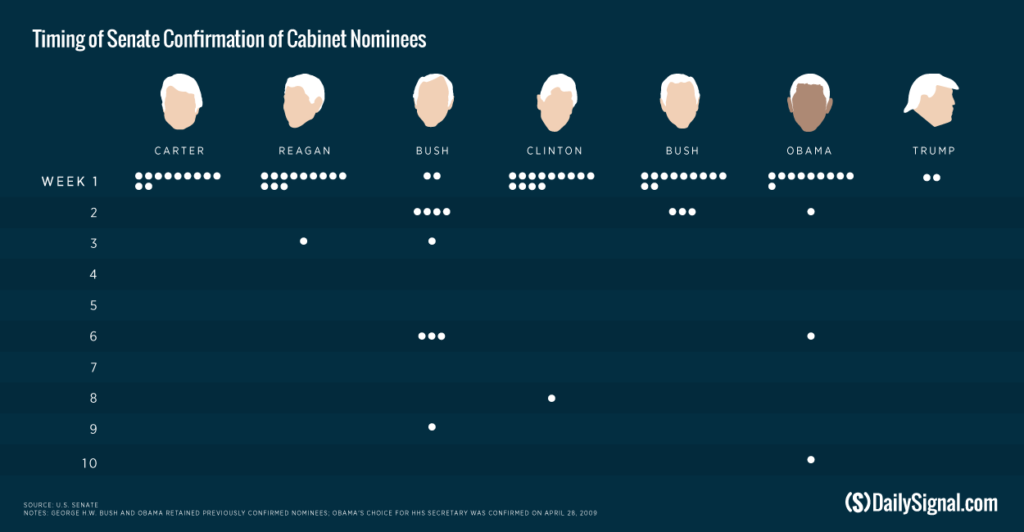
It’s also a sharp contrast from President Barack Obama’s early days. Trump’s Democrat predecessor had 11 of his 15 Cabinet secretaries in place after his first week (including Robert Gates, who remained as defense secretary from the prior administration).

Five of the past six presidents—Jimmy Carter, Ronald Reagan, Bill Clinton, George W. Bush, and Obama—had nearly their entire Cabinet installed by their second week in the White House. President George H.W. Bush faced delays, but he had the advantage of retaining three of Reagan’s Cabinet secretaries.

This week’s planned confirmation votes on Tillerson and Chao, coupled with committee action on several other nominees, should generate some movement after the GOP-controlled Senate made little progress last week. (See list at bottom for this week’s schedule.)

Last week, Republicans left town for a three-day retreat in Philadelphia, but they did confirm two non-Cabinet officials: Mike Pompeo to lead the CIA and Nikki Haley as U.S. ambassador to the United Nations. On Jan. 20, Inauguration Day, the Senate approved James Mattis for defense secretary and John Kelly for homeland security secretary.

Democrats have vowed to mount a fight against at least eight of Trump’s nominees, including Tillerson. Due to a rules change that Democrats made in 2013 while they were in the majority, however, they lack the votes to ultimately defeat Trump’s nominees. It now takes a simple majority to confirm nominees, and Republicans control 52 seats compared to the Democrats’ 48. Senate Minority Leader Chuck Schumer still can employ delaying tactics, though.

170120_Confirmation-Timing-1024x532

Such delays could stall the Trump administration’s ability to implement policies or carry out executive orders, said Don Devine, director of the Office of Personnel Management under Reagan.

“This is a president who wants change, and he has got to get his nominees confirmed as soon as possible if he is going to get that change,” Devine told The Daily Signal.

Continuity of government is usually not a problem, but implementing the president’s agenda is, said Becky Norton Dunlop, the Ronald Reagan distinguished fellow at The Heritage Foundation. Dunlop served in the Reagan administration at the White House, Justice Department, and Interior Department.

“From the standpoint of taking control of the government, it’s important for the president to employ people to act,” Dunlop told The Daily Signal.

Most of Trump’s nominees ultimately will be confirmed, Dunlop said. She said this is just an effort by Schumer, D-N.Y., to curb their effectiveness. The minority leader knows that the longer it takes for Trump’s nominees to win Senate approval, the later they’ll start implementing the new president’s agenda.

“This is a way to damage these nominees that might have a more conservative agenda under President Trump and discourage them from moving forward aggressively,” Dunlop said.

For example, Tom Price, the Georgia congressman who Trump nominated to lead the Department of Health and Human Services, will play a crucial role when it comes to dismantling Obamacare.

One of Trump’s first actions directed his administration to rework the health care law’s numerous regulations. But without a secretary in place, there’s no one leading the charge at the agency.

Price, like Tillerson, is on Schumer’s list of eight nominees who Democrats oppose. The others include Betsy DeVos for education secretary, Steve Mnuchin for treasury secretary, Andrew Puzder as labor secretary, and Jeff Sessions for attorney general. Schumer’s list also includes Scott Pruitt to head the Environmental Protection Agency and Mick Mulvaney for the Office of Management and Budget, although they aren’t part of the Cabinet.

The remaining unconfirmed Cabinet nominees include Ben Carson for housing and urban development secretary, Rick Perry for energy secretary, Sonny Perdue for agriculture secretary, Wilbur Ross for commerce secretary, David Shulkin for veterans affairs secretary, and Ryan Zinke for interior secretary.

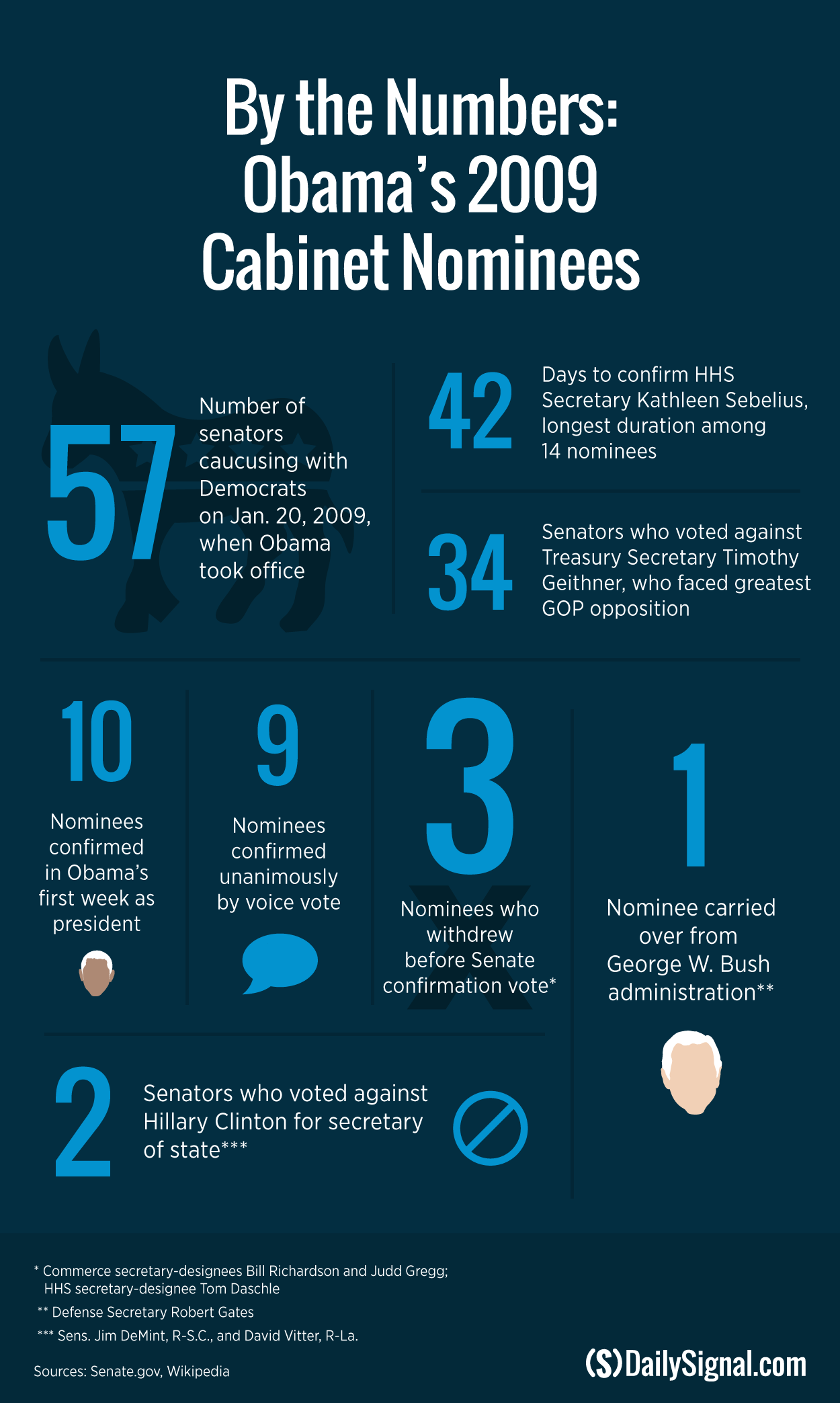
Republicans were in the Senate minority in 2009 when many of Obama’s nominees won quick confirmation without obstruction or delay. In fact, nine of Obama’s nominees were approved by voice vote, meaning Republicans didn’t even request a roll-call tally.

170103_2009-cabinet-picks_v3

Despite having 57 Democrat senators on Jan. 20, 2009, Obama’s final Cabinet secretary wasn’t confirmed until April 28 of that year. Two of his picks for commerce secretary withdrew, as did former Senate Majority Leader Tom Daschle, whom Obama picked to lead the Department of Health and Human Services.

The vacancy hampered the health agency when the swine flu outbreak occurred, recalled Tevi Troy, who served as a deputy secretary at HHS during the George W. Bush administration.

“It is a problem because these agencies are not able to be totally effective without a secretary at the top of the agency giving direction to assistant secretaries for the entire agency,” Troy told The Daily Signal.

During the interim period before a Cabinet secretary is confirmed, the acting agency head could be either a career employee or a political appointee designated by the previous administration. Either way, the White House designates someone to work with the acting secretary during the interim.

“The tradition has been that in the first day or the first week, a lot of nominees are confirmed,” Troy said. “My view is that if a nominee is both ethical and qualified, then the Senate should defer to the president’s choice for a Cabinet nominee.”

Schedule for Week of Jan. 30

Monday: Senate confirmation vote for Rex Tillerson, secretary of state; Senate Finance Committee vote on Steven Mnuchin’s nomination for treasury secretary

Tuesday: Senate confirmation vote for Elaine Chao, secretary of transportation; Senate Judiciary Committee vote on Jeff Sessions’ nomination for attorney general; Senate Energy and Natural Resources Committee vote on Ryan Zinke for interior secretary and Rick Perry for energy secretary

Wednesday: Senate Homeland Security and Governmental Affairs Committee vote on Mick Mulvaney for director of the Office of Management and Budget (Mulvaney also needs approval from the Senate Budget Committee) (For more from the author of “13 of Trump’s Cabinet Nominees Await Senate Approval, Leaving Agencies Without a Leader” please click HERE)

Follow Joe Miller on Twitter HERE and Facebook HERE.
A Powerful Week Under a Pro-Life President

During my bus ride to the March for Life this morning, I found myself gratefully reflecting on the good work the pro-life movement has been doing over the past week.

Only days after the conclusion of Barack’s Obama’s presidency, we are witnessing an unprecedented barrage of pro-life activity in Washington D.C. Despite being a very recent convert on the pro-life issue, Trump may be presiding over the most energetically pro-life White House since Roe v Wade.

Let’s look at the week leading up to the March for Life, one day at a time.

This Week of Life and Hope

On Sunday, the 44th anniversary of Roe v Wade, NBC News reported that “a Trump administration official” told the network it was “a shame that the March for Life, which estimates the same number of marchers” as the pro-abortion Women’s March, “will not get anywhere near the same amount of coverage that this march got – and those pro-life members were NOT welcome at the Women’s March.”

On Monday, President Trump reinstated the Mexico City Policy, cutting off American taxpayer funding for abortions abroad. In a fuming press release, leading abortion provider Marie Stopes International reacted to Trump’s decision by providing some stats that are music to pro-life ears: “In 2017, USAID funding would have helped us reach 1.5 million women in some of the poorest, most underserved countries in the world.” (Read between the lines: That’s 1.5 million poor women whose children MSI won’t be able to abort.)

On Tuesday, the House voted 238-183 for H.R. 7, the No Taxpayer Funding for Abortion and Abortion Insurance Full Disclosure Act of 2017, which would make the Hyde Amendment permanent law, ending all federal funding of abortion and banning the use of Obamacare subsidies to obtain insurance coverage for abortions. The new legislation has yet to pass through the Senate, but the White House made a point of boosting its chances with a public promise: “The Administration strongly supports H.R. 7. … If the President were presented with H.R. 7 in its present form, he will sign the bill.”

Also on Tuesday, White House Press Secretary Sean Spicer mentioned the March for Life to the White House press pool on national television, promising that the pro-life cause was “very important” to the president, and that there would be a “heavy administration presence” at the March.

On Wednesday, President Trump shamed the press to its face for the deliberate, yearly media blackout of the March for life. In a conversation with the President, ABC News interviewer David Muir seemed to be aiming for a “gotcha” moment when he confronted Trump for supposedly not paying enough attention to the pro-abortion Women’s March that occurred in Washington D.C. the previous week.

“Could you hear them from the White House?” asked Muir.

“No, I couldn’t hear them but, the crowds were large,” the president replied, “but you’re gonna have a large crowd on Friday too, which is mostly pro-life people.”

Muir visibly tensed up.

“You’re gonna have a lot of people coming Friday,” Trump continued breezily, “and I will say this, and I didn’t realize this, but I was told, you will have a very large crowd of people, I don’t know as large or larger, some people said it’s going to be larger, pro-life people. And, they say the press doesn’t cover them.”

“I don’t want to compare crowd sizes,” Muir said, before trying to change the topic. “No, you shouldn’t,” Trump interjected, and repeated the complaint: “but let me just tell you, what they do say is that the press doesn’t cover them.”

On Thursday, President Trump again drew attention to the March for Life, and again embarrassed the press by calling out the obvious bias of refusing to cover it. This time, his comments had the advantage of coming during the nationally televised GOP Retreat in Philadelphia.

“By the way on Friday, a lot of people are going to be showing up to Washington,” the president said in what seemed to be an extemporaneous aside in the middle of his address.

Lot of people. You know the press never gives them the credit that they deserve. They’ll have three hundred-, four hundred-, five hundred-, six hundred-thousand people—you won’t even read about it. When other people show up, you read bigtime about it. Right? So it’s not fair, but … nothing fair about the media.

On Friday, of course all of this culminated in the national March for Life in Washington D.C., the largest annual human rights march in the world, with tens of thousands attending every year, often despite harsh winter weather conditions. The Washington Post — but not its headline writers — described this year’s assembly as “massive.”

“This is a new day, a new dawn for life,” said White House counselor Kellyanne Conway.

Not only was Conway a featured speaker, but for the first time a sitting vice president addressed the March for Life. In his beautiful, gentle speech Mike Pence declared, “Life is winning again in America.”

Later, as I marched, I was disappointed (if not surprised) at how few network news organizations were present. But unlike in past years, the White House not only took notice of the March, but publicly took note of its plight as a worthy human rights event purposely stifled by the powerful and the press.

“1000s gathered in DC to stand up for life & adoption and @CNN refers to them as ‘demonstrators’ #MarchForLife,” tweeted White House spokesmn Sean Spicer.

President Trump himself weighed in, tweeting, “The #MarchForLife is so important. To all of you marching — you have my full support!”

Later, in an interview with CBN News, the President spoke of his imminent Supreme Court nomination. “Evangelicals, Christians will love my pick and we’ll be represented very, very fairly.”

Beyond the March for Life

There is still much to be done for the pro-life cause in 2017, but it can’t be denied we are off to a hopeful start. Pro-life Americans should all look to President Trump and the Republican majorities in the halls of power, reminding them continually of the commitments we fully expect them to deliver on, including the defunding of Planned Parenthood, and the nomination of a pro-life Supreme Court Justice, which Trump promises to announce next Thursday.

Again, this amount of pro-life advocacy from the White House is unprecedented, and inspires a lot of hope for the pro-life cause. In fact, if we keep up our efforts and President Donald Trump continues to keep his promises, 2017 will be the pro-life movement’s most successful year to date. (For more from the author of “A Powerful Week Under a Pro-Life President” please click HERE)

Follow Joe Miller on Twitter HERE and Facebook HERE.
Don’t Forget: WE Are the Checks and Balances on Trump’s Executive Actions

In his first few days in office, President Donald Trump has attacked the presidency with gusto, issuing a slew of executive actions on everything from a federal hiring freeze to the long promised border wall. Maybe he is eager to prove himself effective, maybe he wants to get started fulfilling campaign promises, or maybe this kind of energy will be typical of his administration even after the new starts to wear off. It’s impossible to say.

So far, the response from the Right has largely been to cheer for the new president. Many on the Right have applauded his zeal to get things done, especially things that conservatives have been asking for so long. After all, easing the burden of Obamacare is certainly important, and the hiring freeze is well within the rights of the executive branch as well as a much needed check on the size of government.

But before we engage in too public jubilation, I would advise conservatives and libertarians to be a bit more circumspect in their praise. The danger of hypocrisy, and of turning into the mirror image of our ideological opponents, is a real one.

Barack Obama was routinely criticized by the Right for his executive overreach and apparent contempt for Congress. His “I’ve got a pen and a phone” comment sent chills down the spine of anyone who valued limited government. He started wars without congressional approval, acted unilaterally on immigration enforcement, and frequently used regulations in place of laws to push forward his agenda. Conservatives howled and liberals sat smugly silent, pleased that “their guy” was doing whatever it took to get around that obstructionist “party of no” in the minority.

Now the situation is reversed. Democrats are in the minority, and are freaking out about Trump’s executive actions. Republicans, on the whole, have either been silent or celebratory, as Trump uses the power of the executive branch to move his agenda forward.

So what’s wrong with that? Politics is all about getting your agenda passed by any means necessary, and resisting that of your opponents, right? Maybe for some people, but there is at least a large share of conservatives and libertarians who operate under a principled belief that too much government power is dangerous, regardless of who happens to be in office. Giving the executive branch unchecked authority may work out well some of the time, but that can come back to bite you when the other side inevitably regains power, as Democrats are learning now.

The founders very specifically created a system with built in checks and balances, a separation of powers, a process by which no one branch of government — much less one person — could do too much damage before the others would rein him in. This is the process that led to America becoming the world’s greatest success story, creating previously unheard of wealth and freedom for its people. This process matters. It could even be argued that it matters more than results, because once the process collapses, there’s nothing to stand in the way of tyranny and oppression, as we see in other undemocratic countries the world over.

This process is what allowed Republicans to block Obama’s Supreme Court nomination, something almost all conservatives will agree was a good thing. Without it, we’d have Merrick Garland on the Supreme Court right now, with who knows what consequences for the laws of the country. But you can bet that when Trump names his own nominee, and Democrats try to resist, a lot of the same people who cheered Mitch McConnell, R-Ky. (F, 40%) for blocking Garland will change their tune, calling for the Senate to change its rules and approve the nominee with a simple majority. This is shortsighted thinking.

Not all of Trump’s actions so far have been overreach. Some are well within his purview, and I must admit that I’m pleased with some (though certainly not all) of the policies. For example, putting temporary freeze on hiring within the executive branch is constitutional, and appropriate to be addressed by the chief executive. However, demanding that the Keystone pipeline be built with only U.S. made steel is something that Congress should be responsible for, not the president. Once Trump gets into the habit of having everything he wants, with no resistance from Congress, the courts, or the people, there will be nothing to stop him from legislating from the White House.

You can’t have it both ways. Either you believe in limited government, or you don’t. That belief shouldn’t change with the inhabitant of the White House, or else it’s no true belief at all. (For more from the author of “Don’t Forget: WE Are the Checks and Balances on Trump’s Executive Actions” please click HERE)

Follow Joe Miller on Twitter HERE and Facebook HERE.

The Left’s Politics: Exclusion in the Name of Inclusion

Politics is, in part, a mathematical art: Its practitioners only win by accruing enough voters to carry elections.

It is therefore odd that the Left continues to subtract voters from its ranks. Deliberately. And it does so in the name of “inclusion.”

In a Gallup Poll taken in May 2016, 41 percent of Democrats identified as moderate or conservative on social issues. Yet clearly, the national Democratic Party is veering hard Left on such matters as abortion, same-sex marriage, and transgender “rights.”

Rejecting Life

Consider the 2016 Democratic Party platform on abortion. It reads as if written by a clenched fist in a mailed glove: “We believe unequivocally … that every woman should have access to quality reproductive health care services, including safe and legal abortion — regardless of where she lives, how much money she makes, or how she is insured. We believe that reproductive health is core to women’s, men’s, and young people’s health and well-being. We will continue to stand up to Republican efforts to defund Planned Parenthood health centers. … We will continue to oppose — and seek to overturn — federal and state laws and policies that impede a woman’s access to abortion, including by repealing the Hyde Amendment.”

1984’s Ministry of Truth could not have decreed it better.

Federal funding for abortion. An end of all state restrictions on abortion-on-demand, through the ninth month of pregnancy (even Roe allows for the possibility of state laws against such). And abortion (“reproductive health”) is “core” to “health and well-being.” This is chillingly reminiscent of a statement by the co-founder of what became the National Abortion Rights Action League, Lawrence Lader, who wrote in 1973 that abortion is “central to everything in life and how we want to live it.”

Abortion is the most wrenching and disturbing example of the Democrats’ sharp turn to the Left, yet in terms of the political calculus employed by the DNC, it is emblematic of a certain stubborn denial of reality.

A Marist College poll released on January 23 found that “there is a clear bi-partisan consensus on limiting abortion to — at most — the first trimester, with a majority of Clinton supporters (55 percent) and more than nine in 10 Trump supporters (91 percent) saying they support such limits.”

The poll also found that “Among Americans overall, nearly three-quarters (74 percent) want abortion restricted to, at most, the first trimester. Among those who want restrictions, 74 percent want the Supreme Court to rule in favor of those restrictions. This equates to about 55 percent of Americans who support such action by the court.”

Based on these data, is it hard to surmise why Hillary Clinton and her denizens could not win in the Midwest, large regions of the industrial North, or, of course, the South?

Rejecting Labor

Social issues are just one aspect of the Democrats’ battle plan of subtraction. President Trump is now making substantial inroads with the leaders of organized labor, traditionally one of the Democratic Party’s most reliable constituencies. “Today, President Donald J. Trump gave continued hope to thousands of skilled craft construction professionals in America’s heartland for whom the Keystone XL and Dakota Access pipeline projects have been an economic lifeline,” said North America’s Building Trade Unions in a statement following their meeting with the President on January 24.

This follows former President Obama’s cancellation of these key energy projects over the past few months.

This follows the widely-reported abandonment of millions of lower-middle income voters to the Republican Party. As long-time Democrat insider Tad Devine said in a National Public Radio interview shortly after the November election, “those middle-class workers thought that our party was not speaking to them, to their issues, to their concerns, to their priorities — that we were not in touch with them the way we should have been.”

Those workers didn’t just think that — they knew it. As former Labor Secretary Robert Reich, a man of the Left, wrote right after the Trump victory, “Democrats have occupied the White House for 16 of the last 24 years, and for four of those years had control of both houses of Congress. But in that time they failed to reverse the decline in working-class wages and economic security.”

The political viability of the Democratic Party is dubious, at best. “Obama … managed to hold a coalition of leftist and centrist Democrats together, but that is already crumbling,” writes David Graham in The Atlantic. “There will be great pressure for the party to adopt a vision that draws on the populist success of both Trump and Sanders, but that pressure will meet opposition from party insiders as well as from the educated, well-to-do whites on whom the party increasingly depends.”

In 2013, President Obama rescinded his invitation to respected Evangelical pastor Louis Giglio to pray at his second inauguration because Giglio had once preached that marriage is the union of one man and one woman (a position held by orthodox Jews and Christians since the beginning of their faiths). Because he was not “inclusive” enough, Giglio was excluded.

Exclusion is not how to build winning political coalitions. But in taking radical stances on a host of issues, alienation has become the Democrats’ stock-in-trade.

It is far too premature to write the final obituary of the party of FDR, JFK, Bill Clinton and Barack Obama. But a first draft, at least, might be worth having on hand. (For more from the author of “The Left’s Politics: Exclusion in the Name of Inclusion” please click HERE)

Follow Joe Miller on Twitter HERE and Facebook HERE.