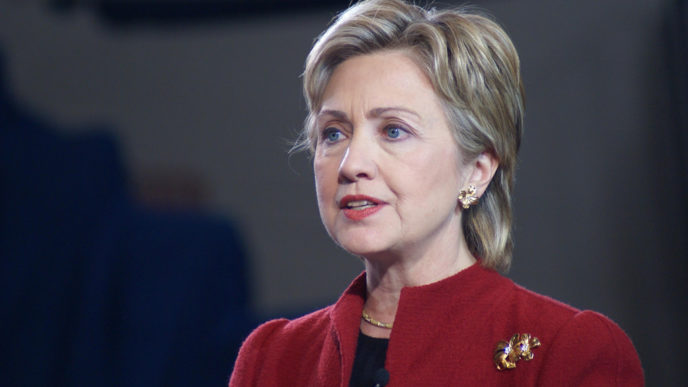
SMOKING GUN: Hillary Did Not Turn Over Email Showing She Hid Information

Hillary Clinton did not turn over an important email about the problems caused by her use of a private email server for classified information.

Clinton sent an email to her deputy chief of staff stating that she did not want some of her emails to be “accessible,” presumably to Congress or to the State Department itself. That email helped form the basis of a scathing inspector general report that found Clinton violated rules.

Now, we know that Clinton did not hand over that email to State Department investigators, proving that Clinton violated her sworn statement that she handed over all of her emails. Her inability to hand over this email could also provide more evidence that she violated the Espionage Act by allowing national defense information to be “lost, stolen, abstracted, or destroyed” through gross negligence.

“While this exchange was not part of the approximately 55,000 pages provided to the State Department by former Secretary Clinton, the exchange was included within the set of documents Ms. Abedin provided the department in response to our March 2015 request,” said State Department spokesman John Kirby in a statement to the Associated Press. (Read more from “SMOKING GUN: Hillary Did Not Turn Over Email Showing She Hid Information” HERE)

Follow Joe Miller on Twitter HERE and Facebook HERE.

Organization Seeks to Run Third Party Candidate for Unsatisfied Voters

Many Americans are unsatisfied with the choice between Donald Trump and Hillary Clinton as the United States’ 45th president. The organization Better For America was launched June 14 with just such Americans in mind and is planning running an independent candidate for president.

The group is made up of religious leaders and political operatives and is currently choosing a candidate to run. According to The Federalist, the organization’s chief strategist has confirmed that three names have committed to run if they are chosen.

Better For America’s website states that their mission is “to get a credible candidate on the ballot who can win both red AND blue states, presenting the nation with a third party option who changes the historically bad choice we’re facing this fall.”

No independent candidate has won an Electoral College vote since George Wallace in 1968. The Federalist reported:

Even Ross Perot, who netted nearly 20 percent in the 1992 election, failed to win a single state. So what makes Better For America believe this year can be different? The short answer is the unfavorable ratings of both Clinton and Trump.

Better For America’s launch corresponds with new polls showing Trump’s popularity decline. According to CBS News, polls this week showed Clinton up by between four and nine points. Trump is also falling behind in several swing states.

John Kingston III, a former Republican delegate and the founder and chair of Better For America, wrote an opinion piece for CNN about his decision to decline to be a delegate to the Republican National Convention.

“I could not support a candidate like Donald Trump, whose behavior disqualifies him to be a PTA member, let alone president,” Kingston wrote.

Kingston reached out to colleagues and friends who felt the same way. Better For America was born from a “remarkable grassroots coalition of lawyers, pollsters, ballot access professionals and others who shared the belief that something had to be done.”

Trump has also struggled to raise funds for his campaign, which has raised $3.1 million in private donations, while Clinton’s has pulled in approximately $26 million. CBS News reports that the super PACs supporting the candidates also had a large gap: the biggest pro-Trump group had $500,000, while the main pro-Clinton group had $52 million at the end of May.

Trump blamed some of these financial difficulties on the lack of support he is receiving from the Republican Party, Los Angeles Times reported. Although he feels Clinton is receiving more support from her party, he said he feels confident he can fund himself.

“I have a lot of cash; I may do it in the general election,” Trump said. “But it would be nice to have some help from the party.”

But Better For America “is not an attempt to undermine Trump,” according to The Federalist. Better For America plans to win.

Kingston pointed to the polling done by Data Targeting, Inc. on the viability of a third-party candidate, which suggests that 65 percent of respondents would be willing to support a candidate besides Trump or Clinton. The research also found that 90 percent of millennials wanted to see a third party candidate on the ballot.

A possible third party candidate is Libertarian Gary Johnson, though current support for him is quite modest. A CNN poll showed Johnson with 9 percent support nationwide. Jill Stein, the likely Green Party nominee, has 7 percent support.

CNN held a live town hall event Wednesday night with Johnson and his running mate Bill Weld. “The two-party system is a two-party dinosaur, and they’re about to come in contact with the comet here,” Johnson told CNN’s Chris Cuomo. (For more from the author of “Organization Seeks to Run Third Party Candidate for Unsatisfied Voters” please click HERE)

Follow Joe Miller on Twitter HERE and Facebook HERE.

Obama Releases Bin Laden’s Bodyguard From Gitmo

The Obama administration released Guantanamo Bay detainee Abdel Malik Ahmed Abdel Wahab despite a review board’s recommendation that he remain in United States custody.

Wahab was reportedly a bodyguard to Al Qaida leader Usama bin Laden and had a relationship with the former head of Al Qaida’s global operations, Nasir al Wuhayshi. The review board feared Wahab would return to the battlefield after spending his time in Afghanistan with bin Laden, “fighting on the frontlines, [his] possible selection for a hijacking plot, and significant training.”

U.S. authorities concluded that he continued lying to his interrogators as late as 2008, insisting he traveled to Afghanistan to “teach the Koran.” A leaked U.S. military report assessed all of Wahab’s statements “to be false” and found he was employing evasion strategies used by other trained terrorists.

The report further noted Wahab’s “ties to a relative who is a possible extremist, raises concerns about his susceptibility to re-engagement.” While Wahab is being released to Montenegro his future incarceration is no longer at the discretion of the United States government. Guantanamo Bay detainees have returned to the battlefield in the past, setting a troubling precedent.

In 2007 the U.S. released Taliban commander Abdul Qayyum Zakir from Guantanamo Bay to the government of Afghanistan. Zakir was subsequently released from Afghan prison for no apparent reason whatsoever and returned to the Afghan battlefield as a senior commander.

Zakir has since spent his time in Afghanistan masterminding plots to kill US soldiers in southern Helmand province, and reportedly makes millions of dollars in the illicit opium trade. Zakir is currently spearheading the successful Taliban advance against the Afghan National Security Forces in Helmand province, pacified by U.S. troops as late as 2012.

Despite significant ties to known high profile terrorists Wahab will be granted asylum in Montenegro for “re-socialization” and “a return to his family.” When Montenegro accepted another Yemeni detainee in January 2016 it specified the detainee would not required to remain in the country but would “eventually be free to choose the country they want to live in.” (For more from the author of “Obama Releases Bin Laden’s Bodyguard From Gitmo” please click HERE)

Follow Joe Miller on Twitter HERE and Facebook HERE.

What’s the Real Reason Americans Hate Obamacare?

University professors, existing as they do in the rarified air of academia, tend to be too clever for their own good. They look for complicated explanations when simple ones would do perfectly well.

Case in point: professors Lawrence Jacobs and Suzanne Mettler recently coauthored a slightly befuddled sounding op-ed, in which they fret over the continued unpopularity of the Affordable Care Act, better known as ObamaCare. When a policy delivers benefits, they argue, it should be popular. So why do people continue to hate ObamaCare?

According the Kaiser Family Foundation, only 38 percent of Americans approve of the health care law, yet 49 percent disapprove. While there has been some fluctuation within the last year, the favorability gap has persisted over the last three years or so. In fact, the only tie when a majority of Americans consistently approved of the law was in 2010, before the actual effects of the government’s health care takeover could be felt.

To you and me, the reason for this widespread dissatisfaction is obvious, but not to Jacobs and Mettler, who conclude with obvious frustration that the real culprit is “partisanship.”

“Prevailing attitudes of distrust in government, strong partisanship and ingrained attitudes — not features of the law itself — are perpetuating the public’s negative opinion. The ACA remains highly politicized, to say the least. Republicans in the House have voted to delay, defund or repeal the law some 60 times, and its very nickname — ObamaCare — primes us to think of the ACA through a political lens.”

That’s right, gang. It’s those evil Republicans, poisoning our minds against Dear Leader’s health care law. Oh, if only we sheep weren’t so easily led astray by Fox News telling us what to think. Thank heavens for academics, selflessly leading us out of the darkness of our ignorance.

What never seems to occur to these people is that maybe Americans don’t like the law because it has made health care in America measurably worse. Deductibles for the least expensive ObamaCare plans have more than doubled since last year, and are now approaching $7,000 for an individual, an outrageous figure that few will be able to afford, much less the least fortunate, the very people the law was supposedly designed to help.

But even if you do manage to overcome the deductible hurdle, you’re not out of the woods, as many doctors and hospitals are now refusing to accept ObamaCare exchange plans, due to their low reimbursement rate. At the same time, health savings accounts, one of the few ways still possible of increasing price transparency and reducing medical costs, are being boxed out of the ObamaCare marketplace, and more than half of the co-ops created under the law have now gone out of business. Finally, United Healthcare Group, one of the nation’s largest insurance providers, is abandoning ObamaCare plans as unprofitable.

In short, everywhere you look, ObamaCare is reducing access to health care, not expanding it. Defenders of the Affordable Care Act keep boasting about how many more people are “covered” than before, but coverage itself means nothing if you can’t afford the deductible, and if your doctor won’t accept your coverage.

It’s insulting to imply that Americans are insensitive to these problems, incapable of feeling the pain that comes from mandatory reduced access to health care, and incapable of forming informed political opinions based on these observations. I shouldn’t have to point out that people dislike a bad policy because it is bad, but in today’s world of over-analysis and eagerness to ignore obvious truths, apparently such demonstrations are necessary.

Then again, when you consider that ObamaCare, like all big government programs, was passed by people who regard consumers as incapable of tending to their own well-being, and who need to be cared for by a paternalistic state, I suppose it isn’t all that surprising after all. (For more from the author of “What’s the Real Reason Americans Hate Obamacare?” please click HERE)

Follow Joe Miller on Twitter HERE and Facebook HERE.

Major Companies Pull Support for Republican Convention

Coca Cola’s funding of the Republican convention dropped from 660,000 dollars four years ago to just 75,000 pledged for this year. The company has reportedly taken heat from a civil rights group demanding the beverage company completely defund the Republican convention in light of Trump’s controversial comments involving minorities.

Trump criticized Ford Motor Company for opening up a new factory in Mexico, but it is uncertain whether his criticism had anything to do with the company deciding not to fund the Democratic or the Republican convention in 2016.

Hewlett Packard’s CEO Meg Whitman is a Republican, but has reportedly been critical of Trump throughout the campaign. Trump’s disparaging remarks about former CEO Carly Fiorina may have contributed to HP’s decision not to fund the convention this year, even though the company has a long history of doing so.

The Republican National Committee set a goal of raising 64 million dollars for its convention set to take place in Cleveland, Ohio in July. However, while the RNC says they are well on their way to reaching their goal, they are not receiving help from many companies who funded the convention in years past.

With Donald Trump as the presumptive Republican nominee, a number of major companies are either pulling their funding or greatly diminishing what they have previously given to previous conventions.

According to the Independent Journal, Apple has stated it will not fund the Republican convention and will not provide any support. The move may come as no surprise to some as Trump called for an Apple boycott after Apple CEO Tim Cook refused to work with the FBI in unlocking the iPhone belonging to one of the terrorists in the San Bernardino shooting.

The list of companies foregoing funding the Republican Party’s convention goes on, including but not limited to JPMorganChase, Metlife, Microsoft, Motorola, Walgreens, Wells Fargo, and UPS. It seems Trump’s campaign to “Make America Great Again” will go on without the support of many of America’s greatest corporations. (For more from the author of “Major Companies Pull Support for Republican Convention” please click HERE)

Follow Joe Miller on Twitter HERE and Facebook HERE.

Senator Reportedly Trump’s Top Choice for Vice President

Alabama Sen. Jeff Sessions is reportedly GOP presidential candidate Donald Trump’s top choice for a running mate, with less than a month to go until the Republican National Convention.

Newsmax’s John Gizzi reported that sources close to the candidate say that Sessions is getting top billing at the moment.

“The square Sessions seems to fit many square holes for Trump: he’s conservative and nails down the party’s right flank, he endorsed Trump early and has been extremely loyal, he has Washington legislative experience — a key requirement — and importantly, he can be totally trusted never to criticize Trump no matter what he might say in the coming months,” writes Gizzi.

“The selection will reassure conservatives,” said G. Terry Madonna, a Franklin & Marshall College professor and a top pollster in the swing state of Pennsylvania. “Sessions is one of the more conservative senators — that should be reassuring to economic conservatives and the religious right.”

Sessions scores 80 percent on the Heritage Action scorecard, well above the Republican average of 58 percent. Further, he hits over 94 percent in the lifetime rating for the American Conservative Union (the sponsor of CPAC).

The Alabama senator’s top issues have been fighting illegal immigration, Obamacare and abortion.

As reported by Western Journalism, Trump listed political experience on Capitol Hill as one of the top qualifications he is seeking in a running mate. Former House Speaker Newt Gingrich is another name that has been bandied about as fitting that criteria and being supportive of Trump’s candidacy.

A Trump/Sessions ticket or a Trump/Gingrich ticket would be the oldest ever to seek the Oval Office. Trump just turned 70 earlier this month, while Sessions is 69 and Gingrich is 73. Ronald Reagan was the oldest to win the presidency in 1980 at the age of 69, until he ran again in 1984 at 73 years old. Reagan’s running mate, George H.W. Bush, was 56 in 1980.

According to Gizzi, nothing is concrete at this time with Trump likely planning to hold off making the announcement until the convention, which begins on July 18. In addition to Sessions and Gingrich, former Arizona Gov. Jan Brewer, Oklahoma Gov. Mary Fallin and former Defense Intelligence Agency Director Michael Flynn also reportedly make the short list.

Sens. Tim Scott, R-S.C., and Joni Ernst, R-Iowa, are two others who have been mentioned as a possible Trump running mate. (For more from the author of “Senator Reportedly Trump’s Top Choice for Vice President” please click HERE)

Follow Joe Miller on Twitter HERE and Facebook HERE.

Senate Takes Test Votes on Gun Bills; One Remains Alive

A bipartisan version of the “no fly, no buy” gun control legislation sought by congressional Democrats survived a procedural vote Thursday, but remains short of enough votes to be adopted.

The bill was proposed by Sen. Susan Collins, R-Maine. Her plan would ban people on two federal terror lists from buying guns, but include an appeal process to address Republicans’ concerns that people will be unjustly stripped of their Second Amendment rights if they are wrongly included on a government list. She offered the proposal as an amendment to a spending bill.

Senate Majority Leader Mitch McConnell, R-Ky., proposed tabling the measure, which would have pushed it to the sidelines and all but killed it. By a 52-46 vote, the Senate kept the bill alive.

However, because the bill needs 60 votes to pass, its eventual fate remains uncertain.

Majority Whip Sen. John Cornyn, R-Texas, had called the voting a “test vote to see what it looks like.”

The Collins bill would ban sales to about 109,000 people, including 2,700 Americans, who are on two lists: The no-fly list and a so-called selectee list, which allows individuals to fly but requires extra scrutiny at airports. The bill gives individuals the right to take the federal government to court to appeal a denial. It also notifies authorities if a prospective gun buyer was on broader terrorism watch lists within the past five years.

The measure was one of two voted on by the Senate.

A proposal by Sen. Ron Johnson, R-Wisc., received only 31 votes in support. Although his goal was similar to that of Collins, his bill put the burden of proof on the government, forcing it to go to court to show why an individual should be blocked from buying a gun.

“We were trying to get something merged between Sen. Collins’ approach and we were unsuccessful in doing that,” Cornyn said. Of the two bills, he said, one “provides for due process, and one … does not. “

Cornyn said he also thought it was time to debate other subjects.

“I think we need to be engaged in something more constructive that would’ve actually stopped the Orlando shooter,” he said. (For more from the author of “Senate Takes Test Votes on Gun Bills; One Remains Alive” please click HERE)

Follow Joe Miller on Twitter HERE and Facebook HERE.

Paul Ryan Under Pressure to Outflank Democrats, Not Just Scold Them

A visibly irritated Speaker Paul Ryan chastised Democrats on Thursday morning for hijacking the House floor, and promised to bring the legislature back to regular order shortly.

The House’s top Republican criticized Democrats for pulling a “a political stunt, a fundraising stunt.”

How the GOP will restore order remains an open and difficult question, though. So far, other than Ryan’s lecture for Democrats, Republicans haven’t developed an answer.

Around 11:25 a.m. Wednesday, the minority party seized control of the House floor, refusing to leave and staging a 1960s-style sit-in to demand a vote on gun control 10 days after the Orlando terrorist attack. Republicans in turn took up a controversial package to fight the Zika virus rather than engaging with Democrats.

Around 3 a.m. Thursday, Ryan brought to the floor a partially funded, $1.1 billion bill to combat Zika. It passed mostly along party lines, 239-171. Only two Republicans opposed the measure, even though conservatives had said they’d oppose any bill that didn’t use unspent money dedicated to fighting the Ebola virus to eradicate the new disease.

Then the House adjourned a day early for lawmakers’ recess.

Ryan promised to prevent another ruckus like the one Wednesday night, when shouting Democrats refused to come to order on the floor.

“I think it sets a very dangerous precedent,” Ryan said. “We are reviewing everything right now as to what happened and how to make sure we can bring order to the chaos. This is the people’s house and [Democrats] are descending into chaos. I don’t think this should be a very proud moment for democracy, or for the people who staged these stunts.”

After Ryan’s press conference, Democrats—who had been chanting “no bill, no break” for almost 24 hours—promptly left the floor around 1 p.m., pledging to return when the House comes back in session July 5.

“A fire has been lit across our nation,” Rep. Joe Crowley of New York, vice chairman of the Democratic caucus, said. “It’s a new day in Washington, it’s a new way to fight as well.”

Perhaps disorientated from a night of little sleep, the chairmen of the three biggest Republican caucuses seemed unsure how to respond.

Rep. Jim Jordan, R-Ohio, chairman of the Freedom Caucus, told The Daily Signal he thinks the House should focus on terrorism, not gun control.

In particular, Jordan said he wants the House to take up a bill it passed last year to tighten background checks for Iraqi and Syrian refugees. The Senate didn’t consider the bill.

“So we’re pushing our leadership to bring those sorts of things to the floor,” Jordan said.

Rep. Bill Flores, R-Texas, chairman of the Republican Study Committee, credited Ryan for “taking a measured approach” to Democrats’ extreme tactics. He told The Daily Signal that, like Jordan, he doesn’t believe “guns are the issue.”

To turn the debate back toward terrorism and “put the Democrats in a tight spot,” he proposed forcing a vote on a House resolution affirming the Second Amendment.

Rep. Charlie Dent, R-Pa., chairman of the Tuesday Group, told The Daily Signal he plans on investigating Democrat violations of decorum and House rules.

“Adopting tactics used by fringe groups like Occupy Wall Street is counterproductive,” Dent said, “and will not help or lead to any sort of consensus or action on firearms.”

Reviewing the play-by-play of the night before, Rep. Dave Brat, R-Va., said Republicans should’ve seen the sit-in coming.

“If we would’ve anticipated it, which we should’ve, we could’ve made some better moves,” Brat told The Daily Signal, adding that rehashing Republican strategy amounted to little more than “Monday morning quarterbacking now.”

Several conservative congressional staffers voiced similar frustration with Republican leadership. They told The Daily Signal that GOP leaders failed to counter the Democrats’ protest with legislation that shifted the focus back to terrorism or in defense of the Second Amendment. They said Republicans now face a similar scenario upon their return from recess.

Legislative alternatives weren’t the only option for Republicans. They could have followed the example Democrats set in 2008 after adjourning for August recess: When Republicans stayed on the floor to protest lack of action on rising gas prices, then-Majority Leader Nancy Pelosi, D-Calif., killed the microphones and lights. Pelosi’s party attempted to remove reporters from the press gallery.

Ryan said he isn’t ready to shut off the lights yet. Instead, he seemed to yield control of the floor to Democrats, saying they “can talk all they want.”

Now Democrats have the Republican conference on the run, a top GOP aide told The Daily Signal. Ryan and the rest of leadership didn’t squash the Democrat sit-in, the staffer said, because they’re afraid of the immediate political blowback and long-term campaign consequences.

“Members fear political votes,” he said. “They fear the ads. They fear the liberal grassroots in their district mobilizing a populist message.”

Rep. Ken Buck, R-Colo., interpreted the sit-in as part of an ongoing campaign by Democrats to throw the House off track.

Buck pointed to controversial policy riders from Democrats—including amendments regarding transgender bathrooms and Confederate flags—in addition to their sit-in as evidence that, in his words, “Democrats are hell-bent on giving Paul Ryan a black eye” and “have no interest in governing.” (For more from the author of “Paul Ryan Under Pressure to Outflank Democrats, Not Just Scold Them” please click HERE)

Follow Joe Miller on Twitter HERE and Facebook HERE.

Obama Says He Won’t Let Defeat on Amnesty Deter Other Executive Actions

President Barack Obama said the Supreme Court decision halting his executive actions to grant amnesty to illegal immigrants won’t discourage him from making other such moves without going through Congress.

“It does not have any impact from our perspective on the host of other issues we are working on because each one of these issues has a different analysis and is based on different statutes and different interpretations of our authority,” Obama said in the White House briefing room Thursday.

The president cited climate change as an example, saying his participation in related international efforts doesn’t involve the same principle as his executive amnesty, namely “a theory of prosecutorial discretion that in the past every other president has exercised.”

Rather, Obama said, his climate change agenda is “based on the Clean Air Act, the EPA and previous Supreme Court rulings.”

The Supreme Court’s deadlocked 4-4 decision announced earlier in the day lets stand an appeals court decision upholding an injunction against the Obama administration actions in November 2014 to shield up to 5 million illegal immigrants from deportation and allow them to work here legally.

Texas and 25 other states filed the lawsuit, United States v. Texas.

“On the specifics of immigration, I don’t anticipate that there are any additional executive actions that we can take,” Obama told reporters. “We can implement what we’ve already put in place that has not already been affected by this decision.”

“We have to follow now what has been ruled on in the Fifth Circuit because our Supreme Court could not resolve the issue and we are going to have to abide by that ruling until an election and a confirmation of a ninth justice of the Supreme Court so that they can break this tie,” he said, “because we’ve always said we are going to do what we can lawfully through executive action.”

Obama has used executive actions on other high-profile issues such as gun control, the environment, transgender policy in schools, and his own health care law. Such moves prompted Republican members of Congress to question whether the president has the authority to act in such ways.

While the president may be correct that the Supreme Court decision has no legal bearing on other executive actions, he should not feel more comfortable in acting without Congress, said Elizabeth Slattery, a legal fellow in the Center for Legal and Judicial Studies at The Heritage Foundation.

“He certainly shouldn’t feel emboldened to take even broader authority,” Slattery told The Daily Signal in a phone interview.

Slattery said she believes the president is on shaky legal ground in regard to executive actions.

“The president has an abysmal record in the Supreme Court. He lost 9-0, with his own court appointees ruling against him,” Slattery said, referring to a case in which the court rejected Obama’s attempts to make a so-called recess appointment to the National Labor Relations Review Board when the Senate actually was not in recess.

“That’s not how the Constitution works,” she said.

House Speaker Paul Ryan said the final ruling was meaningful in upholding the Constitution’s separation of powers.

“Today, Article I of the Constitution was vindicated,” Ryan, R-Wis., said in a formal statement. “The Supreme Court’s ruling makes the president’s executive action on immigration null and void. The Constitution is clear: The president is not permitted to write laws—only Congress is. This is another major victory in our fight to restore the separation of powers.”

In March, the Republican-controlled House voted to authorize Ryan to file a brief in support of the 26 states in the immigration case.

Obama dismissed the Supreme Court’s tie vote and used it to underline his own frustrated attempt to fill the seat of Justice Antonin Scalia, who died in February.

“The Supreme Court wasn’t definitive one way or the other on this,” Obama said. “The problem is they don’t have a ninth justice. So, that will continue to be a problem. With respect to Republicans, what it tells you is, if you keep on blocking judges from getting on the bench then courts can’t issue decisions. What that means is you’re going to have the status quo frozen.” (For more from the author of “Obama Says He Won’t Let Defeat on Amnesty Deter Other Executive Actions” please click HERE)

Follow Joe Miller on Twitter HERE and Facebook HERE.

POLL: Clinton Outpaces Trump in This Historically Republican State

Former Secretary of State Hillary Clinton outpaced Republican front-runner Donald Trump in an Arizona poll published Wednesday. Over 46 percent of likely voters living in Arizona support the Democratic presumptive nominee, according to an OH Insights poll, which surveyed 1,060 likely voters across the state. If the general election were held today, Clinton would break a 64-year-old Republican Party win record in the state.

Conversely, 42.2 percent of voters support Trump, while the remainder polled support a third-party candidate.

Support for each candidate varied widely based on region. Mostly rural areas leaned towards Trump, while the densely populated Pima county, gave Clinton a 17-point lead over the business mogul.

Women in Arizona also favored Clinton over Trump, giving the former secretary a 12-point lead when that demographic was polled.

Clinton managed to earn 82.3 percent support from Democrats, while Trump earned 78.2 percent of Republican support.

Clinton’s recent poll numbers of 46.5 percent support is statistically consistent with the past numbers of completely different candidates — negative perceptions like “establishment” beliefs minimally affect voter attitudes in Arizona.

“Every statewide office in Arizona is held by a Republican, with a significant majority in the state House and Senate…. Arizona should be a reliably red state,” Wes Gullett, GOP consultant stated about the poll results.

The only other time Arizona went blue was in 1996, when it voted 44 percent for Republican Candidate Bob Dole, and 46.5 percent for former President Bill Clinton. (For more from the author of “POLL: Clinton Outpaces Trump in This Historically Republican State” please click HERE)

Follow Joe Miller on Twitter HERE and Facebook HERE.