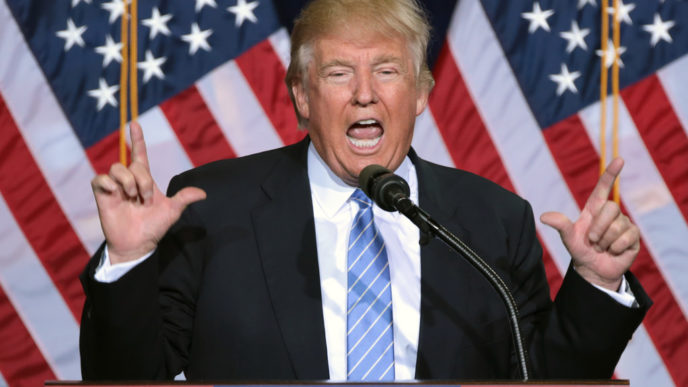
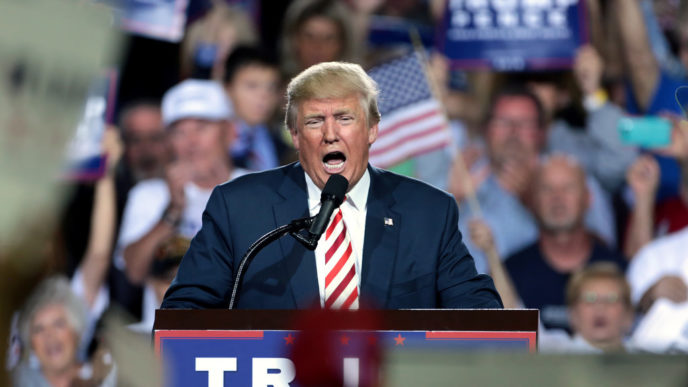
The American people elected Donald Trump to exact conservative change here at home, thus his focus on his domestic agenda.
But when the focus does turn to foreign policy, he and the GOP also need to show that they heard the voters! President Obama’s election demonstrated voters’ disgust for adventures abroad. Similarly, President-elect Trump’s indicated that voters do not want to see the United States kicked around.
Here are some priorities to help the new administration color inside voters’ lines:
1. Radical Islam, radical Islam, radical Islam
Fighting that insipid ideology is Trump’s lodestar. When Tip O’Neill coined the phrase “all politics is local” he did not have in mind Islamists in Orlando, but that does not mean it does not apply.
2. The South China Sea.
President Obama delegated our security interests there to the UN. The result should be no mystery. Rebuilding our standing will require steadfast leadership, more than just economic threats, and new alliances, not just a show of force. Doing just the latter will bring out China’s fishing boat navy. Voters will not tolerate shooting them; nor will they accept our Navy being run off … so the new administration must avoid policies that present that binary choice.
Reversing China’s eight-year shopping spree will take time, so Trump should set expectations accordingly.
3. Iran.
Trump must rebuild our regional containment system. Wrecking Obama’s naive nuclear deal is not enough. That means reconstituting our regional alliances, undermining Iran’s radical Islamic ideology, ripping out Hezbollah root and branch around the globe, and learning to love Iraq (the invasion and regime change happened almost 14 years ago in our rearview mirror. We must stop treating it as untouchable).
4. Spread the pain.
President George W. Bush launched the multilateral Six-Party Talks in 2003 in response to North Korea’s bad behavior. This diplomatic exploratory surgery gifted North Korea a large stage on which to act out. Importantly, it also meant the U.S. owned the issue, giving countries like China and Russia leverage over us.
When North Korea acts up again, ask first how to get it off the U.S. docket. Convincing China to own the response is smart statecraft, and sounds like a negotiation worthy of Donald Trump.
Likewise, allies can provide in-kind burden sharing. For example, with American support, the Balts, Georgia, Ukraine, etc., can keep Putin busy.
Trump must keep this in mind as the multitude of rogue states vies for his attention. Already, Russia, a country that should be in our peripheral vision, inspires a national freak-out.
5. Israel.
Do not just stymie immoral UN behavior; bring the pain to Turtle Bay. Of course, Jerusalem is the capital of Israel. And, for the love of God, the Oslo Process, ongoing since 1993 (actually, since the 1979 Camp David Accords), will never — never —work. Settlements do not prevent peace.
Palestinian Islamic extremism does. Target Iran’s sponsorship of groups like Hamas and Palestinian Islamic Jihad. Push for Arab recognition of Israel. Help alleviate our ally’s existential security threats. Only then can peace happen.
6. Reform our sclerotic national security structure.
Create a credible diplomatic option so that our statecraft choices go beyond shooting, sharply worded demarches, and sanctions. It will make the above possible.
Fix our broken State Department. Create a political warfare capability. Get our intelligence community out of the business of running its own military so it can back to doing what it does best: spying.
Successfully tackling this impossibly long list will require that the government relearn what used to be part of our statecraft muscle memory: applying leverage. Diplomacy is not about negotiations. It is about presenting other countries with choices and then using leverage so that they make the decisions we want.
Success also requires that American foreign policy once again reflects American exceptionalism. Americans value not just where we live but how. That has practical implications. For example, most of our allies reflect our values, and our values are non-negotiable.
Defense of our values requires a muscular internationalism. That does not imply the active use of the military. Ronald Reagan never invaded a country larger than Grenada, and he protected our values just fine. But simply drawing inward like Obama leaves our values and allies vulnerable. Ask Israel.
Conservatives need the Trump administration to succeed at the list I outlined. Voters elected him to fulfill fundamental, conservative goals (which the above are), and they gave the GOP both houses of Congress to help.
The GOP has not had conservative foreign policy since the 1980s. On top of that, throw decades lazy post-Cold War strategic thinking and the fact that Obama did not focus on any of these goals (constructively). Moreover, we have never tried to combat radical Islam, and it has been a threat since 1979. Conservatives have a UUGE task ahead of them. I hope they understand that. (For more from the author of “6 Issues That Should Dominate Trump’s Foreign Policy Agenda” please click HERE)
Like no one before him, Donald Trump has shaken our nation, and love him or loathe him, he has done what no one else has ever done. On his journey to the presidency, he has broken (and rewritten) the rules, he has defied the establishment, he has challenged the status quo, he has played both the bully and the victim, he has proved the pundits wrong, and he has emerged from every storm stronger than before.
Not only so, but the climate of the nation has changed (some say for better and some say for worse), to the point that what seemed inevitable just three months ago no longer seems so inevitable. Could it be that America is about to make a massive change in direction, a radical course correction?
This, to me, is an important aspect of what some are calling the “Trump effect” (often in pejorative terms; a Google search on January 12 yielded 1,160,000 for “Trump effect” in quotes): The inevitable can be challenged; the status quo can be changed; the bullies can be conquered.
Again, I’m aware that for many, President-elect Trump is the ultimate bully, hardly a model to follow, especially for followers of Jesus, and my goal here is not to call pastors and believers to emulate his tone or his style. Instead, I’m encouraging us to learn from his example that America’s course has not been inexorably set, that the seemingly impossible is very possible, that history is full of surprises, and that now is the time for fresh courage and commitment.
The Nation Turned on a Dime
For several years now, we conservatives have been told that we have lost the culture wars, that we should throw in the towel and concede, that we should consolidate our losses and move on to non-controversial, spiritual issues, that the tide of history is set against us. And those of who refused to go along with this narrative were mocked and ridiculed, told that we represented a dying breed that was about to be replaced by an enlightened generation, mocked as unfortunate relics of a bygone age, ridiculed as an endangered species soon to be obsolete.
Now, the tide of history has shifted suddenly, with the real possibility of a complete reversal in the expected makeup of the Supreme Court (under Hillary) and the equally real possibility of a wholesale repudiation of radical liberalism. And to think that on Election Day, even into early election evening, this was the exact opposite of what was widely expected to be. The direction of the nation literally turned on a dime, and with it, the sense that anything is possible. The very rules of engagement have changed.
Who says that we have to cower before the cultural bullies? Who says that we have to apologize for our convictions? Who says that the mainstream media sets the agenda and establishes the talking points? Who says that the defeat of conservative values is inevitable?
Again, I am not saying that we emulate the style of our president-elect (in terms of the negative aspects of his style) or that we take on the posture of bullies. Instead, I’m urging us to learn from what he has accomplished, to change our way of thinking, and to seize the day and take back the ground that has been pulled from under our feet.
Just three months ago, it appeared that Planned Parenthood would be firmly ensconced and generously funded for a generation or more. Now, the abortion giant stands on the verge of national defunding.
Just three months ago, it appeared that Roe v. Wade would not be overturned in our lifetimes or perhaps even in the lifetimes of our children. Now, talk of its possible reversal is anything but fantasy.
Just three months ago, it appeared that LGBT rights would push religious rights into the closet. Now, an unlikely champion of religious rights has arisen (and oddly enough, he fashions himself a friend of LGBT rights as well).
This is not just the tables turning. This is the floor becoming the ceiling and the ceiling becoming the floor. This is nothing less than upheaval.
Rise Up, Stand Tall!
Of course, we have no way of knowing how President Trump will govern and how far the Republican-led Congress will go in terms of making positive, necessary changes.
But what’s clear is this: Donald Trump, in the past more famous for hedonism than for heroics, has declared war on a sacrosanct, PC world, and it’s high time for others who call themselves overcomers and world changers and who fashion themselves to be countercultural Christians — I’m speaking about the born-again Church of America — to rise up, stand tall, and speak the truth in love.
After all, if a thrice-married, formerly-playboy, billionaire businessman can shake the nation, why can’t we as the Lord’s people — in the power of the Spirit and in the footsteps of Jesus, overcoming evil with good?
Enough with our compromise and cowardice. It’s time for courage and conviction. It’s time we led the way. (For more from the author of “Will the ‘Trump Effect’ Trickle down to Christian Conservatives?” please click HERE)
https://joemiller.us/wp-content/uploads/29381357345_27b53e0902_b-3.jpg6831024Joe Millerhttps://joemiller.us/wp-content/uploads/logotext.pngJoe Miller2017-01-13 21:32:092017-01-13 21:32:09Will the ‘Trump Effect’ Trickle down to Christian Conservatives?
President-elect Trump has nominated a number of outstanding men and women for top foreign policy positions in his administration. Marine Corps Gent. (Ret) James Mattis for Secretary of Defense. South Carolina Gov. Nikki Haley for U.N. Ambassador. My one-time boss, former Senator Dan Coats, for Director of National Intelligence. Marine Corps Gen. (Ret) John Kelly for Director of Homeland Security. Congressman Mike Pompeo for CIA Director. Great choices, all.
Then there’s Rex Tillerson.
Former head of Exxon-Mobil, Mr. Tillerson has extensive experience in corporate management, international trade, and building a strong professional team. He is reputed to be an effective negotiator and his ability to lead a sprawling bureaucracy is not in question. No doubt he is a patriot and a highly capable individual.
Sadly, he also seems to be completely ill-suited to be Secretary of State. Listening to Mr. Tillerson at his Senate hearing was like hearing an awkward teenager talking to his girlfriend’s father.
The Tillerson Eqivocation
His refusal to acknowledge the moral ugliness of Vladimir Putin was striking. An impassioned and probing Sen. Marco Rubio asked Mr. Tillerson about Putin’s responsibility for the deaths of up to 300,000 Chechens, his murder of political opponents, his military backing of Syrian mass murder Bashir al-Assad (including missile strikes against civilians), and his invasion of the Ukraine to regain Russian control of the Crimea.
Mr. Tillerson’s equivocation was astonishing. Not just in his refusal to call Vladimir Putin a war criminal but in his insistence he needed more information to comment. As a rightly exasperated Sen. Rubio said, the information about Putin’s campaign of death is in the public domain — it is not classified.
It is one thing for a national leader to be temperate, to refuse to surrender to the pressure of the moment, and to maintain an even keel in the face of intense questioning. It is quite another to abandon moral outrage and persist in not calling evil, whether committed by the governments of Russia, Saudi Arabia, the Philippines, or anywhere else, what it is. This latter characterized Mr. Tillerson’s responses to Sen. Rubio.
Volatility is not what America needs in the chief representative of her foreign policy. In this, the steady Mr. Tillerson acquitted himself well. But an unwillingness to characterize mass murder and thuggish aggression as the brutality and moral horror they are does not indicate prudence. Rather, it is a disturbing display of weakness.
Tillerson and Religious Persecution
Concerns about Mr. Tillerson’s potential conduct as our chief diplomat extend to the growing pattern of religious persecution in many corners of the world. Reading the just-issued 2017 Open Doors’ World Watch List, the U.S. Commission on International Religious Freedom’s Annual Report, or the State Department’s International Religious Freedom annual report gives one a sobering, arresting sense of the extent of religious persecution, much of it against Christians, throughout the world.
Defending the persecuted should be a cornerstone of American foreign policy, not only because of our nation’s founding conviction that one’s submission to God takes precedence over allegiance to the state, but because standing with those suffering for their religious beliefs is in our national interest.
As Georgetown University’s Dr. Thomas Farr, the first director of the State Department’s Office for International Religious Freedom, said recently, by upholding the right of all people to believe according to their consciences and live out their faiths freely, America fosters “stable self-governance, economic development, and the defeat of religion-based terror. If we act to rediscover those reasons ourselves, and overcome our contemporary skepticism about engaging religious ideas and actors in American diplomacy, we can avert the momentous consequences of rising religious persecution and declining global religious freedom.”
By fighting for the persecuted, America also lets them know they have a friend who cares about their dignity and liberty. This will bear great fruit over time. As many former prisoners of Cold War Communism have testified, understanding that Ronald Reagan and his team were raising their incarceration and treatment at the highest levels of their oppressive governments inspired them to carry on. And this brave allegiance to religious freedom created a loyalty to our country among the former prisoners and their fellow freedom-lovers that remains strong today.
As the eloquent closing comments of Sen. Rubio make, clear, the stakes could not be higher:
We can’t achieve moral clarity with rhetorical ambiguity … For those 1,400 people in jail in China, those dissidents in Cuba, the girls that want to drive and go to school (In Saudi Arabia), they look to the United States; they look to us, often to the Secretary of State … When they see the United States is not prepared to stand up … it demoralizes these people all over the world. And it leads people to conclude this, which is damaging and it hurt us during the Cold War and that is this: America cares about democracy and freedom as along as it is not being violated by someone that they need for something else. That cannot be who we are in the twenty-first century.
Mr. Tillerson has no background in standing against tyrants, brutes, and, yes, criminals like Vladimir Putin or Kim Jong-Il. At a time of rising international tension, America needs a Secretary of State who has a deft hand as well as a spine of steel. Dealing with dictators, cagey adversaries, and outright enemies is not like negotiating with a potential business partner. It is about standing firmly, sometimes stonily, for America’s national security and vital interests.
Our opponents appreciate resolve, strength, and courage, not sweet reason or a rather pathetic desire to be liked. The Obama foreign policy too often has been typified by a desperate eagerness for other countries to approve of us. The consequences — a newly emergent Russia, an emboldened China, a militaristic North Korea, and an uncertain NATO alliance — pose an increasingly imminent danger to the United States.
Donald Trump appreciates toughness, forthrightness, and candor. In his performance before the Senate Foreign Relations Committee, Rex Tillerson showed none of these. (For more from the author of “Rex Tillerson’s Moral Indecision” please click HERE)
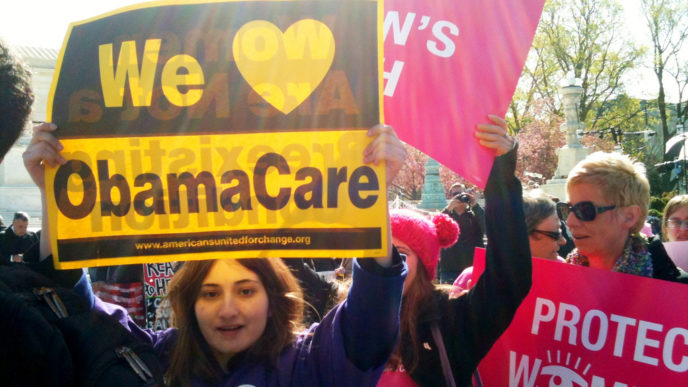
Liberals are notorious for caring about “groups” of people, but when it gets down to individual persons, not so much. You’re about to see this play out in spades as Democrats cry crocodile tears over the coming repeal of Obamacare.
You hear it over and over again: “This will be catastrophic for the 20 million people who were previously uninsured but now have coverage! You can’t take away their health care!”
First of all, no one is talking about doing that. Any repeal legislation will have a transition period for those who got coverage through Obamacare to move to new plans. And second, they will have more choices and better options. Win. Win.
But liberals would rather focus on quantity, how many millions we’ve given something to, versus quality, what does that “gift” mean for individual people.
The Obama administration claims 20 million more Americans today have health care due to Obamacare. The reality is that when you look at the actual net gains over the past two years since the program was fully implemented, the number is 14 million, and of that, 11.8 million (84 percent) were people given the “gift” of Medicaid.
And new research shows that even fewer people will be left without insurance after the repeal of Obamacare. Numbers are still being crunched, but between statistics released by the Congressional Budget Office and one of the infamous architects of Obamacare, the Massachusetts Institute of Technology’s Jonathan Gruber, it’s estimated that anywhere from 2 to 7 million people now on Medicaid would have qualified for the program even without Obamacare.
That further discredits the administration’s claim of 20 million more Americans having health insurance because of Obamacare.
Multiple studies have also shown that even those who are uninsured often have better outcomes than those with Medicaid. A University of Virginia study found that for eight different surgical procedures, Medicaid patients were more likely to die than privately insured or uninsured patients. They were also more likely to suffer complications.
And it is important to note that this study focused on procedures done from 2003-2007, prior to the geniuses in Washington deciding it was a good idea to put even more people on the already overburdened Medicaid system.
Additionally, despite what proponents of the law promised, there is little evidence to show that the use of emergency rooms, which have a higher level of medical errors, has decreased due to Obamacare.
Then there is this reality: While Obamacare has handed out millions of new Medicaid cards, that does not mean the recipients now have quality health care. In fact, it doesn’t ensure they have health care at all. That’s because increasing numbers of doctors aren’t accepting Medicaid.
As a Louisiana woman told The New York Times, “My Medicaid card is useless for me right now. It’s a useless piece of plastic. I can’t find an orthopedic surgeon or a pain management doctor who will accept Medicaid.”
Keep that in mind every time liberal Democratic senators pull out the Kleenex boxes bemoaning the fact Republicans are the ones trying to take people’s health care away.
Speaking of which, a much underreported fact of Obamacare is how many truly needy and disabled Americans are NOT getting the services they need because of the expansion of Medicaid for able-bodied adults (aka healthy) of prime working age, 19-54.
So while the left talks about all the new people Obamacare is helping, it neglects to mention that over half a million disabled people, from those with developmental disabilities to traumatic brain injuries, are on waiting lists for care.
And many of them are on waiting lists because Obamacare gives states more money to enroll able-bodied adults than it does to take care of disabled children and adults who qualified for Medicaid prior to Obamacare.
If you think that doesn’t have a real-world perverse impact, note this. Since Arkansas expanded its Medicaid program under Obamacare, it’s rolls have grown by 25 percent. During that same time, 79 people on the Medicaid waiting list who suffered from developmental disabilities have died. I would encourage you to read my former Heritage Foundation colleague Chris Jacob’s full piece on this.
Finally, it’s not just those enrolled in Medicaid that are finding fewer health care provider options. For people who now have health plans through the Obamacare exchanges, new Heritage Foundation research shows that this year, in 70 percent of counties across the country, those consumers will have only one or two insurers to choose from.
Add to that the millions of people who lost the doctors and health plans they liked and are now paying higher premiums for less coverage, and you can see that quality health care and anything resembling “choice” has quickly disappeared for an increasing number of Americans due to Obamacare.
So the next time a defender of Obamacare tries to take the moral high ground about the millions of people the law has helped, ask them to define what “help” looks like. (For more from the author of “Why Obamacare’s ’20 Million’ Number Is Fake” please click HERE)
The confirmation hearing of Sen. Jeff Sessions, R-Ala. (C, 78%) earlier this week is the perfect occasion to discuss something we conservatives must be better at.
We almost always set aside the level of self-assessment and introspection necessary to achieve political victory, if the opportunity to rip on progressives distracts us like a cat infatuated with a spool of yarn. Sure, go ahead and have a little fun at their expense every now and then. I’ve been known to indulge myself a time or two, so who am I to judge? But if we’re not careful, we’ll descend into self-deception that amounts to little more than “four legs good, two legs bad” trolling.
Like when Sessions was hazed during his hearings by Code Pink protestors dressed up as members of the Ku Klux Klan, it was right and just to point out the Left’s undying penchant for Trump-electing self-destruction.
Or when MTV News writer Ira Madison III mocked Sessions’ Asian-American grandchildren by calling them “props,” and telling Sessions to “return this Asian baby to the Toys ‘R’ Us you stole her from.” You bet it was a moral imperative to demonstrate how modern-day progressives are Sith-level bigots.
However, when in the midst of defending your guy he wets the bed a bit, it requires a clean-up of your own mess. Otherwise, you will come to learn the hard way that it ain’t no fun when the rabbit’s got the gun.
While there was no end to our hot pursuit of Sessions’ enemies both during and after the confirmation hearing, I saw almost no discussion of merit about his own need to heal thyself on a matter of moral certainty. When confronted during his confirmation hearing on the merits of Roe v. Wade, Sessions went a wee bit wobbly. And that might actually be giving the prospective attorney general — who is also one of the best cabinet appointments Donald Trump has made for conservatives — the benefit of the doubt.
Sessions said that while he believed Roe v. Wade violated the Constitution, he went on to say that “it is the law of the land…and I would respect it and follow it.”
Now, I am on record as saying that Sessions was a strong pick to undo the damage done to our rule of law by the Holder/Lynch cabal. Yet in this instance the best case scenario is he missed a grand opportunity here. At worst, he has forsaken the very rule of law he’s long been known to champion.
For how on earth can the actual law of the land — the Constitution — be violated and yet the violation itself can somehow still be raised to the level of holy writ? To point out the fallacy here is not pedantic nor a distinction without a difference. If the Constitution is indeed the law of the land, then that which violates it by very definition illegal.
As in “forbidden by law or statute” according to the dictionary definition of the term. And since judges neither have the power to make laws or sign statutes into law, their opinions cannot unto themselves have the force of law. Let alone the power to become an unelected and permanent constitutional convention. Able to amend the Constitution on a whim outside the will of the people, whenever the new tolerance which tolerates no dissent demands.
This is the very progressive scam which the Holders and Lynches of the world have foisted upon us, so that they may impose their Leftists fantasies by fiat rather than risk rejection by the voters at the ballot box. In other words, this is anathema to the very rule of law we’re expecting Sessions to protect and defend as attorney general.
Now, maybe Sessions was just rope-a-doping or doing his best Rahab-the-harlot impression. As in smile and wave during the dog and pony show. Or living to fight another day by simply telling the lynch mob what it wants to hear at the time. All the while you’ve already aligned yourself with the righteous side, which will be revealed at the opportune time.
I could be convinced of that on some level. But clearly there must be some middle ground somewhere between taking a bullet to the face, and regurgitating our opponent’s statist talking points on the world’s biggest stage? If there is no clever rhetorical sleight of hand for such an occasion, then that is yet another failure of our movement to prepare our champions for such a time as this.
Besides, hasn’t Trump himself shown there is an audience for throwing out red meat to drive progressives and the media (but I repeat myself) bonkers by destroying their most cherished flawed premises?
Here’s hoping that going forward Attorney General Sessions will prove respecting and following that which violates the Constitution, like he says of Roe v. Wade, doesn’t mean what the Left thinks it means. (For more from the author of “Some Constructive Criticism for Jeff Sessions” please click HERE)
https://joemiller.us/wp-content/uploads/160120-H-NI589-0103_24226495370.jpg29074296Joe Millerhttps://joemiller.us/wp-content/uploads/logotext.pngJoe Miller2017-01-12 21:27:512017-01-12 21:27:51Some Constructive Criticism for Jeff Sessions
Most of the time, when I report here on secular elitists, the only right tone is outrage. That’s fitting when those who are strong and spoiled kick down at the dogged and decent. But when godless self-righteous hysterics throw a futile hissy fit, then the only Christian thing to do is to sit back and throw peanuts. We all did that in the days after the election, as snowflakes who’ve burrowed into debt like hungry mole rats for B.A.s in cultural studies had a catastrophic meltdown, and were herded into playrooms with coloring books and crayons for group hug sessions and sing-ins.
Now someone has topped that. No crying jag at Oberlin that ends with herb tea and Playdoh can top this blog post from Ned Resnikoff, an allegedly grown up writer at Think Progress and al Jazeera (!), who went online to explain to America his phobia of his plumber:
This afternoon, I had a plumber over to my apartment to fix a clogged drain. He was a perfectly nice guy and a consummate professional. But he was also a middle-aged white man with a southern accent who seemed unperturbed by this week’s news. And while I had him in the apartment, I couldn’t stop thinking about whether he had voted for Trump, whether he knew my last name is Jewish, and how that knowledge might change the interaction we were having inside my own home. I have no real reason to believe he was a Trump supporter or an anti-Semite but in my uncertainty I couldn’t shake the sense of potential danger. I was rattled for some time after he left.
I’m very privileged insofar as this sense of danger is unfamiliar to me. And I know I felt it much less acutely than a lot of other people right now. I’m still a straight, white guy who can phenotypically pass for gentile. Plus my first name is pretty WASP-y.
But today was a reminder that ambiguous social interactions now feel unsafe and unpredictable in a way that never did before. And even if Trump is gone in four years, I don’t expect to ever reclaim that feeling of security. That’s just one more thing you voted for, if you voted for him.
The Cashmere Hair-Shirts of Park Slope, Brooklyn
Really, how can a writer do justice to Resnikoff’s reflections? It’s almost like drowning a perfectly grilled piece of prime rib with heavy Bernaise sauce. But let me at least add a dash of salt and pepper.
It is rare, Ned, to see such twisted, self-torturing scruples outside James Joyce’s portraits of teenage sexual guilt in 1890s Ireland. But it’s not God you fear offending. If I might follow your example and deduce your world view from surface social cues, you’re not worried about Him. You surely don’t fear hell. And yet you police your inmost thoughts like an East German union meeting. Who exactly do you think is listening — Meryl Streep?
Perhaps you sound tortured with guilt because you started off your reflections by reacting with thinly veiled hatred (disguised as fear) for a stranger because of the way he talked, the color of his skin, and what he does for a living. When other people do that, you call that behavior “bigoted.” But here you are indulging it — not just in a private moment, which is natural enough, if far from optimal.
No, you’re sharing it with the world, and you clearly expect to be congratulated for it — in exactly the same way some alt-right hater would post his dyspeptic comments about black teenagers he’d run into down at Walmart, then spend the day reading the comments in his Spider Man pajamas.
And then, Ned, you make it even worse, when you switch gears from simple snobbery and tribalism into a frenzied dance of virtue-signaling, worthy of a worker bee whose wiring tells it how to point the way to the honey. You do not stop to consider whether you might be a bigot for assuming that the man who fixed the sink which you have no idea how to unplug hates you because you are Jewish — since he might have voted for a doggedly pro-Israel candidate with a Jewish daughter and grandchild.
No, instead, you clutch at your pearls and pretend to flagellate yourself because — while the sense of danger you indulged through the plumber’s visit was perfectly valid, of course — there are other groups of people less privileged than yourself, whom you imagine walk through the world in a permanent state of panic. You assume that all blacks, Latinos, Jews, and gays — millions of whom, by the way, did vote for Donald Trump — feel persecuted and terrified. No, Ned, that’s just you and your tiny circle of insufferable, overpaid friends.
What to Expect from Southerners
Now I will admit it: As a native New Yorker, when I hear a southern accent, I have my own set of expectations. I expect that the people I’m dealing with might well be grounded in some sane and functioning culture. I imagine that they’re more likely to believe that there is a God. I figure the odds are higher that they stay in touch with their grandparents, and have a deference for veterans. Whatever their social class or color, I expect that they will display a higher level of civility, and I make sure to offer that back. I try to restrain my New York City impatience with needless chit-chat and seemingly pointless delays, with time spent on pleasantries that humanize transactions. It isn’t always easy.
But I try, Ned, because I realize that not everyone on this earth is exactly the same as I am. And I’m okay with that. You clearly aren’t. You live in an organic vegan soap bubble where everyone, of every color and sexual deviation has exactly the same ideas, and is equally smug about them. You have pro-gay, pro-choice, pro-Muslim (don’t try to do the math here, people) friends of every ethnic background. Whatever their ancestors thought, whatever their skin color or accents, their souls have all been bleached as white as bones. (For more from the author of “Is My Southern Plumber a Nazi?” please click HERE)
https://joemiller.us/wp-content/uploads/2000px-Question_Mark.svg-1.png15002000Joe Millerhttps://joemiller.us/wp-content/uploads/logotext.pngJoe Miller2017-01-12 21:14:342017-01-12 21:14:34Is My Southern Plumber a Nazi?
Tonight, in Chicago — the nation’s murder capital, Barack Obama boasted of his self-styled achievements as president, and gave a preview of his future as the nation’s first activist former president. The setting provided a bitter irony for Obama’s self-praising. Chicago is both where Obama honed his activist chops, and is one of the places most negatively affected by his policies. A perfect allegory for a failed presidency.
In the final year of the Obama presidency, under the guidance of his former chief of staff Rahm Emmanuel, Chicago’s murder rate has spiked. This is directly the result of president Obama’s war on cops. Rather than put themselves in danger through aggressive policing, Obama’s friends in the Black Lives Matter movement have made their neighborhoods more dangerous, with police just staying out of certain neighborhoods.
Chicago is Obama’s legacy. Tonight he tried to put a shine on his legacy. But the facts tell a different story.
Obamacare
Obama once again touted success with Obamacare. He crowed about millions more now insured. That may be true, but at what cost? He even, with no hesitation, said that health costs are growing at their “lowest rate in 50 years.” As CR’s Daniel Horowitz recently explained Obamacare is more expensive than if nothing had been done … especially when it comes to Medicaid.
The cost of covering an individual in the subpar Medicaid program was $3,247 per individual in 2011 before Obamacare was enacted. In 2015, according to data from the Department of Health and Human Services, the cost of enrolling an individual in Medicaid doubled to $6,366 per individual. And that is only for the second year of implementation. The cycle of regulation, public funding, overutilization, and lack of ability to peg the cost to the service has created a circuitous death spiral of unaffordable costs and unsustainable subsidies.
But it’s not just that. Millions of middle class Americans now have coverage they can’t afford to use. Before the election Bloomberg highlighted the problem:
Harris is one of many people with Obamacare plans that feature high out-of-pocket costs that can put health services out of reach. That’s because the insurance coverage Harris and others like her have purchased is designed not to kick in until patients have spent thousands of dollars.
She’s not alone. While the Affordable Care Act has pushed the uninsured rate in the U.S. near a record low, a Commonwealth Fund study this year found that about four in 10 adults in ACA plans aren’t confident they could afford care if they got sick.
Obamacare has also been a drag on the overall economic outlook for millions of Americans. The full-time employer mandate has meant more people are working part-time and in need of multiple jobs. The CEO of Carl’s Jr., a Trump supporter, said in January of 2015 that ‘Obamacare has caused millions of full-time jobs to become part time.” A statement that even Politifact had to rank as “half true” — a moniker they use when the facts buttress an argument but the editors of Politifact don’t like the outcome.
Oh and about that lowest health cost claim, CNNMoney reported in September of 2016 that healthcare costs rose the most in 32 years. Speaking of Politifact, they gave a similar claim by Hillary Clinton during the campaign a rating of FALSE.
National Security
Obama told the nation that we are safer because of his presidency. He touted that no foreign terrorist organization has attacked American soil. Of course, he is parsing words. As the Daily Wire wrote in December of 2016, many of the jihadi attacks in America have been inspired by jihadi organizations or the jihadis were trained by those organizations.
The list compiled by the Daily Wire reports on “the major, verifiable radical Islamic attacks over the last eight years.” The Daily Wire further explains that there have been other attacks in which jihad is suspected but not verified. The thirteen attacks highlighted include the Little Rock military recruiting station attack, the Fort Hood attack, the Boston Marathon bombing and subsequent firefight, a beheading in Moore Oklahoma, a Queens hatchet attack, the execution-style murders of two cops in Brooklyn, the Garland draw Mohammed attack, the Chattanooga recruiting station attack, the San Bernardino Christmas party attack, the Orlando night club attack, the St. Cloud mall attack, the New York/New Jersey bomber, and the Columbus Ohio State University attack.
“Climate Change”
Obama also took credit for his climate change agenda. Something he has always believed poses a greater threat to world peace than radical Islamic terrorism. Jack Welch, the former CEO of GE, explained on CNBC why Obama’s focus on climate change has hurt the nation as a whole.
Jack Welch, former chairman and CEO of General Electric, said Thursday the Obama administration’s heavy focus on combating climate change is “radical behavior” that’s holding back the economy.
A longtime GOP supporter, Welch told CNBC’s “Squawk Box” the priority on preventing climate change spills over into “all kinds of policies throughout the different agencies.”
The result, he said: “You get an economy that won’t move. You get ozone regs that are wacky.”
“You [also] get a reduced military,” he added — saying the U.S. needs to rebuild its national defenses to combat the threat from the so-called Islamic State terrorist group. “You can’t be sitting here with the real threat of a caliphate and ISIL … and talking about climate change.”
The Obama focus on ‘climate change’ has led to a weaker, less prosperous, and less safe America. Hardly an accomplishment to crow about. Not to mention that now some scientists think we are headed into a new ice age.
Jobs
Obama also once again tried to paint the nation’s employment picture as rosy. He boasted about how he “unleash[ed] the longest stretch of job creation in our history.” While it may be factually correct, it belies the type of job growth and the stagnant rate of growth.
Because of Obamacare, there have been a disproportionate number of part-time jobs created. The labor force participation rate is still anemically low.
CR’s John Gray has blown a hole in Obama’s jobs record. Back in 2015 he laid out the case, which hasn’t changed much.
Obama Touts This. Currently at 5 percent, the unemployment rate is at the lowest level since Obama became president. In addition, the president has “created” about 8.1 million net new jobs since 2009 – a little less than the 8.7 million that were lost during financial crisis in 2008 and 2009.
But Not This. Those rosy unemployment numbers fail to factor in millions of people only marginally attached to the workforce, or those who would like to work, but have quit looking for employment out of frustration at the lack of opportunities. When those workers are factored in, the real unemployment rate, otherwise known as the underemployment rate is now 9.9 percent – nearly twice the rate of the “official” metric.
More importantly, a growing share of the population is no longer participating in the workforce altogether. The labor force participation rate has dropped to 62.4 percent, or nearly 94 million American not in the labor force; labor force participation has not been this low since 1977. Those are just a few of the areas that Obama tried to take “credit” for improving. He then went on to talk about areas he would be judging President-elect Trump on, signaling that he would not step aside quietly to let his successor govern, as is the precedent with past presidents.
Tonight’s speech was a powerful reminder of how much better the nation will be when the ink in Obama’s pen runs dry, and his government cell phone contract is dropped. Then all he’ll have is a soapbox, where he can utter “just words.” (For more from the author of “Named and Shamed: Tom Cotton Calls out Cory Booker’s Disgraceful Sessions Chicanery” please click HERE)
https://joemiller.us/wp-content/uploads/3601294800_a0686756b8_b.jpg7661024Joe Millerhttps://joemiller.us/wp-content/uploads/logotext.pngJoe Miller2017-01-10 21:20:452017-01-15 00:35:554 Ways Obama’s Final Speech Was a Load of Crap
It got rowdy at times during the hearing Tuesday on Sen. Jeff Sessions’ nomination to become attorney general, but not so much because of fellow senators who questioned the Alabama Republican.
Protesters interrupted the Senate Judiciary Committee hearing multiple times, some dressed in Ku Klux Klan outfits, others wearing the familiar Code Pink attire. They shouted “No Trump! No KKK! No fascist USA!” and other slogans.
The hearing itself wasn’t as contentious as some expected, as even some Democrats noted their friendship with Sessions, President-elect Donald Trump’s choice to run the Justice Department as attorney general.
Until Sen. Al Franken, D-Minn., challenged Sessions on the precise number of civil rights cases he was involved in as a U.S. attorney in Alabama, there was little talk about the allegations of racism that helped sink Sessions’ 1986 nomination as a federal judge.
Here are eight takeaways from the first day of the Sessions confirmation hearings:
1. Racism Allegations ‘Damnably False’
During his opening remarks, Sessions confronted head-on allegations lodged 30 years ago by other Justice Department lawyers that he was hostile to civil rights.
“I was accused in 1986 of failing to protect the voting rights of African-Americans by presenting the Perry County case, the voter fraud case, and of condemning civil rights organizations and even harboring—amazingly—sympathies for the KKK,” Sessions told his colleagues on the Judiciary Committee. “These are damnably false charges.”
He explained that he brought a 1982 voter fraud case in Perry County, Alabama, against civil rights advocate Albert Turner at the urging of local prosecutors and a grand jury foreman.
“The voter fraud case my office prosecuted was in response to pleas from African-Americans, incumbent elected officials who claim that the absentee ballot process involved a situation in which the ballots cast for them were stolen, altered, and cast for their opponents,” Sessions said. “The prosecution sought to protect the integrity of the ballot, not to block voting. It was a voting rights case.”
Turner and others were acquitted.
Sessions noted his role as both a U.S. attorney and later as Alabama’s attorney general in the prosecution and execution of Klansman Henry Hays.
“As to the KKK, I invited civil rights attorneys from Washington, D.C., to help us solve a very difficult investigation into the unconscionable, horrendous death of a young African-American,” Sessions told the committee, adding:
There was no federal death penalty at the time and I felt the death penalty was appropriate in this case. I pushed to have it tried in state court, which was done. That defendant was indeed convicted and sentenced to death and 10 years later—ironically—as Alabama’s attorney general, my staff participated in a defense of that verdict. That murdering Klansman was indeed executed. I abhor the Klan and what it represents and its hateful ideology.
Sessions said he “never declared the NAACP was un-American nor that a civil rights attorney was a disgrace to his race,” as he had been accused of in 1986.
2. He’ll Recuse Himself on Clinton
Sessions said as attorney general he would recuse himself from any federal investigation into former Secretary of State Hillary Clinton or the Clinton Foundation, because he publicly criticized the Democratic nominee during the 2016 presidential race.
Sen. Dianne Feinstein, D-Calif., the ranking member of the Judiciary Committee, asserted her concerns during opening remarks.
“The president-elect said to his opponent during a debate, ‘If I win, I’m going to instruct my attorney general to get a special prosecutor to look at your situation,’” Feinstein said. “Mr. Chairman, that’s not what an attorney general does. An attorney general does not investigate and prosecute at the behest of a president.”
Later, Judiciary Chairman Charles Grassley, R-Iowa, raised the question.
“In light of the comments that you made, some have pressed concern about whether you can approach the Clinton matter impartially in both fact and appearance. How do you plan to address those concerns?” Grassley asked.
Sessions said it was a highly contentious campaign.
“I, like a lot of people, made comments about the issues in that campaign with regard to Secretary Clinton and some of the comments I made I do believe could place my objectivity in question,” Sessions said. “I’ve given that thought. I believe the proper thing for me to do would be to recuse myself from any kind of investigations involving Secretary Clinton and matters raised during the campaign.”
Later in the hearing, in response to a question from Sen. Sheldon Whitehouse, D-R.I., Sessions said he never joined the chants of “lock her up” during the presidential campaign.
3. Russian Espionage
Sen. Dick Durbin, D-Ill., asked whether Sessions would recuse himself and appoint a special prosecutor for an investigation of any Trump campaign officials that might have worked with Russian intelligence. Durbin said it was “a hypothetical.”
His decision to recuse himself from any Clinton probe was “because I’ve made public comments that could be construed as having an impact on the final judgment that would be rendered,” Sessions said, adding:
I don’t think I made any comments on this issue that would go to that. But I would review it and try to do the right thing as to whether or not it should stay within the jurisdiction of the attorney general or not.
Early in the hearing, Sen. Lindsey Graham, R-S.C., asked about the alleged Russian hacking of the Democratic National Committee and of Clinton campaign chairman John Podesta’s email.
“How do you feel about a foreign entity trying to interfere in our election? I’m not saying they changed the outcome, but it is clear they did it. How do you feel about it and what should we do?” Graham asked.
Sessions called it a “a significant event.”
“We have penetration apparently throughout our government by foreign entities. We know the Chinese revealed background information on millions of people in the United States,” Sessions said, adding:
These I suppose ultimately are part of international big power politics. But when a nation uses their improperly gained or intelligence-wise gained information to take policy positions and impact other nation’s democracy or approach to any issue, then that raises real serious matters. Really I suppose it goes in many ways to our State Department and our Defense Department in how we as a nation have to react to that.
4. ‘Access Hollywood’ Video
In a line of questioning that seemed to catch Sessions off guard, Sen. Patrick Leahy, D-Vt., brought up the 2005 “Access Hollywood” video, in which Trump is heard making lewd comments about groping women.
“If a sitting president or any other high federal official is accused of committing what the president-elect described in a context in which it could be federally prosecuted, would you be able to prosecute it and investigate it?” Leahy asked.
Sessions, who also agreed any such behavior would be sexual assault, said the president could be prosecuted.
“The president is subject to certain lawful restrictions and they would be required to be applied by the appropriate law enforcement official if appropriate, yes,” Sessions said.
5. Saying ‘No’ to President Trump
Sessions talked about how he would move from making law and voting on policy to enforcing laws—even laws he voted against—as a matter of duty. Stressing independence, he also said the attorney general is not a political office.
“He or she must be committed to following the law,” he said. “He or she must be willing to tell the president ‘no’ if he overreaches. He or she cannot be a mere rubber stamp to any idea the president has.”
He added:
He or she also must set the example for the employees in the department to do the right thing and ensure that they know the attorney general will back them up, no matter what politician might call, or what powerful special interest, influential contributor, or friend might try to intervene.
6. Abortion and Same-Sex Marriage
Feinstein pressed Sessions on two major social issues, abortion and same-sex marriage. Sessions said he would enforce the law on both.
“You have referred to Roe v. Wade as ‘one of the worst, colossally erroneous Supreme Court decisions of all time.’ Is that still your view?” Feinstein asked.
Sessions responded:
It is. I believe it violated the Constitution and really attempted to set policy and not follow law. It is the law of the land. It is established and has been so for a long time. It deserves respect, and I will respect it and follow it.
Asked later whether his Justice Department would argue before the Supreme Court in favor of overturning Roe v. Wade, which legalized abortion across the nation, Sessions said the question was too hypothetical.
Feinstein referred to a November interview that Trump gave on “60 Minutes” in which the president-elect said same-sex marriage was settled law. She asked whether Sessions agreed.
“It was 5-4 and five justices on the Supreme Court, the majority of the court has established the definition of marriage for the entire United States of America, and I will follow that decision,” Sessions said.
7. Illegal Immigration
On one of Trump’s signature issues, curbing illegal immigration, Sessions said the U.S. must enforce its laws. He also said Congress has a role in fixing the nation’s broken immigration system.
“Colleagues, it has not been working right,” Sessions said. “We’ve entered more and more millions of people illegally into the country. Each one of them produces some sort of humanitarian concern. But it is particularly true for children. We’ve been placed in a particularly bad situation.”
When the matter came up later, Sessions talked about the economic impact of illegal immigration.
“Immigration has been a high priority for the United States. We’ve been a leading country in the world in accepting immigration,” Sessions said, adding:
I don’t think the American people want to end immigration. I do think if you bring in a larger flow of labor than we have jobs for, it does impact adversely the wage prospects, the job prospects of American citizens. As a nation, we should evaluate immigration on whether or not it serves and advances the national interest and not the corporate interest. It has to be in the people’s interest first.
8. Operation Choke Point
Sessions briefly addressed Operation Choke Point, a secretive Justice Department program that works with the Federal Deposit Insurance Corp. and other agencies to target legal businesses—such as payday lenders, tobacco sellers, and gun dealers—that the Obama administration opposes.
Choke Point refers to the aim of discouraging banks and other lenders from doing business with these industries, thus choking off financing.
Sen. Mike Crapo, R-Idaho, later asked Sessions whether it is proper to target legal businesses for political reasons, and whether he would stop it if confirmed.
“At least as you framed this issue, as I understand the issue, from what little I know about it, fundamentally, a lawful business should not be attacked by having other lawful businesses pressured not to do business with the first business. For me that would be hard to justify,” Sessions said.
(For more from the author of “8 Takeaways From the First Day of Jeff Sessions’ Confirmation Hearings” please click HERE)
https://joemiller.us/wp-content/uploads/6235841005_2c1baba0b3_b-1-1.jpg6831024Joe Millerhttps://joemiller.us/wp-content/uploads/logotext.pngJoe Miller2017-01-10 20:12:382017-01-10 20:12:388 Takeaways From the First Day of Jeff Sessions’ Confirmation Hearings
On the subject of language and speech, I offered an initial list (by no means comprehensive!) of some things I hope we stop saying in 2017 because these words and their meanings have been twisted and malformed so as to make madness seem normal and sanity seem cruel.
It’s good to start by naming the madness and refusing to speak the perverted language, but it’s only a place to start — not a place to live. We have to do more than opt-out of the insanity. We have to intentionally inject sanity into the culture again. We have to purposely re-infuse our society with truth again, and just as corrupting the language reaps destruction, restoring the truth of our words and recovering some lost wisdom will reap healing.
So here’s another list to get us started.
The Language of Virtue
Let’s begin speaking the language of virtue. The cardinal virtues of fortitude, temperance, prudence and justice, as well as the virtues of chastity, fidelity and courage.
1. Chastity is a word we must learn to speak without embarrassment or hesitation, since it is a virtue everyone is called to regardless of their state in life. Chastity is lived differently for a single person than a married person, but the virtue is the same. It is the “integrity of the powers of life and love” in the person, and involves an “apprenticeship of self-mastery which is a training in human freedom.” (Catechism of the Catholic Church, 2338 and 2339)
Simply put, chastity is happiness. Have a look out there — people, relationships, and families are more broken and miserable than ever. That’s because the person dominated by passions is neither free nor happy. Everything most people do nowadays is centered on their feelings, so people are constantly tossed about on the wind of emotions and changing desires. “The alternative is clear: either man governs his passions and finds peace, or he lets himself be dominated by them and becomes unhappy.” (CCC 2339)
The culture out there is not making people happy. That’s our cue to talk about the means of being happy. Along with chastity, let’s talk about the virtues of fidelity and temperance.
2. Fidelity? What’s that? For the hook-up generation, everything is permanently temporary. When I was a child, only a few kids in my class had divorced parents. Today, it’s exactly the reverse. So few children have an intact home with both their parents. Fidelity must make a strong comeback.
The younger generations need to know that people can keep their vows; people can say no to promiscuous sex; men and women can respect one another and not use one another for animalistic gratification. People can learn to love and be faithful — yes, even til death.
3. Temperance is that virtue that helps us moderate even good and pleasurable things, keeping balance in our lives, being directed by our will and not our instincts or desires. (CCC 1809) It’s learning a measure of self-denial for a higher good. It’s one cookie rather than five. It is discretion and restraint. It’s a healthy level of detachment from “stuff.” It sets us free to love God and love other people.
4. When’s the last time you heard someone extol the virtue of prudence? (Never mind the SNL skits of President Bush the elder.) Let’s dig up this pearl and keep it in our pockets once again. Prudence is “right reason in action” says St. Thomas Aquinas. Prudence helps us discern the true good and choose what is right. (CCC 1806) In this dangerously confused age, we need men and women of virtue who will think and act with prudence.
5. Justice is a virtue most people today will eagerly get behind, even though they likely misunderstand it and apply it unevenly and, ironically, unjustly. The “social justice warriors” are a new class of citizen-activists who are determined to enforce behavioral standards that satisfy their vision of justice, no matter how unjust those standards actually are.
True justice, first of all, requires giving God what God is due. Justice is then found in “habitual right thinking” and uprightness of conduct toward our neighbor. (CCC 1807) Justice promotes the true common good. (How can we determine the true common good? Ask prudence, temperance, chastity, and fidelity.)
Justice demands that we recognize the humanity of the child in the womb and protect the child from being killed. Justice requires that we provide for our children what we are obligated to give them, and not deprive them for the sake of our own wants and preferences. Justice insists that we protect the elderly, the disabled, the sick, the poor, the marginalized, those whom we are tempted to consider “less than.”
6. Fortitude is the virtue that strengthens us to choose what is right when it seems easier to compromise. It’s the inner steel that bolsters our resolve, and pushes us on “in the pursuit of good.” Along with courage, it enables us to “conquer fear, even fear of death, and to face trials and persecutions.” (CCC 1808) Fortitude turns sinners into saints.
When our neighbors talk about the necessity of contraception, we should be talking about the freedom of chastity. When they talk about the “rights” of women and “reproductive justice,” we must answer them with true justice and defend the child in the womb.
When excess and self-indulgence is celebrated, we need to encourage temperance. When the prevailing opinion says we must go along with madness, we must call on prudence instead, and have courage!
When they say, “I won’t impose my personal beliefs on others…” we need to instruct them in fortitude. When they announce their impending divorce, someone must be brave enough to counsel them to choose fidelity instead.
Obviously, just talking about virtue isn’t going to get the job done. We have to walk this talk. We will not get very far without the grace of God. It is divine grace that gives us mere mortals the power to live a virtuous life. God will help us begin, and begin again, and again, for as long as we ask.
So let’s begin! People want to be free. They want to be happy. Let’s show them the truth — real happiness will never be found apart from virtue. (For more from the author of “What We Ought to Talk About in 2017” please click HERE)
https://joemiller.us/wp-content/uploads/2017-14729858561Ry.jpg19201920Joe Millerhttps://joemiller.us/wp-content/uploads/logotext.pngJoe Miller2017-01-09 22:12:552017-01-09 22:12:55What We Ought to Talk About in 2017
On the path to making America great again, President-elect Donald Trump will have a tremendous opportunity to reverse the steady slide away from a property rights-oriented American patent system.
There are good reasons to believe a Trump administration will readily grasp this critical problem and work to revitalize the American patent regime.
First, someone like Trump who has succeeded so well on the world’s biggest stages in real estate development will readily understand the fundamental need for sound, secure, enforceable property rights. After all, you face huge risks and problems developing real estate if you haven’t first secured the rights to that property.
The same holds true for developing and commercializing an invention if you don’t first gain the rights to its intellectual property. It would be foolish to start down the path of commercializing a new wireless telecommunications technology, a cutting-edge implantable medical device, or a new biopharmaceutical therapy without first securing the proper patent rights.
It is vital to secure the freedom of innovators to operate by securing for them the relevant patents, or by licensing that intellectual property from the patent owner. Otherwise, innovators will be vulnerable to intellectual property infringement, which is akin to trespassing on or even stealing someone else’s real property.
Second, the restoration of strong, secure patent rights fits in with the Trump-Pence vision for making America great again: tax reform, regulatory reform, reinvigorating U.S. manufacturing, and rebuilding our military might.
While making corporations like Carrier and Ford Motor Co. curb their outsourcing strategies may do some good, it isn’t sufficient.
Revitalizing our system of patent property rights will incentivize massive private investment into the discovery, research, and development stages of innovation. These risky stages may take years to lead to commercialization, but they are essential for clearing the way for new inventions.
Only confidence in an enforceable right to your own inventions translates into the kinds of research and development that result in new manufacturing plants, good-paying jobs, and continued innovation.
Likewise, to strengthen national security, we must ensure that we create and produce in America the components and parts to our military and national security material and sensitive equipment.
Allowing China and other foreign countries the easy opportunity to steal American intellectual property or to install malware into computers that run our energy grids or warplanes, for instance, creates tremendous national security and cybersecurity vulnerabilities. Trump gets this.
Similarly, the Trump administration could stand up for U.S. intellectual property rights abroad by threatening real consequences when foreign governments deny U.S. businesses due process, use questionable antitrust claims to devalue or to appropriate their intellectual property, or otherwise advantage their own domestic companies and harm American firms.
Third, Donald Trump Jr. has experienced the anti-intellectual property behavior of the anti-patent side. MacroSolve, a mobile technology firm that the president-elect’s son was involved with, found its patents being infringed by incumbent companies.
When the small company tried to defend its patents, the big companies invoked the “patent troll” smear and kept right on infringing—economically benefiting from the unauthorized use of the stolen technology in the marketplace while refusing to pay to license MacroSolve’s patents.
The younger Trump explained the problem in a 2012 op-ed in The Daily Caller:
Not every company that brings suit for software patent infringement is an exploiter. Some are genuine tech innovators with a real historical and financial investment in their ideas. To conflate these two situations, as many opponents of software patent litigation do routinely, unfairly maligns companies that deserve to reap the fruits of their labor.
The same can be said for legitimate inventors in garages, university labs, and corporate research and development people who are inventing the next immunotherapy, semiconductor, advanced material, or robotic device. Just as Trump Jr. learned, all these creators deserve the exclusive right to their inventions.
Fourth, when it comes to presidential administrations, personnel is policy—and several Trump picks bode well for restoring patent rights.
Certainly, Vice President-elect Mike Pence grasps the economic importance of Indiana’s inventive life sciences sector and other manufacturing. He values Indiana’s academic assets of invention and tech transfer such as Purdue University. Explaining the importance of the Bayh-Dole Act and the Hatch-Waxman Act—two landmark patent laws from recent decades—should resonate with Pence.
Wilbur Ross, Trump’s commerce secretary nominee, considers intellectual property an asset on which a business or entrepreneur can raise capital. He also backs strong enforcement of intellectual property rights, and he understands the close link between manufacturing and invention.
Intellectual property expert Peter Harter recently catalogued Ross’ pro-intellectual property record in IPWatchdog, citing Ross’ “zero tolerance for [intellectual property] theft.”
Josh Wright, a former commissioner for the Federal Trade Commission, currently heads the Trump transition’s antitrust efforts.
Unlike antitrust leadership in the Obama administration, Wright has opposed using antitrust laws to devalue patents out of fear of an unproven theory known as patent holdup, which says the patent system threatens the rate of innovation in the U.S. economy. This theory lacks empirical evidence, and it should not hold sway in the Trump administration.
Thus, the incoming administration could well integrate strong patent rights for inventors—individual, corporate, and academic alike—into its overarching economic strategy. Returning our intellectual property regime and patent property rights to their roots would take us far toward making America great again. (For more from the author of “How Trump Can Make Intellectual Property Great Again” please click HERE)
https://joemiller.us/wp-content/uploads/30089589826_e1366e9ef1_b.jpg6831024Joe Millerhttps://joemiller.us/wp-content/uploads/logotext.pngJoe Miller2017-01-09 21:41:062017-01-09 21:41:06How Trump Can Make Intellectual Property Great Again