Top DOJ Official Spills Epstein Cover-Up in Shocking Honeypot Sting; DOJ Posts “Embarrassing Apology”

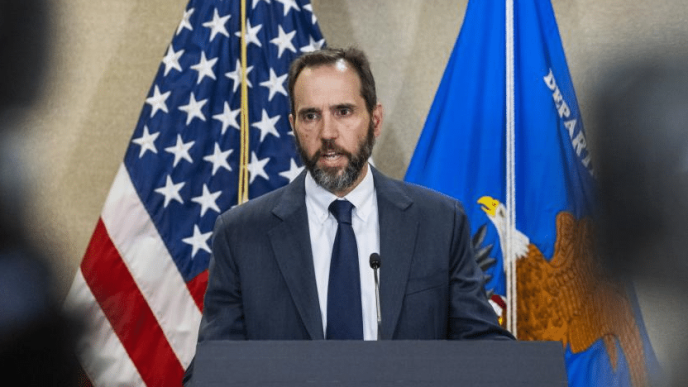
The Justice Department is facing intensified scrutiny following the release of a clandestine video in which DOJ Acting Deputy Chief Joseph Schnitt reportedly admitted plans to politically shape disclosures tied to the Jeffrey Epstein case.

In the video released by political activist James O’Keefe of O’Keefe Media Group, Schnitt is seen telling an undercover operative—who he met through the dating app Hinge—that Epstein-related documents would be “redact[ed] every Republican or conservative person in those files, leave all the liberal, Democratic people in those files” to deliver a decidedly one-sided narrative. He further alleged that Ghislaine Maxwell’s transfer to a minimum-security facility violated Bureau of Prisons policy—suggesting it was a “benefit … to keep her mouth shut.”

Schnitt also claimed internal conflict within the DOJ, describing Attorney General Pam Bondi as a “yes person” aligned with former President Trump, while FBI Deputy Director Dan Bongino pushed for broader file release.

The department swiftly denied the claims, calling them baseless and unrelated to its internal process. A DOJ spokesperson stated Schnitt’s comments “have absolutely zero bearing with reality and reflect a total lack of knowledge of the DOJ’s review process.”

The video emerges amidst mounting political pressure for full disclosure of Epstein-related documents. House Oversight Committee members recently made 33,000 pages available publicly—though Democrats argue that only ~3% of those pages contained new information.

Republicans and Democrats alike are pushing for further transparency. Figures such as Rep. Thomas Massie (R) and Rep. Ro Khanna (D) are spearheading bipartisan efforts to compel a full release of all unclassified DOJ materials.

Meanwhile, former President Trump dismissed the controversy as a partisan “Democrat Epstein Hoax,” calling for it to end while some GOP lawmakers continue to call for more disclosures.

Questions remain: Was Schnitt’s off-the-record admission a true reflection of internal DOJ intent—or merely personal conjecture? How many truly new documents remain unreleased?

Feud Explodes as Country Star Slams Megachurch Pastor Joel Osteen: ‘You’re Not Going to See Him Do That’

A bizarre feud has ignited between country star John Rich and megachurch pastor Joel Osteen after the singer accused the televangelist of omitting a key teaching from the Bible in his sermons.

Former Lonestar bassist Rich has slammed Osteen for allegedly avoiding talking about the 24th chapter of the Book of Matthew in the New Testament, which outlines the ‘end times’, because it would make congregants feel ‘uncomfortable’.

The chapter in question begins with the disciples asking Jesus: ‘What will be the sign of your coming and of the end of the age?’

Jesus responds by warning them that they will face a perilous period of ‘famines and earthquakes’ while being confronted with false Messiahs, adding that his actual coming will be unexpected.

Speaking on the Shawn Ryan Show on Wednesday, Rich, 51, described the passage at length before accusing Osteen, 62, of omitting the key teachings from his preaching because ‘it’s very uncomfortable for Christians to have to think about’.

‘To say that God would never make his people go through something like that is one of the most ignorant, spiritually ignorant things a person could say,’ Rich said. (Read more from “Feud Explodes as Country Star Slams Megachurch Pastor Joel Osteen: ‘You’re Not Going to See Him Do That'” HERE)

Photo credit: Flickr

“We Know Their Names”: Epstein Survivors Vow to Make Their Own List

On September 3, 2025, survivors of Jeffrey Epstein held an emotional two‑hour news conference just outside the U.S. Capitol, calling for transparency, justice, and resolute action in the aftermath of their years of abuse. Many attendees spoke publicly for the first time, delivering deeply personal testimonies that revealed the harrowing world behind Epstein’s exploitation—and what they hope comes next.

Survivors described being duped as teenage masseuses into predatory environments. One recounted the chilling reality of being coached into the exploitative roles, while Haley Robson, appearing in media coverage earlier, revealed she was coerced into recruiting other teenage girls. Robson said she was paid per recruit, saying, “I was told it would be possibly in your bra and underwear, but it would just be a massage.”

Another survivor, Marina Lacerda—long identified as “minor victim one”—spoke about being lured under the guise of opportunity, only to be trapped in abuse that derailed her education and childhood.

For years, investigators have asserted that no formal “client list” of powerful individuals associated with Epstein exists. Yet survivors are now proactively taking matters into their own hands. At the press conference, Lisa Phillips—who runs a podcast for Epstein survivors—announced:

“We have been discussing creating our own list. We know the names… it will be done by survivors, for survivors. Stay tuned.”

Attorney Brad Edwards clarified that no official list was found in Epstein’s records, and emphasized that while survivors know who was in “his world,” any naming would come with serious legal risks. Rep. Marjorie Taylor Greene backed up survivors’ rights to hold their collaborators accountable; she offered to publicly read their list in Congress—protected by the Speech or Debate Clause, if given permission

Meanwhile, at a simultaneous White House event, President Trump dismissed the renewed focus on Epstein and the push for document transparency as a “Democrat hoax that never ends,” urging the public to shift attention to the “greatness of our country.”

Survivors were joined by bipartisan lawmakers—Rep. Ro Khanna (D-CA), Rep. Thomas Massie (R-KY), and Rep. Marjorie Taylor Greene (R-GA)—to press for the release of all documents related to the Epstein and Maxwell case. They criticized the Justice Department’s recent release of over 30,000 pages as heavily redacted and largely redundant, with many key files still withheld.

Rep. Khanna framed the fight as fundamental to restoring trust: “A nation that allows rich and powerful men to traffic and abuse young girls without consequence… has lost its moral and spiritual core.”

Victims and families—including those of Virginia Giuffre, who died earlier this year—criticized Trump’s “hoax” characterization. Giuffre’s family called out the administration, insisting that the survivors’ demand for justice will not fade.

Survivors have clearly declared their intent: justice, truth, and closure. Whether through full governmental transparency or survivor‑led accountability, their resolve endures. The release—or potential disclosure—of the “client list” could reignite legal and political ramifications.

Trump Administration Cancels Army Program After Officer Participation Plummets

The Trump administration has officially scrapped the Army’s Command Assessment Program (CAP) — a leadership evaluation system that incorporated psychological testing, peer feedback, and behavioral analysis into the promotion process for senior officers — following years of declining participation and controversy within the ranks.

The decision marks a sharp break from the Army’s recent attempts to modernize its promotion pipeline by reducing bias and incorporating non-traditional metrics like emotional intelligence and cognitive capacity. CAP, introduced in 2020 and formally codified in early 2025 under former Army Secretary Christine Wormuth.

According to internal Army documents, the program used a range of psychometric tools to measure leadership traits such as self-awareness, conscientiousness, and emotional intelligence. Each year, approximately 2,000 senior officers were invited to undergo the assessments as part of the process to fill key command positions.

But the program struggled to gain traction. By 2024, more than half of eligible officers — 54% — declined to participate, up from 40% in 2019. Critics within the ranks argued the assessments were overly subjective, bureaucratic, and disconnected from actual field performance.

Army Secretary Dan Driscoll placed the program under review last month before officially pausing it. The Army will now revert to the Centralized Selection List (CSL) process, which evaluates candidates based on their service record, prior assignments, and evaluations from senior leaders — a more traditional method long favored by military brass.

The termination of CAP also aligns with a broader Defense Department review, ordered in June, to evaluate how officer promotions are conducted across all branches. The June 20 memo from the Under Secretary of Defense for Personnel and Readiness called for a return to selection methods that emphasize proven performance and experience over experimental assessment tools.

With CAP now shelved, the Army will re-center its leadership selection process around the CSL system. Proponents argue this will restore confidence and objectivity to promotions.

Medical Examiner Uncovers Cause of Death for US Attorney Who Prosecuted Leaker

Police revealed the cause of death for former U.S. Attorney Jessica Aber on Monday, months after she died in her sleep at home in March.

The medical examiner’s office in Alexandria, Virginia says the former official died from a “sudden unexpected death in epilepsy,” according to the Virginian-Pilot. Police had said earlier this year that they had “found no evidence suggesting that her death was caused by anything other than natural causes.”

(see the earlier story HERE about Ms. Aber’s work on CIA leak cases and Russian fraud)

Aber’s family had released a statement to the press shortly after her death noting that she had suffered from epilepsy and related seizures “for many years.”

Aber, 43, worked as the U.S. attorney for the Eastern District of Virginia from 2021 to 2025 before stepping down on Jan. 20, the same day that President Donald Trump returned to the White House.

In her resignation letter, she called her role “an honor beyond measure.” (Read more from “Medical Examiner Uncovers Cause of Death for US Attorney Who Prosecuted Leaker” HERE)

Photo credit: U.S. Department of Justice Archives

Father’s Eerie Last Message to Wife Revealed Before Mountain Tragedy

A Minnesota hiker was found deceased in Wyoming’s Bighorn Mountains nearly a month after he sent a final text message to his wife and was not heard from again, authorities said Thursday.

The body of Grant Gardner, 38, was found underneath a ledge near the summit of the 13,000-foot Cloud Peak by a professional climbing team from North Carolina, the Big Horn County Sheriff’s Office said in a statement.

“While it’s not the outcome we hoped for, we are hopeful this will provide much needed peace and closure to the family,” the sheriff’s office said.

Gardner went missing on July 29 in the Cloud Peak Wilderness, where he had planned a three-day hike through the Misty Moon Lake area before eventually summiting Cloud Peak.

Phone records showed Gardner’s last known contact was a message to his wife on that day, “letting her know he’d made it to the summit,” the sheriff’s office has said. Authorities said the text indicated “the climb was more taxing than he expected and he was tired.” (Read more from “Father’s Eerie Last Message to Wife Revealed Before Mountain Tragedy” HERE)

Photo credit: Flickr

Putin’s Three Demands for Ukraine Peace Revealed After Alaska Summit With Trump: Report

Russian President Vladimir Putin has laid out three conditions he says are necessary to achieve peace in Ukraine, according to a new report.

Putin, who met with Donald Trump two weeks ago in Alaska for a high-stakes summit, is demanding that Ukraine surrender control of the remaining parts of the Donbas region, abandon its bid to join NATO, and accept strict neutrality that bars Western forces from setting foot in the war-torn country, three sources familiar with Kremlin thinking told Reuters.

The reported proposal marks a scaling back from Moscow’s earlier demands. In June 2024, Russia insisted Kyiv give up four provinces: Donetsk and Luhansk in the east, along with Kherson and Zaporizhzhia in the south. Now, according to Russian sources, Putin is seeking only the full Donbas in exchange for halting operations in Kherson and Zaporizhzhia.

Russia currently controls about 88% of the Donbas, as well as 73% of Zaporizhzhia and Kherson, according to U.S. intelligence estimates and open-source data. Moscow has also signaled it could return small parts of the Kharkiv, Sumy, and Dnipropetrovsk regions as part of a potential settlement.

Still, Putin remains firm on his two other core demands: that Ukraine’s NATO ambitions, written into its constitution, be abandoned, and that Western militaries not be allowed to deploy in Ukraine under any peacekeeping mandate.

“Putin is ready for peace — for compromise,” one Russian source told Reuters. “That is the message that was conveyed to Trump.”Ukrainian President Volodymyr Zelensky has repeatedly rejected any deal that involves ceding internationally recognized Ukrainian territory to Russia. On Thursday, he stressed the Donbas region is essential to his country’s survival.

“If we’re talking about simply withdrawing from the east, we cannot do that,” Zelensky said. “It is a matter of our country’s survival, involving the strongest defensive lines.”

He also argued that Ukraine’s NATO aspirations are a sovereign matter and should not be dictated by Moscow.

For now, no direct talks between Putin and Zelensky are scheduled. Russian Foreign Minister Sergey Lavrov told NBC News that “the agenda is not ready at all” for such a summit.

“President Putin said clearly that he is ready to meet provided this meeting is really going to have an agenda, presidential agenda,” Lavrov said, accusing Kyiv of stalling.

Meanwhile, Trump has applied pressure from the sidelines, warning of “massive” sanctions and tariffs if Putin and Zelensky fail to move toward negotiations.

“I’ll see whose fault it is,” Trump said Friday. “If there are reasons why, I would understand that. I know exactly what I’m doing. We’re going to see whether or not they have a meeting — that will be interesting to see.”

Zelensky has said he is ready to meet Putin but accused the Kremlin leader of blocking progress.

Photo credit: Flickr

Trump’s Tariffs Ruled Illegal in Stunning Blow to President’s Agenda

A federal appeals court delivered a major setback to President Donald Trump’s trade agenda Friday, ruling that the sweeping tariffs he imposed earlier this year are illegal under U.S. law.

In a 3–0 decision, the U.S. Court of Appeals for the Federal Circuit found that the International Emergency Economic Powers Act (IEEPA) — the statute Trump cited to justify his global tariff program — does not grant the president authority to unilaterally impose such broad duties.

The ruling affirmed an earlier decision from the Court of International Trade, which struck down Trump’s executive orders in May. However, the appeals court paused its judgment until October 14 to allow the administration time to seek Supreme Court review.

“This is a significant constitutional question about the limits of presidential power,” said Georgetown University law professor Michael Ramsey. “The courts are signaling that trade policy — especially blanket tariffs — belongs to Congress, not the White House.”

Trump made tariffs a centerpiece of his second term after declaring a national emergency at the southern border on January 20. By April, he rolled out a sweeping tariff regime that reshaped U.S. trade relations with dozens of countries.

The measures included:

“Reciprocal tariffs”: a 10% baseline duty on nearly all imports, with higher surcharges for countries like China, India, and Canada.

Drug-related tariffs: 25% duties on Mexico and Canada and up to 20% on China, justified as part of the fight against fentanyl and cross-border trafficking.

Industry-specific tariffs: a 25% “fentanyl tariff” on Chinese pharmaceutical imports, a 100% duty on foreign films, and doubled steel and aluminum tariffs (from 25% to 50%).

Automobile duties: a 25% tariff on imported cars.

De minimis repeal: ending the exemption for low-value international packages, meaning even small online purchases from abroad now face tariffs.

At their peak, tariffs on Chinese goods climbed to 145% before a temporary July truce lowered rates to 30%. Canada, Mexico, and India were also hit with duties ranging from 25% to 50%.

The tariff blitz sparked immediate backlash. A coalition of small businesses and 12 states filed suit earlier this year, arguing that Trump’s actions were unconstitutional and exceeded his statutory authority.

Small manufacturers, retailers, and farm exporters said the tariffs increased costs, strained supply chains, and invited retaliatory measures from key trading partners. China and Canada both responded with their own counter-duties, escalating trade tensions.

“We’ve been left in a state of uncertainty for months,” said David Brown, who runs a small auto-parts importing business in North Carolina. “Now at least we know the courts are siding with the rule of law instead of executive overreach.”

The White House has not yet issued an official response, but senior officials are widely expected to appeal to the Supreme Court before the October deadline. If the high court agrees to hear the case, it could set up a defining legal battle over the scope of presidential authority in trade policy.

The ruling also reopens debate on Congress’s role in shaping tariffs and trade. While the Constitution grants Congress the power to regulate commerce with foreign nations, presidents of both parties have increasingly tested the boundaries of executive authority in the trade arena.

For now, businesses, consumers, and America’s trading partners are left waiting to see whether Trump’s tariffs — a cornerstone of his “America First” agenda — will survive judicial scrutiny.

Photo credit: Gage Skidmore via Flickr

Pete Hegseth Fires Director of Defense Intelligence Agency After Iran Strike Report

Defense Secretary Pete Hegseth has removed the director of the Defense Intelligence Agency (DIA), Air Force Lt. Gen. Jeffrey A. Kruse, following the release of a preliminary assessment regarding U.S. strikes on Iran in June, according to multiple reports.

The New York Times reported that both a senior defense official and a senator confirmed Kruse’s dismissal, making him the second top military intelligence leader to be ousted since President Donald Trump returned to office in January. Earlier this year, Gen. Timothy D. Haugh, head of the National Security Agency, was forced out after complaints raised by a right-wing commentator.

Kruse, a veteran intelligence officer, had been serving as director of the DIA since 2023. His removal was described by officials as stemming from a “loss of confidence,” though it was not immediately clear whether he would be reassigned within the Air Force. Two congressional officials told the Times that lawmakers were formally notified of the decision.

Sen. Mark Warner (D-VA), chairman of the Senate Intelligence Committee, sharply criticized the move, saying it highlighted what he called the Trump administration’s “dangerous habit of treating intelligence as a loyalty test rather than a safeguard for our country.”

The Washington Post also confirmed Kruse’s firing, citing two people familiar with the matter. They reported that officials did not immediately provide a reason beyond the stated “loss of confidence.”

Kruse’s dismissal came in the wake of a DIA preliminary report assessing the impact of U.S. military strikes on three Iranian nuclear facilities in June. The assessment reportedly caused friction within the administration, though the precise contents of the report have not been made public.

The firing underscores growing tension between the Pentagon’s intelligence community and the Trump administration.

Photo credit: Gage Skidmore via Flickr

Three States Face Loss of Federal Funding Over Trump Trucking Mandate

Transportation Secretary Sean Duffy on Tuesday warned California, New Mexico, and Washington that they have 30 days to comply with federal English proficiency rules for truck drivers or risk losing millions in federal funding.

The announcement follows a Department of Transportation investigation into an August 12 crash on the Florida Turnpike in which three people were killed. Authorities said the driver, Harjinder Singh, an illegal immigrant, caused the crash after making an illegal U-turn. Singh had been granted a commercial driver’s license in both California and Washington. New Mexico law enforcement also failed to administer an English proficiency test when Singh was stopped for speeding in July, investigators found.

“We at DOT and Federal Motor Carriers, we are not going to tolerate states that don’t comply with the rules that come from this department,” Duffy said at a press conference. “We are going to give these states 30 days to come into compliance with truck drivers speaking proficiently the English language, or we’re going to look at the federal funding that they receive under the Motor Carriers Safety Assistance Program.”

Under the mandate, California could lose $30 million, Washington $10 million, and New Mexico $7 million in funding if they fail to enforce the standards. The English proficiency rule was announced in May by the Trump administration and took effect at the end of June.

“When we did that, there was a lot of press that complained to us that we were being unfair to people, that we were being mean to people,” Duffy said. “And what we said was, ‘no, this is a safety issue.’ Making sure drivers of very heavy, 80,000-pound rigs can speak the language is truly a critical safety issue.”

A Federal Motor Carrier Safety Administration review found that between June 25 and August 21, California allowed at least 23 drivers with documented English proficiency violations in other states to continue driving. Washington allowed six such drivers to remain on the road, while New Mexico allowed seven.

Duffy said additional enforcement measures would be considered if the states fail to comply within the 30-day deadline.

Photo credit: Flickr