OOPS: Michigan Recount Appears to Expose Industrial-Scale Democrat Vote Fraud

Over half of Detroit’s 662 voting precincts may be ineligible for the ongoing Michigan recount, since the number of ballots in precinct poll books do not match those from voting machine printout reports.

More than a third of precincts in Wayne County, Michigan’s largest county and home to Detroit, could be disqualified from the statewide recount because county officials, “couldn’t reconcile vote totals for 610 of 1,680 precincts during a countywide canvass of vote results late last month,” according to the Detroit News.

Wayne County has over 1.7 million residents and voted overwhelmingly for former Secretary of State Hillary Clinton, at 95 percent. Krista Haroutunian, chair of the Wayne County Board of Canvassers, told the Detroit Free Press that the discrepancies could make 610 precincts across the county (including the 392 in Detroit), ineligible for recount. A final decision has not yet been made.

The Michigan Republican Party, President-elect Donald Trump and the state’s Republican attorney general all filed notice that they plan to appeal a U.S. District Court decision to start the recount Monday, arguing the effort should not be decided by the federal courts system. (RELATED: Michigan GOP Files Appeal To Stop Recount)

“This is a Michigan issue, and should be handled by the Michigan court system,” Michigan Republican Party Chairman Ronna Romney McDaniel said in a press release. (Read more from “OOPS: Michigan Recount Appears to Expose Industrial-Scale Democrat Vote Fraud” HERE)

Follow Joe Miller on Twitter HERE and Facebook HERE.

That Japanese Investment Money Trump Announced Today? Turns out It’s from Saudi Arabia!

On Tuesday afternoon, President-elect Donald Trump excitedly announced that telecommunications giant SoftBank Group has pledged to invest $50 billion in the U.S. and create 50,000 new jobs.

Of course, Trump made sure to give credit where credit was due.

The deal sounds great on the surface. After all, who could possibly argue with a $50 billion infusion and 50,000 jobs gained in the U.S. economy?

Now, what if you were told that the money was actually coming from the government of Saudi Arabia?

Here’s what Trump left out of his grand announcement:

According to the Wall Street Journal, the majority of the investment will come from a $100 billion investment fund that SoftBank set up in partnership with the Kingdom of Saudi Arabia.

The Saudi Arabia Public Investment Fund, which is controlled by the Saudi royal family, is the fund’s lead partner, the report added. This means that most of the money Mr. Son is going to invest in America is actually coming straight from Riyadh, and not through his Japan-based conglomerate.

The fund is overseen by Saudi Deputy Crown Prince Mohammed bin Salman bin Abdulaziz. Notably, the Saudi royal, who is the most powerful member of the family (outside the king himself), made sure to congratulate Trump on his election victory in November.

While on the campaign trail, Donald Trump rightfully demanded that Hillary Clinton return the investments the Clinton Foundation received from Saudi Arabia and other foreign governments.

“Hillary wrote that the governments of Qatar and Saudi Arabia are ‘providing clandestine and financial and logistical support to ISIL.’ Yet, in that same year, Bill and Hillary accepted a check from Saudi Arabia,” Trump said. “I think she should give back the $25 to $35 million she’s taken from Saudi Arabia. And she should give it back fast.”

Trump again castigated Clinton in June for taking money from the oil-rich kingdom.

“Saudi Arabia and many of the countries that gave vast amounts of money to the Clinton Foundation want women as slaves and to kill gays. Hillary must return all money from such countries!” Trump said on Facebook.

Saudi Arabia is a strict Islamic fundamentalist society. The country does not protect the unalienable human rights of its citizens. Women are forced to wear burkas, and are not allowed to travel freely without a male guardian. No religion other than Islam is recognized by the state, and apostates and atheists are often sentenced to death.

The United States and Saudi Arabia have almost zero shared values. The Washington, D.C. foreign policy establishment wants to preserve the monarchy there, but only to ensure that the unknown (e.g. a nefarious terrorist group) does not acquire control over the oil-rich territory.

The Saudis have utilized the wealth of their massive oil revenues to pursue influence operations in foreign countries, such as the U.S. Studies have shown that Riyadh’s campaigns to infiltrate American institutions, such as the media, academia, and Big Business, has had success in shaping a more pro-Saudi policy. The coming $50 billion Saudi-Japanese infusion into America will undoubtedly come with plenty of strings attached.

For the entirety of Trump’s presidential campaign, he forwarded a nationalist vision of putting American interests first — impervious to foreign and outside influences. And his “America first” messages garnered him a fiercely loyal following. Now that Donald Trump is the president-elect, he appears ready to abandon America’s interests for some decent publicity, betraying his electoral platform and base along the way. (For more from the author of “That Japanese Investment Money Trump Announced Today? Turns out It’s from Saudi Arabia!” please click HERE)

Follow Joe Miller on Twitter HERE and Facebook HERE.
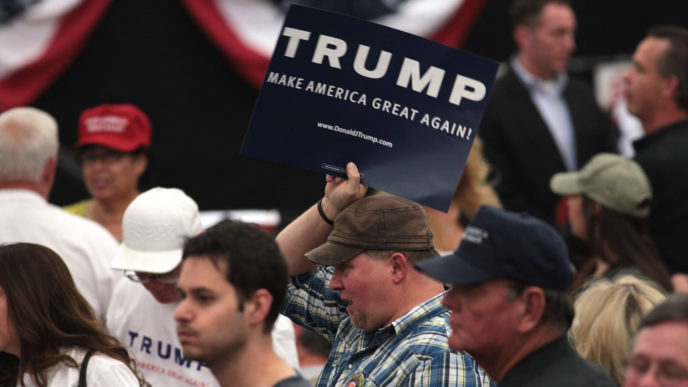
Trump’s Treasury Nominee Already Has a New Idea to Reduce the Debt

President-elect Donald Trump’s cabinet is taking shape. He has locked down his picks for attorney general, departments of Treasury, Education, Health and Human Services, Commerce, and Transportation.

So far, most of the names submitted are familiar in the political world, but one is not: Steven Mnuchin, Trump’s pick for Treasury secretary.

Mnuchin is better known among America’s financiers and investment bankers because he spent 17 years as a partner at Goldman Sachs. He is also known in Hollywood, where his firm, RatPac-Dune Entertainment, produced films like the “X-Men” and “Avatar.”

When it comes to public policy, Mnuchin has no real experience. In fact, The New York Times dubbed Mnuchin a true, “Outsider to Public Policy.” His policy suggestions so far appear to mirror talking points from the Trump campaign: He opposes the Dodd-Frank financial regulation bill, he regrets the lack of punishment for Wall Street titans post crisis, and he wants to help facilitate a large, new tax cut.

Yet, Mnuchin recently branched out with a policy proposal of his own to curb U.S. debt. The proposal recommends a review of Treasury maturities to determine whether ultra-long-term treasuries should be added to debt security options. A Treasury maturity is the timeline for a debt to remain outstanding, after which the security expires. For example, U.S. government securities are currently sold to the public with maturities of between 30 days (Treasury bills) and 30 years (Treasury bonds).

But Mnuchin would like to explore adding 50- or 100-year bonds. Why would he propose such an option to deal with the debt? Well, it really has everything to do with today’s low interest rates. Here’s why:

This year (fiscal year 2017), the government will run a deficit of $590 billion. To cover the deficit, the government will need to borrow money by selling its debt. However, the government will actually have to borrow far more — enough money to cover “rollover” maturing debt. That means the government has to take on new debt to cover the old debt that is effectively expiring.

So, instead of ‘just’ $590 billion in new debt, the U.S. government will also have to borrow about $3.3 trillion to pay off the old maturing debts. That means the government will need borrow almost $4 trillion this year alone!

Although the government offers Treasury securities with many different maturities, historically, the government borrows long-term debt i.e., securities with maturities of more than 10 years. However, this trend significantly shifted toward short-term U.S. debt under the Clinton administration.

This was done to save money since short-term treasuries offer a lower yield than say the 30-year bonds. Long-term U.S. debt usually pays a percentage or two more in interest payments than short-term debt. This is mostly to cover implicit risks. First, there is greater risk that a debtor will fail to make payments over 30 years, then say, five years. In addition, the higher interest rate on long-term debt helps cushion future inflation that would reduce the value of those interest payments to the lender. Therefore, short-term debt allows the government to borrow more money at a cheaper cost but not without serious risks.

First, since short-term debt needs to be “rolled over” more frequently, it subjects that new debt to the fluctuation of immediate interest rates. Short-term debt may be insanely cheap for the government, with less than a few percentage points of interest payments. But that’s today. There is no guarantee the government will have the same luxury a year or two from now. Yet on the other hand, 30-year bonds have a fixed interest rate over the course of three decades, which is particularly attractive right now since rates are historically low — even for longer-term debt.

John Cochrane, economist at Stanford’s Hoover Institution, points out the troubling scenarios for short-term securities if interest rates return to “normal” levels. He writes,

Here’s the nightmare scenario: Suppose that four years from now, interest rates rise 5 percent, i.e. back to normal, and the US has $20 trillion outstanding. Interest costs alone will rise $1 trillion (5% of $20 trillion) — doubling already unsustainable deficits! This is what happened to Italy, Spain, and Portugal. Don’t think it can’t happen to us.

These short-term securities cause “rollover risk.” Since the U.S. government is in the business of issuing a lot of debt that is short-term, outstanding for only two, three, five, or seven years, then we have to hope that the world remains interested in continuing to purchase U.S. treasuries — and often. At present, the current maturity rate is 68 months, or less than six years. According to Cochrane, the government rolls over about half its debt every two years — or all of the $20 trillion in debt every half-decade.

This could lead to a partial default on our debt in the event we can’t find enough buyers in those short timeframes (unless, of course, the Federal Reserve steps in to purchase unwanted securities with printed dollars – a dangerous tactic in itself). And, because interest rates on short-term debt are so low, lenders (i.e., anyone who wishes to invest in government debt) become skittish in their willingness to continue to loan money to the U.S. government, as it continues to rack up records amount of debt.

If there aren’t enough investors to continue to buy our debt, America is deep trouble.

Countries like Belgium, Canada, France, and the United Kingdom have issued debt with maturities of 100 years. So why hasn’t the U.S.? Part of the reason has to do with market needs and liquidity demands in the economy. But, politically speaking, it has much to do with the government’s wishes to spend as recklessly and cheaply as possible.

For example, since long-term debt has higher interest rates than short-term debt, converting all the short-term debt currently outstanding into long-term would increase the near-term interest costs by about $277 billion, according to Cochrane. Yet, it could save billions — if not trillions — of dollars over the long-term if interest rates return to normal levels. In addition, locking in long-term debt helps insure against rollover risk.

There are some valid reasons for issuing short-term debt, yet, there is merit to the idea of locking in trillions of dollars of debt into low interest rates for the long-term. Mnuchin’s idea is intriguing and certainly deserves consideration. And, it’s noteworthy that it’s not a mainstream political idea. After all, near-term spending that is issued with debt-bearing higher interest rates (as would be the case by issuing 50- or 100-years bonds) will certainly make Washington’s spending spree a little more difficult to swallow.

Although the idea of issuing long-term debt is an interesting concept, Mnuchin also must advocate for less debt in general. Regardless of his wishes to implement new debt management techniques, unless our debt is reduced, the U.S. is headed toward a fiscal crisis. We must not forget that no matter what, the taxpayers of this country must repay all of this debt some day. At present, it will cost more than $160,000 per household.

Now, that’s a debt problem. (For more from the author of “Trump’s Treasury Nominee Already Has a New Idea to Reduce the Debt” HERE)

Follow Joe Miller on Twitter HERE and Facebook HERE.

7 Top RINO Moments of Betrayal This Week

One of the excuses for Republicans failing to promote a conservative agenda is that “outside organizations” have unrealistic expectations of what they can accomplish when they are out of power.

That excuse comes to an end in January when Donald Trump is sworn into office with a Republican-controlled House and Senate. However, based on what we’re seeing from the lame-duck session, it is clear that the dearth of conservatism is not due to a lack of power but a lack of will. The alacrity of Republicans to promote mediocre or liberal priorities in a lame-duck session with Obama as president instead of passing a budget CR and getting out of town — so that we can do better things next year — demonstrates that they fundamentally don’t share our values.

To that end, I present a week in review in the form of the top seven RINO moments of betrayal. (Warning: John McCain, R-Ariz. (F, 32%) and Lindsey Graham, R-S.C. (F, 30%) are the stars of the show.)

1. Sold out to the transgender lobby

GOP leaders negotiated a conference report for the final version of the FY 2017 defense bill (NDAA). The transgender lobby pushed hard to remove a provision protecting defense contractors from Obama’s mandate forcing them to comply with his transgender policies and views on gay marriage or risk losing contracts. John McCain, as the lead Republican negotiator, agreed to take out this provision (the Russell Amendment).

Let’s get this straight: Republicans are passing an NDAA in a lame duck, which is already several months into the fiscal year, instead of waiting until early next year when we have a Republican president who could sign an NDAA with better provisions, protecting religious liberty. Remember, this is an authorization bill — not an appropriations bill — and can wait until February. Then again, the sexual identity movement tells Republicans to jump and they ask, “How high?”

Unfortunately, with leadership presenting members with a false choice of passing a defense bill with bad provisions instead of waiting, conservatives felt compelled to vote for it and so as not to appear they oppose the military. This is what leadership does to conservatives on a daily basis.

2. Jammed through 1,000-page health care spending bill

Who doesn’t want to cure cancer? Under the guise of discovering the cure to cancer, GOP leadership passed an “unpaid-for” $6.3 billion health care spending bill that threw even more money at the HHS, which already spends about $1 trillion a year on health care programs. Once again, conservative members were placed in a tough position between the false choice of either appearing to be against a cure for cancer and some good reforms or creating a lot of wasteful big government programs.

3. Funded Syrian al Qaeda in defense bill

In addition to caving on the transgender provision in the NDAA, Republicans, at the behest of John McCain, extended funding for the training and equipping of Syrian rebels through 2018! Yes, they are extending Obama’s legacy of funding Syrian Islamist groups — who call for the beheading of the troops who are training them — into Trump’s presidency. Again, why not wait until Trump becomes president and disband this harmful program? Because McCain, as you will see in a moment, loves himself some Islamist rebels.

4. Proposed an amendment to protect al Qaeda and Saudi Arabia

Obama is not the only one who mixes up enemies and allies. Just how strong is the support of John McCain and Lindsey Graham for the Syrian Islamist rebels? They proposed an amendment this week to strip out a provision from the Justice Against Sponsors of Terror Act (JASTA), which allows families of terror victims to bring civil claims against governments that fund those terrorist groups responsible.

As Patrick Poole reports, the intent behind their amendment, which comes on the heels of an intense lobbying campaign from Saudi Arabia, is “to immunize countries like Saudi Arabia and Qatar that have funded Sunni terrorist groups in Syria — the Syrian ‘rebel’ effort that both McCain and Graham have publicly supported since 2011.” Meanwhile, as they promote Saudi Arabia and Syrian al Qaeda, McCain and Graham are publicly criticizing domestic policies of Egyptian President al-Sisi in his efforts to clamp down on the Muslim Brotherhood. Who needs Democrats when we have two of the most senior Republicans on foreign policy promoting the same dyslexic Muslim Brotherhood agenda?

5. Thom Tillis threw a tantrum over criminal justice reform

Imagine being a Republican now as we look forward to the opportunity of controlling all branches of government. There is an endless list of conservative priorities to push on social, fiscal, and national security issues, right? Well, for Sen. Thom Tillis (R-K Street), his hill to die on his promoting jail break.

This week, he threatened to retire from the Senate in 2020 unless Republicans pass criminal justice “reform.” So as a member of the Judiciary Committee, with the opportunity to focus on immigration and election fraud, which are helping create a permanent Democrat majority, he instead focuses on Soros’ number one priority: help grow the Democrat voter base?! This is a man whose priorities are already dyslexic, as he sided with the transgender lobby over his own state party. His threat to retire should actually come as welcome news to conservatives. Unfortunately, his threat is likely as real as the threat from Hollywood actors to leave the country when Trump becomes president.

6. Lindsey Graham just can’t divorce himself from amnesty

Lindsey Graham has long peddled the open borders electoral myth: Republicans cannot win elections without embracing amnesty. This election completely repudiated that premise and proved conclusively that just the opposite is true. So what is Graham’s first priority for 2017? He plans to introduce another Dream Act amnesty designed to preserve Obama’s executive amnesty! At a time when more and more young, illegal immigrants are flooding our southern border, induced precisely by these very promises of amnesty, Lindsey wants to pour gasoline on the fire.

Meanwhile, there are new reports that illegal immigrants are more successful than ever at evading apprehension at the border and that unaccompanied minors are draining our federal health care funds. Thanks Lindsey! You are just what the doctor ordered.

7. Orrin Hatch might violate his pledge and run again

Facing a competitive primary in 2012, old-bull establishment hack Orrin Hatch, R-Utah (F, 33%) pledged that this would be his final — and most conservative — term in the Senate. Well, it has been his most liberal, and he is now indicating he will break his pledge and run for another term in 2018. If re-elected, he will be 90 years-old at the end of his term. Then again, the growing fumes of more power will always get in the way of doing the right thing, turning the House of Lords into a retirement home.

With friends like these … (For more from the author of “7 Top RINO Moments of Betrayal This Week” please click HERE)

Follow Joe Miller on Twitter HERE and Facebook HERE.
Obama’s Last Christmas Present to America? A Boatload of New Regulations

Barack Obama’s presidency may be waning, but that isn’t stopping the administration from issuing a volley of new regulations designed to implement the departing president’s agenda.

From commodities speculation to air pollution, Medicare drug payments to protecting funding for Planned Parenthood, agencies are hard at work issuing mandates, grasping at their last opportunity to lock in rules on Obama’s legacy issues.

These actions are nothing new. In fact, “midnight regulations” are almost a permanent feature of lame-duck presidents. Midnight regulations spiked under President Bill Clinton and were also used extensively by President George W. Bush.

However, President Obama has been far more direct about using the regulatory state to impose his agenda nearly by executive fiat — or without the approval of Congress. Under Obama, regulations have exploded. According to the Heritage Foundation, the Obama Administration issued 184 major rules during its first six years in office — at a cost of almost $80 billion a year.

Though only two months remain in Obama’s term, there are thousands of rules yet to finalize. Over 1500 proposed rules and regulations are in the pipeline, including over 700 dubbed “economically significant” — meaning those that cost the economy over $100 million per year. It’s these regulations that are likely candidates to be imposed in a last-minute flurry.

Is Congress powerless to stop this power grab by the executive branch?

Yes. And no.

By law, Congress has the authority to issue a “congressional review” of regulations it finds objectionable. Congress has 60 days to hold and up or down vote on regulations it chooses to review. This is tougher than it sounds — in fact, since its enactment, the Congressional Review Act (CRA) has only been successfully used once.

So, really, Congress provided itself with a tool to challenge executive regulations that is nearly impossible to utilize. I’m not too shocked.

However, this shouldn’t stop Republicans in the new Congress from seeking every opportunity to use the CRA. President Obama has issued more regulations — and at greater cost — than any sitting president to date. It is the constitutional role of Congress to check an overly-enthusiastic executive, and to do so requires Congress to muster the will to assert itself against this regulatory excess.

There is another way in which Congress can assert a permanent check on the power of the executive, and that is by passing the Regulations in Need of Scrutiny Act, or the REINS Act. This proposed bill would require every major regulation — those costing the economy $100 million or more per year — to receive an approval vote from Congress before it can go into effect.

Such a law, if enacted, would put accountability back where it belongs — in the hands of Congress, and the members that have been elected by the people. No longer would agency bureaucrats be able to write billion dollar regulations and impose them on the voters, who lack the recourse to stop them.

Consider the regulatory burden imposed by President Obama, without the approval of Congress:

Obama’s air pollution rule would be “the most expensive regulation ever imposed on the American public,” according to the National Association of Manufacturers, who calculated the rule would cost $3.4 trillion in economic output, and 2.9 million jobs by 2040.

The Obama administration’s rules on the financial industry reach over 19,000 pages so far.

EPA’s rule on emissions for automobiles costs $2.4 billion annually, according to one estimate.

The Federal Policy for the Protection of Human Subjects, a rule co-authored by every cabinet agency, could impose more than 12.1 million paperwork hours onto the medical research industry (in addition to costing $13.3 billion).

The regulatory state now comprises a literal “fourth branch” of government — one that is unchecked, and unaccountable. It is vital that Congress reasserts its Constitutional authority as a check on the executive branch. The new Congress must act aggressively to counter Obama’s surge of midnight regulations with the Congressional Review Act, and they must pass the REINS Act to subject major regulations to Congressional scrutiny.

More than that, however, this new Congress must be cautious about giving so much authority away to federal agencies. In many cases, harmful regulations are the result of Congress giving agencies vague directions and overly broad mandates. Too often legislation is passed that is half-written; allowing unelected bureaucrats to fill in the holes. If government is going to work as the Founders intended, then Congress must stop shirking the hard work of legislating, and write bills that contain clear direction — and limits — for agency power.

Unfortunately, midnight regulations are only part of a much larger regulatory problem. Unless Congress acts quickly, America will continue to be governed by unelected bureaucrats, accountable to no one but themselves. If this new Congress is serious about “draining the swamp,” their first step will be to rein in regulatory state. (For more from the author of “Obama’s Last Christmas Present to America? A Boatload of New Regulations” please click HERE)

Follow Joe Miller on Twitter HERE and Facebook HERE.

Cough Syrup With GPS Tracker Helps Police Nab Suspected Pharmacy Burglars

The suspects had no idea that the bottle of cough syrup perched on a shelf at a Tustin pharmacy contained something more than cough relief.

It wasn’t until the nondescript package was removed from the small Newport Avenue business by burglars that its secret ingredients went to work.

Concealed inside the bottle of cough syrup was a GPS device that began tracking the medicine thieves’ every move, according to police investigators.

After days of tracking, undercover surveillance and evidence gathering, investigators arrested Willie James Clark, 21, of Roland Heights and Brian Vega Salinas, 20, of La Puente on suspicion of committing the Nov. 10 burglary. (Read more from “Cough Syrup With GPS Tracker Helps Police Nab Suspected Pharmacy Burglars” HERE)

Follow Joe Miller on Twitter HERE and Facebook HERE.

Tolerance Strikes Again: College Students Shout Down Rick Santorum During Speech

Open-minded, tolerant liberals are at it again — this time, shouting down former Pennsylvania U.S. Senator and two-time presidential candidate Rick Santorum for making a speech at Cornell University on the future of America under President-elect Donald Trump. Famously socially conservative, Santorum made a short speech and opened up the floor to questions from the packed audience.

But liberals couldn’t wait that long to heckle Santorum, both in the marked area outside the auditorium and indoors. Hosted by the Cornell Republicans, the campus’ Young America’s Foundation and the Student Activities Funding Commission, Santorum was introduced by Cornell College Republicans President Olivia Corn. Within a minute of speaking, Corn had to firmly ask hecklers to “please give me the respect I’m giving you.”

It only got worse from there, with hecklers chanting “Shame!” as Santorum spoke. They also said he should leave campus, and were otherwise hostile despite claiming to have liberal values. The event can be seen in full at the video immediately below, starting around 29:00.

In a particularly poignant clip, Santorum seemed to chuckle as he noted that the same liberal students yelling “Shame!” were likely to “walk around this campus and talk about tolerance.” Santorum was interrupted this time by cheers and a partial standing ovation, after which he continued: “And all of them will tell you that you have to celebrate what? Diversity! Celebrate diversity! Preach tolerance! But when it comes to anybody who disagrees with them, there is no tolerance.”

The conservative student publication Cornell Review mocked the protesters, while The Cornell Daily Sun gave prominent voice to students who claim Santorum is “anti-gay” and “racist.” The independent student newspaper The Daily Sun article noted that the evening began with the usual reading of the university’s free speech policy, which had to be read again half-way through, “as protesters were continually hindering the speaker’s ability to address attendees.”

The SJW students at Cornell clearly can’t tolerate a viewpoint or rationale with which they disagree, though it appears the number of outlandishly rude and intolerant students was small compared to the 500-person audience reported by the Review. Cornell’s student leadership and administration deserve credit for hosting Santorum despite the students who showed their liberal values go no further than their safe spaces. (For more from the author of “Tolerance Strikes Again: College Students Shout Down Rick Santorum During Speech” please click HERE)

Follow Joe Miller on Twitter HERE and Facebook HERE.

SHOCK: Senate to Vote on Letting Democrats Keep Control of the FCC

Multiple sources confirm that the nightmare scenario identified by ATR is indeed likely to occur: Senate Democrats have picked off enough Republicans to force a vote next week on reconfirming Democrat Jessica Rosenworcel to the FCC, resulting in at best an initial 2-2 deadlock on the committee if Tom Wheeler, the current chairman, follows precedent and resigns, leaving only four commissioners at the FCC until another is confirmed. That would delay action on President Trump’s job creation agenda at the agency, which is bad enough.

But there is an even more disturbing possibility: If Wheeler follows through on his threat not to resign, it would mean Democrats would retain control of the FCC well into Trump’s presidency.

The FCC is a huge deal economically, overseeing a portion of the economy – television, radio, the Internet, mobile – roughly equal in size to the healthcare sector.

Moreover, under Obama the FCC has been a massive weapon of regulatory control, imposing public utility-style regulation of broadband, with a serious negative impact on investment and job creation. In that and many other ways, the FCC has been politicized and corrupted under Obama Democrats.

Imposing a Democratic FCC on a Republican president is completely outrageous and no Republican should vote for it. It is inconsequential whether it is paired with Republican Ajit Pai’s renomination, because he is already slated to stay on the FCC for another year and can be easily reconfirmed next year.

Under these circumstances, a Senate vote on Jessica Rosenworcel has nothing to do with her qualifications or record on the FCC.

It is a simple referendum on one thing: should an Obama FCC be forced on President Trump and rewarded for its outrageous regulatory assault on the U.S. economy by retaining power? (For more from the author of “SHOCK: Senate to Vote on Letting Democrats Keep Control of the FCC” please click HERE)

Follow Joe Miller on Twitter HERE and Facebook HERE.

One of These 21 Men and Women Will Be Trump’s First Supreme Court Pick

President-elect Donald Trump is that rare president who will nominate a Supreme Court justice almost immediately after taking office.

Trump is expected to act quickly to fill the seat of Justice Antonin Scalia, who died in February.

Two of the remaining eight Supreme Court justices, Ruth Bader Ginsburg, 83, and Stephen Breyer, 78, are older than average for a justice and may choose to retire. One-third of the potential nominees on Trump’s list of 21 contenders are 50 or younger, and four are women.

This could present a historic opportunity for Trump to reshape the Supreme Court, author and presidential historian Craig Shirley says.

“With a vacancy and aging people on the court, just as there was a Reagan court and just as there was a Roosevelt court, we might see a Trump Supreme Court,” Shirley told The Daily Signal, adding:

It is less likely these justices will retire. It’s more likely they will go out feet first. When you’re in your 80s, you might as well show up at the office. You’re not going to take up water skiing.

White House press secretary Josh Earnest told The Daily Signal that President Barack Obama is well aware of coming changes on the high court, though Earnest said he hasn’t heard the president discuss it.

“I’m not aware that the president has spoken to this, either publicly or privately,” Earnest said. “I think the president’s expectation is that President Trump will fill vacancies on the Supreme Court by appointing people who are quite different than the kind of people that President Obama appointed.”

Top Trump adviser Kellyanne Conway has said the president-elect is committed to choosing justices from the list of 21 candidates he released earlier this year.

Trump’s release of the list during the campaign was an unprecedented move, Carrie Severino, chief counsel and policy director for the Judicial Crisis Network, noted after the election.

“Given the significance of the court to Trump’s voters, I’m confident that he will stand by his campaign promise to appoint someone from his excellent list of constitutionalist judges,” Severino said in a formal statement, adding:

While that still would leave the Supreme Court in a 4-4-1 balance, with Justice [Anthony] Kennedy as a swing vote, Trump is likely to have the opportunity to appoint additional justices, who can ensure that the Constitution is interpreted according to its text and original meaning and isn’t used as a vehicle for political policy goals.

Most on the list are state Supreme Court justices or U.S. Court of Appeals judges. The list include two individuals who have served in Congress and would have a political record to defend. Two brothers also are on the list.

Trump faced some criticism for lack of diversity, with eight white males among the 11 names on the initial list he released in May; his subsequent list in September included one South Asian and one Hispanic.

A Political Trail

At Senate confirmation hearings, Supreme Court nominees who already are judges typically avoid directly answering questions about how they would rule on a policy that might come before the nation’s highest court.

However, three of those on Trump’s list were elected by voters to offices that require taking public stances during the course of a campaign. Two of the three have gone on to become judges:

U.S. Sen. Mike Lee, R-Utah, is a big favorite of conservatives. Lee, 45, was also a strong critic of Trump during the presidential campaign. As a member of the Senate Judiciary Committee, Lee typically would be in the advise and consent role during confirmation hearings for judicial nominees. Before he was elected to the Senate in 2010, Lee served as an assistant U.S. attorney for Utah. He is a graduate of Brigham Young University Law School and clerked for Justice Samuel Alito.

Florida Chief Justice Charles Canady, 62, was a four-term Republican member of the U.S. House of Representatives in the 1990s. Canady was one of the impeachment managers that acted as a prosecuting team against President Bill Clinton during his Senate trial in 1999. Canady, on the state’s high court since 2008, was elevated to chief justice in 2010. He previously was a state appeals court judge. He is a graduate of Yale Law School.

Judge William H. Pryor Jr., a Bush appointee, has served since 2004 on the U.S. Court of Appeals for the 11th Circuit in Alabama. Pryor, 54, became Alabama’s attorney general in 1997 after his predecessor, Jeff Sessions, was elected to the U.S. Senate as a Republican. (Trump has announced he intends to nominate Sessions as U.S. attorney general.) Pryor was elected in his own right in 1998 as state attorney general and was re-elected in 2002. In 2013, he was confirmed to a term on the United States Sentencing Commission. Pryor received his law degree from Tulane.

State Supreme Court Justices

In recent years, presidents typically have plucked federal appeals court justices to serve on the Supreme Court.

Not since President Ronald Reagan nominated Arizona state appeals court judge Sandra Day O’Connor to the Supreme Court in 1981 has a state judge of any kind been elevated to the high court.

Trump’s list includes as many state supreme court justices as federal appeals judges. The inclusion of two district judges, however, means federal judges outnumber state judges:

Georgia Supreme Court Justice Keith Blackwell, named by Gov. Nathan Deal to the court 2012, previously was a state appeals court judge and state prosecutor. Blackwell, 41, was an assistant district attorney for Cobb County before becoming a deputy state attorney general. A graduate of the University of Georgia School of Law, Blackwell also has worked in private practice.

Colorado Supreme Court Justice Allison Eid, named to the state’s high court by then-Gov. Bill Owens, a Republican, in 2006, won 75 percent of the vote to retain the position. Eid, 51, previously was the state’s solicitor general. A graduate of the University of Chicago Law School, Eid clerked for U.S. Supreme Court Justice Clarence Thomas.

Michigan Supreme Court Justice Joan Larsen was named to the state’s high court by Gov. Rick Snyder, a Republican. Larsen, 48, in 2002 became an assistant attorney general in the Justice Department’s Office of Legal Counsel. Larsen, who also taught law at the University of Michigan. received her law degree from Northwestern and clerked for Scalia.

Utah Supreme Court Justice Thomas Lee is the brother of Mike Lee, so the list is no small achievement for the Lee family. Both men are the sons of former U.S. Solicitor General Rex Lee. Thomas Lee, 52, began serving on Utah’s high court in 2010, nominated by Gov. Gary Herbert, a Republican. (His brother was elected to the U.S. Senate that same year.) Lee previously was on the faculty of Brigham Young University Law School, where he continues to teach in an adjunct capacity. During the Bush administration, he was deputy assistant attorney general in the Justice Department’s Civil Division from 2004 to 2005. A graduate of the University of Chicago Law School, he clerked for Thomas.

Iowa Supreme Court Justice Edward Mansfield was appointed in 2011 by Gov. Terry Branstad, a Republican, and voters decided to retain him in 2012. Mansfield, 58, previously served on the Iowa Court of Appeals. He is a graduate of Yale Law School.

Minnesota Supreme Court Justice David Stras, 42, was appointed by Gov. Tim Pawlenty, a Republican, in 2010. He was elected to a six-year term in 2012. Before serving on the bench, Stras taught at University of Minnesota Law School. He received his law degree from the University of Kansas and clerked for Thomas.

Texas Supreme Court Justice Don Willett has served on the state’s high court since 2005, appointed by then-Gov. Rick Perry, a Republican, and re-elected twice by voters. Willett, 50, previously was a senior fellow at the Texas Public Policy Foundation. An adviser to George W. Bush’s gubernatorial administrations, Willett later served as a deputy assistant attorney general in the Justice Department’s Office of Legal Policy when Bush became president. He also was a deputy attorney general under then-Texas Attorney General Greg Abbott, now the state’s Republican governor. Willett received his law degree from Duke University.

Michigan Chief Justice Robert Young, 65, was appointed to the state’s high court in 1999 by then-Gov. John Engler, a Republican. He previously served as a judge on the Michigan Court of Appeals. He is a graduate of Harvard Law School.

Federal Appeals Judges

Trump could follow the model of most recent Supreme Court nominations by choosing a federal appeals court judge.

Two of President Barack Obama’s nominees were appellate judges—Sonia Sotomayor, confirmed by the Senate, and Merrick Garland, his pick to replace Scalia, who has not been confirmed.

President George W. Bush nominated John Roberts and Samuel Alito, both former appeals court judges who were successfully confirmed.

Obama also successfully nominated Elena Kagan, a former solicitor general who never before served as a judge. Bush nominated and later withdrew White House counsel Harriet Miers, also never a judge.

President Bill Clinton’s two Supreme Court appointees, Ginsburg and Breyer, were both federal appeals court judges.

President George H.W. Bush named David Souter, a former appeals court judge. Reagan’s other two nominees, Scalia and Kennedy, were both federal appeals court judges.

Appeals court judges on Trump’s list are:

Judge Steven Colloton of the U.S. Court of Appeals for the 8th Circuit in Iowa, was appointed in 2003 by George W. Bush. Colloton previously served as a U.S. attorney for the Southern District of Iowa. The 53-year-old graduate of Yale Law School clerked for the late Supreme Court Chief Justice William Rehnquist.

Judge Neil Gorsuch, 49, of the U.S. Court of Appeals for the 10th Circuit in Colorado, was appointed in 2006 by Bush. Before that, Gorsuch was a deputy assistant attorney general at the Justice Department. The Harvard Law School graduate clerked for both Kennedy and Byron White.

Judge Raymond Gruender, 53, was named by Bush to the U.S. Court of Appeals for the 8th Circuit in Missouri in 2004. He previously was a prosecutor and served as the U.S. attorney for the Eastern District of Missouri. He received his law degree from Washington University in St. Louis.

Judge Thomas Hardiman was appointed by Bush in 2007 to the U.S. Court of Appeals for the 3rd Circuit in Pennsylvania. Hardiman, 51, previously was a federal district judge for the Western District of Pennsylvania, a position he took in 2003. A Notre Dame graduate, Hardiman practiced law in Washington and Pittsburgh.

Judge Raymond Kethledge was named by Bush to the U.S. Court of Appeals for the 6th Circuit in Ohio in 2008. Kethledge, 50, previously served as judiciary counsel to then-U.S. Sen. Spencer Abraham, R-Mich. He also was in-house legal counsel for Ford Motor Co. The University of Michigan graduate clerked for Kennedy.

Judge Margaret A. Ryan of the U.S. Court of Appeals for the Armed Forces was appointed by Bush in 2006. As a military judge and a veteran, she stands out among other contenders. Ryan, 52, served in the Marine Corps in the Philippines and during the Persian Gulf War. She graduated from Notre Dame Law School on a military scholarship and served as a JAG officer for four years. She clerked for Thomas.

Chief Judge Timothy Tymkovich of the U.S. Court of Appeals for the 10th Circuit in Colorado, a Bush appointee, has served since 2003. Tymkovich, 60, previously was Colorado’s solicitor general. He is a graduate of the University of Colorado College of Law.

Judge Diane Sykes of the U.S. Court of Appeals for the 7th Circuit in Wisconsin was named by Bush in 2004. Sykes, 58, had been a justice on the Wisconsin Supreme Court since 1999. Before that, she was a trial court judge in both civil and criminal matters. She received her law degree from Marquette.

Federal District Judges

Federal district judges are also rare Supreme Court nominees, but Trump’s list includes two:

Judge Federico Moreno of the Southern District of Florida is a member of the Judicial Conference of the United States, the national policymaking body for the federal courts. Moreno, 64 and Hispanic, appointed in 1990 by President George H.W. Bush, previously was a state and county judge in Florida. He is a graduate of the University of Miami School of Law.

Judge Amul Thapar of the Eastern District of Kentucky was appointed by the younger Bush in 2007. He has taught law students at the University of Cincinnati and Georgetown. Thapar, 47, previously served as an assistant U.S. attorney in Washington, D.C., and the Southern District of Ohio. He is of South Asian descent. Just before being named to his judgeship, Thapar was U.S. attorney for the Eastern District of Kentucky. He got his law degree from the University of California, Berkeley.

(For more from the author of “One of These 21 Men and Women Will Be Trump’s First Supreme Court Pick” please click HERE)

Follow Joe Miller on Twitter HERE and Facebook HERE.
The Diversity Police Went Too Far in Attacking HGTV’s Fixer Uppers

For years I have said that gay activists and their allies would overplay their hand and that their bullying would backfire. It is happening today in front of our eyes as a Christian couple, Chip and Joanna Gaines, who recently graced the cover of People magazine, is now being attacked simply for attending a Christian church. Oh, the thought of it!

Yes, if you are a public figure and you attend a church that preaches that marriage is the union of one man and one woman and you actually believe that homosexuals can be changed by the power of the gospel, you should be shamed, ridiculed and perhaps even fired.

That is the obvious offshoot of BuzzFeed’s recent article which carried the headline, “Chip And Joanna Gaines’ Church Is Firmly Against Same-Sex Marriage.” How terrible!

Chip and Joanna attend a church that actually believes what the Bible says? They’re part of a congregation that preaches what the church has taught for 2,000 years? Worse still, “Their pastor considers homosexuality to be a ‘sin’ caused by abuse,” although, “whether the Fixer Upper couple agrees is unclear.” Horror of all horrors. What kind of monsters are these two?

And note that the Gaines’ crime was not making a public statement against homosexuality, as Duck Dynasty’s Phil Robertson did, after which he was promptly (albeit briefly) suspended by A & E.

Their crime was not making ministry-related statements against abortion and homosexual practice, as the Benham Brothers did, because of which they were promptly fired by HGTV (after that network was bullied by radical left activists).

Their crime was not preaching in their own church that homosexuality was a sin, as Dr. Eric Walsh did, because of which he was fired by the state of Georgia as Public Health Director.

Their crime was not writing a book that made passing, negative reference to homosexual practice as did Kelvin Cochran, because of which he was fired by the city of Atlanta as fire chief.

Their crime was not penning an op-ed piece in a local newspaper, taking respectful issue with the notion that gay is the new black, as Crystal Dixon did, because of which she was fired as Associate Vice President of Human Resources at the University of Toledo.

Their crime was not even signing a petition after a church service which called for a popular vote on same-sex “marriage” in the state of Maryland (rather than letting legislators decide this), as Dr. Angela McCaskill did, because of which she was placed on leave by Gallaudet University in Washington, D.C. where she served as Associate Provost of Diversity and Inclusion (a position, by the way, which made no reference to sexual issues in its description).

No, the crime of Chip and Joanna Gaines was simply that they attend a gospel-preaching church. How much farther will these witch hunts go?

The Gaines and their representatives have not even issued a statement as to their own beliefs (if they do, I sure hope they affirm what their church teaches), nor has there ever been the slightest hint that anything they said on or off the show has been offensive, mean-spirited or hateful. Still, the very fact that they are popular, conservative Christians has put a target on their backs.

I repeat: This kind of shaming and bullying will backfire, and it will backfire sooner rather than later.

That’s why the left-leaning Washington Post already published an article by Brandon Abrosino, himself open and proudly gay, taking issue with the BuzzFeed article and noting that almost 40 percent of Americans are “not on board” with same-sex “marriage.” In response to this Abrosino asks, “Is the suggestion here [meaning, on BuzzFeed] that 40 percent of Americans are unemployable because of their religious convictions on marriage? That the companies that employ them deserve to be boycotted until they yield to the other side of the debate — a side, we should note, that is only slightly larger than the one being shouted down?”

Under no circumstances can gay activists and their allies wave the flag of Equality, Diversity and Tolerance when it comes to the BuzzFeed article. No, this is an overt and explicit attack on equality, diversity and tolerance and is, itself, an example of bigotry and intolerance of the highest order.

So, here’s a word of wisdom for BuzzFeed and those applauding their attack on Chip and Joanna Gaines: The Bible will be here long after you are gone, and the words of Moses, Jesus and Paul will be quoted for generations to come, while articles like the current hit piece on Chip and Joanna will be here today and gone tomorrow.

Put another way, as Bible-believing followers of Jesus, we’re not backing down or cowering in a corner or going underground. We’re here to stay, we are not ashamed, and the more you attack us, the stronger we become.

(For more from the author of “The Diversity Police Went Too Far in Attacking HGTV’s Fixer Uppers” please click HERE)

Follow Joe Miller on Twitter HERE and Facebook HERE.