Posts

CIA-Trained Afghan Forces Responsible for Atrocities, May Have Committed War Crimes, Says Watchdog

U.S.-backed Afghan special forces allegedly committed atrocities and are responsible for civilian deaths, according to a Thursday report from Human Rights Watch.

The report called for an investigation into whether the U.S. has been involved in committing war crimes in Afghanistan, according to The Associated Press. It accused Afghan forces allegedly committing atrocities of being “part of the covert operations” of the CIA and suggested disbanding the forces or having the Defense Ministry control them, the AP added.

“These troops include Afghan strike forces who have been responsible for extrajudicial executions and enforced disappearances, indiscriminate airstrikes, attacks on medical facilities, and other violations of international humanitarian law, or the laws of war,” the report stated.

Human Rights Watch detailed specific raids in the report, including ones in Zurmat. Afghan and U.S. strike forces allegedly shot four men dead as family members looked on, according to the report, and other people home for a holiday were killed in another house.

The findings in the report have been shared with Afghan and U.S. authorities, according to the AP. It added that the U.S. allegedly hasn’t looked into “raid incidents” by Afghan forces. (Read more from “Cia-Trained Afghan Forces Responsible for Atrocities, May Have Committed War Crimes, Says Watchdog” HERE)

Follow Joe Miller on Twitter HERE and Facebook HERE

Trump Wants to Pull All U.S. Troops out of Afghanistan by the 2020 Election

NBC News is reporting that Donald Trump has told White House aides that he wants to pull all U.S. troops out of Afghanistan by the 2020 election.

Current negotiations with the Taliban may make that possible. The two sides appear to be inching closer to a political deal that would include a total withdrawal of all U.S. forces.

But the NBC report alludes to some serious friction between the State Department and the Pentagon over the timing of the withdrawal. “It’s tense,” said one former official briefed on the debate:

Last December Trump threatened not only to immediately withdraw all troops from Afghanistan but also to shut down the U.S. embassy in Kabul, complaining to aides that it is too large and expensive, according to officials. The president’s threat to close the U.S. embassy — which has not been previously reported — so alarmed administration and military officials that they quickly offered him a plan to move up the timing of efforts to scale back the size of the embassy staff, officials said. . .

But Trump argued that without a military presence U.S. embassy staff could be in danger, so it should be closed, the officials said. He also said it was time for the U.S. to get out of the war there otherwise it could bankrupt the U.S. like it did Russia in the 1980s, the two former defense officials said.

(Read more from “Trump Wants to Pull All U.S. Troops out of Afghanistan by the 2020 Election” HERE)

Follow Joe Miller on Twitter HERE and Facebook HERE

America’s One Big Mistake in Afghanistan – Fighting the Wrong War

In his June 23, 2019 Military Times opinion article “America’s three big mistakes in Afghanistan,” Brig. Gen. Donald C. Bolduc (Ret) correctly noted three factors, which contributed to the pending U.S. defeat in Afghanistan:

“Misstep No. 1: The expansion of US forces and the introduction of large conventional units into the vast expanse of Afghanistan;

Misstep No. 2: Allowing the Taliban resurgence to occur in Afghanistan-2003-2009 and 2014-2019;

Misstep No. 3: Our inability to manage, let alone solve, Afghanistan’s illicit narcotics trade.”

Yet, none of those three could have been corrected or decisive while ignoring the geopolitical realities upon which an effective strategy is based.

That geopolitical reality is Pakistan, which has never shared the same objectives for Afghanistan as the U.S. and from which American strategic “mistakes” originated, those beyond the self-inflicted wounds of poor management and accountability, well-documented by the Special Inspector General for Afghanistan Reconstruction.

American military leaders consistently violated the most fundamental of strategic principles, ones taught at every U.S. war college, know your enemy and do not mistake a war for something that is alien to its nature.

The war in Afghanistan is not an insurgency. It is a proxy war being waged by Pakistan against the U.S. and Afghanistan.

Both the Pentagon and multiple U.S. political administrations have known from nearly the beginning of the conflict that an American victory in landlocked Afghanistan was impossible as long as Pakistan regulated the operational tempo by providing safe haven and support to its Taliban proxies and controlled the supply of our troops, critical factors which have never been adequately addressed.

Under such conditions, the application of counterinsurgency, which, I hasten to add, is a doctrine or collection of tactics, not a strategy, would ultimately be ineffective, whether executed by conventional or special forces. The same is true for counter-narcotics operations, where the trafficking of Afghan opium is largely occurring unimpeded through Pakistan.

Over nearly the entire course of the conflict, the U.S. supplied Pakistan with generous aid packages to bribe them from pursuing a course of action opposed to our own, but one Pakistan considered in its national interest. In essence, our leaders, through a combination of incompetence and indifference, allowed the United States to be defeated by Pakistan and paid them to do it.

Pakistanis now openly brag about it.

Shortly before his death in 2015, Lieutenant General Hamid Gul, the former head of Pakistan’s ISI, a committed Islamist and known as the “godfather of the Taliban,” said in an Urdu language television interview:

“One day, history will say that the ISI drove the Soviet Union out of Afghanistan with the help of USA and another sentence will be recorded that says the ISI drove the USA out of Afghanistan with the help of the USA.”

The Pakistani audience roared with laughter and applauded in approval.

The same pattern of duplicitous behavior by Pakistan has continued for seventeen years.

Late last year, during a Taliban attack on the Afghan provincial capital of Ghazni, large numbers of Pakistani nationals were found among the dead, presumably fighting with the Taliban. The bodies were subsequently returned to Pakistan.

In a recently released video, al Qaeda emphasizes its unity with Taliban and its role within the Taliban insurgency, as the jihadists, including Pakistanis, fight together to resurrect the Taliban’s Islamic Emirate of Afghanistan.

And yet American political leaders and senior military officers have done nothing, preferring to remain puzzled or cynical as to why we have not won in Afghanistan.

Despite Pakistani duplicity, Taliban safe havens in Pakistan remained largely untouched.

Pressure was never applied to Pakistan’s pain points, its moribund economy and financial insolvency and the existential threat of ethnic separatism, in particular among Pakistan’s Baloch and Pashtun populations.

An American withdrawal from Afghanistan will only be a humiliating defeat, if the U.S. is forced into strategic retreat from South Asia because we do not have a plan in place to address the changing regional conditions in a post-U.S. Afghanistan.

Fortunately, you can find such a new strategic plan here.

(Published in full with the permission of the author, find the original posting HERE)
_________________________________________

Lawrence Sellin, Ph.D. is a retired US Army Reserve colonel, an international IT businessman and a veteran of Afghanistan, Iraq and a humanitarian mission to West Africa. He receives email at [email protected] and can be found on Twitter @LawrenceSellin.

Follow Joe Miller on Twitter HERE and Facebook HERE

China Hosts Taliban Delegation to Enlarge Role in Afghanistan

A Taliban delegation recently traveled to Beijing to discuss U.S.-backed peace efforts as well as “mutual” counterterrorism concerns in Afghanistan, the Chinese foreign ministry confirmed on Thursday.

Indian media reported that New Delhi’s rival Beijing hosted the delegation — led by the Taliban’s political deputy chief Mullah Abdul Ghani Baradar — in a bid to expand its role in Afghanistan, which is expected to house projects from Beijing’s Belt and Road Initiative (BRI).

Asked about the Taliban’s visit on Thursday, Lu Kang, a spokesman for China’s Ministry of Foreign Affairs, told reporters that the two sides exchanged views “on Afghanistan’s peace and reconciliation process, counter-terrorism and other issues of mutual interest.” . . .

The Trump administration has intensified peace-seeking efforts over the last year, making the political reconciliation between Afghanistan and Kabul the primary goal of its strategy to end the nearly 18-year-old war. Nevertheless, the Taliban’s refusal to allow Kabul to participate in the ongoing negotiations has surfaced as the primary hurdle to the talks.

Taliban narco-jihadis, who are fighting to establish a sharia-compliant Islamic emirate in Afghanistan, consider themselves the only legitimate government of Afghanistan, dismissing Kabul as an American “puppet.” (Read more from “China Hosts Taliban Delegation to Enlarge Role in Afghanistan” HERE)

Follow Joe Miller on Twitter HERE and Facebook HERE
Things Are Going So Great in Afghanistan That the Government No Longer Wants to Share the News

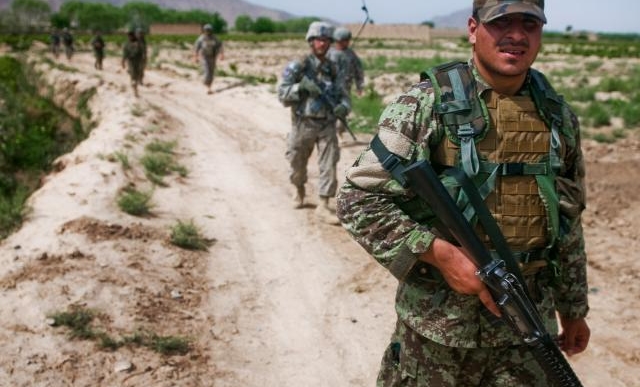
Remember that troop surge announced in August 2017 to finally win the undefined Afghanistan tribal war after 16 years? Well, it must be succeeding so well that now the Defense Department has placed a complete gag on any reports of how many provinces the “Afghani military” controls, once touted as the key metric of success or failure. But at least 14,000 of our best soldiers remain entangled in this undefined and untenable mission, with young soldiers now serving in a dangerous nation-building operation that began before they were born! Meanwhile, our own border remains in control of narco-terrorists who are just as evil as the ones in Afghanistan, except they actually directly affect us.

From 2015 to October 2018, the number of districts in the hands of the Afghani military dropped from 72 percent to 54 percent. And the definition of “control” is quite tenuous, to say the least. Now, according to the Special Inspector General for Afghanistan Reconstruction (SIGAR), the last beacon of truthful government reporting on this quagmire, the Afghanistan mission “formally notified SIGAR that it is no longer assessing district-level insurgent or government control or influence,” because the command no longer believes the data has decision-making value.

Don’t shout all the good news from the rooftop at once.

Indeed, just 17 months ago, General John Nicholson, former commander of our operation in Afghanistan, referred to this measure as “the most telling” metric of success.

Thus, after 17-plus years refereeing tribal warfare rather than exacting retribution, leaving, and then securing our borders and visa system, we have nothing to show for the war effort but $840 billion wasted, 2,400 dead soldiers, roughly 20,000 wounded or psychologically disabled from trauma, and nearly 100,000 Afghani immigrants to our shores!

We still spend $45 billion a year propping up the Islamist Afghani government and military when we could be using that money for Americans, or at the very least to build up allies in our own backyard in Latin America. We could have built an enormous military and diplomatic deterrent with potential allies in Latin America to block Russia, China, and Iran from invading our backyard and fueling the “Bolivarian” revolutionaries in countries like Venezuela. But we cast our lot halfway around the world to prop up a military in which there is nothing but incompetence, corruption, radical Islamism, and even pedophilia.

In SIGAR’s quarterly report released Wed., Inspector General John Sopko noted that we’ve spent $133 billion just on reconstructing Afghanistan and that despite our efforts, there has been a 33 percent increase in casualties among Afghani security forces. Our soldiers remain in mortal danger while our government continues to negotiate with the Taliban and knows there is nothing left to do in the country.

The report further found that 40 percent of Afghanis who were brought to Fort Worth to train in flying light combat aircraft went AWOL, so the program had to be discontinued. It was unclear whether our government has ever tracked down the missing Afghanis in our country. Wait … tell me again why we went overseas … to fight the enemy there so potential terrorists don’t … err … come here??

It would be tragic enough to continue this ill-fated operation if all was good on our home front and we had the luxury of callously expending our lives and money on refereeing a 1,300-year tribal war across the world. But the sad reality is that we have drug cartels, mass migration, and transnational gangs pouring over our border. That is precisely where we need our military. And no, not just to serve as bus drivers and cooks.

Look at the twisted priority of how hard we work to secure the sovereignty of an undefined and unworthy foreign government from enemies that are similar to the ones on our own border, which we ignore. According to a new Fox News report, the elite Task Force ODIN — Observe, Detect, Identify, Neutralize — has been deployed there with “a complex mix of interwoven variables — to include networked drones, fixed-wing intelligence aircraft and helicopters coordinating real-time video feeds with target analysis and aircraft-mounted electro-optical sensors.” Their job is to “find and destroy enemy targets and weapons in the austere, mountainous terrain of a war-weary country.” The operation is described as “extremely active and successful.”

As one listener of my podcast noted, “Seems like a shame they have to go all the way to Afghanistan to do that stuff. Hmm, where else might there be a mission just waiting for Task Force ODIN, any ideas? Rugged terrain, remote international borders, paramilitary militias, narco-terrorists… nope, I’m drawing a blank. Well, if you think of anywhere please let the Pentagon know.”

There are cartel members crossing our border with AK-47s to orchestrate a flow of migrants, drugs, gangs, and criminals (and likely terrorists) into our country, yet we will do nothing to eliminate or apprehend them or empower the military to do so. We all understand that the military-industrial complex is keeping this mission in Afghanistan alive because they get a lot of money for making cool war toys, but they can actually have their cake and eat it too, and benefit our country to boot, if our soldiers were to be deployed against the enemies that directly threaten our homeland and irrevocably bring crime and mayhem to our communities and our border.

Which raises the question: For whom does our military exist? (For more from the author of “Things are going so great in Afghanistan that the government no longer wants to share the news” please click HERE)

Follow Joe Miller on Twitter HERE and Facebook HERE

The Dossier: The Case to Skip the Taliban ‘Peace Deal’ and Withdraw From Afghanistan ASAP

. . .President Trump took to Twitter this morning to highlight the long wars in Afghanistan in Syria, stressing the need to bring American troops back home.

“I inherited a total mess in Syria and Afghanistan, the ‘Endless Wars’ of unlimited spending and death. During my campaign I said, very strongly, that these wars must finally end. We spend $50 Billion a year in Afghanistan and have hit them so hard that we are now talking peace…” the president tweeted.

“….after 18 long years. Syria was loaded with ISIS until I came along. We will soon have destroyed 100% of the Caliphate, but will be watching them closely. It is now time to start coming home and, after many years, spending our money wisely. Certain people must get smart!” he added.

It’s refreshing to see that President Trump is ready to draw down troops from places where there are few to no U.S. interests and where U.S. cash is being burnt away to the tune of tens of billions of dollars per year.

When he mentions “talking peace,” the president is referring to the ongoing negotiations with the Taliban and the central government in Kabul. The misguided idea of peace negotiations with a terrorist group has mostly been pushed by senior bureaucrats in the State Department and Pentagon and the Taliban’s hosts in Qatar. It’s a fool’s errand to negotiate peace with the Taliban, given that it is a full-fledged jihadi group with one goal in mind: to take over Afghanistan by any means necessary. They are not to be trusted. The president should skip negotiating a peace deal that is sure to fail. The Taliban has all the momentum. This reality is unfortunate for the people of Afghanistan, but in order to counter this momentum, the United States would need to deploy countless soldiers in harm’s way, sacrificing American troops for the interests of Afghans. These “peace talks” are not worth being held responsible for the aftermath of a U.S. withdrawal. Instead of negotiating our withdrawal, President Trump should simply prioritize the safety and security of American troops and depart Afghanistan as soon as possible. As I have written about at length at Conservative Review, there is no longer an American interest in deploying troops to Afghanistan. U.S. soldier casualty counts continue to escalate, leaving America’s bravest in harm’s way for no good reason. (For more from the author of “The Dossier: The Case to Skip the Taliban ‘Peace Deal’ and Withdraw From Afghanistan ASAP” please click HERE)

Follow Joe Miller on Twitter HERE and Facebook HERE
For Just 12.5 Percent of Annual Afghanistan Costs, We Can Secure the Border

The United States continues to spend an enormous amount of money nation-building in Afghanistan, where the U.S. has virtually zero interests, in a country whose people present no current threat to us.

In 2018 alone, the Pentagon estimated that the U.S. military dropped $45 billion dollars on the long Afghan war, which has been going on for 17 years and counting. As I detailed last month in Conservative Review, there is no longer an American interest in Afghanistan, and there has not been for quite some time. And given that President Trump appears to be leaning toward finally withdrawing soldiers from Afghanistan, we can hope that significant funds will soon be freed up for other U.S. priorities.

Topping that list of unfunded national security priorities is a no-brainer: our southern border, which remains recklessly unsecure and leaves our Border Patrol agents hopelessly underfunded for stopping some of the most dangerous criminal organizations and individuals from entering our country.

For just 12.5 percent ($5.7 billion) of the $45 billion that we spent in Afghanistan last year, the president and Congress can fund and bolster border security. Plus, we can reopen the government and repurpose wasted funds to reinforce actual national security measures.

There are many other places where the president can seek funds for the border wall. But given that the border wall is a national security issue, it’s much easier to make the case that the funds should come from the Defense Department.

Afghanistan isn’t the only multibillion-dollar boondoggle in the defense apparatus. The Daily Caller reported Wednesday, “The Defense Department has relinquished over $27 billion to the U.S. Treasury since 2013 simply because it couldn’t spend the money quick enough.”

In recent years, the Pentagon has burned through $125+ billion in bureaucratic waste. U.S. taxpayers footed the bill for the trillion-dollar boondoggle that is the F-35 program. The DOD also overpays defense contractors in a system that awards no-bid, non-competitive contracts.

Many legal experts agree that the president has the statutory authority to build the wall and the right to reappropriate defense funding for the border wall, which should be priority 1A for our national security. If he doesn’t want to cut the Afghanistan nation-building budget by a mere 12.5 percent, he can find plenty of funds elsewhere within the Defense Department. (For more from the author of “For Just 12.5 Percent of Annual Afghanistan Costs, We Can Secure the Border” please click HERE)

Follow Joe Miller on Twitter HERE and Facebook HERE

Salvaging America’s Defeat in Afghanistan

It is no longer a question of whether the United States will leave Afghanistan; it is a question of under what conditions.

Will it be a repeat of the chaotic withdrawal from Vietnam in 1975 and America’s subsequent timidity in the pursuit of our national interests? Or will it be simply a segue to a more successful regional foreign policy?

Now that U.S. policymakers are slowly coming to the realization that there will be no military victory in Afghanistan, it is critical to understand why we were defeated because it provides a foundation to formulate a more effective strategy.

Not to put too fine a point on it, we were fighting the wrong type of war.

In the face of clearly contradictory facts, the Pentagon insisted on pursuing counterinsurgency operations confined geographically to Afghanistan while the generals in Islamabad were using the Taliban to conduct a proxy war, launching attacks against American, NATO and Afghan forces from safe havens in Pakistan.

The Pakistanis have openly stated that they took billions of U.S. dollars while plotting to defeat the United States.

Case in point — In 2015, Lieutenant General Hamid Gul, the former head of Pakistan’s intelligence service, the ISI, a committed Islamist and known as the “godfather of the Taliban,” said the following in an Urdu language television interview:

One day, history will say that the ISI drove the Soviet Union out of Afghanistan with the help of USA and another sentence will be recorded that says the ISI drove the USA out of Afghanistan with the help of the USA.

The Pakistani audience roared with laughter and applauded in approval. And why wouldn’t they? America was monumentally stupid.

It borders on tactical insanity to conduct a war when the enemy controls, simultaneously, as Pakistan has, the operational tempo and the supply of your troops. Pakistan could always do just enough to prevent us from winning and protect the Taliban from losing by providing sanctuary.

The United States should have known that — even before we put boots on the ground. Pakistan is an ally of China, has never shared U.S. objectives in Afghanistan and began obstructing those objectives within days of 9/11.

In strategic reality, it is not the Taliban nor Pakistan with which we should be concerned. And the problem does not reside solely in Afghanistan.

The threat is from China in the form of the Chinese-Pakistani alliance. China’s aim is to dominate South Asia, first economically based on the China-Pakistan Economic Corridor (CPEC) and then militarily using its alliance with Pakistan to establish military bases in Balochistan, Pakistan’s southwestern province.

Those bases would provide a critical link between China’s military facilities in the South China Sea and its naval base in Djibouti at the entrance of the Red Sea and the Suez Canal.

Chinese naval and air bases on the Balochistan coast would control the vital sea lanes of the Arabian Sea and northern Indian Ocean and threaten another strategic chokepoint, the Strait of Hormuz. A successful implementation of the Chinese-Pakistani plan would mean the isolation of India, which is not at all advantageous to the international order.

Key to that plan is the withdrawal of U.S. troops from Afghanistan and the removal of American influence from South Asia.

Countering those ambitions does not require direct confrontation with China. Instead, it involves applying pressure to Pakistan’s major pain points, a crumbling economy and ethnic separatism.

An obvious economic target is CPEC, the flagship of China’s Belt and Road Initiative, which runs through Balochistan, the location of CPEC’s major port, Gwadar, thus making Balochistan a strategic center of gravity.

Balochistan, traditionally secular and tolerant, has also been the home of a festering ethnic insurgency since the partition of India in 1947, when the region was forcibly incorporated into Pakistan. Despite its mineral wealth, the Baloch have been intentionally kept underdeveloped by the Pakistan government.

This underdevelopment has been a cause for sporadic uprisings, along with oppression and alleged extrajudicial killings by the Pakistani military. Similar resentment exists within two of Pakistan’s other major ethnic groups: the Pashtuns and Sindhis.

By exploiting those two Pakistani pain points, the United States could maintain regional influence, thwart China’s march to the sea, create options for Afghanistan, affect the stability of the Iranian regime and, potentially, drive a stake into the heart of radical Islam.

The expenditure of blood and treasure in Afghanistan will only be in vain if we fail to improvise, adapt and overcome.

Lawrence Sellin, Ph.D. is a retired U.S. Army Reserve colonel, an IT command and control subject matter expert, trained in Arabic and Kurdish, and a veteran of Afghanistan, northern Iraq and a humanitarian mission to West Africa.

Follow Joe Miller on Twitter HERE and Facebook HERE

Trump’s New Strategy ‘Is Working,’ Afghan Leader Says

Despite seventeen years of war with no apparent victory in sight for the U.S-led effort, the chief executive of Afghanistan, Abdullah Abdullah, insists that the Trump administration’s renewed approach to the stalemate conflict “is working.”

“Imagine a situation without that commitment. Things would be very different. It is working,” he told Fox News in an exclusive interview during last week’s United Nations General Assembly (UNGA) in New York. “They announced a strategy and mobilized other countries and partners in NATO. They doubled the size of our Afghan Commandos, they’ve supported our Air Force — which is important in the way of Medevacs transporting the injured. These things are going to take time, but it is working.”

Most significantly, Abdullah said, is the Trump team’s “conditions-based” procedure rather than the Obama administration’s “time-based” plan, which entailed a 2014 drawdown and has been widely condemned to have enabled the Taliban to simply regroup and wait.

“These sorts of policies will yield results; you will see fruition. It won’t be in a matter of days or months, but as long as it’s the right track it will bring results,” he continued, noting that while it is too hard to give an estimated time frame of how long U.S. troops will be needed on the ground, it “won’t be a 50-year engagement.”

Army. Gen. John Nicholson, the former commander of NATO’s Resolute Support – the name given to the Afghan mission after 2014 – echoed such a sentiment of slow success in his final press conference on the state of affairs in Afghanistan in late August, indicating that they were “on a glide path to reduce our forces and eventually close down the mission” and that the “enemy believed we had lost our will to win” prior to President Trump’s welcomed new South Asia effort in August 2017. (Read more from “Trump’s New Strategy ‘Is Working,’ Afghan Leader Says” HERE)

Follow Joe Miller on Twitter HERE and Facebook HERE.

Afghanistan Is Un-Winnable

Carl von Clausewitz, 19th century military theorist, stressed the importance of knowing your enemy: “The first, the supreme, the most far-reaching act of judgment that the statesman and commander have to make is to establish … the kind of war on which they are embarking; neither mistaking it for, nor trying to turn it into, something that is alien to its nature.”

For 17 years, we wrongly applied counterinsurgency doctrine to a proxy war waged by Pakistan against the United States and Afghanistan. That approach was never a winning strategy as long as Pakistan controlled the supply of our troops in landlocked Afghanistan and regulated the operational tempo through its proxy army, the Taliban, who has maintained an extensive recruiting, training and financial support infrastructure inside Pakistan and immune to attack.

An American withdrawal will only be a humiliating defeat if the United States is forced into strategic retreat from South Asia because we do not have a plan in place to address the changing regional conditions in a post-U.S. Afghanistan.

I have written and spoken extensively about China orchestrating a strategic shift in South Asia working closely with Pakistan, Russia and Iran.

That geopolitical plan cannot succeed without the removal of the U.S. forces and influence from Afghanistan. China’s plan is for the Belt and Road Initiative (BRI) to become the dominant economic driver in South Asia through the China-Pakistan Economic Corridor (CPEC). The Shanghai Cooperation Organization will be the controlling regional alliance led by China.

Although not stated, Chinese militarization of the region will follow to ensure “security.” In many cases, expect that militarization to occur initially disguised as civilian construction projects.

Nowhere has Chinese ambitions been more clearly and publicly articulated than in a June 2018 China Daily article by former Pakistani diplomat, Zamir Ahmed Awan, who works for the Beijing-controlled Center for China and Globalization:

New [Chinese] initiatives for peace in Afghanistan are welcome, and may change the scenario in the whole region.

I believe American think tanks and leadership, especially military leadership, [have] already realized that this war cannot be won. The only option is withdrawal, the sooner the better.

Pakistan can play a vital role in a sustainable solution to the Afghan conflict [controlling Afghanistan as a client state]. Complete withdrawal and an Afghan-led [Taliban-led] solution is the only permanent way out. Pakistan can facilitate an honorable and safe passage for U.S. withdrawal.

Peace in Afghanistan will allow economic activity between Central Asia, Russia, China and the Arabian Sea…It can change the fate of the whole region. Chinese projects like the Belt and Road Initiative and the objectives of the Shanghai Cooperation Organization [SCO] … At the recent SCO summit, the Afghanistan president was invited as a guest and observer. Hopefully, the country will soon join SCO. The China-Pakistan Economic Corridor may also be extended to benefit Afghanistan in the near future if there is peace.

Since that article was published, China has offered to extend CPEC to Afghanistan; China will build a military facility in and deploy Chinese troops to Afghanistan; Afghan military personnel will be trained in China; and members of the Afghan Parliament have recommended that the Bilateral Security Agreement (BSA) between the U.S. and Afghanistan be cancelled, presumably to be replaced by China.

The only bargaining chip the United States has in peace negotiations is simply our presence in Afghanistan. According to the Voice of America, talks with the Taliban are stuck over the issue of the maintenance of U.S. military bases in the country. The United States wants to preserve two military facilities, Bagram Air Base and the Shorabak base in Helmand province.

The “presence” argument is tenuous at best. The United States should be identifying new forms of leverage, in the short term, to bolster our negotiating position, and, in the long term, as a basis of a new South Asian strategy.

The recently-announced effort to strengthen military ties with India is a step in that direction. The U.S. should also include measures to thwart Chinese plans for regional hegemony through BRI and its evitable military component. CPEC is the flagship of BRI, Balochistan is CPEC’s center of gravity and ethnic separatism is Pakistan’s major pain point. Both the Baloch and Pashtun resistance to Pakistani government oppression offer the opportunity to create greater leverage through the use of our own proxies.

The foundations of a new U.S. strategy in South Asia should be burden shifting and, when necessary, strategic disruption of our adversaries.

Lawrence Sellin, Ph.D. is a retired U.S. Army Reserve colonel, an IT command and control subject matter expert, trained in Arabic and Kurdish, and a veteran of Afghanistan, northern Iraq and a humanitarian mission to West Africa. He receives email at [email protected].

Follow Joe Miller on Twitter HERE and Facebook HERE.