Posts

Is One of the Big Continents Going to Split in Two?

By WND. Alarming reports are coming out of Africa that a 50-foot-deep crack that has developed in the earth across many miles actually could end up – eventually – splitting the continent into two parts.

The crack has appeared along Kenya’s Great Rift Valley, and runs from Somalia, in the northeast part of the continent, hundreds of miles down to South Africa, they say.

CBS explained it opened “suddenly” and “many scientists believe it could end up breaking Africa’s continent apart . . .

CBS quoted Smithsonian geologist Ben Andrews with the comment, “We’re seeing a crack that in all likelihood formed over many thousands of years or hundreds of thousands of years.”

Denying the obvious concern that those in that region have, commenters followed the CBS report with a variety of opinions, including “This is horrible. We should restrict gun sales in the U.S.” and “Well, this is alarming. Winged de
mons coming out of there?” (Read more from “Is One of the Big Continents Going to Split in Two?” HERE)

_______________________________________

Breaking up Is Hard to Do: Africa Could Eventually Split Into Two Continents

By USA Today. It’ll take tens of millions of years, but Africa may eventually split into two parts.

While geologists have known about this possibility for a while, it became news recently when a large crack, stretching several miles in length, made a sudden appearance in southwestern Kenya following heavy rain.

The tear, which continues to grow, collapsed part of a highway and “was accompanied by seismic activity in the area,” said Lucia Perez Diaz, a postdoctoral researcher on tectonics at Royal Holloway, a university in London.

The crack is located in a region known as the East African Rift Valley. It measures more than 50 feet in depth and 65 feet across, according to National Geographic. A rift valley refers to a lowland region where tectonic plates rift, or move apart.

(Read more from “Breaking up Is Hard to Do: Africa Could Eventually Split Into Two Continents” HERE)

Follow Joe Miller on Twitter HERE and Facebook HERE.

Lions Reportedly Devour Suspected Poacher in South Africa

South African police are trying to identify a suspected poacher who was reportedly killed and partially devoured by lions in a private game reserve near the Kruger National Park.

The man’s mauled remains, including his head, were reportedly found today alongside a hunting rifle and ammunition.

“The process of identifying the deceased has already commenced and it might be made possible by the fact that his head is amongst the remains that were found at the scene,” South African Police Service spokesman Lt. Col. Moatshe Ngoepe told the country’s News24.

Ngoepe added: “We are now waiting for a person from the family but we are also utilizing our investigative resources to see if we can successfully identify the deceased.”

Ngoepe told Agence France-Presse news agency: “It seems the victim was poaching in the game park when he was attacked and killed by lions. They ate his body, nearly all of it, and just left his head and some remains.” (Read more from “Lions Reportedly Devour Suspected Poacher in South Africa” HERE)

Follow Joe Miller on Twitter HERE and Facebook HERE.

Obama Policy Helped Create the Top African Threat

Barack Obama went to the United Nations Security Council to coordinate military intervention against Libyan strongman Moammar Gadhafi’s regime, claiming the objective was to save the lives of peaceful, pro-democracy protesters, describes a new report in Joseph Farah’s G2 Bulletin.

Foreign Affairs warned, however, that far from being the new foundation for democracy, Obama’s campaign “was an abject failure, judged even by its own standards.

Libya, the report said, “has devolved into a failed state” with “violent deaths.”

Newsweek asked whether the “role the Obama administration played in the North African country’s instability” could be blamed for the newly developing slave trade there . . .

The CRS, quoting a statement from U.S. Africa Command, explained the instability in Libya following Obama’s intervention “may be the most significant, near-term threat to U.S. and allies’ interests” in Africa. (Read more from “Obama Policy Helped Create the Top African Threat” HERE)

Follow Joe Miller on Twitter HERE and Facebook HERE.

Zimbabwe to Give White Farmers 99-Year Leases, like Black Counterparts

Zimbabwe will issue 99-year leases to white farmers, according to a government circular, after new President Emmerson Mnangagwa said he would end discrimination along racial lines in agriculture.

Fewer than 400 white farmers are still operating in the southern African nation, after former president Robert Mugabe’s government evicted more than 4,000 under an often violent land reform program.

Those who remained were issued with five-year renewable leases by the state compared to 99-year leases for black farmers, leaving their land vulnerable to expropriation by the government.

The agriculture ministry circular to staff, seen by Reuters, says white farmers should now be issued the same 99-year leases as black farmers.

“Please be informed that the minister of Lands, Agriculture and Resettlement has directed that all remaining white farmers be issued 99-year leases instead of the 5-year leases as per the previous arrangement,” said the circular, dated Jan. 19. (Read more from “Zimbabwe to Give White Farmers 99-Year Leases, like Black Counterparts” HERE)

Follow Joe Miller on Twitter HERE and Facebook HERE.

‘Holy Grail’: Newly Discovered School Bus-Sized Dinosaur Species Found in Sahara Desert

Researchers from Mansoura University in Egypt have recently discovered a new dinosaur species they say represents an advancement in our understanding of prehistoric land animals on the African and European continents.

As Fox News reports, the Mansoura University Vertebrate Paleontology program led the Egyptian expedition in the Sahara desert during which fossils belonging to the new species, subsequently named Mansourasaurus shahinae. The remains are believed to be about 80 million years old.

The species is described as a long-necked herbivore with bony plates embedded in its skin. It was about the size of a school bus, weighing more than 5 tons and stretching 33 feet long, according to Reuters.

Along with a detailed description of the remains found, a report published by Nature Ecology and Evolution noted that the discovery “provides an opportunity to test hypotheses of biotic connections between northern Africa and southern Europe during the (post-Cenomanian Cretaceous).”

That period, roughly 94 million to 66 million years ago, has provided few fossilized remains on the continent, according to the journal.

“Here we present a new titanosaurian sauropod dinosaur from the Late Cretaceous (Campanian) of Egypt that is represented by the most complete terrestrial vertebrate skeleton yet discovered from the PCC of the African mainland,” the researchers wrote.

According to an author who contributed to the study, scientists might be closer to addressing a number of unanswered questions in light of research on this new species.

“Mansourasaurus shahinae is a key new dinosaur species, and a critical discovery for Egyptian and African paleontology,” Dr. Eric Gorscak said.

He went on to say that Africa is still in many ways a “giant question mark in terms of land-dwelling animals” during the period preceding the extinction of the dinosaurs.

“Mansourasaurus helps us address longstanding questions about Africa’s fossil record and paleobiology — what animals were living there, and to what other species were these animals most closely related?” said Gorscak, a postdoctoral research scientist at the Field Museum.

He noted that at least one question was answered with the discovery itself.

“Africa’s last dinosaurs weren’t completely isolated, contrary to what some have proposed in the past,” Gorscak said. “There were still connections to Europe.”

There has long been disagreement among scientists regarding how continental drift impacted the connection between Africa and Europe during this period.

Dr. Matthew Lemanna, a paleontologist at the Carnegie Museum of Natural History and another author of the study, was even more effusive in his celebration of the discovery.

“When I first saw pics of the fossils, my jaw hit the floor,” he said.

Lemanna called the fossil the “Holy Grail,” echoing the study’s emphasis on its potential to answer longstanding questions.

He said that “a well-preserved dinosaur from the end of the Age of Dinosaurs in Africa” is something “we paleontologists had been searching for for a long, long time.” (For more from the author of “‘Holy Grail’: Newly Discovered School Bus-Sized Dinosaur Species Found in Sahara Desert” please click HERE)

Follow Joe Miller on Twitter HERE and Facebook HERE.

What Is the American Interest in Niger?

Three American Green Berets were tragically killed and two more wounded when a joint U.S.-Nigerien patrol was ambushed near the Mali-Niger border Wednesday. As details continue to emerge, we take a look at what brings U.S. forces into the West African landlocked country.

What happened?

The patrol was reportedly ambushed by militants operating in the region. The Pentagon has disclosed few details about the operation in southwest Niger.

However, according to local media reports, the attackers (which media reports speculate may be members of al-Qaeda in the Islamic Maghreb, or AQIM) may have come into the country from neighboring Mali. A U.S. official told Reuters that the joint patrol had no specific objective that day. Five Nigerien soldiers were reportedly killed in the attack.

What are we doing there?

The U.S. role in Niger and the surrounding region is often described as a support role, helping local governments with the resources and training to combat global jihadist groups.

According to U.S. Africa Command (AFRICOM), the military is in Niger “to provide training and security assistance to the Nigerien Armed Forces, in their efforts to counter violent extremist organizations in the region.”

In January 2013, the Obama administration struck a deal with Niger to allow unarmed U.S. surveillance drones to be based in the country to monitor Islamic terrorists in the region. At the time, Islamic militants were battling against a French-led coalition in neighboring Mali.

How many troops do we have there?

In February 2013, the U.S. deployed around 100 soldiers to Niger to provide intelligence support.

A June letter to Congress by President Trump indicated there were 645 U.S. military personnel deployed to Niger, and hundreds more in the surrounding countries.

What is the threat to American interests in Niger?

The chief threat to U.S. interests in Niger and the surrounding region is al-Qaeda in the Islamic Maghreb. Like most terrorists organizations, AQIM seeks to install an Islamic caliphate and institute sharia law.

Given that its leadership is mainly Algerian nationals and north African Arabs, AQIM has taken a particular interest in overthrowing the government of Algeria, along with all other non-Islamist governments .Since its 2007 rebranding, the group has successfully carried out many mass casualty terror attacks.

According to the State Department, AQIM raises a great deal of its funds through kidnapping for ransom payments and other criminal activity such as arms trafficking, money laundering, and drug trafficking. Additionally, the Algerian government alleges that AQIM receives financial and logistical support from the Iranian regime and the Sudanese government.

Niger and the surrounding region also face threats from the Boko Haram terrorist group, which has pledged allegiance to the Islamic State. Forces from Chad, Cameroon, Niger, and Nigeria are training alongside the U.S. military in response to the terrorist threat.

Another new jihadist group, which calls itself the Islamic State in Greater Sahara (ISGS), has claimed many attacks in the region in recent years. The outfit has pledged allegiance to the Islamic State terror group.

Is the U.S. military presence in Africa legally justified?

That’s up for debate. Since 2001, Presidents Bush, Obama, and now Trump have justified overseas military action under the post-9/11 Authorization for Use of Military Force, which Congress initially approved for operations in Afghanistan.

What’s Next?

French troops are reportedly readying a counterattack as part of a response to Wednesday’s ambush. The Pentagon has not released details about whether American forces will be involved in the reported ongoing operation. (For more from the author of “What Is the American Interest in Niger?” please click HERE)

Follow Joe Miller on Twitter HERE and Facebook HERE.

‘Man-Made’ Famine Leaves Millions Facing Starvation in Africa

Years of internal conflicts and poor governance are not the only problems facing the African countries of South Sudan, Nigeria, and Somalia.

The United Nations recently declared famine in parts of South Sudan and Nigeria. Judging by current conditions, it won’t be long before Somalia follows suit.

The number of people affected is staggering. In South Sudan, 100,000 people are on the verge of starvation with another 5 million at risk. That number of at-risk people totals 6.2 million in Somalia—half of its population—and 4.4 million in Nigeria.

Across all three countries, roughly 1.4 million children are at imminent risk of death. Those numbers are unlikely to decrease anytime soon and could even increase in the coming weeks.

This is not the first time these three nations have faced famine and starvation. The semi-arid climates in parts of their countries make them prone to drought.

But this current famine was brought on by more than below-average rainfall. Humanitarian aid organizations and the U.S. State Department have called the famine in South Sudan “man-made.”

It is not difficult to understand why. Weather conditions may cause drought, but poor governance and instability quickly turn a drought into a humanitarian crisis.

Take South Sudan as an example.

After 25 years of war, the country gained independence from Sudan in 2011. Only 18 months later, tensions within the government plunged the South Sudanese nation into a crippling civil war that cut off South Sudan’s trade routes with neighboring countries, prevented farmers from growing and harvesting food, and caused remaining food prices to skyrocket.

A famine was narrowly averted in 2014 thanks only to a massive international humanitarian effort. However, famine looms again. Various countries have pledged help for this latest hunger crisis, but this relief may never reach the people who need it most.

Despite the South Sudanese government promising “unimpeded access” for aid workers in the country, the South Sudanese security services and aligned forces frequently block the delivery of humanitarian relief.

The government has delayed agencies’ paperwork that would allow them to distribute aid. Soldiers have instituted military checkpoints around famine stricken areas and are preventing relief workers from crossing them.

The government is blocking aid for a number of likely reasons. It has for years stirred up anti-Western and anti-U.N. sentiment over the international community’s pressure on the government to halt its campaign of war crimes and ethnic killings. It may be blocking humanitarian aid in an attempt to retaliate.

The government is also likely blocking aid to rebel-controlled or influenced areas to punish those communities for what the government believes is their support for the rebels.

Poor governance and internal conflict have similarly contributed to the hunger crises in Somalia and Nigeria. Internal conflict has wreaked havoc in Somalia for nearly three decades, and the internationally-backed government has been mired in corruption and bickering.

Furthermore, the government has been unable to extend its authority to much of the country.

Nigeria’s government is relatively stable, but for years it has mismanaged the fight against the ISIS-aligned Boko Haram terrorist group that at one point controlled much of northwest Nigeria. Now, that same northwest region—torn by violence and terrorism—faces the worst of this famine crisis.

As the current humanitarian crisis grows, the international community will continue to offer emergency relief, and it should. But without better governance and stability in these countries, there is only so much these efforts will achieve. (For more from the author of “‘Man-Made’ Famine Leaves Millions Facing Starvation in Africa” please click HERE)

Follow Joe Miller on Twitter HERE and Facebook HERE.
Ghana Is Leading the Way for Democracy in Africa

Ghana, a West African country, has experienced peaceful transitions of power each time there has been a change in government since the country ended military rule in 1992.

Solidifying its notable status as one of Africa’s most stable democracies, Ghana is about to embark on another handover of power from the sitting head of state to the candidate of a longtime opposition party who won the recent presidential poll.

In a testament to Ghana’s functioning democracy, the country’s outgoing president, John Mahama, who fought hard for re-election, said during his farewell state of the nation address:

I stand here today, Mr. Speaker, holding the baton of leadership prepared to pass it on with pride, goodwill, and determination to Nana Akufo-Addo and to ask all Ghanaians to cheer him on as he runs his portion of this important relay for Ghana.

The president-elect, Akufo-Addo, former attorney general and foreign minister of the county who emerged victorious in his third presidential attempt, will be sworn in as Ghana’s new president on Jan. 7.

In fact, The Heritage Foundation had a unique opportunity to welcome then-presidential candidate Akufo-Addo to Washington and hear about his vision for Ghana in October 2015.

Akufo-Addo remarked in his speech,

I thank The Heritage Foundation for inviting me to speak at one of Washington’s most celebrated centers of thought and intellectual endeavor. It is an honor to be here in such company and to see so many people eager to discuss the future of my country, Ghana, and Africa more broadly … I remain staunchly optimistic about our future. I am proud to be a Ghanaian, the people who were the first in sub-Saharan Africa to free themselves from colonial rule, and who remain the pace-setters in the development of the principles of democratic accountability, respect for human rights, and the rule of law on the African continent. And as we move toward another election, I am reminded—and proud—of how hard we have fought for our democracy.

During his presidential campaign, Akufo-Addo highlighted the damaging effects of government corruption in Ghana and plans to tackle the issue by strengthening the judiciary and enacting constitutional reforms to decentralize power from the executive branch.

At The Heritage Foundation event last year, Akufo-Addo also emphasized that “[t]here is a connection between poor democracy and poor economic performance. Short-termism and political expediency in regard to elections tend to correlate with a lack of vision and incompetence in the economic field.”

In addition to strengthening the rule of law, Akufo-Addo’s vision for Ghana includes reforms in three key areas to transform the economy and set out a path to growth: pursuing economic diversification, unleashing the private sector from burdensome regulation and excessive taxation, and reining in the national debt.

As Ghanaians welcome and embrace this new presidency, Akufo-Addo should follow through with these reforms to enhance Ghana’s economic freedom and advance opportunities for all Ghanaians. (For more from the author of “Ghana Is Leading the Way for Democracy in Africa” please click HERE)

Follow Joe Miller on Twitter HERE and Facebook HERE.
Prosecutors Say This 66-Year-Old Chinese Woman Is One of Africa’s Most Notorious Smugglers

They call her the Queen of Ivory — a 66-year-old Chinese woman who became famous for her role in Africa’s illegal wildlife trade. Over 15 years, she helped smuggle more than 700 elephant tusks out of Africa, officials said Thursday. But as authorities closed in, Yang Feng Glan managed to evade arrest.

Until now.

Yang was detained in the Tanzanian capital Dar es Salaam after a high-speed chase and is apparently the most prominent Chinese national charged with wildlife trafficking in Africa. The short, bespectacled owner of a well-known Chinese restaurant doesn’t fit the image of a poaching kingpin, but that’s exactly what she is, according to Tanzanian officials.

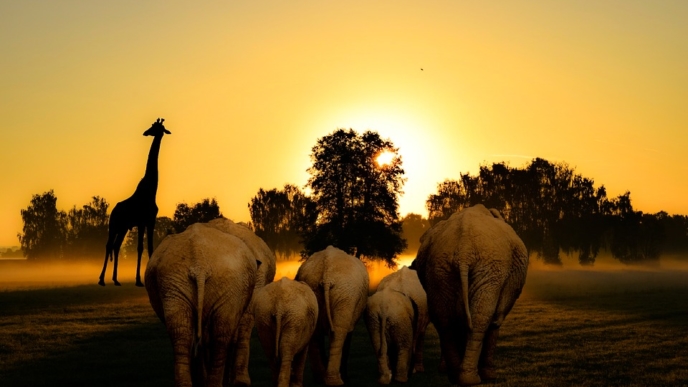
Yang was behind an illicit trade worth millions of dollars, using her ties to the Chinese and Tanzanian elite to move ivory across the world, officials said. Ivory trafficking has resulted in immense damage to wildlife across Africa, but particularly in Tanzania. Between 2009 and 2014, the country’s elephant population plummeted from 109,051 to 43,330.

“She was at the center of that killing,” said Andrea Crosta, the executive director of Elephant Action League, a U.S.-based environmental watchdog group. (Read more from “Prosecutors Say This 66-Year-Old Chinese Woman Is One of Africa’s Most Notorious Smugglers” HERE)

Follow Joe Miller on Twitter HERE and Facebook HERE.

Out of Africa Comes a Cry for Help Against the Culture of Death

Arriving in the Philippines last January, Pope Francis warned his millions of listeners to resist “ideological colonization.” This destructive assault on families, the Pope continued, included efforts to “redefine the very institution of marriage, by relativism, by the culture of the ephemeral, by a lack of openness to life.”

Africans, above all, know what he is talking about. After all, their continent has been the playground of Western imperialists for the past two centuries. Their bodies were enslaved, and their countries were colonized. Now the target is their very minds.

The assembled African bishops—all 40 or so of them—recently denounced this new kind of colonialism. Their joint Declaration, drafted in June but only released this month, begs wealthy Western nations “… to end the filthy campaigns that promote a civilization of death on our continent.”

The Declaration continues:

[There is] a terrifying resurgence of a colonialist spirit under the guise of the appealing names of liberty, equality, rights, autonomy, democratization and development. Condoms, contraceptives, sex education programs fabricated elsewhere, purely technical and deprived of moral content, so-called “safe abortions”, have become commodities that are more accessible to Africans than the way of delivering integral development, of which we have such a vital need.

(Read more from “Out of Africa Comes a Cry for Help Against the Culture of Death” HERE)

Follow Joe Miller on Twitter HERE and Facebook HERE.