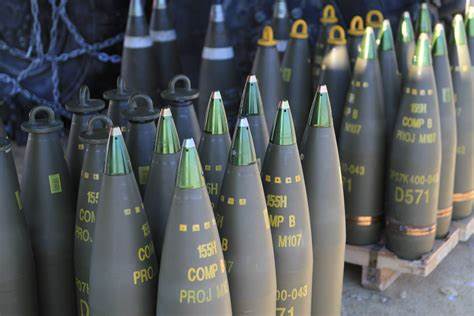
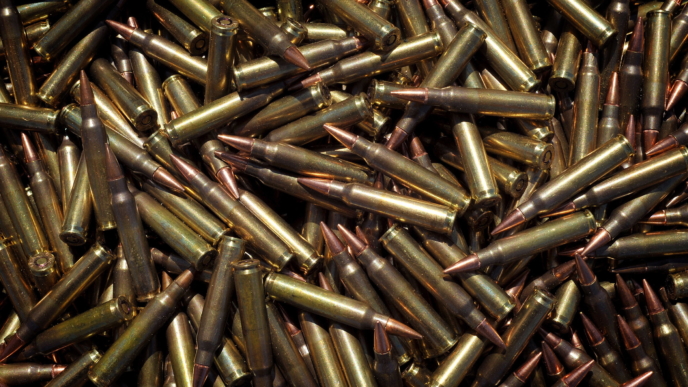
A new domestically-based plant supplying arms to the U.S. and Ukraine is filled almost entirely with foreign technologies, The Wall Street Journal reported on Monday
A new factory built by defense contractor General Dynamics in Texas is playing a key role in producing the needed armaments, but it is nearly totally reliant on foreign-provided technology and machinery, underscoring the U.S.’ increasing reliance on the international community to revamp domestic weapons production, according to the WSJ. The Biden administration is spending billions of dollars to quickly boost arms production amid the ongoing Russia-Ukraine war and a commitment to supply weapons to Kyiv — and to restock the U.S.’ own military stockpiles.
“Without the support from Turkey, this facility would be empty,” U.S. Army Secretary Christine Wormuth said during a recent tour of the factory, according to the WSJ.
General Dynamics tapped Repkon, a Turkish-based defense contractor, to supply hydraulic presses critical in the production of artillery shells, according to the WSJ. The Biden administration is seeking to ramp up shell production from roughly 30,000 to 100,000 by the end of 2025, and the General Dynamics Texas plant would account for roughly half that total.
The Turkish company provided the presses because no U.S.-based supplier would have been ready in time to get the plant operational within the next two years, according to the WSJ. Robotic and automated machines in the factory are supplied from Germany by the manufacturer Kuka, which was bought out in 2016 by Chinese-based company Midea, according to the WSJ. (Read more from “American Factory Supplying Ammo to U.S., Ukraine is Apparently Reliant on Foreign Tech” HERE)
https://joemiller.us/wp-content/uploads/OIP-2024-06-24T224420.672.jpeg316474Joe Millerhttps://joemiller.us/wp-content/uploads/logotext.pngJoe Miller2024-06-24 21:52:452024-06-24 21:45:01American Factory Supplying Ammo to U.S., Ukraine is Apparently Reliant on Foreign Tech
Bryan Hagerich, a 39-year-old father of two from Pennsylvania, is confronting the possibility of a minimum 12-year jail sentence in Turks and Caicos after authorities uncovered ammunition in his luggage during a routine search in February. Hagerich, who was returning from a family vacation with his wife and children when he was apprehended, raised concerns about the unintended ramifications of the island’s legislation designed to combat illegal firearm trafficking.
In a recent court appearance in Turks and Caicos, a judge ruled that Hagerich must remain on the islands for an additional three weeks until his sentencing. During this period, he will discover whether he will be subjected to the mandatory 12-year sentence for possessing ammunition in his bag at the airport, or if his case can be resolved through other means.
This is Bryan Hagerich
He’s a married father of 2 from Pennsylvania who is rotting away in a Turks & Caicos jail cell after some stray ammunition from a prior hunting trip was found in a random pocket of his checked bag while he was on a family vacation
Speaking to “America’s Newsroom” on Tuesday, Hagerich recounted the shock of the discovery, emphasizing that the ammunition was found during a random search of his checked luggage. He expressed his family’s bewilderment at the situation, stating that they were abruptly separated without the opportunity to comprehend or address the unfolding events.
While the Transportation Security Administration (TSA) mandates that ammunition be stored in a secure case within checked luggage, the laws in Turks and Caicos differ significantly. The U.S. Embassy in Nassau has issued a travel advisory cautioning against the possession of firearms, ammunition, or other weapons in Turks and Caicos, emphasizing the strict enforcement of related laws.
Hagerich acknowledged the intent behind the stringent regulations, aimed at curbing violence and firearm trafficking. However, he underscored the unintended consequences of a law that adopts a uniform approach without considering individual circumstances. Despite the ordeal, he emphasized that he and his family pose no threat to the island or its inhabitants, characterizing themselves as law-abiding citizens who inadvertently made a mistake.
In addition to Hagerich, three other Americans are awaiting sentencing for similar charges. Tyler Wenrich, a 31-year-old father from Virginia, was permitted to return home after posting bail. Meanwhile, Ryan Watson, a 40-year-old father of two from Oklahoma, remains on the island after being arrested for inadvertently carrying ammunition in his bag. Another individual, Michael Lee Evans, 72, pleaded guilty to a similar offense, with his sentencing hearing scheduled for June 18, according to local media reports.
https://joemiller.us/wp-content/uploads/1200px-Resorts_on_Grace_Bay_Providenciales.jpeg8001200Joe Millerhttps://joemiller.us/wp-content/uploads/logotext.pngJoe Miller2024-05-14 23:50:082024-05-18 19:13:17NEVER Travel to the Turks & Caicos
. . .Rumors have swirled about various companies and their ammo production. Some believed Vista Outdoors, the parent company of Federal, Remington, CCI, and Speer Ammunition, ceased manufacturing all together while others have insisted the company is picking and choosing who to sell ammo true.
Steve and Jason Hornady, owners of Hornady Ammunition released an update on ammo production. The pair used April Fool’s Day to troll gun owners and squash the notion that the government is paying them to seize the production of ammo.
“So, the government might be sending you a stimulus check but they are not paying us to not ship ammo,” they said with a laugh. “It just doesn’t work that way.”
(Read more from “Company Addresses Rumors About the Ongoing Ammunition Shortage (VIDEO)” HERE)
Delete Facebook, Delete Twitter, Follow Restoring Liberty and Joe Miller at gab HERE and MeWe HERE
https://joemiller.us/wp-content/uploads/5.56mm_Ammunition_Rounds_for_SA80_Rifle_MOD_45152184.jpg16632500Joe Millerhttps://joemiller.us/wp-content/uploads/logotext.pngJoe Miller2021-04-05 16:52:222021-04-10 20:41:48Company Addresses Rumors About the Ongoing Ammunition Shortage (VIDEO)
Firearms sales in the U.S. soared in 2020. Whether the broad spike in purchases was motivated by the new coronavirus pandemic, anti-racism protests, upcoming election or something else is debated, but both vendors and researchers have reported rising demand for the better part of this year.
Additional analyses note ammunition sales rose more significantly than gun sales alone. Ammunition manufacturers are reporting backlogs as a result of elevated demand, and some suggest shortages could last until at least January.
Ammo Incorporated, an ammunition manufacturer based in Scottsdale, Arizona, is one of the most recent vendors to confirm a significant backlog due to heightened demand from consumers. Last week, the company said its backlogged orders amounted to $80.1 million in purchases as of August 31, which set a new record after months of increasing numbers. . .
“In fact, [the Federal Bureau of Investigation’s National Instant Criminal Background Check System] data shows federal background checks for purchasing firearms have increased 72% year-over-year and we don’t anticipate consumer demand for firearms or ammunition slowing anytime soon,” Wagenhals’ statement continued. “As a result, our facilities continue to operate at near maximum capacity to meet customer needs and we are continuing to expand our production capabilities.” (Read more from “Why Is There an Ammunition Shortage in the U.S.?” HERE)
https://joemiller.us/wp-content/uploads/ammunition-1870751__340.jpg340510Joe Millerhttps://joemiller.us/wp-content/uploads/logotext.pngJoe Miller2020-10-06 19:08:082020-10-10 21:22:49Why Is There an Ammunition Shortage in the U.S.?
Since the day President Obama was elected, gun owners have been on an unprecedented buying spree, purchasing everything from .22 ammunition to every kind of semi-automatic firearm available.
Their fears are not unwarranted — especially because, for a while, the federal government seemed to be racing private owners to buy the ammo first.
Closer examination shows that some fears of federal activity on this front are overblown. Others, though, are deeply rooted in legitimate concerns.
While Obama claims to support “common-sense” gun laws, he has made high-profile public announcements telegraphing his anti-gun intentions and engaged in behind-the-scenes gun control — tweaking government regulations to deny gun rights to veterans, seeking the same for Social Security recipients, and using the ATF to ban certain types of popular ammo. Calling guns more dangerous than terrorism, Obama recently indicated he’ll devote the rest of his time as president to gun control.
But one event in particular fed fears of back-door government gun control: the unprecedented purchase of ammunition by the feds.
In early 2013, the Internet blazed with news that the Department of Homeland Security intended to purchase over 1.6 billion rounds of pistol and rifle ammunition. The order would fulfill DHS requirements for five years, reportedly. DHS has 55,471 employees authorized to carry firearms, which comes to about 5,800 rounds per year, per employee.
For perspective, during the first year of the war on terror, approximately 72 million rounds were expended in Iraq and another 21 million in Afghanistan — about 2,000 rounds per war fighter. Thus, giving DHS agents a much larger quota of 5,000 rounds did seem extreme.
Some people asserted the feds deliberately intended to dry up the private market for ammunition. Lawmakers demanded answers. Yet the overall requisition, in context, may not have been unreasonable.
[Listen to a recent interview with the author below:]
The largest order, 750 million rounds, came from DHS’s Federal Law Enforcement Training Center (FLETC) for instruction purposes. Another 650 million rounds were slated for Inspections and Customs Enforcement, or ICE. FLETC public affairs director Peggy Dixon said at the time that the purchase request was “a ceiling. It does not mean that we will buy, or require, the full amounts of either contract.” FLETC in fact uses approximately 20 million training rounds per year, and overall, actual DHS purchases have declined continually since 2009. In 2014, DHS-planned purchases were 75.1 million rounds, down from 84.4 million in 2013.
But there was more. In 2012, the Social Security Administration published a requisition for 174,000 rounds of hollow point pistol ammo — a particularly lethal type and certainly not suited for target shooting. Why on earth would the SSA need it? For that matter, why does SSA need a police force, much less highly trained SWAT teams? Do they anticipate an armed revolt by elderly Social Security recipients upset with their latest cost of living increases? Do they fear an anti-government conspiracy launched over tepid coffee in the reading lounges of retirement communities across the country? Given Obama’s attitude toward the elderly (e.g. “Granny, take the pill”) they may have reason to fear.
Again, though, many such purchases are based on a justifiable rationale — or at least justifiable for the size of the government we have. (Whether it should be that large in the first place is a very different question.)
An unfortunate consequence of massive government growth and expansion is the requirement for a law enforcement presence to oversee it all. One would not think the Social Security Administration or the Department of Agriculture, for example, would need a large law enforcement presence.
But welfare and food stamp fraud is epidemic. Some gangsters engaged in these activities are as dangerous as drug traffickers – and are involved, often, in both. Determined welfare fraud rings connected to organized crime are ripping off billions of taxpayer dollars. One of the most dangerous federal law enforcement jobs is — believe it or not — ole’ Smokey Bear, the National Park Service rangers, since a great deal of criminal activity takes place within the peaceful aura of life in the woods. (Marijuana fields, for example, are guarded by trigger-happy, AK-47 toting goons.)
At the same time, fears of an omnipresent federal law enforcement infrastructure are justified. The growing federal police force contains the potential to evolve into a police state.
The increasing use of SWAT-type raids against established businesses like Gibson Guitar, Duncan Outdoors and Mountain Pure Water Co., and countless smaller raids against other non-threatening targets for essentially routine administrative matters reinforce the belief among many that such a police state is just around the corner, if not here already. Innocent people have been killed in some of these unwarranted raids.
It is not the amount of ammunition purchases posing the threat. Instead, it is the ominous growth of federal law enforcement under a president who abuses power and ignores the constitutional limits of his office.
Obama has done his best to induce panic among gun owners. This, more than anything else, has created the shortages – driven by an unprecedented increase in private market demand. At the height of the frenzy, the NRA provided a good analysis in its American Rifleman magazine. While ammunition manufacturers are loath to admit exact production numbers, the NRA found that between 2007 and 2012, excise taxes on ammunition purchases doubled.
Many other reports tell a similar story, but it is easy to understand with a simple example. There are over 80 million gun owners in the U.S. If every single one went out and bought just 100 rounds – barely enough for one afternoon on the range – it would require 8 billion rounds of ammo. But many gun owners have been stockpiling, and retailers seek to purchase large quantities to capitalize on higher demand and prices. The shooting sports, meanwhile, have enjoyed a revival, even on college campuses.
Despite the unprecedented explosion in demand, the shortage is now largely past. After producing round the clock for years, ammunition manufacturers are now able to fulfill orders for most of the popular calibers, albeit at higher prices. Even the popular .22, long unavailable after supplies of other ammo reappeared, is finally coming back on the shelves.
While the ammo shortage was not caused by excessive government purchases, Obama can nonetheless take credit for creating justifiable panic among private citizens that prompted an unprecedented ammo buying spree that cleared retailer shelves for years. It would not be at all surprising to see another uptick in demand if Obama makes good on his threat to push more gun control.
https://joemiller.us/wp-content/uploads/logotext.png00Joe Millerhttps://joemiller.us/wp-content/uploads/logotext.pngJoe Miller2015-07-30 03:57:482016-04-11 10:58:19Where Have All the Bullets Gone?
The Bureau of Alcohol, Tobacco, Firearms and Explosives announced Tuesday it “will not at this time seek to issue a final framework” implementing a proposed ban on what it’s still insisting is “armor piercing ammunition.” The special advisory issued by the Public Affairs Division noted that with the comment period scheduled to close by next Monday, “ATF has already received more than 80,000 comments, which will be made publicly available as soon as practicable.”
‘Although ATF endeavored to create a proposal that reflected a good faith interpretation of the law and balanced the interests of law enforcement, industry, and sportsmen, the vast majority of the comments received to date are critical of the framework, and include issues that deserve further study,” the advisory explained. “ATF will process the comments received, further evaluate the issues raised therein, and provide additional open and transparent process (for example, through additional proposals and opportunities for comment) before proceeding with any framework.”
While an angry reaction from gun owners and a letter opposing the ban signed by 52 senators challenged implementing the ban and making it stick, the fact that 5.56 M855 “green tip” ammunition is off the table for now by no means indicates a willingness to give up a power the agency has exercised in the recent past.
Case in point, in April of last year, ATF issued a special advisory banning importation of 7N6 5.45×39 ammunition for the same reasons – that it was not considered “sporting,” that it was considered “armor piercing,” and because “ATF’s analysis also concluded that the ammunition could be used in a commercially available handgun … which was approved for importation into the United States in November 2011.”
“The Special Advisory letter claims that in 2011 a Polish made 5.45×39 Onyks 89S pistol was submitted for import approval by an unspecified entity,” The Bang Switch reported at the time. “It’s so obscure in fact that only 200 were produced in Poland and to my knowledge none were ever imported nor sold on the U.S. market as semi-automatic pistols.”
That hardly matters when the criteria being argued about include concepts like “sporting purposes.” The term appears nowhere in the Constitution, and its first documented enforcement over firearms was in 1938 German law. Likewise, the Constitution is similarly silent on any branch of government, let alone a federal agency, having legitimate delegated authority to override the clear “shall not be infringed” mandate in the Second Amendment.
As for potential armor-piercing capability, the opinion rendered in the Supreme Court’s 1939 Miller decision provides guidance on founding intent. The court held a weapon falls under Second Amendment protection if it “is any part of the ordinary military equipment, or that its use could contribute to the common defense.”
While arguments are correct that M855 ball ammo does not meet ATF’s own definition of “armor piercing,” the larger point, that there is no legitimate authority to impose such criteria in the first place, is being missed. So when ATF declares they’ll be back, until such time as that usurpation is addressed and resolved, it’s prudent to believe they will be, at the first political opportunity. (See “ATF Temporarily Shelves Proposed Ammo Ban While Power to Proceed Remains Intact”, originally posted HERE)
The Joe Miller Show broadcasts weekdays from 2 p.m. to 4 p.m. Alaska Time (6 p.m. to 8 p.m. EST), on 1080 AM and 95.1 FM, Anchorage. It is also carried via live streaming at JoeMiller.us. Podcasts from prior shows are found HERE. If you’d like to advertise on or sponsor The Joe Miller Show, please email [email protected]
https://joemiller.us/wp-content/uploads/logotext.png00Joe Millerhttps://joemiller.us/wp-content/uploads/logotext.pngJoe Miller2015-03-12 03:59:522016-04-11 11:01:23Although ATF Temporarily Shelved Proposed Ammo Ban, Don’t be Fooled: Power to Proceed Remains Intact [+video]
Environmental Protection Agency and FBI agents raided the ammunition company USA Brass over alleged “environmental violations” early Thursday morning.
NBC Montana was tipped off by witnesses that federal investigators were there until at least 4 a.m. on Thursday. Federal agents could be seen going through the company’s building and taking items to a truck parked outside. EPA lead criminal investigator Bert Marsden said that the agency was looking into alleged “environmental violations” by USA Brass.
“We are investigating alleged violations of environmental law,” Marsden said on Thursday. “An investigation takes as long as it takes, and I can’t provide any details as it relates to that.”
“I can make a statement that there is no immediate threat to the public or the community at this time,” said Marsden.
Photo Credit: APIran has signed a deal to sell Iraq arms and ammunition worth $195 million, according to documents seen by Reuters – a move that would break a U.N. embargo on weapons sales by Tehran.
The agreement was reached at the end of November, the documents showed, just weeks after Iraq’s Prime Minister Nouri al-Maliki returned from lobbying the Obama administration in Washington for extra weapons to fight al Qaeda-linked militants.
Some in Washington are nervous about providing sensitive U.S. military equipment to a country they worry is becoming too close to Iran. Several Iraqi lawmakers said Maliki had made the deal because he was fed up with delays in U.S. arms deliveries.
A spokesman for the Iraqi prime minister would not confirm or deny the sale, but said such a deal would be understandable given Iraq’s current security troubles.
“We are launching a war against terrorism and we want to win this war. Nothing prevents us from buying arms and ammunition from any party and it’s only ammunition helping us to fight terrorists,” said the spokesman, Ali Mussawi.
Photo Credit: APThe Department of Homeland Security (DHS) is contracted to purchase 704,390,250 rounds of ammunition over the next four years, which is equal to a total of about 2,500 rounds per DHS agent per year, according to a January 2014 Government Accountability Office (GAO) report entitled Ammunition Purchases Have Declined Since 2009.
“If DHS were to purchase all 704 million rounds over the next four years, and if they were used by 70,000 DHS agents and officers, it would be roughly 2,500 rounds per agent per year,” David Maurer, author of the GAO report, told CNSNews.com.
“That would be higher than what we saw in past years at DHS and higher than the average annual number of rounds per agent or officer at the Department of Justice (DOJ),” he said.
“The 704,390,250 number of rounds is like a ceiling or credit limit which DHS wouldn’t have to fully execute,” said Maurer. “It’s there to use over the next four years until fiscal year 2018, if DHS needed to purchase those rounds.”
In Appendix III of the GAO report, “Department of Homeland Security Ammunition Contracts, as of October 1, 2013,” it states that “the 29 existing DHS ammunition contracts extend over the next 4 fiscal years and have a remaining contract limit of approximately 704 million rounds (for various ammunition types) if every option for purchasing ammunition were exercised into fiscal year 2018.”
https://joemiller.us/wp-content/uploads/logotext.png00Joe Millerhttps://joemiller.us/wp-content/uploads/logotext.pngJoe Miller2014-02-20 00:25:052016-04-11 11:11:52DHS Contracted to Purchase 704 Million Rounds of Ammo Over Next 4 Years: 2,500 Rounds Per Officer
Gun records checks, fueled by a post-Newtown boom of gun sales, hit a new high in 2013, and industry analysts expect ammunition to be the big seller this year as consumers catch up to all of those firearms purchases.
More than 21 million applications were run through the National Instant Criminal Background Check System last year, marking nearly an 8 percent increase and the 11th straight year that the number has risen.
Background checks serve as a proxy for the number of gun sales, which soared in the months immediately after the December 2012 Sandy Hook Elementary School shootings. But NICS checks plummeted in November and December compared with a year earlier, suggesting that the boom may be over.
“2013 was the best year for firearm sales (commercial, domestic) in history — period! That’s true for NH to Hawaii,” said Richard Feldman, president of the Independent Firearm Owners Association in Rindge, N.H. “Ruger alone sold well over one million guns this year.”
Mr. Feldman said to expect the next surge to be in bullets.
https://joemiller.us/wp-content/uploads/logotext.png00Joe Millerhttps://joemiller.us/wp-content/uploads/logotext.pngJoe Miller2014-01-08 00:28:142014-01-08 00:28:14Gun Sales Hit New Record, Ammo Boom to Follow (+video)