Posts

Band of House Republicans Stand Against Debt Ceiling Deal

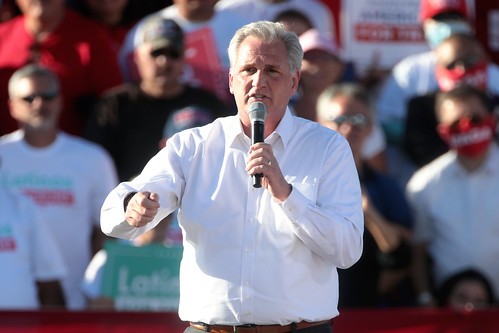
As many as 20 House Republicans oppose the deal hashed out between the White House and Speaker Kevin McCarthy (R-CA) to avoid a U.S. debt default.

Leading the GOP charge against the compromise, which would suspend the debt limit until January 2025 in exchange for various restraints on spending, was the conservative House Freedom Caucus, which views the agreement as being too watered down. Their opposition, if it holds, means a bipartisan vote will be necessary for passage as Republicans hold a narrow majority in the lower chamber.

“This deal fails, fails completely,” Rep. Scott Perry (R-PA), chairman of the House Freedom Caucus, said at a press conference outside the U.S. Capitol on Tuesday. “We will do everything in our power to stop it and end it now,” he also said.

“Not one Republican should vote for this deal,” said Rep. Chip Roy (R-TX), another member of the group. “No one sent us here to borrow an additional $4 trillion to get absolutely nothing in return,” he added.

Roy said McCarthy’s deal with the White House “at best, if I’m being really generous” offers “a spending freeze for a couple years.” (Read more from “Band of House Republicans Stand Against Debt Ceiling Deal” HERE)

Photo credit: Flickr

Delete Facebook, Delete Twitter, Follow Restoring Liberty and Joe Miller at gab HERE.

Biden Bristles at Reporters Over Debt Ceiling Questions: ‘You’re Not in the Real World’

President Biden bristled when questioned Monday about the high-stakes debt ceiling vote expected later this week — refusing to tell reporters how he might persuade skeptics in his own party while saying the press doesn’t “live in the real world.”

The House is set to vote on the debt-ceiling deal Wednesday after Biden and House Speaker Kevin McCarthy (R-Calif.) reached a deal Saturday. A 99-page bill outlining the details of the agreement was released Sunday, prompting pushback from some lawmakers on both sides of the aisle.

“I’m not going to tell you,” Biden, 80, snapped at a reporter when asked on the White House lawn Monday what he would say to Democrat skeptics.

“Look, you guys all go on and say, ‘Tell them what a good deal this is’ — how about, ‘this was a 100% deal for Democrats!’ Do you think it’d help me get it passed?” he sneered.

When another reporter asked if the legislation would pass “no question” by June 5, the commander-in-chief also lashed out.

“You realize you’re not in the real world?” he shot back. (Read more from “Biden Bristles at Reporters Over Debt Ceiling Questions: ‘You’re Not in the Real World'” HERE)

Photo credit: Flickr

Delete Facebook, Delete Twitter, Follow Restoring Liberty and Joe Miller at gab HERE.

Biden Gives Update on Debt Ceiling Agreement

President Joe Biden announced on Sunday that a debt ceiling bipartisan agreement with House Speaker Kevin McCarthy (R-Calif) has taken the “threat of catastrophic default off the table.”

The two finalized the deal and is expected to go to the House Wednesday evening. However, the agreement still needs approval from both chambers of Congress.

“[The deal] represents a compromise, which means no one got everything they wanted. But that’s the responsibility of governing,” Biden said. “The agreement prevents the worst possible crisis and default for the first time in our nation’s history.”

The agreement comes just days before the U.S. would have faced its first-ever default. (Read more from “Biden Gives Update on Debt Ceiling Agreement” HERE)

Photo credit: Gage Skidmore via Flickr

Delete Facebook, Delete Twitter, Follow Restoring Liberty and Joe Miller at gab HERE.

Mitch McConnell on Debt Ceiling: I ‘Protect’ the Country

Photo Credit: APSenate Minority Leader Mitch McConnell said he voted to advance a clean debt-ceiling bill this week because his job is “to protect the country” when he can.

The Republican leader said at a Friday campaign event in Louisville, Ky., that he has long preferred making structural changes to fiscal policy as a condition to raising the debt ceiling.

But given that the House could pass only a clean debt ceiling — every policy rider Speaker John Boehner tried to attach failed to garner sufficient support — McConnell said he was left with one option: Avoid economic catastrophe.

McConnell and most of his leadership team voted to break a filibuster demanded by Sen. Ted Cruz (R-Texas), to the ire of many conservatives and surprise of Capitol Hill, given his recently stated opposition to any clean lift of the debt ceiling.

Read more from this story HERE.

GOP Ready to Surrender on Debt Ceiling

Photo Credit: AP

Photo Credit: AP

The most senior figures in the House Republican Conference are privately acknowledging that they will almost certainly have to pass what’s called a clean debt ceiling increase in the next few months, abandoning the central fight that has defined their three-year majority.

The reason for the shift in dynamics in this fight is clear. Congress has raised the debt limit twice in a row without drastic policy concessions from President Barack Obama and Senate Democrats, essentially ceding ground to Democrats. Obama and Senate Majority Leader Harry Reid (D-Nev.) are again ruling out negotiations over the nation’s borrowing limit, which would leave Republicans fighting against a unified Democratic front. It’s a tricky situation for the GOP in an election year: They would have to pass a clean debt limit bill or risk default.

The vast majority of Democrats will vote against everything except a clean debt ceiling increase, so if Republicans try to tack extraneous policy onto a debt ceiling measure, they’ll have to pass it on their own. At least a dozen Republican aides and lawmakers are highly skeptical they will be able to craft something that will attract the support of 217 GOP lawmakers. In short, Republicans have few options and even less time: The Obama administration says the debt limit must be raised by the end of February. Republicans, though, are skeptical of that date.

“I’ve been saying publicly that once we voted for the budget, you knew that you were going to get a clean debt ceiling,” said conservative Rep. Raúl Labrador (R-Idaho), referring to the recently passed budget deal that he voted against. “The time to fight for spending cuts is when you’re talking about spending, not at debt ceiling time. So when people caved on the budget and caved on the [Ryan-Murray] agreement, it’s really hard for them to come back and say, ‘We don’t want to increase the debt ceiling’ when they’ve already voted for something that increases the debt.”

Read more from this story HERE.

____________________________________________________________________________

White House Won’t Pay ‘Ransom’ for Debt Limit Hike

Photo Credit: Thinkstock

Photo Credit: Thinkstock

White House senior adviser Dan Pfeiffer on Sunday pressed Republican lawmakers to raise the debt ceiling without conditions, saying that the American people “should not have to pay Congress ransom.”

But Pfeiffer sidestepped questions about whether Obama would veto a bill that did not offer a clean debt hike.

“Our position on this is the same as it was in October and the same as it has been for more than a year,” said Pfeiffer on “Fox News Sunday.” The American people should not have to pay their members of Congress ransom for doing their most basic function which is paying the bills.”

A GOP effort to defund Obamacare led to a 16-day federal government shutdown in October and brought the U.S. to within hours of defaulting on its debt.

Read more from this story HERE.

Lew: US Will Hit Debt Ceiling Late February

Photo Credit: AP

Photo Credit: AP

On Wednesday, Secretary of the Treasury Jack Lew said that America would once again hit the debt ceiling by late February, despite Congress’ temporary debt limit increase back in October 2013. That agreement suspended the debt ceiling and funded the federal government, as well as creating a committee with an eye toward a deficit reduction plan. The deal did contemplate that the debt ceiling would run out by February 7.

Lew wrote, “I respectfully urge Congress to provide certainty and stability to the economy and financial markets by acting to raise the debt limit before February 7, 2014, and certainly before late February.”

Read more from this story HERE.

Senate Deal Weakens Congress On Debt Ceiling (+video)

Capitol Hill talk regarding the Senate deal apparently includes a provision that would take away the Congress’ power to increase the debt ceiling. According to Politico, it looks like the buzz appears to be true.:

The plan includes a proposal offered by McConnell in the 2011 debt ceiling crisis that allows Congress to disapprove of the debt ceiling increase, which means lawmakers will formally vote on whether to reject a debt ceiling increase until Feb. 7. Obama can veto that legislation if it passes. If Congress fails as expected to gather a two-thirds majority to override the veto, the debt ceiling would be raised.
National Journal reported last week:

Whether it’s four weeks from now or in one year, there’d be even less reason to put faith in a last-minute deal next time the U.S. is up against the debt limit.

There’s only one foolproof way to avoid a future crisis: Fundamentally change the way the debt ceiling works.

This approach isn’t all that radical. Sen. Barbara Boxer, D-Calif., proposed a reform in January that would change the debt-ceiling mechanism so that Congress would vote to disapprove of an increase, as opposed to approving one. Such a change would limit debt-ceiling negotiations to a veto-proof majority, while still leaving Congress with some power.

Read more from this story HERE.

Senate GOP Blocks Dems from Extending Debt Limit Beyond 2014 Midterm Elections

Photo Credit: Cliff Owen Senate Republicans on Saturday blocked a bid by Senate Majority Leader Harry Reid (D-Nev.) to extend the nation’s debt limit until after the 2014 midterm elections.

In an 53-45 vote, the Senate failed to win the 60 votes necessary to advance the debt-limit measure to a floor debate. The bill would increase the federal debt by an estimated $1.1 trillion.

Every Democrat supported the measure, though Reid switched his vote at the end to preserve the right to bring the motion up for another vote later.

Republicans criticized the legislation as politically transparent. Sen. Susan Collins (Maine) and two other centrist GOP senators have instead proposed raising the debt-limit only until Jan. 31, 2014.

During the vote, a large number of Democratic senators huddled around Collins (R-Maine). Sens. Lisa Murkowski (R-Alaska) and Kelly Ayotte (R-N.H.), the other two GOP centrists backing the Collins plan, joined her.

Read more from this story HERE.

The Morning After America’s Debt Binge

Photo Credit: Frugal Cafe/Reason.comPresident Barack Obama is adamant that he will not be held “hostage” by the Republicans in the House of Representatives, who are threatening not to raise the U.S. debt ceiling without some concessions on future spending and Obamacare. If the debt limit is not raised, allowing the Treasury Department to borrow more money, the federal government will default on some of the bills it owes in the next couple of weeks. Lots of commentators believe that such a default would have significant, if not devastating, downside economic effects.

Maybe so. But we should also want to consider the ways a relentlessly rising level of debt could damage our economic prospects. The debt ceiling for the United States is currently set at $16.7 trillion. In 2000, the U.S. national debt stood at $5.7 trillion. The amount of the U.S. national debt is now roughly the same size as the annual output of the economy. Is this a problem?

Yes, suggests recent research by numerous macroeconomists. Specifically, they find that a big public debt “overhang” likely slows down future economic growth for more than two decades. In other words, excessive national debt racked up now will make future Americans considerably poorer than they would have been otherwise.

Let’s start with a 2012 study in the Journal of Economic Perspectives, conducted by the Harvard economists Carmen Reinhart and Kenneth Rogoff and Morgan Stanley chief economist Vincent Reinhart. In that study, which looked at 22 advanced countries, the researchers identify in the years between 1800 and 2011 some 26 episodes lasting more than five years in which public debt to GDP ratios exceeded 90 percent. They argued that if the public debt-to-GDP ratio is greater than 90 percent for five or more years, then, on average, economic growth rates fall from an average of 3.5 percent to 2.3 percent annually, a drop of 1.2 percent. Even the fierce critics who pointed out a major error in the earlier work of Rogoff and Reinhart find that when the debt-to-GDP ratio is greater than 90 percent that subsequent economic growth averages 2.2 percent annually, falling from 4.2 percent when the ratio is below 30 percent.

Similarly, a 2010 working paper by the International Monetary Fund economists Manmohan Kumar and Jaejoon Woo looked at the effect that high public-debt-to-GDP ratios had on the economic growth of 38 advanced and emerging economies between 1970 and 2007. The study found evidence that surpassing a debt-to-GDP threshold of 90 percent has a significant negative effect on growth. The researchers also reported that a 10 percent increase in the debt-to-GDP ratio is associated with a 0.2 percent slowdown in annual real per capita GDP growth. As it happens, America’s debt-to-GDP ratio climbed from around 60 percent in 2003 to a projected 108 percent this year. If the IMF’s findings are accurate, that implies that future economic growth rates will be about one percent lower than they would otherwise have been. Kumar and Woo concluded that the chief cause for depressed economic growth is less investment in capital goods, which in turn produces a slowdown in labor productivity.

Read more from this story HERE.