Posts

Living under a President You Didn’t Want: Four Words of Encouragement for Liberals

Liberal Americans, may I speak to you for a moment? I have some words of encouragement for you.

I know that today, Inauguration Day, is a rough day for you. Very rough. Actually from my perspective as a conservative it looks like you’re in a panic.

As I write this, you’re planning protests all around the country — “massive” ones, according to some reports. The ACLU is printing 10,000 leaflets on protestors’ rights, for use in Washington alone. At least one other legal group has laid plans to be ready to help you if you get arrested.

It’s going to be a long day for you. I’m sure you see it as the start of a long four years.

There are conservatives, too — #NeverTrumpers — who would prefer it if we were swearing in someone else as president today. But I haven’t seen any sign that they’re joining in with your protests. I’m sure that’s partly because they, like all conservatives, have practice in this already.

You see, we, too, know what it’s like to have a president we didn’t want.

When Barack Obama was inaugurated we expected things would be rough — just as you are expecting as Trump is inaugurated today. Undoubtedly you see his administration in a much better light than we do, but for us, this past eight years has been disastrous in matters including health care, energy policy, marriage, right to life, and a host of foreign policy matters.

But we made it through not just one but two inaugurations, plus eight years of Obama in charge, without the kind of panic many of you are displaying.

I know it’s risky to offer unsolicited advice, but I think our experience may be instructive to you. So let me offer you four words of encouragement if I may: four things you can do to make it through the Trump administration with patience, with grace, and especially without splitting apart the country more than it already has been.

Don’t Forget It’s a Democracy

President Obama reminded us eight years ago that “elections have consequences.” Conservatives would have to live with his leadership and his agenda, he said, because the country elected him president: “At the end of the day, I won.”

He won twice. Now someone else has won. Donald Trump will be our president, because elections have consequences.

Some of you love to proclaim, “Not my president!” Please understand how anti-democratic this appears from our point of view. Barack Obama was president for both liberals and conservatives. If we had denied that, we would have denied American democracy itself; for America’s historically revolutionary democratic processes are defined by our free elections and the country’s acceptance of their results.

So we accepted Barack Obama as our president.

Of course we knew we would get our chance again in four years, and again in another four. You, too, will get your chance in 2020.

In the meantime you should feel welcome to use every legitimate democratic means at your disposal to stand for your view of America. You can protest; that’s American democracy in action. It does no good, though, if it turns disruptive or violent, so please be on guard for that. In your panic you appear not more than frightened: you look angry and sometimes hateful, which in large crowds often turns dangerous. I know you don’t want that to happen, but you’re running quite a risk of it.

I think you might want to re-consider your use of protests anyway. You’ll get further in the long run by working with the rest of us than by shouting at us.

Take the Long View

We are swearing in our 45th president today. There will be a 46th, and it won’t be Donald Trump. Nothing lasts forever. Conservatives have kept that in mind over the last eight years. Our patience has yielded this day for us, the end of extreme progressive national leadership — for now. There will be a 46th president for us, too, and who knows who that will be?

Social movements take time, too. The Civil Rights movement began with the abolitionists before the Civil War. It’s advanced since then through a series of huge ups and downs. If this is a “down” moment — as I’m sure you think it is — it’s still part of the long advance.

That might be little comfort if you want change right now! But change can’t be hurried. Eight years under Obama didn’t bring you the change you wanted. It isn’t because he wasn’t on your side. It’s because no matter how fast you might want change to happen, some things can’t be rushed.

While you’re taking that longer view, I suggest you also take a broader one. You don’t know conservative America. Of course we don’t agree with all your policies and politics, but we aren’t as hateful as you think we are. You might want to get to know us as we are, rather than the way your fellow liberals and progressives describe us. To judge us simply by the label “conservative” without knowing us is to stereotype us, and I’m sure you don’t believe in stereotyping.

Trust God

onald Trump may be president, but he’s not the one who’s ultimately in charge. God is. And God is good. The Bible assures us that God takes a longer view and for higher purposes than we could even begin to comprehend.

Not every conservative lives by that belief, but it’s fair to say there are enough of us to influence the overall mood on our side of the American public. Sure, we’ve cringed over many of Obama’s decisions, yet we’ve been able to stand firm with the confidence that God is in control.

And I think that confidence explains our relative calm. It’s the reason we haven’t resorted to panic measures like your protests. There’s something to be said for bearing under bad news with equanimity. It would be healthier for you, as it was healthier for us while Obama served as president.

Your trust in God could include prayer:

First of all, then, I urge that supplications, prayers, intercessions, and thanksgivings be made for all men, for kings and all who are in high positions, that we may lead a quiet and peaceable life, godly and respectful in every way. This is good. (1 Tim. 2:1-3a)

Calm Down

Finally, take a deep breath. If you can remember this is still a democracy, if you can take the long view, and especially if you can trust God, you might be able to calm your panic.

It will do you a lot of good. It will do us all good. (For more from the author of “Living under a President You Didn’t Want: Four Words of Encouragement for Liberals” please click HERE)

Follow Joe Miller on Twitter HERE and Facebook HERE.

Trump Should End Government Funding of NPR’s Biased News

Is National Public Radio’s description of an Obama urban directive as something that merely “links [government] funding to desegregation” fake news?

Well, it’s so slanted that if you had no prior knowledge of the program, and heard NPR’s depiction of it, you would just say to yourself, “Sounds good to me.”

But to many conservatives, including the man that President Donald Trump has nominated to be the new secretary of housing and urban development, Ben Carson, the Orwellian “Affirmatively Furthering Fair Housing” is a tortured interpretation of the Fair Housing Act.

To them, coercing suburbs to build high-density, low-income housing in order to reflect the national racial makeup—even when there isn’t a hint of discrimination—is an outrageous attempt to pursue the liberal dream of closing down the suburbs by changing their nature.

To Stanley Kurtz, writing in National Review, “the regulation amounts to back-door annexation, a way of turning America’s suburbs into tributaries of nearby cities.”

Carson, writing in The Washington Times, said the Affirmatively Furthering Fair Housing directive reminded him of the “failed socialist experiments of the 1980s.” That view was not reflected in NPR reporter Pam Fessler’s unflattering piece on Carson following his nomination. The piece referred positively to the housing program as “stepped up enforcement of the 1968 Fair Housing Act, which is intended to reduce segregation.”

Like other examples of NPR’s treatment of Cabinet appointments and other domestic and international news, Fessler’s report echoed almost exclusively the worldview of the left.

This is a characteristic that is shared to some degree by the Public Broadcasting System, NPR’s television equivalent.

And this attribute will become a problem for the taxpayer-funded Corporation for Public Broadcasting, which oversees both NPR and PBS, as the incoming Trump administration looks to make cuts in the budget—as it should.

To be sure, NPR and PBS will have the odd National Review editorial writer or conservative scholar on as a guest commentator once in a while. But that is not the issue.

The issue is that a conservative philosophy and outlook doesn’t inform the way the news is written and presented the way, say, Mother Jones seems to do.

We saw what happens when a journalist “gets” both sides. Fox News’ Chris Wallace received bipartisan praise for the way he moderated the last presidential debate in October.

As The Wall Street Journal put it at the time, there was a reason he was more effective than his preceding moderators:

He asked questions that would never have even occurred to the other moderators. Mr. Wallace’s personal politics are a mystery to us, but his position as an anchor at Fox News … means he is exposed to political points of view that are alien at most other media outlets.

NPR has done nothing to counter its persistent liberal bias, despite years of complaints from conservatives—including us—that its patent lack of diversity of thought was unfair and misguided for a tax-funded entity.

Several changes at the top during the past few years have had no apparent impact.

The partially taxpayer-funded public broadcaster appeared to be trying to turn a new leaf in 2011 when it brought in Gary Knell as CEO “to calm the waters,” following the ouster of Vivian Schiller. Charges of liberal bias under Schiller had revived conservative calls to defund NPR.

Knell lasted only 20 months, however, and several changes later, NPR in 2014 doubled down on its worldview. It named as its CEO Jarl Mohn, a former senior official with the American Civil Liberties Union who has given at least $217,000 mostly to “Democratic candidates and political committees” by NPR’s own admission.

NPR’s only response to conservative complaints about its liberal viewpoint is to deny that this is the case. It’s the “Who you gonna believe, us or your lying ears?” defense.

So, no wonder the reporting on the nominees was off. Carson wasn’t the exception. Here are several others:

The piece on Oklahoma Attorney General Scott Pruitt’s nomination as head of the Environmental Protection Agency, for example, lacked any kind of perspective on the harm that the agency’s aggressive regulatory zeal has caused to companies large and small. Also missing was how the EPA shakes down companies and forces them either to make contributions to environmental groups or face huge fines.

Such details may have put into context the scathing, melodramatic attack on Pruitt by the Sierra Club, one of the groups that may now lose both influence and funds, which reporter Nell Greenfieldboyce included in her piece. The “conservative balance” lacked any of these details, but actually offered another negative: George Will’s observation that Pruitt had been “one of the Obama administration’s most tenacious tormentors.”

Jessica Taylor’s report on the choice of fast-food restaurant CEO Andrew Puzder as secretary of labor made note of his opposition to raising the minimum wage. The piece was remarkably neutral in that it did not reflect any assumption as to whether this policy is good or bad for employees making minimum wage.

Not so for the analysis that Jeremy Hobson (host of NPR’s “Hear and Now”) conducted with Business Insider’s Kate Taylor. There, the worries of “labor groups” about Puzder’s “commitments to labor rights” were prominent.

“Anybody pushing for passage of laws that protect labor rights are going to have a bit of an uphill struggle,” Taylor concluded. There was no conservative counterweight.

Nor is NPR’s liberal slant limited to only Trump’s Cabinet appointments.

Scott Simon’s commentary on Cuban dictator Fidel Castro upon his death was actually titled, “Easy to See Why Some Loved Fidel Castro’s Cuba, Many More Fled.”

Right up front there was a trope about how “American mobsters used to run this place.” But actually, Cuba was a thriving economy when Castro took over in 1958, one that compared favorably with Mediterranean Europe or Southern U.S. states. But you didn’t hear that from Simon.

It shouldn’t surprise that the views held by the left form the background of many stories, as NPR either directly quotes liberal outlets as reference points or uses language that is undistinguishable.

On the very controversial public debate over whether men should be able to use women’s bathrooms if they identify as women, NPR’s Ethics Handbook uses as a reference point the National Lesbian & Gay Journalists Association’s guidelines in recommending that the debate be cast as “whether transgender people should be allowed to use public bathrooms ‘based on their gender identities or, instead, what’s stated on their birth certificates.’”

Many Americans—and not just conservatives—however, take issue with the notion that “a man can be trapped in a woman’s body” or vice-versa. Sex to them is a matter of objective biology, not a subjective social construct.

As the Washington Examiner put it before the end of the year, “Not everyone heeds the command to pretend that Caitlyn Jenner is a woman.”

These are views held by millions of taxpayers. By choosing only one side, NPR’s reporting can be as skewed as anything found on MSNBC—or conservative talk radio for that matter.

But because it is delivered in mellifluous and serene tones, a pitch which NPR staffers refer to with self-congratulation as “Minnesota Nice,” and because it has the stamp of the government’s endorsement, the reporting is considered objective and reflective.

The consumer, therefore, is likely not adding an extra layer of caution—the caveat emptor factor that one adds with Rachel Maddow or Sean Hannity.

To the question asked at the start of this piece: No, NPR’s description of “Affirmatively Furthering Fair Housing” wasn’t fake news. But it wasn’t the whole news, either.

And listeners have a right to know they must use a prism, just as taxpayers have a right not to fund a one-sided news outlet.

The 2017 federal appropriations for the Center for Public Broadcasting were $445 million. PBS gets about $300 million of that.

Defenders say that in the age of a $19 trillion debt, this is a “rounding error.” Well, if it’s so small, then maybe cutting won’t hurt as much, and the money can be used elsewhere, or returned to taxpayers.

NPR will survive without government funding. It has a good membership model. It also offers a good product, as does PBS.

But the new conservative administration and congressional majority coming in have a responsibility to the conservative base not to continue to fund a “public broadcaster” that leaves half the nation feeling ignored.

If it doesn’t, the new governing majority had better get used to seeing its policies traduced on a regular basis by NPR, the way the new Cabinet’s positions clearly have been. (For more from the author of “Trump Should End Government Funding of NPR’s Biased News” please click HERE)

Follow Joe Miller on Twitter HERE and Facebook HERE.

Relief Is on the Way: What Trump’s Obamacare Executive Order Will Do

A newly inaugurated President Donald Trump rang the opening bell for what will be a multistep process to repeal and replace the Affordable Care Act, or Obamacare, as he signed an executive order on Friday directing his subordinates to:

exercise all authority and discretion available to them to waive, defer, grant exemptions from, or delay the implementation of any provision or requirement of the Act that would impose a fiscal burden on any State or a cost, fee, tax, penalty, or regulatory burden on individuals, families, healthcare providers, health insurers, patients, recipients of healthcare services, purchasers of health insurance, or makers of medical devices, products, or medications.

While it is true that Congress will need to enact legislation to address Obamacare’s major components, the Trump administration can immediately begin to pare back and rework the law’s numerous and detailed regulations.

In large part, that is because the law itself granted the executive branch considerable discretionary authority to fill in the details through regulation. Those details can now be changed by a new administration, and this executive order makes doing exactly that the official policy of the Trump administration.

As to the substance, the new president’s clear directive is for his appointees to focus on minimizing the damaging effects of the law. That constitutes a sharp change in direction from the one taken by the Obama administration.

The implementation approach taken by the Obama administration was essentially to try to increase subsidized enrollment heedless of any resulting costs or disruptions to either the public or private sectors. This executive order signals that the Trump administration’s first order of business for Obamacare will instead be to minimize those costs and disruptions.

That will be particularly welcome news for those who faced loss of their coverage and doctors and escalating premiums and deductibles, but received no offsetting Obamacare subsidies.

Their lived experience of Obamacare as “all pain, no gain” was a major factor explaining not only the law’s persistent unpopularity but also why voters in sequential elections handed Republicans control of first the House, then the Senate, and finally the White House.

As for the mechanics, the new administration’s actions to implement this executive order in the coming weeks will reflect considerations of both effect and timing.

The Trump administration is likely to prioritize those changes that will have the biggest and most immediate effects—such as ones that can help stabilize the unsubsidized individual and small employer health insurance markets and head off any repeat in 2018 of the massive increases in premiums announced last fall for 2017.

What is little appreciated, even by Washington policymakers, is that while subsidized Obamacare enrollment has been slowing, the damage the law is doing to unsubsidized markets has been accelerating.

For instance, while insurers exiting Obamacare’s subsidized exchanges was widely reported last fall, less attention was paid to the more disturbing news that a number of insurers were also exiting the unsubsidized individual and small employer health insurance markets as a result of Obamacare.

The administrative actions called for in this executive order can help to shore up those nonexchange markets.

Furthermore, the Trump administration acting (wherever possible) to quickly roll back Obamacare’s voluminous and detailed regulations will support and encourage congressional efforts to advance repeal and replace legislation; signal a new direction for health reform to insurers, providers, employers, and other stakeholders; and offer consumers tangible evidence that relief is on the way. (For more from the author of “Relief Is on the Way: What Trump’s Obamacare Executive Order Will Do” please click HERE)

Follow Joe Miller on Twitter HERE and Facebook HERE.

Trump’s Nominees Face ‘Unprecedented’ Democrat Obstructionism

President Donald Trump starts his first full week in the White House with just two Cabinet secretaries confirmed by the U.S. Senate. That’s the lowest number in decades and a sharp contrast from former President Barack Obama.

Trump’s picks have fared worse than past Cabinet nominees. Even though Trump enjoys a Republican-led Senate, Democrats have kept their promise to delay confirmation of his nominees, even if they lack the votes to ultimately defeat them.

The Daily Signal reviewed Senate confirmation data for newly elected presidents, beginning with Jimmy Carter in 1977 through Obama in 2009. The chart above shows when the Senate confirmed each president’s Cabinet secretaries.

Those six presidents had an average of 10 Cabinet secretaries confirmed in their first week in office. President Bill Clinton had the most with 13. President George H.W. Bush had two nominees confirmed in week one, although three others remained in office from the Reagan administration.

The Senate confirmed two Trump nominees on Inauguration Day: James Mattis to be secretary of defense (98-1) and John Kelly to be secretary of homeland security (88-11). Senators were also supposed to vote Friday on a non-Cabinet nominee—Rep. Mike Pompeo, R-Kan., to be CIA director—but Democrats objected and delayed the vote until Monday.

Most of Trump’s nominees haven’t yet advanced out of Senate committees. Some of those votes will take place this week. The Senate Commerce Committee, for instance, announced it would vote on the nominations of Elaine Chao for transportation secretary and Wilbur Ross for commerce secretary on Tuesday.

While it’s possible the full Senate could act on those nominees this week, there’s nothing officially on the calendar.

Senate Majority Leader Mitch McConnell, R-Ky., didn’t hold back in his criticism of Democrats for their delaying tactics.

“I urge colleagues to remember that we worked with the administration of former President Obama after he was first inaugurated,” McConnell said in a Senate floor speech Friday. “We confirmed seven members of his Cabinet the day he took office, and nearly the entire Cabinet was filled within two weeks.”

In 2009, Obama had 10 Cabinet secretaries confirmed after his first week in office. Nine of those nominees won Senate confirmation by voice vote, where an official tally isn’t recorded. The Obama nominee who faced the greatest GOP opposition—Timothy Geithner for treasury secretary—was approved 60-34 on Jan. 26, 2009, less than a week after Obama took office.

Like Trump, Obama enjoyed a Senate controlled by his own party. Democrats had 57 senators on Jan. 20, 2009, when Obama took office. Today, Republicans have 52 senators.

None of Trump’s nominees currently face the likelihood of defeat, yet that hasn’t stopped Senate Minority Leader Chuck Schumer, D-N.Y., from delaying the confirmation process.

Schumer said Sunday on NBC’s “Meet the Press” that he would continue to play the role of obstructionist.

“There are so many of these nominees that have different views than what the president-elect, now the president, campaigned on that of course there should be scrutiny,” Schumer said. “Now will we win some of these fights? Possibly. That’s why we have a debate.”

Friday’s debate over Pompeo illustrated the divisiveness in the Senate.

A new president’s national security team is usually the first to be confirmed. In the case of the CIA, both Director John Brennan and Deputy Director David Cohen resigned Friday, leaving the agency without a permanent director.

“It makes no sense to leave this post open,” McConnell said Friday. “Not for another week, not for another day, not for another hour. America’s enemies will not pause in plotting, planning, and training simply because the Democrats refuse to vote.”

Schumer countered that Trump’s nominees are “poorly prepared.” He said Democrats were slowing down the process to conduct a more thorough examination.

“If I were the Republicans, of course I’d want to ram a Cabinet like this through. I’m embarrassed by it,” Schumer said on “Meet the Press.”

Earlier this month, The Washington Post called the Democrats’ tactics “an unprecedented break with Senate tradition.”

“Republicans treated a newly inaugurated President Obama’s nominees fairly, and Democrats should do so now,” McConnell said. “Our country is counting on it.” (For more from the author of “Trump’s Nominees Face ‘Unprecedented’ Democrat Obstructionism” please click HERE)

Follow Joe Miller on Twitter HERE and Facebook HERE.

7 Obama Executive Orders That Are Ripe for Annihilation

As Donald Trump prepares to take office Friday, thoughts of President Obama’s legacy looms. Simply put, many of the president’s signature achievements are built on a foundation of unconstitutional executive overreach. Barack Obama’s mark on U.S. history is that of an imperial president. His legacy is one of governance by fiat.

Article I of the U.S Constitution endows the Congress with the legislative power of government – the power to make laws. The presidency, as part of the executive branch, is given the Article II, Section 3 requirement of faithfully executing the laws passed by Congress.

After the Democrats lost control of the Senate in 2014, Obama declared at his first Cabinet meeting: “We’re not just going to be waiting for legislation … I’ve got a pen and I’ve got a phone. And I can use that pen to sign executive orders and take executive actions and administrative actions that move the ball forward.”

He assumed for himself Congress’ lawmaking power. Ignoring the people’s representatives in Congress, the president repeatedly and unconstitutionally sought to implement his far-left agenda through executive action.

His efforts bore fruit in the passage of several liberal policies. But now, with November’s election shakeup, whatever Obama accomplished through executive action can be undone by executive action.

Repealing Obama’s unconstitutional executive orders is exactly what President-elect Trump has pledged to do. Here is where he should start …

1. DACA and DAPA amnesty

The president unilaterally superseded the nation’s immigration laws by illegally granting amnesty to thousands of illegal immigrants through his Deferred Action on Childhood Arrivals (DACA) and Deferred Action for Parents of Americans (DAPA) executive orders.

This, of course, came after the president said at least 22 times that he does not have the power to make such sweeping, unilateral moves such as granting temporary legal status to illegal immigrants via executive order. The amnesty-granting move was so outrageous even the Washington Post editorial board characterized the move as “unprecedented” and wrote “Republicans’ failure to address immigration also does not justify Mr. Obama’s massive unilateral act.”

2. Obama’s Clean Power Plan executive actions

After the Obama administration failed to see cap-and-trade legislation become law in 2009, the president decided to take action himself. Through the EPA, the president instituted a series of rules that effectively instituted cap-and-trade (essentially a tax on carbon emissions). The plan is a job-killer (especially for the already-struggling coal industry) and raises costs for all U.S. households. It also illegitimately reinterprets the Clean Air Act to achieve its policy and is facing several court challenges from the states. President-elect Trump can put an end to the onerous climate regulations by instructing the EPA formally revoke the plan.

3. Forcing federal contractors to violate their religious beliefs

Executive Order 13672 required all federal contractors and subcontractors to affirmatively state that they make employment decisions without regard to sexual orientation or gender identity. There was no exemption for religious liberty, and those that refused to comply with the order were declared ineligible to contract with the federal government. What this policy did, in effect, was restrict the First Amendment liberties of federal contractors, such as military chaplains, by forcing them to use vendors who disregard the religious teachings on marriage and gender identity respective to their denominations.

In the particular case of a military chaplains, they are required to have the backing of an endorsing body. If that endorsing body – say the Catholic Church – has a doctrine that disagrees with the progressive view on sexual liberty, that body will not be permitted to contract with the government and the chaplain will lose his sponsor, rendering him unable to serve. To preserve the First Amendment freedoms of federal contractors, this executive order must be revoked.

4. The transgender bathroom order

Obama issued guidelines to public school districts in the U.S. admonishing them to let transgender students use the bathroom of their self-proclaimed identity. Though the letter does not have the force of law, Obama’s Department of Education went ahead and threatened to revoke federal funding to schools that do not permit confused boys and girls into the bathrooms and locker rooms of the opposite sex.

The most troubling aspect of Obama’s actions is, as CR’s Nate Madden wrote, “the administration has declared itself a scientific arbiter of what constitutes the very nature on man and woman.” The government should not have such power, and President-elect Trump should instruct his nominee for secretary of education, Betsy Devos, to roll back the Department of Education’s funding threats.

5. Appeasing the world’s leading terrorism sponsor: Iran

President Obama upturned a two-decade standing policy of the United States when he revoked economic sanctions against the terrorist-sponsoring Iranian regime in early 2016. The move freed up as much as $150 billion of frozen Iranian assets under the assumption that Iran would comply with the nuclear deal negotiated by the Obama administration.

A year later, we know that Obama secretly gave Iran exemptions on certain provisions in the deal, and even with these exemptions Iran is violating the terms of the agreement. President-elect Trump should reimpose sanctions on Day 1.

6. Gun control

In early 2016, President Obama announced sweeping executive actions on gun control that instructed the Bureau of Alcohol, Tobacco, Firearms and Explosives to redefine who is “engaged in the business” of selling firearms. By broadening that term, the administration could classify anyone who sells a firearm as a “firearms dealer,” potentially subjecting private sellers to a slew of onerous regulations meant to apply to retail firearms dealers.

Redefining a law to apply to individuals Congress did not intend the law to apply to is an unconstitutional overreach by the executive branch. Further, placing an undue burden on gun owners potentially infringes on the Second Amendment rights of U.S. citizens. As a strong supporter of the Second Amendment, President-elect Trump ought to put these regulations on the chopping block.

7. Gutting work requirements for welfare

In the mid 1990s, a Republican-controlled Congress led by Newt Gingrich successfully compromised with President Bill Clinton to enact welfare reform that placed a work requirement on the Temporary Assistance for Needy Families (TANF) program. These work requirements were made mandatory and nonwaivable, and the subsequent success of the welfare reform led to a drop in welfare recipients and a decrease in child poverty.

President Obama illegally claimed the authority to waive the TANF work requirements. As a result, more individuals are back on on the government dole. If President-elect Trump wishes to pursue a pro-growth policy and get people working again, he should reinstate welfare reform requirements.

These are just a few of the many executive orders issued by President Obama that are under review by the incoming Trump administration. Obama staked his legacy on the election of a Democrat to succeed him and uphold his policies.

It is now in President-elect Trump’s power to ensure the Obama legacy is enshrined in our memories, and not in our laws. (For more from the author of “7 Obama Executive Orders That Are Ripe for Annihilation on Trump’s First Day” please click HERE)

Follow Joe Miller on Twitter HERE and Facebook HERE.
5 Remarkable Quotes from President Trump’s Inaugural Address

It is official. Donald John Trump has taken the oath of office and is now the 45th President of the United States of America.

In his Inaugural address, President Trump talked about the people who put him into office, the “forgotten” men and women of America who have been left behind by the liberal, Big-Government policies of the previous administration.

His speech was not a conservative speech. He did not talk about limited government. Rather, President Trump pledged that the powers of government will now turn and be subservient to the American people.

“At the center of this movement is a crucial conviction that a nation exists to serve its citizens,” Trump said. “Americans want great schools for their children, safe neighborhoods for their families, and good jobs for themselves. These are just and reasonable demands of righteous people and a righteous public.”

President Trump’s government will put “America first,” he promised. It will put the American people, all American people first, he said.

Here are some of the highlights from his speech:

1. America first:

“We assembled here today are issuing a new decree to be heard in every city, in every foreign capital, and in every hall of power. From this day forward, a new vision will govern our land. From this day forward, it’s going to be only America first, America first.”

2. On domestic policy:

“We will build new roads and highways and bridges and airports and tunnels and railways all across our wonderful nation. We will get our people off of welfare and back to work, rebuilding our country with American hands and American labor.”

3. On foreign policy:

“We will seek friendship and goodwill with the nations of the world, but we do so with the understanding that it is the right of all nations to put their own interests first. We do not seek to impose our way of life on anyone, but rather to let it shine as an example. We will shine for everyone to follow.”

4. On unity:

“The bible tells us how good and pleasant it is when God’s people live together in unity. We must speak our minds openly, debate our disagreements honestly, but always pursue solidarity. When America is united, America is totally unstoppable.”

5. On the common brotherhood of all Americans:

“It’s time to remember that old wisdom our soldiers will never forget, that whether we are black or brown or white, we all bleed the same red blood of patriots.”

It is well and good that President Trump believes in a government for, and by, the people of the United States of America. But to make America truly great again, the new president must heed the wisdom of America’s founding fathers. His government must respect the constitutional limits imposed upon it by our founding documents. His administration must pursue an agenda that does not ask what government can do for the people, but rather what individuals, with the inestimable blessings of liberty, can do for themselves and their neighbors.

If President Trump’s administration adheres to the United States Constitution, if it secures the natural rights of the people and protects American liberties, he will be great. (For more from the author of “5 Remarkable Quotes from President Trump’s Inaugural Address” please click HERE)

Follow Joe Miller on Twitter HERE and Facebook HERE.
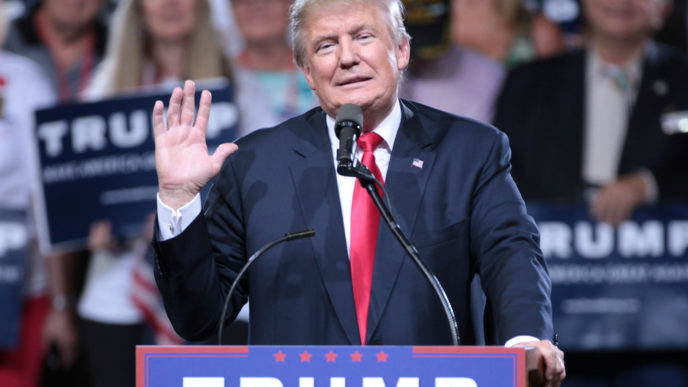
So Much for Tolerance: Photos of the Violent Protests of Trump’s Inauguration

In some parts of the nation’s capital today, it looks like a war zone.

And it’s because of protesters who are presumably taking out their anger over the election—and the voters’ decision—by acting violently and destructively on the streets of Washington.

Here are some of the most compelling photos and tweets documenting the destruction:

(For more from the author of “So Much for Tolerance: Photos of the Violent Protests of Trump’s Inauguration” please click HERE)

Follow Joe Miller on Twitter HERE and Facebook HERE.

Trump’s Inauguration Speech: Two Feet Firmly Planted on Our Fallen Earth

Donald Trump has provoked more outright panic among people with advanced degrees than any politician in recent history. It would be easy for the unwary to draw the darkest conclusions. The desperate urgency of his enemies, from panicked globalists penning incendiary columns to social justice warriors literally torching limos, suggests that his rise represents some new force of extremism, or dark, regressive forces that threaten our very Republic.

Surely (onlookers could reason) Trump holds to some radical, dangerous creed, or else why are all these smart people engaged in such a nationwide public meltdown? If you’re sitting in a crowded theater, and not just one person but dozens are shouting, “Fire!”, you are likely to head for the exit.

But sometimes where there’s smoke, there really isn’t any fire, but instead a smoke machine planted in Lady Liberty’s skirt. Today we saw the peaceful transfer of power in our Republic, and the American experiment in ordered liberty is as safe as it ever was. In fact, in key ways it is safer.

Donald Trump: Inclusive Patriot

To those listening honestly with even a modicum of charity, Trump’s speech should have helped to disarm most of the genuine causes for worry that his critics have raised over many months. Trump firmly rebuked the small, vociferous cult of online Caucasoid tribalists whom some have tried to smear him as championing. Trump used these ringing words, which clearly came from the heart:

A new national pride will stir our souls, lift our sights and heal our divisions.

It is time to remember that old wisdom our soldiers will never forget: That whether we are black or brown or white, we all bleed the same red blood of patriots, we all enjoy the same glorious freedoms, and we all salute the same great American Flag.

President Trump made it starkly clear that his vision of national solidarity, of “loyalty to each other” has everything to do with citizenship, and nothing to do with race. His is the healthy, Jacksonian nationalism of a Truman or a Reagan — and not the narrow, crabbed and envy-ridden sentiment of racial separatists or supremacists of any color.

A Foreign Policy for a Fallen World

Trump’s foreign policy principles are clearly drawn from that same Jacksonian heritage, which does not use lofty promises of global transformation that are sometimes hard to distinguish from Jacobin or Leninist rhetoric. Instead, Trump speaks plainly of defending our national interest in a fallen and perilous world. How often over the past 16 years have our decisions on crucial questions, from Iraq to the “Arab Spring,” been distorted and rendered delusional by universalist abstractions, which ignore the stubborn facts on the ground in Fallujah or Benghazi.

Too many “forgotten Americans” from coal mining country or struggling farms have bled out and died on alien sand, as our nation’s debts piled still higher, in pursuit of fantastical projects that seemed uplifting to some speechwriting civilian over on M Street.

Making Citizenship Great Again

Those who are tempted to panic over Trump’s pledges to enforce our duly enacted immigration laws should know that his promises, just like those laws, grow out of a deep respect for citizenship as a concept with texture and meaning, carrying both rights and duties — not some blank PDF which anyone on earth may download and print out at Kinkos.

While we recognize the equal humanity, under God, of foreign nationals, for Trump it is unpatriotic to treat them as indistinguishable from our fellow Americans — whose ancestors worked, fought, may even have slaved for the weal of this nation in particular, not for humanity as a category.

In fact, Trump’s vision of citizenship goes a good deal further than many libertarians and classical liberals think fitting: He sees the United States as one vast extended family, to the point that we should be willing to sacrifice economic efficiency for the sake of looking out for the least among us. Sound economists have warned us of the Rube Goldberg absurdities that come along with protectionism, and it’s not at all clear that less fortunate Americans would benefit from a trade war that we provoked.

Helping the Forgotten American

So when it comes time to implement Trump’s agenda in nitty-gritty policies, we must insist that measures meant to help Americans whose livelihoods are challenged by foreign competition be as small-scale and short-term as possible. Just as Trump rightly sees that the U.S. government cannot create democracy where the seeds for it always shrivel, he must realize that the same government cannot save entire industries whose economic foundations in reality are crumbling.

Americans have traditionally been a flexible, adaptable, “can-do” people, who picked up and moved from New England to flee its stony soil for the vast fields of the West, and left unprofitable farms to staff the vast factories of Chicago and Detroit. What Trump sees, as most other Republicans didn’t, is that the transitions which economic reality has imposed on many less-connected Americans have been bumpy, painful, and sometimes destructive.

Wall Street gamblers were able to threaten an economic meltdown in 2008, to gain a golden parachute from the government. The election of Donald Trump is a fitting rebuke to elites in both parties who allowed that injustice to happen.

Trump tapped into the populist current that now runs through most Western countries, a wholesome rebellion against the cozy backroom deals and policy tweaks customized to serve the self-styled “cognitive elite,” the people who sail from elite colleges to corner offices, who use the rhetoric of “justice” and “inclusion” to rise to unaccountable power in U.S. federal agencies and European Union commissions. He spoke in brash and divisive terms of an open split between the interests of these elites and the people they claim to represent. It was bracing to hear him state matters so bluntly.

Restoring the Balance in American Politics

No, Donald Trump will not create a Peronist regime, which wrecks the U.S. economy in pursuit of some ill-conceived “social justice.” He will not embark us on wars of naked aggression and foreign conquest. He will not seed our cities with racial hatred, nor blacklist Hollywood actors.

What he will do is repair the grave imbalances in our politics that has emerged in recent decades. For too long we have allowed those who can master phrases and administer people to thrive, while those who work with their hands are shunted aside — and often replaced by compliant foreigners. Too many policy debates are dominated by a battle of empty abstractions, as taxes rise, budgets burst and real-world communities wither.

In an age when European governments react to the crime waves inflicted by a massive influx of Muslims with Third World skill sets and a 7th century worldview by censoring the news so citizens won’t rebel, it is more than simply refreshing to have a president like Trump, who is impervious to happy talk and in touch with ordinary people. It might even prove redemptive. (For more from the author of “Trump’s Inauguration Speech: Two Feet Firmly Planted on Our Fallen Earth” please click HERE)

Follow Joe Miller on Twitter HERE and Facebook HERE.

Trump Supporters in Their Own Words

Thousands of voters traveled to the nation’s capital Friday to witness the inauguration of President Donald Trump. But have their voices been accurately reflected over the past few months? The Daily Signal spoke with Trump supporters about who they are, why they came out to support the nation’s 45th president, and whether they think the media’s narrative is fair. Watch the video to hear their responses.

(For more from the author of “Trump Supporters in Their Own Words” please click HERE)

Follow Joe Miller on Twitter HERE and Facebook HERE.

Trump Signs Executive Order Curbing Obamacare

Hours after taking the oath of office, President Donald Trump followed up on his campaign pledge to try to start chipping away at Obamacare, and curb federal regulations.

Trump signed an executive order on Friday evening from the Oval Office “to ease the burden of Obamacare as we transition to repeal and replace,” White House press secretary Sean Spicer told reporters Friday.

The new president’s goal is to repeal the Affordable Care Act, better known as Obamacare, which will require congressional actions.

“Potentially the biggest effect of this order could be widespread waivers from the individual mandate,” Larry Levitt, a senior vice president at the Kaiser Family Foundation, told The Washington Post. Currently, individuals who do not have health insurance and do not qualify for an exemption must pay a $695 annual fee or up to 2.5 percent of annual household income.

“They’re very aware of the fact that the first job is to prevent the Affordable Care Act from doing more damage than it’s already done,” says Ed Haislmaier, a senior research fellow in health care policy at The Heritage Foundation. “As we saw with the premium increases in the fall, people who are buying individual or small employer coverage without a subsidy are getting hammered.”

Haislmaier cautioned, however, that the executive order is “the beginning of the process.” The order states that it’s the goal of the administration to repeal the law, but:

In the meantime, pending such repeal, it is imperative for the executive branch to ensure that the law is being efficiently implemented, take all actions consistent with law to minimize the unwarranted economic and regulatory burdens of the act, and prepare to afford the States more flexibility and control to create a more free and open healthcare market.

The order mentions several times, “To the maximum extent permitted by law,” and continues:

[T]he heads of all other executive departments and agencies … with authorities and responsibilities under the act shall exercise all authority and discretion available to them to waive, defer, grant exemptions from, or delay the implementation of any provision or requirement of the act that would impose a fiscal burden on any state or a cost, fee, tax, penalty, or regulatory burden on individuals, families, healthcare providers, health insurers, patients, recipients of healthcare services, purchasers of health insurance, or makers of medical devices, products, or medications.

Democrats have argued that gutting the law that mandates individuals buy health insurance and employers provide it would leave millions uninsured. Republicans say the mandate has been overly burdensome.

Obamacare has seen an increase of about 14 million insured, based largely on Medicaid expansion. The law requires individuals to buy insurance and employers to provide it.

However, the Obama administration admitted that health care premiums increased by an average of 25 percent across 39 states in October. Further, 33 states have fewer insurers offering coverage on Obamacare in 2017 than in 2016. Only one state, Virginia, gained insurers. Five states have one insurer, while 13 have just two. One-third of all U.S. counties will have just one insurer.

White House chief of staff Reince Priebus sent a memo titled “Regulatory Freeze Pending Review” to block all pending regulations under review but not yet in the Federal Register. (For more from the author of “Trump Signs Executive Order Curbing Obamacare” please click HERE)

Follow Joe Miller on Twitter HERE and Facebook HERE.