Posts

House Republicans Lay out Their Plan to Rein in the EPA

House Republicans released their proposal to balance the federal budget in 10 years, which included their plans to rein in the regulatory power of the Environmental Protection Agency.

Republicans plan three broad reforms for the EPA: reduce its funding, cut global warming programs, and eliminate the agency’s policy office . . .

However, the House’s plan for the EPA would cut the agency’s budget 80 percent less than what the White house recommended in its May budget proposal.

A House appropriations bill introduced days ago gives the EPA a $7.5 billion budget in fiscal year 2018, or $528 million less than the agency’s 2017 budget. The bill also ignored many Trump administration requests to cut dozens of EPA programs. That bill is still making its way through committee.

The House appropriations bill would give $31.4 billion to federal environmental programs at the EPA, Department of the Interior, and other agencies. That’s $824 million below 2017 levels, but $4.3 billion less than the White House’s request. (Read more from “House Republicans Lay out Their Plan to Rein in the EPA” HERE)

Follow Joe Miller on Twitter HERE and Facebook HERE.

Exposing the EPA’s Gold King Mine Cover-Up

Does the Environmental Protection Agency care more about its image than it does about the environment?

Its behavior in response to the massive 2015 Gold King Mine disaster in Colorado would suggest a very clear “yes.”

The Environmental Protection Agency is hiding its incredible recklessness in the affair by giving official accounts that are clearly contradicted by ample evidence in the government’s possession.

As the new EPA administrator, Scott Pruitt has an opportunity to drain a bit of the swamp by exposing the EPA’s cover-up.

An Environmental Disaster

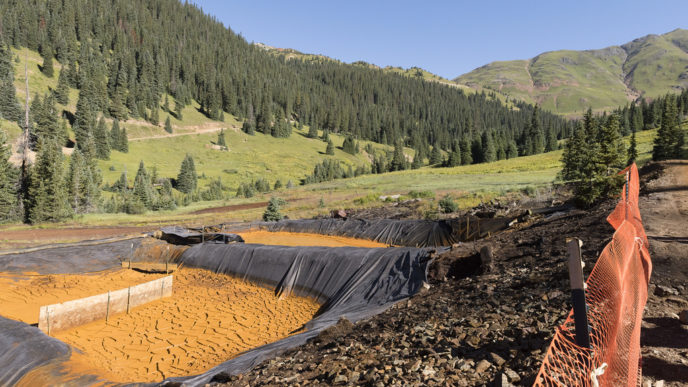
In August 2015, an EPA crew inexplicably dug out the rock and rubble “plug” to the long abandoned Gold King Mine, triggering a massive blowout that flooded the Animas River with 3 million gallons of acid mine drainage and, according to the EPA, over 550 tons of metals.

Had the EPA actually been doing what it claims it did, the disaster would never have happened. However, it seems the EPA could not allow its reputation to be tarnished with the truth.

The EPA has put forth the fiction that its crew had simply removed backfill that was blocking access to a mine tunnel, but did not disturb the natural plug that had formed in the tunnel’s opening that was holding back a sea of acid mine drainage.

The EPA claims its crew planned to wait for experts who would address the plug. It says its team was just further cleaning up the site when, through some inexplicable bad luck, the plug eroded, causing a blowout that turned the Animas River bright orange.

In essence, the agency wants us to believe that this was an accident that could have happened to anybody.

The truth the EPA is concealing is that its team did not stop after excavating to the tunnel’s opening, and never had any intention of stopping.

The EPA crew began removing the plug as it had planned, even though it anticipated acid mine drainage would flow out and that the drainage could be pressurized.

The EPA’s actions could be likened to poking a balloon with a pin to let out just a little air. At best, the EPA’s actions were incredibly reckless.

Numerous federal officials in and outside the EPA turned a blind eye to the truth, and never challenged the fiction that the EPA maintains to this day and that was just repeated Monday by the EPA’s inspector general.

For an agency more concerned about its own welfare than its environmental mission, the almost unfathomable incompetence is sufficient motive to cover up what really happened.

There are other reasons as well. Some grossly negligent acts can be criminally prosecuted under provisions the Clean Water Act—a measure the EPA has used against private parties in the past. Additionally, New Mexico has already brought a lawsuit seeking damages.

Further, the EPA’s dishonest actions after the fact likely provide even more impetus to continue the deception.

Given the contradictory assertions they have made in public and the bogus reports they have produced for public and congressional consumption, it is difficult to imagine how the EPA officials involved could have possibly been honest with the inspector general investigators.

Pruitt’s team has inherited a tangle of half-truths, misdirection, and deceit. Like the Gold King Mine disaster itself, this is a mess the agency needs to clean up.

A Prelude to Disaster

Years before the Gold King Mine disaster occurred, there had been a collapse within a tunnel (an adit) used to access, ventilate, and drain the mine’s inner content.

Water can naturally accumulate within mines, and if there has been a collapse, fine solid matter like clay can eventually fill all the spaces between the collapsed rock, forming a natural plug. Eventually a pool of water forms behind the plug, and with enough time there can be so much water that it becomes pressurized.

In 2009, after this collapse, a pipe had been inserted into the mine in an attempt to prevent the accumulation of water. Then, the old structure at the entrance to the adit (posts and timbers supporting a roof to protect from debris sliding down from the slope above) was demolished, and the area in front of the mine opening was backfilled, burying all except the end of the drainage pipe.

Subsequently, water flowing from the mine had slowed to a trickle, a possible indicator that the mine was plugged.

When the EPA crew came to the mine in 2015, it came specifically to address the concern about conditions that could lead to a blowout.

The crew, however, was operating under outlandish assumptions that the agency had made one year before, which are covered in greater detail by a congressional committee report.

In brief, based on almost no evidence, the EPA had concluded during a visit in 2014 that the floor of the mine was 6 feet lower than the ground immediately outside the mine.

It assumed that water in the mine would have to be over 6 feet deep before it would flow out of the pipe. Seeing little flow out, it conjectured the backfilled mine was only half-full and not pressurized.

This conclusion was contrary to available old photographs, documents from the Colorado’s Division of Reclamation, Mining and Safety, and the basic fact that the tunnel was designed in part to drain the mine—so recessing the floor 6 feet would make no sense.

The ground immediately outside the mine was made of the waste rock removed to create the tunnel. Why and how would a tunnel be dug so it couldn’t drain or be accessed?

An additional clue should have been clear to the crew: During a 2014 visit, the EPA removed a stinger—a pipe that is used to drive through a collapse to drain impounded water.

This is especially true given that when the crew yanked the stinger from the rubble, it found the front section mangled, indicating there had possibly been an unsuccessful attempt to penetrate a blockage.

In any case, whether the mine was full or not could have been determined by drilling to test for hydrostatic pressure. However, because drilling was difficult and expensive, the EPA chose to rely on faulty assumptions rather than data.

In 2015, the EPA crew set about removing unconsolidated backfill (material that was not holding back water) to reach the plugged tunnel opening cut into the mountain’s rock face. This was accomplished the first day of digging.

The crew’s outlandish assumptions were proven to be just that when it reached the tunnel’s opening. It had exposed the entire plug from the bottom to the top of the tunnel, not just the upper half.

With the tunnel not recessed as anticipated, the crew should have realized, and likely did, that the basis of its assumption that the mine was not full of water had evaporated.

In what appears to have been a hopeless effort to account for this, the following day, the EPA crew reburied all but the very top portion of the plug. It built a large mound of earth (a berm) in front of the tunnel opening and constructed a makeshift channel to the side.

The crew apparently anticipated that when it dug a hole into the top of the plug, any water that came out would calmly flow through the channel and to a pre-existing ditch that ran down the mountain to settling ponds.

Hope springs eternal.

Although the EPA fails to mention the reburying of the plug in any of its reports, several executive branch reports, along with an EPA inspector general report released this week, described what supposedly happened next.

All these reports are wrong, and most, if not all, are intentionally deceitful.

Rewriting History

First, the EPA produced a report that asserted its crew was just digging to clear the bedrock face, but not touching the plug. Then, somehow, the lower bedrock crumbled and the mine just blew out.

The Department of the Interior produced the next report, a bureaucratic treatise that says the EPA crew discussed a plan, but then ambiguously states “the contractor continued to excavate.”

Exactly what the crew was excavating—the dirt above the tunnel opening (which in fact had already been removed) or the plug itself—is left unsaid. The report asserts that the EPA crew planned to insert another stinger through the now-exposed plug to drain the mine.

The crucial fact omitted by the report is that the EPA did not have a stinger. So, the plan was pure fiction.

In fact, the Department of Interior report was so short on details that an Army Corps of Engineers peer-reviewer made his signature conditional on including additional text in the executive summary.

He included the line:

The report discusses field observations by EPA (and why they continued digging), but does not describe why a change in EPA field coordinators caused the urgency to start digging out the plug rather than wait for [Bureau of Reclamation] technical input as prescribed by the EPA project leader.

Unlike the Corps reviewer’s comments, the remainder of the Interior report is nebulous.

Then, the night before a congressional hearing on the Interior report, the EPA issued an addendum to its first report, stating that the report was based on an unrecorded, untranscribed, simultaneous interview of the two EPA on-scene coordinators in charge of the site.

According to the addendum, the on-scene coordinator who was on vacation at the time of the blowout had handed supervision off to the other, along with an emailed list of instructions.

Curiously, this critically important email was not mentioned in the narrative of the two earlier reports. The email provides explicit instructions on steps to take to remove the upper portion of the plug.

The EPA’s midnight addendum also asserts that its crew was following these instructions with one exception. Without any supporting evidence whatsoever, the report claims that after he sent the email, the on-scene coordinator who would be on vacation told his replacement not to remove the plug, something inconsistent with his instructions.

Even if this supposed “clear verbal direction” was ever given, it definitely wasn’t followed.

The report goes on to repeat the fiction that the EPA crew was digging high above the tunnel opening and preparing the site for when the experts would arrive when, somehow, the mine inexplicably burst open.

Finally, the EPA Inspector General’s Office released its report this Monday that at best demonstrates an inability to uncover the truth by repeating the fiction.

After omitting any serious discussion of the outlandish assumptions from the EPA’s 2014 site visit, the EPA inspector general repeats the official EPA line, stating that:

According to the [on-scene coordinator] on-site, the team stopped excavation in front of the blockage on Aug. 4, 2015, after they reached material that was compacted, well consolidated, and considered by the [on-scene coordinator] on-site to be the blockage.

The EPA inspector general goes on to state that the next day, “[t]he excavator operator built a ramp to enable reaching higher.” This was reportedly done so the excavator operator could “scratch” above the mine entrance where the plug was.

Like the other reports, the inspector general omits any mention that the plug that had been unearthed the day before was reburied—as is demonstrated in this series of photos—and that the rock face had already been “scratched” clean before the blowout, as demonstrated in this series of photos.

Time for Truth and Accountability

All these reports are clearly refuted by an email from the Department of Interior recently released by the House Committee on Natural Resources, which states:

On 8/5/2015, the EPA was attempting to relieve hydrologic pressure behind a naturally collapsed adit/portal of the Gold King Mine. The EPA’s plan was to slowly drain and treat enough mine water in order to access the inner mine working and assess options for controlling its discharge. While removing small portions of the natural plug, the material catastrophically gave-way and released the mine water.

This document, site photographs, and other information clearly contradict the fiction that the EPA has spun. The cover-up is so bold it fits the old saying, “Who you going to believe, me or your lying eyes?”

While the EPA crew did not snap a photo of the excavator bucket that was digging the last fateful scoop of the plug, it might as well have.

There are enough people inside the agencies that know the truth, and a trail of pictures and papers show that they know it.

It is time the cover-up be uncovered, and the EPA be exposed for caring more about its own institutional interests than protecting the quality of the environment. (For more from the author of “Exposing the EPA’s Gold King Mine Cover-Up” please click HERE)

Follow Joe Miller on Twitter HERE and Facebook HERE.

Trump’s EPA Chief Backs Approach to Science That Could Upend the Global Warming ‘Consensus’

Environmental Protection Agency Administrator Scott Pruitt reignited a long simmering debate over a method of scientific inquiry that could upset the supposed “consensus” on man-made global warming.

In an interview with Breitbart’s Joel Pollak on Monday, Pruitt said he supported a “red team-blue team” set up to test climate science. Pruitt was inspired by an op-ed by theoretical physicist Steven Koonin, but others have been pushing this idea as well.

“If truth is what we are all after, why would any scientific organization object to an independent look at the claims of the climate establishment?” climate scientist John Christy said.

Christy has testified on the value of “red teams” for climate science many times in the past decade. This time, however, environmentalists and “consensus” scientists are worried Congress will take him seriously.

Red teams would challenge blue teams on global warming hypotheses on “what do we know, what don’t we know, and what risk does it pose to health, the United States, and the world,” Pruitt told Breitbart. (Read more from “Trump’s EPA Chief Backs Approach to Science That Could Upend the Global Warming ‘Consensus'” HERE)

Follow Joe Miller on Twitter HERE and Facebook HERE.

Why Conservatives Should Be Excited About New EPA Agenda

Environmental Protection Agency Administrator Scott Pruitt has been in his new role for just over 80 days.

He spoke with The Daily Signal about his objectives for the first year, which he says include “getting back to basics.” Pruitt says the agency needs to do a much better job of respecting individual states and the rule of law, and promoting policies that are pro-jobs, pro-growth, and pro-environment.

He also explains why President Barack Obama was not the environmental savior some suggest, and why he calls the Paris Agreement an “America Last” policy.

(For more from the author of “How Jeff Sessions Is Getting Tough on Drug Crime” please click HERE)

New EPA Administrator Emphasizes Federalism, Rule of Law

“The future ain’t what it used to be at the EPA.”

That was the message of Scott Pruitt, the newly confirmed administrator of the Environmental Protection Agency, to conservatives gathered Saturday at the Conservative Political Action Conference, or CPAC.

“Process, rule of law, and cooperative federalism, that is going to be the heart of how we do business at the EPA,” Pruitt said.

In his role as EPA administrator, Pruitt said that he would work to restore the role of the states.

“What really matters a lot is federalism,” the former Oklahoma attorney general said.

“We are going to once again pay attention to states across this country. I believe the people in Oklahoma, in Texas, Indiana, Ohio, New York, and California and all the states across the country … care about the air they breathe and they care about the water they drink and we are going to be partners with those individuals, not adversaries.”

Pruitt said the EPA will also “pay attention to process.”

“We are not going to bypass rule-making,” he said. “We are going to do the work that Congress has said we must do.”

The new administrator also said he will make sure the EPA pays “keen attention to [the] rule of law.”

“As we engage in real rule-making, as we make sure that we don’t use the courts to regulate, we are going to do so with a keen attention to rule of law,” Pruitt said. “Rule of law matters.”

Pruitt said executive agencies must operate under the authority Congress has given them, and not go beyond it.

“Executive agencies only have the power that Congress has given them, they can’t make it up as they go,” Pruitt said. “They can’t fill in the blank. They can’t say, ‘We’re just simply going to go forward without Congress speaking.’”

CPAC, the largest annual national gathering of conservative activists, runs from Wednesday to Saturday at the Gaylord National Resort and Convention Center in National Harbor, Maryland, just outside Washington. (For more from the author of “New EPA Administrator Emphasizes Federalism, Rule of Law” please click HERE)

Follow Joe Miller on Twitter HERE and Facebook HERE.
Trump’s Choice for EPA Chief Wants to Partner with, Not Punish, States

President-elect Donald Trump’s pick to run the Environmental Protection Agency explained how he would make cooperating with the states a priority of the department during a Wednesday hearing on Capitol Hill.

Scott Pruitt, the Oklahoma attorney general, stressed “cooperative federalism” would be his guiding philosophy in running the EPA, meaning he wants the often controversial agency to work with states.

“Cooperative federalism is at the heart of many of the environmental statutes that have been passed by this body,” Pruitt told the Senate Committee on Environment and Public Works. “The reason for that is that it’s the states, many times, that have the resources, the expertise, and understanding what the unique challenges are for the environment in improving our water and our air.”

As his state’s attorney general, Pruitt led more than a dozen lawsuits against the EPA—which he defended as not being opposed to environmental regulations, but opposing legal overreach by the agency.

“We need a partnership, a true partnership, between the EPA performing its role, along with the states in performing theirs,” Pruitt said. “If we had that partnership as opposed to punishment, as opposed to uncertainty and duress that we currently see in the marketplace, I think we’ll have better air, better water quality as a result.”

Democrats on the Senate committee criticized Pruitt for suing to block certain EPA regulations, such as the Clean Power Plan and the Waters of the United States rule.

Sen. Sheldon Whitehouse, D-R.I., said his state has “bad air days” when people are informed to stay inside because of out-of-state smokestacks that pollute the air.

“Because those smokestacks are out of state we need EPA to protect us and I see nothing in your record that would give a mom taking her child to the hospital for an asthma attack any comfort that you would take the slightest interest in her,” Whitehouse said. “Your passion for devolving power down to states doesn’t help us because our state regulators can’t do anything about any of those problems. They all come from out-of-state sources.”

Pruitt said he wanted the EPA to adhere to its statutory authority from Congress.

I believe there are air quality issues and water quality issues that cross state lines that the jurisdiction of the EPA, its involvement in protecting our air quality and improving our nation’s waters is extremely important. The EPA has served a very valuable role historically. After all, it was Republicans who created the EPA under an executive order in the 1970s and this body has passed many pieces of legislation since the 1970s to focus on improving our air and improving our water quality.

In response to a question from Sen. Ed Markey, D-Mass., Pruitt asserted, “I do not believe that climate change is a hoax.”

Pruitt, in his opening remarks, said the debate about the degree of human impact on climate change is open for dialogue.

“We should encourage open and civil discourse. One such issue where discourse is absent involves climate change,” Pruitt said.

Sen. Kirsten Gillibrand, D-N.Y., accused Pruitt of only being worried about financial costs of regulations.

“I need you to care about human health and really believe that the cost when people are dying is far higher than it is to the cost of that polluter to clean up the air,” Gillibrand said.

However, Sen. Joni Ernst, R-Iowa, talked about what a threat the EPA can be to American citizens.

“What I hear without fail at these town halls is that folks are frustrated with the EPA and the gotcha mentality that is stemmed from the agency,” Ernst said. “My constituents tell me that the EPA is out to get them rather than work with them. There is a huge lack of trust between my constituents and the EPA.”

Pruitt responded it does not have to be this way.

“This paradigm that we live within today that if you’re pro-energy, you’re anti-environment or if you’re pro-environment, you’re anti-energy is a false narrative,” Pruitt said. “We can do better than that. In fact, this country has shown for decades that we can grow our economy and be a good steward of our air, land, and water.” (For more from the author of “Trump’s Choice for EPA Chief Wants to Partner with, Not Punish, States” please click HERE)

Follow Joe Miller on Twitter HERE and Facebook HERE.

EPA Makes an About-Face on Fracking Report: Science or Politics?

Gordon Tomb pays about $40 per month to heat his home in central Pennsylvania. And he wants to keep it that way.

“I’ve lived in Pennsylvania for more than 60 years and have never paid so little for my home heating,” Tomb, a senior fellow with the free market Commonwealth Foundation, said in an interview.

He credits his low heating bills to the boom in natural gas production brought on by hydraulic fracturing (“fracking”), which enables energy companies to tap into the state’s gas-rich Marcellus Shale formation.

“The natural gas industry has been the brightest spot in the Pennsylvania economy for the past decade and it’s likely to be for a long time,” Tomb said “It’s contributed billions to property owners in royalties and leases alone. There are hundreds of millions of dollars in tax revenues and in wages by the economic activity of hundreds of thousands of jobs.”

In 2009, a handful of Dimock, Pennsylvania, homeowners sued a Houston-based company, alleging their drinking water was tainted by fracking.

The Pennsylvania complaint and others like it from across the country prompted a five-year, $29 million Environmental Protection Agency study, which, according to a draft report released in June 2015, “did not find evidence that these mechanisms have led to widespread, systemic impacts on drinking water resources in the United States.”

This was a relief to the oil and gas industry, given that fracking currently accounts for half of the nation’s crude oil production and two-thirds of the natural gas production, yet has also been controversial.

But something happened between last year and last week to make the EPA change its tune.

In its final report released last week, “Hydraulic Fracturing for Oil and Gas: Impacts from the Hydraulic Fracturing Water Cycle on Drinking Water Resources in the United States,” the EPA said fracking can affect drinking water resources “under some circumstances.”

But it cited no cases in which such contamination was confirmed. Instead, the EPA concluded that there is a paucity of data on which to base a conclusion, and in the instances where data is available, there are too many uncertainties to conclude anything with confidence.

“Because of the significant data gaps and uncertainties in the available data, it was not possible to fully characterize the severity of impacts, nor was it possible to calculate or estimate the national frequency of impacts on drinking water resources from activities in the hydraulic fracturing water cycle,” the study says. “We were, however, able to estimate impact frequencies in some, limited cases (i.e., spills of hydraulic fracturing fluids or produced water and mechanical integrity failures).”

On that thin reed, environmentalists are taking a victory lap. But what changed?

It wasn’t the science, according to Jeff Stier, senior fellow at the National Center for Public Policy Research, but politics.

“The EPA already said in its draft report that there was no systemic effect on the water supplies from fracking. Nothing in the underlying science of the report was changed, it’s simply a change in their framing of it,” Stier said. “There’s been a concerted political campaign to apply pressure to the EPA. Certainly the report as it was written in draft form would have taken away any leg that activists had to stand on.”

Specifically, Stier says, certain members of Congress, environmental activists, and the EPA’s independent researchers pushed for the scholarly flip-flop.

The draft report, and its fracking-favorable findings, remained status quo for more than a year.

Then in August of this year, the agency’s Science Advisory Board sent a letter to EPA Administrator Gina McCarthy. The board complained in the 180-page letter that the statement about “widespread, systemic impacts” was not supported and needed revision. The board also advised the EPA add specific research on places with a track record of reported problems—including Dimock, Pennsylvania.

On Oct. 20, McCarthy got a scathing follow-up letter signed by 51 members of Congress. The note blasted not only the 2015 draft report, but the EPA’s public handling of the report, and urged the EPA to either revise the “widespread, systemic impacts” statement, or delete it.

The EPA opted for the delete button, offering this explanation on its website:

After receiving comments from the [Science Advisory Board], EPA scientists concluded that the sentence could not be quantitatively supported. Contrary to what the sentence implied, uncertainties prevent EPA from estimating the national frequency of impacts on drinking water resources from activities in the hydraulic fracturing water cycle. Additionally, EPA scientists and the [Science Advisory Board], came to the conclusions that the sentence did not clearly communicate the findings of the report.

‘Hanging on by a thread’

U.S. Rep. Matthew Cartwright, D-Pa., was among those who pressed the EPA to change its conclusion. He said that he has been at the forefront of federal efforts to crack down on fracking to protect communities and environment in which fracking occurs, including his home state.

“I am pleased that the EPA took seriously the issues raised by the Scientific Advisory Board, and revised its report accordingly,” he said. “My priority has always been to see that the fracking industry operates safely and responsibly, and I have repeatedly introduced legislation aimed at encouraging that.”

Tomb, however, is wary of any regulations coming from Washington to a state that’s well-schooled in natural resources and well-equipped with fracking regulations.

“I see nothing good about additional federal regulations in this area,” he said. “The first oil well was drilled in Pennsylvania in the mid-1800s. So this state has been dealing with this industry going on 200 years. And in my lifetime, it’s done very well.”

Stier says the push by the congressmen and the review board is part of a much broader “keep it in the ground” movement.

“The big picture opposition to fracking has nothing to do with drinking water. It’s opposition to humans taking energy out of the earth,” Stier explained. “These opponents realize they would not be able to win a political argument in the court of public opinion considering they don’t want us taking energy out of the ground. So they had to argue that this threatened our drinking water because that’s a way to get everyone to agree because we all want clean drinking water.”

Swapping out the previous conclusion is, according to Stier, a last leg for the anti-frackers on the eve of the Trump administration. “They’re hanging on by a thread to sow doubt about the safety of fracking. But I don’t think it’s a very strong leg to stand on because it’s simply a political document now.”

Indeed, a hostile letter-writing campaign will likely not have the same effect on Oklahoma Attorney General Scott Pruitt—President-elect Donald Trump’s pick to replace McCarthy at the EPA. Pruitt has been a frequent and effective critic of EPA overreach, and took a leading role in efforts to put the Obama administration’s Clean Power Plan on hold.

“From what I’ve seen so far from the Trump administration, they don’t care about idiotic claims by people looking to advance their own skewed view of how the world should be, who want to meddle in everybody’s lives and everybody’s business,” Tomb added. “Most people want to live their lives, raise their families—all that can be done and has been done, while protecting the environment.” (For more from the author of “EPA Makes an About-Face on Fracking Report: Science or Politics?” please click HERE)

Follow Joe Miller on Twitter HERE and Facebook HERE.
EPA Pick Scott Pruitt Shows Trump Is Serious About Shredding Obama’s Climate Change Regs

President-elect Donald Trump is delivering on his campaign promise to reign in environmental regulations and bring coal miners back to work by selecting Oklahoma Attorney General Scott Pruitt to head the Environmental Protection Agency (EPA).

Pruitt’s nomination goes hand and hand with Trump’s energy policy that seeks to unleash domestic energy production by reducing regulations and expanding natural resource development.

The Oklahoma AG is a vocal critic of the EPA’s regulatory overreach and disagrees with the claim that global warming science is settled. Instead, he believes the relationship between man’s activities and global warming needs vigorous debate.

The selection of Pruitt should allay any fears that Trump was softening his stance on reversing President Obama’s climate change regulations by recently meeting with former Vice President Al Gore.

Key to Trump’s pledge to bring back coal mining jobs, Pruitt is a critic of EPA’s Clean Power Plan (CPP) rule which serves as the foundation of Obama’s climate change agenda.

The CPP seeks to cut carbon dioxide from coal-fired power plants and it also serves as the regulation that would deliver the U.S emissions targets promised as part of the United Nations Climate Change Paris Agreement.

Pruitt strongly opposed the EPA’s plan to regulate carbon dioxide. He was one of the leaders of a state attorneys general coalition legal fight against the CPP that led to the Supreme Court decision to block the regulation.

The immediate fate of the CPP now rests at a lower court. Regardless of the pending decision, odds are the legality of the rule will be argued again before the Supreme Court.

As head of the EPA, Pruitt — if confirmed by the Senate — would be in a great position to undo or significantly alter the CPP. (For more from the author of “EPA Pick Scott Pruitt Shows Trump Is Serious About Shredding Obama’s Climate Change Regs” please click HERE)

Follow Joe Miller on Twitter HERE and Facebook HERE.

Trump’s Pick for EPA Has a History of Fighting the Agency

President-elect Donald Trump reportedly has nominated Oklahoma Attorney General Scott Pruitt to head the Environmental Protection Agency.

Pruitt is known for waging legal battles against the EPA over its climate change agenda, suggesting that Trump could intend to make good on his promise to “get rid of [the agency] in almost every form.”

Pruitt, a Republican, led the charge in the states’ fight against what he considers an overreach by the EPA on issues including the Clean Power Plan, which aims to combat global warming; the Waters of the United States rule, which aims to protect wetlands and waterways; and the Renewable Fuel Standard, which aims to reduce greenhouse gas emissions.

He has publicly expressed skepticism about climate change science, and supports the notion that the debate is “far from settled.”
The possibility of undoing a series of rules and regulations established under the Obama administration immediately caused alarm among green groups on the left.

“The mission of the EPA and its administrator requires an absolute commitment to safeguard public health and protect our air, land, water, and planet,” said Rhea Suh, president of the Natural Resources Defense Council. “If confirmed, Pruitt seems destined for the environmental hall of shame.”

“Having Scott Pruitt in charge of the U.S. Environmental Protection Agency is like putting an arsonist in charge of fighting fires,” added Michael Brune, executive director of the Sierra Club. “He is a climate science denier who, as attorney general for the state of Oklahoma, regularly conspired with the fossil fuel industry to attack EPA protections.”

Karl Rove, a former senior adviser under the George W. Bush administration, came to Pruitt’s defense, congratulating Trump “on another superb pick.”

“About time for sensible regulator again at such powerful agency,” Rove tweeted.

Pruitt has been criticized for having cozy relationships with energy companies. In 2014, The New York Times reported a letter he sent to the EPA was written “almost entirely” by Devon Energy, a natural gas and petroleum producer.

But in the face of criticism, Pruitt responded: “It should come as no surprise that I am working diligently with Oklahoma energy companies, the people of Oklahoma, and the majority of attorneys general to fight the unlawful overreach of the EPA and other federal agencies.”

Pruitt, who serves in one of the biggest oil and natural gas states in the country, has also been active in defending companies who express skepticism about climate change science.

In March, a group of state attorneys general formed a coalition to “criminally investigate energy companies for disputing the science behind global warming.”

Pruitt, along with Alabama Attorney General Luther Strange, came to the defense of the companies. In a statement, they voiced strong opposition to a coalition they said is an attempt to “use the law to silence voices with which we disagree.”

“Reasonable minds can disagree about the science behind global warming, and disagree they do,” Pruitt and Strange said in a statement. “This scientific and political debate is healthy, and it should be encouraged. It should not be silenced with threats of criminal prosecution by those who believe that their position is the only correct one and that all dissenting voices must therefore be intimidated and coerced into silence.”

Pruitt was elected as attorney general in Oklahoma in 2010, and before that served as a conservative in the Oklahoma state Senate.

In addition to prosecuting the EPA, Pruitt has challenged the Affordable Care Act and the Obama administration’s transgender bathroom guidance. (For more from the author of “Trump’s Pick for EPA Has a History of Fighting the Agency” please click HERE)

Follow Joe Miller on Twitter HERE and Facebook HERE.
EPA Issues 57-State Climate Warning!

Strike that. It’s a 50-State warning. That 57 came from elsewhere in the Obama administration.

Well, 50 is less than 57, so the warning is not as dire as you might have thought. Yet it’s still serious. Everybody knows that our beneficent government knows best and that all its cautions should be heeded. This is why you should listen to its bureaucratic experts, who are saying “climate change” will have “impacts.”

Impacts!

“Very real impacts,” says the EPA. And what is real is not a fantasy. So get ready to rumble, weather wise. But before thinking about that, we have to understand what “climate change” is.

Here is a scientific fact. In 1936, a typical year, the climate of the earth was perfect. Every afternoon everywhere was sunny and a clement 78 degrees on Mister Fahrenheit’s scale, even in winter. The rain fell in amounts sufficient to water every crop, fill every stream, and extinguish every forest fire — and then it stopped. Floods didn’t happen. There was just enough wind to loft every kite, and no more.

Of course, it’s true that an anomalous heatwave killed over 12,000 Americans in 1936. But still, since there was quite a lot less carbon dioxide in the air then than now, the climate was necessarily better.

The climate was also better in 1886, long before people were burning gasoline on their commutes to work. It was better because there was less atmospheric carbon dioxide, even less than in 1936. And it was better even though the USA was hit by seven hurricanes, the most since records began to be kept (which wasn’t that long ago).

The climate continued to be better than it is now, right up through the 1960s and 1970s when the consensus was that global cooling was going to kill many people. Good thing it never happened (the government had not yet reached its current state of perfection).

Then the climate changed sometime in the mid 1980s into what it is now, with death, doom, destruction on every side. Consult the media for the latest horror. Why did this happen? As hinted at above, a miniscule increase in the atmospheric trace gas carbon dioxide caused the climate to change.

Scientifically speaking, all climate change is bad. Nothing good can ever come of the climate changing. The climate in the past was always better than it is now. The government and environmentalists are in agreement that any change whatsoever to the climate must necessarily be towards greater evil. This is why we must “fight” climate change.

So it’s 2016 and the climate has changed, and will continue to change unless the government can control all aspects of the economy. Sure, you might not think it’s so bad where you live, and that the weather hasn’t been anything unusual. But if you concentrate only on the good news, you’ll miss the important scientific fact that things could be worse. And they will be if the climate continues to change.

And that’s where the EPA comes in, to tell of the “implications of climate change.” The outlook is bleak.

For instance, the climate has changed since 1980, and all climate change is bad. Corn production in 1980 was about 7.5 billion bushels, changing to around 14 billion bushels in 2015 amidst the changing climate. Statisticians call this kind of signal a “correlation.” The EPA warns that climate change in corn-growing Michigan could exacerbate the risk of increased production. Farmers might run out of bushels if the correlation persists, a disaster caused by climate change.

The EPA warns of climate change in Iowa. They say “Hot days can be unhealthy — even dangerous.” Cold days can be unhealthy and dangerous, too. Climate change puts Iowans in danger of both, whereas before climate change such calamities were not possible; or at least they were not caused by climate change. A significant problem, as in Michigan, are “bumper crops” of corn, soybeans, and other foodstuffs. This is causing prices for food to drop. Climate change is thus bad news for those wanting higher prices.

It isn’t only agriculture. Take Texas, where the state GDP was $815 billion in 1997, a time of rapid climate change, according to the EPA. By 2015, amidst a still-changing climate, the GDP had changed to $1,475 billion. The EPA warns “Texas’s climate is changing.” If the observed correlation between GDP and climate change holds, we could see even more changes like these to the GDP.

We could do each state, but you have the picture now. Ravage after ravage. This is why it is a good thing the EPA warned of the dire consequences of climate change a month before the election. Voters will have the chance to choose between Hillary, who has vowed to cease climate change, and Trump, who has said climate change is not especially worrisome. (For more from the author of “EPA Issues 57-State Climate Warning!” please click HERE)

Follow Joe Miller on Twitter HERE and Facebook HERE.