Posts

Kevin Warsh Sworn in as Federal Reserve Chair; ‘I Want Him to be Totally Independent,’ Trump Says

Kevin Warsh was sworn in Friday as the new chairman of the Federal Reserve, taking over leadership of the world’s most powerful central bank at a moment of rising inflation fears, market jitters and ongoing concerns about the entity’s independence.

President Donald Trump said at a White House ceremony Warsh would be “totally independent”

“I want Kevin to be totally independent,” he said. “Don’t look at me, don’t look at anybody.”

Supreme Court Justice Clarence Thomas swore in Warsh, 56, whom the Senate confirmed as chair last week.

“I will lead a reform-oriented Federal Reserve, learning from past successes and mistakes, both escaping static frameworks and models and upholding clear standards of integrity and performance,” Warsh said. (Read more from “Kevin Warsh Sworn in as Federal Reserve Chair; ‘I Want Him to be Totally Independent,’ Trump Says” HERE)

Trump Federal Reserve Nominee Interrogated over Undisclosed Finances and Ties to Epstein

Senator Elizabeth Warren interrogated President Donald Trump’s Federal Reserve nominee, Kevin Warsh, during his confirmation hearing Tuesday.

Senator Warren focused on the nominee’s $100 million in undisclosed financial holdings, as reported by CNBC, and potential conflicts of interest.

Warsh holds two individual assets each worth more than $50 million, while his wife Jane Lauder, granddaughter of Estée Lauder cosmetics founder, maintains an estimated $1.9 billion fortune.

Warren questioned whether Warsh’s Juggernaut fund or TSDFS LLC invest in companies affiliated with Trump, entities facilitating money laundering, Chinese-controlled companies, or financing vehicles established by Jeffrey Epstein.

Although Warsh acknowledged ethics scandals have undermined the Federal Reserve’s credibility, he declined to directly answer Warren’s yes-or-no question. Instead stating, he worked with the Office of Government Ethics to lawfully divest holdings. (Read more from “Trump Federal Reserve Nominee Interrogated over Undisclosed Finances and Ties to Epstein” HERE)

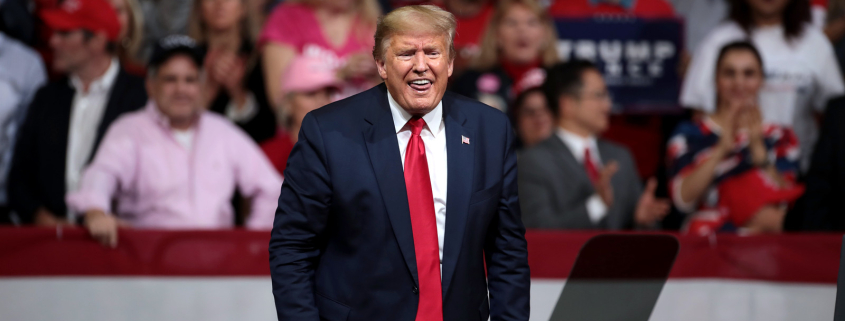
Photo credit: Gage Skidmore via Flickr

Fed Cuts Rates by a Quarter Point

The Federal Reserve reduced its interest rate benchmark by a quarter-point for a second time this year on Wednesday, bringing the short-term borrowing rate to a range of 3.75 percent to four percent.

“Available indicators suggest that economic activity has been expanding at a moderate pace. Job gains have slowed this year, and the unemployment rate has edged up but remained low through August; more recent indicators are consistent with these developments. Inflation has moved up since earlier in the year and remains somewhat elevated,” the Fed said in a statement at the conclusion of its two-day policy meeting.

The rate cut extends the central bank’s effort to support the labor market after several months of slowing job growth. The decision was widely expected by investors and comes amid a prolonged government shutdown that has delayed the release of major economic reports, leaving policymakers without timely data on employment and inflation trends.

Wednesday’s move lowers the federal funds rate to its lowest level in three years, following an earlier quarter-point reduction in September. The central bank also voted to end the runoff of Treasury securities from its $6.6 trillion balance sheet, halting the process of shrinking its holdings of government debt.

Fed officials face uncertainty about how much further to reduce rates as they balance risks to both sides of their dual mandate. Some policymakers have argued that inflation, which has hovered near three percent, remains too high to justify additional cuts, while others see evidence that the economy is losing momentum and may require more support. (Read more from “Fed Cuts Rates by a Quarter Point” HERE)

Photo credit: Flickr

Federal Reserve Cuts Interest Rates a Quarter Point as US Job Market Wobbles

The Federal Reserve cut interest rates by a quarter point as central bankers said worries about a wobbly US job market have begun to outweigh anxieties over inflation.

Eleven of the Fed’s 12 central bankers voted for the regular-size cut including Fed Chairman Jerome Powell, who has spent most of the year deflecting attacks from President Trump over his refusal to lower rates.

The exception was Stephen Miran, who instead voted for a jumbo-size, half-point cut — one day after he left his position as Trump’s economic adviser to become a Fed governor.

Central bankers have been delaying rate cuts over fears that tariffs could reheat inflation, which has shown signs of picking up over the summer. Consumer spending has likewise been resilient despite Trump’s tariffs.

Fed Chairman Jerome Powell called Wednesday’s decision a “risk-management cut” as policymakers confront a “very different picture of the risks to the labor market” following major downward revisions to job growth earlier this month. (Read more from “Federal Reserve Cuts Interest Rates a Quarter Point as US Job Market Wobbles” HERE)

Photo credit: Flickr

Fed Keeps Rates Unchanged — But Two Vote against Powell’s ‘Wait-And-See’ Approach

The Federal Reserve kept interest rates unchanged Wednesday despite intense pressure from President Trump for a cut — and votes by two of the central bank’s governors against Jerome Powell’s “wait and see” approach.

The central bank’s policy-setting Federal Open Market Committee maintained the benchmark rate between 4.25% and 4.5%, where it has been since December.

It marked the first meeting in three decades where more than one governor on the 12-member board has dissented on an interest-rate vote .

“On the dissents, what you want from everybody, and also from a dissenter, is a clear explanation of what you’re thinking is and what are the arguments you’re making and we had that today,” Chairman Powell said during a press conference immediately following the meeting.

“This was quite a good meeting all around the table where people thought carefully about this.” (Read more from “Fed Keeps Rates Unchanged — But Two Vote against Powell’s ‘Wait-And-See’ Approach” HERE)

Fed Shock: Fed Officials Forecast Higher Rates and Higher Inflation

The Federal Reserve delivered an unexpected blow to hopes for lower borrowing costs in the future, projecting higher inflation and higher interest rates in updated forecasts released Wednesday. While policymakers left their benchmark rate unchanged and signaled that they may cut in the second half of this year, forecasts of officials showed they expect fewer cuts next year and the year after that.

The central bank held the federal funds target at 4.25 to 4.50 percent, its level since the December rate cut. But the accompanying economic projections revealed rising concern that inflation is not receding fast enough—and that rates may need to stay elevated to keep it in check.

Officials now forecast that the Fed’s preferred inflation gauge, the personal consumption expenditures (PCE) index, will climb to 3.0 percent by the end of 2025. Core PCE inflation, which excludes food and energy, is expected to reach 3.1 percent. Both represent notable upward revisions from the March forecast, which anticipated 2.7 percent and 2.8 percent respectively.

“We expect a meaningful amount of inflation to arrive in the coming months,” Fed chairman Jerome Powell said. “We have to take that into account.”

This came as a surprise to many Fed watchers because recent inflation data has come in softer than expected, with prices holding steady or rising only at a slow rate. The annualized quarterly pace of the PCE inflation is 1.5 percent, below the Fed’s two percent inflation target, and core PCE inflation is two percent, according to the Federal Reserve Bank of Cleveland. (Read more from “Fed Shock: Fed Officials Forecast Higher Rates and Higher Inflation” HERE)

Photo credit: Flickr

Federal Reserve: Businesses Say Vaccine Mandates Are Hurting Employment

The Federal Reserve on Thursday said that businesses have reported COVID-19 vaccine mandates have hurt employment and are contributing to labor supply problems—even before President Joe Biden’s previously announced vaccine mandate for private businesses goes into effect.

While employment increased at a modest to moderate rate in recent weeks, the Fed’s so-called Beige Book noted that the U.S. economy has been “dampened by a low supply of workers,” partially due to vaccine mandates.

“Transportation and technology firms saw particularly low labor supply, while many retail, hospitality, and manufacturing firms cut hours or production because they did not have enough workers,” its report summary said. “Firms reported high turnover, as workers left for other jobs or retired. Child-care issues and vaccine mandates were widely cited as contributing to the problem, along with COVID-related absences.”

Individual Fed banks said they have heard of employees quitting over mandates. While the Federal Reserve Bank of Philadelphia reported that few businesses lost employees over the mandates, the Federal Reserve Bank of Atlanta reported that companies were worried that implementing a vaccine requirement could cost them workers.

“Most employers shared that they would like to implement COVID-19 vaccine mandates but were concerned about losing employees,” the Atlanta Fed said in the report. “Worries about employee mental health, burnout, safety, and vaccine mandates impacting company culture were mentioned.” (Read more from “Federal Reserve: Businesses Say Vaccine Mandates Are Hurting Employment” HERE)

Follow Joe Miller on Twitter HERE and Facebook HERE

Federal Reserve Sees Interest Rate Target Near Zero Through 2022

The Federal Reserve on Wednesday announced that it will keep its interest rate target near zero.

Officials projected not raising the rates through at least 2022. In fact, Fed Chairman Jerome Powell said on Wednesday that raising rates is not being discussed at his organization.

“We’re not thinking about raising rates. We’re not even thinking about thinking about raising rates,” he said.

The central bank last cut its interest rate target on March 15 to between 0% and 0.25% in an emergency response to the pandemic. Powell has said the target will not change until the nation has been able to contain the spread of the coronavirus.

He also expects an economic recovery to begin in the next quarter and last for a couple of years.

“Generally, the expectation of an economic recovery is beginning in the second half of this year and lasting over the next couple of years, supported by interest rates that remain at their current level, near zero,” he said. (Read more from “Federal Reserve Sees Interest Rate Target Near Zero Through 2022” HERE)

Follow Joe Miller on Twitter HERE and Facebook HERE

Conspiracy Theory Confirmed: Federal Reserve Exposed Working as Arm of US Intelligence

While some may have called it a conspiracy theory at one point, a new report is shedding light on the United States Intelligence services’ cozy relationship with the nation’s central banking structure, and how they collaborate to spy on foreign banks.

Confidential accounts within the Federal Reserve have been used by the U.S. Treasury and other departments “several times a year to analyze the asset holdings of the central banks of Russia, China, Iraq, Turkey, Yemen, Libya and others,” according to a report from Reuters that cites more than a dozen current and former senior U.S. officials.

The U.S. central bank keeps a tight lid on information contained in these accounts. But according to the officials interviewed by Reuters, U.S. authorities regularly use a ‘need to know’ confidentiality exception in the Fed’s service contracts with foreign central banks.

The report claimed that the exception was used by U.S. federal officials “to glean information about the movement of funds in and out of the accounts.” That information was then used to help the U.S. “monitor economic sanctions, fight terror financing and money laundering, or get a fuller picture of market hot spots around the world.”

The Federal Reserve was established in 1913, and the current headquarters in New York houses around $3.3 trillion in assets from around 250 foreign central banks—which adds up to about half of the world’s dollar reserves.

In all, the people interviewed by Reuters identified seven instances in the last 15 years in which the accounts gave U.S. authorities insights into the actions of foreign counterparts or market movements, at times leading to a specific U.S. response.

The report cited a case from March 2014, in which U.S. intelligence used the Federal Reserve loophole to monitor Russia after its invasion of Crimea. As a result, when the Obama administration responded by placing economic sanctions on Russia, and the foreign holdings at the New York Fed dropped by $115 billion, the U.S. automatically knew that Russia’s central bank had pulled its funds.

The Federal Reserve acknowledged the practice of disclosing account intelligence, but attempted to downplay it, by claiming it was only used on “rare occasions.”

“While our account agreement does provide for the sharing of information with the U.S. government in limited circumstances, we require a clearly demonstrated need for the information and a commitment that the information will be treated confidentially,” a New York Fed spokeswoman told Reuters. “This exception has been used on rare occasions and on a limited basis for such issues as compliance with sanctions requirements and anti-money laundering principles.”

Reuters noted that the requests from information through the Federal Reserve “became more frequent after the passage of the 2001 U.S. Patriot Act, mostly from the Office of Foreign Assets Control, a Treasury division enforcing sanctions and targeting terrorist financing, money laundering, and weapons and drugs trafficking.”

The Free Thought Project has reported on multiple instances of the failure of the Federal Reserve. In June 2016, former Federal Reserve Chairman Alan Greenspan even warned that the world is in “the worst period” he has ever seen.

“If we went back on the gold standard and we adhered to the actual structure of the gold standard as it exited prior to 1913, we’d be fine,” Greenspan said. “Remember that the period 1870 to 1913 was one of the most aggressive periods economically that we’ve had in the United States, and that was a golden period of the gold standard. I’m known as a gold bug and everyone laughs at me, but why do central banks own gold now?”

Even Donald Trump called for an audit of the Federal Reserve. However, like most of his promises, this one will most likely be broken too — just as Ron Paul predicted last year.

There have also been multiple versions of legislation seeking to “Audit The Fed,” in order to gain insight into how the world’s most powerful financial institution conducts its business. The latest version was sponsored by Kentucky Sen. Rand Paul, and was approved by the Republican-controlled Committee on Oversight and Government Reform in March.

While the report does serve as a reminder of the capabilities of U.S. intelligence, it shouldn’t come as a surprise. Countries such as Iraq, Libya and Syria have all felt the wrath of the United States after their respective leaders chose to drop the U.S. dollar—and each invasion should serve as a reminder of the power of coercion between the government and the media to push an agenda that furthers the U.S. central banking system. (For more from the author of “Conspiracy Theory Confirmed: Federal Reserve Exposed Working as Arm of US Intelligence” please click HERE)

Follow Joe Miller on Twitter HERE and Facebook HERE.

The Federal Reserve Is a Weapon Being Used by the Globalists to Destroy America

I have written on the subject of the Federal Reserve’s deliberate sabotage of the U.S. economy many times in the past. In fact, I even once referred to the Fed as an “economic suicide bomber.” I still believe the label fits perfectly, and the Fed’s recent actions I think directly confirm my accusations.

Back in 2015, when I predicted that the central bankers would shift gears dramatically into a program of consistent interest rate hikes and that they would begin cutting off stimulus to the U.S. financial sector and more specifically stock markets, almost no one wanted to hear it. The crowd-think at that time was that the Fed would inevitably move to negative interest rates, and that raising rates was simply “impossible.”

Many analysts, even in the liberty movement, quickly adopted this theory without question. Why? Because of a core assumption that is simply false; the assumption that the Federal Reserve’s goal is to maintain the U.S. economy at all costs or at least maintain the illusion that the economy is stable. They assume that the U.S. economy is indispensable to the globalists and that the U.S. dollar is an unassailable tool in their arsenal. Therefore, the Fed would never deliberately undermine the American fiscal structure because without it “they lose their golden goose.”

This is, of course, foolish nonsense.

Since its initial inception from 1913-1916, the Federal Reserve has been responsible for the loss of 98% of the dollar’s buying power. Idiot analysts in the mainstream argue that this statistic is not as bad as it seems because “people have been collecting interest” on their cash while the dollar’s value has been dropping, and this somehow negates or outweighs any losses in purchasing power. These guys are so dumb they don’t even realize the underlying black hole in their own argument.

IF someone put their savings into an account or into treasury bonds and earned interest from the moment the Fed began quickly undermining dollar value way back in 1959, then yes, they MIGHT have offset the loss by collecting interest. However, this argument, insanely, forgets to take into account the many millions of people who were born long after the Fed began its devaluation program. What about the “savers” born in 1980, or 1990? They didn’t have the opportunity to collect interest to offset the losses already created by the Fed. They were born into an economy where saving is inherently more difficult because a person must work much harder to save the same amount of capital that their parents saved, not to mention purchase the same items their parents enjoyed, such as a home or a car.

Over the decades, the Fed has made it nearly impossible for households with one wage earner to support a family. Today, men and women who should be in the prime of their careers and starting families are for the first time in 130 years more likely to be living at home with their parents than any other living arrangement.

People are more likely to be living with their parents now than back during time periods in which young people actually wanted to stay close to their parents to take care of them. That is to say, most young people are stuck at home because they can’t afford to do anything else, not because they necessarily want to be there.

This is almost entirely a symptom of central bank devaluation of the currency and its purchasing potential. The degradation of the American wage earner since the Fed fiat machine began killing the greenback is clear as day.

The Fed is also responsible for almost every single major economic downturn since it was established. As I have noted in the past, Ben Bernanke openly admitted that the Fed was the root cause of the prolonged economic carnage during the Great Depression on Nov. 8, 2002, in a speech given at “A Conference to Honor Milton Friedman … On the Occasion of His 90th Birthday:”

In short, according to Friedman and Schwartz, because of institutional changes and misguided doctrines, the banking panics of the Great Contraction were much more severe and widespread than would have normally occurred during a downturn.

Let me end my talk by abusing slightly my status as an official representative of the Federal Reserve. I would like to say to Milton and Anna: Regarding the Great Depression. You’re right, we did it. We’re very sorry. But thanks to you, we won’t do it again.

Bernanke is referring in part to the Fed’s program of raising interest rates into an economic downturn, exacerbating the situation in the early 1930s and making the system highly unstable. He lies and says the Fed “won’t do it again;” they are doing it RIGHT NOW.

The Fed was the core instigator behind the credit and derivatives bubble that led to the crash in 2008, a crash that has caused depression-like conditions in America that we are still to this day dealing with. Through artificially low interest rates and in partnership with sectors of government, poor lending standards were highly incentivised and a massive debt trap was created. Former Fed chairman Alan Greenspan publicly admitted in an interview that the central bank KNEW an irrational bubble had formed, but claims they assumed the negative factors would “wash out.”

Yet again, a Fed chairman admits that they either knew about or caused a major financial crisis. So we are left two possible conclusions — they were too stupid to speak up and intervene, or, they wanted these disasters to occur.

Today, we are faced with two more brewing bubble catastrophes engineered by the Fed: The stock market bubble and the dollar/treasury bond bubble.

The stock market bubble is rather obvious and openly admitted at this point. As the former head of the Federal Reserve Dallas branch, Richard Fisher, admitted in an interview with CNBC, the U.S. central bank in particular has made its business the manipulation of the stock market to the upside since 2009:

What the Fed did — and I was part of that group — is we front-loaded a tremendous market rally, starting in 2009.

It’s sort of what I call the “reverse Wimpy factor” — give me two hamburgers today for one tomorrow.

Fisher went on to hint at his very reserved view of the impending danger:

I was warning my colleagues, Don’t go wobbly if we have a 10 to 20 percent correction at some point… Everybody you talk to… has been warning that these markets are heavily priced. [In reference to interest rate hikes]

The Fed “front-loaded” the incredible bull market rally through various methods, but one of the key tools was the use of near-zero interest rate overnight loans from the central bank, which corporations around the world have been exploiting since the 2008 crash to fund stock buybacks and pump up the value of stock markets. As noted by Edward Swanson, author of a study from Texas A&M on stock buybacks used to offset poor fundamentals:

We can’t say for sure what would have happened without the repurchase, but it really looks like the stock would have kept going down because of the decline in fundamentals… these repurchases seem to hold up the stock price.

In the initial TARP audit, an audit that was limited and never again duplicated, it was revealed that corporations had absorbed trillions in overnight loans from the Fed. It was at this time that stock buybacks became the go-to method to artificially prop up equities values.

The problem is, just like they did at the start of the Great Depression, the central bank is once again raising interest rates into a declining economy. This means that all those no-cost loans used by corporations to buy back their own stocks are now going to have a price tag attached. An interest rate of 1% might not seem like much to someone who borrows $1000, but what about for someone who borrows $1 Trillion? Yes, borrowing at ANY interest rate becomes impossible when you need that much capital to prop up your stock. The loans have to be free, otherwise, there will be no loans.

Thus, we have to ask ourselves another question; is the Fed really ignorant enough to NOT know that raising rates will kill stock markets? They openly admit that they knew what they were doing when they inflated stock markets, so it seems to me that they would know how to deflate stock markets. Therefore, if they deliberately engineered the market rally with low interest rates, it follows that they are deliberately engineering a crash in markets using higher interest rates.

Mainstream economists and investment “experts” appear rather bewildered by the Federal Reserve’s exuberance on rate hikes. Many assumed that Janet Yellen would hint at a pullback from the hike schedule due to the considerable level of negative data on our fiscal structure released over the past six months. Yellen has done the opposite. In fact, Fed officials are now stating that equities and other assets appear to be “overvalued” and that markets have become complacent. This is a major reversal from the central bank’s attitude just two years ago. The fundamental data has always been negative ever since the credit crisis began. So what has really changed?

Well, Donald Trump, the sacrificial scapegoat, is now in the White House, and, central bank stimulus has a shelf life. They can’t prop up equities for much longer even if they wanted to. The fundamentals will always catch up with the fiat illusion. No nation in history has ever been able to print its way to prosperity or even recovery. The time is now for the Fed to pull the plug and lay blame in the lap of their mortal enemy – conservatives and sovereignty champions. They will ignore all financial reality and continue to hike. This is a guarantee.

In the Liberty Movement the major misconception is that the Fed is attempting to “catch up” to the next crash by raising interest rates so that they will be ready to stimulate again. There is no catching up to this situation. The Fed has no interest in saving stock markets or the economy. Again, the fed has raised rates before into fiscal decline (during the Great Depression), and the result was a prolonged crisis. They know exactly what they are doing.

What does the Fed gain from this sabotage? Total centralization. For example, before the Great Depression there used to be thousands of smaller private and localized banks in America. After the Great Depression most of those banks were either destroyed or absorbed by elite banking conglomerates. Banking in the U.S. immediately became a fully centralized monopoly by the majors. In a decade, they were able to remove all local competition and redundancy, making communities utterly beholden to their credit system.

The 2008 crash allowed the banking elites to introduce vast stimulus measures requiring unaccountable fiat money creation. Rather than saving America from crisis, they have expanded the crisis to the point that it will soon threaten the world reserve status of our currency. The Fed in particular has set the U.S. up not just for a financial depression, but for a full spectrum calamity which will include a considerable devaluation (yet again) of our currency’s value and resulting in extreme price inflation in necessities.

The next phase of this collapse will include the end of the dollar as we know it, making way for a new global currency system that uses the IMF’s SDR basket as a foundation. This plan is openly admitted in the elitist run magazine The Economist in an article entitled “Get Ready For A Global Currency By 2018.”

It is important to understand what the Fed actually is — the Fed is a weapon. It is a weapon used by globalists to destroy the American system at a given point in time in order to clear the way for a new single world economy controlled by a single managerial entity (most likely the IMF or BIS). This is the Fed’s purpose. The central bank is not here to save the U.S. from harm, it is here to make sure the U.S. falls in a particular manner — a controlled demolition of our fiscal structure. (For more from the author of “The Federal Reserve Is a Weapon Being Used by the Globalists to Destroy America” please click HERE)

Follow Joe Miller on Twitter HERE and Facebook HERE.