
Improper Recycling Could Land You in Jail: How Overcriminalization Threatens Everyone
Criminal laws and regulations in the United States have increased to absurd proportions in the past few decades, posing a growing threat to our constitutional liberties.
There are nearly 5,000 criminal laws and an estimated 300,000 or more criminal regulations at the federal level alone. In fact, there are so many possible criminal offenses that Harvey Silverglate, a civil liberties attorney, contends the average American probably commits at least three felonies a day, most without knowing it.
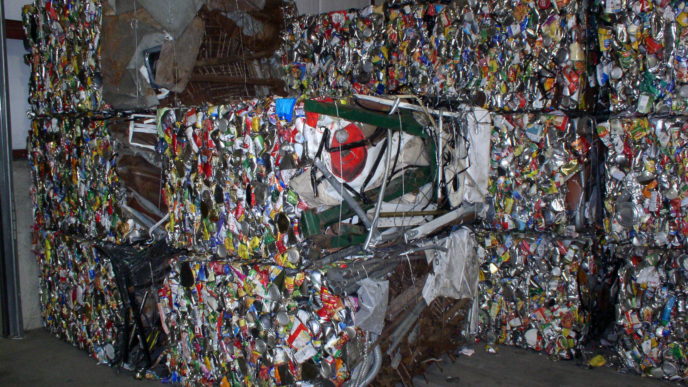
In April, the perils of overcriminalization were on full display when Brian Everidge traveled to Michigan with more than 10,000 bottles and cans, seeking to capitalize on Michigan’s generous 10 cents-per-bottle refund program. He stood to make $1,000.
Everidge was pulled over for speeding and found himself facing a $5,000 fine and up to five years in prison after the state trooper discovered his cargo. As it turned out, transporting more than 10,000 bottles into Michigan with the intent to collect a deposit is a felony.
Besides Michigan, nine other states have bottle deposit laws—California, Connecticut, Hawaii, Iowa, Massachusetts, Maine, New York, Oregon, and Vermont. Though each state law varies slightly from the others, each law operates on the same basic premise: Consumers pay a deposit on specified beverage containers and get reimbursed upon returning the emptied container.
Deposits vary from 5 cents to 15 cents by state and container size. When a person knowingly brings in containers sold outside the state, they are deceiving state officials by seeking the return of a deposit they never paid.
Surprisingly, interstate bottle fraud can be big business. In 2015, California officials uncovered a recycling ring that raked in $14 million from 2012 to 2014 on approximately 250 million containers brought from Arizona to California recycling centers.
The Michigan Treasury Department reported that interstate bottle fraud costs the state $10 to $13 million every year. Michigan state Rep. Kenneth Kurtz, a Republican, said of repeat “scammers who drive car and truck loads of cans from Indiana, Wisconsin, and Ohio,” that “If you are intending to defraud … then you should be held accountable for it.”
Six of the 10 bottle bill states—California, Maine, Massachusetts, Michigan, New York, and Vermont—have codified penalties specifically for cashing in on out-of-state bottles, or attempting to. Only Michigan and California, however, make it a crime.
Michigan’s penalties work on a sliding scale. Attempt to return up to 99 containers, you’ll get off with a civil fine; attempt to return 100 to 9,999 containers, you’re guilty of a misdemeanor; and if you attempt to return 10,000 or more, you’re now a felon and subject to up to five years in prison, a $5,000 fine or both.
Other types of fraud, such as dishonest practices in connection with official records on milk and butter production or failing to label imitation leather boots as such, are misdemeanors—no matter how much butter is produced or how expensive the boots are.
In California, trading in out-of-state recyclable containers is also a felony if the redemption value is more than $400. One truck driver faced criminal charges for smuggling 7,000 pounds of containers worth more than $7,100 in redemptions, with possible jail time of six months to three years.
The United States Supreme Court stated recently, in Bond v. U.S. (2014), that states “have broad authority to enact legislation for the public good—what we have often called a ‘police power.’” It also ruled in Minnesota v. Clover Leaf Creamery (1981) that a state can outright ban the sale of retail goods in a “plastic nonreturnable, nonrefillable container” if it so chooses, respecting the states’ broad discretion to implement environmental policies.
Heritage Foundation scholars have argued, however, that “the most successful environmental policies emanate from liberty.”
Criminal laws and penalties, writes John Malcolm, director of Heritage’s Meese Center for Legal and Judicial Studies, are “meant to enforce a commonly accepted moral code that is set forth in language the average person can readily understand and that clearly identifies the prohibited conduct.”
Administrative schemes like state bottle recycling programs, Malcolm writes, should “establish rules of the road (with penalties attached for violations of those rules) to curb excesses and address consequences in a complex, rapidly evolving, highly industrialized society.”
Maine’s bottle fraud rules exemplify a proper understanding of how law ought to work. Maine imposes civil fines whenever a person attempts to deposit more than 48 containers not sold in the state, with the penalty being the greater of a $100 fine for each container or $25,000 fine for each attempted transaction.
This creates a disincentive for cashing in on out-of-state containers and more than compensates the state for its losses without branding every person who violates the scheme as a criminal.
Moreover, Maine requires all recycling centers to post a sign that clearly defines “bottle fraud” and warns customers of its penalties, so anyone who unlawfully takes advantage of Maine’s incentive structure does so with a full understanding of the consequences.
Heritage scholars have identified ways to address the overcriminalization crisis. Lawmakers must reassess current laws and scrutinize any new laws that use criminal instead of civil penalties, incorporating safeguards to ensure that the criminal code is not a trap for the unwary. Everidge and the many others caught up in cases of overcriminalization deserve better from our justice system. (For more from the author of “Improper Recycling Could Land You in Jail: How Overcriminalization Threatens Everyone” please click HERE)
Follow Joe Miller on Twitter HERE and Facebook HERE.
