Posts

In Alaska, Summer’s Getting Too Hot for the Salmon Run

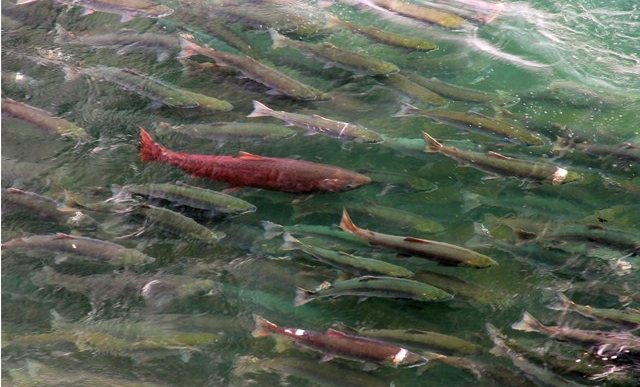
Last summer, across southwest Alaska’s Bristol Bay region—home to the largest sockeye salmon fishery in the world—tens of thousands of fish washed up dead along riverbanks. Rivers running at temperatures above the threshold for salmon health were killing the fish even as record numbers of them were returning from the ocean to reproduce.

On the Ugashik River, a wide, muddy tributary of the bay, salmon schooled near the river’s mouth, hunkered down in the deeper, cooler water, but they refused to swim upstream into the too-warm waterway. Because no salmon were reaching spawning grounds upriver, the state closed commercial fishing on the Ugashik in early July, right at the normal peak of the run.

Unable to wet their nets and unsure when the fishery would reopen, Ugashik fishermen bided their time at seasonal camps, looking on as jumpers pocked the water all day long. “You’re pretty much watching your income go by,” Catie Bursch, a commercial setnetter on the Ugashik, said later. As Bristol Bay fishermen gear up for this year’s salmon season—one beset by fears that Covid-19 could overwhelm this remote region as thousands of seasonal workers from across the world descend on fishing communities with scant medical resources—they must also contend with a slower-moving hazard: the warming temperatures that threaten a $1.5 billion industry and the people it supports. . .

The state stipulates that water temperature must not exceed 59 degrees Fahrenheit in order for salmon to stay healthy during upstream migration. Last summer, however, river temperatures in Bristol Bay reached 76 degrees. That spells problems for the fish: When salmon can’t avoid warm water, they can sicken or die. Warm water adds stress at a time when fish are already tackling the herculean task of returning to headwater lakes and streams to spawn, making them more susceptible to diseases and speeding up their already-taxed metabolisms. Something like a heart attack can follow: Warm water holds less oxygen than cooler water, but at higher temperatures, salmon actually need more oxygen to survive. Under those conditions, their hearts can’t pump blood fast enough to support their brains and bodies. (Read more from “In Alaska, Summer’s Getting Too Hot for the Salmon Run” HERE)

Follow Joe Miller on Twitter HERE and Facebook HERE

Hunters, Fishermen Targeted by Feds for Local Violations

Photo Credit: peteSwede

Photo Credit: peteSwede

U.S. law enforcement agencies are conducting thousands of investigations using a law that makes violating state wildlife statutes a federal crime, often ensnaring hunters and fishermen for seemingly minor infractions.

Some even suffer stiff federal prison sentences.

Special agents and wildlife inspectors for the U.S. Fish and Wildlife Service conduct about 2,500 investigative cases a year of violations of the Lacey Act, a 1900 law meant to combat illegal trafficking of wildlife. Additional probes of Lacey Act violations also are conducted by other federal agencies, as well as state and local governments.

Though a small percentage of the Lacey Act cases result in prison time, a high percentage plead guilty, consistent with a federal system in which 97 percent of cases end in plea deals.

But for those imprisoned, ensnared in costly investigations, or who pleaded guilty to reduced charges, the horrible repercussions can have a devastating impact on their livelihoods.

Read more from this story HERE.

Angler Gets Jail Time for Cheating at Fishing Tournament

Photo Credit: parkrapidsenterprise

Photo Credit: parkrapidsenterprise

A Long Prairie angler long suspected of cheating at fishing tournaments was given seven days in jail Monday for cheating at the Park Rapids American Legion Community Fishing Derby this winter.

Alfred “Tom” Mead, 72, pled guilty to a felony charge of Theft By Swindle May 20, for sneaking a previously caught fish into the tournament Feb. 2. He has two prior gaming convictions and a decade-long trail of suspicion about his tournament winnings.

“Your conduct had a major impact on these things (fishing tournaments),” Judge Robert Tiffany scolded him. “I hope you realize the seriousness of your conduct.”Cheating, the judge said. “takes the enjoyment and joy out of it for those who bring their kids” and honest participants.

Mead is to report to the Hubbard County jail in one week.

He will be on probation for four years, during which he is barred from the Legion Club, was fined $200 and ordered to pay a $75 public defender co-payment.

Read more from this story HERE.

Beaver Bites, Kills Fisherman (+video)

Photo Credit: AP

The horrific injury of a fisherman who died after being bitten by a beaver when trying to take a picture of the animal has been pictured.

The image shows the 60-year-old man’s wounded leg following the incident at Lake Shestakov in Belarus.

The man was attacked as he approached the beaver to take its picture and later bled to death as a result of his injuries

His friends desperately tried to staunch the blood welling up from the wound but the animal’s bite had severed a major artery and his life could not be saved.

The man, from Brest, was pronounced dead when he arrived at Sulim’s clinic in the village of Ostromechevo.

Read more from this story HERE.

Fishermen Found Guilty, Although Court Agrees Subsistence Salmon Fishing is Religious

Photo Credit: Alaska PublicNearly 50 fishermen were cited for illegal salmon fishing last June. Half of them pled not guilty and have been fighting it in court ever since.

In recent weeks, the fishermen had been waiting to hear a decision on whether they have the religious right to subsistence fish, even during state closures.

The trial resumed May 20 in Bethel and the fishermen packed into the courtroom with some people left standing in the hallway. It was a trial by judge and Judge Bruce Ward, in a gentle voice, said the court found that the state’s need to restrict King salmon supersedes the fishermen’s right to religious practice.

“The court wants all parties to know that this was a very difficult decision to make,” Ward said. “This was not easy.”

The fishermen were challenging the state based on a free exercise clause of the Alaska constitution, arguing that subsistence fishing is a religious practice and that when they fished last summer during closures, they were practicing their religion.

Read more from this story HERE.

A fisherman sues the feds for acting like crooks

Photo credit: NOAA

As raw December 1998 swept over the Atlantic off New Bedford, Mass., scallop fisherman Larry Yacubian brought around his boat, Independence, hailed by the Coast Guard. The officers who boarded his fishing vessel didn’t tell Yacubian it was a setup to coerce out of him a ruinous fine and to destroy his life so thoroughly he could never get it back.

Captain Yacubian lost his business, his boat, his license to fish — and literally the farm that had been in the family for generations — trying to exonerate himself of false accusations that he had been fishing in a prohibited area and free himself from a malicious prosecution for lies that he never told. His persecutor? The Commerce Department’s National Oceanic and Atmospheric Administration.

Two weeks ago, Captain Yacubian filed the lawsuit that may well restore his money and his life after nearly 15 years of gut-wrenching bludgeoning by the NOAA.

The Commerce Department’s inspector general reviewed the NOAA’s Asset Forfeiture Fund — where Yacubian’s $430,000 fine went — and found that “these funds were used to purchase ‘luxurious’ undercover vessels, buy 202 vehicles for a staff of 172 enforcement personnel, and take trips around the world.”

A special investigative judge concluded there is “credible evidence that money was NOAA’s motivating objective in this case.” There’s also knowledgeable belief that the NOAA’s purpose is to eradicate the fishing industry.

Read more from this story HERE.