Posts

Scientists Discover Fossil of Massive Rodent-Like Animal Called ‘Crazy Beast’, Creates Even More Confusion for Evolutionists

. . .The remains are the first near-complete fossil of the badger-esque creature named “Adalatherium hui,” or “crazy beast,” that roamed the southern supercontinent of Gondwana 66 million years ago, according to a new study published Wednesday in Nature journal.

Even with the findings, scientists still can’t parse crazy beast’s anatomy and aren’t even sure how the animal walked. The creature is also oddly large for a mammal of its time — about 100 times bigger than the mostly rodent-sized mammals of the Mesozoic era. . .

There are some clues to its behavior. Adalatherium was a plant-eater, with rodent-like teeth to gnaw on roots and other vegetation. It was probably a skilled digger that could have excavated burrows thanks to its powerful hind legs and long claws on its back feet.

But the creature’s gait has baffled researchers. Its smaller front legs were placed beneath its body like other mammals, but its back legs fan out more akin to a reptile, meaning it likely sauntered like a lizard with its spine swaying side to side. (Read more from “Scientists Discover Fossil of Massive Rodent-Like Animal Called ‘Crazy Beast’” HERE)

Follow Joe Miller on Twitter HERE and Facebook HERE
Smallest Dinosaur Found Trapped in Amber (VIDEO)

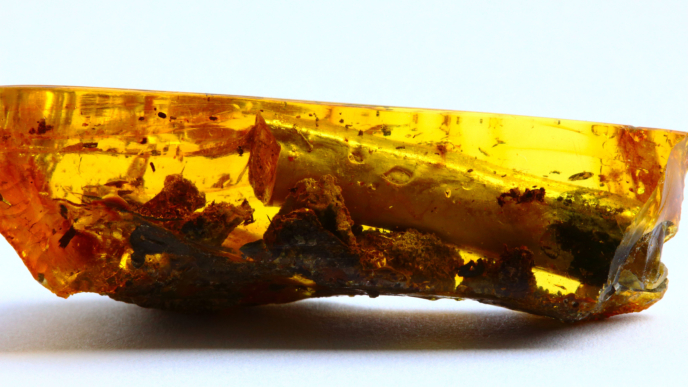
The bird-like skull of a tiny new species of dinosaur has been discovered trapped in amber at an archaeological site in northern Myanmar. Scientists say the fossil find represents the smallest dinosaur from the Mesozoic era to date and its diminutive size makes it smaller than the smallest living bird found on Earth today.

“When I first saw this specimen it just blew my mind,” Jingmai O’Connor, a paleontologist with the Chinese Academy of Sciences and co-author on the paper, said in a Nature video. “I had literally never seen anything like this.”

The skull is estimated to be nearly 100 million years old, according to details of the remarkable find published Wednesday in the journal Nature. The find measures just over 15 millimeters in length, around the same size as the diameter of a US penny. Analysis of the skeletal features suggest the tiny creature was mature, had really big eyes and a lot of tiny teeth. For that reason, the new species has been given the scientific name of “Oculudentavis khaungraae” with the generic name “Oculudentavis” derived from the Latin for “eye-teeth-bird”. Its species name relates to the person responsible for donating the specimen.

To study the skull, the team ran the amber specimen through a specialized scanner that can determine features down to millimeter scales and generate a 3D reconstruction of the skull. Using the reconstruction allowed the team to infer how Oculudentavis may have lived and its eating habits. The reinforced skull also suggests it may have had a stronger bite than similar size species and likely fed on small insects. (Read more from “Smallest Dinosaur Found Trapped in Amber” HERE)

Follow Joe Miller on Twitter HERE and Facebook HERE