Posts

Why Washington Hates Trump’s Budget

The Trump administration is getting pushback on its 2018 federal budget, and it’s coming from elected officials on both sides of the aisle.

Why does Washington find the budget plan so distasteful? As our video explains, maybe it’s because President Donald Trump’s budget focuses more on what’s good for taxpayers as opposed to what’s good for special interests and the federal bureaucracy.

(For more from the author of “Why Washington Hates Trump’s Budget” please click HERE)

Follow Joe Miller on Twitter HERE and Facebook HERE.

Key Takeaways From CBO Score of the Republican Health Care Bill

The Congressional Budget Office updated its score of the House-passed American Health Care Act this week, prior to its being sent over to the Senate.

This budgetary analysis projects that if passed into law, the bill would reduce the number of insured by 23 million, but would decrease the deficit by $119 billion while also reducing federal outlays by $1.1 trillion and federal revenue by $992 billion.

While the score is roughly similar to the score from the original version of the bill released on March 23, several modifications to the law occurred since then and were not reflected in earlier estimates.

The new CBO score addresses the effect of allowing states to waive the Affordable Care Act essential health benefit and community rating requirements on premiums in particular.

Effects on Coverage and Premiums

First, the CBO finds that 2 million fewer people in 2020 and about 1 million fewer in 2026 would become uninsured under the American Health Care Act.

It cites that this is due to “4 million more people with employment-based coverage, as employers in states making changes to market regulations would probably view the insurance products in the nongroup market as less desirable alternatives and decide to offer insurance to their employees, and 3 million fewer people with nongroup coverage, as some would enroll in employment-based coverage, and others would become uninsured.”

This is an interesting way to frame the effects of the bill, since reducing premium levels by rolling back regulations could actually have the effect of making plans more desirable for individuals looking to pay less.

The CBO lacks any real discussion of these positive effects.

As for premiums, the CBO finds the effects the same as previously estimated for roughly half the population, or for the people residing in states that did not pursue any waiver.

However, for the other half of the population, the CBO attempts to estimate the effects of different combinations of waiver decisions. It estimates that one-third of the population would be in states that make some changes to market regulations.

For these states, the CBO finds premiums to be 20 percent lower than under current law by 2026.

It also expects that these lower premiums would lead to more people having insurance, but fewer in the nongroup market—although “lower premiums could attract more enrollees to the nongroup market.”

About one-sixth of the population would reside in states that would substantially alter essential health benefits and waive community rating rules. For this population, the CBO projects “significantly lower premiums for those with low expected health care costs.”

However, it caveats that there is an issue of drastically raising premiums on higher-cost and older individuals in the market.

Ultimately, the CBO’s treatment of these effects could be more deeply analyzed. Most importantly, its methodology is relatively opaque, and ultimately includes an internal disagreement around whether or not lowering premiums leads to increased take-up in insurance coverage.

Regardless of these internal issues, the CBO still projects meaningful premium reductions by 2026 under the American Health Care Act, especially with moderate regulatory reforms.

Medicaid and State Exchanges

The largest projected savings in the bill come from reforms in Medicaid, along with the elimination of the Affordable Care Act’s subsidies in the individual market. The CBO’s score on Medicaid still reflects that it assumes more states would likely have expanded in the future under the Affordable Care Act.

Thus, its projection that 14 million fewer people would be insured due to not having Medicaid under the American Health Care Act might be overstated in all of its scores of the legislation.

Of that 14 million, 4 million will choose to be uninsured in 2018, which suggests the CBO’s methodology with regard to the effect of the individual mandate is unchanged from its original score of Obamacare.

In Medicaid, the CBO projects that these changes result in $834 billion savings from 2017-2026. There is little difference here between the past scores and the current.

Similar optimism from the CBO remains for the Affordable Care Act on the exchange side, as it is important to remember this number would be against a baseline that assumes the Affordable Care Act will enroll 7 to 8 million more people in the individual market, when in reality it does not appear this will be the case, as Avik Roy pointed out in response to the first score.

Nonetheless, savings from elimination of the Affordable Care Act’s subsidies is projected to amount to $665 billion in savings.

Key Takeaways

The CBO’s new score of the American Health Care Act has not changed much from the previous iteration besides incorporating views about how the states will respond to the available waivers, and incorporating the increased spending also included in the manager’s amendments.

While there might be disagreements about the coverage effects of state waivers, it is clear that there are meaningful premium reductions from allowing states to pursue them.

Given this, the CBO has still done nothing to address the inherent uncertainty involved in scoring large, complex pieces of health legislation by hiding large considerations behind opaque methodologies.

It also has still failed to walk back its overly optimistic views on the power of the individual mandate or the performance of Obamacare moving forward. (For more from the author of “Key Takeaways From CBO Score of the Republican Health Care Bill” please click HERE)

Follow Joe Miller on Twitter HERE and Facebook HERE.

Here Are the Challenges Facing the Senate After House Passes Obamacare Replacement Bill

Republicans cleared a major hurdle on Wednesday in advancing their proposal repealing and replacing Obamacare. But the House GOP’s health care bill is likely to see major changes in the Senate, where Republicans must contend with strict budget rules and slim margins to pass the legislation.

The House passed the American Health Care Act by a vote of 217-213 Thursday afternoon, capping weeks of negotiations that sought to satisfy conservative and centrist Republicans.

The bill repeals a number of Obamacare’s major provisions, including the individual and employer mandates, and replaces the law’s tax credits with age-based, refundable tax credits.

House leaders and the White House worked for weeks to get the health care bill through the lower chamber after conservatives and centrist Republicans came out against the original proposal.

The legislation that passed Thursday included amendments to address the concerns of both factions of the Republican party.

But though the health care plan was narrowly approved by the House, the bill could undergo a major makeover in the Senate.

There, a 12-member group of senators is drafting the Senate’s own proposal repealing and replacing Obamacare, which will include parts of the plan that passed the House.

“The safest thing to say is there will be a Senate bill, but it will look at what the House has done and see how much of that we can incorporate in a product that works for us in reconciliation,” Sen. Roy Blunt, R-Mo., said.

Republicans are using a budget tool called reconciliation to fast-track their Obamacare replacement plan through the Senate, where it will need 51 votes to pass.

Republicans hold 52 seats.

Margins for Senate Majority Leader Mitch McConnell are slim, and already, several GOP senators have been skeptical of the House’s Obamacare repeal plan.

Sen. Susan Collins, R-Maine, criticized the bill in March and opposes efforts to defund Planned Parenthood. The legislation strips the organization of its federal funding for one year.

Additionally, four other Republican senators—Rob Portman of Ohio, Cory Gardner of Colorado, Lisa Murkowski of Alaska, and Shelley Moore Capito of West Virginia—expressed concerns about the bill’s plan for phasing out Obamacare’s Medicaid expansion in March.

Portman reaffirmed his opposition to the legislation Thursday.

“I’ve already made clear that I don’t support the House bill as currently constructed because I continue to have concerns that this bill does not do enough to protect Ohio’s Medicaid expansion population, especially those who are receiving treatment for heroin and prescription drug abuse,” the Ohio Republican said in a statement.

Conservatives, too, have their own concerns with the House’s Obamacare repeal plan.

Sen. Ted Cruz, R-Texas, emboldened his colleagues to “continue to improve the bill.”

“For many weeks, I have been working closely with my Senate colleagues, from across the ideological spectrum, on consensus reforms to make health insurance more affordable,” Sen. Ted Cruz, R-Texas, said in a statement. “We must deliver on that promise.

Conservative members of the Freedom Caucus are holding out hope that the upper chamber repeals more of Obamacare.

“Let’s be honest, when we sent an Obamacare repeal legislation to the Senate, it got better because we had folks like Mike Lee and Sen. [Ted] Cruz and Sen. [Marco] Rubio and Sen. [Rand] Paul and all these conservative senators who pushed the so-called reconciliation rules, who pushed the envelope and made it a slightly better piece of legislation,” Rep. Jim Jordan, R-Ohio, told The Daily Signal. “So we’re hoping that’ll happen again.”

In addition to addressing the concerns of Senate Republicans, GOP senators crafting their own bill must adhere to strict rules that govern the reconciliation process. Those rules ensure the tool is used only on bills that change taxes, spending, or the deficit.

Senators can challenge a provision of legislation by raising a point of order against “extraneous matter” included in the bill if he or she believes it violates the Byrd rule, named for the long-serving Democratic senator from West Virginia, Robert Byrd.

The Byrd rule outlines six tests to determine what constitutes “extraneous matter,” and some tests hold more weight than others.

If a senator objects to a part of a reconciliation bill, the Senate parliamentarian advises members on whether it meets the requirements or not. If the parliamentarian says a provision violates the Byrd rule, it may be removed from the bill, or it may be deemed fatal to the legislation.

House Speaker Paul Ryan said the House GOP’s health care bill was crafted to adhere to the rules of reconciliation.

But health policy experts warn that some provisions of that legislation could pose problems for Republicans in the Senate.

“I think the bill is ultimately going to have to be significantly rewritten to answer some of those concerns and hopefully takes it more toward something approaching an actual repeal of Obamacare,” Chris Jacobs, a senior health care policy expert at the Texas Public Policy Foundation and founder of Juniper Research Group, told The Daily Signal.

Jacobs has previously warned about pro-life protections included in the tax credits, which prevent the use of federal dollars to pay for most abortions, and the Senate parliamentarian has ruled in the past that those pro-life provisions violate the Byrd rule.

“There’s past precedent to suggest that this is ultimately a policy change and may not be permitted under the Byrd rule,” he said. “A policy change with an incidental budgetary impact. Therefore, it’s essentially not permitted under the Byrd rule.”

But removing the pro-life provisions for the tax credits could pose further problems for Republicans in both chambers.

“It raises the entire question of whether or not the tax credits remain politically viable because it will be taxpayer funding for plans to cover abortion, just like Obamacare,” Jacobs said.

Jacobs and other experts raised concerns about the fate of the House GOP’s original bill in the Senate several weeks ago. But since then, Republican leaders have added several amendments to the legislation, including one that allows states to pursue waivers to opt out of some Obamacare regulations and another that allocates money to states to set up programs to protect people with pre-existing conditions.

The Senate parliamentarian hasn’t yet ruled whether those amendments will pass muster in the upper chamber, but Jacobs said an analysis from the Congressional Budget Office would’ve provided some clarity.

Reconciliation bills can’t increase the deficit, and Jacobs said a “score” from the nonpartisan agency will detail the provision’s fiscal impact.

The House voted without an analysis from the Congressional Budget Office, which estimates how many people will lose or gain coverage and what the costs of the bill will be.

Though it’s unclear whether the waiver scheme created by the House GOP’s bill will withstand what’s called a “Byrd bath,” Jacobs said it would’ve been better for Republicans to repeal the regulations outright.

“I think a better solution is to repeal the regulations rather than having this waiver option of if you like your Obamacare, you can keep it,” he said. (For more from the author of “Here Are the Challenges Facing the Senate After House Passes Obamacare Replacement Bill” please click HERE)

Follow Joe Miller on Twitter HERE and Facebook HERE.

What You Need to Know About the Obamacare Subsidies at the Center of the Health Care Debate

While Republicans and Democrats negotiated a government spending bill this week, another form of financial assistance that aims to help low-income Americans under Obamacare has been at the center of a debate involving insurance companies, consumers, and President Donald Trump.

These subsidies aren’t the tax credits implemented under the health care law, which lower the cost of premiums for eligible consumers, but are called cost-sharing reductions.

They’ve been the subject of much scrutiny lately, and a source of concern for insurance companies, congressional Democrats, doctors, hospitals, and the U.S. Chamber of Commerce.

So what are the cost-sharing reductions, how do they work, and why have they been thrust to the center of debate?

What Are the Cost-Sharing Reductions?

The cost-sharing reductions are subsidies designed to reduce out-of-pocket costs for low-income patients who purchase silver-level plans through Obamacare’s exchanges. The subsidies are only available to marketplace customers with an income between 100 percent and 250 percent of the federal poverty line ($12,000 to $30,000 for an individual).

In 2017, 7 million people—58 percent of marketplace enrollees—qualified for cost-sharing reductions, according to the Department of Health and Human Services.

How Do the Cost-Sharing Reductions Work?

While Obamacare’s tax credits and cost-sharing reductions are both intended to help lower the cost of coverage for low-income Americans, both serve different functions.

The tax credits are paid directly to consumers and lower the cost of premiums. But the government pays cost-sharing reductions directly to insurers.

Insurance companies then offer plans with reduced deductibles, copayments, and out-of-pocket limits to eligible patients.

In 2016, the government reimbursed insurers roughly $7 billion for cost-sharing reductions.

Why Are They in the News?

The cost-sharing reductions were the subject of much scrutiny in 2014, and now they’re back in the news again.

In 2014, the Republican-led House of Representatives filed a lawsuit against the Department of Health and Human Services, then led by Secretary Sylvia Mathews Burwell, over the subsidies.

Republican lawmakers argued that the Obama administration made payments to insurers without an appropriation from Congress, which they said was unconstitutional. But the Obama administration said it intended for lawmakers to fund the cost-sharing reductions alongside Obamacare’s tax credits.

In 2016, a federal district court judge in the District of Columbia sided with House Republicans and ruled that because Congress never appropriated money for the cost-sharing reductions, the Obama administration violated the Constitution.

President Barack Obama’s Department of Justice quickly appealed, and the judge’s order has been halted since then.

Now, the Trump administration has to decide whether it will continue the Obama administration’s fight, and the next court date is scheduled for May 22.

What Does the Trump Administration Want to Do?

At this stage, no one is entirely sure what Trump and his officials plan to do about the cost-sharing reductions.

Both the White House and the Department of Health and Human Services, now led by Secretary Tom Price, have sent mixed signals on whether they intend to continue funding the subsidies.

In a statement to The New York Times last month, the Department of Health and Human Services said the agency would continue to make payments to insurance companies.

But Trump floated the idea of using the cost-sharing reductions as leverage to bring Democrats to the negotiating table over a bill replacing Obamacare.

“Obamacare is dead next month if it doesn’t get that money,” Trump said of the subsidies in an interview with The Wall Street Journal last month. “I haven’t made my viewpoint clear yet. I don’t want people to get hurt … What I think should happen and will is the Democrats will start calling me and negotiating.”

Even more recently, though, White House budget director Mick Mulvaney told reporters Tuesday the administration hadn’t yet decided whether it will make cost-sharing reduction payments for May.

What Options Does Trump Have?

The Trump administration could drop the Obama administration’s lawsuit, and the Department of Health and Human Services would stop making payments to insurers.

But if the White House decided to continue funding the subsidies, it could move forward with the lawsuit that originated with the Obama administration.

Trump could also urge Congress to appropriate the money in future appropriations bills.

Democrats pushed the president and congressional Republicans to allocate money for cost-sharing reductions in a stopgap government spending bill that passed Congress this week. But money for the subsidies was ultimately left out of the legislation.

That spending bill keeps the government running until September.

While it remains unclear how the Trump administration wants to proceed—and whether Congress will appropriate money for cost-sharing reductions—the subsidies could be eliminated entirely.

The House GOP’s health care bill, called the American Health Care Act, gets rid of cost-sharing reductions.

What Happens If the Cost-Sharing Reductions Stop?

If the Trump administration decided to halt subsidies, insurance companies would lose the money they’re reimbursed for offering reduced deductibles, copays, and out-of-pocket limits to consumers.

To compensate for the lost money, insurers could raise premiums for all of their customers. The Kaiser Family Foundation estimates that if that were to happen, health insurance premiums would increase an average of 19 percent.

Insurance companies could also decide to leave the marketplace by canceling contracts with state and federal regulators, and end coverage for consumers mid-year, according to the Commonwealth Fund.

However, the Commonwealth Fund said leaving the marketplace would be complicated.

Where Do Republicans and Democrats Stand?

For Democrats, the answer to the question on what to do with the cost-sharing reductions is easy: They want Congress to appropriate the money to fund the subsidies.

They’re joined by a coalition of insurance companies, physicians, hospitals, and the U.S. Chamber of Commerce, which collectively sent a letter to congressional leaders last month urging them to fund the cost-sharing reductions.

Though the Republican-led Congress didn’t appropriate money for the subsidies in this week’s spending bill, top GOP lawmakers are also in favor of continuing the cost-sharing reductions.

Rep. Tom Cole, R-Okla., told The New York Times he believes Congress should provide the money to fund the subsidies.

He was joined by House Energy and Commerce Chairman Greg Walden, R-Ore., who said lawmakers had an obligation to insurers and consumers to make sure the government’s payments to insurance companies were made.

“We cannot leave them high and dry,” he told The New York Times. (For more from the author of “What You Need to Know About the Obamacare Subsidies at the Center of the Health Care Debate” please click HERE)

Follow Joe Miller on Twitter HERE and Facebook HERE.

In Alaska, Anxiety Grows as Debate over Health Care Rages

Going without health insurance is a risk. Going without it in Alaska can be a gamble of a much higher order, for this is a place unlike anywhere else in the U.S., a land of pitiless cold, vast expanses and dangerous, back-breaking work such as pulling fishing nets from the water or hauling animal carcasses out of the woods.

And yet many people on the Last Frontier do not carry insurance. For them, the Affordable Care Act just isn’t working.

For reasons that have a lot to do with its sheer size, sparse population and harsh environment, Alaska has some of the highest health care costs in the nation; the most expensive insurance premiums, according to one key measure; and just one insurer in the whole state writing individual policies. (Read more from “In Alaska, Anxiety Grows as Debate over Health Care Rages” HERE)

Follow Joe Miller on Twitter HERE and Facebook HERE.

It’s Official: The Post-RINOcare War on Conservatives Has Begun

Seven years of campaign promises to repeal Obamacare were broken when the Republican Party rolled out the American Health Care Act. But somehow, the Freedom Caucus is now taking the brunt of the abuse for the bill’s failure to launch.

Everyone but House leadership seemed to recognize the bill was bad. The chief complaint of conservatives in the House Freedom Caucus was the bill’s failure to repeal mandated essential health benefits – those insurance regulations responsible for increasing premiums and high deductibles. Still, moderates thought the bill went too far and sought to protect Medicaid expansion in their states. Voters across the political spectrum were unhappy, with the AHCA polling at only 17 percent public approval.

When those concerns were brought to the president from the Freedom Caucus, he reportedly told them to “forget about the little shit.” What the president failed to understand was that the “little shit” would break this bill. House Conservatives were on the cusp of supporting the legislation if Speaker Paul Ryan and leadership agreed to repeal the fundamental insurance regulation problems. Moderates in the party balked at that proposition and the Speaker Ryan pulled the bill Friday.

Now the spin has begun. Rep. Austin Scott, R-Ga., declared it was Freedom Caucus Chairman Rep. Mark Meadows, R-N.C., who “betrayed” the American people.

The media has latched on to that narrative. The Wall Street Journal lambasted the Freedom Caucus as “the Obamacare Republicans.” Politico published a hit piece over the weekend detailing insider frustrations with the “far-right” members who sunk the bill, insisting that if fulfill seven years of campaign promises.

Rep. Adam Kinzinger, R-Ill., is running around insisting that the Freedom Caucus just saved Obamacare, and pledging to work with Democrats to overcome conservative opposition to future legislation.

Rep. Rodney Frelinghuysen, R-N.J., is one of the moderates, with a 29 percent Liberty Score©. He is the chairman of the powerful House Appropriations Committee, and the news that he wouldn’t support the bill opened the floodgates to more moderate defections.

According to one report, Speaker Ryan was pleading on one knee with Rep. Don Young of Alaska for support on the bill. Young, with an “F” Liberty Score©, is hardly one of the conservative “purists” who supposedly defeated this bill. Yet Paul Ryan was begging for his support? If it was the moderates who were pulling out on the GOP health care plan, how is it the conservatives’ fault it all fell apart?

Regardless, on Sunday morning, the president chose a side.

On Friday, President Trump blamed the Democrats for Obamacare’s failures. In the same remarks, he said he would be “totally open” to working with Democrats after Obamacare “explodes.”

Really, the whole of the weekend’s news can be summed up in one succinct Ben Shapiro tweet.

As the Republican Party moves on to tax reform, conservatives should be prepared to be boxed out of negotiations, again. (For more from the author of “3 Questions Ryan Needs to Answer Before Running to the LEFT on RINOcare” please click HERE)

Follow Joe Miller on Twitter HERE and Facebook HERE.

Don’t Follow That Shiny Object! RINOcare Defunds Planned Parenthood but … Not Really

Call it Obamacare-lite, RINOCare, Repeal in Name Only, Ryancare, or Trumpcare … the new health care plan looks like a stinker right out of the gate. Nonetheless, it stands to gain at least a modicum of public support for one of its most precarious proposals.

While language defunding America’s largest abortion provider and infamous peddler of baby body parts is one of the few redeeming portions of the new “replacement” bill, it’s little more than a shiny object and fig leaf for the GOP leadership’s latest legislative dumpster fire.

At the sight of the language, the abortion lobby’s water carriers went to work almost immediately panning the provision.

Due to the naturally Manichean nature of the politics of killing the unborn, responses like these are sure to illicit at least the desire to celebrate Obamacare-lite from the “not forcing people to subsidize baby murder” front. Pro-lifers, however, should be careful not to get played like they were the last time Republican leadership promised a defund provision … or the time before that.

First off, it’s highly unlikely that the defund provision will make it past the parliamentarian on the Byrd Rule (which keeps regulations out of funding measures). So unless leadership is willing to swap out parliamentarians (it won’t be), it won’t clear the first hurdle.

Even in the unlikely event that the defunding provision makes it to the Senate, it probably won’t survive scrutiny in the upper chamber, which will be far more hostile to the measure.

Saying that this bill “at least” defunds Planned Parenthood is like saying that there’s “at least” no gun control; that ought to be a baseline[AK1] . There’s no reason that abortion providers should continue to receive public funds when Republicans were handed both houses of Congress and the Oval Office running on an overwhelmingly conservative platform.

Defunding Planned Parenthood was a major GOP promise during the 2016 campaign, and one they should follow through on (come hell or high water).

What it shouldn’t be, however, is political cover for abject FAILURE to follow through on another vital campaign promise, by foisting Obamacare-lite on the American people. (For more from the author of “Don’t Follow That Shiny Object! RINOcare Defunds Planned Parenthood but … Not Really” please click HERE)

Follow Joe Miller on Twitter HERE and Facebook HERE.
After Paul Ryan Admits Obamacare Plan Needs Changes, Conservatives Hope to Strike Deal Uniting Party

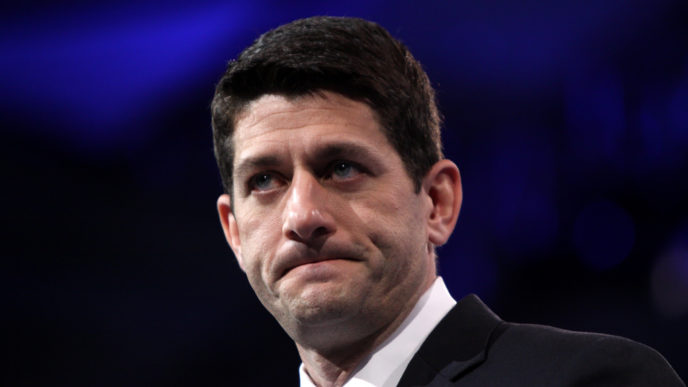
Conservatives in the House are proceeding with cautious optimism as they continue negotiating the bill that repeals and replaces Obamacare following an admission from House Speaker Paul Ryan that the legislation needs to undergo necessary “improvements and refinements.”

The concession from Ryan comes just a week after the Wisconsin Republican told his fellow Republicans the bill, called the American Health Care Act, was the “closest we’ll ever get to repealing and replacing Obamacare.”

But following the release of a report from the Congressional Budget Office that predicted premiums would initially rise under the proposal and 14 more million people would be without insurance next year, conservatives say they believe the door is now open for them to unite the conservative and moderate wings of the conference.

“We don’t want to completely ignore moderate members of the House,” Rep. Raúl Labrador, R-Idaho, told reporters Thursday at a monthly Capitol Hill gathering. “That would be bad negotiating.”

“The final product has to be representative of every member of Congress,” he continued.

Labrador and members of the House Freedom Caucus are drafting an amendment to the House GOP’s Obamacare replacement plan they say is designed to “find reasonable middle ground.”

The conservative lawmakers wouldn’t share the details of the plan, which will be presented to Republican leadership and members of the House Rules Committee next week.

But Rep. Jim Jordan, R-Ohio, said their amendment would be “consistent with the promise to the American people.”

“We’re focused on repealing Obamacare and bringing down the cost of premiums,” he said. “And that’s what our amendment is designed to reflect.”

Members of the Freedom Caucus have frequently criticized the insurance regulations and mandates implemented under Obamacare for raising the cost of premiums, and have called on GOP leaders to repeal those provisions.

The conservative lawmakers say they are vehemently opposed to the proposal rolled out by House leaders last week.

“The problem with this bill is that everything is wrong with it,” Labrador said Thursday.

But conservatives aren’t willing to abandon Ryan yet, and are instead saying they hope that the House speaker and the chamber’s right flank can begin negotiations.

“The rollout and the way it was rolled out was not indicative of an open process,” Freedom Caucus Chairman Mark Meadows, R-N.C., said of the Obamacare replacement plan. “Is it an indictment on his speakership? No, I don’t see that. I think we’re going to move on and end up finding a way to get this done.”

Since the House GOP revealed its long-awaited plan to repeal and replace Obamacare last week, Ryan has been fielding complaints from all sides of the House Republican conference.

Conservatives are concerned the bill will cause health insurance premiums to rise, and their fears were compounded by the CBO’s analysis of the legislation.

The nonpartisan agency, which works for Congress, estimated that under the Obamacare replacement plan, premiums would increase by 15 percent to 20 percent over the next two years before dropping 10 percent by 2026.

More liberal Republicans, meanwhile, say they want to ensure those newly enrolled in the Medicaid expansion are able to retain their coverage. Those lawmakers oppose any efforts to repeal the Medicaid expansion before 2020, a change conservatives have advocated.

The opposition from both wings has left Ryan trying to strike a delicate balance.

The speaker needs 216 votes—there are currently five vacant seats in the House—for the Obamacare replacement plan to pass. Republicans control 237 seats, and opposition from 22 GOP lawmakers would sink the bill in the lower chamber.

Initially, Ryan stressed the GOP’s proposal was a “binary choice.”

But after a closed-door meeting with his fellow Republican lawmakers Wednesday, Ryan conceded that the bill needed to be changed for it to pass the House and attributed the strategy shift to the CBO’s report.

“Now that we have our score … we can make some necessary improvements and refinements to the bill,” Ryan told reporters.

For conservatives, who have been meeting with President Donald Trump and administration officials frequently, the change of heart from the speaker was “welcome news.”

“I welcome the fact that Speaker Ryan is now talking about the fact that we’re going to actually negotiate in good faith, to come up with something that serves the American people,” Meadows said Wednesday night. (For more from the author of “After Paul Ryan Admits Obamacare Plan Needs Changes, Conservatives Hope to Strike Deal Uniting Party” please click HERE)

Follow Joe Miller on Twitter HERE and Facebook HERE.

Will the Establishment Reps Abandoning RINOcare Spell Its Defeat?

Is RINOcare DOA? It sure looks like it.

House Republican leadership has been putting the squeeze on conservative members to toe the party line on health care reform. Speaker Paul Ryan has characterized support for the current legislation as a “binary choice” between repealing Obamacare or keeping the law forever.

“This is the closest we will ever get to repealing and replacing Obamacare,” he said. “It really comes down to a binary choice.”

Well, after the Congressional Budget Office released its report on the American Health Care Act (AHCA), now it’s the moderates and progressive Republicans who are threatening to kill the bill.

Rep. Ileana Ros-Lehtinen (R-Fla.) declared Tuesday she would vote “No” on the AHCA, based on the liberal “uninsured” argument.

Rep. Leonard Lance (R-N.J.) said he believes the bill will likely fail in the Senate, which gives him an excuse not to vote for it in the House. “I do not want to vote on a bill that has no chance of passing over in the Senate,” Lance said this week. “The CBO score has modified the dynamics.” And then there’s Rep. Charlie Dent (R-Penn.), who blamed conservatives for pushing RINOcare too far to the right by demanding a rollback of Medicaid expansion.

Over on the Senate side, Bill Cassidy (R-La.) is accusing President Trump of breaking his promise on health care reform. Not because the Republican plan does not fully repeal Obamacare, but rather because the recent CBO estimate that 24 million will lose their insurance by 2026 under the American Health Care Act. “That’s not what President Trump promised,” Cassidy told CNN. “That’s not what Republicans ran on.”

The Republican Party needs 51 votes in the Senate to send the reconciliation repeal bill to President Trump’s desk. If three Republicans defect, the bill dies. Senators Tom Cotton (R-Ark.), Rand Paul (R-Ky.), and Mike Lee (R-Utah) oppose the bill because they believe it does not go far enough to repeal Obamacare’s treacherous policies. Vice President Mike Pence told Conservative Review Editor-in-Chief Mark Levin Tuesday that conservative amendments were expected to be added to the legislation to make it more palatable.

But when you consider how Republican moderates think the bill already goes too far, things look bleak for the American Health Care Act in the U.S. Senate.

What is the GOP to do? Sen. Lindsey Graham (R-S.C.) suggests that if the party can’t come to a consensus, they should leave Obamacare alone, to implode all its own.

President Trump has also floated this idea. “Let it be a disaster,” Trump told state governors recently, explaining his Plan B in the health care fight. “[B]ecause we can blame that on the Dems that are in our room, and we can blame that on the Democrats and President Obama.”

Trump can certainly blame Obama and the Democrats for the collapse of the health insurance market. But those criticisms won’t be as effectual as he believes, because the Democrats are out of power. Republicans hold Congress and the White House now; voters expect them to act. They want promises of full repeal delivered on. RINOcare does not keep Republican promises.

The GOP is well and truly caught between a rock and a hard place. If they make the bill more conservative with amendments, more progressive Republicans will bolt. If they water down the bill further, conservatives won’t vote for it.

If Republicans want to save face, they should take the Freedom Caucus’ lead — take up and vote on the 2015 full repeal bill that every Republican previously voted for. Senator Mike Lee made such a case at The Daily Signal this week, noting the 2015 bill has already cleared the “Byrd rule” hurdle. So, if Republicans were actually serious about repealing Obamacare in 2015, this bill should fly through Congress straight to President Trump’s desk now.

That is, if Republicans were actually serious about repealing Obamacare. (For more from the author of “Will the Establishment Reps Abandoning RINOcare Spell Its Defeat?” please click HERE)

Follow Joe Miller on Twitter HERE and Facebook HERE.
Mark Levin: There Is Something Horribly Immoral About RINOcare

Thursday on the radio, Conservative Review Editor-in-Chief Mark Levin gave the rundown on the press conference of Speaker Paul Ryan, R-Wisc. (F, 51%), in which Ryan tried to give the hard sell to Americans on the Republican American Health Care Act “reform” plan.

Levin called Ryan’s proposal “repeal in name only.” Or, if you will, “RINOcare,” because the GOP plan keeps the core of Obamacare in place.

Listen:

Levin had a “number of questions” for the speaker, questions that so far remain unanswered.

“Now, here’s my question Mr. Ryan,” Levin said. “How much will the average American’s deduction go up, or down?”

Further, Levin asked, how much will the federal government be spending on subsidies for certain individuals? Will individuals be able to see the doctors they want? The specialists they need? Will individuals be able to go to the hospital of their choice? Will they be able to get the medicines they need to get?

At the end of the day, the problem with RINOcare, Levin explained, is it embraces the Left’s assumption that government involvement is needed to make health insurance affordable. It embraces progressivism; it embraces centralization.

“Republicans have blown it,” Levin said. “There is something horribly immoral about RINOcare.” (For more from the author of “Mark Levin: There Is Something Horribly Immoral About RINOcare” please click HERE)

Follow Joe Miller on Twitter HERE and Facebook HERE.