Posts

Homeless Web Developer Made Sign Asking for Job, Not Handouts, and the Results Were Fantastic

. . .After sleeping on a park bench in Mountain View, California, [David] Casarez decided to wear his best shirt and tie Friday morning and begin begging — for a job.

He put together a stack of resumes and made a sign that read: “HOMELESS. HUNGRY 4 SUCCESS. TAKE A RESUME.” . . .

A passing driver, Jasmine Scofield, stopped and asked Casarez if she could take his photo and post it on Twitter. . .

“Google reached out to me,” Casarez, 26, told the New York Post. “So many other companies. Pandora. A bunch of startups.”

“A product manager from Bitcoin.com was wondering if I could work remotely of if I want to relocate to Tokyo,” he added. “But tonight, I’ll be back on my bench in Rengstorff Park.” (Read more from “Homeless Web Developer Made Sign Asking for Job, Not Handouts, and the Results Were Fantastic” HERE)

Follow Joe Miller on Twitter HERE and Facebook HERE.

Cops Find Family Sleeping in Car, Get Them New Car, Home

By News Miami 7. A homeless family of six living out of their car has been given a new chance at life with a temporary home.

The Opa-locka Police Department pitched in along with members of the community to help provide the family with a new home. . .

The family recently moved to South Florida from Philadelphia and fell on hard times. . .

A Chrysler 200 was gifted to the family after concerns about the safety with their old vehicle. . .

The family can stay rent free at their new home until July 1. (Read more from “Cops Find Family Sleeping in Car, Get Them New Car, Home” HERE)

__________________________________________________

Phoenix Officers Step in to Help Homeless Man Get off the Streets

By ABC 15. A pair of police officers stepped in to help a homeless man who had been down on his luck after a chance encounter in central Phoenix.

Back in November 2017, Billy Walston was standing under the I-17 overpass bridge on Central Avenue. . .

He was roadside, begging for a buck when two Phoenix officers pulled up. . .

Officer Gallegos and his partner, Officer Benjamin Zamora, then made Walston a promise. . .

Through a program called Phoenix Cares and the Phoenix Rescue Mission, they got Walston a place to stay. (Read more from “Phoenix Officers Step in to Help Homeless Man Get off the Streets” HERE)

Follow Joe Miller on Twitter HERE and Facebook HERE.

Everything Wrong With Toxic Charity and Welfare Statism in a Single Perfect Quote

Should helping the poor merely make poverty more comfortable, or should it actually help people get out of it? A recent debate over how best to deal with California’s growing homeless problem offers some insight into the old question.

This lengthy story from the Associated Press details how forms of charity for California’s exploding homeless problem are fomenting concerns that the “charity” given helps people remain homeless more than it helps them improve their circumstances. It begins with a lawyer and activist being denied permission to install toilets on the site of a 400-person homeless encampment in an Orange County riverbed.

While he calls the matter “a question of basic empathy,” others are concerned that this particular brand of charity is doing more harm than good for the Golden State’s homeless population.

One local resident, 46-year-old Shaun Dove, a policeman from Anaheim nearing retirement, put it best:

“If the ultimate goal is to get them under a roof, why on Earth are you giving all the advantages you would have under a roof on the riverbed? … There’s no doubt that giving them stuff there prevents them from a desire to move.”

Mr. Dove puts the issue in a nutshell: Helping the poor is actually supposed to help them out of poverty, not just make long-term poverty more comfortable.

This is nothing new. I saw the same kinds of problems while spending a summer during college studying international development in east Africa.

If you talk to anyone who has been in the field of international development, they too rail against forms of toxic charity administered with the same do-gooder mentality that does everything to create dependence and apathy in the populations it seeks to help. A quick search of any academic database on the subject turns up paper after paper featuring case studies of what works to create sustainable growth in the developing world and what only works to create a never-ending stream of short-term do-gooders flown in from developed economies.

The subject is complex, but it all comes down to one basic contrast: Do acts of charity really seek the long-term benefit of those they try to help? Or do they benefit the giver’s sense of accomplishment more than the recipient’s long-term well-being?

The latter looks a lot like what folks are now concerned about in California. But this problem of toxic charity has been in place in the United States for a long time, through our ever-growing, poorly-managed welfare state.

There’s a ton of literature on this subject as well. But one need only look at the documented, discouraging effects that our current welfare structure has on things like work and marriage (yes, the infamous “benefits cliff”) — things proven to cut down on poverty rates — in the populations it ostensibly seeks to help to get the picture: Charity that doesn’t prudently seek the betterment of its object only creates more poverty.2

Yet, over and over again, those who seek to reform our demonstrably broken system — as the GOP plans to do next year — are routinely demonized as hurting the poor, though nobody in that particular peanut gallery ever seems to ask how well the poor are being truly helped out of poverty by the current design of the social safety net.

Yes, creating more amenities for down-on-their-luck folks in a riverbed in California, or handing out benefits via a faceless federal government program, may assist the poor in the short term while providing “givers” with a case of the warm fuzzies, but in the long run, all they really do is just ensure more poverty. (For more from the author of “Everything Wrong With Toxic Charity and Welfare Statism in a Single Perfect Quote” please click HERE)

Follow Joe Miller on Twitter HERE and Facebook HERE.

Homeless Man Returns $10,000 Check, Gets Rewarded in Huge Way

On November 14, a successful business woman from New Haven thanked a homeless man, who returned a $10,000 check she had dropped in the street, by giving him money and entrance into her real estate school, free of charge.

But, Wednesday morning, another surprise awaited the homeless man. The Greater New Haven Chamber of Commerce played hist to some true thanks giving.

“He has absolutely no idea what’s about to happen,” said Dr. Roberta Hoskie, who was about the change the homeless man’s life . . .

Hoskie reminded Mr. Alvarez she will pay for his real estate course through her school and English language classes. Then, an unexpected gift.

“You don’t have to worry about being in the cold,” she told Alvarez. “We have housing for you.” (Read more from “Homeless Man Returns $10,000 Check, Gets Rewarded in Huge Way” HERE)

Follow Joe Miller on Twitter HERE and Facebook HERE.

Homeless Vet Spends Last $20 to Keep Woman Safe

Kate McClure didn’t expect to run out of gas on her drive to Philadelphia last month.

And she definitely didn’t expect that her misfortune would give her the opportunity to change someone else’s life.

Pulled over on the side of I-95, McClure, 27, was approached by a homeless man named Johnny. She was apprehensive at first, but Johnny told her to get back into her car and to lock the doors while he walked to get her help. He went to a nearby gas station, used his last $20 fill a can and brought it back to fill up her car.

Grateful, but without a dollar to repay him, McClure promised she would come back with something.

In the weeks since, she’s returned to the spot along I-95 where Johnny stays with cash, snacks and Wawa gift cards. Each time she’s stopped by with her boyfriend, Mark D’Amico, they’ve learned a bit more about Johnny’s story, and become humbled by his gratitude. (Read more from “Homeless Vet Spends Last $20 to Keep Woman Safe” HERE)

Follow Joe Miller on Twitter HERE and Facebook HERE.

Mystery in Salt Lake City: Where Have Hundreds of Homeless People Gone?

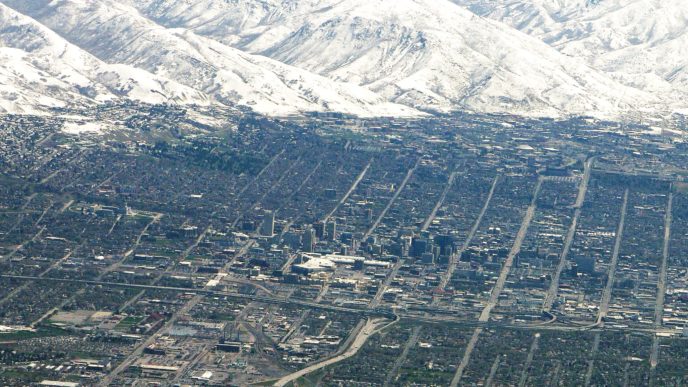
The streets around Salt Lake City’s downtown emergency shelter have long been home to hundreds of homeless people. In recent weeks, though, nearly all seem to have vanished following a police operation. Local residents are mystified as to where they’ve gone.

The Salt Lake City police chief, Mike Brown, said he had visited parks and the Jordan river, which threads its way to the Great Salt Lake and has homeless camps dotted along its banks, but he hadn’t seen an influx from downtown. Sgt Brandon Shearer has been up in a police helicopter looking for camps and seemed equally perplexed when asked where the people had gone. “I don’t know,” he said. “That’s a good question.”

Advocates, for their part, fear a humanitarian crisis is brewing.

The unfolding drama is all the more remarkable considering that several years ago, national media reports published claims by Utah that it had “won the war” on homelessness there, at least when it came to housing those who had been outside the longest. Jon Stewart ran a laudatory piece titled “The homeless homed”. But the picture wasn’t quite that simple.

While the country’s most prominent homeless crises are in coastal cities – New York, San Francisco, Los Angeles – the mountain-ringed capital of the Mormon church has also long struggled to house or, in the view of some, has politely ignored its homeless population. The Republican legislature in Utah is fond of the philosophy of pulling yourself up by your bootstraps, and struggling not-for-profit groups pick up the slack when it comes to homelessness funding. (Read more from “Mystery in Salt Lake City: Where Have Hundreds of Homeless People Gone?” HERE)

Follow Joe Miller on Twitter HERE and Facebook HERE.

Underreported: How This Nonprofit Is Solving Homelessness Without Government Funding

Growing up, Teena Faison never imagined she’d find herself a single mom and homeless.

“We didn’t wake up one day and go, ‘Hey, I just want to be homeless with my kids,’” she told The Daily Signal “No. There’s many, many contributing factors to that—lack of education, lack of resources, addiction.”

At 34 years old, Faison decided to change her ways and go to Solutions for Change, a family homeless nonprofit located in Vista, California, 45 minutes outside San Diego. Instead of simply providing residents a place to sleep, Solutions for Change takes a holistic approach to solving homelessness, requiring residents to go through counseling, take courses in financial literacy, parenting, leadership, and anger management, and eventually, get a job.

Over the past 17 years, Solutions for Change has gotten 1,200 families off government assistance and back on their feet. But because its program requires residents to be drug-free, Solutions for Change is ineligible to receive government funding.

Watch the video to learn more about why, despite its high success rates at solving family homelessness, Solutions for Change chose to maintain its drug-free policy instead of accepting government funding. (For more from the author of “Underreported: How This Nonprofit Is Solving Homelessness Without Government Funding” please click HERE)

Follow Joe Miller on Twitter HERE and Facebook HERE.

This Privately Run NYC Shelter Offers the Homeless Something Big Government Programs Can’t

This Christmas, 60,000 homeless New Yorkers are feeling the sting of failed Big Government policies that were instated to help them.

New York City’s (Marxist) Mayor Bill de Blasio recently expanded his administration’s 2016 budget for homeless services to $1.6 billion, an historic high and a 60 percent increase from when he took office in 2014. An even more damning commentary on the mayor’s hopeless governance, is the source of de Blasio’s record budget.

“Funding from city funds seems to be flat,” Doug Turetsky, of the city’s Independent Budget Office, told The New York Times. “Any increase in the overall budget seems to be driven by state and federal aid.”

Improving the city’s homelessness problem was a key platform of de Blasio’s 2013 campaign, but as a new election year draws near, New York’s homeless population has risen by close to 20 percent — including nearly 24,000 in the city’s shelters.

“They keep creating new programs because they still believe that they will find a magic bullet,” Lilliam Barrios-Paoli, a former New York City deputy mayor who oversaw homelessness until she resigned last year, recently told The Wall Street Journal. “Sometimes it is easy to get caught up in the immediate crisis and to forget that you need to step back and create more permanent solutions.”

What sort of solution would it take to eliminate a problem as pervasive and complicated as homelessness? On whom or on which group should this responsibility fall? In other words, whose job is it to care for these individuals? The federal government? The city? Churches and nonprofits? Local residents?

James Winans, chief development officer at The Bowery Mission, a faith-based homeless shelter located on Manhattan’s Lower East Side, told Conservative Review that he believes all of these groups have an important and irreplaceable role to play in combatting homelessness.

“Homelessness is a crisis in our entire community, and so it takes the entire community to respond,” Winans said. “We actually feel like government, nonprofit organizations, churches, individuals all have a role to play. It actually takes all of us together, working together, to effect this problem. It’s not something any one sector of our society is going to solve on its own.”

The Bowery embodies the economic principle of subsidiarity, which holds that what can be accomplished by smaller bodies should not be usurped by larger, more complex institutions. The idea is that local organizations are best equipped to handle local issues, because they are more intimately tied to these issues than a larger, faceless government entity.

Aside from one city partnership serving 77 program participants at a time, the Bowery is privately funded. Since its founding in 1879, the shelter has relied on the generosity of individuals, businesses, and other local institutions to keep its doors open.

CDO James Winans, who first began serving in one of the Bowery’s men’s recovery programs 17 years ago, told CR that high-dollar government programs are often unsuccessful because they only focus on immediate, material needs like food and shelter. A complex problem like homelessness requires a personal, human response that addresses the physical, emotional, and spiritual needs of these individuals.

“The city of New York is going to invest $1.6 billion this year in the problem of homelessness,” he said. “And we feel like their response is not holistic enough — that, in fact, it’s a community-based organization like the Bowery Mission that can actually offer a holistic response.”

According to Winans, when it comes to long-term recovery, community is key. The Bowery provides the same services as many shelters — meals, lodging, showers, clothing, and medical care — all in a “community of care.” And what sets this mission apart is its dedicated community of staff, volunteers, Christian church leaders, and donors that is truly invested in the personal wellbeing of its individuals.

“We want to invite people to change the direction of their life,” Winans said.

The Bowery’s residential recovery program was created with this major goal in mind. The one-year program offers counseling, the mission’s daily chapel services, job-training classes, and assistance in reconnecting with family, all while living in that community of care.

Winans noted that, for all of the stereotypes, for some homeless people, all it took was a health crisis, the loss of a job, or a dissolving marriage for them to find themselves on the street.

More than money, he said that the homeless people he meets are longing for something many people take for granted: a support system. In order to meet this crucial need, the Bowery staff relies on thousands of volunteers who are willing to invest their time in someone else’s future.

“People giving generously of their time creates a community where life transformation happens,” Winans said.

The Bowery, once referred to as New York’s “Skid Row,” is now a bustling cosmopolitan district with high-end stores, restaurants, and museums. And though some may assume that a homeless shelter would offer a deterrence to urban renewal, the Bowery Mission’s Winans has found that many of these businesses are eager to partner and share their prosperity with the less fortunate in New York City.

For example, this holiday season, a designer shoe store across the street from the mission is running a shoe drive, encouraging customers to donate their old pairs of shoes to the shelter. The store has even offered to repair badly worn shoes for free.

The Bowery staff has been able to witness the power of private charity and the spontaneous order that emerges in the absence of notoriously inefficient Big Government programs. And while gigantic bureaucracies with an endless flow of cash can’t help but continue getting in their own way, the effectiveness of the mission community approach speaks for itself. Subsidiarity works, and it can be applied in any community — big or small.

“Make no mistake about it: There is homelessness in every community,” Winans told CR. “Be it urban, rural, suburban communities, there are people experiencing life without a home. Life without a support system. Life without a support structure.”

James Winans understands that human problems require human solutions. Flourishing occurs when individuals acknowledge their duties as not merely compulsory taxpayers, but neighbors, leaders, mentors, caretakers, and friends.

The Christmas season is always among the busiest times of year for the Lower East Side Bowery. And while this is to be expected, Winans believes that these people are looking for more than just physical warmth:

“The holidays [are] a time when people are seeking community. They’re seeking to not be isolated and lonely. They’re seeking to be … connected with others”

It is this type of insight that has helped restore hope to so many people who have come to the Bowery Mission in a desperate state. It is something money simply can’t solve and simply can’t buy. (For more from the author of “This Privately Run NYC Shelter Offers the Homeless Something Big Government Programs Can’t” please click HERE)

Follow Joe Miller on Twitter HERE and Facebook HERE.

Police: Homeless Seeking Shelter from Cold in Subways to Be Kicked Out

Photo Credit: DNA/Stephanie Keith
The NYPD and the MTA plan to clear homeless men and women out of the subway system after a skyrocketing number of people have sought shelter there from the brutally cold winter, police officials said.

The plan, which is set to begin before dawn on Monday, comes amid an upswing in homeless people in the subway system during the exceptionally cold winter. There were more than 1,800 people living on the subways in 2013, up from 1,000 in 2009, according to the city’s annual HopeNYC street survey.

Starting Monday at 3 a.m., teams of transit workers, NYPD officers and emergency medical technicians will go to the E train stations at Jamaica Center and at the World Trade Center, officials said.

Each time a train pulls into one of the two stations, teams will check each car, and take all the homeless people inside to either a shelter or hospitals, officials said.

The trains will then be cleaned for the morning rush hour.

Read more this story HERE.

Student Homelessness Hits Record High (+video)

Photo Credit: John Moore/Getty Images The number of homeless students in U.S. public schools is at an all-time high, according to new data.

There were 1.2 million homeless students during the 2011-12 academic year, from preschool all the way through high school. That’s up 10% from last year and 72% from the start of the recession, according to the most recent data available from the National Center for Homeless Education, which is funded by the Department of Education.

Advocacy groups say continuing economic struggles are causing more students to end up homeless, meaning that they live in shelters, motels, or are staying temporarily with someone else because they have nowhere to live.

Read more from this story HERE.