Posts

Ninth Circuit Forces Arizona to Follow Obama’s Illegal Amnesty, Provide Illegals With Driver’s Licenses

You heard that right. At the same time the Ninth Circuit is flipping federal immigration power on its head and allowing states to block Trump’s lawful order reducing dangerous immigration, it is forcing Arizona to comply with Obama’s executive amnesty and provide illegal aliens with driver’s licenses.

There is no word in the English language to describe this degree of perfidy and hypocrisy. I don’t know how I missed this, but just one week before the Ninth Circuit nullified federal immigration laws and lawfully delegated presidential powers, the full court refused to overturn a three-judge panel that forced Arizona to provide DACA recipients with driver’s licenses.

The rationale of the court? Arizona was preempted by federal immigration powers!!!

“The federal government, not the states, holds exclusive authority concerning direct matters of immigration law,” wrote the radical Judge Harry Pregerson. This opinion to deny the rehearing of the case was joined by 23 of the remaining 28 active judges on the Ninth Circuit … including Judge Michelle Friedland. She wrote the opinion last week saying that states can force the federal government to bring in more immigrants even when the president is acting on iron-clad statutory authority.

Just last week, I detailed how the federal courts are flipping federalism and immigration on its head — upside down, inside out. However, the juxtaposition of these two decisions takes the duplicity to a new level. A few points to consider:

1) Sure, the federal government controls immigration, but which branch? Congress. With Obama’s DACA amnesty, Obama unilaterally nullified federal statutes and created his own immigration program, a program that was explicitly rejected by Congress. Trump, on the other hand, was following a long tradition of delegated authority to ratchet down immigration as needed, in concert with five congressional statutes.

2) Arizona was being asked by illegal aliens, who should never have had standing to sue, to initiate a positive action in order to abide by Obama’s unlawful amnesty. Washington and Minnesota, on the other hand, were given no mandate by Trump’s order. They were the ones burdening the federal government and overriding federal plenary power over immigration.

3) As Scalia noted in Arizona v. U.S., “the naturalization power was given to Congress not to abrogate States’ power to exclude those they did not want, but to vindicate it.” On the other hand, it was designed precisely to prevent liberal states from flooding the rest of the union with immigrants the federal government deemed undesirable, as the Ninth Circuit allowed Washington to do last week.

4) In Texas v. U.S., the Obama administration explicitly argued that states could not get standing to sue against the executive amnesty precisely because, in their view, states were not obligated to issue driver’s licenses! Now the Ninth Circuit is contending that states must give driver’s licenses but have no reason to complain!

5) After ruling that the state of Washington will suffer irreparable harm if Trump exercises his legitimate authority to keep out un-vetted immigrants from war-torn countries, the same panel ruled that “Arizona has no cognizable interest in making the distinction it has for drivers’ licenses purposes.” The fact that almost 30,000 driving offenses have been committed just by the 30,558 criminal aliens Obama released in fiscal year 2014 alone is evidently of no concern to Judge Pregerson, who has replaced jurisprudence with political rants.

6) There is a seamless flow from obtaining a driver’s license to voting via the motor-voter laws. Yet, this same court has prevented Arizona from verifying proof of citizenship in order to register to vote.

7) With at least 630,000 illegals residing in the state, at a cost of $2.4 billion a year, Arizona is left defiled and helpless in protecting its own residents and even their right to vote in untainted elections. Over 10% of the state’s public school population is comprised of illegal alien children. The Arizona Department of Corrections estimates that illegal aliens comprise 17% of its prison population and 22% of all felony defendants in Maricopa County. Arizona has become the drug smuggling capital of the country. From 2010-2015, heroin seizures in Arizona have increased by 207%, while methamphetamine seizures grew by 310%. In FY 2014, there were more pounds of marijuana seized in the Tucson corridor than every other border sector combined. Yet, the state has no “cognizable interest” in fighting a past president’ illegal amnesty, but Washington state has an interest in overturning federal immigration power of an existing president and demanding its own immigrants!?

The courts of Sodom and Gomorrah indeed.

This is why it is foolish for any conservative to suggest that a better prepared Trump administration could have survived the Ninth Circuit. Those judges are willing to use opposing legal theories in order to achieve the “right” political outcome at any and all costs. That is why we need wholesale judicial reform and why it must start with breaking up the Ninth Circuit. Meanwhile, Arizona’s junior senator, Jeff Flake, R-Ariz. (F, 50%) is more bothered by the criticism of these judges than what they are doing to disembowel his own state.

The fact that states are still being forced to issue driver’s licenses to illegal aliens is another reason why Trump must terminate DACA. It’s not merely about the inaction of declining to deport this category of illegal aliens. These illegals are unconstitutionally obtaining Social Security cards, which forces states to issue driver’s licenses. It’s time for Trump and Congress to unite on behalf of Arizona and expose the duplicity of the courts. (For more from the author of “Ninth Circuit Forces Arizona to Follow Obama’s Illegal Amnesty, Provide Illegals With Driver’s Licenses” please click HERE)

Follow Joe Miller on Twitter HERE and Facebook HERE.

Bye Bye Sanctuary Cities? Trump Gets Tough on Havens for Illegal Aliens

In a major departure from the previous administration, President Donald Trump has directed the Department of Homeland Security to get serious on tackling crimes committed by illegal immigrants.

The executive order instructs the Homeland Security Secretary General John F. Kelly, to “utilize the Declined Detainer Outcome Report or its equivalent and, on a weekly basis, make public a comprehensive list of criminal actions committed by aliens and any jurisdiction that ignored or otherwise failed to honor any detainers with respect to such aliens.”

The purpose of this order is “to better inform the public regarding the public safety threats associated with sanctuary jurisdictions.”

In other words, President Trump has taken his first steps towards ending sanctuary city policies.

He is, of course, going to meet resistance from the Left. California Governor Jerry Brown, in what Politico described as an “anti-Trump manifesto,” proudly declared that despite the supremacy of federal immigration laws, California would take measures to protect its sanctuary policies from the president.

“We may be called to defend those laws, and defend them we will,” Brown said.

So, here’s where Trump’s executive order is brilliant. By publishing the statistics of crimes committed by illegal immigrants in areas of the country with sanctuary city policies, Trump is essentially telling the public “your Democratic politicians are protecting crime in your cities with their sanctuary city policies.” The president is handing ammunition the political opponents of big-city Democratic politicians everywhere in the country.

Sanctuary city policies are already vastly unpopular with the American people. Even as Gov. Brown delivered his amnesty ultimatum, 74 percent of California residents want to see an end to sanctuary city policies.

That opposition crosses party lines. It is unifying. And President Trump’s national policies can be used to rally that opposition at the ballot box and kick out the bums at the state level.

This is the kind of strategic thinking that has been woefully lacking from Washington Republicans for far too long. It is the style of anti-establishment governance the president’s most ardent backers promised Trump would bring to the nation’s capital.

Let’s hope the president applies a similar strategy to the other items on his agenda. (For more from the author of “Bye Bye Sanctuary Cities? Trump Gets Tough on Havens for Illegal Aliens” please click HERE)

Follow Joe Miller on Twitter HERE and Facebook HERE.

This Is What REAL Hope Looks Like: GOP Senators Fight for Families of Victims of Illegal Aliens

The 115th United States Congress has only been in session for a few days, but Republicans are already taking advantage of their overwhelming majority.

On Thursday, Senator Joni Ernst, R-Iowa (F, 59%) released a statement announcing that she, along with Senators Chuck Grassley, R-Ind. (D, 66%), Deb Fischer, R-Neb. (F, 55%), and Ben Sasse, R-Neb. (A, 94%), reintroduced a piece of legislation that would require federal officials to take custody of illegal immigrants “charged with a crime resulting in the death or serious bodily injury of another person.”

The legislation, known as Sarah’s Law, was named to honor Sarah Root, a 21-year-old Iowa woman who was killed last January in the “sanctuary city” of Omaha, Neb., by 19-year-old Edwin Mejia, an illegal immigrant who was driving drunk three times over the legal limit, and drag racing. Mejia, a Honduran native who entered the United States as an “unaccompanied minor” in 2013, disappeared after posting the $5,000 bail and has been at large ever since.

“Mr. Mejia has been on the [U.S. Immigration and Customs Enforcement’s] Most Wanted List for more than nine months — that’s time he should have been behind bars,” Senator Sasse, a member of the Senate Judiciary Committee, said in the press release this week. “Congress has an opportunity to make sure this never happens again. Sarah’s Law would make it absolutely clear that ICE must immediately detain any illegal alien who kills someone.”

Thursday’s move to reintroduce the law offers families of individuals killed by illegal immigrants renewed hope that their loved ones will be vindicated. If passed, the legislation would require ICE officials to “make reasonable efforts to identify and provide relevant information to the crime victims or their families.”

“It is unconscionable that nearly one year after Sarah’s death, Edwin Mejia remains at-large, and the fact remains that today U.S. immigration law does not require federal immigration authorities to detain those here illegally who harm American citizens,” Senator Ernst said. “Although nothing can bring Sarah back to her family or heal the wounds of such unimaginable loss, we have an obligation to the American people to ensure that no citizen falls victim to this injustice again. Sarah’s Law is about honoring Sarah, and her legacy; I have already had conversations with the incoming administration, and am hopeful that they will work with Congress to pursue

In his nomination acceptance speech at the Republican National Convention in July, Donald Trump described Sarah Root as “just one more American life that wasn’t worth protecting. One more child to sacrifice on the altar of open borders.” The president-elect made illegal immigration a focal point of his presidential campaign, inviting family members of those killed by illegals to join him onstage at the RNC and to speak at various campaign stops.

“We are sadly hearing of these instances far too often. If the Obama administration won’t protect our citizens, Congress will make it clear illegal immigrants who have committed serious crimes will be detained. We must do everything possible to prevent the pain Sarah’s loved ones and too many others have endured,” said Sen. Pat Roberts, R-Kan. (F, 51%).

Since Sarah’s Law was first introduced in June 2016, the legislation has gained new support from Senators Jerry Moran, R-Kan. (D, 67%), Pat Roberts, John Thune, R-S.D. (F, 44%), Ted Cruz, R-Texas (A, 97%), and Jim Inhofe, R-Okla. (C, 72%). Congressman David Young, R-Ind. (F, 38%) will lead a House companion bill.

Sen. Cruz indicated that the November election afforded Congress “an extraordinary chance” to strengthen border security and restore the rule of law in a post-Obama America.

“The last eight years under the Obama Administration have seen a disastrous deterioration of the rule of law and an unwillingness to justly prosecute those who break our laws,” said Senator Cruz. “But now we have an extraordinary chance to reverse that course, secure our border, and strengthen our immigration laws. I am proud to be a sponsor of Sarah’s Law and other similar law enforcement measures that will deter illegal immigration, and ensure those who disregard our immigration laws and bring harm to our citizens are held accountable.” (For more from the author of “This Is What REAL Hope Looks Like: GOP Senators Fight for Families of Victims of Illegal Aliens” please click HERE)

Follow Joe Miller on Twitter HERE and Facebook HERE.

DMV Licensed 800,000 Illegal Aliens Under 2-Year-Old Law

On the day that California officials implemented a controversial law that allows undocumented residents to obtain driver’s licenses, DMV offices throughout the state were packed with immigrants looking to take advantage of the opportunity.

Two years after the implementation of AB 60 on Jan. 1, 2015, an estimated 806,000 undocumented residents have received driver’s licenses, according to Department of Motor Vehicles statistics this month. About 14,000 of these licenses were issued in November alone, the DMV said.

The law has allowed undocumented residents to come out of the shadows and drive safely in their neighborhoods, according to Maricela Gutierrez, executive director of the immigration advocacy organization, SIREN.

“Many of them have been able to drive their kids to school and to run errands, when many times they were taking buses that would take them up to three hours to get from point A to point B,” she said. “It opened up new opportunities.”

One San Jose resident who applied for a license just a few days after AB 60 went into effect received his license in the mail shortly after. (Read more from “DMV Licensed 800,000 Illegal Aliens Under 2-Year-Old Law” HERE)

Follow Joe Miller on Twitter HERE and Facebook HERE.

Illegals Demand Obama Issue Mass Pardons Amid Trump Deportation Fears

Illegal immigrants are preparing to ask President Obama to pardon some 750,000 Dreamers, saying such a move is their last, best hope to stave off what they fear will be a wave of deportations once Donald Trump takes the Oval Office.

Community leaders have planned a rally in New York on Wednesday to make the request.

“Millions of law abiding undocumented immigrants are fearful of what will happen when the new Administration takes control in January,” the group of New York state lawmakers and immigration advocates said in a statement announcing the rally. “However, President Obama has the power of pardons that he can use to protect all DACA enrollees.”

As of September, more than 740,000 illegal immigrants had been approved for Mr. Obama’s Deferred Action for Childhood Arrivals program, a minor amnesty that grants young adult illegal immigrants a two-year stay of deportation and issues them work permits, entitling them to driver’s licenses and some taxpayer benefits.

Mr. Trump has signaled that he would cancel that order, leaving Dreamers out of status when their work permits expire. That puts Mr. Obama in a bind because he has expressed an interest in helping illegal immigrants but also has acknowledged limits on power. (Read more from the author of “Illegals Demand Obama Issue Mass Pardons Amid Trump Deportation Fears” HERE)

Follow Joe Miller on Twitter HERE and Facebook HERE.

The ‘Untold Threat’ Responsible for 40% of Illegal Aliens

While the debate over illegal immigration tends to focus on how to control and treat those who make it across our nation’s borders, a more enduring challenge for the U.S. government has been what to do to stop legal entrants from overstaying their allotted time here.

The problem of so-called visa “overstays”—which make up about 40 percent of the 11 million people living illegally in the U.S.—will continue on past the Obama administration and follow the next president.

That’s partially because the government has not yet delivered on its long-promised—and congressionally mandated—plan to create a better checkout system to track who has left the country on time, and who hasn’t.

“It [visa overstays] is the most overlooked issue when it comes to immigration,” Rep. Michael McCaul, R-Texas, who chairs the House Homeland Security Committee, said in an interview with The Daily Signal.

“It’s an untold threat,” McCaul added. “We are allowing millions of people to overstay visas and remain in this country who could potentially pose a threat to homeland security.”

The uncertainty around the scope of the problem comes at a time when a growing percentage of the illegal immigrant population is made up of visa overstays as opposed to people being apprehended at the border.

For more than 20 years, the U.S. government had struggled to quantify just how many people entered the country legally with a visa and stayed too long, making it impossible to prescribe policy fixes.

That finally changed in January, when the Department of Homeland Security released a first-of-its-kind study reporting that 527,127 people who traveled legally to the U.S. for business or leisure and were supposed to leave the country in fiscal year 2015 in fact overstayed their visas.

This figure is larger than the 337,117 people caught crossing the border illegally last year.

The long-awaited data from 2015 was not all-encompassing. It counted only visa holders who entered the U.S. by air and sea, not by land, and it did not include those who came as students or temporary workers.

Still, immigration and security experts as well as policymakers welcomed the new information because they thought it would force the government to move faster on methods to improve, most importantly in trying to assemble a system to obtain biometric data—such as fingerprints, facial recognition images, and eye scans—on those leaving the country.

‘A Top Issue’

The 9/11 Commission recommended the Department of Homeland Security complete an entry and exit system “as soon as possible,” viewing it as an important national security tool because two of the hijackers on Sept. 11, 2001, had overstayed their visas.

Plagued by financial and logistical challenges, the government has introduced various pilot projects at some airports and land borders, but is still a few years off from implementing a biometric exit system on a large scale.

Homeland Security Secretary Jeh Johnson has pledged to have biometric checks at major airports in 2018, and Congress in last year’s omnibus spending bill authorized $1 billion in visa fee increases over 10 years to pay for an exit system.

The struggle to install a biometric exit tracking system is well known.

Foreigners who apply to enter the U.S. on a visa are interviewed and photographed and have their fingerprints taken at a consulate overseas before arriving here. But collecting biometric data on those exiting the country is not as easy.

That’s because U.S. airports do not have exclusive terminals for domestic and international flights, which makes it hard for officers from Homeland Security’s Customs and Border Patrol to screen overseas travelers and get their information.

“Most countries have a designated checkout system built in airports,” Stewart Verdery, a senior Homeland Security official during George W. Bush’s administration, said in an interview with The Daily Signal. Verdery added:

We just didn’t build our airports this way. So the question is where do you collect the information in a way that doesn’t inconvenience travelers and is actually effective in making sure someone has left? None of the options are particularly great. And though the biometric equipment is very mature, there is also a manpower issue over who maintains the machines.

To satisfy these limitations, Verdery expects the government to pursue a facial recognition exit system that automatically would snap a traveler’s photograph—likely at the gate.

‘It Doesn’t Matter’

Even if the U.S. were to settle on a workable exit tracking method, some national security experts doubt that such a system would be an effective counterterrorism tool, especially when considering its cost.

David Inserra, a homeland security expert at The Heritage Foundation, says the government could just as well use already collected biographical information, such as a traveler’s name and date of birth, to track exits and collect overstay data. But other experts say bad actors could use fake passports and aliases to bypass a system that did not require biometrics such as fingerprints and facial recognition.

No matter the method used, Inserra and other experts note that an exit system simply reveals who has departed—and remained—in the country. It would not help discover where those that stayed are living, and whether they present a security risk.

“Even if you have the greatest biometric exit system, if someone doesn’t leave, it doesn’t matter,” Inserra said, adding:

You are now left with the problem of every other police officer looking for someone. They are a missing person who doesn’t want to be found. If you want to stop visa overstays, the solution isn’t to spend money on an exit system.

Inserra argues that policymakers instead should give more money to intelligence agencies such as Homeland Security’s Immigration and Customs Enforcement so they can go into communities and try to locate—and deport—people who overstayed their visas.

Yet other experts are doubtful that would happen. They say the government does not prioritize enforcing immigration law against those who’ve stayed past their visa expiration date because those travelers were screened before coming here.

“In terms of removing a garden variety illegal migrant, you aren’t going to search for somebody on that basis,” Edward Alden, an immigration and visa policy expert at the Council on Foreign Relations, said in an interview with The Daily Signal. “The notion we will have some special dedicated effort to go find overstays I find completely implausible.”

Alden says the government can take simpler steps to deter visa overstays, by emailing reminders to foreigners of their expected departure date, specifying the consequences of not leaving on time.

Many who overstay their visas don’t intend to settle in America, Alden contends.

The Homeland Security report from earlier this year found that as of Jan. 4, a total of 416,500 of the 527,127 overstays in 2015 remained in the U.S. More have left the country since then, the government says.

The government also has taken diplomatic steps to better track foreign visitors, especially by improving information sharing with Canada, the country that had the most overstays in the U.S.

The U.S. and Canada exchange names and biographical information of those from third countries who enter on their shared border. Mexico, the second-largest source of visa overstays in the U.S., generally does not yet have the capacity to exchange information like that, Alden says.

‘Serious About Enforcement’

Despite these improvements, Congress is not backing off its demand for a biometric exit system.

McCaul, the chairman of the House Homeland Security Committee, says he hopes for a vote next year on a broad border security bill he sponsored last year. It includes a provision requiring the government to establish an exit system at the 15 largest airports, seaports, and land ports within two years.

The legislation, which President Barack Obama promised to veto, would impose financial and other penalties on Department of Homeland Security political appointees if the government fails to meet the timeline.

Having the best data possible, supporters of the exit system say, will give the government incentive to more aggressively enforce the law against those who’ve overstayed visas.

“I think once the government gets an exit system up and running, they’ll be serious about enforcement,” Verdery said, adding:

We will never have a system where we will go out and find someone who overstays and just wants to do nothing on their buddy’s couch. But we will go out and find them when they try to get a job, draw the attention of law enforcement, or illegally try to claim benefits.

(For more from the author of “The ‘Untold Threat’ Responsible for 40% of Illegal Aliens” please click HERE)

Follow Joe Miller on Twitter HERE and Facebook HERE.

How Much Longer Can We Tolerate Illegal Aliens Stealing Our Sovereignty?

The jurisdiction of the nation within its own territory is necessarily exclusive and absolute. It is susceptible of no limitation not imposed by itself. Any restriction upon it deriving validity from an external source would imply a diminution of its sovereignty to the extent of the restriction and an investment of that sovereignty to the same extent in that power which could impose such restriction. All exceptions, therefore, to the full and complete power of a nation within its own territories must be traced up to the consent of the nation itself. They can flow from no other legitimate source.”
~ Chief Justice John Marshall 1812

Welcome to Absurdistan where Sheriff Joe Arpaio faces the prospect of jail time for enforcing federal immigration laws. Roy Moore, Chief Justice of the Alabama Supreme Court, is suspended indefinitely for not redefining marriage in his state. Meanwhile, illegal aliens are out in full force campaigning in a presidential election and blocking traffic on one of the nation’s busiest bridges. And nobody bats an eyelash.

Earlier this week, the Washington Post reported that CASA In Action has mobilized groups of illegal aliens to organize ground game for the Clinton campaign in states like Virginia and Pennsylvania. What is particularly disturbing about this effort is that it is utilizing those who received Obama’s illegal executive amnesty. Which means that “crime pays” so to speak — Democrats are benefiting from the illegal violation of American sovereignty.

Let this observation sink in slowly: American sheriffs and state supreme court justices are being punished for upholding legitimate laws and sovereignty of the people, yet CASA can harbor illegal aliens and use them for get-out-the-vote efforts. Hence, people can break into this country and then organize publicly in order to sway an election and bestow themselves with citizenship rights against the consent of the people. We now have no control over our own destiny.

Fast-forward to Wednesday, when a group of illegal aliens chained themselves together across the George Washington Bridge, blocking traffic in New York at the peak of rush hour and delaying commuters for as much as 90 minutes. What are the odds a single protester will be deported?

No words can describe the depravity of our stolen sovereignty; no analogies can fully capture the moral and intellectual dyslexia playing out without understating the problem. One of the reasons why so many immigrants have flocked to our country over the years is because they respect the stability of democracy, the rule of law, and private property rights. Many of them have emigrated from countries that have no civil society or stable system of governance — countries where mob rule reigns supreme. Now, this generation of illegal aliens is bringing with them the mindset of the governments from which they have fled.

What we are witnessing today with the refusal of the federal government to enforce national sovereignty is the greatest mass trespassing of private property rights. Public property is paid for by the citizenry of the nation-state, and, for those here without the consent of the people, to takeover that property is the ultimate violation of property rights. And between illegal aliens campaigning to sway an election and some non-citizens registering to vote (and courts preventing states from weeding out non-citizen voting), they are stealing the most sacred right of a citizen — the franchise.

Let’s be clear: if Hillary wins this election, the outrage over stolen sovereignty will not abate. She would not have won based on this issue or any other policy initiative. She would have won by making this election a referendum on the personal character of her former donor. No election entitles a president to steal the sovereignty of her people. The citizenry will not tolerate this for much longer. (For more from the author of “How Much Longer Can We Tolerate Illegal Aliens Stealing Our Sovereignty?” please click HERE)

Follow Joe Miller on Twitter HERE and Facebook HERE.

Feds Wrongly Granted Citizenship to Hundreds Facing Deportation

More than 800 illegal immigrants from countries of concern who were set for deportation were mistakenly granted U.S. citizenship because the Department of Homeland Security didn’t have their fingerprints on file, according to an internal audit released Monday.

The Homeland Security Department’s inspector general found the immigrants used different names or birthdates to apply for citizenship with the U.S. Citizenship and Immigration. In the case of 858 immigrants from “special interest countries or neighboring countries with high rates of immigration fraud,” the discrepancies weren’t caught because their fingerprints were missing from government databases.

A few even managed to get aviation or transportation worker credentials, though they were later revoked. One became a law enforcement officer.

The findings were released, incidentally, as authorities were investigating a string of weekend attacks, allegedly connected to foreign-born suspects.

The inspector general report could further fuel warnings about immigration security. The report warned that when immigrants become naturalized, “these individuals retain many of the rights and privileges of U.S. citizenship, including serving in law enforcement, obtaining a security clearance, and sponsoring other aliens’ entry into the United States.” (Read more from “Feds Wrongly Granted Citizenship to Hundreds Facing Deportation” HERE)

Follow Joe Miller on Twitter HERE and Facebook HERE.

Under Obama’s New Enforcement Program, Fewer Illegal Aliens Being Captured for Deportation

Under a revamped Obama administration program intended to encourage greater cooperation from local law enforcement agencies in helping deport illegal immigrants who the government considers “a danger” to public safety, fewer people are being taken into custody for eventual removal from the country.

In November 2014, the administration introduced the Priority Enforcement Program (PEP), a less demanding version of a previous system that had been accused of violating immigrants’ civil rights, and did not differentiate between low-level and serious offenders.

The old program, called Secure Communities, influenced a number of local jurisdictions—known as “sanctuary cities”—to not work with the federal government.

While more local agencies are indeed working with federal immigration authorities since the new program began, a new study shows that those closer ties have not resulted in greater apprehensions of illegal immigrants who the government seeks to deport.

The federal Immigration and Customs Enforcement Agency (ICE) reports that only 2 percent of its requests to local law enforcement were declined in the first two months of fiscal year 2016.

However, during that same time period, ICE did not take custody of more than 60 percent of individuals it had requested information on.

“Obviously it takes an enormous time to turn around something as big as a Department of Homeland Security program, and this is clearly something that needs continuing monitoring,” said Susan Long of the Transactional Records Access Clearinghouse (TRAC) at Syracuse University, who acquired and compiled the data for her recent study. “But there is no indication at this point that the PEP directives have in fact been implemented successfully.”

New Program, Narrower Focus

In the old program, Secure Communities, ICE asked law enforcement agencies to hold somebody in custody for an extra 48 hours from when they would normally be released so that person could be picked up and deported. These requests were known as detainers.

With the new program, local authorities, in most cases, are asked to only notify Immigration and Customs Enforcement when they plan to release someone from jail whom the government seeks to deport.

ICE still can issue a detainer if it believes it has probable cause to deport an illegal immigrant who has been arrested, even if they haven’t been convicted.

In addition to switching from Secure Communities to the Priority Enforcement Program, the administration at the same time also announced it was narrowing the types of people it seeks to deport.

ICE officers are told to first target illegal immigrants considered to be threats to national security and public safety, who have likely been convicted of a felony. Other priorities for deportation include individuals who have been convicted of multiple misdemeanors, and recent arrivals who came here illegally after Jan. 1, 2014.

With about 11 million immigrants living in the country illegally, the administration argues that smart policy dictates focusing its deportation efforts more specifically, at people it considers to be dangerous.

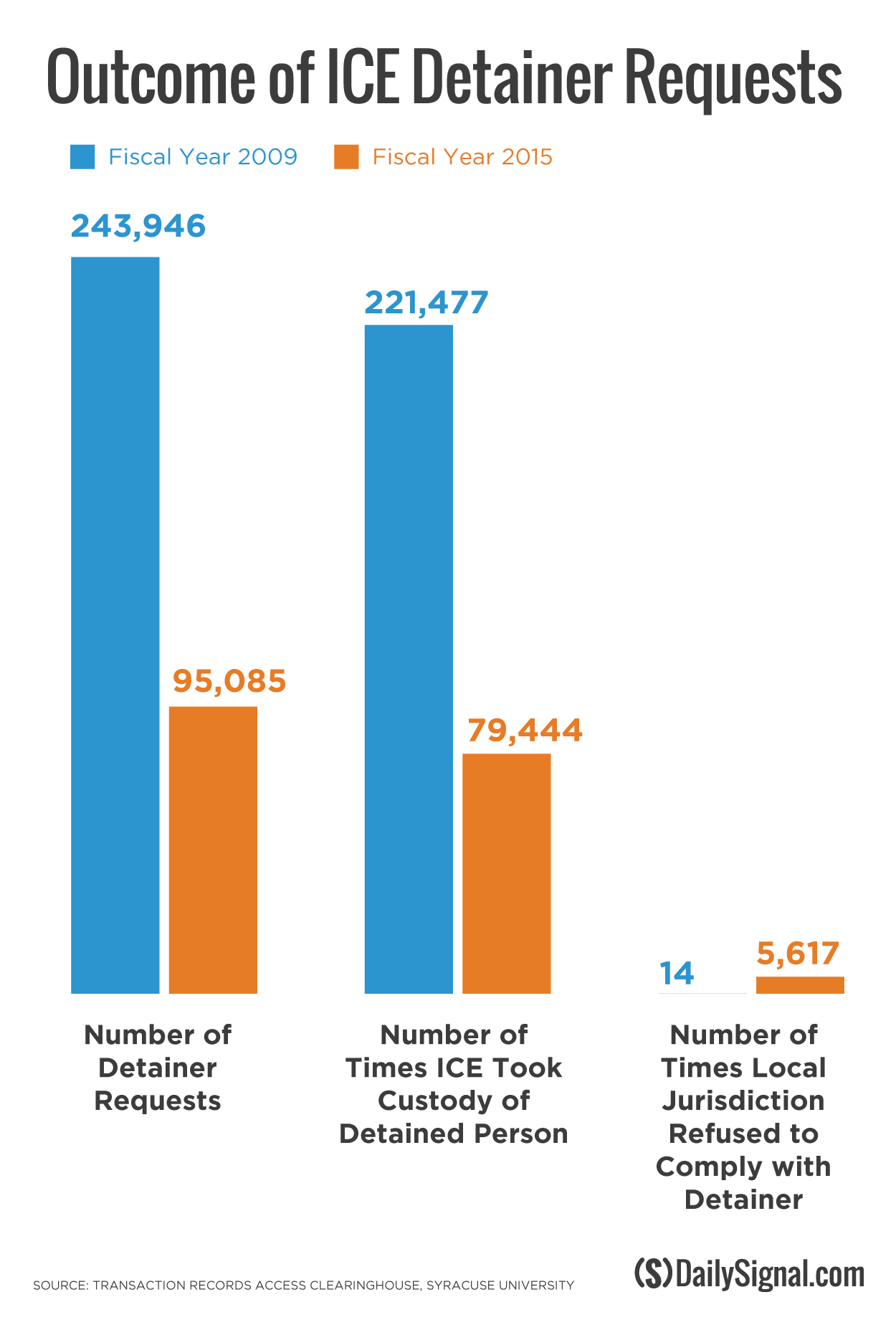
The natural result of this more narrow focus is that ICE is seeking to deport fewer people, according to the statistics acquired by TRAC.
160824_ICE-Detainer_v1

Under a revamped Obama administration program intended to encourage greater cooperation from local law enforcement agencies in helping deport illegal immigrants who the government considers “a danger” to public safety, fewer people are being taken into custody for eventual removal from the country.

In November 2014, the administration introduced the Priority Enforcement Program (PEP), a less demanding version of a previous system that had been accused of violating immigrants’ civil rights, and did not differentiate between low-level and serious offenders.

The old program, called Secure Communities, influenced a number of local jurisdictions—known as “sanctuary cities”—to not work with the federal government.

While more local agencies are indeed working with federal immigration authorities since the new program began, a new study shows that those closer ties have not resulted in greater apprehensions of illegal immigrants who the government seeks to deport.

The federal Immigration and Customs Enforcement Agency (ICE) reports that only 2 percent of its requests to local law enforcement were declined in the first two months of fiscal year 2016.

However, during that same time period, ICE did not take custody of more than 60 percent of individuals it had requested information on.

“Obviously it takes an enormous time to turn around something as big as a Department of Homeland Security program, and this is clearly something that needs continuing monitoring,” said Susan Long of the Transactional Records Access Clearinghouse (TRAC) at Syracuse University, who acquired and compiled the data for her recent study. “But there is no indication at this point that the PEP directives have in fact been implemented successfully.”

New Program, Narrower Focus

In the old program, Secure Communities, ICE asked law enforcement agencies to hold somebody in custody for an extra 48 hours from when they would normally be released so that person could be picked up and deported. These requests were known as detainers.

With the new program, local authorities, in most cases, are asked to only notify Immigration and Customs Enforcement when they plan to release someone from jail whom the government seeks to deport.

ICE still can issue a detainer if it believes it has probable cause to deport an illegal immigrant who has been arrested, even if they haven’t been convicted.

In addition to switching from Secure Communities to the Priority Enforcement Program, the administration at the same time also announced it was narrowing the types of people it seeks to deport.

ICE officers are told to first target illegal immigrants considered to be threats to national security and public safety, who have likely been convicted of a felony. Other priorities for deportation include individuals who have been convicted of multiple misdemeanors, and recent arrivals who came here illegally after Jan. 1, 2014.

With about 11 million immigrants living in the country illegally, the administration argues that smart policy dictates focusing its deportation efforts more specifically, at people it considers to be dangerous.

The natural result of this more narrow focus is that ICE is seeking to deport fewer people, according to the statistics acquired by TRAC.

For example, in October of 2008, the first month and year from TRAC’s data, ICE issued more than 19,000 detainer requests to local law enforcement. None of those requests were rejected by local law enforcement.

In November of 2015, the last month and year of TRAC’s data, ICE submitted a little more than 6,000 detainer and notification requests to local agencies. Almost 100 of the requests were rejected. Still, that refusal rate—about 1.6 percent—is much less than what it was at the height of the controversy over Secure Communities, when there were more sanctuary cities.

In June and July of 2014, for instance, 10.4 percent of ICE requests to local law enforcement were refused.

Serious Criminals ‘Getting Through’?

Immigration experts who reviewed the TRAC study noted that it has limitations. It only captures a short amount of time since PEP was implemented, and it does not show how many of those taken into custody by ICE were actually deported.

But some observers are concerned that even with increased cooperation from local law enforcement, ICE is apprehending fewer people it seeks custody of.

Randy Capps, the director of research for U.S. programs at the Migration Policy Institute, says that because ICE is more narrowly tailoring its deportation focus to those it considers to be serious criminals—and recent border crossers—it stands to reason that some of those who are not taken into custody are dangerous.

“It’s clear that the overall number of people getting detainers and into ICE custody are both going down so we have evidence that ICE is narrowing whom they seek to deport,” Capps told The Daily Signal. “And it is also clear a lot more major jurisdictions are sending people into ICE custody, while there are still some that are not.”

“So one has to ask, are people who would be considered a top priority and may commit a serious crime getting through and not getting deported?” Capps added. “We don’t know for sure because ICE has other ways to pick these people up. But one can assume a fair number with serious convictions are not getting into ICE custody.”

‘No Correlation’

An ICE official, who would not comment directly on the TRAC study, told The Daily Signal it’s not appropriate to conclude that just because the agency is receiving greater compliance from local jurisdictions, it should therefore be taking custody of more people who are referred to them for deportation.

That’s because, in instances where local agencies refuse to help facilitate the removal of illegal immigrants targeted by ICE, federal immigration officials often go off into communities on their own to find and take custody of those individuals.

These dispatched ICE officers, known as Fugitive Operations Teams, are usually tasked with finding and apprehending illegal immigrants who don’t show up for their deportation hearings, or those who have been ordered removed but escape before they’re deported.

But in other situations, the ICE official and Capps said, the Fugitive Operations Teams will be dispatched to find those who the government considers to be serious criminals—people who local agencies refuse to help deport.

“There is no direct correlation between a record showing an alien in ICE custody and a local jurisdiction honoring an ICE detainer,” the ICE official said. “In uncooperative jurisdictions, ICE officers often attempt to track down and arrest those individuals after they have been released from local custody. These are considered ‘at-large’ arrests because they take place outside the confines of a jail.”

These type of arrests that occur without the help of local law enforcement are not included in TRAC’s data.

“That wouldn’t show up in this [TRAC] data,” Capps said. “It does not count as someone taken into custody via a detainer. And as the number of issued detainers comes down, I think you will see fugitive operations picking up a higher share of people than in the past.”

Fugitive operations are also considered more expensive and time-intensive, Capps said.

“The limitation of fugitive operations is ICE has to go find people,” Capps said. “With that, there are all sorts of extra constraints, and it is much more expensive and difficult to do. When someone is in jail, they are captive, and you just go get them.”

Local Laws ‘Trumping’ ICE Policy

For ICE, the implementation of PEP was supposed to help avoid that extra effort, by promoting flexibility with how cities and counties devise their policies, and thus encouraging more cooperation.

That has happened in some cases.

ICE reports that of the 25 jurisdictions with the highest number of declined detainers, 17 of those jurisdictions are now PEP participants in some shape or form. These 17 jurisdictions represent 61 percent of previously declined detainers. So from ICE’s perspective, there is still progress left to be made.

Indeed, the TRAC data shows that since fiscal year 2014, a number of local jurisdictions in California have racked up the highest numbers of declined detainers and notification requests.

Before PEP was implemented, the Santa Clara County Main Jail had the highest refusal rate in the nation at 88.2 percent.

In the latest available data since PEP has been in place, from July through November 2015, ICE reports that Santa Clara County has only declined 4.8 percent of requests. Yet ICE has still been unable to take custody of the illegal immigrant in nearly every one of those cases.

“This raises the question: Did Santa Clara’s cooperation actually increase? Or did ICE simply stop recording refusals that occurred? Or is there some other explanation for these wildly dissimilar trends?” the TRAC report states.

To Capps, no matter what ICE considers to be cooperation, the data makes sense. In California, it’s harder to apprehend illegal immigrants through detainer requests because of a state law, known as the Trust Act, that strictly limits the situations in which local agencies will help ICE take custody of those it seeks to deport.

“The huge discrepancies in the refusal rate vs. not taking somebody into custody suggests to me that the refusal rate does not have that much meaning,” Capps said. “The share taken into custody has much more meaning in showing who is actually cooperating, and how well PEP is performing as it’s intended to. And some of that is outside ICE’s control if states and localities have laws that for the time being seem to be trumping ICE policies.” (For more from the author of “Under Obama’s New Enforcement Program, Fewer Illegal Aliens Being Captured for Deportation” please click HERE)

Follow Joe Miller on Twitter HERE and Facebook HERE.

How Other Nations Stop US From Deporting Criminal Illegal Aliens

Susanna Ruth Makinson can blame a lot of things for why her then-husband was shot dead eight years ago while patrolling the streets of Fort Myers, Florida, the first time since 1930 a police officer had been gunned down in the city.

That’s because, in a distant way out of her—and his—control, Andrew Widman’s death felt preventable; his killer, Abel Arango, was an illegal immigrant and convicted felon who was released from detention because his native Cuba wouldn’t take him back.

But though Makinson wishes the government would do more to fix this little-known problem in the immigration system, to do more to pressure uncooperative countries to accept their citizens who are here illegally and commit crimes, she also has gained a lifetime of perspective raising three kids without their father.

“It’s a huge problem that criminals take advantage of; most people don’t know it’s possible for the originating country to decline the person being deported,” Makinson told The Daily Signal in an interview. “It bothers me. At the same time, what if I had been sick that day and my husband hadn’t gone to work? I would go crazy thinking through every ‘what if’ scenario. I try not to do that. We don’t live in a perfect world.”

Pressure to Do More

Yet in 2016, the inability to deport criminals continues to frustrate lawmakers, advocates of tougher immigration laws, and families who’ve been victimized by violent offenders.

According to Immigration and Customs Enforcement (ICE), an agency of the Department of Homeland Security, thousands of illegal immigrants with criminal convictions have been released from custody—some who’ve committed crimes like assault and murder—because they can’t be repatriated.

As of May, ICE classified 23 countries, including China, Afghanistan, Iraq, Iran, and Libya, as being “recalcitrant,” or uncooperative.

That lists also still includes Cuba, a country with which the Obama administration restored diplomatic relations with last year after five decades of hostility.

“We shouldn’t allow other countries to dictate who will be deported from the United States,” said Jessica Vaughan of the Center for Immigration Studies. “The Obama administration has been passive on this and not used the tools Congress has given them to address this problem.”

Deporting illegal immigrants is more complex than simply sending them on a plane home.

Like anyone traveling abroad, those destined for deportation need documentation, like a passport.

If the native country refuses to issue those papers, the U.S. cannot deport people there.

But critics say the government can be more aggressive in using diplomatic leverage to pressure countries to comply.

Under immigration law, the State Department can deny visas to citizens of countries that refuse to repatriate their nationals.

The government is reluctant to use this authority, however. A State Department official told The Daily Signal that the government has refused to issue visas to only one nation, in 2001 against the South American nation of Guyana.

“Visa restrictions are not imposed lightly,” the State Department official said. “For many years, we have worked with DHS [Department of Homeland Security] to review the status of each recalcitrant country on a case-by-case basis. We engage at the highest levels to resolve these issues diplomatically when possible, while remaining ready to invoke visa restrictions, as warranted, in consultation with DHS.”

Sen. Chuck Grassley, R-Iowa, who chairs the Judiciary Committee, wrote a letter last month to Homeland Security Secretary Jeh Johnson urging him to work with the State Department to more liberally administer visa sanctions to noncompliant countries.

“The Department of Homeland Security and the State Department together have an effective tool to discourage this behavior, and it’s high time they use it,” Grassley told The Daily Signal in an emailed statement. “No other American family should have to endure a tragedy because criminal immigrants are allowed to stay in this country, even if foreign countries won’t take responsibility.”

In addition, Sen. Richard Blumenthal, D-Conn., plans to introduce legislation to sanction countries that won’t take back their citizens.

One of the most egregious crimes occurred in Blumenthal’s state. Last month, Jean Jacques, an illegal immigrant from Haiti, was sentenced to 60 years in prison for murdering Casey Chadwick, a 25-year-old woman from Norwich, Connecticut.

Jacques, 41, had a previous attempted murder conviction and should have been deported, but Haiti would not take him back because they said he could not prove he was a citizen.

Challenges to Deportation

The government faces a number of challenges in deporting illegal immigrants who commit crimes here.

A 2001 Supreme Court decision, Zadvydas v. Davis, said that the government cannot indefinitely detain an immigrant just because that person’s country of origin declines to accept his repatriation. If the immigrant cannot be deported after six months, they must be released from custody. However, according to ICE, immigration authorities can hold immigrants longer in a “very narrow category of cases involving special circumstances, including certain terrorist [activities] and dangerous individuals with violent criminal histories.”

But immigration officials argue the legal standard for keeping an immigrant in detention for that reason is tough to meet.

“The Supreme Court’s Zadvydas decision has required ICE to release thousands of dangerous individuals,” said ICE Deputy Director Daniel Ragsdale in testimony before Congress this month. “Sadly, ICE records indicate a number of these aliens have gone on to commit additional crimes while in the United States.”

Despite the hurdles, ICE and the State Department claim to be making progress.

In fiscal year 2015, Ragsdale told Congress, ICE was able to remove convicted criminals to 10 countries, including Uganda and Sudan, which did not previously accept its citizens back.

The State Department and ICE are pursuing other avenues to push countries to cooperate.

An ICE official told The Daily Signal that the agency has sent 125 letters this fiscal year to nation’s embassies in the U.S. seeking cooperation in the deportation process. The official said ICE has issued more of these letters this year than in any other year.

Also, before resorting to visa sanctions, the government can recall a recalcitrant country’s ambassador to the U.S. for a meeting.

‘Andy’s Story’

Despite these efforts at improvement, uncooperative nations continue to contribute to a glaring weakness in the U.S. immigration system, leading to tragic consequences.

Makinson, the then-wife of Widman, the murdered Fort Myers police officer, cannot be the agent of change people may want her to be.

Now 37 years old and remarried, Makinson is consumed with raising the three kids she had with Widman, in a place far away from Fort Myers, in Franklin, North Carolina.

It would have been too hard to remain in a city where her deceased husband’s legacy literally exists—the street outside the Fort Myers police station was renamed Widman Way.

But Makinson still holds dear her relationship with Widman, which began when the couple met at Toccoa Falls Bible College in Toledo, Ohio.

It was there that Widman studied to become a missionary, before he was later attracted to the service of law enforcement.

“He was very community minded,” Makinson said. “He wasn’t in police work because he wanted to prove something. He really want to help people and impact their lives, and he thought this was a good way.”

Widman had been at the police department less than year—and patrolling his own car for even less time than that—when he was called to patrol downtown Fort Myers in the early morning hours of a muggy July night in 2008.

The clubs and bars were letting out when Widman intervened on a verbal argument between Arango, the Haitian immigrant, and a woman. Arango shot Widman, 30, from close range in the face, killing him instantly.

Widman’s surviving children, Samuel, Sasha, and Sylvia, carry his last name, they know his story, and will carry it on.

“The conversations about Andy [Widman] never stop,” Makinson said. “This is their history, this is their life and it always will be. It’s helped them to be free to talk about him and ask me questions—anything from, ‘I don’t like carrots; did dad like carrots?’ To my son asking me what his voice sounds like, and I tell him it sounds like his dad.”

Samuel, the oldest, was only 4 when Widman was killed. He shares his father’s spiritual, thoughtful demeanor, Makinson says.

The children refer to Makinson’s new husband, Jonathan, as “dad.” Their biological father has his own special title. “We talk about him as ‘dad in heaven,’” Makinson said.

Makinson is trying to fulfill her own life, and her children’s lives, as best she can, while preserving meaning from Widman’s.

“The most courageous thing I’ve ever done with my entire life is moving to participate in life and be a real person for my children after Andy’s death,” Makinson said. “But I’m still hoping that Andy’s story can be a catalyst for change, and if we can get that immigration loophole closed, I hope it can save other lives.” (For more from the author of “How Other Nations Stop US From Deporting Criminal Illegal Aliens” please click HERE)

Watch a recent interview with the author below:

Follow Joe Miller on Twitter HERE and Facebook HERE.