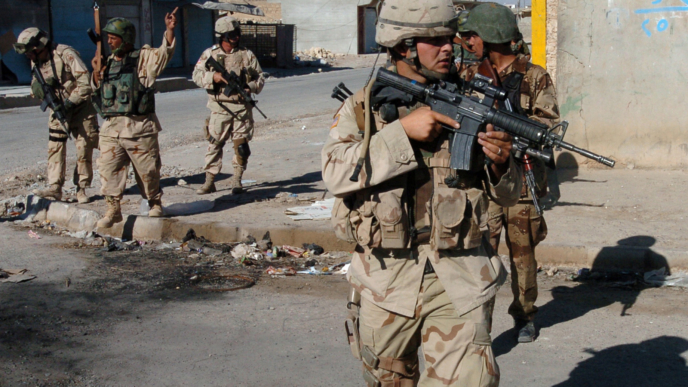
US military officials have escalated their warnings to Iran that a military conflict could be looming between the countries in Iraq due to incessant attacks on US-linked targets blamed on Tehran-backed militias. . .
Washington has expressed mounting concern about the flurry of attacks on US bases and diplomatic missions, several of which it has blamed on Shiite militia groups trained by its foe and rival for influence Tehran.
Tensions between Iran and the US have soared since Washington pulled out of a landmark nuclear agreement with Tehran last year and reimposed crippling sanctions.
Baghdad — which is close to both countries and whose many security forces have been trained by either the US or Iran — is worried about being caught in the middle. . .
A senior official was quoted Wednesday by the Reuters news agency as warning the escalation could become uncontrollable and that “no one will like the outcome.” (Read more from “U.S. Officials Warn of Uncontrollable Escalation With Iran in Iraq” HERE)
https://joemiller.us/wp-content/uploads/U.S._Army_and_Iraqi_soldiers_Tal_Afar_Iraq_Sept._11_2005-2.jpg12241840Joe Millerhttps://joemiller.us/wp-content/uploads/logotext.pngJoe Miller2019-12-12 20:30:402019-12-12 20:26:35U.S. Officials Warn of Uncontrollable Escalation With Iran in Iraq
President Trump wants to keep U.S. troops in Iraq for eyes on neighboring Iran
President Trump has floated the idea of keeping a strong U.S. military presence in Iraq to keep eyes on its neighbor, the terrorist regime that runs Iran.
The president made the comment during an interview with CBS that aired Sunday afternoon.
“I want to be able to watch Iran. All I want to do is be able to watch. We have an unbelievable and expensive military base built in Iraq. It’s perfectly situated for looking at all over different parts of the troubled Middle East rather than pulling up,” the president explained. “We’re going to keep watching and we’re going to keep seeing and if there’s trouble, if somebody is looking to do nuclear weapons or other things, we’re going to know it before they do.”
China to export ‘tiny cars’ to the United States
China is seeking to enter the U.S. auto market with ridiculously cheap electric vehicles. The U.S. version of the low-speed electric vehicles (LSEVs) will sell for under $10,000 dollars but will come with many restrictions, such as a top speed of under 40 miles per hour, that will make it impractical for long trips. It will also cost almost four times more than its cost in China.
Venezuela defections continue; more side with opposition
Venezuelan military officials continue to abandon socialist dictator Nicolas Maduro, siding with opposition leader Juan Guaido, who has declared himself the true interim president of Venezuela.
Over the weekend, a Venezuelan Air Force general posted a video announcing that he was supporting Guaido, claiming that 90 percent of the military no longer has faith in Maduro as its leader.
It’s still too early to tell who will prevail. The United States, along with much of the Western world, is pushing hard for Guaido to wrest control over the country from Maduro, whose socialist policies have left the country in ruins.
Trump State of the Union may include North Korea talks, wall funding
The president has hinted that two of the major national security and foreign policy issues he will discuss in his Tuesday State of the Union address are the upcoming North Korea summit and finding funding for border security. On Friday, the president said that his upcoming meeting with North Korean dictator Kim Jong Un “is set,” leading many to speculate that those details will emerge tomorrow. The president also said that there’s a “good chance” he will have to declare a national emergency to receive the funding necessary to secure the southern border.
(For more from the author of “The Dossier: Trump May Keep Troops in Iraq to Watch Iran” please click HERE)
https://joemiller.us/wp-content/uploads/37916062-Soldiers-in-assault-on-grunge-USA-flag-American-army-military-concept-Stock-Photo-1.jpg7791300Joe Millerhttps://joemiller.us/wp-content/uploads/logotext.pngJoe Miller2019-02-04 23:29:522019-02-04 23:26:49The Dossier: Trump May Keep Troops in Iraq to Watch Iran
For the past two Christmases, historically Christian neighborhoods and towns in Northern Iraq have passed the holiday without church bells, thanks to ISIS occupation. While this year will be different, those communities are still a long way from fully coming home. One organization is now trying to engage U.S. congregations and parishes to make their return possible.
News broke in October that the military campaign to retake Iraq’s second-largest city, Mosul, from the grips of ISIS’ occupation was met with hopeful anticipation.
In 2003, Iraq’s Christian population numbered around 1.4 million. Thirteen years later, that number has dwindled to just under an estimated 300,000, with most of it concentrated in lands once held by ISIS. Now, Iraqi Christians who want to return home have been met with post-occupation aftermath that leaves many of them wondering when they’ll be able to start putting the pieces of their lives back together.
The problems for those who are trying to repatriate are “multi-layered,” explains Juliana Taimoorazy, founder and president of the Iraqi Christian Relief Council (ICRC) and senior fellow at the Philos Project.
“First off, it’s cold,” she explained, noting the issues of trying to move populations during northern Iraq’s harsh winters. “Secondly, they’re returning to ground zero. The cities that have been liberated, completely … have been completely devastated.”
Taimoorazy is herself an Assyrian Christian. She was smuggled out of her native Iran into Switzerland in 1989 due to religious persecution from Iran’s Islamist regime. She eventually was granted asylum in Germany a year later before coming to the United States in 2000. Now, she works as an advocate for persecuted Christians in the Middle East with ICRC.
One of the biggest problems in the area has been ISIS’ use of chemical warfare and the lasting effect it has on the area. She notes that in one city alone, 60 percent of the homes have been chemically targeted, while many of the farms in the fertile region along the
Tigris River have also been chemically polluted.
Even worse, in many cases ISIS’ devastation has gone beyond the structural and economic damage done to homes, businesses, churches and farms, to something far more fundamental: the family.
“So many people are returning while their mothers and sisters have been sold into ISIS sex slavery, their fathers have been executed, or their kids are missing, ” Taimoorazy said. “So the family unit has been torn apart. It’s not the same as it used to be in many cases. In many ways, their crisis has just gotten worse.”
“This is where we’ve been asking the international community and the Iraqi government to think seriously about what [the displaced individuals’] return and rebuilding is going to look like,” Taimoorazy said. In response, she’s working through her organization to rebuild things, block by block.
The Iraqi Christian Relief Council began planning Operation Return to Nineveh shortly after the military campaign to reclaim Mosul began, launching it in mid-November. The operation’s mission is to “support the return of thousands of families to their ancestral towns [through] the rebuilding of community centers, schools, homes and churches destroyed by ISIS.”
ICRC’s focus currently is primarily on the town of Teleskof, north of ISIS lines, along with Bartella, Baghdeda (Qaraqosh), Karmlis, and Batanya in the Nineveh Plains region, which has been home to Christians since the first century A.D.
One of the group’s biggest efforts right now is to convince American congregations to adopt and sponsor churches in liberated areas for reconstruction and renewal.
“In a lot of these places, the local church structure is still standing, along with a lot of the homes,” Juliana Taimoorazy explained to CR. “But the things inside have been destroyed, looted, or burned.”
“Right now, the biggest challenge is that people are coming back to ground zero with very few [outsiders] stepping up to help,” she added, stating that the conditions present too big an obstacle for some to return at all.
“For the past two years a lot of the people I talk to say they have been living in limbo. They’ve had dreams of returning, and they haven’t been able to see what’s happened to their homes, their churches, and their community centers,” she said. “Now that they’ve been able to return and assess the damage, they’re completely heartbroken. Reality sinks in.”
While funds have come in from “all over the world,” Taimoorazy said, 95 percent of the money raised so far has come from individual donations in the United States. They’ve gotten sums raging from “$2.50 to thousands of dollars.” (Interested parties can donate to VictimsofISIS.org.)
“We are seeking churches to adopt ‘sister churches’ in the region to help them rebuild,” she said. “For example, we have a proposal from St. George’s Church in Teleskof that tells us how much the floor costs, how much the ceiling costs, the price of windows, and things like that.”
ICRC is also seeking corporate and nonprofit partners in their efforts, which have even earned the endorsement of evangelical author Erwin Lutzer, former senior pastor of the Moody Church in Chicago.
“This is an ongoing project and it’s going to be broken into phases,” said Taimoorazy. “Phase 1: the street, the block, so-and-so has been cleaned. Check mark. Phase 2: the Church rebuilding has begun. Check mark.” And so on.
But these efforts, and others like them, need all the help they can get to succeed. (Or even begin, in many cases.)
“I thank people [in the West] for standing with these [Christian refugees] while they were in displacement for two-and-a-half years,” Taimoorazy said. “But now the work begins. Now they need the church’s help, and American help, and Canadian help, and European help more than ever to help them rebuild their lives.” (For more from the author of “Many Iraqi Christians Won’t Be Home for Christmas. One Group Is Determined to Change That” please click HERE)
https://joemiller.us/wp-content/uploads/cross-13436635390nU.jpg12771920Joe Millerhttps://joemiller.us/wp-content/uploads/logotext.pngJoe Miller2016-12-26 23:11:092016-12-26 23:11:09Many Iraqi Christians Won’t Be Home for Christmas. One Group Is Determined to Change That
The aircraft parked on the ramp at this military base in northern Iraq offer a symbolic counterpoint to the White House narrative that U.S. forces are on the sidelines of the ground war against the Islamic State.
U.S. Army medevac Blackhawk helicopters are based here, including the one that picked up mortally wounded Navy SEAL Charles Keating IV under heavy enemy fire during a May 3 battle north of Mosul.
Also lined up on the tarmac are Army Apache attack helicopters; intelligence, surveillance, and reconnaissance aircraft; and a variety of armed special operations aircraft from different military branches.
“We’re in a war zone, and this place is dangerous,” an Army officer told The Daily Signal.
The U.S. base is an operational hub for Operation Inherent Resolve, the U.S.-led, 66-nation coalition combating Islamic State, the terrorist army also known as ISIS that holds territory in Iraq and Syria.
From the base in the vicinity of Erbil, capital of Iraqi Kurdistan, U.S. and coalition personnel coordinate airstrikes to support Kurdish peshmerga forces. U.S. special operations troops also stage operations from here to advise and assist the peshmerga during combat.
To accomplish the advise-and-assist mission, U.S. special operations troops frequently go into areas where combat is happening.
While embedded with the peshmerga on the ground, U.S. special operations troops sometimes call in airstrikes from coalition warplanes against ISIS forces, a U.S. Army officer told The Daily Signal on condition of anonymity due to security concerns and restrictions on speaking with news reporters.
The White House, however, has insisted U.S. ground forces in Iraq are not in combat.
The day of Keating’s death, White House Press Secretary Josh Earnest told reporters in Washington: “The relatively small number of U.S. service members that are involved in these operations are not in combat but are in a dangerous place.”
The night after Keating was killed, the mood on the base in northern Iraq was somber, yet there was not a feeling of shock or surprise.
For many U.S. military personnel on the ground in Iraq, Keating’s death underscored something they’ve known for a long time—U.S. special operations forces are neck-deep in the daily grind of the ground war against ISIS.
“Most people took it in stride,” the Army officer told The Daily Signal. “We’re in a war zone, and this place is dangerous. We know people are going to get hurt.”
Indispensable
The base in northern Iraq has all the trappings of other U.S. military installations spread across the Middle East, North Africa, and Central Asia.
It has a tent gym loaded with Crossfit equipment and truck tires stacked out back. Civilian contractors in khaki 5.11 Tactical cargo pants and button-down shirts are here. And inside the chow hall, called a DFAC, an eclectic mix of uniforms from coalition countries and military branches is on parade.
There’s also a subgroup of oft-bearded, elite troops who tend to stick to themselves.
The infrastructure at the base has expanded noticeably since this correspondent last visited in September 2015. More troops, tents, aircraft, and equipment are here than eight months ago.
The installation’s growth reflects the creeping growth in the U.S. presence in Iraq, and the increasingly indispensable role U.S. airpower and special operations support play in the ground war against ISIS.
“We can’t fight without U.S. airstrikes or U.S. support,” a Kurdish official at the Kurdistan Region Security Council told The Daily Signal on condition of anonymity due to security rules. “But the U.S. mission can’t exist without us. It’s a partnership.”
A Dangerous Place
U.S. special operations forces in Iraq for the advise-and-assist mission are not sequestered inside fortified compounds impervious to attack.
These members of the military, including Navy SEALs and Army Special Forces, deploy to team safe houses behind the front lines to carry out their mission and to forward stage as land-based, quick-reaction forces in case U.S. servicemen and servicewomen come under attack.
The Navy SEAL quick-reaction force in which Keating served was stationed at one such team house outside Mosul.
The SEALs deployed in “nontactical vehicles,” military jargon for civilian SUVs. The ensuing firefight lasted for hours, according to military personnel and news reports.
The U.S. Army DUSTOFF Blackhawk helicopter that picked up Keating came under heavy fire and returned pockmarked with bullet holes.
Keating was the third U.S. service member to die in Iraq from enemy fire since Operation Inherent Resolve began in 2014. And the May 3 battle wasn’t the first time U.S. aircraft took fire from ISIS over Iraq.
In September 2015, Air Force pararescuemen, also known as PJs, and combat rescue officers from the 57th Rescue Squadron, then deployed to this location, told The Daily Signal that ISIS forces frequently fired on the HH-60G Pave Hawk helicopters they used to forward position behind enemy lines.
“We take fire every time we go out,” a combat rescue officer said then.
Also in September, U.S. Air Force A-10 attack pilots flying missions over Iraq and Syria from a base in the Persian Gulf region said the volume of surface-to-air fire they faced was much higher than in Afghanistan.
“There’s a real threat here, unlike in Afghanistan,” an A-10 pilot told The Daily Signal at the time. “I’ve had a few close calls. Do we respect the threat? Yes. Are we afraid of it? No.”
Center of Gravity
The Department of Defense said it officially maintains 4,087 troops or less in Iraq and has plans to increase the number of special operations troops and support personnel in Syria from 50 to 300.
The number of U.S. troops on the ground in Iraq and Syria does not, however, reflect the aggregate U.S. war effort against ISIS.
To support Operation Inherent Resolve and military operations in North Africa, as well as operations in Afghanistan, the U.S. is standing up new bases and refurbishing old ones across the Middle East, reflecting a reversal of White House plans to draw down U.S. forces in the region.
“It’s busier now than it was a year ago,” Air Force Lt. Col. Mike Cummings, a C-130 pilot from the Alaska National Guard, told The Daily Signal during an interview at an undisclosed location in the Persian Gulf region.
“We were drawing down and now we’re building back up,” Cummings said. “Now we’re moving in the opposite direction.”
As of the end of April, the U.S. had conducted 9,073 airstrikes in Iraq and Syria in support of Operation Inherent Resolve, according to the Pentagon. Nearly all the U.S. military aircraft, manned and unmanned, launched from bases and Navy vessels outside Iraq and Syria.
U.S. Central Command, or CENTCOM, declined to disclose the number of bases U.S. forces use throughout the Middle East to support the operation.
CENTCOM also declined to disclose the total number of U.S. military personnel committed to Operation Inherent Resolve due to “host-nation sensitivities and operational security.”
According to news reports and open source data, about 50,000 U.S. military personnel are deployed throughout the Middle East, including locations in Turkey and Navy personnel at sea. And, according to CENTCOM, 9,800 personnel remain in Afghanistan.
In an emailed statement to The Daily Signal, a CENTCOM spokesperson said: “We maintain the necessary forces and capability throughout the region to assist our partners and respond to threats as appropriate.”
Chasing the Front Lines
The total number of U.S. troops throughout the Middle East region is only a fraction of the approximately 170,000 U.S. troops who were in Iraq alone during the “surge” in 2007.
And unlike the days of Operation Iraqi Freedom and Operation New Dawn, no countrywide network of U.S. forward operating bases and combat outposts inside Iraq exists from which ground and air forces can project power.
The war against ISIS in Iraq is a frontal war, with a clear delineation between enemy and friendly territory. The 1,200-mile-long front line in Iraq is defined in places by trenches and hilltop forts. Opposing camps trade potshots across no man’s land.
As Iraqi and Kurdish forces take back ground from ISIS, coalition air assets and advise-and-assist personnel constantly move to new bases closer to the shifting front lines. Some bases that were strategically positioned to launch warplanes a year ago are now inconveniently distant from the battlefield’s northward shifting center of gravity.
Bases in Turkey, consequently, play a more important role due to their geographical proximity to the battle space.
The Turkish air base at Incirlik, for example, was reopened to U.S. Air Force F-16s in August 2015 to conduct airstrikes against ISIS targets. The F-16s were swapped out for A-10 attack planes in October. And, according to news reports, F-15C fighter jets and F-15E strike aircraft also have deployed to Incirlik since August.
The total U.S. military force deployed at Incirlik has grown to nearly 2,500, up from about 1,300 last year, according to news reports.
Long-Term Plans
The Daily Signal recently visited an Air Force base at an undisclosed location in the Persian Gulf region. Military officials at the base said about 1,800 U.S. troops and about 2,200 civilian support personnel are deployed there.
The base is a key airlift hub for Operation Inherent Resolve and for supporting military operations in the Horn of Africa. The location is also the launching pad for U.S. and British drones flying missions over Iraq and Syria. Other coalition partner countries fly intelligence, surveillance, and reconnaissance missions from here.
Air Force Col. Clarence Lukes Jr., commander of the 386th Air Expeditionary Wing headquartered at the base, said Pentagon planners drew up a three- to five-year plan to build up its infrastructure after Operation Inherent Resolve kicked off in 2014. And, Lukes added, the Pentagon plans to use the base “for much longer.”
“This puts us in a perfect crossroads for different types of mission sets … regardless of the adversary,” Lukes said.
The base has a swimming pool, a movie theater, and a state of the art gym. Plans are under way to build brick and mortar dormitories to replace the tents and trailers in which most personnel now live.
A recreation center, called the Drop Zone, includes ping-pong tables, flat screen TVs tuned to the Armed Forces Network, and cans of nonalcoholic Beck’s beer in the fridge.
A coffee shop, the Green Bean, offers free Wi-Fi, mocha lattes, and protein shakes. Wi-Fi is available throughout the base. Self-serve ice cream and Krispy Kreme doughnuts can be found in the DFAC.
“Morale hinges on three things,” Lukes said. “Self-serve ice cream, laundry, and Wi-Fi.”
U.S. servicemen and servicewomen say there has been a noticeable uptick in operational tempo since Operation Inherent Resolve began almost two years ago. Yet, many also consider the battle against ISIS to be just the latest chapter in nearly 15 years of nonstop combat operations.
For them, combat deployments are now a way of life.
“It’s just the status quo,” Lt. Col. Corey Reed, deputy operations group commander for the 386th Air Expeditionary Wing, said. “As Afghanistan tapered off, OIR [Operation Inherent Resolve] kicked off. So it’s business as usual.”
“It’s like the last one never ended,” Cummings, the C-130 pilot, said. “It’s not really the start of something new.” (For more from the author of “‘People Are Going to Get Hurt’: America’s Quiet War in Iraq” please click HERE)
https://joemiller.us/wp-content/uploads/Elements_of_the_3rd_Stryker_brigade_on_patrol_in_Iraq_-a.jpg13122000Joe Millerhttps://joemiller.us/wp-content/uploads/logotext.pngJoe Miller2016-05-12 02:47:432016-05-12 02:47:43‘People Are Going to Get Hurt’: America’s Quiet War in Iraq
The oldest Christian monastery in Iraq has been reduced to a field of rubble, yet another victim of the Islamic State group’s relentless destruction of ancient cultural sites.
For 1,400 years the compound survived assaults by nature and man, standing as a place of worship recently for U.S. troops. In earlier centuries, generations of monks tucked candles in the niches and prayed in the cool chapel. The Greek letters chi and rho, representing the first two letters of Christ’s name, were carved near the entrance.
Now satellite photos obtained exclusively by The Associated Press confirm the worst fears of church authorities and preservationists — St. Elijah’s Monastery of Mosul has been completely wiped out.
In his office in exile in Irbil, Iraq, the Rev. Paul Thabit Habib, 39, stared quietly at before- and after-images of the monastery that once perched on a hillside above his hometown of Mosul. Shaken, he flipped back to his own photos for comparison.
“I can’t describe my sadness,” he said in Arabic. “Our Christian history in Mosul is being barbarically leveled. We see it as an attempt to expel us from Iraq, eliminating and finishing our existence in this land.” (Read more from “Oldest Christian Monastery in Iraq Is Razed” HERE)
https://joemiller.us/wp-content/uploads/logotext.png00Joe Millerhttps://joemiller.us/wp-content/uploads/logotext.pngJoe Miller2016-01-20 19:14:392016-04-11 10:53:37Oldest Christian Monastery in Iraq Is Razed
Amid Washington’s raging debate over refugees and religion, more than two dozen Iraqi Christians who crossed into the U.S. from Mexico in hopes of joining their friends and families are being deported after their bids for religious asylum were rejected.
A total of 27 Chaldean Christians, driven from their homeland by Al Qaeda and ISIS, entered the country in April and May, hoping to join the thriving Iraqi Christian community in and around San Diego. But the door to America is being slammed on the 17 men and 10 women over what their supporters say are technicalities.
“These are families who were split up because of religious persecution, and now the government – which we love – is preventing them from being reunited,” said Fr. Michael Bazzi, of St. Peter Chaldean Catholic Cathedral, in El Cajon. “We wonder why, for thousands of Muslims, the door is open to America, yet Christians are not allowed to come.”
The Chaldeans are among tens and possibly hundreds of thousands of Christians from Iraq and Syria who have been displaced by fighting and persecuted by Al Qaeda, ISIS and even the Iraqi government. But because some had first gone to Germany before making their way to the border, and in some cases were deemed to not have been forthcoming about it on their applications for religious asylum, they were held at the Otay Detention Center in San Diego since entering the U.S. while their applications were considered. So far, 22 have been ordered out of the U.S. and the other five are awaiting a likely similar ruling.
“We will continue to seek to remove the ones who have been ordered removed,” Immigration and Customs Enforcement spokeswoman Lauren Mack told FoxNews.com. (Read more from “While DC Debates Religion, Refugees, Iraqi Christians Feel Uncle Sam’s Boot” HERE)
An American soldier has died in Iraq as a result of the U.S. intervention to support Iraqi forces fighting the Islamic State. It’s the first loss of an American service member since the fight against ISIS began, and the first combat death in Iraq since 2011. U.S. special operations forces operating in Iraq in what Pentagon officials say was a supporting role took part in an Iraqi operation to free Iraqi hostages, including members of the Iraqi Security Forces. After more than 70 hostages were freed, 39-year-old Master Sgt. Joshua Wheeler, a veteran of 14 official combat deployments and doubtless several other less-official trips into danger, died of his gunshot wound.
His death has raised the question of how an American could have died in combat when America, at least according to President Barack Obama and his national security leaders, is not at war.
“We have this capability. It is a great American strength,” Carter said Friday at the Pentagon of special operations raids like the one this week. But he insisted those raids are not the same as the U.S. military “assuming a combat role.”
“Americans are flying combat missions, thousands of combat missions, over Syria and Iraqi territory. There are Americans involved in training and advising Iraqi security forces around the country. We do not have combat formations there the way we had once upon a time in Iraq, or the way we have had in years past in Afghanistan,” Carter said.
Pentagon press secretary Peter Cook had been blunter on Thursday: “Our mission in Iraq is the train, advise and assist mission. This was a unique circumstance…This was a support mission in which they were providing support to the Kurdistan Regional Government. U.S. forces are not in an active combat mission in Iraq.” (Read more from “Why It Matters That Carter Says Iraq Raid Isn’t Combat, Then Says It Is” HERE)
https://joemiller.us/wp-content/uploads/logotext.png00Joe Millerhttps://joemiller.us/wp-content/uploads/logotext.pngJoe Miller2015-10-24 01:16:182016-04-11 10:57:00Why It Matters That Carter Says Iraq Raid Isn’t Combat, Then Says It Is
American and Kurdish commandos raided an Islamic State prison in Iraq on Thursday, freeing about 70 captives believed to be facing “mass execution” and leaving one U.S. soldier dead, U.S. and Iraqi officials said.
It was the first time a member of the U.S. military had been killed in a combat situation in Iraq since President Obama pulled out all U.S. troops in 2011.
In a pre-dawn operation, soldiers from the Army’s Delta Force, supporting a team of elite Kurdish soldiers, descended on a militant compound in the town of Hawijah, where officials believed that dozens of Kurdish fighters known as peshmerga were being held captive.
Militants from the Islamic State, the extremist group that controls a vast area across Iraq and Syria, were planning an “imminent mass execution” of prisoners, Pentagon press secretary Peter Cook told reporters later in the day.
While peshmerga captives were not present at the site, the U.S. and Kurdish forces freed dozens of others, including more than 20 members of the Iraqi security forces, Cook said. Five Islamic State militants were captured, officials said, and at least 10 were killed. In a statement, the Kurdish Security Council said more than 20 militants were killed. (Read more from “First American Soldier Is Killed in Combat in Iraq Since 2011 Troop Exit” HERE)
https://joemiller.us/wp-content/uploads/logotext.png00Joe Millerhttps://joemiller.us/wp-content/uploads/logotext.pngJoe Miller2015-10-23 00:40:202016-04-11 10:57:02First American Soldier Is Killed in Combat in Iraq Since 2011 Troop Exit
Nearly half of the 27 Iraqi Christians the Obama administration has been holding for the past six months at an ICE detention center in Otay Mesa, California, are set to be deported in coming weeks, U.S. Immigration and Customs Enforcement said Monday.
An immigration judge ordered their removal in the last two weeks, ICE spokeswoman Lauren Mack said. She declined to provide specific information about why the immigrants are being deported and where they will be taken.
Immigrants who face deportation are typically returned to the country where they were living before entering the United States. It’s likely that most of the Iraqis will be deported to such countries as Australia, New Zealand, Turkey, Lebanon and Jordan, where many United Nations refugee camps are stationed . . .
The 27 Iraqi Christians — also known as Chaldeans — have been detained in Otay for about six months as their immigration cases proceeded, activists and family members told the San Diego Union-Tribune.
The Chaldeans were detained by immigration authorities after they attempted to cross the U.S.-Mexico border through the San Ysidro Port of Entry without documentation several months ago. (Read more from “Obama Set to Deport 12 Iraqi Christian Refugees” HERE)
https://joemiller.us/wp-content/uploads/logotext.png00Joe Millerhttps://joemiller.us/wp-content/uploads/logotext.pngJoe Miller2015-09-16 23:55:402015-09-16 23:55:40Obama Set to Deport 12 Iraqi Christian Refugees
By Michael Warren. A new ad from the group Veterans Against the Deal features retired Army staff sergeant Robert Bartlett, who in 2005 was badly injured while serving in Iraq. The supplier of the bomb that “cut me in half, from the left corner of my temple to through my jaw” was the regime in Iran. In the ad, Bartlett urges Americans to tell their senators to vote against the proposed nuclear deal with Iran . . .
Watch the 60-second ad below:
(Read more from “Iraq Vets Release Urgent Message: Do Not Let Your Senators Pass Iran Deal” HERE)
By Josh Rogin. A group of Iraq war veterans is launching a million-dollar effort to oppose President Obama’s nuclear deal with Iran, trying to counter the president’s argument that those who are against the deal are in favor of war.
Obama has said recently that there are only two camps: those who support the deal versus those who would prefer a bloody and costly war like the conflict in Iraq. The new ad campaign complicates that, asserting that the deal itself will lead to more war. And the voices putting forth that case do not prefer war; they are soldiers who have had enough of it.
The group, Veterans Against the Deal, was founded last month as a 501(c)(4) nonprofit, and it does not disclose its donors. Its national campaign starts today, including television ads in states whose members of Congress are undecided on the Iran deal. Lawmakers will vote on it in September.
The first of the group’s videos features retired staff sergeant Robert Bartlett, who was badly injured by an Iranian bomb while serving in Iraq in 2005. “Every politician who is involved in this will be held accountable, they will have blood on their hands,” he says in the ad. “A vote for this deal means more money for Iranian terrorism. What do you think they are going to do when they get more money?”
The first ad will go up in Montana, aimed at Democratic Senator Jon Tester. Subsequent ads will air in North Dakota, West Virginia and elsewhere. The group will also send veterans to speak at events in key states. (Read more from this story HERE)
https://joemiller.us/wp-content/uploads/logotext.png00Joe Millerhttps://joemiller.us/wp-content/uploads/logotext.pngJoe Miller2015-08-11 00:30:212015-08-11 00:30:21Iraq Vets Release Urgent Message: Do Not Let Your Senators Pass Iran Deal [+video]