Posts

Mattis Was Asked About the Synagogue Shooting — His Answer Held Nothing Back

By The Daily Caller. Secretary of Defense James Mattis on Sunday condemned the person accused of killing 11 people at a Pittsburgh synagogue, calling him a “coward” and not a real man. . .

“This individual — I won’t even call him a man — he’s the poorest excuse for a man you could ever come up with,” Mattis said, according to the Military Times.

“Who would use a weapon in a house of worship, on unarmed innocent people and even shoot four policemen, then surrender himself? This is a coward,” Mattis added. “He is not a man by any definition that we use in the Department of Defense.”

(Read more from “Mattis Was Asked About the Synagogue Shooting — His Answer Held Nothing Back” HERE)

______________________________________________

In Pittsburgh’s ‘Darkest Hour,’ 2,500 Attend Synagogue Massacre Memorial

By CNBC. Some 2,500 people gathered on Sunday at a memorial service for the 11 Jewish worshipers slain in their Pittsburgh synagogue during Sabbath prayers, a mass murder the mayor called the city’s “darkest hour” while exhorting mourners to “defeat hate with love.”

Several speakers addressing an overflow crowd at the University of Pittsburgh’s Soldiers and Sailors Hall sounded themes of inclusion and unity, in counterpoint to the rise of toxic political discourse widely seen as creating an atmosphere conducive to violence.

“What happened yesterday will not break us. It will not ruin us. We will continue to thrive and sing and worship and learn together and continue our historic legacy in the city with the friendliest people that I know,” Rabbi Jonathan Perlman told the interfaith audience.

Three members of his congregation were among those killed when a man armed with an assault rifle and three handguns on Saturday stormed the Tree of Life temple in the city’s heavily Jewish Squirrel Hill neighborhood yelling “All Jews must die” as he opened fire on worshipers.

In addition to the 11 mostly elderly victims who were killed, six people, including four police officers, were wounded before the suspect was arrested. Two of the surviving victims remained hospitalized in critical condition. (Read more from “In Pittsburgh’s ‘Darkest Hour,’ 2,500 Attend Synagogue Massacre Memorial” HERE)

Follow Joe Miller on Twitter HERE and Facebook HERE.

Mattis Makes Announcement on the Future of Military Exercises With South Korea

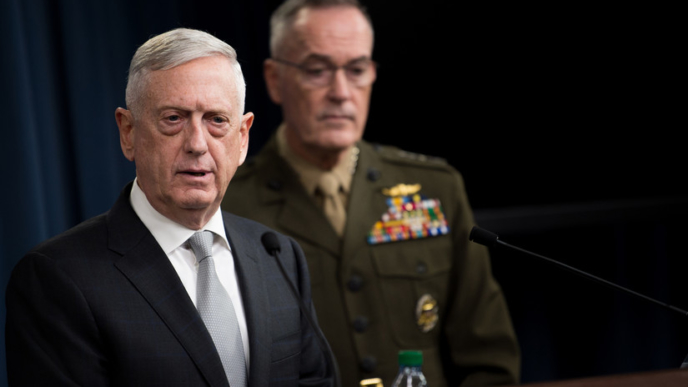
U.S. Secretary of Defense James Mattis told reporters Tuesday that the U.S. is preparing to resume military exercises with South Korea after they were briefly suspended this past summer.

“We took the step to suspend several of the largest military exercise as a good faith measure,” Mattis said at the Pentagon. “We have no plans at this time to suspend any more exercises.”

“We will work very closely … with the Secretary of State and what he needs done, we will certainly do to reinforce his effort,” he added. “But at this time there is no discussion about further suspensions.”

Following a historic summit with North Korean leader Kim Jong Un in June, President Trump suspended war games with South Korea as a gesture of good faith in the denuclearization process. . .

However, relations with North Korea have recently stalled. President Trump cancelled Secretary of State Mike Pompeo’s planned trip to North Korea last week, citing the lack of progress in the goal of denuclearization.

(Read more from “Mattis Makes Announcement on the Future of Military Exercises With South Korea” HERE)

Follow Joe Miller on Twitter HERE and Facebook HERE.

Mattis Gives Disturbing Reasons Why Number Of Americans Qualified For Military Is Dropping

The number of Americans qualified for military service is dropping, Defense Secretary James N. Mattis warned late Wednesday, citing drug abuse, obesity and a lack of “morals” as key reasons why nearly three-quarters of young people can’t meet the minimum requirements.

“We are no longer receiving people from the society who are as much in step with the qualities that our institution must have for success on the battlefield,” Mr. Mattis told reporters Wednesday, following his address to Air Force Academy graduates in Colorado Springs, Colorado. . .

“More than 70 percent of 18- to 24-year-old males and females cannot qualify to be a private in the Army. … I’m told it’s 72 percent, it’s unfortunately going up,” he said.

“This is combination of illicit drug abuse, illicit drug use, obesity is probably the biggest one, morals, you know, just arrests, that sort of thing and there are other reasons,” he continued, adding academic failings as another major factor.

There are roughly 34 million Americans between the ages of 17 and 24. Of those, about 24 million are ineligible to serve, according to a recent report from the conservative Heritage Foundation. (Read more from “Mattis Gives Disturbing Reasons Why Number Of Americans Qualified For Military Is Dropping” HERE)

Follow Joe Miller on Twitter HERE and Facebook HERE.

‘Christmas Card’ Gen. Patton Gave US Troops May Be Manliest Ever Created

When then-President-elect Donald Trump announced Gen. James “Mad Dog” Mattis as his pick for secretary of defense, he told a crowd in Cincinnati, “They say that he is the closest thing to Gen. George Patton that we have,” according to RealClearPolitics.

That was no small statement. Patton looms large over American political history, especially after George C. Scott’s masterful screen performance as the World War II general.

Few scenes in American cinematic history are as iconic as Scott, in character, pacing before the American flag and delivering a speech to his men.

And yet, for all of Hollywood’s hero-making, the real man was even more of a legend — and this Christmas card proves just that.

During the holiday season of 1944, Patton’s Third Army was bogged down in its advance against the Germans.

According to WND, Patton was delayed as he was trying to reach Bastogne, a town in southern Belgium held by 15,000 American troops but encircled by over 50,000 Nazi soldiers bearing down on it.

Unfortunately, due to the weather, Gen. Patton didn’t have the air cover he needed to relieve the 15,000 brave American troops holding off the Germans.

That’s when he decided to rely on the power of prayer.

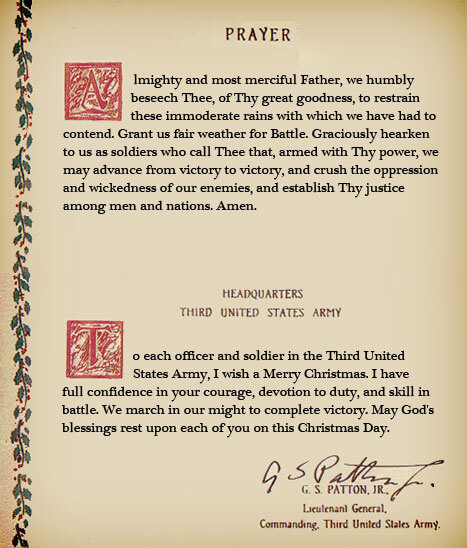
Patton had Chaplain Fr. James O’Neill compose a card to be distributed to each one of the 250,000 troops under his command in the Third Army, and had all of the men pray this simple prayer:

“Almighty and most merciful Father, we humbly beseech Thee, of Thy great goodness, to restrain these immoderate rains with which we have had to contend,” it read.

“Grant us fair weather for Battle. Graciously hearken to us as soldiers who call Thee that, armed with Thy power, we may advance from victory to victory, and crush the oppression and wickedness of our enemies, and establish Thy justice among men and nations. Amen.”

On the reverse side, Patton wrote, “To each officer and soldier in the Third United States Army, I wish a Merry Christmas. I have full confidence in your courage, devotion to duty, and skill in battle. We march in our might to complete victory. May God’s blessings rest upon each of you on this Christmas Day. — G.S. Patton, Jr., Lieutenant General, Commanding, Third United States Army.”

And it worked.

The next day, the weather cleared, Patton’s Third Army made its way into Bastogne to relieve the 101st Airborne, stymie the Nazis, and … well, you know the rest.

If that isn’t a Christmas card to end all Christmas cards, I don’t know what is. (For more from the author of “‘Christmas Card’ Gen. Patton Gave US Troops May Be Manliest Ever Created” please click HERE)

Follow Joe Miller on Twitter HERE and Facebook HERE.

Mattis Wants Open-Ended Wars — With No Accountability

We’ve been fighting open-ended and undeclared wars for 16 years. The worst thing is that they are not even wars, but rather refereeing Islamic civil wars, engaging in social work, and implementing urban renewal projects. Yet, rather than tightening our focus to comport with our current national interests, which are very different from the days immediately after 9/11, Mattis and Tillerson want to continue the status quo. Meanwhile, we continue to bring their boots to our ground and import hundreds of thousands of migrants from these very same countries.

The status quo has cost us trillions of dollars and thousands of lives, yet we have nothing to show for it but a stronger Iran, stronger Sunni insurgency, and hundreds of thousands more Islamic refugees we’ve taken in as a result of these wars. We’ve placed our boots on their ground and placed their boots on our ground — all under the promise of protecting the homeland!

It’s time for a focused debate on strategic interests

I’m a hawk who relishes the prospect of killing those who would harm our strategic interests. And that is exactly why I believe it’s high time for Congress to get back on the playing field, reinvigorate constitutional powers to declare war, and finally provide some direction to the aimless social work and third-world urban renewal projects in which we’ve mired our military for the past 16 years. It’s time for Congress to engage in a complete operational audit to rein in and better direct the focus of these rudderless wars in dozens of countries that gratuitously place our troops at risk indefinitely with no meaningful outcome.

Yesterday, at a hearing before the Senate Foreign Relations Committee, Secretary of State Rex Tillerson and Secretary of Defense James Mattis suggested that even the robust proposal of an AUMF (authorization of use of military force) from the committee members wasn’t good enough. The bipartisan group of senators are seeking to update the 2001 and 2002 AUMFs and explicitly grant a five-year authorization to go after the Taliban, Al Qaeda, and ISIS in Afghanistan, Iraq, Libya, Somalia, Syria, and Yemen. Any other groups would require new approval, and action taken against these groups in other countries will require notification of Congress.

This proposal by itself, in my view, is already too open-ended because we have no understanding of who we are fighting and on behalf of whom we are holding ground in most of those countries. Just look at what we’ve done in Iraq — empowering Shiite militias and Iran to crush the Kurds, our only stable ally. What exactly does “fighting ISIS” mean in the context of multi-fronted civil wars in countries that no longer exist? And what does “fighting the Taliban” mean after 16 years of trying everything but still incurring the worst results, according to the latest inspector-general report? We won’t find out those answers unless we force a debate.

Yet Mattis and Tillerson want more. Mattis said there should be no time or geographical constraints, and Tillerson suggested that Congress should serve as a mere “feedback loop.”

Mattis and Tillerson seem to think that continuing the failed policies of the past 16 years, without congressional buy-in, without conducting a risk vs. return and cost-benefit analysis, and while deviating from the Constitution, is being tough on terror. They are conflating more endless involvement with being tougher on jihad or other threats that directly affect our homeland. In reality, we must conserve our forces for the true existential threats, such as Iran and North Korea, and focus on homeland security, deterrent, and use of soft power against Turkey, Qatar and other funders of Jihad.

Here’s the reality. There are roughly 50 Muslim countries in the world. All of them will have a permanent presence of organized groups that call themselves “Al Qaeda,” ISIS,” or new names we’ve never heard of but undoubtedly will in the coming years. At some point, it’s not worth getting sucked into any theater where some group is shaking their fists at us from a tent in a desert. This is especially true given that in most of these theaters, there are multiple enemies fighting each other and no way to gain and hold ground long-term on behalf of a government that is stable, effective, and pro-American.

Our military does well when we deter a regime or an enemy entity with overwhelming power, leave them to sort out their problems, and get the heck out so we can conserve our deterrent for the next threat. We fail miserably when we engage in protracted refereeing of Islamic civil wars, for powers that will never make us a return on our investments. This is how all our painful endeavors have wound up serving as a windfall for our enemies, most notably Iran.

But instead of learning the mistakes of Iraq, with the glaring images of Iranian-backed troops killing Kurds with our own weapons, our political and military leaders are on to the next theater. And in Syria, the commanding generals don’t even know how many troops we have. Afghanistan is an utter disaster, yet nobody wants to answer important questions:

It’s time to follow the Constitution

This is where we must return to the Constitution and congressional control over initiating offensive actions. Getting congressional authorization for a war is not just the constitutional thing to do, it is strategically smart. It focuses our attention and provides an opportunity for the people through their elected representatives to ask the critical questions: What is the strategic threat and what are our interests? Who are we fighting? Who’s holding the ground? For how long? How it is sustainable? Likely costs? Likely benefits? It gets the confidence of the public behind the action, an imperative ingredient for success. Then, once Congress authorizes the action, the commander-in-chief controls the military and directs the strategy.

This is why the delegates at the Constitutional Convention specifically changed Article I powers from “make” war to “declare” war. They wanted the president to direct the implementation of the war, but clearly, as Madison said, we must abide by the “fundamental doctrine of the Constitution that the power to declare war is fully and exclusively vested in the legislature.”

Clearly, at the time of our Founding, any offensive action taken on foreign soil would have required a declaration of war. However, since WWII, primarily due to the changing logistics of warfare and technology and the nature of threats, we haven’t abided by that doctrine. One can make a strong case for the need to strike swiftly in short-term operations or air strikes when necessary, but it is simply indefensible to suggest that we can insert our troops on the ground indefinitely for years in untenable situations without any congressional buy-in. At least that latter dynamic must come to an end; otherwise our Constitution will become a mockery and our chances for success in foreign operations will be next to zero. It’s time to make our wars properly focused.

To that end, we should propose an AUMF that authorizes any offensive actions around the globe where boots are on the ground for less than 30 days. In this respect, it is even more open-ended than what the Senate committee is proposing. This will grant the president the flexibility to immediately respond to or preempt any threat he deems imminent. However, if we need to keep troops on the ground for longer than 30 days, by definition, this is a can of worms that requires national buy-in and a serious debate over the nature of the threat, an assessment of whether the investment is worthwhile, and an understanding of the players in the theater. A provision can be inserted that would exempt clandestine operations lasting longer than 30 days from a public debate and route the authorization process instead to a closed vote from the committee. This is the only way to finally inject some oversight and forward thinking into endless involvement in Islamic civil wars.

Proponents of the status quo like to wrap themselves up in the flag and accuse those who want change of pulling the rug out from under the troops. The reality is that continuing the status quo ensures their mission fails the minute they step foot on foreign territory. For how can a mission succeed if we can’t even define it? (For more from the author of “Mattis Wants Open-Ended Wars — With No Accountability” HERE)

Follow Joe Miller on Twitter HERE and Facebook HERE.

Here’s How Mattis Plans to Win the War in Afghanistan

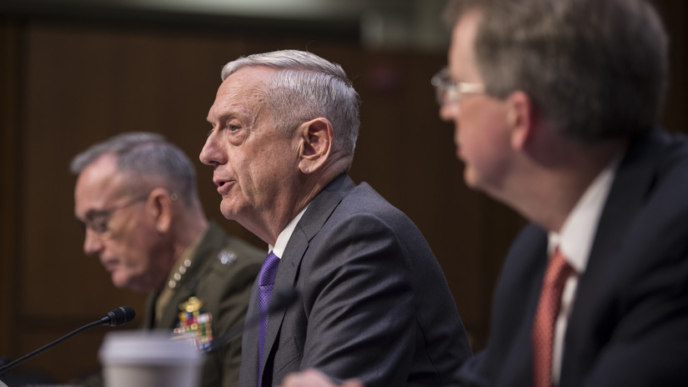
Secretary of Defense James Mattis offered the most detailed view of President Donald Trump’s strategy to turn the tide of war in Afghanistan Tuesday before the Senate Armed Services Committee.

Mattis’s prepared testimony laid out an “R4+S” strategy, which stands for “regionalize, realign, reinforce, reconcile, and sustain.” The strategy hits upon larger themes of Trump’s Aug. 21 address to the American people, when he pledged to adopt a conditions-based approach for withdrawal from Afghanistan that focuses on pressuring Pakistan to crack down on terror safe havens.

The first three R’s emphasize the regional approach the administration intends to take, providing additional U.S. military advisers at lower levels of the Afghan National Security Forces, and pledging to stay in Afghanistan for the foreseeable future. Mattis deployed an additional 3,000 U.S. troops to Afghanistan shortly after Trump’s address to carry out this mission.

The ultimate goal of the strategy is “reconciliation,” which entails “convincing our foes that the coalition is committed to a conditions-based outcome, we intend to drive fence-sitters and those who will see that we’re not quitting this fight to reconcile with the Afghan National Government.” (Read more from “Here’s How Mattis Plans to Win the War in Afghanistan” HERE)

Follow Joe Miller on Twitter HERE and Facebook HERE.

Taliban and ISIS Claim Responsibility for Attack Targeting James Mattis

The Taliban and ISIS have both claimed responsibility for a failed rocket attack at Afghanistan’s main airport Wednesday which targeted Defense Secretary James Mattis.

Taliban spokesman Zabiullah Mujahid said via Twitter that the Taliban launched the attack at Kabul’s Hamid Karzai International Airport and that the main target was Mattis, according to CNN.

Meanwhile, Reuters reported that ISIS also claimed responsibility for the attack via its Amaq news agency.

According to Afghan Interior Ministry spokesman Najib Danis, five civilians were injured, including one critically. Mattis and NATO Secretary General Jens Stoltenberg, who were in Afghanistan for an unannounced visit, had left the airport hours before the attack.

Citing U.S. military officials, ABC News reported that up to 40 rounds of munitions struck the airport, 29 of which were rocket-propelled grenades.

Danis said that the rockets were fired from an unknown location and landed in an open area.

Mattis’ trip was not publicized, but two Taliban commanders told NBC News that “insiders” in the Afghan security community and at the Kabul airport had leaked Mattis’ plans to them.

“We fired six rockets and planned to hit the plane of U.S. secretary of defense and other U.S. and NATO military officials,” said one of the commanders.

“We were told by our insiders that some losses were caused to their installations but we are not sure about James Mattis,” the commander added.

Mattis remarked on the attack during a news conference with Ghani and Stoltenberg, saying that he had only heard some news reports but “an attack on an airport anywhere in the world is a criminal act by terrorist.”

“If in fact this is what they have done, they will find the Afghan Security Forces continuing on the offensive against them in every district of the country right now,” Mattis said.

Mattis’ trip to the country was his first since late August, when President Donald Trump announced a new strategy for the war in Afghanistan.

Afghan President Ashraf Ghani confirmed Afghan special forces were addressing the incident, and had surrounded two houses near the airport in their search for suspects. (For more from the author of “Taliban and ISIS Claim Responsibility for Rocket Attack Targeting James Mattis” please click HERE)

Follow Joe Miller on Twitter HERE and Facebook HERE.

Defense Department Delays Costly Transgender Policy, for Now

Defense Secretary James Mattis has granted the request of top military brass to postpone the Obama-era policy of admitting openly transgender individuals to the armed services until Jan. 1, but a delay is only the first step to blocking the policy, opponents said.

That’s because LGBT activists and the RAND Corp. have been scripting implementation plans from day one, and they are still there, said Elaine Donnelly, president of the Center for Military Readiness, a conservative pro-defense group.

“Everyone should realize that we have a lot of work to do,” Donnelly told The Daily Signal, referring to opposing the agenda set by activists for lesbian, gay, bisexual, and transgender Americans.

“Forget six months: We have only four months, at best, to turn this around. Time to start the engines,” she added.

A RAND Corp. study determined that 2,500 service members and another 1,500 in the reserves were transgender.

Donnelly’s Center for Military Readiness recently released a report urging the Pentagon to revoke the policy ordered last year by then-Defense Secretary Ashton Carter, citing:

–Open-ended costs for lifetime hormone treatments and sometimes irreversible surgeries.

–Infringements on personal privacy in conditions of forced intimacy.

–Demoralizing pressures on military commanders, doctors, and nurses to approve, participate in, or perform procedures that violate medical ethics or sincerely held personal or religious convictions.

“Transgender advocates demand special status for recruits seeking lifetime medical benefits despite deployability problems,” Donnelly said. “They also demand coverage for veterans in an already-overloaded system and for family dependents, including minor children.”

Mattis made the correct move, said Ryan T. Anderson, a senior research fellow in the DeVos Center for Religion and Civil Society at The Heritage Foundation.

“The Obama administration in its last days rushed to impose a politically driven agenda on the entire military,” Anderson told The Daily Signal. “Secretary of Defense Mattis is correct to hit the pause button, to take the time to get this policy correct, maintain military effectiveness, and respect the dignity of all people involved.”

LGBT groups weren’t happy with the Defense Department decision, but expressed some confidence the transgender policy eventually would be implemented.

“Transgender service members have been serving, openly and authentically, since October 2016 with no impact on readiness,” Matt Thorn, executive director for OutServe-Servicemembers Legal Defense Network, a Washington-based advocacy group for LGBT individuals in the military, said in a prepared statement.

Thorn added:

It is time to fully lift the ban on transgender service by enacting this final piece and implementing the accessions policy. This delay is a disservice to the transgender community and to our military as a whole. While we cannot now avoid this six-month delay, we expect the full and unequivocal implementation of this accessions policy for transgender individuals at the end of these six months.

Stephen Peters, spokesman for the Human Rights Campaign, an influential LGBT organization, said in a statement: “Each day that passes without the policy in place restricts the armed forces’ ability to recruit the best and the brightest, regardless of gender identity.”

During a June 28 hearing of the House Armed Services Committee, Rep. Vicky Hartzler, R-Mo., called for Congress to strike the policy because of the cost to readiness.

The surgeries would cost the military an estimated $1.35 billion over the next decade, Hartzler said. Among the items the funds could be used for are 13 F-35s, 14 Super Hornet F-18s, or two B-21 Long Strike Bombers, she said.

“By recruiting and allowing transgender individuals to serve openly in our military, we are subjecting taxpayers to high medical costs, including an average of $130,000 per transition surgery, lifetime hormone treatments, and potential additional surgeries to address the average 25 percent of individuals who experience complications in addition to possible mental health issues and cost of training policies,” Hartzler said during the hearing.

A Rasmussen poll released Friday found that 23 percent of likely voters support allowing openly transgender individuals to serve in the military. Another 31 percent said it’s bad for the military, while 38 percent said it would have no impact.

In a memo announcing the decision released Friday evening, Mattis said the delay “in no way presupposes an outcome.”

“Since becoming the secretary of defense, I have emphasized that the Department of Defense must measure each policy decision against one critical standard: Will the decision affect the readiness and lethality of the force?” Mattis said in the memo, adding:

Put another way, how will the decision affect the ability of America’s military to defend the nation? It is against this standard that I provide the following guidance on the way forward in accessing transgender individuals into the military services.

If the Obama administration policy is fully implemented, the cost to readiness, recruitment, retention, morale, and cohesion will be even greater than the monetary costs, said retired Lt. Gen. William “Jerry” Boykin, a former Army Delta Force commander.

Boykin cited a report that the military is getting machinery parts from museums because of budget constraints.

“The military has been reduced to stripping parts from museums, which is why it makes no sense to spend more than a billion taxpayer dollars on new body parts for anyone who joins the military and identifies as transgender,” Boykin, now an executive vice president at the Family Research Council, said in a formal statement.

“After lost deployment and other costs are factored in, taxpayers could be on the hook for as much as $3.7 billion over the next 10 years. Spending billions of dollars on transgender surgeries and treatment plans, when the military has other priorities that would actually ensure its effectiveness in war, is irresponsible.” (For more from the author of “Defense Department Delays Costly Transgender Policy, for Now” please click HERE)

Follow Joe Miller on Twitter HERE and Facebook HERE.

US rushing dozens of submersible killer drones to Persian Gulf

The Navy is rushing dozens of unmanned underwater craft to the Persian Gulf to help detect and destroy mines in a major military buildup aimed at preventing Iran from closing the strategic Strait of Hormuz in the event of a crisis, U.S. officials said.

The tiny SeaFox submersibles each carry an underwater television camera, homing sonar and an explosive charge. The Navy bought them in May after an urgent request by Marine Gen. James Mattis, the top U.S. commander in the Middle East.

Each submersible is about 4 feet long and weighs less than 100 pounds. The craft are intended to boost U.S. military capabilities as negotiations with Iran over its nuclear program appear to have stalled. Three rounds of talks since April between Iran and the five countries in the United Nations Security Council plus Germany have made little progress.

Some U.S. officials are wary that Iran may respond to tightening sanctions on its banking and energy sectors, including a European Union oil embargo, by launching or sponsoring attacks on oil tankers or platforms in the Persian Gulf. Some officials in Tehran have threatened to close the narrow waterway, a choke point for a fifth of the oil traded worldwide.

The first of the SeaFox submersibles arrived in the Gulf in recent weeks, officials said, along with four MH-53 Sea Dragon helicopters and four minesweeping ships, part of a larger buildup of U.S. naval, air and ground forces in the region aimed at Iran.

Read more from this story HERE.

Photo credit: Official U.S. Navy Imagery