Posts

Mark of the Beast Watch: COVID Tech Startup Says Technology WILL Be Able to Track Your Every Move

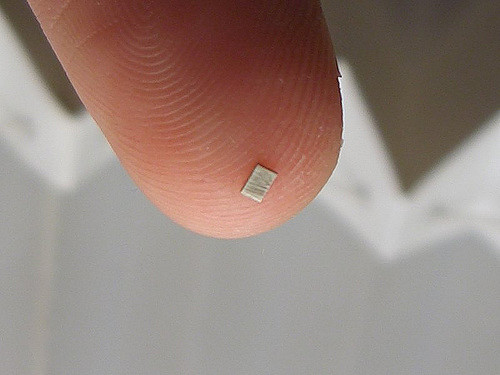
By Express UK. A Swedish start-up tech company announced earlier this month that it invented a scannable microchip that is implanted in people’s arms and can display your COVID-19 vaccination status. This digital implant is designed to be embedded into people’s arms so your vaccine passport pops up when scanned.

While new in humans, this kind of technology is very common for household pets, where most of them are embedded with a microchip that reveals the animal’s medical history when scanned.

For the many people that would be sceptical of the device, the company assured that the implants are not tracking devices, and are only in use when they are scanned.

However, Paul McClure, the co-founder of a different scannable medical card called MedTag, says other companies will be able to use the technology to track people.

Speaking to Express.co.uk, Mr McClure explained: “Basically, the technology works on Near Field Communication (NFC). (Read more from “Mark of the Beast Watch: COVID Technology Startup Says Technology Will Be Able to Track Your Every Move” HERE)

_____________________________________________________________

YouTube Takes Down Antivax Joe Rogan Interview With Dr Robert Malone Which Likened Vaccines to Mass Psychosis

By The Independent. YouTube has removed a video of a recent episode of the Joe Rogan Experience in which the podcast host was talking to Dr Robert Malone – a physician with a history of controversial statements related to Covid-19.

The episode in question, No 1757, was uploaded to Spotify on New Year’s Eve, as Mr Rogan has an exclusive deal with the streaming service. While Mr Rogan no longer uploads full shows to YouTube, several third-party channels have taken it upon themselves to post the episodes that would otherwise only be available on Spotify.

While a number of recent JRE episodes remain on YouTube, one featuring Dr Malone was removed by the platform after only a few hours, The Post Millenial reports.

Given the doctor’s contested views on Covid-19, including his opposition to vaccine mandates for minors, the act by YouTube has sparked several accusations of censorship amongst right-wing politicians and political commentators. (Read more from “YouTube Takes Down Antivax Joe Rogan Interview With Dr Robert Malone Which Likened Vaccines to Mass Psychosis” HERE)

Delete Facebook, Delete Twitter, Follow Restoring Liberty and Joe Miller at gab HERE.
Are We Entering the Age of the Biochip?

Biochips are usually encased in medical glass, have a tiny antenna and an integrated circuit that transmits data when scanned by an electronic reader.

They might be little more than a gadget at this point, but they’re showing signs of catching on. The tiny chips already can replace keys, credit cards and train tickets and buy snacks. The tipping point from novelty to necessity seems inevitable. But what about security? What about privacy?

In 2004, the FDA approved a chip that would store medical records and be implanted in the upper arm. The idea was that it would save time in an emergency. Doctors would be able to scan the chip and quickly learn the patient’s blood type, allergies and health history. A market for the chip didn’t materialize. It failed. A key reason: Doctors said patients were concerned about privacy. . .

Five states — California, Missouri, North Dakota, Oklahoma and Wisconsin — already have passed laws prohibiting “mandatory implantation” of biochips. And what about hacking? As more and more people get biochipped and credit card numbers are stored, won’t criminals soon follow? It’s happened with credit cards, and they are passive. . .

Whether or not it’s the end times, a more immediate question might be: Will biochips mark the end of our personal privacy, or will they finally be embraced by a once-skeptical public? (Read more from “Are We Entering the Age of the Biochip?” HERE)

Follow Joe Miller on Twitter HERE and Facebook HERE

Americans Warming to What Some Call ‘Mark of the Beast’

When Patrick McMullan wants a Diet Dr Pepper while he’s at work, he pays for it with a wave of his hand. McMullan has a microchip implanted between his thumb and forefinger, and the vending machine immediately deducts money from his account. At his office, he’s one of dozens of employees who have been doing likewise for a year now.

McMullan is the president of Three Square Market, a technology company that provides self-service mini-markets to hospitals, hotels, and company break rooms. Last August, he became one of roughly 50 employees at its headquarters in River Falls, Wisconsin, who volunteered to have a chip injected into their hand.

The idea came about in early 2017, he says, when he was on a business trip to Sweden—a country where some people are getting subcutaneous microchips to do things like enter secure buildings or book train tickets. It’s one of very few places where chip implants, which have been around for quite a while, have taken off in some fashion.

The chips he and his employees got are about the size of a very large grain of rice. They’re intended to make it a little easier to do things like get into the office, log on to computers, and buy food and drinks in the company cafeteria. Like many RFID chips, they are passive—they don’t have batteries, and instead get their power from an RFID reader when it requests data from the chip (McMullan’s chip includes identifying information to grant him access to the building, as well as some basic medical information, for instance).

A year into their experiment, McMullan and a few employees say they are still using the chips regularly at work for all the activities they started out with last summer. Since then, an additional 30 employees have gotten the chips, which means that roughly 80 of the company’s now 250 employees, or nearly a third, are walking, talking cyborgs. (Read more from “Americans Warming to What Some Call ‘Mark of the Beast'” HERE)

Follow Joe Miller on Twitter HERE and Facebook HERE.

USA Today Channels the Mark of the Beast: ‘All Americans Will Be Chipped – Eventually’

“It will happen to everybody,” says Noelle Chesley, 49, associate professor of sociology at the University of Wisconsin-Milwaukee. “But not this year, and not in 2018. Maybe not my generation, but certainly that of my kids” . . .

For now, Three Square Market, or 32M, hasn’t offered concrete benefits for getting chipped beyond badge and log-on stats. Munster says it was a “PR stunt” for the company to get attention to its product and it certainly succeeded, getting the small start-up air play on CBS, NBC and ABC, and generating headlines worldwide. The company, which sells corporate cafeteria kiosks designed to replace vending machines, would like the kiosks to handle cashless transactions.

This would go beyond paying with your smartphone. Instead, chipped customers would simply wave their hands in lieu of Apple Pay and other mobile-payment systems.

The benefits don’t stop there. In the future, consumers could zip through airport scanners sans passport or drivers license; open doors; start cars; and operate home automation systems. All of it, if the technology pans out, with the simple wave of a hand. . .

[A]nalysts believe future chips will track our every move. For example, pets for years have been embedded with chips to store their name and owner contact. Indeed, 32M isn’t the first company to embed chips in employees. In 2001, Applied Digital Solutions installed the “VeriChip” to access medical records . . . In Sweden, BioHax says nearly 3,000 customers have had its chip embedded to do many things, including ride the national rail system without having to show the conductor a ticket [and in] the U.S., Dangerous Things, a Seattle-based firm, says it has sold “tens of thousands” of chips to consumers . . . (Read more from “USA Today Channels the Mark of the Beast: ‘All Americans Will Be Chipped – Eventually'” HERE)

Follow Joe Miller on Twitter HERE and Facebook HERE.

It’s Begun – U.S. Company Wants to Microchip Employees

Yes, you read that right; a Wisconsin company, Three Square Market, wants to implant a rice-sized microchip into its employees, ABC News reported.

“It’s the next thing that’s inevitably going to happen, and we want to be a part of it,” Three Square Market Chief Executive Officer Todd Westby said.

So, according to Westby, microchipping employees is “the next thing that is inevitably going to happen.”

Three Square Market designs software for break rooms that are commonly seen in office places. In other words, the markets where you get your food and check out yourself.

“We’ll hit pay with a credit card, and it’s asking to swipe my proximity payment now. I’ll hold my hand up, just like my cell phone, and it’ll pay for my product,” Westby said.

Over a dozen of Three Square Market employees are getting the microchip implant paid for by the company.

The tiny chip, which uses RFID technology or Radio-Frequency Identification, can be implanted between the thumb and forefinger “within seconds,” according to a statement from Three Square Market.

The report noted that the business is not requiring its employees to get the chip and that it’s optional. So far 50 people are believed to have opted in to take the plunge and get the microchip implanted.

What will the chip be used for? Opening doors, the snack machine and logging into company computers and devices.

“We foresee the use of RFID technology to drive everything from making purchases in our office break room market, opening doors, use of copy machines, logging into our office computers, unlocking phones, sharing business cards, storing medical/health information, and used as payment at other RFID terminals,” Westby said in a company statement. “Eventually, this technology will become standardized allowing you to use this as your passport, public transit, all purchasing opportunities, etc.”

But Three Square Market is far from the only business that feels an employee needs a slave branding to work.

Another Swedish start-up hub, Epicenter, home to over 100 business has also introduced the idea that workers require an implantation because it’s convenient.

“The biggest benefit, I think, is convenience,” Patrick Mesterton, co-founder and chief executive of Epicenter said.

Over the years the microchip has been teased throughout the media, from commercials about how cool it is using teens, to propaganda that it’s needed to protect the children. And finally my favorite is that it’s a convenience to buy and sell at your local retailer and it’s a great way for doctors to keep track of your health with immediate access to your medical records.

Meanwhile, Aaron Russo before he died in 2007 warned of the RFID implant chip. Two years later a Saudi inventor’s application to patent a “killer chip,” with a lethal dose of cyanide was introduced and denied in Germany.

I am not saying the two events are connected; what I am saying is that he warned us of the dangers of a chip, then two years after his death those dangers were revealed to the world. A primary danger of getting a microchip is that human beings can be turned off just like a switch.

A microchip filled with a touch of salt of cyanide isn’t your only worry, you could also have an internal electric shock or be burnt as Dr. Katherine Albrecht said.

“The way it works is it picks up and amplifies ambient electro-magnetic energy from the reader devices and if you have one of these things in your arm and you get in the range of an electromagnetic field it can actually burn you,”Albrecht said.

Then there is the fact that the chip might be cancerous according to Dr. Albrecht.

Finally, with privacy violations by the NSA and GCHQ spying and hacking technology, it’s hard to imagine what rational person would want a RFID inside their body.

Interestingly enough Wall St. just tested digital cash in a secret meeting last year – another area which Russo said earlier is the plan, digital cash with a microchip.

“The end goal is to get everybody chipped, to control the whole society, to have the bankers and the elite people control the world,” Russo said.

You have been warned. We will end with a hilarious YouTube parody by “Joy Camp” that needs to be seen by everyone capable of thinking for themselves. That’s the honest 100% truth let this one sink in real deep, in place of that RFID chip.

The RFID Chip is always with you threatening your privacy causing severe risk to your health and personal safety and killing you if you don’t obey rogue government demands.

(For more from the author of “It’s Begun – U.S. Company Wants to Microchip Employees” please click HERE)

Follow Joe Miller on Twitter HERE and Facebook HERE.

Medicine Now Can Be Tracked by Microchips

Photo credit: ninasaurusrex

Pills for anything from the common cold to diabetes or cancer can be embedded with tiny ingestible chips that keep track of whether a patient is taking their medicine on time.

The digital feedback technology, devised by Redwood City, California-based Proteus Digital Health Inc, can also prompt patients to take their medicine and even ask them to take a walk if they have been inactive for too long.

“Overall, people only take their medications half of the time … adherence is a really big issue across all treatments,” Eric Topol, chief academic officer of Scripps Health, a non-profit medical service provider, told Reuters.

Some patients might not like their pill-taking being tracked but the system can help manage patients’ complicated medicine routines, such as diabetes or heart conditions.

“This is a way to have a “friend” helping look after me, since my doctor can’t be there most of the time,” said Kelly Close, a diabetes patient and the founder of diaTribe, a newsletter for people with diabetes. She has not yet used the pill.

Read more from this story HERE.