Posts

Under Trump and Mattis, Gender Engineering in MILITARY Rages On

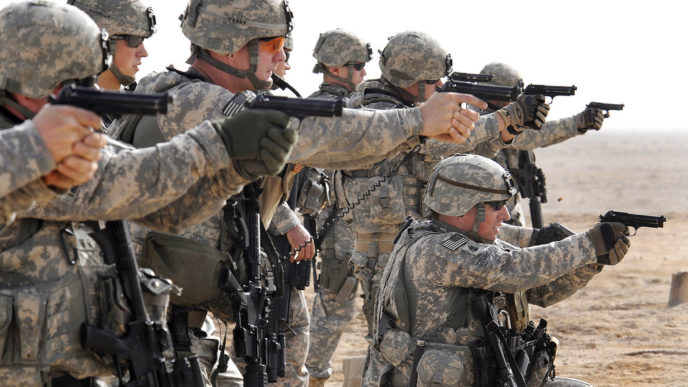
One of the most harmful legacies of the Obama administration was its trashing of our military. From the politicized generals and the depleted resources to the war on religious liberty in the service, shoving women into infantry, and promotion of transgenderism, Obama’s Pentagon used our military as a social engineering petri dish that resulted in the plummeting of morale. The good news is that all of this can easily be overturned administratively by Secretary Mattis, in the same way that it was perpetrated. The bad news is that there are no signs of significant change. Now conservatives must demand that the current defense authorization bill (NDAA) winding its way through the authorizing committees directly address each one of these issues.

Turning our military into a freak show

Last week, our soldiers were forced to attend training for integrating transgenders into our military. You heard that correctly. Five months into the Trump administration, while our troops are precariously flung out across the Islamic world, they are spending time dealing with the logistics of those who castrate themselves or pretend to castrate themselves. This was part of Obama’s end run around Congress to promote transgenderism in the military, once he got tired of promoting the other aspects of the sexual identity alphabet soups. Thus, this policy can easily be overturned administratively, yet, much like with Obama’s executive amnesty, his legacy lives on under the Trump administration.

Why is it that every conservative policy is immediately terminated by a new Democrat administration, but even the most disruptively radical policies imaginable, implemented by the Left, remain during Republican administrations?

Deputy Secretary of Defense Robert Work, an Obama holdover, made it clear that the Pentagon is going full steam with its transgender recruiting mandates. Some might blame this on the “deep state,” but it is clearly supported by Mattis and the shallow state. Moreover, why has it taken over five months to fill the top positions in the Pentagon with conservatives?

In addition to the transgender agenda (or closely related to it), the Obama administration was so obsessed with gender-bending and eradicating all differences between men and women that it shoved women into infantry even after the Marines conducted a painstaking study showing how co-ed integration harms women, men, and combat readiness. The military brass are now doing everything possible to get women everywhere in infantry training and even in special forces. This is sheer lunacy.

During a presidential town hall last year, Lauren Serrano, a Marine captain whose husband is also in the service, confronted Obama about the study, showing how it took mixed units 159 percent longer to evacuate casualties than all-male units. She asked him, “Why were these tangible negative consequences disregarded and how does the integration of women positively enhance the infantry mission and make me and my husband safer?”

Is there nobody in Congress or within this administration who is willing to ask the same question of Trump and Mattis?

Then there is the problem of pregnancies in the military. According to one study, women were sent home from Iraq at three times the rate of men, and three quarters of them were evacuated for getting pregnant. As former Marine Jude Eden warned, “The military seems more ready for motherhood than for warfare.”

According to a survey done by the DOD in 2008, 11 percent of women surveyed reported an unplanned pregnancy. For those of you keeping score at home, that’s 50 percent higher than the average in the United States. According to Time, “[U]nwanted pregnancies are a significant contributor to healthcare expenditures… more than 13% of total bed days, and about 5% of total lost work days in 2011, among all U.S. service members were pregnancy and delivery-related.” The end goal of co-ed social engineering in the military has wasted an ocean of taxpayer money and has hurt mission readiness.

Unfortunately, there is no evidence that any of this has changed under Mattis, even though none of the Obama-era changes were dictated by statute. They were all implemented administratively by Obama’s defense secretary, Ashton Carter.

The opportunity with the NDAA

As Congress debates the FY 2018 NDAA, almost all the focus will be on the spending figures and the procurements for the military. While the size and cost of the military are important, any increase in funds and assets is meaningless if we are going to turn the military into a freak show straight out of Sodom and Gomorrah. To that end, conservatives should demand the following issues be addressed either in the NDAA or by the administration:

Bar recruitment of transgenders: Putting moral and social issues aside, even the transgender lobby admits transgenderism is a disability (when suing under the ADA). Why in the world would we then place them into the military during a time of danger?

Freeze all integration of women into infantry until the other branches of the military conduct a study similar to that by the Marines in 2015. The results would have to be submitted to Congress, and the legislative branch would have to sign off on any decision to continue placing women in infantry units. They should also insert a general prohibition on lowering any standards for women in training and testing in order to serve in various military positions related to combat.

Attach a provision banning the dismissal of any service member for expressing his or her religious beliefs or any chaplain who declines to perform a service against his or her religious beliefs.

Attach the “Russell Amendment,” barring the federal government from discriminating against any defense contractors who don’t accommodate the transgender agenda or who believe in traditional marriage. Obama implemented this policy under his watch, and when conservatives planned to overturn it in last year’s NDAA, Mike Pence called off the dogs and promised that Trump would take care of it executively. He has not done so. As such, there is a need to deal with this through legislation.

Fire Obama generals: It’s a known secret in the military that much of the leadership structure has rotted away from years of political correctness and social engineering. One of the boldest statements from Trump during the campaign was when he declared at the “Commander-In-Chief Forum” that “generals have been reduced to rubble” and that “they have been reduced to a point where it’s embarrassing to our country.” He was right. Now he should direct Mattis to correct the situation.

Today, The Hill.com referred to Mattis as one of the most powerful defense secretaries in recent memory, with full access to and the confidence of the president. This all lies at his feet. In a recent interview, when Mattis was asked what challenges in the world keep him awake at night, Mad Dog quipped, “Nothing. I keep other people awake at night.” Mattis must now ask himself, are the Iranians, North Koreans, and Sunni Islamists really scared of a transgendered social experimentation?

Fortunately, only five months into this administration, it’s not too late to change course, if Mattis cares to do so and if conservatives care to demand it. (For more from the author of “Under Trump and Mattis, Gender Engineering in MILITARY Rages On” please click HERE)

Follow Joe Miller on Twitter HERE and Facebook HERE.
Mattis Is Punting the Military Buildup to 2019

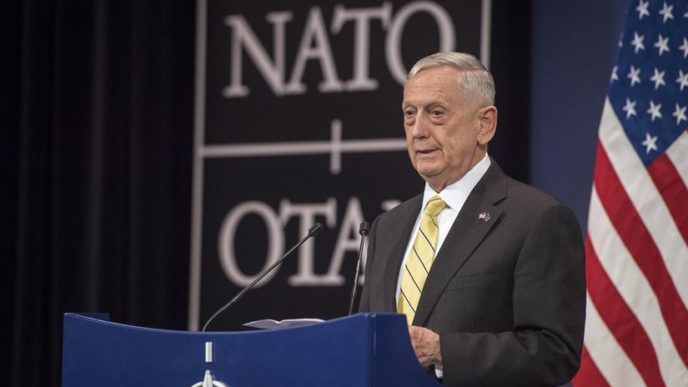
Secretary of Defense James Mattis has news for Congress and for the nation: The military buildup will have to wait until next year.

Mattis delivered that message in a back-to-back series of appearances before Congress, one of them taking place in a rare prime-time hearing on Monday night.

During both testimonies—which were delivered before the House and Senate armed services committees, respectively—Mattis told the Congress that the military buildup promised by President Donald Trump will have to wait until next year. He stressed that while rebuilding the size and capabilities of the military is important, the 2018 defense budget request will focus primarily on addressing near-term readiness problems.

Mattis’ message to both the House and Senate contained two themes: that the 2018 budget is simply intended to fill holes in readiness, and that the promised rebuilding of the military will not take place until 2019.

Responding to multiple questions from lawmakers, Mattis stated that the proposed budget for 2018 will start to “fill the holes and achieve program balance before beginning to significantly grow capacity in future years.”

Testifying alongside Mattis, Joint Chiefs of Staff Chairman Gen. Joseph Dunford explained that there are severe readiness shortfalls in every single branch of the military.

Due to limited resources in recent years’ defense budgets, the services have been forced to prioritize short-term readiness while decreasing the long-term preparedness and modernization of America’s armed forces.

Dunford pointed out, for instance, that the Marine Corps has delayed planned investments in multiple elements, from infrastructure to aircrafts, all to preserve the immediate proficiency of that service’s currently deployed forces.

Mattis pointed out that the readiness crisis is a result of high operational tempo—over 16 years of war—but also of consistent failure by Congress to support the military. That failure is reflected in nine years of continuing resolutions and four years of funding under the budget caps adopted in the Budget Control Act of 2011.

In a dramatic moment in one of the hearings, Mattis stated, “We did not get into this situation in one year, and we won’t get out of it in a year either.”

It will take many years of sustained budgetary growth to rebuild the military—an assessment that is shared by The Heritage Foundation.

Mattis stated multiple times that the next five budgets will have to show considerable increases—he mentioned growth rates of at least 5 percent—in order to rebuild the military to the degree Trump has said is necessary.

Mattis, speaking of the future budget request, made a clear projection:

The fiscal year 2019 budget, informed by the National Defense Strategy, will grow the all-volunteer force. The department will work with President Trump, Congress, and this committee to ensure the budget request we present for fiscal years 2019-2023 is sustainable and that it provides the commander-in-chief with viable military options in support of America’s security.

Mattis indicated he expects the defense budget to grow by 3 to 5 percent over the next five years in order to accommodate necessary increases in personnel and procurement.

Nonetheless, these projections for 2019 and beyond were not part of the president’s budget request for this coming year. In fact, the five-year projection typically included in defense budget requests, referred to as the “Future Years Defense Plan,” was absent.

Instead, Department of Defense officials have stated that future projections included in the 2018 request are not representative of their planning, but rather are just projected growth in light of inflation.

>>> Defense Leaders Agree: US Military Readiness Is at a Dangerous Low

The Heritage Foundation has outlined in multiple documents that there is a need to start rebuilding our military immediately. Heritage’s Index of U.S. Military Strength has highlighted for three years the need for Congress to make the defense budget a priority.

Congress should heed the warnings being issued by both Mattis and Dunford to prioritize our national defense.

Now that the president’s budget request is public, it is Congress’ responsibility to address how to increase defense spending. There is widespread agreement that the military needs resources to rebuild both immediate readiness and the long-term health and capacity of the military.

Mattis starkly highlighted the legislative branch’s role in funding the military, stating, “Congress as a whole has met the present challenge with lassitude, not leadership.”

Congress now has a chance to show the leadership that the secretary called for and that the country needs. It can do so by increasing spending for defense this year and into the future.

The lists of unfunded requirements that the military services by law were required to submit are excellent places to start. (For more from the author of “Mattis Is Punting the Military Buildup to 2019” please click HERE)

Follow Joe Miller on Twitter HERE and Facebook HERE.

The True Bradley ‘Chelsea’ Manning Story Is Stranger Than Fiction

Imagine this scenario for a moment. You are a budding novelist, and you present a new proposal to your agent. The agent looks it over and sends it back, assuring you no publisher would ever go for it. “It’s just too far-fetched,” you are told. “Best to go back to the drawing board.”

What was the scenario you concocted? It went like this.

The Plot

There was a gay private in the army who gained access to a cachet of nearly one million secret military documents. When his gay lover broke up with him, he was depressed. So he decided to download and release these documents, likely costing the lives of our men and women on the field.

He was tried and convicted of crimes against the state and sentenced to 35 years in prison. However, while in prison, he insisted he was actually a woman, not a man. Eventually, the government paid for his sex-change surgery, after which the president decided to commute his sentence. After which he was hailed as a national hero and did his first TV interview, now as a woman.

Well, I could see why a publisher would reject such a story. Who would ever believe a narrative like this? It strains credulity — especially the part about this guy becoming a national hero. But, as the saying proves true once again, truth is stranger than fiction.

The Truth of Bradley Manning

As you realized from the opening lines of this article, this is the true story of Bradley “Chelsea” Manning, not the plot of some far-fetched fiction novel.

Welcome to America, 2017, the country that generates headlines like this: “Transgender man and father-of-two adopted children happily announces he is pregnant with his gay husband, a year after suffering a miscarriage.”

Try to wrap your brain around that one for a while. A transgender man is pregnant. He has a gay husband. He previously suffered a miscarriage.

In other words, this is a woman who identifies as a man, who is “married” to a man who is attracted to men (even if they have female private parts and woman), and “he” is now pregnant after having a miscarriage.

It reminds me of another story I read some years ago in the Village Voice, originally published in 2000 (yes, 17 years ago). It was titled, “Two Dads with a Difference: Neither of Us Was Born Male.” As the article, written by one of the “Dads” explained, “We are transgendered men (female-to-male, or FTM). My boyfriend is the mother of my child.”

So, in this case, two women, apparently attracted to men, chose to identify as gay men. But at least one of them still had her female organs and so could conceive and give birth to a child. (I wonder what happened to that precious child?)

Against backdrops like this, I guess the Bradley-Chelsea Manning story isn’t that unbelievable at all, if not for the political intrigue.

According to reports in 2010, “The US Army intelligence analyst, who is half British and went to school in Wales, appeared to sink into depression after a relationship break-up, saying he didn’t ‘have anything left’ and was ‘beyond frustrated.’

“In an apparent swipe at the army, he also wrote: ‘Bradley Manning is not a piece of equipment,’ and quoted a joke about ‘military intelligence’ being an oxymoron.”

Manning claims that he released the documents to Wikileaks because “I have a responsibility to the public.” Our military, he argues, was covering up atrocities we committed against our enemies. So with little or no thought to the consequences of his actions, he decided to play the hero.

Not Everyone in the LGBT Community is Applauding

Interestingly, although Manning has become an LGBT icon, not everyone in the LGBT community has celebrated his actions.

Writing for Out.com in 2012, James Kirchick declared, “Bradley Manning is No Gay Hero.” He felt Manning disgraced the names of gays who had served with distinction in the military, writing, “Rather than claim Bradley Manning as a hero of the gay community and campaign for his release, we should be the ones advocating most loudly that he face the strictest possible punishment for his treachery.”

But now that Bradley is Chelsea, how could he not be an LGBT hero? Being “courageous” enough to transition from male to female (or vice versa) as a public figure is the instant path to fame. Then, getting pardoned by the president — what more could you ask for?

I seriously doubt that Bradley Manning would have been pardoned by the president if he had been a conservative, heterosexual Christian. And I seriously doubt that he would have been hailed as a hero by other conservatives, even if felt it his duty to expose alleged military abuses.

But because he was: 1) gay; 2) upset with the military; and 3) transgender, his cause proved irresistible.

A Surprise Twist?

So, maybe you can write that novel after all.

Or better still, how about adding a surprise ending to the plot, a real twist? Chelsea Manning has a radical encounter with God, resulting in a dramatic conversion, after which he goes back to being Bradley, marries a fine Christian woman, and spends the rest of the years undoing the damage he did.

I would buy that book. (For more from the author of “The True Bradley ‘Chelsea’ Manning Story Is Stranger Than Fiction” please click HERE)

Follow Joe Miller on Twitter HERE and Facebook HERE.

Afghan Murder of US Soldiers Marks 100th Insider Attack Since ’08

The Pentagon has released the names of the three American soldiers slain in the latest “insider attack” by an Afghan soldier on Saturday against U.S. troops.

Sgt. Eric M. Houck, 25, of Baltimore, Md.; Sgt. William M. Bays, 29, of Barstow, Calif.; and Corporal Dillon C. Baldridge, 22, of Youngsville, N.C., were the latest victims of an all-too common occurrence overseas. The Taliban has claimed responsibility for the attack.

The news comes as Trump administration officials are considering sending thousands of additional troops to Afghanistan in an attempt to stabilize the government there. There is currently about 8,000 American military personnel in the country.

The “green-on-blue” murders mark the 100th insider attack by Afghan soldiers against coalition forces (the vast majority of whom are American) since 2008, according to data compiled by the Long War Journal.

Since Jan. 1, 2008, 155 coalition troops have been killed in insider attacks, and almost 200 wounded.

The Taliban has long encouraged its fighters to infiltrate the Afghan National Army and conduct covert attacks against Americans. However, the Taliban only accounts for about 25 percent of insider attacks, according to estimates.

Not only is the allegiance of the Afghan army to coalition efforts largely suspect (even with the U.S. dumping billions of dollars into arming and training the group), the ground warfare branch of the Afghan Armed Forces has completely failed in the face of the Taliban insurgency.

Corruption is rampant within the Afghan military industry. The Special Inspector General for Afghanistan Reconstruction (SIGAR) report added that Washington is paying millions in salaries to “ghost soldiers” who do not exist, enriching the coffers of Afghan officials to the detriment of regional security. “At a minimum, they’re playing defense and are not taking the fight to the Taliban,” SIGAR head John Sopko said in January.

The security environment in Afghanistan continues to unravel, and the Taliban now controls or contests around 40 percent of the country.

The war in Afghanistan is the longest war in American history; U.S. troops have now been there for 16 years. It has taken thousands of American lives and cost American taxpayers $1 trillion.

The war in Afghanistan commenced as an effort to take out Osama bin Laden and his vast al-Qaida terrorist network inside the country. But now, in 2017, the current mission in Afghanistan is seemingly without an end goal.

There are no objective markers for what would signal the accomplishment of American goals there. The long war continues indefinitely, without an exit plan — much to the detriment of vulnerable U.S. troops stationed in the wilds of Afghanistan. (For more from the author of “Afghan Murder of US Soldiers Marks 100th Insider Attack Since ’08” please click HERE)

Follow Joe Miller on Twitter HERE and Facebook HERE.
With Army Stretched Too Thin, Military Buildup Should Begin Right Now

Testifying in front of the Senate Appropriations’ defense subcommittee last Wednesday, Army Chief of Staff Gen. Mark Milley was characteristically blunt.

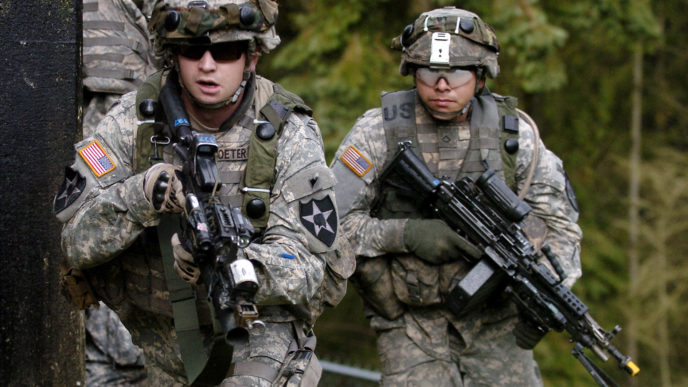
When asked, he told the assembled senators that in his opinion, the Army does not have enough soldiers to accomplish the missions it has been assigned.

Acknowledging that Secretary of Defense James Mattis is currently conducting a defense strategy review, Milley gave his assessment that to accomplish the Army’s portion of the defense strategy, the active component size of the Army should be between 540,000 and 550,000, the National Guard between 350,000 and 355,000, and the Army Reserve between 205,000 and 209,000.

In the active component, after enduring four years of debilitating Obama-era force reductions, the active Army now stands at 476,000, the National Guard at 343,000, and the Army Reserve at 199,000.

To regrow the Army to the level recommended by Milley in the active component alone will require an addition of a minimum of 64,000 soldiers, which will be costly, difficult, but in his judgment, necessary.

In making his assessment, Milley and acting Secretary of the Army Robert Speer reminded the committee that the U.S. faces a much more dangerous international situation than it did five years ago.

They highlighted the growing capabilities of Russia, characterizing it as “formidable;” an “increasingly dangerous” North Korea; China’s “assertive actions;” and a host of challenges in the Middle East ranging from Iran’s missile threat to the terrorist threat from the Islamic State and its ilk.

Milley’s recommendation on Army force structure generally aligns with statements made by President Donald Trump, who has pledged to regrow the Army back to 540,000.

But to the surprise of many, Trump’s 2018 defense budget request unveiled last month did not include a request for any additional soldiers for the Army. Instead, it seeks to maintain the levels authorized in 2017.

Administration representatives endeavored to explain that the rebuilding of the military’s size and equipment will await the completion of Mattis’ strategy review that is now underway, but which is not expected before the fall of 2017.

The Army’s list of unfunded priorities, submitted at the end of May to meet a new requirement in the 2017 National Defense Authorization Act, does however include a requirement to increase the strength of the Army, with a request for 10,000 active, 4,000 National Guard, and 3,000 in the Army Reserve.

The Congress acted correctly and courageously in 2017 to begin to regrow the Army by adding 17,000 active-duty soldiers to President Barack Obama’s proposed request for 460,000. There is near consensus that the last four years of strength cuts have reduced the Army’s ability to execute its missions and significantly raised strategic risk to the country.

Now faced with a similar situation for fiscal year 2018, Congress should act again to incrementally increase the size of the Army and authorize the prudent growth requested in the Army’s unfunded requirements list.

Mattis’ strategy review is a necessary assessment, but there is no danger of “over-growing” the Army. The addition of the requested 10,000 soldiers on the Army’s list would bring them to 486,000, still well below what the chief of staff of the Army believes is needed.

The Army today is too small. Milley and Speer related that today soldiers and units are being deployed at a grueling and relentless pace, stressing service members and their families.

Congress should not allow a “pause” in the rebuilding of the Army. It should instead continue to reverse Obama’s ill-advised cuts to the Army. (For more from the author of “With Army Stretched Too Thin, Military Buildup Should Begin Right Now” please click HERE)

Follow Joe Miller on Twitter HERE and Facebook HERE.
3 U.S. Soldiers Killed by Afghan Soldier

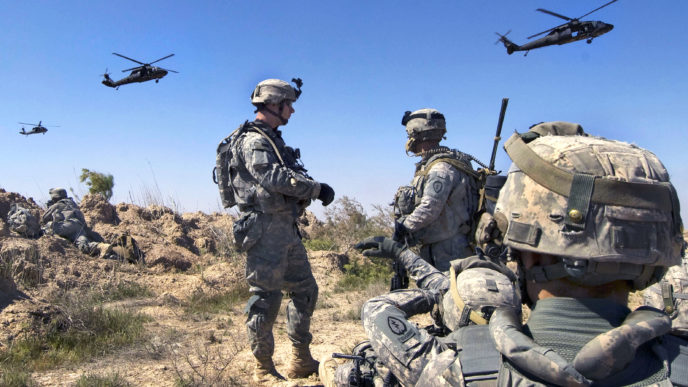
Three U.S. soldiers were killed and another was wounded Saturday in eastern Afghanistan, the Pentagon said.An Afghan official said the deaths and injury stem from an attack by an Afghan soldier, who also died.In a statement from Washington, the Pentagon didn’t provide details about what led to the deaths of the U.S. soldiers. It said the incident was under investigation.A spokesman for the provincial governor in Nangarhar province, Attahullah Khogyani, said in a statement that the attack took place in the Achin district.

The Taliban claimed responsibility for the attack. Taliban spokesman Zabihullah Mujahid says in a statement that a Taliban loyalist had infiltrated the Afghan army “just to attack foreign forces.” (Read more from “3 U.S. Soldiers Killed by Afghan Soldier” HERE)

Follow Joe Miller on Twitter HERE and Facebook HERE.

Let’s Help Military Families by Adopting a ‘GI Bill’ for Their Children

President Donald Trump made helping the “forgotten man” a key theme of his presidency from the get-go.

The challenge for Trump is how to aid the forgotten man by shrinking the programs and institutions that left him behind to begin with while moving toward policies that will help him thrive in the 21st century.

One of the forefronts of that important shift is in expanding education choice, which Trump has announced as one of the priorities of his administration.

In Trump’s first speech to a joint session of Congress he said, “I am calling upon members of both parties to pass an education bill that funds school choice for disadvantaged youth.”

But how can Trump bring school choice to parents across the country without violating the principles of federalism and interfering with state-level innovators who are at the forefront of reform?

The answer is to create school choice within existing federal education programs that actually have a constitutional warrant, not the least of which is a program designed to serve our armed forces.

The Heritage Foundation’s Lindsey Burke and Anne Ryland propose just that in their paper, “A GI Bill for Children of Military Families: Transforming Impact Aid into Education Savings Accounts,” which was recently profiled by The Washington Post.

In a clear reference to the famous GI Bill of the 1940s, which provided education benefits to soldiers upon their return home from World War II, Burke and Ryland’s proposal would bring better education options to over 600,000 children of military families.

The proposal is an innovative way to further the school choice revolution that will hopefully transform America’s K-12 education system, while specifically helping our heroes’ most precious commodities: their children.

Our Constitution is explicit in the necessity to provide for national defense. This plan will help ensure that we provide for those who stand as its bulwark.

Failing Those Who Serve

The paper highlighted how a survey conducted by the Military Times found that a staggering 35 percent of military personnel surveyed said that unhappiness with their child’s education was a critical factor in their decision to remain or leave the armed services.

Many of these families live in states and localities with failing public schools, so if they wish to continue serving their country, they may have to do so amid concerns about the schooling options available to their children.

This is unacceptable, and should be concerning to Americans who believe in taking care of the people who dedicate their lives to defending this country.

Military families already bear the strain of long deployments, constant travel, and stress of deploying into harm’s way.

Additional pressures on our troops, such as concern about their children receiving the education that is right for them, is one Congress can and should attempt to resolve.

However, over half of active-duty military families in the U.S. dwell in states that have no school choice options for them to escape to if their local public schools do not align with their needs.

High-population states like California and Texas, which have the highest number of military families, have no private school choice options whatsoever.

This problem can be alleviated by having Congress redirect roughly $1.3 billion in funds from the Impact Aid program, created to bring federal tax dollars to school districts with military and federally-connected populations, directly to military families through education savings accounts specifically created for them.

Importantly, it would require no additional taxpayer money and would simply be using funds that already exist.

But like with other school choice programs, interest groups have come out to attack any proposal that breaks up the government school monopoly.

Breaking the Status Quo

The National Association of Federally Impacted Schools’ director charged that the military kids school choice plan was “misguided” in a recent interview with Politico, and claimed that it would “dismantle a program based on fairness to taxpayers.”

This echoes arguments that teacher unions in particular have made about school choice in general.

Changing funding mechanisms from districts to individuals threatens the exclusive control over how the money is used, but empowers parents and individuals to decide for themselves what services work best for them.

The National Association of Federally Impacted Schools also released a statement saying that “changing Impact Aid into an [education savings account] would burden local taxpayers with higher taxes and require students to go without.”

The charge that the plan would raise taxes for districts is incorrect. There is simply no reason to increase local taxes to pay for students who are no longer in the public system.

Even the Obama administration recognized the need for reforming Impact Aid.

In recent budget requests, both the Trump and Obama administrations suggested eliminating Impact Aid for federal property, arguing that districts have had plenty of time to adjust their tax rolls to federal acquisitions made decades ago, and that Impact Aid dollars should be directed to federally connected children.

The Obama fiscal year budget request said:

It is the administration’s policy to use available Impact Aid funds to help pay for the education on federally connected children and fund programs that serve federally connected children. Payments for federal property compensates LEAs [districts] for lost property tax revenue due to the presence of federal lands without regard to whether those districts educate any federally connected children as a result of federal presence.

Implicit in that argument is that if the kids aren’t there, the dollars should follow them to where they are: their chosen schools. If the kids leave a district school, the dollars should follow the child.

The Next Generation

Adopting school choice to better serve those who serve us would be a major boon to these families who have carried an enormous weight for the rest of us.

It would also help ensure that the next generation of military personnel—who in very high numbers come from military families—receive a first-rate education that will help them through life.

It will ease the minds and burdens of these families if Congress and Trump can give them the tools they need to thrive. We have a duty not to forget or neglect these people to whom we owe so much.

The forgotten child of the forgotten man will be given the opportunity to succeed and pursue the American dream. (For more from the author of “Let’s Help Military Families by Adopting a ‘GI Bill’ for Their Children” please click HERE)

Follow Joe Miller on Twitter HERE and Facebook HERE.
Memorial Day Is a Time to Teach Our Children About Real Heroes

During a recent drive home from school, my six-year-old daughter began to sing.

“And I’m proud to be an American, where at least I know I’m free,” she sang. “And I won’t forget the men who died who gave that right to me.”

My little girl went on to explain that she was learning the words to the song (Lee Greenwood’s “God Bless the U.S.A.”) in preparation for her kindergarten graduation ceremony. During that special moment, I was filled with both patriotism and pride.

Monday marks the sixteenth Memorial Day since our military went to war after the 9/11 attacks. While the national media’s collective eyes have been largely transfixed on the White House and Kremlin for the past six months, U.S. troops have been killed in action during combat operations in five countries: Afghanistan, Iraq, Syria, Somalia and Yemen.

Five Fallen Heroes

U.S. Navy Chief Special Warfare Operator (SEAL) Kyle Milliken, 38, was one of those American heroes. Earlier this month, he was killed while fighting the al Shabaab terrorist group “in a remote area approximately 40 miles west of Mogadishu,” Somalia, according to the Department of Defense. The Navy SEAL is the first U.S. service member killed in the African nation since the well-known “Black Hawk Down” battle in 1993.

According to the Portland Press Herald in Milliken’s home state of Maine, the high school and University of Connecticut track star joined the Navy in 2002 before earning his place inside the now-legendary SEAL Team Six. He would go on to perform dangerous missions during deployments to Iraq, Afghanistan, and eventually Somalia.

“We were a nation at war when he enlisted,” U.S. Navy Special Warfare Command spokesman Jason Salata told the newspaper. “He has four Bronze Stars. You don’t get that from sitting at home.”

According to the Hartford Courant, Milliken is survived by his wife, Erin, and their two children.

“His sacrifice is a stark reminder that naval special operators are forward doing their job, confronting terrorism overseas to prevent evil from reaching our shores,” U.S. Navy Rear Admiral Timothy Szymanski said in a statement published by the Courant.

In April, our nation lost U.S. Army 1st Lt. Weston Lee, 25, who made the ultimate sacrifice in Mosul, Iraq, along with U.S. Army Staff Sgt. Mark De Alencar, 37, Sgt. Joshua Rodgers, 22, and Sgt. Cameron Thomas, 23, all of whom were killed in Afghanistan’s Nangarhar Province. In the last six months, brave American troops have also died in Syria and Yemen.

All of these fallen heroes had families, friends, and long lists of awards and accomplishments. Despite all they had to live for, these patriots were still willing to trade their lives to protect not only the warrior standing next to them on the battlefield, but people back home who they had never met.

The genuine, astounding selflessness of those who make the ultimate sacrifice is the essence of Memorial Day. That’s why when my daughter finished singing “God Bless the U.S.A.” in the car that day, we had a discussion about both the dangers and heroes of war that I hope other parents will have with their kids as the school year ends and the summer begins.

“God Bless the U.S.A.”

On May 22 in Manchester, England, happy young girls not much older than my little girl were singing along with pop star Ariana Grande. Minutes after the concert ended, a crude, vicious bomb often found on Middle Eastern battlefields pierced the innocent lives of teenagers and children. ISIS claimed responsibility for the cowardly, sickening attack, which cannot be labeled as anything other than pure evil.

My daughter wandered in from another room and looked up at the television as I watched news coverage of the Manchester attack. I could see the confusion and fear in her eyes as they were briefly filled with the searing images of terror.

“That’s why those brave men and women we talked about go to war,” I told her. “They fight the bad people to keep them away from us.”

“I know, Daddy,” she said. “It’s just like the song says.”

A few days later, my little girl graduated from kindergarten while singing those same patriotic lyrics.

“And I’d gladly stand up next to you and defend her still today,” she sang. “Because there ain’t no doubt I love this land. God bless the U.S.A.”

Because of American heroes like Kyle Milliken, Weston Lee, Mark De Alencar, Joshua Rodgers, Cameron Thomas, and thousands more who have put service above self, our children grow up in a land that is not only free, but vigorously and righteously defended. For that, all Americans owe all fallen heroes and their Gold Star families our deepest thanks on Memorial Day – and every day. (For more from the author of “Memorial Day Is a Time to Teach Our Children About Real Heroes” please click HERE)

Follow Joe Miller on Twitter HERE and Facebook HERE.

How a WWII Veteran Grappled With the Horrors of Combat to Resume Life Back Home

Carl Lavin was in high school when the Japanese attacked Pearl Harbor. At 18, the Ohio native decided to join the Army. From there, his life would be forever changed, as he went on to fight as a foot soldier with the 84th Infantry Division in the Battle of the Bulge.

In a new book, “Home Front to Battlefront,” Lavin’s son, Frank, tells the story of how his father grappled with the horrors of combat during World War II to discover truth and meaning back home. Watch the video to hear his story.

(For more from the author of “How a WWII Veteran Grappled With the Horrors of Combat to Resume Life Back Home” please click HERE)

Follow Joe Miller on Twitter HERE and Facebook HERE.

US Military Member Killed in Somalia, 1st Death Since 1993

A U.S. service member has been killed in Somalia during an operation against the extremist group al-Shabab — the first U.S. combat death there in more than two decades — as the United States steps up its fight against the al-Qaida-linked organization in a country that remains largely chaos.

“We do not believe there has been a case where a U.S. service member has been killed in combat action in Somalia since the incident there in 1993,” U.S. Africa Command spokesman Patrick Barnes said Friday. The United States pulled out of Somalia after that incident in which two helicopters were shot down in the capital, Mogadishu, and bodies of Americans were dragged through the streets.

In a statement, the U.S. Africa Command said the service member was killed Thursday during the operation near Barii, about 40 miles (64 kilometers) west of Mogadishu. The Pentagon said two other service members were wounded. (Read more from “US Military Member Killed in Somalia, 1st Death Since 1993” HERE)

Follow Joe Miller on Twitter HERE and Facebook HERE.