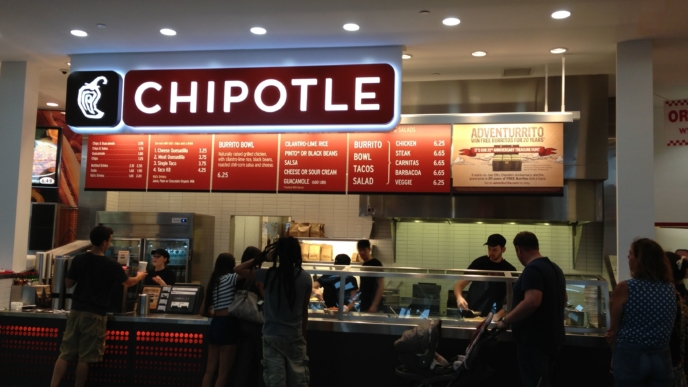
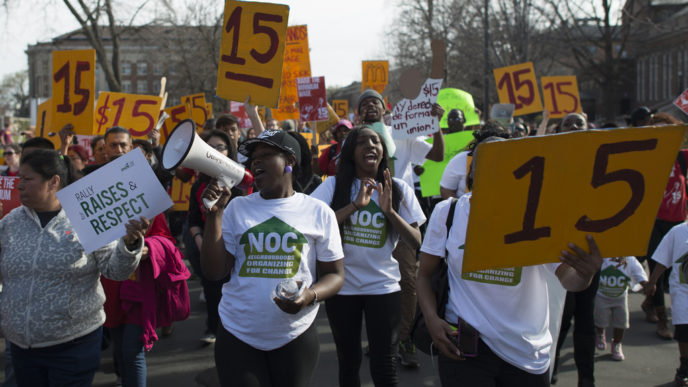
Customers dining at Chipotle restaurants will see higher food prices thanks to a newly announced employee pay raise to $15 an hour.
The fast-casual Mexican food chain said menu prices will be raised by as much as 4% in order to mitigate the employee pay raises announced last month, which will pay employees $15 per hour by the end of June.
“It made sense in this scenario to invest in our employees and get these restaurants staffed and make sure that we have the pipeline of people to support our growth,” Chipotle CEO Brian Niccol said about the move. “And then with that, we’ve taken some pricing to cover some of that investment.”
Democrats across the country have actively pushed to raise the federal minimum wage to $15 an hour and recently failed to attach that provision into a recent COVID-19 spending package. (Read more from “Chain Restaurant Raises Menu Prices To Counteract Its Minimum Wage Hike” HERE)
Delete Facebook, Delete Twitter, Follow Restoring Liberty and Joe Miller at gab HERE.
https://joemiller.us/wp-content/uploads/Chipotle_Brandon.jpeg-2-scaled.jpeg19202560Joe Millerhttps://joemiller.us/wp-content/uploads/logotext.pngJoe Miller2021-06-09 18:15:232021-06-09 18:12:04Chain Restaurant Raises Menu Prices To Counteract Its Minimum Wage Hike
Several prominent Democrats expressed disappointment and frustration after several Democrats joined Republicans in the Senate in rejecting Sen. Bernie Sanders’ (I-VT) effort to raise the minimum wage to $15 an hour.
While the Senate parliamentarian ruled that the $15 minimum wage hike could not be included in the $1.9 trillion coronavirus relief measure, Sanders, as well as his far-left allies, attempted to pave a way to make the hike a reality.
Seven Democrats, as well as an independent who caucuses with the Democrats, joined Republicans in rejecting the effort on Friday. Those include Sens. Joe Manchin (D-WV), Jon Tester (D-MT), Jeanne Shaheen (D-NH), Kyrsten Sinema (D-AZ), Maggie Hassan (D-NH), Chris Coons (D-DE), Tom Carper (D-DE), and Angus King (I-ME).
“There is not one state in our country where you can make ends meet on the current federal minimum wage. Not one! How quickly would Congress raise the minimum wage if they were forced to live on $7.25 an hour?” Sanders asked Friday afternoon. “Outrageous”:
There is not one state in our country where you can make ends meet on the current federal minimum wage. Not one! How quickly would Congress raise the minimum wage if they were forced to live on $7.25 an hour? Outrageous.
It is not acceptable to me that half of our people are living paycheck to paycheck. We need an economy that works for all of us. To do that, we must increase the minimum wage to $15 an hour and give 32 million Americans a raise. pic.twitter.com/4vUBtY9Y1j
I just voted to move forward with raising the minimum wage to $15 an hour. Two-thirds of Americans want to give workers this long-overdue raise to help lift families out of poverty and strengthen our economy. It is time that the Senate reflects the will of the people.
. . .The Democrats have put forward their bill to raise the minimum wage to $15/hour…by 2025. Yeah, you read that right. Personally, there should be no minimum wage, which The New York Times editorial board supported in 1987. Let the market decide the wages for these low-skill workers:
No wonder, but still a mistake. Anyone working in America surely deserves a better living standard than can be managed on $3.35 an hour. But there’s a virtual consensus among economists that the minimum wage is an idea whose time has passed. Raising the minimum wage by a substantial amount would price working poor people out of the job market. A far better way to help them would be to subsidize their wages or – better yet – help them acquire the skills needed to earn more on their own.
An increase in the minimum wage to, say, $4.35 would restore the purchasing power of bottom-tier wages. It would also permit a minimum-wage breadwinner to earn almost enough to keep a family of three above the official poverty line. There are catches, however. It would increase employers’ incentives to evade the law, expanding the underground economy. More important, it would increase unemployment: Raise the legal minimum price of labor above the productivity of the least skilled workers and fewer will be hired.
If a higher minimum means fewer jobs, why does it remain on the agenda of some liberals?
JUST IN: House and Senate Democrats introduce legislation to raise the federal minimum wage from $7.25 to $15 by 2025. pic.twitter.com/yW9hGZmmYK
Flashforward to 2021 and we know which side has won and what it has done for these workers. It’s screwed them—royally. They tried this in Seattle, and it’s ruined the restaurant business. Even USA Today was saying let’s pump the brakes on these minimum wage increases to $15/hour because studies and its application show that it hurts workers, cuts their hours, and kills their employment. It injects steroids into the automation timelines which eliminates a host of these minimum wage jobs as well. (Read more from “Why Everyone Is Laughing at the Democrats Minimum Wage Bill Right Now” HERE)
Delete Facebook, Delete Twitter, Follow Restoring Liberty and Joe Miller at gab HERE and MeWe HERE
https://joemiller.us/wp-content/uploads/Money_Cash-2-scaled.jpg17022560Joe Millerhttps://joemiller.us/wp-content/uploads/logotext.pngJoe Miller2021-01-26 17:16:322021-01-26 17:14:39Why Everyone Is Laughing at the Democrats Minimum Wage Bill Right Now
. . .One restaurant worker in Seattle wrote in The Wall Street Journal this month that while she’s progressive, the minimum wage hike in the city led to her losing her job before Christmas. She also implored the far-left, economically illiterate dolts who push this policy to slow down:
This city’s minimum wage is rising to $16.39 an hour on Jan. 1. Instead of receiving a bigger paycheck, I’m left without any pay at all due to the policy change. That’s because the restaurant where I’ve worked for six years is closing as a consequence of the city’s harmful minimum-wage experiment. . .
But being an established chef and a good employer doesn’t save you from the burden of a sharp minimum-wage increase, up 73% from $9.47 in 2015. For large-scale employers like Mr. Douglas, there’s no separate rate for workers who earn tips. In Washington and a handful of other states, tips aren’t counted as income earned on the job. That means restaurateurs are expected to pay servers like me the full minimum wage in addition to our considerable tip income. . .
I’ve lived in this city for almost 20 years, supporting my family thanks to the full-service-restaurant industry. Today I’m struggling because of a policy meant to help me. I’m proudly progressive in my politics, but my experience shows that progressives should reconsider minimum-wage laws that hurt the very workers they’re trying to protect.
(Read more from “Restaurant Worker: The Minimum Wage Law Killed Jobs Including Mine” HERE)
https://joemiller.us/wp-content/uploads/restaurant-2812274_1280.jpg8531280Joe Millerhttps://joemiller.us/wp-content/uploads/logotext.pngJoe Miller2019-12-26 20:37:492019-12-26 20:34:09Restaurant Worker: The Minimum Wage Law Killed Jobs Including Mine
The state of Maine is bucking the nationwide push to raise the minimum wage as it considers lowering the recent increase the state implemented. On January 1 the minimum wage was raised to $10 an hour, but a bill proposed by Gov. Paul LePage, LD 1757, would lower it by 50 cents in June . . .
The bill states it affects the minimum wage by “reducing the minimum wage from $10 per hour to $9.50 per hour beginning June 1, 2018; reducing the amount by which the minimum hourly wage rates are scheduled to increase annually on January 1st from 2019 to 2021 from $1 per year to 50 cents per year, and decreasing from $12 to $11 the minimum hourly wage rate required to be paid in 2021; eliminating the cost-of-living adjustment to the minimum wage; and establishing a training minimum wage for employees 18 years of age or older and under 20 years of age for the first 90 days of employment and a youth minimum wage for employees under 18 years of age.” (Read more from “U.S. State Bucking National Trend, Considers Lowering Minimum Wage” HERE)
There are political movements to push the federal minimum hourly wage to $15.
Raising the minimum wage has popular support among Americans. Their reasons include fighting poverty, preventing worker exploitation, and providing a living wage.
For the most part, the intentions behind the support for raising the minimum wage are decent. But when we evaluate public policy, the effect of the policy is far more important than intentions.
So let’s examine the effects of increases in minimum wages.
The average wage for a cashier is around $10 an hour, about $21,000 a year. That’s no great shakes, but it’s an honest job for full- or part-time workers and retirees wanting to earn some extra cash.
In anticipation of a $15-an-hour wage becoming federal law, many firms are beginning the automation process to economize on their labor usage.
Panera Bread, a counter-serve cafe chain, anticipates replacing most of its cashiers with kiosks. McDonald’s is rolling out self-service kiosks that allow customers to order and pay for their food without ever having to interact with a human.
Momentum Machines has developed a meat-flipping robot, which can turn out 360 hamburgers an hour. These and other measures are direct responses to rising labor costs and expectations of higher minimum wages.
Here’s my question to supporters of higher minimum wages: How compassionate is it to create legislation that destroys an earning opportunity?
Again, making $21,000 a year as a cashier is no great shakes, but it’s better than going on welfare, needing unemployment compensation, or idleness. Why would anybody work for $21,000 a year if he had a higher-paying alternative?
Obviously, the $21,000-a-year job is his best-known opportunity. How compassionate is it to call for a government policy that destroys a person’s best opportunity? I say it’s cruel.
San Francisco might give us some evidence for what a $15 minimum wage does.
According to the East Bay Times, about 60 restaurants around the Bay Area closed between September and January.
A recent study by Michael Luca of Harvard Business School and Dara Lee Luca of Mathematica Policy Research calculated that for every $1 hike in the minimum hourly wage, there is a 14 percent increase in the likelihood that a restaurant rated 3 1/2 stars on Yelp will go out of business.
Fresno Bee reporter Jeremy Bagott says that even some of San Francisco’s best restaurants fall prey to higher minimum wages. One saw its profit margins fall from 8.5 percent in 2012 to 1.5 percent by 2015.
Most restaurants are thought to require profit margins between 3 and 5 percent to survive.
Some think that it’s greed that motivates businessmen to seek substitutes for labor, such as kiosks, as wages rise. But don’t blame businessmen; just look in the mirror.
Suppose both McDonald’s and Burger King are faced with higher labor costs as a result of higher minimum wages. McDonald’s lowers its labor costs by installing kiosks and laying off workers, but Burger King decides to not automate but instead keep the same amount of labor.
To cover its higher labor costs, Burger King must charge higher prices for its meals, whereas McDonald’s gets by while charging lower prices.
Which restaurant do you think people will patronize? I’m guessing McDonald’s. What customers want is an important part of a company’s decision-making.
But there are other actors to whom companies are beholden. They are the companies’ investors, who are looking for returns on their investments.
If one company responds appropriately to higher labor costs, it will produce a higher investor return than one that does not.
That means “buy” signals for the stock of a company that responds properly and “sell” signals for the stock of one that does not, as well as possible outside takeover attempts for the latter.
The best way to help low-wage workers earn higher wages is to make them more productive, and that’s not accomplished simply by saying they are more productive by mandating higher wages. (For more from the author of “Minimum Wage Hikes Are an Act of Cruelty” please click HERE)
https://joemiller.us/wp-content/uploads/minimum-wage-capitol.jpg432720Joe Millerhttps://joemiller.us/wp-content/uploads/logotext.pngJoe Miller2017-07-11 21:45:112017-07-11 21:45:11Minimum Wage Hikes Are an Act of Cruelty
Progressives are touting a $15 minimum wage as a low-cost policy to reduce poverty and income inequality. However, the costs of a high minimum wage are higher than its proponents would like to believe.
In a recent Heritage Foundation backgrounder, James Sherk outlined the costs to consumers of a $15 minimum wage and took issue with methodological flaws in two studies that proponents of a higher minimum wage often cite.
Relying on peer-reviewed scholarship on the fast-food sector, Sherk estimates that increasing the minimum wage to $15 would raise fast-food prices 38 percent and reduce employment 36 percent. A chicken sandwich that currently sells for $3.05 would instead cost customers $4.21.
The logic is straightforward: With higher labor costs and already narrow profit margins, fast-food restaurants will have to raise prices. But with higher prices, consumers spend significantly less on fast food.
Sherk goes on to argue that two studies predicting little effect from a $15 minimum wage on fast-food business models include fatal flaws.
One study by Purdue’s School of Hospitality and Tourism Management found that a $15 minimum wage would increase a fast-food restaurant’s costs by only about 4 percent.
However, the authors made a major mistake: They added up median costs, rather than average costs, which made 8 percent of all restaurant costs disappear. Since restaurants in the real world can’t make costs vanish, the study has little relevance for them.
A more respectable effort, by the Political Economy Research Institute, likewise found low costs to fast food from a higher minimum wage. However, the institute’s model assumed that fixed costs were constant in the industry, and that the fast-food sector’s future growth would be relatively low cost. With low cost growth ahead of them, restaurants could afford to pay workers more without raising prices.
However, the assumption of constant fixed costs is inappropriate in a multiyear, industrywide projection, since it implies that the industry will be able to grow without building any new stores or buying any new kitchen equipment.
The Political Economy Research Institute also assumed a lower level of price sensitivity than the scholarly consensus indicates. Finally, the institute assumed that turnover costs in the fast-food sector are unrealistically high, generating unrealistic savings from higher wages.
Correcting these three assumptions brings the institute’s model largely in line with Sherk’s.
Advocates of higher minimum wages have laudable goals: helping poor Americans become self-sufficient and showing respect for often thankless jobs.
But a high minimum wage would do more harm than good. It would raise the cost of living for low-income households, including many that don’t include a minimum-wage worker.
A higher minimum wage also would make entry-level employment harder to find, putting the bottom rung of the wage ladder out of reach to those with the fewest marketable skills.
Those who sincerely care about fighting poverty and improving economic mobility will find less costly ways to meet those goals. (For more from the author of “Your Chicken Sandwich Costs More With a $15 Minimum Wage” please click HERE)
https://joemiller.us/wp-content/uploads/ChickFilA-ChickenSandwich.jpg13652048Joe Millerhttps://joemiller.us/wp-content/uploads/logotext.pngJoe Miller2017-02-08 19:39:012017-02-08 19:39:01Your Chicken Sandwich Costs More With a $15 Minimum Wage
In an op-ed published Tuesday by The Washington Post, Wise writes, “I already know what Trump/Puzder economics look like because I’m living it every day. Despite giving everything I had to [labor secretary pick Andy] Puzder’s company for 21 years, I left without a penny of savings, with no health care and no pension.”
Wise worked for 21 years at Hardee’s, which is one of the chains Puzder leads as head of CKE.
“In 1984, I was hired as a cashier at Hardee’s in Columbia, S.C., making $4.25 an hour. By 2005, 21 years later, my pay was only at $8 an hour,” she writes.
“That’s a $3.75 raise for a lifetime of work,” Wise adds. “Adjusted for inflation, it’s only a 2-cent raise.”
Already, the left has jumped on Wise’s story:
After working for Puzder for 21 years, JoAnn left without a penny of savings, with no health care and no pension. https://t.co/e49TlD2XfA
But what’s left unaddressed in Wise’s op-ed is: Why didn’t she leave Hardee’s?
Wise says she asked for raises multiple times and was denied. Perhaps she did deserve a raise. Maybe she should have been promoted further. (She mentions being promoted in her first year, but not after.)
But no one forced Wise to stay with Hardee’s for 21 years without a significant raise. She could have switched jobs to somewhere her talents would have been recognized and/or she could have pursued additional training to be a more attractive candidate for jobs that required more skills and paid more.
I don’t know Wise’s full story, and perhaps there were personal circumstances that made switching jobs or acquiring new training difficult to do. Certainly, she sounds like a hardworking individual.
But does that mean she deserved a higher salary?
I worked at Burger King for two summers in high school, which I realize is a far shorter span than Wise’s. Nonetheless, it certainly gave me a new appreciation for the work of fast-food employees.
It was often tough work, and I don’t remember with fondness simultaneously taking orders, filling orders, and making change at the drive-thru, all while a clock monitored how long each transaction took to make sure it didn’t rise above a certain average time.
But was it work that should have given me a salary enough to support myself and a family?
Underlying Wise’s argument is the thesis that any full-time job, regardless of how few skills it requires, should pay enough for an adult to be self-supporting and, with a partner’s salary, raise children. She writes:
… even with my husband’s salary as the head cook at Fort Jackson, we relied on food stamps and Medicaid. We were two full-time-employed adults; we shouldn’t have had to turn to the government, but we had kids to raise, and so we were left with no other choice.
That’s a thesis the left largely seems to have embraced, particularly with the rise of the movement for $15 an hour wages for fast-food employees. In his 2013 State of the Union, President Barack Obama also made the case for that viewpoint, stating, “Even with the tax relief we put in place, a family with two kids that earns the minimum wage still lives below the poverty line. That’s wrong.”
But it’s a thesis with troubling implications.
For one thing, it’s not clear companies will respond to higher minimum wages by simply hiring the same number of people at the new wage level. There’s already concerns that fast-food restaurants will turn to more and more automation, such as having people order via machines.
In a report issued last year, my former Heritage Foundation colleague James Sherk predicted that a $15 an hour federal minimum wage would eliminate “approximately 7 million full-time-equivalent jobs by 2021.”
In addition, not everyone who is looking for work needs to be able to support themselves and a family.
When I was 15 and working my first summer at Burger King, I knew I needed some money—and I also knew a first (non-babysitting) job would give me valuable skills. In fact, a lot of minimum wage workers are in a similar situation, according to a 2013 Heritage Foundation report:
Many support raising the minimum wage because they want to help low-income Americans get ahead, but minimum-wage earners are not much more likely to live in poverty than are most other Americans: Less than 1 in 4 live in a family with earnings below the poverty line. Two-thirds work part-time, and most are between 16 and 24 years old.
But raising the minimum wage could have the effect of eliminating jobs—which would make it harder for teens and young adults to get that crucial first job, which often helps them get the next better paid job.
Sure, I would have loved to make more than $6.75 an hour at Burger King (minimum wage in California at the time)—but I would also have rather made that than not had the job at all, because it had become automated.
It’s important to have low-skill, first jobs available so young adults can learn skills about teamwork and responsibility—and ultimately move on to jobs that pay enough to support themselves and a family.
There are also other ways to help situations like Wise’s besides hiking the minimum wage. Better schools and overall better educational opportunity for all Americans, via school choice policies, could help ensure most Americans are better equipped to do well in the working world, or advance in higher ed.
Costs that families must bear could be driven down by eliminating certain regulations—for instance, “Corporate Average Fuel Economy standards add $3,800 to the cost of an average new car,” noted The Heritage Foundation’s Salim Furth in a report last year.
There are certainly changes that could help make lives for working families in America easier. But raising the minimum wage is a policy that is more likely in the long run to hurt, rather than help, many working Americans. (For more from the author of “This Woman’s Minimum Wage Story Shows the Left’s Troubling Mindset” please click HERE)
A Chicago restaurant abruptly closed this week, with ownership blaming the “rapidly changing labor market” and a 27 percent increase in base minimum wage costs over the last two years as culprits for the collapse.
Cantina 1910, a farm-to-table Mexican restaurant located in Chicago’s Andersonville neighborhood, opened in September 2015.
Former Cantina 1910 employees said they were shocked to find out late Sunday evening of the closing, DNAinfo reported.
“We are unable to further raise prices in this competitive restaurant market in order to sustain the labor costs necessary to operate Cantina 1910,” Mark Robertson and Mike Sullivan, Cantina 1910’s owners, said in an emailed statement to The Daily Signal.
In December 2014, the Chicago City Council passed an ordinance to raise the city’s minimum wage from $8.25 an hour to $13 an hour by 2019. The minimum wage for nontipped employees went up to $10.50 an hour on July 1.
“Unfortunately, the rapidly changing labor market for the hospitality industry has resulted in immediate, substantial increases in payroll expenses that we could not absorb through price increases,” the restaurant’s owners said. “In the last two years, we have seen a 27 percent increase in the base minimum wage, a 60 percent increase in kitchen wages, and a national shortage of skilled culinary workers.”
The owners say they “do not see a path forward” with mandatory paid sick leave and minimum wage set to increase in 2017. They stated:
As we look down the road, we are facing a Dec. 1 change in federal labor regulations that will nearly double required salaries for managers to qualify as exempt, a 2017 mandatory sick leave requirement and another minimum wage increase. Coupled with increasing Chicago and Cook County taxes and fees that disproportionately impact commercial properties and businesses, we are operating in an environment in which we do not see a path forward.
Raising the minimum wage was a “much needed” and “an essential step in making sure that hard work pays off for all of our residents,” Chicago Mayor Rahm Emanuel, a Democrat and President Barack Obama’s former chief of staff, said in a July 2015 statement.
Employment in the Chicago area’s leisure and hospitality sector sunk to a five-year low, according to government data, after a $1.75 an hour minimum wage hike went into effect in July 2015, Investor’s Business Daily’s Jed Graham wrote this past January.
“The law of demand states that when prices rise, customers buy fewer goods or services,” James Sherk, a research fellow in labor economics at The Heritage Foundation, says. “Cantina 1910’s closing is another demonstration that this economic law applies to businesses too.
“Chicago raised mandatory starting wages in the city, but the restaurant could not afford to stay in business at those prices. So it closed and all its employees lost their jobs. Heritage Foundation analysis finds that if Illinois mandated $15/hour starting wages this would cost over 300,000 jobs statewide.” (For more from the author of “Facing High Labor Costs From Minimum Wage Hikes, Chicago Restaurant Closes” please click HERE)
https://joemiller.us/wp-content/uploads/10470949633_eb4fbe2496_b.jpg7681024Joe Millerhttps://joemiller.us/wp-content/uploads/logotext.pngJoe Miller2016-08-23 19:51:342016-08-23 20:07:16Facing High Labor Costs From Minimum Wage Hikes, Chicago Restaurant Closes
Following legislation in New York and California raising their statewide minimum wages to $15 an hour, a new study has found that such statewide mandates would lead to hundreds of thousands of job losses.
According to a new study from The Heritage Foundation, proposals at the state and federal levels to raise the minimum wage to $15 an hour would lead to job losses in nearly all states and the District of Columbia.
Conducted by James Sherk, a research fellow in labor economics, the study found that state minimum wage hikes would lead to the loss of 9 million jobs across the country.
States like Texas, California, and Florida would see the highest number of job losses in 2021, with Texas and California losing more than 900,000 jobs, and Florida losing more than 700,000.
In California, 34 percent of wage and salaried workers would be impacted, compared to 38 percent and 40 percent of wage and salaried workers in Texas and Florida, respectively.
Additionally, though states like West Virginia and South Dakota would lose 52,000 jobs (West Virginia) and 22,000 jobs (South Dakota), more than 37 percent of those states’ wage and salaried workers would be impacted.
Other states, like New York and North Carolina, could see job losses topping 434,000 and 367,000, respectively.
A federal minimum wage hike to $15 an hour would lead to fewer job losses nationwide—approximately 7 million.
Sherk said this difference can be attributed to the statewide minimum wage proposals that have already been signed into law. States like California and New York, for example, would see fewer job losses since those states are phasing in state minimum wage hikes through 2022. By 2021, California’s minimum wage will be $14 an hour, according to state law, which means the state would lose 134,000 jobs that year.
Additionally, Sherk said federal minimum wage proposals typically exempt those in the agricultural sector, while state laws do not.
A $15 an hour federal minimum wage would hit Texas the hardest, with the state projected to lose more than 900,000 jobs in 2021. Florida, meanwhile, would lose 594,000 jobs, according to Sherk’s analysis.
“In general, it’s bad for places like Texas that are low cost of living states,” Vance Ginn, an economist at the Texas Public Policy Foundation, told The Daily Signal. “Employers are going to want to let go those who are the least skilled and the least educated, which ends up hurting the people we are trying to help along the way instead of letting the market forces work.”
Both Sherk and Ginn agreed that a $15 an hour minimum wage would impact states with lower costs of living—like Texas, Georgia, and South Carolina—more than those that are more expensive to live in.
“In states with lower living costs and lower wages, you’re going to see a strong effect,” Sherk told The Daily Signal.
Sherk said that a worker would have to produce approximately $18.60 an hour in value or the company loses money in hiring them.
“Forcing businesses to pay starting wages at $15 an hour makes less-skilled workers and less-experienced workers unemployable. The worker has to be able to produce at least as much in value through their labor as they’re getting paid in wages as well as the employer share of payroll taxes, unemployment insurance taxes, and the Obamacare mandate,” he said.
“A $15 an hour starting wage mandate means those workers are unemployable,” Sherk continued. “Businesses would lose money hiring them and they’re not going to do that.”
Over the last few years, labor unions have been pushing to raise the minimum wage to $15 an hour. Since then, groups like Fight for $15, made up largely of fast-food workers, have staged strikes in cities nationwide to protest for wage hikes.
The group argues that while their employers are “multi-billion corporations,” they are forced to live in poverty.
Earlier this year, Democratic Govs. Jerry Brown of California and Andrew Cuomo of New York signed bills in their respective states raising the minimum wage to $15 an hour over the next few years.
California’s wage hike will be phased in over a five-year period, bringing the state minimum wage to $15 an hour by 2022. New York’s $15 an hour minimum wage will go into effect in New York City first by 2019, and will take hold statewide by 2021.
“This is about creating a little tiny bit of balance in a system that every day becomes more unbalanced,” Brown said at the bill’s signing.
Already, states and cities with a $15 an hour minimum wage are beginning to see the impact of the higher minimum wage.
American Apparel, for example, said in April it is going to begin outsourcing some of its manufacturing, taking with it 500 Los Angeles jobs, according to the Los Angeles Times.
Additionally, small business owners in San Diego told The Daily Signal earlier this year they would have to either raise prices or close their doors to compensate for the increased labor costs a $15 an hour minimum wage would bring.
And some fast-food restaurants like McDonald’s and Panera Bread have begun installing self-service kiosks.
(For more from the author of “Find out How Many Jobs Your State Could Lose With a $15 Minimum Wage” please click HERE)
https://joemiller.us/wp-content/uploads/16540850364_2fc0fb0641_b.jpg6821024Joe Millerhttps://joemiller.us/wp-content/uploads/logotext.pngJoe Miller2016-08-22 22:44:062016-08-22 22:44:54Find out How Many Jobs Your State Could Lose With a $15 Minimum Wage