Posts

Town Hall Planned to Discuss Alaska Arrow-3 Missile Testing for Israel

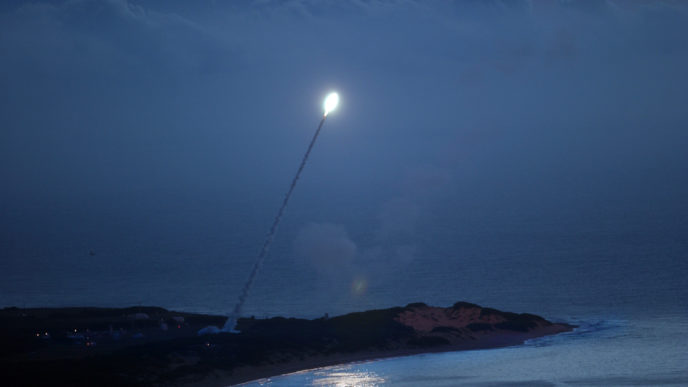
Officials from the spaceport on Kodiak Island will host a town hall meeting Wednesday to answer questions about the U.S. Missile Defense Agency’s plans to test a U.S.-Israeli anti-ballistic missile system in Alaska.

Testing of the Arrow-3 missile system will begin in 2018, the Kodiak Daily Mirror reported. The system was developed by Israel Aerospace Industries and Boeing, and is co-managed by the Missile Defense Agency and the Israel Missile Defense Organization.

It will be part of the five- to six-year, $80.4 million contract between Alaska Aerospace Corporation and the Missile Defense Agency, which was announced last summer, Alaska Aerospace CEO Craig Campbell said. (Read more from “Town Hall Planned to Discuss Alaska Arrow-3 Missile Testing for Israel” HERE)

Follow Joe Miller on Twitter HERE and Facebook HERE.

Successful US Missile Defense Test Shows How Essential This Missile Program Is

The United States Missile Defense Agency has accomplished a historic feat.

On Tuesday, the agency successfully intercepted an intercontinental ballistic missile in an important test utilizing its ground-based midcourse defense system.

The ICMB—mocked up to resemble a missile capable of carrying a nuclear payload similar to the ones that North Korea is feverishly pursuing—was launched over the Pacific Ocean some 4,000 miles away from the intercepting missile’s launch site at Vandenberg Air Force Base in California.

The successful test was an important step in reaffirming our nation’s missile defense program’s ability to protect the American homeland from long-range ballistic missile threats.

This is particularly relevant given the increased bellicosity with which North Korean dictator Kim Jong Un has been attempting to flex his nation’s military might. Since the beginning of the year, North Korea has launched a total of 12 missiles in nine separate tests.

The missiles launched by North Korea have ranged from short- to medium- to intermediate-range ballistic missiles.

The increase in provocative missile tests by the rogue North Korean regime should be seen as both a warning and an opportunity.

It is a warning that, despite past rhetoric to the contrary, North Korea is firmly determined to achieve the capability to strike the American homeland with offensive, nuclear-armed ballistic missiles.

It is also an opportunity because as recognition of North Korea’s intentions and capabilities becomes clear to even the blindest skeptic, Congress and the Trump administration can feel confident in their investment in a robust, comprehensive missile defense program.

A multilayered, robust missile defense system has been, and will remain, an integral element of America’s broader national security apparatus.

Missile Defense Agency Director Vice Admiral Jim Syring hailed the defense system as “vitally important” and said that Tuesday’s successful test “demonstrates that we have a capable, credible deterrent against a very real threat.”

Syring added, “The intercept of a complex, threat-representative ICBM target is an incredible accomplishment for the [ground-based midcourse defense] system and a critical milestone for this program.”

Tuesday’s successful missile defense test against an ICMB-class threat was indeed an important milestone, but it’s also a reminder that missile defense is not a one-time investment.

Missile defense requires a sustained commitment to building upon the successes of today while also investing in the technology of the future.

Investment in and commitment to missile defense technologies wavered under the Obama administration.

As Michaela Dodge of The Heritage Foundation wrote last year, “President Obama’s missile defense policy shifts cost the nation precious time and capabilities at a time when adversaries are succeeding in advancing their own ballistic missile programs.”

Unfortunately, the United States can no longer afford to waste precious time in developing and enhancing the capabilities necessary to defend the American homeland. The threats from rogue nations such as North Korea and Iran, as well as from regional adversaries throughout the world, is only increasing.

Tuesday’s successful test against an ICBM-class missile was an important moment in the history of America’s missile defense program development. Yet it must be understood as only the next step in an evolving and essential program. (For more from the author of “Successful US Missile Defense Test Shows How Essential This Missile Program Is” please click HERE)

Follow Joe Miller on Twitter HERE and Facebook HERE.

Moscow Issues Its First Nuclear Challenge to Trump

Almost right out of the gate, the Trump administration is facing its first arms control challenge from Moscow.

Russia has reportedly deployed its new cruise missile in an apparent violation of the Reagan-era Intermediate-Range Nuclear Forces Treaty, in effect since 1988.

The treaty prohibits the possession of ground-launched ballistic and cruise missiles with ranges of between 500 and 5,500 kilometers. Russia’s ground-launched SSC-8 cruise missile has been under development and testing for several years.

Russia initially violated the treaty by testing the missile during Barack Obama’s presidency. Despite becoming aware of this apparent violation, the Obama administration did not take any forceful action to bring Russia back into compliance with the treaty, merely sending President Vladimir Putin a letter of concern in July of 2014.

The Obama administration was less than forthcoming in discussing challenges that the treaty violation poses for the United States and its allies. The State Department’s annual compliance reports prior to July 2014 wrongly led Americans to believe there was no reason for concern over the Intermediate-Range Nuclear Forces Treaty, even though the missile has reportedly been tested as early as 2008.

The Trump administration must do better.

The missile range limit of 500 kilometers is significant for U.S. allies in Europe situated close to the Russian borders and to Kaliningrad, a Russian enclave that borders Poland and Lithuania. The presence of Russian intermediate-range missiles would considerably complicate any U.S. efforts to defend its allies in the Baltics and Central and Eastern Europe should Russia decide to violate their territorial integrity.

Such a scenario is not as far-fetched as it might seem. Russia has a recent history of violating other nations’ sovereignty and territorial integrity. It also periodically issues nuclear threats against the North Atlantic Treaty Organization allies and conducts military exercises that simulate nuclear strikes against Poland.

Gen. Philip Breedlove, commander of Supreme Allied Command Europe and of U.S. European Command, said NATO allies are “concerned” over the Intermediate-Range Nuclear Forces Treaty issue and argued that violations “can’t go unanswered.”

For its part, Russia accuses the United States of Intermediate-Range Nuclear Forces Treaty violations. But Russian accusations are baseless. U.S. missile defense systems do not violate the treaty because the treaty itself contains an exception for them.

Neither do U.S. drones violate the treaty, as they are simply not mentioned by the treaty at all.

The Trump administration has a range of options to respond to the Russian treaty violations. Purely diplomatic measures to address the violation first begun during the Obama administration may not be sufficient.

Historically, arms control tends to limit how the United States learns about military systems and their interactions in a broader context. This is why terminating the treaty is a viable option.

Currently, Moscow is doing whatever it deems necessary to its strategic interest regardless of the treaty, while the United States continues to abide by it. The administration should not ponder any future arms control initiatives and nuclear weapons reduction agreements at least until this issue is resolved. (For more from the author of “Moscow Issues Its First Nuclear Challenge to Trump” please click HERE)

Follow Joe Miller on Twitter HERE and Facebook HERE.
Tomahawk Cruise Missile Hits Moving Ship Target

Tomahawk_2-490x323The Navy is moving closer to having a sea-launched, anti-ship cruise missile able to change course in flight and hit moving ship targets from distances up to 1,000 miles, according to two recent Tomahawk Block IV tests at China Lake, California.

“The USS Kidd, one of our guided missile destroyers, launched a Tomahawk missile that changed course mid-flight and struck a moving ship after being queued by an aircraft,” Deputy Defense Secretary Bob Work said in a recent speech at the U.S. Naval Institute. “Now, this is potentially game-changing capability for not a lot of cost. It’s a 1,000 mile anti-ship cruise missile. It can be used from practically our entire surface and submarine fleet.

The two tests, which involved firing Tomahawk Block IV missiles against land and sea targets, were conducted by the Navy and Raytheon at Naval Air Weapons Station, China Lake, Calif., in January of this year.

During the first test, a Tomahawk missile fired from the USS Kidd, a guided missile destroyer, and received real-time target information relayed from a surveillance aircraft to a weapons station at China Lake. Updated target information was related to the Tomahawk in flight before the missile then maneuvered and changed course from a pre-planned mission toward a new target, striking a moving ship on the water.

“This demonstration is the first step toward evolving Tomahawk with improved network capability and extends its reach from fixed and mobile to moving targets,” a statement from Raytheon said. (Read more from “Tomahawk Cruise Missile Hits Moving Ship Target” HERE)

Follow Joe Miller on Twitter HERE and Facebook HERE.

US Air Force Conducts Minuteman III Missile Test Launch from Vandenberg

missle launchA team of Air Force Global Strike Command Airmen launched an unarmed Minuteman III intercontinental ballistic missile equipped with a test reentry vehicle today at 3:36 a.m. Pacific Daylight Time from Vandenberg Air Force Base, California.

Every test launch verifies the accuracy and reliability of the ICBM weapon system, providing valuable data to ensure a safe, secure and effective nuclear deterrent. The launch team, under the direction of the 576th Flight Test Squadron, Vandenberg AFB, included Airmen from the 90th Missile Wing at F. E. Warren AFB, Wyoming.

“A lot of work and preparation goes in to an operational test launch from the teams on both bases,” said Lt. Col Tytonia Moore, 90th MW, Task Force commander. “With these launches, we not only verify our processes and the ICBM weapon system, we provide a visual to the world that the Minuteman III is capable of striking pretty much anywhere with extreme precision.”

“The role we play here is vital to the testing and evaluation of the Minuteman III program,” said Col. Kelvin Townsend, 576th Flight Test Squadron commander. “We ensure the facilities and framework are in place to conduct operational test launches in a safe and secure manner with multiple team players contributing to the reliability of the test.” (Read more from “F. E. Warren Conducts Minuteman III Missile Test Launch from Vandenberg” HERE)

Follow Joe Miller on Twitter HERE and Facebook HERE.