Posts

Senate Republicans Block Government Funding, Debt Ceiling Bill

Senate Republicans blocked a government spending and debt ceiling bill Monday, setting up a dramatic showdown between Republicans and Democrats on whether Congress should raise the debt ceiling while Democrats plan to spend trillions on infrastructure and social spending.

The Senate failed to invoke cloture, 48-50, on H.R. 5305, the continuing resolution (CR). Senate Republicans blocked the CR as House Democrats remain poised to vote on the $3.5 trillion infrastructure bill.

Democrats, rather than put the debt ceiling increase in the $3.5 trillion reconciliation bill, decided that they would pack the debt ceiling increase in the government funding bill.

The Democrats’ CR would lift the debt ceiling through the 2022 midterm elections and fund the government through December.

The federal government will run out of funding on September 30, and the debt ceiling must be lifted in early October. (Read more from “Senate Republicans Block Government Funding, Debt Ceiling Bill” HERE)

Delete Facebook, Delete Twitter, Follow Restoring Liberty and Joe Miller at gab HERE.

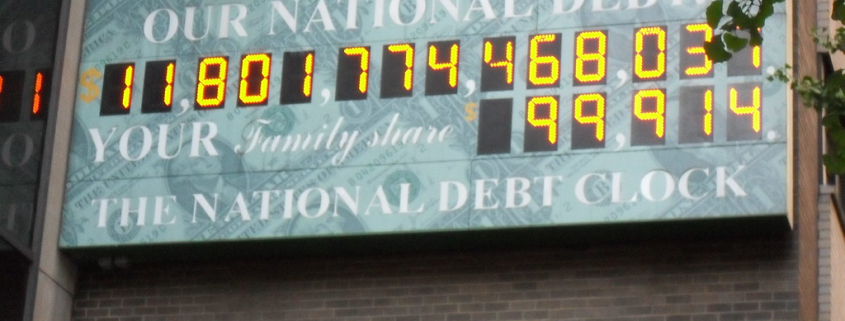
$7,060,259,674,497.51–Federal Debt Up $7 Trillion Under Obama

Photo Credit: AP

Photo Credit: AP

The total federal debt of the U.S. government has now increased more than $7 trillion during the slightly more than five and a half years Barack Obama has been president.

That is more than the debt increased under all U.S. presidents from George Washington through Bill Clinton combined, and it is more debt than was accumulated in the first 227 years of this nation’s existence–from 1776 through 2003.

The total federal debt first passed the $7-trillion mark on Jan. 15, 2004, after President George W. Bush had been in office almost three years.

federal-debt_0

When President Obama took office on Jan. 20, 2009, the total federal debt was $10,626,877,048,913.08. As of the close of business on July 30, 2014, it had risen to $17,618,599,653,160.19–up $6,991,722,604,247.11 from Obama’s first inauguration day.

Read more from this story HERE.

China Now Owns a Record $1.317T of U.S. Government Debt

chinese-flag-nationalChina stepped up its purchases of U.S. government debt late last year, increasing its holdings of Treasurys to an all-time record of $1.317 trillion in November, government data released this week revealed.

The statistics underscore how reliant the U.S. and Chinese economies are on one another even as political tensions occasionally emerge.

According to figures inadvertently released Wednesday evening on the U.S. Treasury Department website, China’s holdings of Treasurys increased by 0.9% in November to $1.317 trillion, up from $1.305 trillion in October. Year-over-year, China’s holdings rose 11.3% from $1.183 trillion.

The $1.317 trillion figure exceeds China’s previous record high in July 2011 of $1.315 trillion, according to the government data.

Read more from this story HERE.

$2,001,093,000,000: Fed’s Ownership of U.S. Debt Breaks $2T for First Time

BEN BERNANKE(CNSNews.com) – The Federal Reserve’s holdings of publicly traded U.S. Treasury securities—federal government debt—pushed above $2 trillion for the first time last week, hitting approximately $2,001,093,000,000 as of Aug. 14, according to the Fed’s latest weekly accounting.

The Fed’s accounting for the previous week showed that it had owned approximately $1,993,375,000,000 in U.S. Treasury securities as of Aug. 7.

Back on Dec. 31, 2008, before the Fed began its strategy of “Quantitative Easing,” the Fed owned only $475.9 billion in U.S. Treasury securities. Since then, the Fed’s holdings of U.S. government debt have more than quadrupled.

Launched in 2009, the Fed’s Quantitative Easing (QE) efforts have attempted to stimulate the economy.

“Under QE,” explains a February 2013 Congressional Research Service report, “the Fed attempts to lower long-term Treasury and MBS [mortgage-backed security] yields directly through purchases that drive down their yields, in the hope that lower Treasury and MBS yields will indirectly filter through to reductions in other private long-term yields. (Lower Treasury yields do not directly stimulate economic activity—they are only stimulative if other yields fall as a result.) This could occur because Treasury securities are considered a ‘benchmark’ against which other private securities are priced, so that other securities are automatically repriced when Treasuries are repriced (although the change is unlikely to be one-to-one).”

Read more from this story HERE.

The Dollar – and the USA – are Toast

Photo Credit: WNDObama has done it. He has brought America down. It only took him just over four years. The Republicans could have stopped him. They didn’t.

How did the nihilistic left succeed in destroying America? Simple. They learned just a little of the capitalism they hate, and they drove your nation into outright bankruptcy.

And here is what the GOP has to say about it: just about nothing.

The once-mighty United States is now the most indebted nation on Earth. In round numbers, here are just some of the vital statistics as the patient dies:

National debt: $17 trillion, or $50,000 per man, woman and child, or $150,000 per taxpayer. Annual federal deficit: $1 trillion. Medicare/Medicaid/Obama”care”: $1 trillion a year. Social Security: another $1 trillion a year. Defense: two-thirds of a trillion. Unemployment handouts: $2 billion per working day. Debt interest: $1 billion per working day. Federal pensions, ditto.

Now for the big numbers. Your government’s Social Security liability is as big as the national debt: $17 trillion. Its prescription drug liability is $22 trillion. Then there’s the Medicare liability of $86 trillion. Total unfunded liabilities of the U.S. government are $125 trillion.

Read more from this story HERE.

Obama's Borrowed More Per Household ($53,616) Than Median Household Earns ($50,502)

Photo Credit: APUnder President Barack Obama, the federal government’s debt has increased by an amount per household that exceeds the annual median household income.

Since Obama’s first inauguration on Jan. 20, 2009, the federal debt has climbed $6,167,472,778,984.22. That equals about $53,616 for each of the 115,031,000 households the Census Bureau currently estimates are in the country.

By contrast, the Census Bureau’s most recent estimate of the median household income was $50,502 (for 2011).

Read more from this story HERE.

Senate Democrats Would Increase Taxes — And The National Debt

Photo Credit: Cliff Owen

Before Wednesday it had been more than 1,400 days since Senate Democrats had produced a federal budget. After only a few hours of Senate Budget Committee testimony, it quickly became apparent why they waited so long.

Now that Obamacare has become law, it is impossible for Democrats to put together a tax-and-spending plan that does not increase taxes by hundreds of billions of dollars yet still add trillions to the national debt.

The Democrats are so eager to raise both taxes and spending that the budget plan they submitted yesterday for the next fiscal year increases spending this year by $46 billion. Then they hike spending another $116 billion next year on their way to a 60 percent increase over the next 10 years.

To put that in perspective, the budget submitted Tuesday by House Budget Chairman Paul Ryan, R-Wis., increases spending by just 40 percent over that same time frame. The Ryan budget, which returns federal spending to its post-World War II historical average, calls for outlays of $41.5 trillion over 10 years. That’s $4.9 trillion less than the Democratic total of $46.4 trillion.

In addition to historically high government spending, the Democratic budget also raises taxes by $1 trillion starting immediately. Thanks to the weakest economic recovery since World War II, federal taxes as a percentage of GDP are still below historic norms. But as the economy improves, Democrats steadily ramp up the government tax burden, reaching a high of 19.8 percent in 2023. Only once since World War II — right before the tech bubble collapsed in 2000 — has the nation’s tax burden ever been that high.

Read more from this story HERE.

Rand Paul Returns Money From Office Account To Treasury

Photo Credit: Political TickerSen. Rand Paul cut another six-figure check to the United States Treasury Wednesday, taking the money he said he didn’t need from his office’s budget to make a tiny dent in the nation’s massive federal debt.

“We watch every purchase,” Paul, a Republican from Kentucky, said at an event next to an oversized check for $600,000. “We watch what computers we buy, what paper we buy, the ink cartridges. We treat the money like it’s our money, or your money, and we look at every expenditure.”

The $600,000 reflects more than 20% of Paul’s annual office budget, according to a press release. Another GOP lawmaker, Rep. Mick Mulvaney of South Carolina, said he would return $160,000 to the federal government, or 12% of his office budget.

“At a time when Americans are tightening their budgets, I have made an effort to do the same with my Congressional office budget,” Mulvaney wrote in a statement. “‘My office has found ways to save money while continuing to provide necessary services to the constituents of the Fifth District. As requested when I returned over $160,000 last year, I ask that Speaker Boehner use this money to pay down the national debt.”

Read more from this story HERE.

CBO Forecast: 1.4% GDP, 8% Unemployment, 7 Million To Lose Health Insurance

Photo Credit: APThe Congressional Budget Office’s just-released economic forecast for 2013 is dispiriting, to say the least. The GDP is expected to grow by only 1.4%, the unemployment rate will “stay near” 8%, the deficit will reach $845 billion, and ObamaCare will cost 7 million their health insurance.

The CBO says things will improve after that, but after three years of being told by the government and its media that “prosperity is just around the corner,” you’ll just have to pardon my cynicism. The media, however, will talk only about how much better the CBO says things will get, because that’s what Obama would want them to do.

What these numbers really mean is that millions of Americans are about to face yet another year of chronic joblessness and economic hardship — which just didn’t have to happen. Reagan inherited an economy in much worse shape than the one Obama inherited. But Reagan’s tax and regulatory policies got out of the way of the economy, and as a result, the engine of American ingenuity was unleashed and the economy exploded. Millions of jobs were created, millions were lifted out of poverty into the middle class, and poverty decreased.

Obama, however, decided he knew better than history and did the exact opposite of what Reagan did. New taxes, ObamaCare, untold numbers of regulations, and an overall Narrative that toxified success, individualism, and the pursuit of prosperity.

And just look at us now.

Read more from this story HERE.

Sign Of The Times: Congressional Appropriations Assignments Are No Longer Coveted

As the story goes, when President Franklin D. Roosevelt in 1942 asked Sen. Kenneth McKellar, then the ranking member of the Appropriations Committee, to quietly provide $2 billion for a secret weapons lab, the Tennessee Democrat had a brief and quick response.

“Mr. President, I have just one question. Where in Tennessee do you want me to hide it?” McKellar said, according to congressional lore about Tennessee’s Oak Ridge National Laboratory, a key part of the Manhattan Project.

It was just one instance among countless cases on Capitol Hill where appropriators — the lawmakers who hold the prized positions closest to the federal purse — found a pressing national priority fitting in neatly with local interests for economic development and the jobs that come with it.

From the funds longtime appropriator John P. Murtha, a Democrat, funneled to his hometown of Johnstown, Pa., by locating the National Drug Intelligence Center there to the federal dollars Harold Rogers, a Republican and now the House Appropriations chairman, steered toward the anti-drug nonprofit Operation Unite, which he helped found in his southern Kentucky district, the appropriations story has been one of political clout executed through the federal spending process.

That’s why legislators such as McKellar and Murtha would have been shocked at the decision Sen. Sherrod Brown, D-Ohio, made at the start of the 113th Congress, when he gave up the chance to move up the seniority ladder on Appropriations for a seat on the tax-writing Finance Committee.

Read more from this story HERE.