Posts

Gorsuch Affirms He’s a ‘Scalia’ Justice

Many voters who said they had reservations about supporting Donald Trump for president cited the U.S. Supreme Court as the No. 1 reason they chose him over Democratic Party nominee Hillary Clinton.

If their desire was to see the court filled with justices who share the judicial philosophy of the late Antonin Scalia, they must be pleased with the record so far of Justice Neil Gorsuch and the pledge the Trump appointee made at a dinner Thursday night in honor of Scalia.

“Tonight I can report that a person can be both a publicly committed originalist and textualist and be confirmed to the Supreme Court of the United States,” Gorsuch said at the dinner, held by the Federalist Society at Union Station in Washington, D.C., the Washington Examiner reported.

“Originalism has regained its place at the table … textualism has triumphed … and neither one is going anywhere on my watch.”

During his remarks, Gorsuch equated criticism of the conservative Federalist Society’s influence to the “red scare” and praised the leadership of Federalist Society Executive Vice President Leonard Leo, who serves as Trump’s adviser on judicial nominations. (Read more from “Gorsuch Affirms He’s a ‘Scalia’ Justice” HERE)

Follow Joe Miller on Twitter HERE and Facebook HERE.

In His First Criminal Cases, Neil Gorsuch Already Mirroring Scalia

It is only Neil M. Gorsuch’s first month as an associate justice on the Supreme Court, but he is already showing just how similar his judicial philosophy is to that of his predecessor, the late Justice Antonin Scalia.

In several difficult criminal law cases, Gorsuch has asked sharp questions from the bench and cast one of his first votes to deny a stay of execution—moves that echo Scalia’s approach to the law.

The Death Penalty in Arkansas

First, in McGehee et al. v. Hutchinson, Gorsuch voted to deny several Arkansas death row inmates’ requests to halt their executions.

Justices Stephen Breyer, Ruth Bader Ginsburg, Elena Kagan, and Sonia Sotomayor would have granted their request. Breyer wrote a two-page dissent questioning “whether the death penalty is consistent with the Constitution” (he clearly believes it isn’t).

While the majority did not state their reasons for denying the inmates’ request, it seems clear that they relied, at least in part, on the reasoning set out by Scalia in his concurring opinion in Glossip v. Gross (2015), in which he wrote that “not once in the history of the American republic has this Court ever suggested the death penalty is categorically impermissible.”

“The reason is obvious: It is impossible to hold unconstitutional that which the Constitution explicitly contemplates.”

Scalia continued, “The Fifth Amendment provides that ‘[n]o person shall be held to answer for a capital … crime, unless on a presentment or indictment of a grand jury,’ and that no person shall be ‘deprived of life … without due process of law.’”

The Washington Post describes votes on stays of execution as “a time when the responsibility of the role crystallizes.” In McGehee, Gorsuch held firm, silently adopting Scalia’s constitutionalist reasoning.

No ‘Linguistic Somersaults’

Second, Gorsuch demonstrated his adherence to textualism through some of the questions he posed to the advocates during oral argument in Maslenjak v. U.S.

At issue in the case is whether the government was justified in removing the U.S. citizenship of Divna Maslenjak, an ethnic Serb from modern Bosnia.

Maslenjak, who came to the United States in 2000 and was subsequently naturalized as a citizen, was convicted of lying to a U.S. immigration official.

During an interview in 1998, she told the immigration officer that she and her husband were seeking asylum because they feared persecution in Bosnia because her husband had evaded conscription into the Serbian army.

In reality, he had served as an officer in a Serbian militia unit which was subsequently accused of war crimes.

In 2006, Maslenjak falsely stated on an immigration form that she had never lied to an immigration officer, and was subsequently convicted of making false statements on a government document.

A key issue before the Court is whether that lie was “material” enough to affect the original immigration decision, which would, in turn, be sufficient to uphold her conviction and her subsequent denaturalization.

As Amy Howe writes at SCOTUSblog, “ruling for the government” in this case “would give U.S. officials boundless discretion to take away citizenship based on even very minor lies.”

In the midst of this high stakes argument, Gorsuch’s questions focused on one issue in particular: The text of the law itself.

The statute, Gorsuch noted, “doesn’t contain an express materiality provision,” and Gorsuch was concerned about having to do “a lot of linguistic somersaults to add” such a provision into the law.

That harkens back to Scalia’s dissenting opinion in King v. Burwell (2015). There, the U.S. Supreme Court held that the Affordable Care Act’s “tax credits are available to individuals in states that have a federal exchange.”

In signature prose, Scalia wrote that “[t]he somersaults of statutory interpretation” that the majority “performed (‘penalty’ means tax … ‘established by the state’ means not established by the state) will be cited by litigants endlessly, to the confusion of honest jurisprudence.”

Gorsuch appears sympathetic to Scalia’s disapproval of “linguistic somersaults” and the idea that judges are empowered to rewrite laws that they may disagree with.

The Big Picture

Third, Gorsuch showed a keen awareness of how the Supreme Court’s rulings carry far-reaching implications for future cases in Weaver v. Massachusetts.

That case involved a man named Kentel Weaver, who in 2006 was convicted of unlicensed possession of a firearm and premeditated murder of 15-year-old Germaine Rucker. Weaver was 16 at the time of the murder.

In 2011, he sought a new trial, claiming that his counsel was ineffective because they did not object to the courtroom being closed during jury empanelment, when the defendant, judge, and jury first meet.

Weaver argued that this was a procedural irregularity that violated his Sixth Amendment right to a public trial.

But as Chief Justice John Roberts pointed out at oral argument, the reason the courtroom was closed was that it was full. Ninety members of the public were in attendance as prospective jurors, and they all needed seats.

Weaver objected to this reasoning, saying that while prospective jurors were seated, his mother and his other supporters weren’t able to enter the courtroom during the early stage of the proceedings.

At this point, Gorsuch entered the fray with a big picture question.

He asked whether a “triviality exception” might apply here, or whether the Court should consider the potential unintended consequences that can arise when it tries to prevent every injustice—no matter how small—by imposing new procedural requirements across the entire criminal justice system.

Gorsuch asked whether ruling for Weaver would create a “Professor Stuntz” problem, whereby in “perfecting procedure, we actually result in its denial…”

This reference was to the late Harvard criminal law professor, William J. Stuntz, who argued that by following the Warren Court’s “fetishization of so many formalistic procedures,” the criminal justice system is now overburdened by an excess of procedural technicalities at play.

Berkeley law professor Andrea Roth summed up Stuntz’s argument, saying that these rules “at best indirectly ensure fairness of trial and sentencing outcomes” but have “rendered trials too expensive” and complex for anyone but elite lawyers to tackle.

In turn, writes Roth, this “has driven prosecutors and lawmakers to seek ways to avoid trial and force pleas through draconian sentencing schemes, a skewed focus on easily detected urban drug crimes mostly committed by racial minorities, and ever-expanding substantive criminal law.”

Scalia worked to constrain some of the Warren Court’s excesses in this regard during his time on the Court.

In Hudson v. Michigan (2006), for example, Scalia, writing for the majority, refused to extend the “exclusionary rule” (which requires the suppression of incriminating evidence, notwithstanding the fact that a defendant may be guilty) to technical violations of “the knock-and-announce rule,” which establishes that, absent extenuating circumstances, police officers must knock on the door and announce their presence before entering a suspect’s home.

He also asserted, in a noteworthy University of Chicago Law Review article, that there is a “dichotomy between ‘general rule of law’ and ‘personal discretion to do justice’”—that is, to rule as a judge personally desires rather than as the law instructs—and that the latter may lead to “unfortunate practical consequences.”

So far, Gorsuch is modeling this Scalia-esque approach and honoring the rule of law.

This is the exact approach he espoused in a dissent in A.M. v. Holmes (2016) while sitting on the U.S. Court of Appeals for the Tenth Circuit. There, he wrote, “[a] judge who likes every result he reaches is very likely a bad judge, reaching for results he prefers rather than those the law compels.”

A Fitting Successor to Scalia

Throughout his nomination and confirmation process, Heritage Foundation legal scholars noted Gorsuch’s striking similarities to Scalia, which include a shared sensitivity to overcriminalization, textualism, and the separation of powers.

In these first few cases, Gorsuch is showing just how well he fits the Scalia mold of being a committed constitutionalist and textualist on the High Court. (For more from the author of “In His First Criminal Cases, Neil Gorsuch Already Mirroring Scalia” please click HERE)

Follow Joe Miller on Twitter HERE and Facebook HERE.

Boom: Neil Gorsuch Just Made Originalists Happy with One Simple Question

Donald Trump’s first appointee to the Supreme Court wasted no time in making his voice heard (literally) before the chamber Monday morning. Among the first questions Justice Neil Gorsuch asked was a positive indicator for originalists who supported his nomination.

Gorsuch’s process of finding the original meaning of the law, as written – one of the more comical non-scandals surrounding his confirmation hearing – has indeed followed him onto his first day on the job, as evidenced by a one-line question he asked from the bench:

“Wouldn’t it be a lot easier if we just followed the plain text of the statute?”

According to a report at ABC News, the newest justice spent a great deal of time questioning the federal worker’s lawyer about the wording of a statute related to the case, before grilling the Justice Department’s attorney about the meaning of the Civil Service Reform Act.

The case in question was Perry v. Merit Systems Protection Board, which revolves around the proper jurisdiction of a federal census worker’s employment dispute. Perry was the first of three that the once-again fully fledged bench was set to hear on the first day of its last session of the current term.

Despite the long, impressive resume that the Colorado native brings to Justice Scalia’s former seat, only time will tell what kind of jurist Trump’s first pick will turn out to be, and what kind of mark he will leave on the body of constitutional law.

But first impressions do matter, and one like this has been on many people’s wish list for a long time. (For more from the author of “Boom: Neil Gorsuch Just Made Originalists Happy with One Simple Question” please click HERE)

Follow Joe Miller on Twitter HERE and Facebook HERE.

Gorsuch’s First Few Weeks on the Job Could Have a Monumental Effect on Religious Liberty

With just a few days on the Supreme Court under his belt, America’s newest justice will hear arguments in a religious liberty case nearly 150 years in the making next week – one that could have a sweeping impact on a majority of state constitutions.

It all began with a church playground and some tire scraps.

The case of Trinity Lutheran v. Cromer started in January 2013 after the state of Missouri denied a preschool access to a statewide public safety program that provides recycled tires for playgrounds simply because the preschool was operated by a church.

In short, they wanted to remove the pea gravel surfacing encompassing the recreational space with safer – and much more boo-boo averse – tire scraps.

Why were they turned down? Because Missouri is one of the majority of U.S. states that have what’s known as a Blaine Amendment. These are legal relics from the 19th century that were dreamed up during a fervor of anti-Catholic sentiment in American history.

Now the question before the Supreme Court, now rounded out with Justice Gorsuch, is whether or not laws like those in Missouri that block public funds from going to religious organizations – regardless of the purpose – are indeed in line with the First Amendment.

The Blaine Amendment is named after former Speaker of the House James G. Blaine of Maine, who in 1875 proposed a constitutional amendment stipulating that “no money raised by taxation in any State for the support of public schools, or derived from any public fund therefore, nor any public lands devoted thereto, shall ever be under the control of any religious sect; nor shall any money so raised or lands so devoted be divided between religious sects or denominations.”

The policy initiative was a response to Catholic schools seeking equal footing in the public square for their desired academic and spiritual curricula. See, at the time, public schools were overwhelmingly Protestant in tone and curriculum; when Catholics asked for equal treatment in education, anti-papal politicians responded in kind.

While Blaine’s law never made it past the U.S. Senate, similar measures took hold in state constitutions across the country. Now some 37 states still have them on the books, leading to situations like that of the Trinity Lutheran playground.

Proponents of such amendments – like the Freedom from Religion Foundation, the ACLU, and the Satanic Temple – view these sorts of laws as a means of preserving the so-called “separation of church and state doctrine.” However, such a doctrine appears nowhere in the Constitution nor Bill of Rights (absent from the Philadelphia Convention), and didn’t make an appearance in the legal discussion until 1947. [See: Lee, “Our Lost Constitution”]

But Erik Stanley, a senior counsel at Alliance Defending Freedom and director of the group’s Center for Christian Ministries, says that what these kinds of laws effectively do is impose a harsher vision of the “separation of church and state” than the Constitution requires, while discriminating against organizations — which violates the Free Exercise Clause of the First Amendment.

“You can’t violate the Free Exercise Clause by trying to have some greater degree of separation of church and state at the state level,” Stanley explains. “Essentially, what Missouri is trying to do is say, ‘Well, upholding our definition of the separation of church and state in our state constitution is treating religion worse than everybody else.’”

One case that Stanley points to is a religious discrimination case from the 1970s in which an 18th century Tennessee law barred Paul McDaniel – a Baptist minister – from being a state constitutional delegate. In an 8-1 decision, the Supreme Court found that the Tennessee law violated the free exercise of religion by making McDaniel’s civil liberties conditional on his willingness to renounce his religious liberties. Therein lies the parallel between this case and a children’s playground in the Show Me State.

“There’s no valid, neutral reason to exclude Trinity Lutheran Church” from the tire scrap program, Erik Stanley said, saying that the church went through the application process and was highly rated for the program. “The only real reason to exclude them was because of their religious status, which is the same as what happened in McDaniel.”

Blaine Amendments don’t just keep playgrounds from getting publicly available safety equipment. Back in October I wrote about how a similar provision in Oklahoma is keeping kids with special needs from using public scholarship money at schools that fit them.

One such example was Wyatt Johnson – born three months premature, hearing imparted, and now a teenager – whose family spent years in litigation trying to get his public scholarship money to Metro Christian Academy in Tulsa. (Sooner State voters opted against getting rid of the law with a ballot initiative in November.)

Furthermore, if you let the logic behind these sorts of rulings play out fully, you run into all sorts of absurdities.

“If [Missouri] can deny Trinity Lutheran access to this neutral benefit program which has nothing to do with religion, solely because of the fact that it’s a church, then they could deny all kinds of things,” Stanley explains. “They could say that we’re not going to send the fire department to a burning mosque or that they’re not going to send police to a synagogue break-in, because those are also neutral benefits that provide aid to religion.”

The question on everyone’s mind now is how Justice Gorsuch will rule in one of the most consequential cases of his first term.

Throughout his months-long confirmation process, Gorsuch’s record on religious liberty as a circuit judge was praised by First Amendment advocates. Now, as a jurist charged with the most difficult legal questions facing our republic, those who awaited his appointment with bated breath will finally get to see how he will rule on an issue so clouded in stigma and misconception.

Stanley is optimistic about the outcome of the case, saying Gorsuch “proved himself to be a friend of religious liberty in how he ruled on the 10th Circuit court,” and that the ADF team has “every reason to believe that he’ll continue that at the Supreme Court.”

Oral arguments in the case are scheduled for April 19. (For more from the author of “Gorsuch’s First Few Weeks on the Job Could Have a Monumental Effect on Religious Liberty” please click HERE)

Follow Joe Miller on Twitter HERE and Facebook HERE.
Gorsuch Is in and the Senate Is More Nuclear. Where Do Conservatives Go From Here?

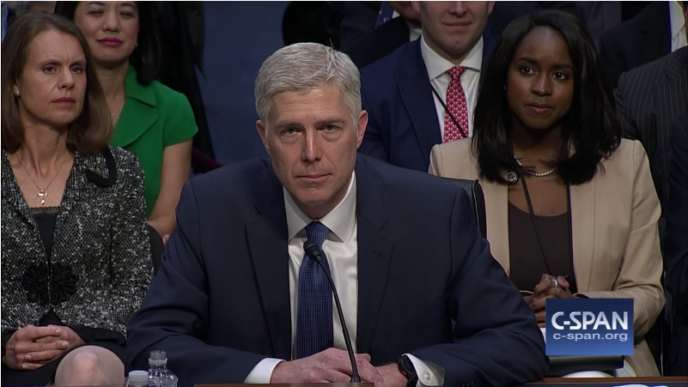
Neil Gorsuch became the 113th justice of the United States Supreme Court Friday afternoon, following a Republican circumvention of a filibuster with a long-anticipated “nuclear vote” majority.

While the fulfillment of this particular Trump campaign promise is cause for modest celebration for constitutionalists, those who promoted Gorsuch’s nomination need to remain clear-eyed about what this victory really means for our ongoing constitutional crisis.

Now that the dust has settled in the upper chamber, we’re left with a few things: a fulfilled promise from the Trump campaign, the end of the Supreme Court filibuster for the foreseeable future, and at least a nominal return to the balance of the Supreme Court before Justice Antonin Scalia’s passing last year.

It’s hard to imagine how this nuclear-option change doesn’t set the stage for the upper chamber to nuke the legislative filibuster in following suit, thus reaching the natural end of what the progressive populists sought to achieve with the 17th Amendment.

As Conservative Review Editor-in-Chief Mark Levin pointed out on his radio program this week, the roots of this move are over 100 years old and lie at the feet of the Progressive movement. In short, progressives cast the first stones, both on changing the nature of the Senate and politicizing the process (See: Robert Bork, 2013 et al.).

Ironically, what we have seen this week is the natural conclusion of two progressivist forces that simultaneously – if seemingly contradictorily – seek the end of centralization through the means of mob rule. Long story short, when your judiciary and contemplative body — with authority over approving its members — have been so politicized by judicial activism, a hyper-partisan outcome to the system was inevitable.

The nature of Gorsuch’s confirmation has made it painfully clear that there is no longer the prospect of lukewarm talent on the bench. Now the impetus remains on Republicans to go all out and take the Obama strategy of stacking the court with Trump appointees in the lower courts – albeit encumbered by the “blue slip” process . (And remembering all the while that this political football will change hands, leaving Democrats to do the same once again in the future.)

But, nuclear or not, Justice Scalia’s seat has been filled with an originalist and all is right again with the world, right? No. Rather, conservatives ought to keep in mind that this appointment — while a big fulfilled promise to a greatly concerned constituency — will not solve the judicial crisis facing our Constitution and our republic.

At best, the court now stands at the same ideological balance that gave us the Obergefell decision. At worst, we’re a few degrees further away from original intent than we were on Justice Scalia’s last night on this Earth. Either way, hanging all of one’s hopes for the republic, the rights of the unborn, or a list of other issues before the court solely on Neil Gorsuch’s confirmation and then walking away is a fool’s gambit.

Certainly, should Anthony Kennedy step down and offer up a way to halt the pivot on the court’s “swing vote,” or should anyone else on the progressivist side of the bench leave, then it will be incredibly easier to confirm an even more originalist jurist to fill the spot, as Josh Hammer points out at The Daily Wire.

Neil Gorsuch may in fact be “the kind of jurist we need,” as Sen. Mike Lee, R-Utah, said before the committee, but there’s ground for healthy skepticism on this front. Daniel Horowitz explains that while Gorsuch is indeed a constitutionalist in a broad sense, and his articulation of the philosophy was both succinct and clear, his history of jurisprudence skews closer to that of an Alito than a Scalia. (And definitely short of a Thomas on the originalism scale.) Only time will tell.

But hope is not a course of action, especially when one branch of our government has so thoroughly co-opted the duties of the other two, as Daniel Horowitz points out in his book “Stolen Sovereignty.” Rather, the problems that so many have sought to fix by finding “better judges” are systemic, and the best answers to them are systemic as well.

The situation we see before us is two-pronged, as is the answer. If we want to see the Senate return to being the Senate again, then it needs to return to its original function prior to the 17th Amendment, while enacting reforms to make the courts themselves less political by nature.

But more important is the need for Congress to depoliticize the process of judicial appointments by depoliticizing the federal courts. Per Article III, the legislative branch has the power to completely reform the black-robed branch of government — as Horowitz and I have written about ad nauseam. And if the Senate’s nuclear outcome doesn’t spur that discussion on both sides of the aisle, perhaps the further politicization of the judicial branch will. Until then, we can only anticipate a more partisan Supreme Court and a more radioactive Senate. (For more from the author of “Gorsuch Is in and the Senate Is More Nuclear. Where Do Conservatives Go From Here?” please click HERE)

Follow Joe Miller on Twitter HERE and Facebook HERE.

Gorsuch May Be Decisive Vote in Divisive Supreme Court Cases

With Neil Gorsuch’s confirmation as the 113th Supreme Court justice Friday, it won’t be long before he starts revealing what he really thinks about a range of hot topics he repeatedly sidestepped during his confirmation hearing.

In less than two weeks, the justices will take up a Missouri church’s claim that the state is stepping on its religious freedom. It’s a case about Missouri’s ban on public money going to religious institutions and it carries with it potential implications for vouchers to attend private, religious schools.

Other cases the court could soon decide to hear involve gun rights, voting rights and a Colorado baker’s refusal to design a cake for a same-sex couple’s wedding. Some of those cases may come up April 13, which could be Gorsuch’s first private conference — where justices decide whether to hear a case. It takes four votes to do so, though the court does not generally announce each justice’s decision. (Read more from “Gorsuch May Be Decisive Vote in Divisive Supreme Court Cases” HERE)

Follow Joe Miller on Twitter HERE and Facebook HERE.

All Sitting Supreme Court Justices Have Been Involved With Federalist Society, Labeled a ‘Front’ Group by Democrats

Judge Neil Gorsuch, President Donald Trump’s Supreme Court choice, came under fire from Democrats Monday because of his involvement with the Federalist Society, a conservative legal organization.

“I don’t know what Donald Trump’s judicial philosophy [is] as president, but we sure do know the judicial philosophy of the Federalist Society, which was given the responsibility of coming up with a list of nominees to fill the [Antonin] Scalia vacancy on the Supreme Court,” Sen. Dick Durbin, D-Ill., said Monday before Gorsuch’s Senate Judiciary Committee vote.

A new report, however, released Monday by the conservative nonprofit America Rising Squared, or AR2, shows that all current U.S Supreme Court justices, appointed by both Democrats and Republicans, and not just Gorsuch, have been involved with the Federalist Society.

The Federalist Society, established in 1982, was “founded on the principles that the state exists to preserve freedom, that the separation of governmental powers is central to our Constitution, and that it is emphatically the province and duty of the judiciary to say what the law is, not what it should be,” according to the society’s website.

Durbin further voiced his opposition to the involvement of the Federalist Society in the Supreme Court vetting process.

“They did it,” Durbin said. “In fact, the Federalist Society takes pride in the fact that they say that under Republican presidents, every appointment to the Supreme Court has either been a member of the Federalist Society or cleared by the Federalist Society.”

Sen. Sheldon Whitehouse, D-R.I., also attacked Gorsuch’s ties to conservative organizations.

“This president chose … a candidate off lists put together by what I consider to be front groups for big special interests,” Whitehouse said. “This nominee’s candidacy was born on a list prepared by right-wing, pro-corporate front groups.”

The report from America Rising Squared shows, however, that justices appointed by both Republican and Democrat presidents have been involved with the the Federalist Society.

Justice Elena Kagan, who was nominated by President Barack Obama in 2010, spoke at a Federalist Society event in 2005 and during her remarks reportedly said, “I love the Federalist Society.”

Justice Sonia Sotomayor, nominated by Obama in 2009, addressed a meeting of the Federalist Society that year.

Justices Stephen Breyer, Anthony Kennedy, and Ruth Bader Ginsburg have all addressed Federalist Society meetings, as have Justices Clarence Thomas, Samuel Alito, and John Roberts.

Jeremy Adler, the communications director at America Rising Squared, told The Daily Signal in an email that “Democrats have no grounds to oppose Judge Gorsuch and are reaching for absurd and untrue claims about the Federalist Society to try and smear his immaculate record.”

Individuals who are familiar with the Federalist Society, Adler said, will see that these accusations are baseless.

“Anyone with an understanding of the Federalist Society would quickly recognize that they are not some secretive, extreme ‘front group,’ but are an upstanding organization that exists to preserve freedom and defend the Constitution,” Adler said.

John Malcolm, the director of the Edwin Meese III Center for Legal and Judicial Studies and a senior legal fellow at The Heritage Foundation, told The Daily Signal in an email that the involvement of justices with the Federalist Society should be recognized and commended.

“The Federalist Society is no more ‘extreme’ than its liberal counterpart, the American Constitution Society for Law and Policy,” Malcolm said. “It is heartening, but not surprising, to know that conservative and liberal jurists and scholars regularly participate in Federalist Society events, and that they also do so at [American Constitution Society] events.”

Gorsuch was appointed by President George W. Bush in 2006 to serve on the 10th U.S. Circuit Court of Appeals.

Trump nominated Gorsuch in January to fill the seat of Scalia, who died in February 2016. (For more from the author of “All Sitting Supreme Court Justices Have Been Involved With Federalist Society, Labeled a ‘Front’ Group by Democrats” please click HERE)

Follow Joe Miller on Twitter HERE and Facebook HERE.

Donnelly Becomes Third Democrat to Back Gorsuch

Sen. Joe Donnelly (D-Ind.) said Sunday that he will support the nomination of Neil Gorsuch to the Supreme Court, becoming the third moderate Democrat to break with his party and back President Trump’s nominee.

“After meeting with Judge Gorsuch, conducting a thorough review of his record, and closely following his hearing before the Senate Judiciary Committee, I believe that he is a qualified jurist who will base his decisions on his understanding of the law and is well-respected among his peers,” Donnelly said in a statement.

Donnelly said the Senate should keep its 60-vote requirement for breaking a filibuster on Supreme Court nominees in place, a reference to Republicans suggesting they may resort to the “nuclear” option.

Republicans, vowing to confirm Gorsuch “one way or another,” have indicated, however, they may alter the Senate rules so that ending debate on Gorsuch would only need a 51-vote simple majority. They currently hold a 52-person majority in the upper chamber and would need five additional Democrats or Independents to back Gorsuch if the rules are not changed . . .

Democrats, still reeling after former President Barack Obama’s nominee to the court was blocked by Republicans from getting a hearing or a vote last year, have largely come out against Gorsuch. Thirty-eight Democrats have said they will oppose his nomination. (Read more from “Donnelly Becomes Third Democrat to Back Gorsuch” HERE)

Follow Joe Miller on Twitter HERE and Facebook HERE.

Why These GOP Senators Aren’t Concerned About Democrats’ Threat to Filibuster Gorsuch

Despite the looming threat of a Democratic filibuster, a group of key Republican lawmakers from the Senate Judiciary Committee displayed confidence that Supreme Court nominee Neil Gorsuch will be confirmed during a press conference in the District of Columbia.

“The Democrats will not succeed in filibustering [Gorsuch],” Sen. Ted Cruz, R-Texas, said. “Judge Gorsuch should be confirmed to the Supreme Court and he will be confirmed.”

The other senators who gathered on the steps of the Supreme Court included Judiciary Committee Chairman Chuck Grassley of Iowa and Judiciary Committee members Lindsey Graham of South Carolina and Mike Lee of Utah.

Several former Gorsuch law clerks were also present at the event.

Graham said he was confident that Gorsuch would eventually be confirmed by the Senate.

“I’m here to tell you [Gorsuch] is going to be on the Supreme Court … it’s not a matter of when, but how,” Graham said.

Graham, who said there is “no better qualified person” than Gorsuch to sit on the Supreme Court, concluded by saying to his Democratic colleagues: “If you’d filibuster a judge like this, then it’s obvious that you’d filibuster anyone.”

Grassley was shocked by the Democrats’ filibuster threat, saying, “It leaves me very stunned why there’s this talk about a filibuster, because if he’s not qualified, then nobody is … it’s quite purely politics.”

Since a whip count has not been conducted yet, Grassley added that is he unsure if Republicans have enough votes to “go nuclear” and stop the Democrats’ filibuster.

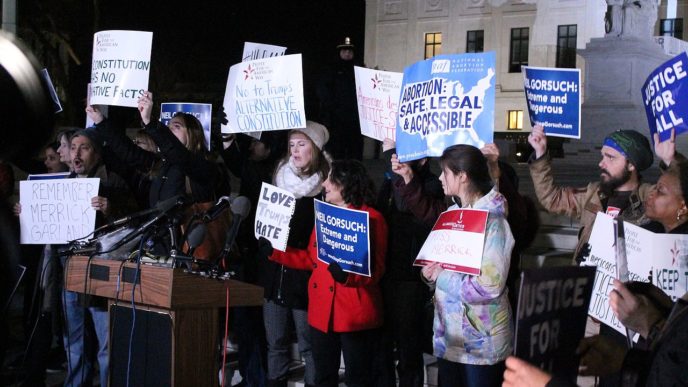
“If Democrats make the choice to filibuster Judge Gorsuch, it will be a foolish choice … it will be a choice driven only by the political fear of incumbent Democrats that their angry political base would primary them,” said Cruz, as he talked over a group of shouting anti-Gorsuch protesters with People for the American Way.

A group of pro-Gorsuch demonstrators also gathered at the Supreme Court and, while dressed in judge attire, sang a number of songs in support of the nominee.

“Gorsuch is uniquely well qualified for the Supreme Court … he’s read every brief, every opinion, every case involving whatever dispute is in front of him,” Lee said.

In response to the claim from Sen. Dianne Feinstein that the judge has ruled on the side of large entities and not “the little guy,” Lee said a judge should ideally side with the law in the courtroom, not “emotionally compelling arguments.”

Leah Bressack, one of the SCOTUS nominee’s former law clerks, was also present at the press conference to advocate for Gorsuch. Bressack also spoke at his committee hearing.

“There’s no question about the judge’s independence and impartiality,” Bressack said. “The hearings have shown that he will not prejudge any cases that come before him. We know that he is a justice of who all Americans will be proud.”

Gorsuch has completed his Supreme Court hearings and awaits an April 7 confirmation vote. If all Republicans in the Senate vote for Gorsuch he will need eight additional votes from Democrats to avoid a filibuster. (For more from the author of “Why These GOP Senators Aren’t Concerned About Democrats’ Threat to Filibuster Gorsuch” please click HERE)

Follow Joe Miller on Twitter HERE and Facebook HERE.

Gorsuch Nearly Got Through His Hearings Unscathed — Then SCOTUS Stepped In

Senate Democrats put Judge Neil Gorsuch on the defensive during his third appearance before the Senate Committee on the Judiciary Wednesday, grilling him over one of his holdings that was reversed by the Supreme Court and for his alleged ties to “dark money.”

The exchanges marked the first time Democratic attacks on the judge seemed to gain traction, since GOP aides rushed spin to reporters for the first time in the hearings. Despite this, there was a tangible sense inside the Capitol Hill committee room that the main work of the hearings had more or less concluded. Empty seats filled the press gallery, before a dais that was nearly vacant for most of the day.

In the early minutes of the hearing, the Supreme Court handed down a ruling which overturned one of Gorsuch’s own holdings. The case involved an autistic student seeking compensation for costs incurred pursuing private education. The student’s family argued they were owed compensation because a special education plan devised by the student’s public school was inadequate to meet his needs, forcing the family to seek a private alternative.

A lower court found in the school’s favor, and anchored much of its analysis in an opinion Gorsuch wrote in 2008 as a judge on the 10th U.S. Circuit Court of Appeals. In the ruling, Gorsuch said schools are in compliance with the Individuals with Disabilities in Education Act (IDEA) — which requires public schools to provide disabled children with a “free appropriate public education” — so long as they provide some form of educational benefit to the student. The Supreme Court unanimously overturned this holding, finding public schools had to provide a greater level of benefit than Gorsuch asserted.

Senate Democrats trumpeted the decision as further proof Gorsuch consistently aligns with the powerful, a theme on which they hit throughout the week.

(Read more from “Gorsuch Nearly Got Through His Hearings Unscathed — Then SCOTUS Stepped In” HERE)

Follow Joe Miller on Twitter HERE and Facebook HERE.