Posts

Obamacare Revealed as Masterpiece of Government’s Failed Central Planning

Obamacare, a veritable fountain of unintended consequences, is a 21st century showcase of government central planning. Let’s be clear. This is what President Barack Obama wanted.

Liberals in Congress meticulously designed the Affordable Care Act’s insurance exchanges as powerful regulatory bodies. They defined the kinds of insurance plans, benefits, and medical treatments and procedures the plans must offer; set all of the insurance rules; determined the permissible premium and deductible levels; and organized the most complex and confusing premium subsidy program imaginable.

So, federal government control was, and is, comprehensive. They planned it all.

Obama’s most high-profile promises, reinforced by “progressive” propaganda, have yielded the following: Americans have less consumer choice, less market competition, exploding insurance premiums, ridiculous deductibles, fewer doctors, a narrowing of provider networks—no, you can’t necessarily “keep” your doctor—and the looming prospect of ever bigger burdens on taxpayers.

Through it all, the Obama administration’s academic and media allies have remained fiercely loyal.

Last year, New York Times columnist Paul Krugman hailed the health care law as “a portrait of policy triumph.” This year, New York Magazine’s Jonathan Chait opined: “The policy rationale for repealing the Affordable Care Act continues to disintegrate, while the political conditions to replace it with an alternative have collapsed entirely.”

Let’s also be clear about something else: What “progressive” politicians want, and their academic and media cheerleaders like, most Americans don’t want or like.

Regardless of the outcome of the presidential election, Obamacare, heading into year seven, remains persistently unpopular—with more and more people saying the law is hurting them.

Moreover, the law is not working as officially anticipated. The proof is in the data.

For 2016, the Congressional Budget Office initially projected 21 million people would enroll in the exchanges. The reality: Only about 11 million enrolled.

For 2017, the Obama administration is projecting 13.8 million will sign up for coverage in the exchanges. You can bet, however, that the actual number who remain will be significantly less.

According to the Kaiser Family Foundation, 17 million more people have health insurance in 2016 compared to 2013. But the so-called “market” is churning rapidly.

Examining complete enrollment data for the 2014 to 2015 period, a Heritage Foundation analysis shows that enrollment in individual insurance (mostly exchange enrollment) increased by 5.8 million, while total private employer market enrollment fell by almost 3.6 million.

This means that total private market coverage over that two-year period increased by almost 2.3 million. On the other hand, Medicaid coverage jumped by almost 11.8 million.

So, Obamacare is mostly a major Medicaid expansion. The law is not encouraging Americans’ enrollment in a robust, well-functioning private insurance market; it’s discouraging it.

Consider insurer supply. Obama promised health insurance market competition would blossom. In 2014, Urban Institute analysts, examining the impact of the law in 10 states, concluded: “The Affordable Care Act has resulted in considerable competition.”

A Heritage analysis in 2014, however, examining insurers’ participation in all 50 states, came to a different conclusion; it found a 21.5 percent reduction in the number of insurers nationwide, reflecting the transition from 2013 to 2014.

During that big transition, millions lost their health insurance plans whether they liked them or not. Liberal commentators dismissed these losses as the elimination of “junk plans” or “substandard plans,” meaning they imposed excessive out-of-pocket costs or provided insufficient coverage.

But today enrollees on the Obamacare exchanges face standard “silver” plan deductibles that average $3,572 for single coverage and $7,474 for family coverage. For the lowest-cost “bronze” plans, deductibles amount to roughly $6,000 for single coverage and $12,393 for family coverage.

Taxpayers subsidize the vast majority of exchange enrollees, more or less heavily, depending on their income. Eligibility for insurance premium subsidies ranges from 100 percent to 400 percent of the federal poverty level, and the lowest-income enrollees benefit the most.

Even so, the Kaiser Family Foundation finds that 40 percent are dissatisfied with their premiums and 46 percent are unhappy with their deductibles.

For any person making in excess of $47,080 per year—a large chunk of America’s middle class—there are no Obamacare taxpayer subsidies for either premiums or deductibles for individual insurance. Unless he or she is self-employed, there is not even any tax relief.

These folks, of course, can buy outside the Obamacare exchanges, where they are likely to secure broader provider networks in the standard health plans, but they pay even higher premiums and deductibles. But they can’t just buy health plans tailored to their personal wants and needs.

Meanwhile, the meltdown of health insurance competition intensifies. In 2017, 15 new insurers will enter the exchanges, but 83 insurers are dropping out. Moreover, according to the latest Heritage review of the data, one-third of all U.S. counties (32.8 percent) will have only one insurer and another third (35.9 percent) will have only two insurers.

So, private insurance plans fail, fewer doctors are in the exchanges, Americans have less choice and face less competition. To keep supply up, the administration and its congressional allies want to bail out insurance companies—with more subsidies. To keep demand from falling through the floor, several “progressive” proposals would increase taxpayer subsidies to alleviate the law’s ugly impact on enrollees’ cost sharing.

The most far-reaching proposal would offset all out-of-pocket costs in all private insurance, both in and out of the exchanges. That would be enormously costly for taxpayers, and explode the nation’s deficit by as much as $90 billion in 2018.

No surprises here. The tacit premise of Washington’s central planners is that anything they screw up can be fixed. Just add more government micromanagement and more taxpayers’ dollars. (For more from the author of “Obamacare Revealed as Masterpiece of Government’s Failed Central Planning” please click HERE” HERE)

Follow Joe Miller on Twitter HERE and Facebook HERE.

Families Struggling With Socialism: Obamacare Tripled My Costs for Much Less Coverage

Obamacare is ubiquitously regarded as an utter failure. However, when viewed through the lens of its supporters, it is a smashing success. The goal of Obamacare was to ensure that no average-income family (or even upper-middle income family) could live in dignity without government subsidies for health insurance. By that measure, the leviathan has achieved its goal. Will we the people let them get away with it?

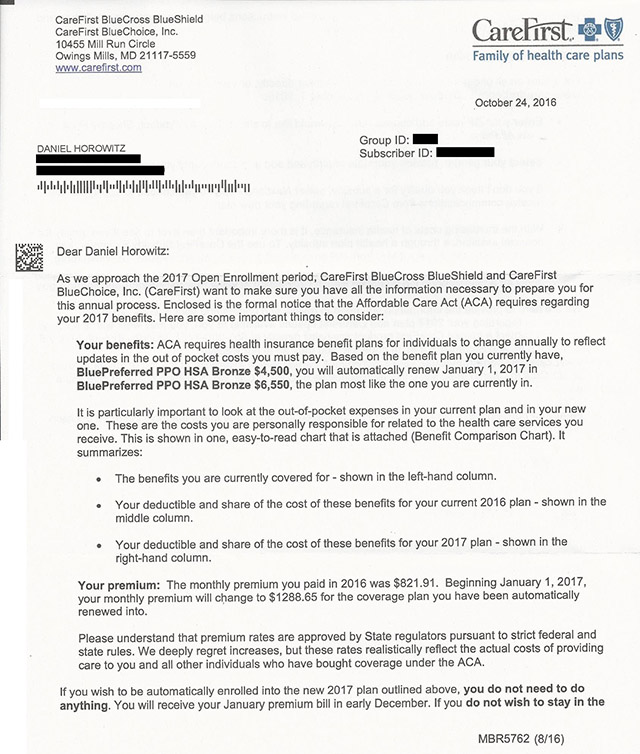
Like millions of other Americans, my wife and I just got the dreaded Obamacare letter in the mail, and it ain’t pretty:

obamacare-letter

My monthly premium for the HSA Bronze plan under CareFirst Blue Cross Blue Shield of Maryland will be going up from the already astronomical $821.91 a month to $1288.65. Worse, the deductible, which was already high, is going up to $13,100. It is an incredible testament to our broken political system the fact that the Republican Party has barely made this an issue during the past two presidential elections. The Obamacare crisis is a once-in-a-generation opportunity for conservatives to win the fight over government intervention once and for all.

To begin with, the price of health care and health insurance was always distorted and inflated thanks to a myriad of government regulations, the employer-based tax exemption (what I refer to as fourth party coverage), and other cultural trends of over-utilizing and over-insuring health care. Nonetheless, there was enough choice and competition in the market for most Americans to find a tailor-made plan that more or less worked for the family at a price that would not place a crushing burden on the family budget.

My Pre-Obamacare Plan

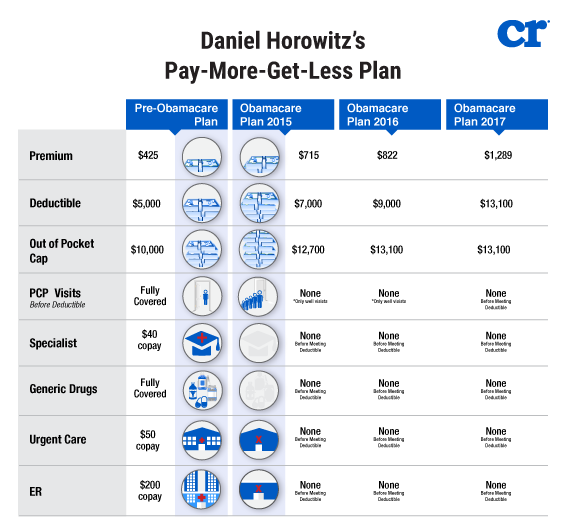
Prior to enactment of Obamacare regulations, my family of five had a plan with a monthly premium of $425. The “Healthy Blue” plan from CareFirst of Maryland had a $5,000 deductible, but it covered most of the basic necessities for absolutely free, even before meeting the deductible. All sick and well visits to the primary care physician were covered 100% without copay, as were generic prescription drugs. Specialists were covered with just a $40 co-pay before meeting the deductible. For a healthy family with three young kids in which ear infections are the most common ailment, this plan worked out perfectly because sick PCP visits and generic drugs account for most of the expenses.

Even under this relatively high deductible plan, I was able to have surgery to remove two Lipomas from my abdomen for just $40 because it was done in the office of the surgeon. Hospitalization was obviously not covered, but that was a worthwhile calculated risk given the money we saved on the premiums. Plus, the deductible, although relatively high (now we’d die for it!), would be met by the time potential extended health costs would surpass the sum we were saving from the cheaper premiums. Those are the decisions that smart families make every day on an array of goods and services when there are actually market-based forces allowing competing offers from which to choose.

The crushing increase in costs in just a few years

Now, take a look at this graphic for a vivid demonstration of what Obamacare has done to our budget:

pay-more-get-less-chart

Our premium has tripled to a crushing cost of $1,288 per month, over $15,000 a year. Just this year’s increase alone will be $467 a month, $5,600 a year. Remember, my entire premium was less than $5,000 before Obamacare. And what do we get for the crushing cost? We pay money in order to pay money. The deductible has gone from $5,000 to $13,100, and unlike with our previous plan, nothing but the dubious “annual well visits” are covered prior to meeting the deductible. That means one must shell out roughly $28,000 in a given year before one red cent of routine or emergency medical care is even partially covered.

Thanks to the overutilization and no market forces in healthcare, even a perfectly healthy year for a family of five — with no costs beyond typical sick visits and basic antibiotics for standard ailments (no hospitalizations or ER visits) — we must shell out $3,000-$5,000 in out-of-pocket-costs. Add that to the $10,000 increase in premiums from Obamacare and my family must pay a minimum of $13,000 more a year in health expenses thanks to the stupidity of those who voted for Obama and the perfidy of the Republicans who have no plans to fight it.

Once you let that sink in, take note of the fact that this is just the third year of implementation. What does the price tag look like 3-4 years from now?

This issue is potent enough for a true opposition party to win

A party that was actually committed to sound conservative policy would utilize this as a teachable moment, irrespective of who becomes president. My story is undoubtedly the story of so many families. Whereas most prior big government interventions took longer to inflate the cost of the private sector, and the deleterious effects were not apparent enough to the public, everyone recognizes that Obamacare is the culprit for the health crisis and they know who is to blame. This is one case where families unambiguously feel the cost of regulation and government intervention.

$13,000 is real money. That is a lot more than what we spend on food a year for a family of five. The $467 increase in monthly premiums just from last year’s increase is more than my monthly car payment for our Toyota Sienna. I could by a new minivan for that cost. Recently, we replaced our heating and air conditioning with a top-of-the-line system and I’m only paying about $260 a month for a zero-interest loan. Heck, it’s a lot more than what we pay for our son’s playgroup.

This issue alone could sink the entire Democrat Party in the long run. Yet, the Chamber of Commerce has already made it their official policy to “fix Obamacare” instead of ending it. Watch for Hillary (if elected) to call for single-payer and Republicans to use that as the new baseline to define the contours of their opposition. They will oppose single-payer but offer nothing more than what the Chamber and insurance companies are looking for — a bailout and a preservation of the coverage mandates, such as pre-existing conditions and community rating — the very mandates that have made insurance actuarially insolvent. That has already been the official policy of GOP leaders for years, even though they run on repealing the law.

Rarely do conservatives have an opportunity to demonstrate why unconstitutional government interventions are not just costly for the federal budget (most people don’t understand how the debt affects them) but also for the family budget. This is an opportunity for a new movement to rise up and pledge to fight this law until the bitter end. This issue was responsible for two landslides in midterm elections that were not overpowered by personality issues, as was the case in 2012 and this election.

Republicans will still have control of the House and very possibly the Senate after next week’s election. If every elected Republican — not just Ted Cruz, R-Texas (A, 97%) shouting from the wilderness — would use the power of the purse to put an end to this problem, even a Democrat president could not overcome the pain crying out from the family budget of millions of Americans. And in fact, Hillary Clinton, who will likely enter the presidency as the most illegitimate and unpopular persona since John Quincy Adams, is the most beatable opponent on this issue. If only we had a real second party ..

Democrats better be careful what they wish for. The people are not with them on a single major issue, Obamacare first and foremost. This issue will only deteriorate for them in the coming months and Hillary is the polar opposite of Obama’s likable “Teflon” personality. The only thing saving them is a fake Republican Party committed to “governing” with them instead of exposing and defeating them. That will not always be the case. It will change one day. The fight will continue, irrespective of what happens next week. Remember, our republic will not rise or fall on your vote for president alone, but whether you acquiesce to this corrupt system or take your own destiny into your hands. (For more from the author of “Families Struggling With Socialism: Obamacare Tripled My Costs for Much Less Coverage” please click HERE)

Follow Joe Miller on Twitter HERE and Facebook HERE.

Insurers Lobby for Changes to Obamacare ‘Bailouts’

Insurance companies continue to put pressure on members of Congress over two Obamacare programs set to expire at the end of the year.

Lawmakers and outside groups expect a fight over the risk corridor and reinsurance programs—referred to as insurer “bailouts” by conservatives—during the lame-duck session, the period after the Nov. 8 election and before the start of the next Congress.

Members of the House and the Senate have spent the past few weeks back in their districts ahead of the election. But insurance companies and trade groups representing insurers have not stopped pressing Congress on the two programs, according to the latest lobbying disclosures filed with both chambers.

From July 1 to Sept. 30, insurers and associated groups spent nearly $10.5 million on lobbying efforts for the risk corridor and reinsurance programs, among other issues related to health care.

America’s Health Insurance Plans (AHIP), a trade group representing insurers, spent more than $1.8 million on lobbying efforts related to the risk corridor and reinsurance programs.

So far this year, the organization has spent $5.6 million on lobbying, according to the Center for Responsive Politics. Not all of that money was related to efforts involving the Obamacare provisions.

The trade group hasn’t shied away from publicly advocating for tweaks to the risk corridor and reinsurance programs.

In an interview with Morning Consult last month, Marilyn Tavenner, America’s Health Insurance Plans CEO and former head of the Centers for Medicare and Medicaid Services, which oversees Obamacare, said changes need to be made to the two programs.

“I know ‘risk corridors’ is a bad word. ‘Reinsurance’ is a bad word. But the fact of the matter is, it’s probably taking longer than three years to stabilize,” Tavenner said. “So I think Congress, after the election, is going to have to take a look at this and decide, ‘How do you stabilize this market?’”

Only the Blue Cross and Blue Shield Association, a trade group representing 36 plans nationwide, outspent America’s Health Insurance Plans on lobbying efforts for the risk corridor and reinsurance programs from July 1 to Sept. 30.

The organization spent $4.6 million on efforts involving the two Obamacare provisions, according to lobbying disclosures.

So far this year, the Blue Cross and Blue Shield Association spent $19 million on lobbying, though not all of it was devoted to the risk corridor and reinsurance programs, according to the Center for Responsive Politics.

A combined $1 million on lobbying was spent from July 1 to Sept. 30 by insurance companies such as Anthem, Moda Health, Highmark Blue Cross and Blue Shield, Centene, and Blue Cross and Blue Shield plans in Michigan, Florida, Kansas, Tennessee, Arizona, and Minnesota.

Though not all of the money went toward lobbying for the risk corridor and reinsurance programs, insurance companies have been pressing Congress to make changes to them over the past few months.

In filings with state regulators, insurers attributed rising premiums, in part, to the end of the reinsurance program.

The risk corridor and reinsurance programs, written into the Affordable Care Act, are set to expire at the end of the year.

The two programs, along with a third, the permanent risk adjustment program, were designed to help mitigate insurers’ risks in enrolling populations that potentially were sicker and costlier than in previous years.

In 2014 and 2015, Republican lawmakers included language in government spending bills requiring the Department of Health and Human Services to use only money it received from insurance companies with lower-than-expected costs through the risk corridor program to pay out insurers with higher-than-expected costs.

As a result, insurance companies received 12.6 percent of the money they requested from the risk corridor program.

Now, several insurance companies including Moda Health and Blue Cross and Blue Shield of North Carolina are suing the Obama administration for the rest of the money.

Republicans in Congress worry that, in order to settle with insurers, the Justice Department will tap into the Judgment Fund, an indefinite appropriation created by Congress and administered by the Treasury Department.

Doing so would provide the White House with a way to pay the full risk corridor payments to insurers, effectively circumventing Congress, they warn.

But in motions to dismiss filed by the Justice Department in response to the lawsuits, the government argued insurers weren’t entitled to the full payments under the risk corridor program.

According to lobbying disclosures, insurance companies want Congress to appropriate more money for the program and combat Republican-led efforts to limit the money available through it.

As with the risk corridor program, insurance companies and related organizations have pushed lawmakers to extend the lifespan of the reinsurance program.

Under the reinsurance program, the Obama administration diverted $5 billion intended for the Treasury to insurers. A legal decision from the Government Accountability Office issued in September found that the Department of Health and Human Services acted illegally in prioritizing giving this money to insurers over the Treasury.

Still, that hasn’t stopped Obamacare’s supporters from encouraging Congress to extend the reinsurance program.

Sen. Ben Sasse, R-Neb., and Rep. Mark Walker, R-N.C., introduced legislation earlier this year requiring the Obama administration to repay the $5 billion owed to the Treasury, or face steep cuts to the Health and Human Services management fund this year and next year. Both House and Senate versions of this legislation have been referred to their respective committees.

It is called the Taxpayers Before Insurers Act, and insurers and groups such as America’s Health Insurance Plans are lobbying members to oppose it.

Conservative groups have issued warnings that health insurance industry giants would look to the lame-duck session as the time to push for changes to the program.

And they, too, lobbied members to oppose any changes.

According to lobbying disclosures, Heritage Action for America, the sister organization of The Heritage Foundation, spent $110,000 from July 1 to Sept. 30 lobbying, in part, for Sasse and Walker’s bill. (For more from the author of “Insurers Lobby for Changes to Obamacare ‘Bailouts'” please click HERE)

Follow Joe Miller on Twitter HERE and Facebook HERE.
Americans Face Fewer Obamacare Choices, Higher Premiums in 2017

As open season begins Tuesday for enrollment in Obamacare next year, most customers for health insurance in the individual market will face both fewer choices and higher premiums under President Barack Obama’s signature health care law.

More than three-fifths of the states, 33 of them, will have fewer insurers offering coverage on the Obamacare exchanges than they did in 2016.

Arizona and Texas are each losing six insurers, while two other states—Kentucky and Ohio—are losing four each. Only one state, Virginia, will have more exchange insurers next year than this year.

Five states—Alabama, Alaska, Oklahoma, South Carolina, and Wyoming—will have only one insurer offering exchange coverage in 2017, while another 13 states will have only two.

Because many of the remaining insurers offer coverage only in part of a state, the reduction in choice is even more pronounced at the county level. One-third of all U.S. counties (32.8 percent) will have only one insurer offering exchange coverage in 2017, and another one-third (35.9 percent) will have only two competing insurers.

So exchange customers in two-thirds (68.7 percent) of U.S. counties will be faced with either a monopoly or a duopoly in health insurance.

At the same time, insurers also have increased premiums significantly. The Department of Health and Human Services, which oversees Obamacare, had to admit that premiums are increasing by an average of 25 percent in the 39 states using the federally run insurance exchange.

Indeed, residents of 10 states using the federal exchange face average premium increases of 40 percent or more: Alabama (58 percent), Arizona (116 percent), Illinois (43 percent), Kansas (42 percent), Montana (44 percent), North Carolina (40 percent), Nebraska (51 percent), Oklahoma (69 percent), Pennsylvania (53 percent), and Tennessee (63 percent). In at least one state running its own exchange (Minnesota) premiums are increasing by a similar rate (56 percent).

The Obama administration has tried to spin this news by repeatedly stating that 85 percent of customers on one of the state insurance exchanges receive taxpayer-funded subsidies for their coverage, which will soften the blow to their wallets.

While that is technically true, it offers an incomplete and misleading picture.

The most recent comprehensive enrollment data show that 17.7 million Americans had health coverage from the individual market as of the end of 2015. Of that number, 7.4 million (42 percent) had coverage subsidized by taxpayers, while the remaining 10.3 million (58 percent) paid the full cost on their own.

Because the Affordable Care Act bars insurers from charging off-exchange customers a different premium than on-exchange customers for the same plan, nearly 60 percent of those with individual market coverage will face the full cost of any premium increases.

Want to understand why Obamacare remains persistently unpopular?

Consider the likely reactions of those 10 million Americans as they open letters from their insurers informing them of their premium increases—or, worse, that their health care coverage is being discontinued. (For more from the author of “Americans Face Fewer Obamacare Choices, Higher Premiums in 2017” please click HERE)

Follow Joe Miller on Twitter HERE and Facebook HERE.
Liberals Should Apologize for Obamacare

Obamacare must have been designed to fail. Even ideologically blind liberals wouldn’t design a program this bad without a secondary agenda. (Not coincidentally they are now floating the “public option” trial balloon.) And if it weren’t designed to fail, then when can conservatives expect an apology from liberals for the legislative disaster known as Obamacare?

I have more than a year of archived episodes of my podcast “Renegade Republican,” and a good number of them were spent warning listeners about the ongoing threats posed by Obamacare. I wish those predictions were fairy tales, but tragically, they are non-fiction. Sadly, I wasn’t the only one sounding the alarm about the coming Obamacare disaster. I say “sadly” because the warnings were pervasive.

If you turned on the radio, you heard conservative talk radio hosts warning about the metastasizing, legislative cancer known as Obamacare.

If you turned on the television, you saw a cavalcade of conservative talking heads warning about the coming Obamacare nuclear winter.

If you happened upon the podcasting arena, you heard numerous conservative podcasters warning about the hidden dangers embedded in the cryptic Obamacare legislation.

Even if you missed all of this but happened to search the Internet for articles about Obama’s signature legislation, you likely stumbled upon one of the thousands of pieces sounding the alarm about the approaching Obamacare asteroid.

But the mainstream media ignored us. They laughed us off as alarmist partisans hell-bent on influencing elections through hyperbolic alarmism, while the rest of the biased media insider class simply ignored us in the hopes we would all go away.

So when can we expect our apology from the liberals for their treatment of conservative Obamacare truth-tellers? I won’t hold my breath. But, as a reminder, we warned you about the following pitfalls which are now reality:

1. Skyrocketing premiums because of the expensive coverage mandated by Obamacare
Obamacare forces Americans to pay for health care insurance for services they either don’t want or don’t need. Where did the liberals think the money to pay for these additional services was going to come from? The tooth fairy? It doesn’t take a Ph.D. in economics to figure out that when you order Americans to buy insurance for health care services they don’t want, their premium costs are going to increase.

2. Increased usage of the emergency room as a primary health care provider because of Medicaid expansion
Again, it didn’t require a deep understanding of health care economics to predict that when you expand a government-run health care program to an entirely new block of recipients — at great cost to the taxpayer but little cost to the recipient — that they were going to use this “free” benefit at emergency rooms and other medical facilities.

3. Health insurance plan cancellations because of non-compliance with Obamacare red tape
Despite President Obama’s disingenuous pledge, “If you like your plan, you can keep your plan,” Obamacare forced health insurance companies to cancel policies by the millions because they didn’t comply with a series of new Obamacare restrictions and mandates.

4. Perverse economic incentives encouraged younger Americans to abandon the Obamacare exchanges
Not surprisingly, younger, generally healthier Americans — also the cohort least likely to be in a strong economic bargaining position because of their limited earning power and life experience —avoided buying the expensive health insurance product, which would have been a long-term drag on their finances and not a net benefit.

Knowing the far-left as I do, I’m betting that it will defend this legislative disaster until its last legislative breath. Liberals never apologize; they just run roughshod over the country and its constitutional restrictions and then blame the carnage on Republicans. This pattern continues because a compliant class of media sheep — led around by its herders in the liberal activist community and the liberal political class — never call out BS, even when BS was called a long time ago by conservatives sounding the Obamacare alarm. (For more from the author of “Liberals Should Apologize for Obamacare” please click HERE)

Follow Joe Miller on Twitter HERE and Facebook HERE.

In Desperate Push to Save Dying Obamacare, President Wants to Bail out Insurers

The death knell for Obamacare has been rung. President Barack Obama’s own Department of Health and Human Services confirmed this week that Americans will experience double-digit premium hikes on their health care plans beginning Nov. 1. In fact, the average increase will be 25 percent.

And while costs are going up, choice is going down: 1 out of every 5 Americans will have only one health insurer to choose from. More costs, less choice—so much for the “affordable” part of the Affordable Care Act.

No doubt about it: Obamacare is dying. But don’t count on it going gently into that good night. Instead, count the billions of dollars Obamacare is trying to rob from the American taxpayer on its way to the grave.

As health policy expert Robert Moffit of The Heritage Foundation explained in a recent commentary, Obamacare is “like a patient suffering from multi-organ failure [and] … central planning is the disease.”

But instead of pulling the plug, Obama and the insurance companies want to put Obamacare on a costly life-support line of cash, all on the taxpayer’s dime.

One symptom of the central planning disease, and indicators of Obamacare’s death spiral, is that the insurance companies haven’t made money by offering qualified health plans on the Obamacare exchanges.

Instead, the insurance companies are losing money hand over fist, despite “risk mitigation” programs baked in by Obamacare architects to sweeten the deal for large insurance companies.

Now, the Obama administration is signaling it wants to find any way it can to funnel as much as $170 billion of taxpayer money to the insurance companies, in hopes of keeping the law alive.

In other words, the administration wants to bail out insurance companies in order to bail out Obamacare.

So what exactly are these risk mitigation provisions, and how might they result in a taxpayer-funded bailout? If you’re in a hurry, you can watch this 2-minute video from The Daily Signal’s Melissa Quinn.

Got some more time? Read this detailed memo from Heritage Action for America, titled “How Congress Can Stop the Impending Obamacare Bailouts.”

But for situational awareness, the main three risk mitigation programs are called 1) cost-sharing subsidies, 2) the traditional reinsurance program, and 3) the risk corridors program.

Cost-sharing subsidies. They required insurers to artificially reduce deductibles and copays for low-income Obamacare enrollees. The administration was caught making illegal payments to the insurers to compensate for the discounts, essentially shelling out billions of dollars that weren’t authorized by Congress.

Thankfully for your wallet, a federal judge has put a pause on any more payments under this program.

The reinsurance program. It was a new tax on employer-provided health insurance, collected to create a pot of money to redistribute to insurance companies that lost profits from covering high-risk individuals. However, under this section of Obamacare, the Department of Health and Human Services also was required to make $5 billion in deposits into the Treasury and back to the taxpayers.

Want to guess how much HHS officials have paid so far? Zero. Why? Because they have broken the law by prioritizing payments to the insurance companies.

Which is why Rep. Mark Walker, R-N.C., and Sen. Ben Sasse, R-Neb., have introduced the Taxpayers Before Insurers Act to force HHS to pay the American people back the $5 billion owed.

Getting Congress to prioritize the taxpayer over the insurance companies hasn’t made the insurance companies happy—especially when they want Congress to continue their gravy train past 2016.

As Ed Haislmaier, another health policy expert at The Heritage Foundation, writes in his appropriately headlined piece, “Grand Theft Health Insurance”:

Recently, the national Blue Cross and Blue Shield Association has been aggressively lobbying Congress to ignore the Obama administration’s illegal diversion of tax dollars into the pockets of—you guessed it—health insurers. … To be sure, it is the Obama administration, and not the insurers, who perpetrated this heist. But for the Blue Cross and Blue Shield Association to now lobby Congress to keep getting the money puts them in the unseemly (to say the least) position of the guy caught with stolen merchandise demanding that he be allowed to keep his ill-gotten goods because he wasn’t the one who originally stole them.

The risk corridors program. It was supposed to create another temporary funding stream to transfer money from insurance companies that made profits to insurance companies that suffered losses from selling Obamacare plans.

The problem is that we’ve seen much higher losses than profits. So the insurance companies that feel stiffed have sued the Obama administration for the difference.

Sadly, the administration seems only too willing to find a way to get the insurers the money they want. Even if it means paying them through the legally questionable method of settling the lawsuits and making payments out of the “Judgment Fund”—something the nonpartisan Congressional Research Service says the administration doesn’t have the authority to do.

But when has lack of authority ever stopped Obama before? Especially when it comes to the law that bears his name.

That’s the bad news. The bailouts are coming and Congress must act to stop them. The good news is that, unsurprisingly, the American people really don’t like the government’s giving their money to insurance companies in an effort to prop up Obamacare.

According to market research conducted by American Perceptions Initiative, which is affiliated with The Heritage Foundation, the vast majority of Americans strongly opposes using taxpayer dollars to bail out Obamacare.

Fully 87 percent of those surveyed agreed when asked whether they agreed or disagreed with this statement: “If private insurance companies lose money selling health insurance under the Obamacare program, taxpayers should not have to bail them out to cover their losses.”

I repeat: 87 percent. That’s what’s known as a mandate. Which means members of Congress and their staff can have complete confidence that Americans support action to stop the impending bailouts.

Or, put another way, if congressional Republican leadership is looking for a unifying issue after the election, it isn’t going to be passing a new internet sales tax or a massive omnibus spending package (like last year). Stopping illegal payments to insurance companies would be a unifying issue.

What’s more, the nonpartisan Government Accountability Office and Congressional Research Service also have thrown flags on the Obama administration’s play of paying insurers at the expense of taxpayers. Both found that the payments under the reinsurance program are illegal—just like they found using the Judgment Fund to make risk corridor payments would be illegal.

So when it comes to the legality of bailing out Obamacare, the Obama administration is 0-3 against a federal judge and two of the government’s own watchdog agencies.

For Congress, the choice couldn’t be clearer: Protect Obamacare or protect the American people.

The only question left to answer is who Congress will side with. The rule of law and its constituents? Or the insurance companies and the president?

As brutal Obamacare premium hikes hit families again in less than a week, and we head into the dangerous waters of a lame-duck session of Congress after the election, it’s as good of time as any to remind Congress that the American people don’t plan on going gently into the night either.

Especially not while their tax dollars are at risk of being used to bail out Obamacare. (For more from the author of “In Desperate Push to Save Dying Obamacare, President Wants to Bail out Insurers” please click HERE)

Follow Joe Miller on Twitter HERE and Facebook HERE.

Alaska: A Case Study in Medicaid Expansion

My home state of Alaska is the latest state to discover the painful side effects of expanding Medicaid under ObamaCare. It’s been roughly a year since Gov. Bill Walker unilaterally made this move via executive order, but the program already costs tens of millions of dollars more than projected for 2016. With the state beginning to shoulder part of the bill for the expansion next year, the program’s higher-than-expected costs now threaten to destabilize a state budget that’s already in disarray.

This is a typical result of Medicaid expansion, and one Gov. Walker should have expected. Although the federal government promises “free money” to cover the cost of the program, there’s no such thing.

Medicaid expansion enables thousands of able-bodied, childless, working-age adults to receive taxpayer-funded health insurance. In Alaska’s case, only about 45% of those eligible under the expansion are currently working. This includes people who may already have private insurance coverage but choose to enroll in the government program instead.

This program is costly. Medicaid’s actuaries released a report earlier this summer that revealed spending per new Medicaid enrollee was 49% higher than expected.

The result is a higher bill for taxpayers. Alaska’s Medicaid expansion was initially expected to cost $145 million this year. Even though the number of enrollees roughly matched expectations, the cost of providing them insurance did not. That clocks in at $175 million, a $30 million difference that’s also higher than the Medicaid expansion’s expected cost for all of 2017, too. (Read more from “Alaska: A Case Study in Medicaid Expansion” HERE)

Follow Joe Miller on Twitter HERE and Facebook HERE.

Why Is Every Political Party and Independents, Terrified of Clinton and the People Around Her?

Never in the history of our country, have we seen a general collaboration of the Republican, Green, Libertarian, and Constitution Parties against the War Machine that is Hillary Clinton.

You can be a supporter of any of these four parties and still unanimously agree that Clinton is a criminal and the Democratic Party is rigging this election.

The fact that all four of these major parties are in complete agreement should scream “WARNING” to those who are even remotely considering voting for Clinton.

I can’t comprehend it.

Then again, we can’t comprehend it. We don’t understand Clinton voters because we have actually read at least one article that shows the amount of war and body trail that Clinton administrations have left behind. The lies that have been told. The fraud that has been committed.

Hillary’s voters have not read one article about her that exposes who they are, without dismissing it immediately to being “just bad guys talking about a nice old woman.”

I’ve spoken to Clinton supporters. They are very unaware to what she really is. Look at Clinton’s Facebook. It’s nothing but stories of a nice old woman that’s “fighting for women and kids.” This is all they know about Clinton because this is all they see. Their environment is safe from the truth because they don’t read online news. They see what’s on TV once in a while, painting the Third-Parties as “never having a chance” and “a wasted vote.” The only talk about Trump being “racist,” a “sexist,” this, that, and whatever. These people have a closed world view that everyone other than Hillary is “the bad guy” and we will be destroying the country for women and children.

This is crunch time. This is the final showdown. The Globalist Bankers want to usher in Clinton to allow them to continue to rob the American people of their money and rights in broad daylight. You have to be gentle as they already view you as “the enemy.” While frustrating, be patient with a Clinton supporter and explain that they should take a look at why every political party in America is terrified of a Clinton Presidency. Ask them to just think about that. When Jill Stein and Donald Trump are agreeing that Clinton is a threat to all of our safety and the world, maybe it will be enough for the idea to hit them to look at all the things that are being said.

We can’t afford another 4 to 8 years of what has felt like one giant Presidential term since Bill Clinton. War since him through Bush to Obama. Poverty and recession. Big banks getting bailed out and avoiding criminal justice. American citizens being killed by the militarized police state and the massive incarceration by the prison industrial complex. We can’t as a nation afford this.

Please, Clinton voters. We are asking that you simply ask the simple question, “Why is every political party and independents, terrified of Clinton and the people around her?” If she’s truly the nice woman that wants to take care of women and children, why are we so scared of this? Just, please, think about it. Then start reading the articles we are sharing, listen to the things we are saying. All we ask is that you look and see what we are talking about and why we do. (For more from the author of “Why Is Every Political Party and Independents, Terrified of Clinton and the People Around Her?” please click HERE)

Follow Joe Miller on Twitter HERE and Facebook HERE.
Will Republicans Help Fix Obamacare?

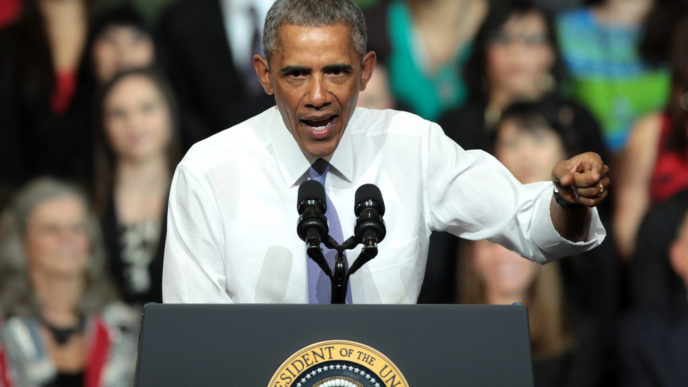
After years of denial and outright lies (“If you like your plan, you can keep it!”), President Obama has recently been forced to acknowledge that his signature law has some big issues — and he’s asking Republicans to join him in fixing it. Only half-joking, Obama quipped at a Hillary Clinton campaign event:

They can change the name of the law to “Reagancare,” or they can call it “Paul Ryancare.” I don’t care about credit. I just want it to work!

And regardless of who controls the White House or Congress in 2017, Republicans may well oblige him. Fixing Obamacare, that is, not calling it “Reagancare.”

Many Republican politicians continue to insist they support repealing and replacing Obamacare. Repeal and a fresh start is what ought to happen in a sane world, given that even Democrats who helped pass the law acknowledge it’s a “trainwreck”.

But given that many Republican leaders never truly supported repeal in the first place, when the effort to merely patch up Obamacare begins, a great many of the GOP will assuredly (feigning reluctance) go with the flow.

The shift from “repeal” to “fix” came early, with Republican leaders warning even before the law came into full effect that Obamacare was “the law of the land” and that we can only hope to work around it. Even the one bold stand Republicans took against Obamacare, resulting in a protracted government shutdown in 2013, was undercut by GOP leadership from the start and accomplished nothing.

What many Republicans and conservatives appear to fear even more than Obamacare is disruption in the health insurance markets. Indeed, they might be said to agree in large part with a very salient observation Hillary made in the second presidential debate:

Look, we are in a situation in our country where if we were to start all over again, we might come up with a different system. But we have an employer-based system. That’s where the vast majority of people get their health care.

The entire health insurance market is organized around a government-altered structure, caused by the massive disadvantage in the cost of individual health insurance versus employer-provided benefits, which are tax-exempt.

Insurers sell the majority of their policies via employers and groups, and middle-class Americans in particular, have become accustomed to getting their benefits this way over several generations. Thus politically, there is a massive incentive to fill the gap in coverage for individuals by just finding the least painful way to give government subsidies in the individual market.

Trying alternative solutions — like letting market forces actually work in health care — would bring a torrent of angry insurance lobbyists to Congress, worried that new policies might endanger their market share.

And, of course, voters are nervous about change as well. For the majority of folks, the current screwed-up system works just tolerably well enough that the prospect of moving away from it in a fundamental way is daunting.

Never mind that just getting everybody on an insurance plan does next to nothing in terms of actually making health care more affordable. In fact, the better and lower deductible that insurance coverage gets, the more it encourages people to overconsume health care services and to ignore the costs because they don’t pay them out of pocket anyways. The price of health care then becomes a struggle between insurers and hospitals and doctors, all deciding how much services will cost in a process patients never see.

But attaining “insurance for all” is easier for politicians to sell than removing government shackles from the health care industry and letting market forces do their work.

Instead of focusing on lowering actual health care costs and improving patient outcomes, even most conservative solutions are more focused on just increasing Americans’ dependence on the third-party payment structure — whether by the government or by insurance carriers. It’s not their intention, perhaps, but if your goal is merely “universal coverage,” that’s the inevitable result.

Moving forward, I’ll be writing about alternatives to the third-party payment model and about how conservatives should focus on allowing patient choice and innovation in the health care marketplace.

The only way out of this broken health care mess is though choice and competition — not just competition within government-managed insurance markets, but competition with the entire insurance model itself. (For more from the author of “Will Republicans Help Fix Obamacare?” please click HERE)

Follow Joe Miller on Twitter HERE and Facebook HERE.

Obamacare’s ‘Bailouts,’ Explained

There has been a lot of talk on Capitol Hill and in the news about taxpayer-funded “bailouts” for insurance companies under Obamacare. But what exactly are lawmakers talking about when they reference these “bailouts?”

The “bailouts” have come in the form of two programs—the risk corridor and reinsurance programs—written into the health care law and designed to mitigate risks for insurance companies.

But they haven’t worked out quite the way they were intended.

Learn more about the risk corridor and reinsurance programs, as well as the debate surrounding their futures, in the video above. (For more from the author of “Obamacare’s ‘Bailouts,’ Explained” please click HERE)

Follow Joe Miller on Twitter HERE and Facebook HERE.