Posts

PRO-COP Atlanta Gym Shows up Neighbor’s Pathetic Anti-Cop Gym

The owners of an Atlanta gym are the victims in a case of mistaken identity, as criticism mounts for neighboring EAV Barbell Club and its controversial “No Cop” policy.

Jim Chambers, owner of EAV Barbell Club, has an explicit “no cop” policy at his gym, where cops and active members of the military are not allowed to join.

“We’ve had an explicitly stated ‘no cop’ policy since we opened, and we also don’t open membership to active members of the military,” Chambers said. His position has ignited a firestorm of outrage from Americans who have been calling the gym and demanding an end to the policy.

But WXIA reports that many people have been calling the wrong gym, because the first result after searching Google for “East Atlanta Gym” is “Village Fitness,” not “EAV Barbell Club.”

You can imagine how the owners of Village Fitness were quite confused when they began receiving calls and had people walking in asking about a “no cop” policy.

“I’m like, wait a second — that’s definitely not us,” Tara Perry of Village Fitness told WXIA. “We do not feel that way.”

But instead of righteous indignation, Village Fitness is happy to clear things up by openly declaring its support for the police and the military. The gym put out a sign in front of its building Wednesday, declaring “We Support Police and Our Military,” and in a Facebook post reiterated its support for “the whole village.”

“When you think of an EV gym, people think of us — Village Fitness. We’ve been here so long, we’re established with the community,” Perry said. “We support our local police and military. We offer discounts for them.”

The owner of Village Fitness told WXIA he plans to keep the sign up for the foreseeable future. (For from the author of “Pro-COP Atlanta Gym Shows up Neighbor’s Pathetic Anti-Cop Gym” please click HERE)

Follow Joe Miller on Twitter HERE and Facebook HERE.

Alaska Town’s Entire Police Force Quits

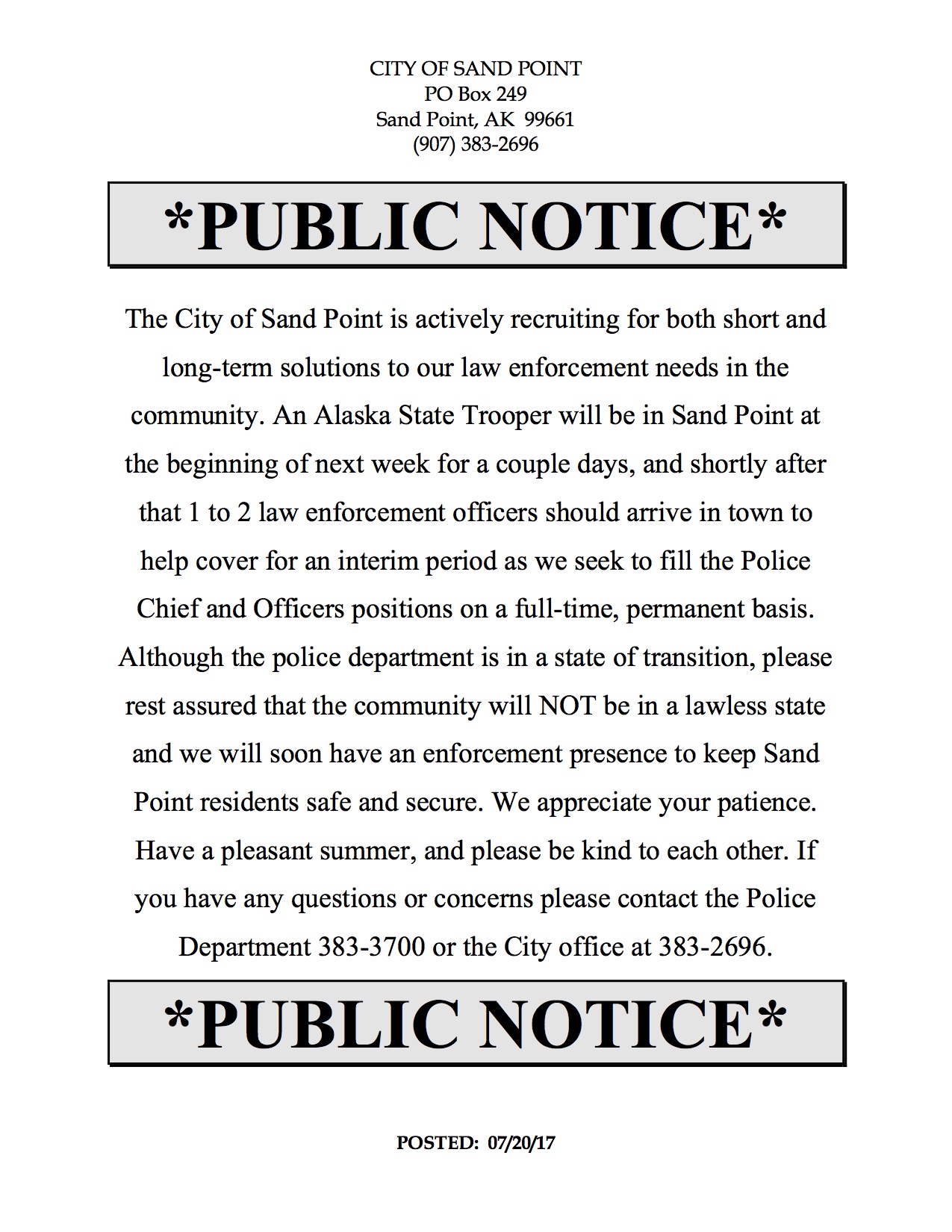
The entire police force of Sand Point, Alaska quit in July in a matter of just three weeks, leaving the town without any authoritative presence, and the transition has been smooth without any type of state enforcement agent.

Sand Point, an Alaskan island town with a population of about 1,000, had a police force of three officers and a police chief mid-July.

That’s when the officers, two of whom were a married couple, began to quit one after the other and then finally the police chief himself resigned.

City Administrator Andrew Varner said that the first officer wanted to be closer to a spouse who is in the military. A week later, two more officers, a married couple, left because of a “family decision.”

That left Sand Point police chief, Roger Bacon, who then decided to take a long-planned month-long vacation to Scotland. This decision cost him his job as a “mutual understanding” was reached between Bacon and the city council that if he left he wouldn’t be returning to his post.

“There was sort of a mutual understanding that if he left to go for a month-long journey — leaving the community with no law enforcement — that if he came back, he would not be an employee of the city,” Varner said. “Within a day or two, he had turned in his resignation.”

On July 20, the city of Sand Point released a press release calling for calm, stating that while the police department was “in transition,” citizens should “rest assured that the community will not be in a lawless state.”

Since the departure of the police force, the town has been calm. No more arrests and charges for fishing without a license, speeding down a public road or any of the other outrageous things that police across the nation try to enforce in the name of the state against the private individual citizen.

There was no Purge–like behavior, people weren’t killing each other without the police as is depicted in movies as propaganda for justifying the need for authoritative structure.

“Sand Point did not devolve into mass lawlessness,” Varner said.

“It’s not like the movie ‘The Purge,’ “in which all criminal activity becomes legal for a 12-hour period,” Alaskan State Troopers spokeswoman Megan Peters.

“Everyone was busy fishing, which was great,” Austin Roof, the general manager of the local public radio station KSDP 830 AM said.

Unfortunately, the paradise of not being harassed by state storm troopers won’t last long for the citizens of Sand Point.

The town has since chosen a new interim police chief, Hal Henning, the former police chief of Seldovia, Varner said.

Additionally, Sand Point will be further patrolled by Alaska State Troopers until they rebuild their armada. (For more from the author of “Alaska Town’s Entire Police Force Quits” please click HERE)

Follow Joe Miller on Twitter HERE and Facebook HERE.

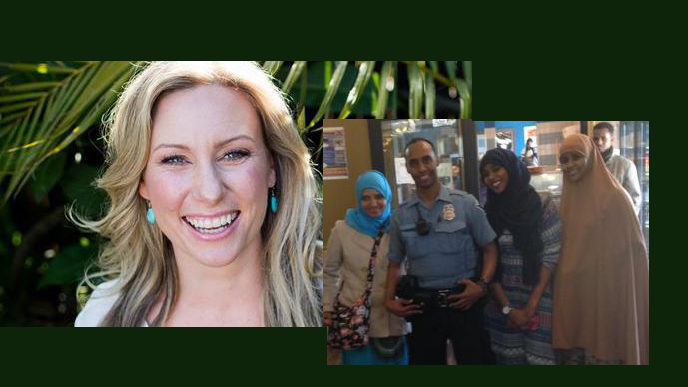
Cop Named Mohamed Shoots, Kills Unarmed Woman Who Called 911

The Minneapolis cop who shot and killed a 40-year-old woman after she called 9-1-1 to report a possible crime near her home was identified Monday as the precinct’s first Somali-American officer — Mohamed Noor.

Noor has only been a police officer for two years and has already been sued for alleged unprofessional behavior. The May 2017 lawsuit also involved a female and accusations of brutality . . .

Justine Ruszczyk Damond, a native of Sydney, Australia, was a veterinarian and a yoga instructor who recently got engaged to longtime boyfriend Don Damond. She and her fiancé lived in the 5000 block of Washburn.

Her fiance was out of town on business Saturday when she heard a commotion in the alley, then picked up the phone to call 9-1-1 to report a possible sexual assault in progress. She ended up being shot dead by one of the two responding officers . . .

KSTP, citing a source with direct knowledge of the shooting, reported that Noor was sitting in the passenger seat of the squad car at the time of the shooting and “shot across his partner” at Damond, who approached the officers’ car in her pajamas and began talking to the officer in the driver’s seat. (Read more from “Cop Named Mohamed Shoots, Kills Unarmed Woman Who Called 911” HERE)

Follow Joe Miller on Twitter HERE and Facebook HERE.

Teen Plays ‘F–K Tha Police’ During Murdered Cop’s Funeral

A teenager said he had a “satisfying” experience blasting “F–k Tha Police” during the funeral of a murdered New York Police Department officer Tuesday.

Sixteen-year-old Julien Rodriguez played the NWA song out his apartment window because he claims police officers killed his older brother and best friend without cause, reports the New York Post.

“Since they did not show respect for my brother and my friend, why should I show respect to them?” Rodriguez said to the New York Post. The Post could not confirm that Rodriquez’s brother and friend were killed by officers . . .

About 20 NYPD officers went up to Rodriquez’s apartment to ask him to turn off the music, police sources told the New York Post. He eventually turned off the song, only after the building supervisor threatened to kick his family out of the apartment, he said. (Read more from “Teen Plays ‘F–K Tha Police’ During Murdered Cop’s Funeral” HERE)

Follow Joe Miller on Twitter HERE and Facebook HERE.

Police Officer Deaths on Duty Have Jumped Nearly 20 Percent in 2017

The ambush shooting that killed a New York City police officer in the Bronx marked the latest in a growing number of officer deaths in 2017, up 18 percent from this time last year.

A total of 67 officers have died so far this year, according to the National Law Enforcement Officers Memorial Fund. It found there were 57 officer deaths between January 1 and July 5, 2016. In addition, gun-related deaths have risen by 9 percent, from 22 to 24 for 2017, the researchers say.

The figures suggest a grim trend; 2016 was the deadliest year for police in 5 years. A total of 135 officers died last year.

New York Police Department Officer Miosotis Familia was “assassinated” during an “unprovoked attack,” according to NYPD commissioner James O’Neill. Familia was sitting in her marked vehicle early Wednesday when a man shot at her through the window.

Randy Sutton, national spokesman for Blue Lives Matter and a retired Las Vegas police lieutenant, said that Familia’s killing is a symptom of the growing violence against law enforcement. (Read more from “Police Officer Deaths on Duty Have Jumped Nearly 20 Percent in 2017” HERE)

Follow Joe Miller on Twitter HERE and Facebook HERE.

The Police vs. The PC Police

As is almost always the case, signs of trouble preceded the latest shooting in Paris, which left one police officer dead and wounded two bystanders before police killed the gunman, later identified as French national Karim Cheurfi, a known criminal with a long, violent record. ISIS claimed to be behind the attack. According to police, a note praising ISIS fell out of Cheurfi’s pocket when he fell.

Cheurfi was of Algerian descent, born in a Paris suburb. The Washington Post reported he had a criminal record and was known to authorities. His rap sheet included four arrests and convictions since 2003. He had spent nearly 14 years in prison for crimes that included burglary, theft and attempted murder.

When Cheurfi attempted to buy weapons French authorities took notice, especially when he made statements about wishing to kill police officers. After he traveled to Algeria earlier this year, Paris prosecutor Francois Molins said Cheurfi was interviewed, but a judge refused to revoke his probation. It makes one question not only France’s probation laws, but the types of background checks in place that ought to have prevented Cheurfi from legally acquiring any firearm (if he bought it legally), much less the Kalashnikov rifle he allegedly used.

French and other European politicians immediately expressed concern over what effect the shooting and the terrorist attacks that preceded it might have on France’s choice of a new president. Rightist candidates immediately tried to exploit the issue, but it has been a subject on the minds of French voters, particularly in Paris, where a major enclave of immigrants from Muslim countries continue to be seen by many as a threat to the French way of life.

Cheurfi should have been back in jail for parole violations. Given his record, his statements and the trip to Algeria, enough red flags were raised to warrant action.

A side note. While Algeria has not been a main source of terrorism in the world, the human rights agency Algeria Watch has noted: “Although Algerian nationals were not among the suicide bombers of 11 September 2001, they have featured prominently in subsequent investigations into al-Qaida activities in North America and Europe.

In the UK, where an Algerian community has grown as a largely unknown minority in recent years, several dozen Algerians have been arrested since mid-2001 in localities as widely spread as Leicester, Glasgow, Edinburgh, London and Manchester. Arrests in London in January 2003 uncovered a cell producing ricin, while in Manchester, one of the Algerian detainees, 27-year-old Kamel Bourgass, was responsible for killing a police officer — the first victim in the UK’s post-11 September anti-terrorist campaign.”

In the United States and other countries in the West, most often someone has to actually break the law before they can be arrested. Given the tactics of terrorists, it might be worth discussing whether to invoke a doctrine of pre-emption, which is sometimes employed when an enemy nation appears to be an imminent threat. If that is an option to prevent death and destruction from countries, why can’t we impose something similar for people who have violent criminal records and who openly state, as Cheurfi did, that he intends to kill police?

Western reluctance to adapt such a practice shows there is one force more powerful than the uniformed police. It is the “PC police.” These are people who care more about how they feel than for the innocent people gunned down in our streets.

Don’t innocents have the right to be protected from fanatics who so often claim to be doing God’s work? With ongoing investigations by the Department of Homeland Security into radical terrorists in every state, it’s long past time to get them before they get any more of us. (For more from the author of “The Police vs. The PC Police” please click HERE)

Follow Joe Miller on Twitter HERE and Facebook HERE.

Watch Police Call in Backup for Veteran Paying Ticket in Pennies

Stories about citizens paying their taxes with pennies aren’t new. But how Billy Spaulding of Manchester paid his parking ticket with pennies might be a first, since he was packing a sidearm while doing so.

As The Free Thought Project has stated before, “police need you to break traffic laws” because writing tickets and receiving funds from doing so is a considerable revenue generator for police departments. It’s how police states maintain their control over the citizenry.

Manchester police didn’t take kindly to Spaulding’s form of payment, and according to reports, called in a SWAT officer to deal with him. At first, the police told Spaulding he should take his form of payment to the bank to get bills instead of pennies.

“You don’t have a bank account?” one officer asked.

Spaulding responded by saying he didn’t. Whether it’s true or not simply doesn’t matter. Spaulding had every right to pay his extortion fees in pennies. According to U.S. Law Code 31.5103, “United States coins and currency (including Federal reserve notes and circulating notes of Federal reserve banks and national banks) are legal tender for all debts, public charges, taxes, and dues.”

Spaulding had a friend record the scene. Although the recording does not start and stop at the beginning and the end of the encounter, it does show police intercepting Spaulding, asking him to find some other form of payment, and then telling his friend he has to stop recording because he didn’t announce he was going to do so.

Refusing to allow the two citizens to record themselves paying a parking fee, is considered a violation of one’s First Amendment rights, so long as it does not interfere with the official duties of the officers. Spaulding may have recourse to file a lawsuit for both issues; refusing to receive his form of payment which resulted in his occurring additional expenditures, and his friend being forced to stop recording.

Recently, an activist by the name of Phillip Turner won a judgment in the 5th Circuit Court of Appeals who ruled he does (and so does every citizen) have a right to film police.

Entering a courthouse or a police station while being armed is also not illegal in New Hampshire. Spaulding knew that as well, but he reportedly had to take his grievance to the Sheriff’s department before he was allowed to go back to the court house and pay his parking ticket in pennies.

Spaulding may have, however, missed an opportunity to have his ticket nullified. Upon having presented his form of payment, and having witnessed his payment refused, he could have asked a judge to dismiss his $75 ticket. The judge would likely have done so, being fully aware that the Coinage Act of 1965 allows all forms of U.S. currency to be used for payment.

After leaving the sheriff’s office, Spaulding once again presented his $75 worth of pennies as payment for his ticket at the county courthouse. The clerk, having been notified by the sheriff to receive the former Marine’s payment, didn’t seem all too pleased to be doing so. Nonetheless, Spaulding passed through the glass window separating the two individuals, a grand total of 7,500 pennies and a $5 bill just in case he or the clerk miscounted.

Below is the video of this epic encounter.

(For more from the author of “Watch Police Call in Backup for Veteran Paying Ticket in Pennies” please click HERE)

Follow Joe Miller on Twitter HERE and Facebook HERE.

For the First Time, Federal Court Explicitly Establishes Filming Police as a Right

There’s been an ongoing battle between police and the citizenry over who has the right to film in public. Disputes between police and the public have led to cameras being confiscated by police, and citizens being manhandled, beaten, and arrested. Now, it seems, the courts are weighing in, and not on the side of police.

The court’s opinion comes from a federal civil rights lawsuit filed by Phillip Turner vs. Driver, Grinald, and Dyess (2017). The plaintiffs are all officers from Ft. Worth, Texas. According to court documents, “Plaintiff-Appellant Phillip Turner was video recording a Fort Worth police station from a public sidewalk across the street when Defendants-Appellees Officers Grinalds and Dyess approached him and asked him for identification. Turner refused to identify himself, and the officers ultimately handcuffed him and placed him in the back of a patrol car.”

Prior to this case, there was no clear precedent that specifically established filming the police as a First Amendment right. In fact, as we’ve reported before, U.S. District Judge Mark Kearney of the Eastern District of Pennsylvania issued a ruling last year stating that citizens do not have a First Amendment right to record the police in public.

According to the recent precedent:

At the time in question, neither the Supreme Court nor this court had determined whether First Amendment protection extends to the recording or filming of police. Although Turner insists, as some district courts in this circuit have concluded, that First Amendment protection extends to the video recording of police activity in light of general First Amendment principles, the Supreme Court has “repeatedly” instructed courts “not to define clearly established law at a high level of generality”: “The general proposition, for example, that an unreasonable search or seizure violates the Fourth Amendment is of little help in determining whether the violative nature of particular conduct is clearly established.” Thus, Turner’s reliance on decisions that “clarified that [First Amendment] protections . . . extend[] to gathering information” does not demonstrate whether the specific act at issue here—video recording the police or a police station—was clearly established.

The court went on to note that police nor Turner had a precedent to reference in which filming cops was specifically protected as a First Amendment right.

In light of the absence of controlling authority and the dearth of even persuasive authority, there was no clearly established First Amendment right to record the police at the time of Turner’s activities.

Now there is.

In the recent ruling, the Fifth Circuit Court of Appeals weighed in on the citizens’ rights to film police movement, activities and buildings. The court determined,

“We conclude that First Amendment principles, controlling authority, and persuasive precedent demonstrate that a First Amendment right to record the police does exist, subject only to reasonable time, place, and manner restrictions.” The court set the first ever precendent giving citizens the right to film police, within reason, of course. In other words, the court believes the public has a right to film police so long as it is within reason, in public, and not in private. Going further, the court seemed to empathize with the public’s demand for a transparent government. They wrote, “speech is an essential mechanism of democracy, for it is the means to hold officials accountable to the people. The right of citizens to inquire, to hear, to speak, and to use information to reach consensus is a precondition to enlightened self-government and a necessary means to protect it.”

Turner asserted his First Amendment rights were violated when he was disallowed from filming the police station he was recording. For refusing to provide identification when asked, Turner was detained, handcuffed, and placed into the back of a squad car —an action he contends was a violation of his fourth amendment rights to unreasonable search and seizure and arrest.

When the supervisor arrived, Turner told him he was aware of his rights to withhold his identity. The supervisor agreed, he was given back his camera and allowed to leave. Unfortunately, the court’s ruling was not put in place prior to his case, or else he would have been allowed to continue filming and free to come and go as he pleased. Even though he never was sent to jail, his detainment was a form of arrest, a contention he raises going further with his case.

While the Texas precedent is not a national precedent, those who are attempting to film the police can, nonetheless, cite the precedent in the hopes police officers will continue to allow them to film without being impeded. Until such time as the Supreme Court weighs in on the matter, the right to film police will still continue to be a matter of contention between the police and the public, and dealt with on a state by state basis.

For his part, Turner appears to welcome the challenge to take his case all the way to the Supreme Court. We reached out to Turner for comment but have not yet heard back from him as of the writing of this article. But he did post a comment to his Facebook page. “5th circuit established, is the Supreme Court next??,” he stated, apparently feeling the weight of his victory in court.

If you or someone you know is planning to attempt to film cops, here are some things you need to know. According to the ACLU’s guide to photographing in public:

Taking photographs and video of things that are plainly visible in public spaces is a constitutional right—and that includes transportation facilities, the outside of federal buildings, and police and other government officials carrying out their duties.

Unfortunately, law enforcement officers have been known to ask people to stop taking photographs of public places. Those who fail to comply have sometimes been harassed, detained, and arrested. Other people have ended up in FBI databases for taking innocuous photographs of public places.

The right of citizens to record the police is a critical check and balance. It creates an independent record of what took place in a particular incident, one that is free from accusations of bias, lying, or faulty memory. It is no accident that some of the most high-profile cases of police misconduct have involved video and audio records.

As for video, the ACLU recommends;

No matter who you are you have the First Amendment right to:

Peacefully assemble and protest in public spaces and photograph and videotape the police or anything else in a public space.

Here’s the deal:

Public spaces include streets, sidewalks, and public parks.

Private property owners can set rules for public entry (like a theater saying “no cell phones”).

The right to take photos does not give you the right to:

Go places you’re not otherwise allowed, record audio of other people’s private, conversations, trespass, or interfere with police engaged in legitimate law enforcement operations.

Police officers may not: confiscate or demand to view your digital photos or videos without a warrant, or delete your photos or videos under any circumstances.

If you’re stopped or detained for taking photos:

Be polite.

Don’t resist.

Ask, “Am I free to go?”

If the officer says “no,” you are being detained.

If you are detained, ask what crime you’re suspected of committing.

Until you ask to leave, being stopped is considered voluntary.

It’s perfectly reasonable and acceptable to remind the police officer that “taking photographs is your First Amendment right” and “does not constitute reasonable suspicion of criminal activity” according to the American Civil Liberties Union. (For more from the author of “For the First Time, Federal Court Explicitly Establishes Filming Police as a Right” please click HERE)

Follow Joe Miller on Twitter HERE and Facebook HERE.

Cop Draws on Divine Backup in Anchorage Streets

Luke Bowe can’t guarantee that you’ll sleep at night, but, Lord willing, he does his best to keep you and your neighbors safe as an officer with the Anchorage Police Department. Unfortunately, there’s plenty of work for Bowe, 37, and the nightlives of others often take him to the ragged edges of humanity during the course of his 12-hour shift.

The tall, lean officer — married with three young children — is on duty the night of Anchorage’s first appreciable snowfall. He pulls away from the APD headquarters and leaves the brightly lit parking lot behind. An array of electronics hangs from his headliner, and his armrest is crowded with a locking vertical rack that holds his AR-15 rifle and a shotgun at the ready.

OUTSIDE THE SAFE ZONE

The screen of his laptop refreshes every few seconds with updated information, as the radio blares incessantly with the voice of a dispatcher and officers responding to calls of sexual assault, violations to restraining orders, domestic violence, gunshots to a vehicle, people lying on the highway.

By any measure there is a lot going down. But most Anchorage residents live in a protected sphere, rarely if ever encountering what Bowe and his fellow officers face as they drive through residential areas in response to calls.

“It’s our job to make it so people can go to bed and not see all of that,” he said.

In his nine years with the APD, he has had to break up countless domestic and public disturbances, haul inebriates to the warmth of shelters, discover dead bodies and everything else under the rubric of keeping the law. He has been shot at twice, been spit upon, threatened with every imaginable weapon. More than a few times he has had to tighten down on the trigger of his own gun in the sober task of taking down a gunman who’s threatening harm to fellow officers.

‘SPIRITUAL READINESS’

Night after night Bowe shoulders the duel task of enforcing the law and offering compassion, the demands of which often find him using words of consolation and handcuffs during the same household visit.

The most severe crimes demand drawing from within himself to treat hardened criminals with the same respect as any other citizen. That’s where his Catholic faith provides perspective.

“Were it not for my faith,” Bowe said, “this would be a pretty bad job.”

He and 380 other officers sworn into duty with APD have committed to protecting the safety of Anchorage’s civilians. In upholding the law, several of his colleagues and a first cousin have paid the ultimate price through the years.

That the possibility of death lurks but a radio call away provides impetus for “maintaining a spiritual readiness,” said Bowe, a cradle Catholic. In addition to keeping his spiritual life aimed at eternity he said he embraces a strong sense of resignation to God’s will. So far that arrangement has worked out well and he returns each morning to his wife Lisa, 36, son Leo, 4, and daughters Regina, 2, and Yvette, 8 months.

“God knows when it’s my time to go,” Bowe reflected.

Equally daunting in the spiritual health of a Catholic cop is the split-second decision to use deadly force to take the life of another. Involved in more than one shootout during his tenure with APD, he has not had to pull the trigger on a killing shot. Still, he well remembers his first time being among officers who did.

“The first thought that went through my mind was for the repose of his soul,” Bowe recalled, adding that he prays for perpetrators in crimes of all kinds.

DIVINE GRACE AMID EXCRUCIATING PAIN

“When you respond to a sexual assault call and (the perpetrator) turns out to be a relative (of the victim), seeing Jesus in any way, shape or form can be difficult,” he said. “Or when somebody with an alcohol addiction hits the bottom of the bottle, and I pick them up and they’re cursing me and urinating all over themselves in the back seat of my patrol car it can be hard to find Jesus.”

“They’re not Jesus in their actions,” Bowe observed, “but they are the image and likeness of Christ.”

He has responded to much worse: “I think across the board most of us would agree that a baby not breathing is the most difficult call,” he said. “We deal with the loss of life all the time; that’s a natural occurrence on the job, but when you arrive and it’s a baby there isn’t going to be anything optimistic to come out of that.”

He explained that in cases where caregivers or parents are not perpetrators and there has been no crime, the line of questioning can be excruciatingly painful.

“It’s bad enough that these poor people have just lost their baby, and then I have to ask a bunch of questions that makes it sound like they are suspects in a homicide.”

While it’s no secret that the night-to-night intensity of the work causes some police officers and other emergency workers to burn out and quit their jobs — or find less-than-healthy ways to cope with stress — Bowe relies on his connections with God and the saints to provide courage, wisdom and strength on his patrols.

“It’s God’s support that I get from him,” he said. “I think that there are definitely graces we get from those who are interceding for us in heaven.”

As for Bowe’s days off, you’ll find him singing in Holy Family Cathedral’s schola choir or serving as lector, attending eucharistic adoration, participating in a Catholic men’s group and spending time with his young family.

At 5 a.m. the calls coming from the dispatcher diminish in frequency, and at one point there is an eerie silence of several minutes. Bowe explains that Anchorage’s nightlife is winding down and that the majority of dispatcher calls will involve motor vehicle accidents with the coming of commuters in the new day.

He parks the cruiser, flips open his notepad and finishes typing up the night’s reports. It will be daylight soon. He will park the cruiser, head home for some rest and patrol the same streets the next night. (For more from the author of “Cop Draws on Divine Backup in Anchorage Streets” please click HERE)

Follow Joe Miller on Twitter HERE and Facebook HERE.

Leftist Policies Continue to Fail Chicago, but They’d Rather Just Blame the Police!

As President Obama finalizes his tenure in the White House, the city that he calls home has completely spiraled out of control.

Homicide has claimed the lives of over 700 individuals in Chicago this year, which is on pace to have its highest murder rate in about 20 years. There are about 10 shootings every day, with gun violence attributable for almost 650 of this year’s homicides. Tragically, detectives are unable to solve most of these crimes. Forbes.com reported in September that at least one person had been murdered daily in Chicago since February 2015.

It is arguably more dangerous to grow up in the inner-city of Chicago than to serve overseas in wartime Iraq and Afghanistan.

Niall McCarthy put it in great perspective for Forbes: “Since 2001, Chicago has experienced 7,916 murders (as of September 06, 2016). The number of Americans killed in the wars in Afghanistan and Iraq was 2,384 and 4,504 respectively since 2001.”

It’s easy for rabble rousing-groups like Black Lives Matter to sit back and continue railing against the police, but Chicago officers are hardly responsible for the skyrocketing murder rate. So, what has led to the spike in 2016? Many have their theories.

FBI Director James Comey has suggested that the “Ferguson effect” is at play. He believes that police are afraid to do the work necessary to make inroads in the community, for fear that the “viral video effect” of one wrong move or word will damage their reputations and careers forever.

The number of police officers on the Windy City streets has actually decreased in recent years. Chicago Mayor Rahm Emanuel claims he has made plans to hire 1,000 additional officers. Emanuel campaigned on the promise to restock the ranks of the Chicago PD, but has yet to do so after five years in office. There’s plenty of data to show that stocking up on additional police units helps stop crime. Leaders in the New York City Police Department have long been proponents of such measures.

Some anti-Second Amendment groups insist that better gun control measures are the answer. But Chicago already has some of the strictest gun laws in the nation.

While many of the shootings can be linked to gang violence, what is often overlooked is what leads young men to join gangs in the first place. Facing extreme poverty and a lack of opportunity, many turn to gangs as a means to survive.

Almost half of 20- to 24-year-old black males in Chicago are out of school and out of work. Instead of encouraging entrepreneurship and removing barriers to employment, government officials have decided again and again to raise the minimum wage, which economists widely agree harm the poor the most.

On the education front, Democrats have dumped tons of money into Chicago’s public education system, but the funding has done virtually nothing to change the tragically corrupt system. The unions have secured deals to ensure an 80 percent increase in teacher salaries since 1998.

As the Illinois Policy reported in April, Chicago teachers have “the highest lifetime salaries in the nation compared with the largest school districts in the U.S.” and “diverted almost $3 billion intended to fund pensions towards school salaries instead.”

So, what does the city have to show for it? Chicago’s youth remains poor — without hope and without opportunity.

Leftist policy initiatives have failed

Chicago’s most vulnerable. Albert Einstein is widely attributed with defining insanity as “doing the same thing over and over again and expecting different results.” As we ring in the new year, it’s time to stop the insanity that is failed Big Government, Democrat policies, and give the youth in Chicago a fighting chance to make it in America. (For more from the author of “Leftist Policies Continue to Fail Chicago, but They’d Rather Just Blame the Police!” please click HERE)

Follow Joe Miller on Twitter HERE and Facebook HERE.